What's inside
- Where to buy
- Key Takeaways
- Quick Picks
- How We Chose These Picks
- Who Still Buys a TV With a DVD Player, and Why?
- Side by Side: The Six Combos on the Decisions That Matter
- How Do You Get the Best From a Disc Library in 2026?
- What Mistakes Do Combo Buyers Make?
- How Does a Combo Change the Rooms It Lives In?
- What Should You Check About the Disc Drive Itself?
- How Long Should a Combo Last, and How Do You Help It?
- Which Combo for Which Household Member?
- What About Sound in Small Rooms?
- How Do Combos Handle Broadcast TV and the Rest of the Day?
- What Should You Do in the First Week With a New Combo?
- A Word on Children’s Discs, Exercise Discs and the Unstreamable
- How Do You Choose Between Smart and Non-Smart, Finally?
- What Does the Combo Cost to Run and Keep?
- Gifting a Combo: The Quietly Perfect Present
- Final Recommendation
- Frequently Asked Questions
- Related Guides
As an Amazon Associate I earn from qualifying purchases. This post may contain affiliate links at no extra cost to you.
gizmoverdict.com is reader-supported. When you buy through links on our site, we may earn an affiliate commission.
Where to buy
TV-DVD combos live in a quieter corner of Amazon’s US catalogue than mainstream televisions, and the listings repay a careful read: confirm the disc region handling, the power supplies in the box and whether the set is smart or deliberately not, because in this category those three details are the whole purchase. Sellers of combos include specialists in mobile and small-room sets, so buy from the listing that states its specification plainly.
The best tvs with dvd players answer a need the streaming era keeps insisting is dead and households keep proving is not. A built-in DVD player means the film collection on the shelf still works without a separate box, a spare HDMI socket and a second remote; it means entertainment in the RV, the boat, the guest room, the kitchen and the holiday let where the Wi-Fi is a rumour; and it means a screen a grandparent, a child or a tired traveller can operate with one button and zero passwords. The combo is not a nostalgia product. It is the television as appliance — self-contained, unbothered by accounts, indifferent to the network’s mood.
Every pick in this guide has a DVD player built in, as its listing states, and the six divide along the lines that actually matter in this class. Size runs from 24 inches for kitchens and bunks to a 40-inch set for rooms that want a real screen. Two philosophies compete: smart combos that add streaming to the disc drive, and non-smart combos that refuse the whole conversation and are loved for it. And a mobile thread runs through the category — several of these sets run on 12-volt DC power with wide voltage tolerance, because the combo’s natural habitats include RVs, campers and boats as much as spare bedrooms.
Set expectations the way the category sets them: these are honest, practical televisions, not flagship panels, and their discs play DVDs in standard definition, upscaled by the screen. Judged as what they are — the simplest route from a shelf of films to a watched film — several of them are close to perfect.
Key Takeaways
- The SYLVOX 32-inch smart combo takes the top spot: a 1080p screen, a built-in DVD player and 9–32V wide-voltage power for house, RV or boat.
- Westinghouse’s 32-inch non-smart combo is the purist’s pick — HD picture, a disc drive and no accounts, menus or updates standing between you and the film.
- The SYLVOX 32-inch QLED combo owns the picture-quality crown in this class, pairing its DVD drive with a QLED panel and Google TV.
- Westinghouse’s 40-inch combo is the big-screen answer for rooms that want the disc library on a proper canvas, still proudly non-smart.
- Supersonic’s SC-2412 is the 24-inch veteran: 1080p, AC/DC power and a monitor’s versatility for desks, kitchens and campers.
- The Emerson ESTD-2400 is the smart 24-inch route — a 720p streaming combo for small rooms that want apps and discs in one box.
Quick Picks
| Pick | Badge | Why it is here |
|---|---|---|
| SYLVOX 32″ TV with DVD | Best Overall | Smart streaming, a disc drive and vehicle-grade power tolerance in one tidy 32-inch set. |
| Westinghouse 32″ TV with DVD | Best Non-Smart | The disc-and-broadcast purist: no accounts, no updates, just films. |
| SYLVOX 32″ QLED TV with DVD | Best Picture | QLED colour and Google TV wrapped around the built-in player. |
| Westinghouse 40″ TV with DVD | Best Big Combo | Forty inches of Full HD for the room that wants its library on a real screen. |
| Supersonic SC-2412 24″ | Best 24-Inch | A long-serving AC/DC combo that moonlights as a monitor. |
| Emerson ESTD-2400 24″ | Best Smart Combo | Streaming apps plus a disc drive in a wall-mountable 24-inch frame. |
How We Chose These Picks
The entry ticket was absolute: a DVD player built into the television, stated in the listing — not a bundle, not a separate player in the same box. From there we judged the class on its own terms. Screen size and resolution were read against the rooms these sets serve; smart features were weighed as a genuine fork in philosophy rather than a ladder, because many combo buyers are specifically fleeing the smart-TV experience; and power flexibility mattered wherever a listing claimed it, since the RV, camper and boat audience is core to this category rather than incidental.
We also respected the disc itself. A combo’s player is a mechanical device in a way a streaming app is not: it should load promptly, run quietly enough not to intrude on a quiet scene in a small room, and sit in a slot or tray that does not fight the user in a moving vehicle or a dark bedroom. Listings cannot prove those graces, so we favoured established combo makers with long-running models — the Supersonic’s vintage is a feature here — and framed the rest honestly as specification-led judgement.
Finally, we kept the category’s promise in view: simplicity. Any set whose disc playback was buried under smart-TV ceremony scored worse in our judgement than a plainer set that plays a film when you press play, whatever the spec sheet said.
Who Still Buys a TV With a DVD Player, and Why?
More households than the streaming charts suggest, for reasons that compound. The film collection is the first: twenty years of DVDs sit on shelves in most homes, bought and paid for, including children’s films, exercise discs, family recordings transferred to disc and titles that drift on and off streaming services at a licensor’s whim. A combo makes that library a living room asset again for the price of one appliance. The second reason is place: RVs, boats, cabins, holiday lets and student rooms where broadband is absent, capped or shared into uselessness — a disc has no bandwidth, no buffer and no monthly fee.
The third reason is people. A combo is the screen you can give a grandparent, a guest or a child without an account, a password reset or a tutorial: insert disc, film happens. The fourth is reliability of a particular kind — the film you own cannot be removed from a catalogue, region-shifted or interrupted by an outage — and the fifth is the second-room economy: kitchens, workshops, guest rooms and dens need a screen that entertains simply, and a combo plus a shelf of discs is a complete system in a single box. None of these reasons is nostalgic. All of them are practical, and together they explain why this category quietly refuses to die.
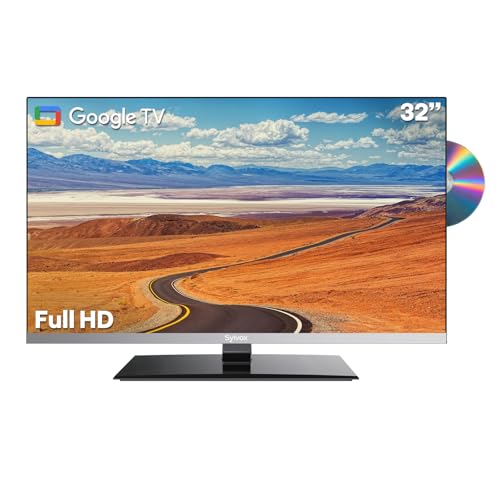
SYLVOX 32″ TV with DVD — Best Overall
The top pick is the combo that refuses to choose between the disc era and the streaming era. SYLVOX’s 32-inch set is a 1080p Full HD smart television with a DVD player built in, AC/DC power across a 9–32V wide-voltage window, low energy consumption, a bezel-less design and — in the listing’s own framing — a seismic design intended to keep the set composed in vehicles. Its intended homes are listed as car, RV, camper, truck, boat and house, and that breadth is earned: this is the one set in the guide that can live in the guest room this year and the motorhome next year without changing a thing about how it is powered or used.
At home, the smart platform covers the streaming services while the disc drive covers the library, and the 32-inch Full HD panel is the sweet spot for a second room — big enough for a film to feel like an event, small enough for a kitchen counter’s end or a bedroom wall. On the road, the wide-voltage tolerance is the specification that matters: vehicle electrics sag and surge, and a set designed across 9–32V takes that behaviour in its stride where a domestic set would sulk. The bezel-less styling is a small grace that matters in small spaces, where every frame of plastic is visible.
Keep the expectations calibrated: the DVD side plays discs in their native standard definition, upscaled — as every combo here does — and the smart platform is a convenience layer, not a flagship interface. Judged as the complete, portable, one-box entertainment system it sets out to be, it is the most complete answer in this guide.
- Screen: 32-inch, 1080p Full HD, bezel-less design
- Disc drive: integrated DVD player in the cabinet
- Power: AC/DC, 9–32V wide voltage, low energy consumption
- Build note: seismic design per listing, for vehicle use
- Platform: smart TV
Strengths
- House and vehicle in one set — the widest brief in this guide, honestly covered.
- Wide-voltage DC running suits RV and boat electrics as designed, not adapted.
- Full HD at 32 inches is the second-room sweet spot.
Trade-offs
- DVD playback is standard definition upscaled, as across this class.
- The smart layer adds menus some combo buyers are actively fleeing.
- Vehicle-grade design is wasted on a set that will never leave a lounge.
Best for: households and travellers who want one set that works everywhere they do. Not suited for: the dedicated cinema room, where a combo’s honest panel meets ambitions it never claimed.

Westinghouse 32″ TV with DVD — Best Non-Smart
This Westinghouse is the combo for the buyer who read the word “smart” in the pick above and felt tired. It is a 32-inch HD television with a DVD player built in and nothing else competing for your attention: no account, no app shelf, no update waiting at the worst moment, no interface redesigning itself overnight. The listing frames it for RVs, campers and bedrooms, and notes that it works happily with a Fire Stick, Roku or Apple TV type device if streaming is ever wanted — which is exactly the right relationship between a television and the internet: optional, on an HDMI socket, at the owner’s sole discretion.
The virtues compound in the rooms it serves. In a guest room, it is the screen a visitor can use at midnight without a password or a moral dilemma. In a child’s room, it plays the disc library and the broadcast channels and nothing the internet might suggest next. In a camper, its simplicity is power discipline: instant on, no background downloads, no account phoning home over a metered connection. The HD resolution is the honest compromise at its price and size — at 32 inches in a bedroom, the difference from Full HD is a footnote most viewers will never read.
What you give up is written on the badge: nothing streams natively, and the panel’s HD specification trails the Full HD picks on paper. What you get is the purest expression of this category’s promise — a television that plays your films — and for a large share of combo buyers, that is not the compromise model. It is the point.
- Screen: 32-inch, HD
- Disc drive: built-in player, no separate box needed
- Platform: non-smart by design; works with external streaming sticks
- Intended rooms per listing: RV, camper, bedrooms
- Operation: single-remote, account-free
Strengths
- Zero-account operation — the guest room and grandparent gold standard.
- Streaming remains possible via stick, entirely on the owner’s terms.
- Simple electronics suit vehicles and second rooms perfectly.
Trade-offs
- HD rather than Full HD resolution.
- No native apps — the stick is an extra purchase if wanted.
- Picture refinement is honest rather than impressive.
Best for: guest rooms, children’s rooms, campers and anyone allergic to smart-TV ceremony. Not suited for: a main lounge that streams nightly and would feel the missing apps within a week.

SYLVOX 32″ QLED TV with DVD — Best Picture
If the combo in your life will be watched closely rather than merely used, this is the one. SYLVOX’s second 32-inch entry pairs its built-in DVD player with a QLED 1080p panel — quantum-dot colour is a genuine step above the ordinary LED panels that populate this class — inside a Google smart TV running on 12/24V DC across a 9–32V window or 100–240V AC mains. The listing aims it at RV, camper and home, and the QLED panel changes what those places can expect: richer colour for nature documentaries and animated films, better saturation from the disc library’s best transfers, and a picture that rewards the viewer who sits down to watch rather than glancing while cooking.
The Google TV platform is the other half of its polish. Where the top pick’s smart layer is a convenience, this set’s is a headline: the full app shelf, voice-friendly search across services, and casting from the household’s phones, all wrapped around the disc drive. For the motorhome that considers itself a small apartment or the bedroom that serves as a second lounge, that completeness is the argument — streaming in the evening, a disc when the site Wi-Fi folds, and a panel good enough that neither source feels like the poor relation.
The calibration notes mirror its sibling’s: DVD remains standard definition at the source, however good the panel, and QLED money is real money in a category defined by value. But for the buyer who asked this guide’s most discerning question — which combo actually looks best — the answer is this one, and it is not close.
- Screen: 32-inch QLED, 1080p
- Disc drive: DVD playback built into the set
- Power: 12/24V DC, 9–32V window; 100–240V AC
- Platform: Google Smart TV with Wi-Fi and Bluetooth
- Connections: HDMI and USB per listing
Strengths
- QLED colour — the finest picture in this combo class.
- Google TV completeness around the disc drive.
- The same vehicle-grade power tolerance as the top pick.
Trade-offs
- The class’s premium panel carries a premium within the category.
- Discs remain SD at source; the panel flatters, it cannot invent detail.
- Smart features are surplus in a pure guest-room deployment.
Best for: the discerning second room and the well-appointed motorhome. Not suited for: a kitchen counter where its picture will be glanced at between chopping and stirring.

Westinghouse 40″ TV with DVD — Best Big Combo
Every other pick in this guide asks the room to accept a small screen as the price of the disc drive. This Westinghouse declines the bargain: 40 inches of Full HD, non-smart, with the DVD player built in, aimed by its listing at RVs, campers and bedrooms — and, we would add, the dens, spare rooms and small lounges where 40 inches is not a compromise at all but the correct size. For the household whose film library is a serious collection and whose second room is a serious room, this is the combo that treats both seriously.
Full HD at 40 inches is a meaningful combination: the panel has the resolution to make broadcast television and a streaming stick’s output look composed, while the disc library plays at the largest scale this category offers. The non-smart philosophy scales up gracefully — the same account-free, instant, guest-proof operation as its 32-inch sibling, now with the presence to host a family film night rather than merely accompany one. And the stick-friendly HDMI arrangement means the set can grow a streaming brain the day the household wants one, without the television’s own nature changing.
The cautions are geometric and vehicular. Forty inches in a small camper is a wall, not a television, and the set’s size and mains-first design make it the least mobile pick here despite its listing’s RV mention — check the vehicle’s space and power before believing that part of the brief. In the house, though, it is the answer to the question the rest of the category cannot hear: why should the disc library be exiled to small screens?
- Screen: 40-inch, Full HD
- Disc drive: in-cabinet DVD player
- Platform: non-smart; works with Fire Stick, Roku and similar devices
- Intended rooms per listing: RV, campers, bedrooms
- Role: the largest canvas in this guide
Strengths
- The only big-screen combo here — the library at living-room scale.
- Full HD resolution suits its size and its stick-fed streaming.
- Account-free operation at a family-film size.
Trade-offs
- Too large for most vehicle installations its listing gestures at.
- Non-smart by design — streaming needs the external device.
- Heavier and more committed than the portable picks.
Best for: dens, spare rooms and small lounges built around a disc collection. Not suited for: compact campers and bunks, where its canvas becomes the room’s whole wall and its appetite.

Supersonic SC-2412 24″ — Best 24-Inch
The Supersonic SC-2412 has been answering this category’s questions for years, and its longevity is itself a specification: a 24-inch HDTV with a built-in DVD player, 1080p resolution, HDMI, USB and AC/DC compatibility, designed to transition between television and PC monitor duties. In a class where models flicker in and out of catalogues, a set that households have bought, re-bought and recommended across a decade has passed the only review process that cannot be gamed — time, in kitchens, dorms, campers and workshops.
Its modern case rests on versatility. The same screen that plays a disc in the kitchen in the morning can take a laptop’s HDMI in the afternoon as a monitor, then run from DC power in the camper at the weekend; the AC/DC flexibility in its listing is the real thing, the feature around which this model’s reputation was built. At 24 inches and 1080p, text is respectably crisp for the monitor role, and films at desk or bunk distance look sharper than the HD small sets manage.
The honest footnotes are age’s own: its design and interface belong to its era, the smart features are absent rather than minimal, and buyers wanting apps should pair it with a stick or choose the Emerson below. None of that dents its brief. As the small, flexible, disc-playing utility screen, the SC-2412 remains the category’s benchmark — the set the others are measured against at this size.
- Screen: 24-inch, 1080p
- Disc drive: DVD player housed in the television
- Power: AC/DC compatibility per listing
- Connections: HDMI, USB; TV-to-PC monitor transition
- Pedigree: a long-running model in this class
Strengths
- A decade of service history — the proven article at this size.
- Monitor versatility doubles its usefulness in small spaces.
- AC/DC running covers home, desk and vehicle without accessories.
Trade-offs
- Interface and styling are of its era.
- No smart platform — streaming arrives by stick or not at all.
- Twenty-four inches is a personal screen, not a family one.
Best for: kitchens, desks, dorms and campers needing one screen that does everything simply. Not suited for: a room whose main event is streamed 4K film night — a different category entirely.

Emerson ESTD-2400 24″ — Best Smart Combo
The Emerson closes the guide with the small-room synthesis: a 24-inch HD smart television with a DVD player built in, Wi-Fi streaming, USB and RCA inputs, a space-saving wall-mountable design and a remote in the box. The RCA inputs are the detail that reveals its intended household — this is the set that also welcomes the old games console, the camcorder or the legacy player from the cupboard, making it a small embassy for every era of the family’s media at once.
Its resolution is 720p HD, and the review should be plain about what that means at 24 inches: at kitchen, bedroom and bunk distances, streamed and disc content looks perfectly respectable, while the pixel-counters will find the Full HD picks sharper on paper and at nose distance. In exchange, the Emerson is the only 24-inch pick here with streaming built in — no stick to buy, no second remote — which in a guest room or a rental property is a genuine operational advantage: one box, one remote, discs and apps both native.
Choose it where its synthesis is the brief — the small room that wants everything, simply — and choose the Supersonic where DC power and monitor duty matter more, or the Full HD sets where sharpness is the priority. As the smart small combo, the Emerson’s place in the six is secure.
- Screen: 24-inch class, 720p HD LED
- Disc drive: onboard DVD playback
- Platform: smart TV with Wi-Fi streaming
- Connections: USB and RCA inputs — legacy-friendly
- Design: space-saving, wall mountable, remote included
Strengths
- Discs and streaming native in one small box — no stick required.
- RCA inputs welcome the household’s older devices.
- Wall-mountable design suits the smallest rooms in this guide.
Trade-offs
- 720p trails the Full HD picks for sharpness.
- No DC vehicle power story — a mains room set.
- Its smart platform is a small-room convenience, not a flagship interface.
Best for: guest rooms, rentals and small bedrooms wanting discs plus apps with one remote. Not suited for: vehicles or off-grid rooms, where its mains-only, HD design meets briefs it never applied for.
Side by Side: The Six Combos on the Decisions That Matter
Read the table by your room rather than by the columns. The vehicle question eliminates or elevates the SYLVOX pair and the Supersonic at a stroke; the smart question divides the guide into those who want apps native and those who want them absent or optional; and size is simply the room telling you its name. What the table cannot show is temperament — the non-smart sets feel calmer in use than any specification conveys — so let it shortlist, then let the reviews’ closing verdicts decide.
| Pick | Size / resolution | Smart? | Power story |
|---|---|---|---|
| SYLVOX 32″ with DVD | 32″ 1080p | Yes | AC/DC, 9–32V window |
| Westinghouse 32″ with DVD | 32″ HD | No — stick-friendly | Mains, simple |
| SYLVOX 32″ QLED with DVD | 32″ QLED 1080p | Google TV | DC 9–32V and AC |
| Westinghouse 40″ with DVD | 40″ Full HD | No — stick-friendly | Mains |
| Supersonic SC-2412 | 24″ 1080p | No | AC/DC |
| Emerson ESTD-2400 | 24″ 720p HD | Yes | Mains |
How Do You Get the Best From a Disc Library in 2026?
Treat the collection as a library rather than a pile: shelf it where the combo lives, keep the children’s discs at child height, and let the set’s upscaling do its quiet work by sitting at the distance the screen size intends — a DVD on a 32-inch set at six feet looks far better than nostalgia or cynicism predicts. Clean discs matter more than any setting; a fingerprint that a forgiving old player skipped past can stall a modern drive, and a soft cloth from centre to edge is the whole maintenance liturgy. Where a treasured disc is failing, play it on the most tolerant device you own and enjoy it while it lasts — the combo’s job is the living library, not the archive of last resort.
Pairing habits complete the picture. A combo plus a modest streaming stick in its HDMI socket is the configuration many households settle into: discs for the library and the no-network days, the stick for the new releases, one television conducting both. The non-smart picks were designed for exactly that marriage, and even the smart sets lose nothing by it. What matters is that the disc drive stays the first-class citizen it was bought to be, not a novelty demonstrated to guests and forgotten.
What Mistakes Do Combo Buyers Make?
The first is buying the category for the wrong room: a combo in the main lounge, where a flagship panel and a separate player would serve films better, breeds disappointment with an honest product. The second is the reverse snobbery — assuming the second room deserves a dim, tiny set — when the 40-inch Westinghouse and the QLED SYLVOX exist precisely to give secondary rooms primary respect. The third is ignoring the power question in vehicles: a mains-only set in a camper means an inverter, a draw and a hum that the DC-native picks were invented to avoid.
Buyers also forget the discs’ feelings. A combo in a moving vehicle wants its library in a wallet or case, not loose in a drawer turning into percussion; a combo in a kitchen wants its slot away from the steam’s direct path; and every combo wants its remote kept with it, because the universal-remote drawer is where combo remotes go to be lost among their ancestors. Small disciplines, all of them — and together they are the difference between a set that delights for a decade and one that is replaced in irritation within two years.
How Does a Combo Change the Rooms It Lives In?
The guest room is the clearest case. A visitor’s evening stops depending on your household’s accounts, your Wi-Fi password etiquette and a tutorial at the bedroom door; there is a shelf of films everyone likes, a remote that explains itself, and a screen that asks nothing. Hosts underestimate how much hospitality lives in that simplicity until the first guest thanks them for a television they could actually use. The children’s room is the second case: a curated shelf is a walled garden, every title chosen by the household, with no algorithmic corridor leading anywhere else — a feature no parental-control menu has ever matched for peace of mind.
The kitchen’s case is rhythm. A combo there plays the morning news from broadcast, a cookery disc in the afternoon and a comfort film during a long evening of baking, all without evicting anyone’s phone from its recipe. And the workshop, garage or studio case is company: background films and familiar series that ask nothing of the hands or the attention, in rooms where a streaming interface’s demands would be genuinely unwelcome. In each room the same appliance wears a different virtue, which is why this category’s buyers so often end up owning two.
What Should You Check About the Disc Drive Itself?
Three things, in the listing and in the first week. Loading style: a slot-loading drive suits vehicles and tight shelves, swallowing the disc without a tray to snap; a tray suits careful home use and arthritic hands. Noise: a drive that whirs audibly through quiet scenes will be forgiven in a kitchen and cursed in a bedroom, so test it with the volume low on the first night, while returning is painless. And resume behaviour: a player that remembers where the film stopped — across a pause, a power-off, a child’s bedtime interruption — is the difference between a library that gets finished and one that restarts forever. None of these graces appears in a headline specification, which is why established combo makers with long-running models earn their premium in this class: their drives have been civilised by years of exactly these complaints.
How Long Should a Combo Last, and How Do You Help It?
The panel in a modern combo will likely outlive its owner’s interest; the moving part is the drive, and its lifespan is a story of dust, discs and kindness. Keep the set’s vents clear, the discs clean and stored in cases, and the slot free of the small objects that children post into interesting openings, and a combo’s drive will serve for years of regular use. In vehicles, the seismic and vehicle-grade designs exist because vibration is the drive’s natural enemy; mount the set solidly and let the design do the rest. When a drive eventually tires, the television remains a television — the HDMI sockets see to that — which makes the combo a gentler purchase than its critics claim: its worst-case future is an ordinary good screen.
Which Combo for Which Household Member?
For grandparents, the non-smart Westinghouse 32-inch is the kindest technology in this guide: their discs, their channels, one remote, no passwords, and a screen that never asks them to update anything. For the travelling family, the top-pick SYLVOX converts the motorhome into the cinema the children lobby for at every site, with downloads and discs sharing the work when the site’s connection wilts. For the student, the Supersonic earns its desk twice — lectures and notes on the monitor by day, the disc library by night — while the Emerson suits the rented room whose landlord’s Wi-Fi is the one amenity that actually works. For the film collector whose second room matters, the QLED SYLVOX or the 40-inch Westinghouse, chosen by whether the household streams: the collector who does takes the QLED’s colour and Google TV; the collector who pointedly does not takes the big Westinghouse and its magnificent indifference.
Notice that none of these assignments is about the “best” set in the abstract. Combos are bought the way kettles are bought — for a place, a person and a habit — and the guide’s six-way split exists because those triples genuinely differ. Match yours honestly and the category delivers its quiet miracle: a television that is simply used, daily, without a single support conversation.
What About Sound in Small Rooms?
Combo televisions carry small speakers into small rooms, and the match is usually honest: a bedroom, kitchen or camper does not need — and cannot use — cinema volume. Dialogue clarity at modest levels is the real requirement, and it is served less by the set than by the room: a combo on a hard shelf against a hard wall will sound harder than the same set on a mat in a furnished corner. Where a room does defeat the speakers — a workshop over its own machinery, a kitchen over an extractor — a small soundbar or even a Bluetooth speaker paired with the smart SYLVOX sets lifts speech without rebuilding the setup. Judge the sound on the third evening, not the first: ears calibrate, rooms reveal themselves, and most combo owners discover the built-in audio was sized for their room all along.
How Do Combos Handle Broadcast TV and the Rest of the Day?
It is easy to forget, in a disc-centred guide, that these are televisions first in their tuners’ eyes: connect an aerial and every set here is a broadcast receiver, carrying the morning news, the match and the weather with no network involved. In the rooms combos serve, that layer matters more than in the main lounge — the kitchen’s breakfast headlines, the workshop’s afternoon game, the holiday let’s local news — and it costs nothing beyond the aerial the house probably already has. Between broadcast for the day’s texture, discs for the evening’s intention and, on the smart sets or via a stick, streaming for the new release, a combo household is running a three-layer entertainment system from one unassuming box. That layering, more than any single feature, is the category’s mature form.
The layers also insure each other. The broadband fails on the night of the big release: the library answers. The disc you wanted is lent to a neighbour: the stream answers. The aerial signal fades in a storm: both answer. Main-room setups achieve the same resilience with a rack of devices and a remote for each; the combo achieves it in a single appliance that a child can conduct. Simplicity, it turns out, was never the opposite of capability — in this category it is capability’s most durable packaging.
What Should You Do in the First Week With a New Combo?
Play the library’s hardest cases first: the scratched favourite, the disc with the elaborate menu, the box set whose episodes must be navigable by a tired person in the dark. Set the picture for the room’s real light — combos often arrive in a vivid shop mode that flatters nothing in a bedroom — and teach the household the one trick that matters, which is where the eject button lives. If the set is vehicle-bound, test it on the vehicle’s own power before the first trip, at the engine-on and engine-off voltages the road will actually serve; the wide-voltage sets should shrug, and the first week is when you verify that yours does. Keep the box until the week is out. Then shelve the discs beside the set, put the remote in its permanent home, and let the appliance disappear into the household’s routines — which is, for this category above all, the definition of success.
A Word on Children’s Discs, Exercise Discs and the Unstreamable
Every household library holds a shelf the streaming services cannot replicate: the children’s discs bought for car journeys and rainy days, worn smooth with love; the exercise and yoga discs whose routines are muscle memory; the language courses, the dance tutorials, the local history documentary bought at a visitor centre in 2009; the wedding and the school play, transferred to disc by an uncle who knew how. These are not content in the catalogue sense — they are household infrastructure and family archive — and a combo is their natural player, permanently connected, in the room where they are used. Streaming’s great library is somebody else’s; the shelf by the combo is yours, and its unstreamable corners are often the discs that would be missed most if the player vanished.
That is also why the category’s centre of gravity keeps shifting toward rooms rather than lounges. The main room has gone to the streamers, fairly and squarely. The rest of the house — where life is actually lived in its variety — still runs on a mixture of broadcast, shelf and signal, and the combo is the one appliance fluent in the first two and unbothered by the third. Buy it for the room it will serve, in the size that room requests, and it will be used more honestly than the flagship in the lounge.
How Do You Choose Between Smart and Non-Smart, Finally?
Ask who will hold the remote. If the answer is a household that streams daily and treats apps as furniture, the smart SYLVOX sets and the Emerson remove a device and a remote from the room, and their platforms will feel like home. If the answer includes guests, grandparents, children or a vehicle — anyone for whom the television should be a closed, kind system — the non-smart sets’ refusal is the feature, and a stick can be added the day a specific need names itself. Ask also what the room’s internet is honestly like: a combo bought for a dead-zone cabin that arrives full of smart features has spent its money on the layer that will be used least, where the same money in the non-smart sets buys size or simplicity instead.
There is no wrong door here, only mismatched ones — and the mismatch is always visible within a week, in whether the set is used daily with pleasure or negotiated with daily with patience. Choose for the remote-holder, and the negotiation never starts.
What Does the Combo Cost to Run and Keep?
Very little, which is part of its charm. Small panels sip power beside their lounge-sized cousins, the DC-native sets sip it directly from a vehicle’s system without an inverter’s toll, and there are no subscriptions hiding inside the appliance — the library was bought years ago, the broadcast is free, and even the streaming layer, where present, is the household’s existing account rather than a new one. Maintenance is a cloth, a dust-free shelf and a remote with batteries; repairs, when a drive eventually tires, are a decision rather than a disaster, because the screen’s second career as a plain television is built into its sockets. In a decade of household electronics, few appliances will ask less of their owners than a combo asked to do exactly the job it was bought for.
Gifting a Combo: The Quietly Perfect Present
It is worth saying plainly, because this category is bought as a gift more than any other in the television world: a combo is the rare electronic present that arrives complete. No account to create, no subscription to fund, no companion device to explain — the set, the remote, and a first disc chosen with intent, and the recipient is watching a film on Christmas evening without a single phone call to the giver. For a parent downsizing, a student leaving, a grandparent whose old player has died, the combo respects the recipient’s competence and their routines at once. Add the household’s spare copy of the film that matters most to both of you, and the gift is finished in a way no voucher ever is.
One last honesty before the verdict, about what a combo is not. It is not a home-cinema component, not a gaming display, not a showcase for the newest formats — and the households that love theirs are the ones that never asked it to be. It is the television equivalent of the radio that has sat on the kitchen shelf for fifteen years: limited on paper, beloved in practice, and used more hours a week than the impressive equipment elsewhere in the house. Buy it in that spirit and it will repay the spirit exactly.
And when the set is installed and the first disc is in, resist upgrading the experience for at least a month. Live with the room as it is — the set, the shelf, the chair — and let the household discover which of its habits the combo has quietly restored: the film chosen from a shelf by hand, the episode watched because it is next in the box, the evening that began without anyone scrolling a catalogue in silence. Those restored habits are the purchase. Everything else was specification.
Keep the manual, too — a single folded sheet in the drawer with the spare batteries. Combo households are long households; the set you install this year will be operated in ten years by someone who never met its box, and the one page that explains the disc slot, the input button and the power options is the kindest documentation a house can keep. Small appliance, long life, simple papers: that is the whole philosophy, filed where it belongs.
Finally, a note for the household that is hesitating between a combo and a separate player for the main room: the two purchases serve different masters and the hesitation usually means both are wanted. Let the main room have its proper player and its flagship screen, and let the combo do the work it is unrivalled at in the rooms beyond — because the library, in the end, does not care which room it is watched in, only that it is watched, easily and often, by the people it was collected for.
There is a small ritual worth adopting on the first night, whichever of the six comes home: choose the disc together, from the shelf, by hand — not the newest, not the most impressive, but the one the room has been meaning to watch again. A combo’s first film sets its character in the household, and a beloved rewatch tells everyone, correctly, that this screen is not a gadget to be configured but a habit to be resumed.
And if a visitor raises an eyebrow at the disc drive — someone always does — let the room answer: the film starts in seconds, the collection on the shelf cost real money and real years, and nobody in the house can remember the last time this television asked for a password. The eyebrow lowers. It always does, somewhere around the opening credits.
Buy once, buy the right size, and buy the philosophy — smart or proudly not — that the room’s remote-holder will thank you for at midnight in February. That is the whole method of this guide, and it has never yet produced a combo that ended up in the cupboard with the other good intentions.
The shelf, the set and the seat: get those three in the same room, at the right size for each other, and the technology disappears into the oldest pleasure in home entertainment — choosing a film you own and watching it all the way through, together, without asking the internet’s permission.
One practical grace remains to be claimed: label the remote’s batteries with the month they went in, and keep the spare pair in the same drawer as the manual. Combo households measure their appliances in years, and the only interruptions such a set should ever suffer are the kind that take ninety seconds and a drawer to fix.
Then let the category rest its case in the only court that matters: a year from now, count the evenings the set was used. Combo owners, reliably, stop counting because the number embarrassed the flagship in the lounge — and that, quietly, is the verdict this whole guide has been circling.
Choose the set, shelve the discs beside it tonight, and let the first film be an old favourite — the room will understand the purchase before the credits finish.
That first evening, done properly, is the whole sales pitch the category ever needed — which is why it survives every prediction of its death, one satisfied second room at a time.
Final Recommendation
Buy the SYLVOX 32-inch smart combo if one set must do everything — house, vehicle, streaming, discs — and buy its QLED sibling if the picture will be watched with a critic’s love. Choose the Westinghouse pair when the appeal is precisely the absence of the internet: the 32-inch for bedrooms and campers, the 40-inch when the library deserves a wall. At 24 inches, take the Supersonic for versatility and DC running, the Emerson for one-box streaming simplicity. Then put the discs on the shelf beside it, where they belong — back in service, one button from the screen, exactly as a film collection should live.
Frequently Asked Questions
Do these TVs play Blu-ray discs too?
No — the built-in players in this class are DVD players, as the listings state. Blu-ray households should pair a separate player through HDMI, or treat the combo as the DVD library’s home and keep the Blu-ray setup in the main room. Check any individual listing if a seller claims otherwise; the claim would be unusual enough to verify twice.
Can I still stream Netflix and similar services?
On the smart picks — both SYLVOX sets and the Emerson — yes, natively through their platforms. On the non-smart Westinghouse pair and the Supersonic, streaming arrives through an HDMI stick or box, which those sets were designed to welcome. Either way, the disc drive works with no network at all.
Will a 12V combo drain my RV battery quickly?
Small DC-native sets are modest drinkers, and the wide-voltage SYLVOX models are designed for vehicle electrics — but any television is a real load across an evening, so count it in the battery budget alongside the fridge and lights, and prefer the set whose size matches the room rather than the largest that fits.
Is DVD picture quality acceptable on a modern screen?
At the sizes and distances this category serves — 24 to 40 inches, across a bedroom or from a camper’s seating — a well-made DVD upscaled by a modern panel looks genuinely good, especially the animated and documentary discs that fill most family libraries. It is not high definition and does not pretend to be; it is a good picture of a film you own.
Do the players handle discs from other regions?
Region handling varies by model and is exactly the kind of detail to confirm on the specific listing before buying, particularly for households with discs bought abroad. Do not assume; the listing or the maker’s specification is the authority, and a mismatched library is the one disappointment no picture quality can soften.
Can a combo work as a computer monitor?
The Supersonic SC-2412 is designed for that double life, with HDMI input and 1080p resolution at a desk-friendly size. Others can display a computer over HDMI too, but the Supersonic’s listing makes the TV-to-PC transition its explicit brief, which is why it holds the versatility crown here.
Related Guides
Outfitting the rest of the small-room setup? Our guide to compact televisions for kitchens, dorms and spare rooms covers the non-disc side of the same rooms, the roundup of televisions for RVs and campers goes deeper on 12-volt life, and our picks for streaming sticks for older televisions complete the non-smart sets’ second act.


