What's inside
- Where to buy
- Key Takeaways
- Quick Picks
- How We Chose These Picks
- Why Does the Ceiling Change Everything About Bedroom Viewing?
- Roku or Google TV: Choosing the Best TV Projectors for Bedroom Use by Platform
- How Does Sound Work in a Room Meant for Sleep?
- What Size Image Actually Suits a Bedroom?
- How Do the Six Picks Sit Alongside Each Other?
- How Do You Set Up a Bedroom Projector for Sleep-Friendly Viewing?
- What Mistakes Do Bedroom Viewers Make With Projectors?
- Whose Bedroom Is It? Children, Guests and Shared Rooms
- How Long Should a Bedroom Projector Last, and What Ages First?
- Final Recommendation
- Frequently Asked Questions
- Related Guides
As an Amazon Associate I earn from qualifying purchases. This post may contain affiliate links at no extra cost to you.
gizmoverdict.com is reader-supported. When you buy through links on our site, we may earn an affiliate commission.
Where to buy
All six picks are listed on Amazon’s US store. Bedroom projectors live or die on details no listing photograph can settle — fan behaviour in a silent room at midnight, whether the auto keystone really squares the picture from your nightstand — so choose a listing with an easy returns route and spend the first three evenings testing from your own pillow before the box goes in the recycling.
The best tv projectors for bedroom use share one defining luxury: no television. A bedroom projector turns a blank wall or the ceiling itself into the screen, vanishes as a visual presence when it is off, and asks nothing of the room’s furniture layout. In exchange it demands a different honesty than a living-room cinema setup. The viewing happens in the dark or near it, at pillow distance from the machine, often with a partner asleep beside you and a door that must not leak a fan’s drone into the landing. Every priority in this guide flows from that scene: built-in streaming so no extra boxes or sticks clutter the nightstand, auto correction because the projector will sit at whatever angle the room allows, rotation because the ceiling is a legitimate screen, and quiet manners above raw spectacle.
A word of category honesty before the picks. Several listings in this pool use the phrase “4K support”, and in this class of compact projector that phrase means the unit accepts and decodes a 4K signal from a source — it does not mean the projected image is native 4K, and this guide never calls a 1080P-native pick a 4K projector. Where a title states a native resolution, we say so; where it states support or decoding, we say that instead, in those words. The other honesty note concerns the galaxy and star projectors that crowd search results for this keyword: those are night lights that scatter decorative stars, charming in their place, but they cannot play a film and they are not picks here. Everything below is a real video projector with real streaming built in.
Key Takeaways
- Every pick here streams on its own — Roku TV or Google TV built in, or official apps on board — so no separate stick is required.
- “4K support” in these listings means decoding a 4K input on a 1080P-class panel, never native 4K projection; the wording matters and this guide keeps it straight.
- Ceiling viewing is a design case, not an accident: the rotatable picks aim at the ceiling on purpose, from a nightstand.
- Fan noise is the bedroom specification nobody publishes — judge it from your pillow during the returns window.
- Auto vertical keystone earns its keep nightly, because bedroom projectors live at angles a cinema would never accept.
- The two HAPPRUN picks run different platforms, Google TV and Roku, and the right one is the ecosystem your household already speaks.
Quick Picks
| Pick | Badge | Why it earns its place |
|---|---|---|
| ELEPHAS Roku TV Smart Projector | Roku simplicity first | A mini projector with Roku TV built in and Dolby Audio, for bedrooms that want television without a television. |
| BIGASUO Roku TV Smart Projector | Ceiling-ready rotator | A Roku TV projector with auto vertical keystone, zoom and a body that rotates 180 degrees toward the ceiling. |
| HAPPRUN Google TV 1080P Projector | Native 1080P all-rounder | A native 1080P Google TV projector with 4K decoding and console compatibility, the strongest all-round specification here. |
| HAPPRUN Roku TV Smart Mini Projector | Compact Roku sibling | The same brand’s mini Roku route — built-in streaming and auto keystone in the smallest HAPPRUN footprint. |
| Magcubic Mini Projector WiFi | Value swivel pick | A compact projector with auto keystone and 180-degree rotation, stating a 200 ANSI brightness figure in its listing. |
| HP SW100 Smart Mini Projector | Speaker-base design | An ultra-compact HP mini with built-in official apps and an upgraded speaker base, shaped for the nightstand. |
How We Chose These Picks
We started from the pillow and worked outward. The first requirement was self-sufficiency: a bedroom projector should switch on, present its streaming home screen and play, without a stick, a console or a laptop pressed into service, because every additional box is another remote, another cable and another glow in a room meant for sleep. All six picks meet that bar — two streaming platforms divide the field, Roku TV on three models and Google TV on one, with the remaining pair carrying built-in official apps of their own. The second requirement was placement forgiveness. Bedrooms offer a nightstand corner, a dresser edge, perhaps a shelf — rarely the centred, level, measured position a projector would choose — so auto keystone, zoom and rotation were weighted as heavily as any picture specification.
The third requirement was linguistic discipline, applied to the listings themselves. This category’s titles blur native resolution, input support and decoding into a single fog of numbers, and a guide that repeats the fog betrays its readers. We separated the claims as the titles state them: the HAPPRUN Google TV model is the native 1080P pick; its decoding of 4K inputs is a compatibility virtue, described as such; the Magcubic’s 4K support is likewise input support; and the HP’s title wording around 1080P support is reported as support, not upgraded into a native claim. Brightness was handled the same way — the Magcubic states a 200 ANSI figure in its title and we quote it as the maker’s figure; the other titles are silent, so the others are judged in class terms and by the pillow test described later. Readers who want the full cinema argument, with screens and throw calculations, will find it in the roundup of the best 1080p home theater projectors; this guide stays in the bedroom, where the rules are different and the ceiling counts as a screen.
Sound was the final filter, judged structurally since no honest decibel figure appears in these listings. Built-in audio matters more in a bedroom than anywhere else — nobody wants a soundbar on a nightstand — so Dolby Audio branding, speaker-base designs and Bluetooth for a bedside speaker or headphones were all read as bedroom features, and the sections below weigh them pick by pick.
Why Does the Ceiling Change Everything About Bedroom Viewing?
Because it removes the last piece of furniture from the equation. Wall viewing still asks the room for a clear surface opposite the bed and a projector position that threads the beam over the pillows; ceiling viewing asks only for a nightstand and a body that can lie back. Watching from a pillow, neck neutral, is also the most comfortable posture a bedroom offers, and the one that ends evenings most gently — no propped cushions collapsing at the climax, no television’s rectangle dominating the room’s décor through the day. The rotatable picks in this guide exist because manufacturers finally noticed where bedroom audiences actually look, and a projector that rotates 180 degrees on its stand is designed around the ceiling as a first-class screen rather than a party trick.
Ceiling viewing does impose its own disciplines. The image lands where the geometry says, not where you wish, so auto keystone and a little zoom become the tools that centre the film over the bed rather than over the wardrobe. Light behaves kindly — a white ceiling in a dark room is a forgiving surface — but a textured or coloured ceiling taxes brightness and shifts colour in ways worth testing on the first night. And the social geometry changes too: two viewers side by side share a ceiling image more equally than a wall image angled from one nightstand, which quietly makes the rotatable picks the diplomat’s choice for couples who disagree about everything except what to watch.
There is a sleep argument as well. A ceiling film that ends, or a sleep timer that fades it, leaves the room dark and screenless; a television leaves a standby glow and a black rectangle waiting for morning. Households converting a spare room, a child’s bedroom or a small flat’s only sleeping space will feel that difference nightly. It is also why the star and galaxy projectors mentioned earlier keep appearing in searches for this keyword — people sense the ceiling is the bedroom’s natural screen. Those devices stop at decoration. The six picks below put the film there instead.
Roku or Google TV: Choosing the Best TV Projectors for Bedroom Use by Platform
The platform decision outlives the projector decision, so make it deliberately. Roku TV offers the plainest interface in streaming — a grid of apps, minimal fuss, an experience a guest or grandparent decodes in seconds. Google TV offers the richer recommendation engine and the deeper app catalogue, and it flatters households already living in Google’s ecosystem of accounts and voice control. Neither is wrong; each is wrong for the household fluent in the other, because the bedroom is the last place anyone wants to hunt for a setting at midnight. The picks below divide three-to-one toward Roku, with one Google TV flagship and two app-carrying alternatives, and the honest advice is to let your living room’s existing habits arbitrate.
Accounts are the hidden part of the decision. A platform your household already uses arrives with its watchlists, its purchased films and its parental settings half-built; a new platform starts from an empty home screen and a password hunt at bedtime. If the living room runs Roku, the bedroom’s Roku picks inherit that continuity for free, and the same logic blesses the Google TV flagship in a Google household. The two app-carrying alternatives — the Magcubic and the HP — sit outside that inheritance question, offering their own built-in apps for households whose streaming is light enough that the platform barely matters. Decide which household you are before the picks below start competing, and half the competition resolves itself.
Voice control deserves one honest sentence in a bedroom context: it is genuinely useful with the lights off and the remote lost in the bedding, and the ELEPHAS states its assistant compatibility in its title for that reason. It is also a microphone in the most private room of the house, and households differ in their comfort with that trade. The picks here function fully by remote, so voice can be treated as an optional convenience to enable or ignore, rather than a term of entry.
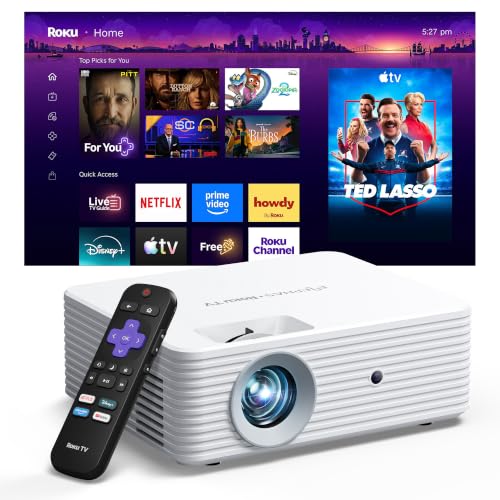
ELEPHAS Roku TV Smart Projector — Roku simplicity first
The ELEPHAS takes the most direct route to the bedroom’s goal: television behaviour without television furniture. Roku TV is built into the unit itself, so the machine wakes to the familiar Roku home screen and the household’s streaming services, with no stick occupying a port and no second remote breeding on the nightstand. Dolby Audio is named in the listing, voice-assistant compatibility with Alexa and Google Home is stated, and the portable mini format means the same box that serves the bedroom can be carried to a garden wall in summer — a double life the listing itself acknowledges by naming bedroom and outdoor use together.
Its character is the uncomplicated evening. This is the pick for the viewer who watches the news, a series episode and perhaps a film on weekends, and who values the two-minute path from pillow to programme over any specification arms race. Roku’s interface is the great leveller here: every member of the household already knows it or learns it in one sitting, and the projector’s job reduces to throwing a clean, watchable picture onto the wall the bed already faces. Set it on the nightstand or a small tripod, let the platform handle the rest, and the room keeps its calm.
Where expectations should be set is spectacle. A mini projector of this class is a creature of the darkened room; daylight viewing belongs to televisions, and even lamplight taxes the image in ways the first-night test will show you honestly. Judge it instead on the full bedroom ledger — simplicity, tidiness, adequate sound from its Dolby Audio setup, and the freedom to move it between rooms and seasons. On that ledger the ELEPHAS is the guide’s baseline recommendation, the pick against which the more specialised machines below must justify their extra talents. Households whose viewing extends to a garden cinema will find kindred machines in the roundup of the best backyard projectors, though few of those carry their streaming quite this neatly.
- Platform: Roku TV built in, per the title
- Audio: Dolby Audio, per the title
- Voice: compatible with Alexa and Google Home, per the title
- Form: portable mini projector, per the title
- Connections: WiFi and Bluetooth, per the title
- Settings named: bedroom and outdoor, per the title
Strengths
- Roku TV inside the box — no stick, no second remote.
- The plainest interface for guests and family of every age.
- Portable format gives the bedroom projector a summer second life.
Trade-offs
- A dark-room machine; daylight belongs to a television.
- No rotation claim in the title for dedicated ceiling viewing.
- Mini class means built-in audio, not cinema sound.
Best for: bedrooms wanting simple, tidy, platform-familiar viewing every night. Not suited for: bright-room use or viewers chasing the largest image.

BIGASUO Roku TV Smart Projector — Ceiling-ready rotator
The BIGASUO is the Roku route with its head tilted back. Roku TV is built in — the listing underlines that no streaming stick is needed — Dolby Audio rides along, and then the placement features take over the title: auto vertical keystone, zoom, and a body that rotates through 180 degrees. Read as a bedroom sentence, that says the machine expects to sit on a nightstand, aim upward, correct its own geometry and fill the ceiling over the bed. Auto vertical keystone is precisely the correction ceiling viewing consumes, because the upward angle is exactly the distortion that feature exists to undo, and zoom lets the image be sized to the ceiling’s available expanse without moving furniture at midnight.
The working routine this enables is the gentlest in the guide. Projector stays put; viewer lies back; the film occupies the ceiling; a sleep timer ends the evening without a glowing rectangle or a remote hunt. For viewers with neck or back complaints that make propped-up wall viewing a misery, that routine is not a luxury but the difference between watching in bed and not watching in bed at all. The BIGASUO also names home and outdoor settings in its title, so the rotation serves a garden wall as happily as a ceiling, though the ceiling is plainly its home terrain.
Choose it over the ELEPHAS above when the ceiling is genuinely your screen — measure the ceiling’s clear span and its colour before buying, since a heavily textured or dark-painted ceiling will tax any projector in this class. Choose it, too, when the projector’s position is fixed and off-axis, because its correction features are aimed at exactly that compromise. What it shares with its Roku sibling is the platform’s simplicity and the class’s dark-room nature; what it adds is a body designed around the way bedrooms are actually used after lights-out, and for ceiling watchers that addition is the whole decision.
- Platform: Roku TV built in, no stick needed, per the title
- Rotation: 180 degrees, per the title
- Correction: auto vertical keystone and zoom, per the title
- Audio: Dolby Audio, per the title
- Connections: WiFi and Bluetooth, per the title
- Settings named: home and outdoor, per the title
Strengths
- Rotation and vertical keystone are designed for ceiling viewing.
- Zoom sizes the picture without moving the nightstand setup.
- Roku’s simplicity keeps the midnight interface effortless.
Trade-offs
- Ceiling colour and texture will shape the picture you get.
- Still a dark-room class of machine, like every pick here.
- Wall viewers gain less from its headline talents.
Best for: ceiling watchers and anyone whose neck prefers a pillow-flat posture. Not suited for: rooms with dark or heavily textured ceilings.

HAPPRUN Google TV 1080P Projector — Native 1080P all-rounder
The HAPPRUN Google TV model carries the strongest specification in this guide, and its title is unusually specific about which parts are which. It is a native 1080P projector — the projected resolution itself — running officially licensed Google TV, with 4K decoding listed separately and correctly: the machine accepts a 4K source and decodes it for its 1080P panel, which is a compatibility virtue and is described here in exactly those terms. The listing speaks of an app catalogue in the tens of thousands as the maker’s framing of Google TV’s breadth, and adds Dolby audio support, AirPlay, WiFi and Bluetooth, outdoor readiness and compatibility with a current games console — a breadth of claims that positions this unit as the bedroom’s all-rounder rather than a single-purpose sleeper.
Google TV changes the evening’s texture compared with the Roku picks. Recommendations surface across services, the interface rewards households already signed into Google’s world, and the app depth suits viewers whose tastes run beyond the big three platforms — the niche film service, the sports app, the children’s catalogue that lives in exactly one place. For a main bedroom that doubles as the house’s second cinema, that depth plus native 1080P sharpness makes this the pick to beat: text in menus stays crisp, faces hold together at larger image sizes, and the console compatibility means the same wall serves a late film and an earlier game without a hardware shuffle.
The trade is a busier interface and a machine with more to configure. Households that prize the two-tap path to a programme may find Google TV’s recommendations a noise floor they never asked for, and first-evening setup runs longer than the Roku route. None of that diminishes the recommendation for the right viewer; it defines the right viewer. If the bedroom screen is your primary screen, if a console lives in the room, or if your streaming life is already Google-shaped, this is the most complete projector in the guide, and the one whose picture specification needs no careful wording at all.
- Resolution: native 1080P, per the title
- Platform: officially licensed Google TV, per the title
- Input: 4K decoding — accepts and decodes a 4K source, per the title
- Audio and casting: Dolby and AirPlay, per the title
- Connections: WiFi and Bluetooth, per the title
- Extras: console compatibility and outdoor readiness, per the title
Strengths
- Native 1080P is the clearest picture claim in this guide.
- Google TV’s app depth suits eclectic streaming households.
- Console compatibility makes one wall serve games and films.
Trade-offs
- A busier interface than Roku’s two-tap calm.
- Longer first setup than the simpler platform picks.
- 4K decoding is input handling, not 4K projection — by design.
Best for: main bedrooms doubling as a second cinema, and Google households. Not suited for: viewers who want the plainest possible interface.

HAPPRUN Roku TV Smart Mini Projector — Compact Roku sibling
Sharing a surname with the pick above and a platform with the two before it, this HAPPRUN mini is the compact Roku expression of the family. Roku entertainment is built in, Dolby Audio is named, auto keystone handles the nightstand angle, and the whole package is described as a smart mini projector for portable use across outdoor and home settings. If the Google TV sibling is the household’s second cinema, this one is the bedroom’s quiet specialist: smaller ambitions, smaller footprint, and the Roku interface’s trademark refusal to complicate an evening.
Why would a household choose it over the ELEPHAS, which tells a similar Roku story? By the margins that decide real purchases: the mini format suits the smallest nightstands and the guest bedroom that hosts a projector twice a month; HAPPRUN’s own design language and remote will suit hands that already know the brand from another room; and its auto keystone emphasis speaks to setups where the projector migrates — nightstand tonight, dresser tomorrow, a child’s room for a Saturday matinee. Portability inside the house is an underrated bedroom virtue, because bedrooms borrow projectors from each other constantly, and a mini that re-squares itself at every landing is the one that actually gets borrowed.
Set expectations by the class it declares. A mini projector is a dark-room, modest-image instrument; it will delight at the scale a bedroom wall offers from a bed’s distance and disappoint anyone secretly shopping for a living-room centrepiece. Within that honest frame, the combination of built-in Roku, named Dolby Audio and self-correcting setup makes it the easiest machine in this guide to move into a room and forget about — which, for a guest room, a teenager’s room or a rented flat’s main bedroom, is frequently the entire brief. Artists borrowing the bedroom projector for a wall sketch will find the dedicated drawing tools live elsewhere, in the roundup of the best projectors for mural art; this machine’s talents are tuned for films, not outlines.
- Platform: Roku TV built in, per the title
- Form: smart mini projector, portable, per the title
- Correction: auto keystone, per the title
- Audio: Dolby Audio, per the title
- Connections: WiFi and Bluetooth, per the title
- Settings named: outdoor and home theatre use, per the title
Strengths
- The smallest route to built-in Roku in this guide.
- Auto keystone suits a projector that migrates between rooms.
- Dolby Audio named, where many minis stay silent on sound.
Trade-offs
- Mini class means modest image scale and dark-room viewing.
- No rotation claim for dedicated ceiling duty.
- Shares a brand name with a stronger sibling — check the model.
Best for: guest rooms, teenagers’ rooms and small main bedrooms. Not suited for: the household’s main, largest-screen viewing.

Magcubic Mini Projector WiFi — Value swivel pick
The Magcubic — its listing names the model HY300Pro — is the value expression of the ceiling idea. Its title states a brightness figure of 200 ANSI, the only explicit brightness number in this guide’s pool, quoted here as the maker’s figure; it offers auto keystone, a 180-degree rotation for ceiling and wall alike, WiFi and Bluetooth, and the “4K Support” wording that this guide translates on sight: the unit accepts a 4K input signal, a compatibility note about sources, not a claim of native 4K projection. A smart, portable, small machine at the accessible end of the category, it has become a common first projector precisely because its promises are shaped like the bedroom use case.
Its virtues are placement and price-class honesty. Rotation plus auto keystone is the ceiling kit; the compact body disappears onto a shelf; and the stated brightness figure, modest as it is, at least lets a buyer plan — a dark bedroom, a white ceiling, an image kept to a sensible size will flatter it, while a bright room will expose it, and the title’s own number told you so in advance. That is a more useful honesty than a silent listing, and it is why the Magcubic earns a place rather than a warning: judge it as a dim-room instrument with a published figure, and it performs its role without pretending to another.
The cautions are the class’s cautions, concentrated. Built-in sound on a body this small is accompaniment, not cinema, so a Bluetooth speaker on the nightstand is a natural partner. The smart interface on value-tier projectors rewards modest expectations — keep the household’s demanding apps for a platform pick if your tastes run exotic. And the first-night pillow test matters most here of all: fan character, focus uniformity at the ceiling’s distance, the remote’s behaviour in the dark. Pass those, and the Magcubic is the easiest entry into ceiling cinema in this guide; fail them, and the returns window exists precisely so that the lesson costs nothing.
- Brightness: 200 ANSI stated in the title
- Rotation: 180 degrees, per the title
- Correction: auto keystone, per the title
- Input: 4K support — accepts a 4K signal, per the title
- Model: HY300Pro, per the title
- Connections: WiFi and Bluetooth, per the title
Strengths
- The pool’s only stated brightness figure lets buyers plan honestly.
- Rotation and auto keystone deliver the ceiling setup at value tier.
- Compact body suits shelves and small nightstands.
Trade-offs
- 200 ANSI is a dim-room figure — size the image modestly.
- Built-in sound benefits from a Bluetooth speaker partner.
- 4K support describes the input, never the projected resolution.
Best for: first-time ceiling viewers and value-conscious bedrooms. Not suited for: large images, bright rooms or demanding app tastes.

HP SW100 Smart Mini Projector — Speaker-base design
The HP SW100 approaches the bedroom from the audio side. Its listing describes an ultra-compact smart mini projector with official apps built in, auto keystone, and — the distinctive phrase — an upgraded speaker base, which is a design decision aimed squarely at the nightstand problem: in a bedroom, the projector is usually the only speaker in the room, and a base built to carry sound turns a visual gadget into the room’s whole entertainment appliance. HP’s name on a mini projector also signals a particular buyer, the one who prefers a familiar brand’s documentation and support channels behind an unfamiliar product category.
Its picture wording deserves the careful reading this guide promised at the start. The title speaks of HDR10 and 1080P support — support language, which we report as written rather than upgrading into a native-resolution claim the listing does not plainly make. HDR10 support, fairly read, means the unit accepts and handles HDR10 signals; combined with built-in official apps, the proposition is a tidy, brand-backed streaming box for the bedroom wall or ceiling, with auto keystone forgiving the placement and the speaker base sparing you a second device. For households whose viewing is series, news and the occasional film, that proposition is complete as stated, with no fog required.
Consider it the grown-up’s mini: the pick for the spare room that hosts grandchildren, the home office that becomes a guest room, the buyer who reads support pages before unboxing. Its ultra-compact claim suits rooms where the projector must vanish into a drawer between uses, and its app-built-in design keeps the stick count at zero like every pick here. What it asks in return is the same pillow test as its rivals — fan, focus and the speaker base’s real voice at low volume, where bedroom listening actually happens and where small speakers either prove their design or confess. The mini shelf beyond this guide, surveyed in the roundup of the best 1080p mini projectors, trades streaming brains for portability in several cases; the SW100’s insistence on carrying its own apps is what keeps it on this page instead.
- Form: ultra-compact smart mini projector, per the title
- Audio: upgraded speaker base, per the title
- Apps: official apps built in, per the title
- Signal: HDR10 and 1080P support, as worded in the title
- Correction: auto keystone, per the title
- Settings named: bedroom, ceiling and home use, per the title
Strengths
- Speaker-base design answers the bedroom’s only-speaker problem.
- Built-in official apps keep the setup to one box and one remote.
- A familiar brand’s support stands behind a new category.
Trade-offs
- Title wording is support language — read the picture claims as written.
- Ultra-compact bodies trade image scale for tidiness.
- Low-volume listening quality needs the first-night test.
Best for: tidy bedrooms and guest rooms wanting one brand-backed box with real sound. Not suited for: buyers seeking a plainly stated native-resolution flagship.
How Does Sound Work in a Room Meant for Sleep?
Bedroom audio obeys different physics of politeness. The living room rewards power; the bedroom rewards clarity at a whisper and the ability to keep sound inside the room’s intentions. Dialogue is the test material — a whispered conversation in a drama, a newsreader at low level — because that is what a viewer beside a sleeping partner actually plays, and small projector speakers separate themselves quickly on it: some stay intelligible turned well down, others dissolve into a mumble that forces the volume up and defeats the exercise. The HP SW100’s speaker base is a direct answer to this test, and the Dolby Audio branding on the Roku and HAPPRUN picks signals attention to the same problem, but the pillow audition described in the setup section remains the only verdict that counts, delivered at your volume, on your programme, beside your partner.
Bluetooth is the bedroom’s pressure valve. Every pick here carries it, and its best use is not the party trick of a big speaker but the opposite: a small speaker or a pair of headphones placed at the listeners, so the sound’s centre of gravity moves from the projector’s corner to the bed itself. Volume can then fall, because the distance the sound must travel shrinks to arm’s length. Households with different bedtimes should treat that pairing as core infrastructure rather than an accessory, set it up in the first week, and leave it connected; the couple that solves sound solves the majority of bedroom-viewing friction, and it is solved with placement, not power.
One more courtesy is worth configuring: the platform’s volume levelling and night modes, where offered, tame the advertisement or action-scene that arrives twice as loud as the dialogue around it. Nothing in a listing can promise your household peace at that moment; a settings pass in week one can. Sound, in short, is where bedroom projectors are won and lost after the picture has passed its audition, and it rewards the same approach as everything else in this room — test quietly, place kindly, and let the machine disappear.
What Size Image Actually Suits a Bedroom?
Smaller than the advertisements suggest, and better for it. A bedroom’s viewing distance is the bed’s length plus a little — a few metres at most — and at that distance a moderate image delivers the cinematic feeling without the tennis-match eye movement a wall-filling picture demands at close range. Compact projectors also concentrate their light into a smaller image more convincingly: the same modest brightness that looks washed across a huge expanse looks rich and settled across the span a bedroom actually offers. This is the class’s quiet bargain, and it is why the minis in this guide are not failed cinema projectors but correctly sized bedroom ones. Size the image to the wall the room gives you, resist the maximum the throw allows, and the picture will repay the restraint every night.
The ceiling has its own sizing logic. An image directly overhead reads larger than the same image on a wall, because it fills the prone viewer’s field without competition from the room’s edges; most ceiling watchers settle on a span noticeably smaller than they first imagined and find it generous. Start small during the test evenings and grow the zoom across a week — the BIGASUO’s zoom and the correction features across this pool exist for exactly that calibration — because an oversized ceiling image is not merely tiring but oddly wakeful, the opposite of the room’s purpose. The right size is the one you stop noticing, where the story occupies you and the rectangle’s edges leave your thoughts entirely.
Guests and children recalibrate the answer again. A child’s bedroom hosting a Saturday matinee for four small viewers on the floor wants the wall and the widest comfortable span; a guest room wants whatever size the dresser-to-wall geometry gives without a fight. The migratory minis — the HAPPRUN Roku and the HP — earn their keep in these rooms precisely because they re-derive the answer at each landing, auto keystone squaring a fresh geometry while the audience is still choosing the film.
How Do the Six Picks Sit Alongside Each Other?
| Pick | Streaming brain | Placement talent | Watch out for |
|---|---|---|---|
| ELEPHAS Roku TV | Roku TV built in | Portable mini, wall duty | No rotation claim for ceilings |
| BIGASUO Roku TV | Roku TV built in | 180-degree rotation, vertical keystone, zoom | Ceiling surface shapes the result |
| HAPPRUN Google TV | Google TV, licensed | All-round wall viewing | Busier interface to learn |
| HAPPRUN Roku Mini | Roku TV built in | Mini format, auto keystone | Modest image scale |
| Magcubic HY300Pro | Built-in smart system | 180-degree rotation, auto keystone | 200 ANSI suits dim rooms only |
| HP SW100 | Official apps built in | Ultra-compact, auto keystone | Support wording on picture claims |
The platform column divides the table before any specification does: three Roku machines, one Google TV, two app-carrying alternatives. Choose the brain your household already speaks, then let the placement column — rotation for ceiling watchers, compactness for migratory minis — finish the decision.
Notice what no column can hold: the sound of each machine in a silent room and the feel of its remote in the dark. Those two unglamorous traits decide more bedroom purchases in the end than any row here, which is why every recommendation in this guide is conditioned on the same ritual — three evenings, from the pillow, before the returns window closes.
How Do You Set Up a Bedroom Projector for Sleep-Friendly Viewing?
Build the setup around the evening’s end, not its beginning. Place the projector where it will live permanently — a nightstand corner, a headboard shelf, a small tripod in the room’s dead corner — because a setup rebuilt nightly will be abandoned within a month. Aim and correct once, in the dark, from the pillow: keystone squared, focus set on the furthest text the menu offers, image sized to the wall or ceiling area that the room’s light can support. Then configure the sleep machinery while you are in the settings anyway: the sleep timer, the platform’s autoplay restraint, and a brightness or eco mode if offered, because the last episode of the night should end in darkness rather than in a menu glowing until dawn.
Sound deserves its own pass at pillow volume. Test the built-in speakers with dialogue, not an action trailer, at the level you will actually use beside a sleeping partner; dialogue clarity at low volume is the bedroom’s real audio specification. If it fails, pair a small Bluetooth speaker placed near the pillows rather than beside the projector, so the sound lives with the listeners and the level can drop further still. Headphones paired over Bluetooth are the final kindness for the household with mismatched bedtimes, and worth testing in the first week even if you expect to use them rarely.
Light discipline completes the ritual. Blackout the projector’s own status lights where settings allow, keep the remote in a known spot reachable without sitting up, and give the machine’s fan a clear airway — a projector suffocating in a drawer-nook runs louder and hotter, and bedroom fans are judged at a distance of one pillow. The permanent-placement version of this discipline, for rooms that justify it, appears in the survey of the best ceiling mounted projectors; most bedrooms, honestly, are better served by the nightstand and the habits above.
What Mistakes Do Bedroom Viewers Make With Projectors?
The first is shopping by living-room logic: chasing the biggest image and the boldest specification, then discovering the bedroom wanted calm, quiet and a two-tap interface instead. The second is misreading support language as native resolution — a fog this guide has worked to disperse — and feeling cheated by a machine that does exactly what its title said. Read titles the way this page does and the disappointment never happens. Third is ignoring the fan until the third night, when the returns conversation is harder and the partner’s verdict has hardened; audition noise on night one, from the pillow, with the film paused.
Fourth is a wandering setup — projector repositioned nightly, focus and keystone redone by feel, image never twice the same — when a fixed perch and one careful evening of adjustment would have ended the fiddling forever. Fifth is treating the ceiling as free: a coloured or stippled ceiling taxes every projector here, and the test costs one evening, not a redecoration. Sixth is forgetting the sleeping half of the room’s population. Light spill, status LEDs, autoplay rolling into the next episode at full volume — the bedroom projector’s failures are mostly failures of consideration, and they are all preventable in the first week’s settings pass.
Whose Bedroom Is It? Children, Guests and Shared Rooms
A child’s bedroom asks the projector to be two things in sequence: a matinee machine in the afternoon, when the audience sits on the floor and the room is bright with company, and a wind-down machine in the evening, when one small viewer and a timer matter more than any specification. The platform picks serve the second role best, because a familiar interface and a sleep timer turn lights-out into a feature of the film rather than an interruption of it — and parents should note that the decorative star projectors discussed earlier make their peace offering here, as night lights after the real projector sleeps. What a child’s room does not need is the household’s sharpest picture; it needs a machine simple enough for a grandparent to run at babysitting o’clock, which points squarely at the Roku minis.
A guest room asks for instant legibility above all. The visitor does not know your household’s streaming habits, will not read a manual, and judges the room by whether the evening’s entertainment explains itself in ninety seconds. A built-in platform with a plain home screen, a remote left visibly on the pillow-side table, and a projector already squared to the wall: that is hospitality in this category, and it is why the self-sufficient picks — every model here, by this guide’s first requirement — suit guest duty better than any brighter machine that needs a stick, a login and a tutorial. Test the guest room as a guest: arrive with no knowledge, switch on, and time yourself to a playing film.
Shared and multi-purpose rooms — the studio flat, the office that hosts a fold-down bed, the teenager’s domain that becomes a cinema on Fridays — reward the migratory virtues. A mini that re-squares itself on a shelf, a desk edge and a nightstand across one week serves these rooms better than a fixed installation, and the household that owns one good migratory projector often discovers it has quietly replaced the idea of a second television altogether. Judge your own room honestly against these three portraits before weighing specifications, because the projector that fits the room’s social life will be watched; the one that merely wins the spec sheet will be admired, briefly, from a drawer.
How Long Should a Bedroom Projector Last, and What Ages First?
Plan on the platform ageing before the optics. A compact projector’s light source is rated in the tens of thousands of hours in this product class generally, far beyond bedroom duty across years of evenings; what dates a streaming projector is its software — app support, platform updates, the slow drift of services away from older systems. That is an argument for the platform picks with the deepest ecosystems, Roku and Google TV, whose update horizons are measured in ecosystems rather than in a single manufacturer’s attention span, and for treating any projector’s smart layer as the part with a lifespan, the lens as the part with a legacy. When the platform eventually tires, a stick in the port revives the panel for years more — the self-sufficiency this guide demanded is a starting virtue, not a life sentence.
Physical care is mostly dust and heat discipline. Keep the vents clear, resist the drawer-nook that suffocates airflow, and let the machine cool before it travels between rooms. Remotes are the true consumable of bedroom viewing — they vanish into bedding with a discipline that suggests intent — so learn the platform’s phone-app remote in the first week, while the physical one is still findable, and the evening will never again be held hostage by a cushion. Households that adopt those small habits find a bedroom projector among the longest-serving gadgets they own, outlasting several televisions’ worth of furniture rearrangements precisely because it was never furniture at all.
Final Recommendation
Let the room cast the deciding vote. Ceiling watchers should start with the BIGASUO, whose rotation and vertical keystone were designed for the pillow-flat audience, with the Magcubic as the value route to the same posture and the only stated brightness figure in the pool to plan around. Wall viewers who live in Roku’s world take the ELEPHAS for the plainest path to nightly viewing, or its HAPPRUN mini cousin when the projector must migrate between rooms. The household whose bedroom doubles as its second cinema — console, eclectic apps and all — belongs with the native 1080P HAPPRUN Google TV, while the tidy-minded will appreciate the HP SW100’s speaker base and single-box manners. Buy one, test it from the pillow for three honest evenings, and keep it only if the room feels calmer with it than without it, because a bedroom projector has succeeded precisely when the technology disappears and all that remains is the film, the dark and the ceiling doing its quiet work above the bed.
Frequently Asked Questions
Is a projector really better than a TV in a bedroom?
For many rooms, yes: it removes the screen from the room’s daytime life, scales larger than a bedroom television at this class, and enables ceiling viewing that no panel can offer. A television still wins in bright rooms and for instant-on casual viewing. The honest test is your own evening — if the room is dark by viewing time and the wall or ceiling is clear, the projector’s advantages are real.
What does 4K support actually mean on these projectors?
It means the projector accepts and decodes a 4K signal from a source such as a streaming box or console, then displays it at the panel’s own resolution. It is a useful compatibility trait — your sources need no special settings — but it is not native 4K projection, and this guide never describes it as such. Judge picture sharpness by the native resolution a title states, where it states one.
How loud are bedroom projectors?
Listings in this pool publish no comparable noise figure, so the only honest answer is procedural: audition the fan from your pillow, film paused, on the first night, while returning the unit is painless. Placement helps — a projector with clear airflow on a solid surface runs calmer than one boxed into a nook — and a Bluetooth speaker near the pillows lets dialogue stay clear at lower overall volume.
Can I watch on the ceiling with any of these?
The rotatable picks are built for it: the BIGASUO and the Magcubic both state 180-degree rotation in their listings, aiming the image upward from a nightstand. Others can sometimes be angled toward a ceiling with a suitable stand, but a designed rotation with auto keystone is the difference between a feature and an improvisation, and ceilings also reward a test evening for colour and texture before you commit.
Do I need a screen?
No. A pale, smooth wall or ceiling is the bedroom standard, and part of the format’s appeal is that the room needs no new furniture. A screen improves matters in rooms with coloured or textured walls, but try the wall first across a few evenings; most bedrooms discover the wall was sufficient all along, and the money saved buys the blackout curtain that improves viewing more.
What about the star projectors that appear for this search?
They are night lights, not video projectors: they scatter a decorative star field and cannot play a film, a series or a console. Lovely for a child’s ceiling at lights-out, and several households own one alongside a real projector — but if the goal is television in bed, choose from machines like the six above that carry an actual streaming platform and a lens meant for programmes.
Can a bedroom projector replace our living-room TV?
It can replace a second television comfortably and a main one only in households that watch mostly after dark. Living rooms gather daylight, groups and glancing viewing across the day, all of which flatter a panel; bedrooms gather evenings, which flatter a projector. Many households run exactly this division — panel in the living room, projector in the bedroom — and find each screen doing the job its room actually asks for, rather than one screen compromising in both.
Where should the projector sit if there is no nightstand space?
A headboard shelf, a small tripod in the corner behind the bed, or a dresser edge all serve, provided the position is fixed rather than nightly. Auto keystone across these picks forgives the off-centre angles those perches create, though the further the angle, the more image the correction spends — so prefer the perch closest to square with your wall or ceiling, and let the correction handle the remainder instead of the whole problem.
Related Guides
For neighbouring questions, compare the cord-free machines in the roundup of the best android wifi projectors, the pocketable shelf surveyed among the best mini bluetooth projectors, and the permanent-installation logic in the best ceiling mounted projectors guide for rooms ready to commit a mount to the ceiling joists.
The throw-distance maths in this guide scales up to wall-size work in our roundup of the best projectors for mural art, where artists project outlines before painting.
Related guides
- Best 1080p IP Cameras: PoE Domes, Turrets, Bullets and a PTZ That Earn Their Cable
- Best 43 1080p TVs: Why 43 Inches Went 4K — and Where True Full HD Survives
- Best Doorbell Cameras No Subscription: Local Storage Picks, and the Ring/Blink Truth
- Best AC Powered Wireless Security Cameras: Wi-Fi Data, Mains Power, Zero Sleep


