What's inside
- Key Takeaways
- Quick Picks: Church Projectors Over 4000 Lumens at a Glance
- How Did We Choose These Best Church Projectors Over 4000 Lumens?
- Brightness, Resolution and Light Source: The Six in One View
- How Do You Work Out Throw, Screen Size and Mount Position?
- What Should the Installation Weekend Actually Involve?
- Lyrics, Scripture and Video Make Three Different Demands
- From the Sound Desk: Control, Cabling and the Volunteer’s Morning
- Two Sanctuaries, Talked Through Honestly
- Looking After the Machine Across a Decade of Sundays
- What Mistakes Do Churches Make When Buying a Projector?
- The Screen Is Half the Picture Nobody Budgets For
- Lamp Fading and Laser Steadiness, in Plain Terms
- How Should a Committee Actually Run This Decision?
- The Building Works Weekdays Too
- Reading a Projector Listing Like a Treasurer
- The First Month With the New Machine
- Overflow Rooms, Cry Rooms and the Second Screen
- A Brief Note on Sound, Since the Projector Will Be Blamed for It
- Funerals, Weddings and the Services Nobody Rehearses
- Why Four Thousand Lumens Became This Category’s Threshold
- Odd Angles: When the Projector Cannot Hang Level and Square
- Final Recommendation
- Frequently Asked Questions
- Related Guides
As an Amazon Associate I earn from qualifying purchases. This post may contain affiliate links at no extra cost to you.
gizmoverdict.com is reader-supported. When you buy through links on our site, we may earn an affiliate commission.
Where to buy: the six projectors below are sold through Amazon, and a church should order the way it should plan — by measuring the sanctuary first and choosing second — because this guide to the best church projectors over 4000 lumens exists for one specific room: a worship space with tall windows nobody wants to black out, a screen that must carry hymn lyrics and scripture to the back pew, and a small volunteer team that needs the picture to simply be there, bright and legible, every single week of the year. Every pick states at least 4,000 lumens in its own listing title, and the differences that matter are what sits behind that figure — laser or lamp, 1080p or WUXGA or WXGA, and how the machine behaves in a ceiling mount ten feet above the nearest ladder.
Brightness in a sanctuary is not about cinema drama. It is about text at distance in ambient light: the chorus line read by an eighty-year-old in the last row, the announcement slide that must survive a sunny morning through stained glass. That is why this category begins at four thousand lumens and why the honest questions are about light source life, lens flexibility and control from the ground — the things a volunteer notices across two hundred Sundays, long after the specification that won the committee meeting has been forgotten.
Key Takeaways
- Every pick states 4,000 lumens or more in its listing title, from the PA503 pair at that threshold to the Panasonic PT-VMZ61 at 6,200.
- Resolution differs honestly across the six: the ViewSonic HD models and the Panasonics’ WUXGA differ in fine-text sharpness, and the PA503W is a WXGA machine — a real distinction for lyric slides.
- Laser picks remove the lamp-change ritual from a ceiling mount; lamp picks cost the committee less deliberation up front and ask for occasional lamp care.
- Lens zoom and keystone ranges, stated per listing, decide whether the projector can live where the building allows it to live.
- Screens, mounts and cables are accessories to plan alongside, never the pick itself — the projector choice comes first.
Quick Picks: Church Projectors Over 4000 Lumens at a Glance
Four ViewSonic machines across two light-source families and two Panasonics at the top of the brightness table — the badges name the sanctuary each suits.
| Pick | Badge | Why it is here |
|---|---|---|
| ViewSonic LS740HD 5500 Lumens | Laser Value Anchor | 5,500 lumens of laser light at 1080p with corner adjustment, for sanctuaries that want brightness without lamp errands. |
| ViewSonic LS741HD 5000 Lumens | Flexible-Lens Laser Pick | A 1.6x zoom, LAN control and 24/7 operation rating suit buildings where the mount position is dictated, not chosen. |
| ViewSonic PA503HD 4000 Lumens | Straightforward Lamp Pick | Full HD DLP at the category’s entry brightness, with the simple manners a volunteer team appreciates. |
| ViewSonic PA503W 4000 Lumens | WXGA Budget Route | The widescreen WXGA option for halls and fellowship rooms where slides matter more than fine detail. |
| Panasonic PT-VMZ61 6200 Lumens | Brightest in the Room | 6,200 lumens of WUXGA laser light for large, bright sanctuaries that defeat lesser machines. |
| Panasonic PT-VMZ50 5000 Lumens | Established WUXGA Step | The earlier VMZ generation at 5,000 lumens, for churches wanting Panasonic optics at a gentler tier. |
How Did We Choose These Best Church Projectors Over 4000 Lumens?
The gate was the keyword itself: a listing had to state 4,000 lumens or more in its own title, because brightness claims buried in marketing copy are how sanctuaries end up squinting. All six passed on their titles’ own figures. Resolution was recorded with the same discipline — the PA503W is WXGA and is reviewed as WXGA, the Panasonic pair are WUXGA, the remaining ViewSonic models are 1080p — because lyric text at forty feet is exactly where those distinctions stop being pedantry. Readers comparing the wider sanctuary field will find the same title-first discipline in our best church projectors guide.
Light source was the second sort. Laser machines — the LS740HD, the LS741HD and the PT-VMZ61 — promise years without a lamp change in a mount nobody wants to visit; the lamp-based PA503 pair trades that freedom for a simpler purchase conversation. Both trades are respectable, and the reviews argue them in the open. Lens and control features were weighed last and practically: zoom range decides whether the projector can sit on the existing mount point, corner adjustment rescues imperfect geometry, and LAN control lets a volunteer manage a ceiling machine from the sound desk rather than from a ladder.
What was excluded matters too. Screens, mounts and cables flooded the search results, and all of them are accessories — necessary, budget-worthy, and not projectors. A church should absolutely plan them, in the order this guide recommends: projector first, then the mount it needs, then the screen its brightness deserves.

ViewSonic LS740HD 5500 Lumens — Laser Value Anchor
The LS740HD makes the sanctuary argument for laser in its simplest form: 5,500 lumens, stated in its title, from a laser light source, at Full HD, with optical zoom, keystone and corner adjustment, and a listing that names auditorium and ceiling-mount use in its own words. For a mid-sized church whose windows face the morning sun, that combination answers the two questions that dominate real sanctuaries — will the words be readable, and will anyone have to climb up there this year — with unusual directness.
Corner adjustment deserves its sentence, because sanctuaries are rarely the perfect rectangle of the brochure. A screen hung slightly off, a mount inherited from the previous machine, a beam where the ideal position should be: four-corner correction lets the installer square the picture to the screen the building actually has. The laser source then removes the recurring errand that defines lamp ownership in a ceiling mount — no lamp hours to log, no dimming tail to apologise for in the months before a change. For a volunteer-run AV cupboard, that absence of errands is not a luxury; it is the difference between a system that gets maintained and a system that gets endured.
- Brightness: 5,500 lumens, as stated in the title
- Resolution: 1080p Full HD, per the title
- Light source: laser, per the title
- Geometry: optical zoom, keystone and corner adjustment named in the title
- Positioning in the title: auditorium, classroom, ceiling mount, 360 projection
Strengths
- Laser light at this brightness removes lamp changes from a high mount’s future.
- Corner adjustment rescues real sanctuaries whose geometry is imperfect.
- 5,500 stated lumens give genuine headroom for sunlit morning services.
Trade-offs
- 1080p rather than WUXGA — lyric text is crisp, fine spreadsheet detail less so.
- Laser machines ask more deliberation from the budget committee than lamp models.
- Its talents are wasted on a small dark hall that never needed this brightness class.
Best for: mid-sized and larger sanctuaries with ambient light and a volunteer team. Not suited for: a small chapel that meets in a blackout-friendly room and could spend less.

ViewSonic LS741HD 5000 Lumens — Flexible-Lens Laser Pick
If the LS740HD is the brightness argument, the LS741HD is the placement argument. Its title trades five hundred of its sibling’s lumens for the installer’s favourite numbers: a 1.6x optical zoom, horizontal and vertical keystone, four-corner adjustment, 360-degree projection, LAN control and a 24/7 operation rating, all around a 5,000-lumen 1080p laser engine. A 1.6x zoom is a wide corridor of possible mounting distances for a given screen size, and in buildings where the mount must go where the beam, the balcony or the previous machine’s cabling dictates, that corridor is worth more than the surrendered brightness.
LAN control is the other grown-up feature here. A projector that can be monitored and managed over the network lets the AV volunteer check the machine from the sound desk, schedule its behaviour and notice a problem on a weekday rather than during the opening hymn. The 24/7 rating speaks to duty cycle rather than brightness — a machine built to run long hours without complaint, which suits churches whose buildings double as schools, conference venues and polling stations through the week. Choose between the two LS siblings by walking the sanctuary: if the mount position is free and the room is bright, take the 740’s lumens; if the position is fixed and awkward, take the 741’s lens and controls.
- Brightness: 5,000 lumens, as stated in the title
- Resolution: 1080p, per the title
- Light source: laser, per the title
- Lens: 1.6x optical zoom, named in the title
- Extras named in the title: H/V keystone, corner adjustment, LAN control, 24/7 operation
Strengths
- The 1.6x zoom fits the projector to the mount the building permits.
- LAN control moves management from the ladder to the sound desk.
- A 24/7 operation rating suits multi-use church buildings.
Trade-offs
- Five hundred fewer stated lumens than its LS740HD sibling.
- Still 1080p; fine-detail work belongs to the WUXGA Panasonics.
- Its control depth rewards a volunteer willing to learn the network side.
Best for: sanctuaries with fixed or awkward mount positions and weekday building use. Not suited for: the very brightest large rooms, where the VMZ61’s output is the point.

ViewSonic PA503HD 4000 Lumens — Straightforward Lamp Pick
The PA503HD is the honest entry point of this category: a 4,000-lumen, 1080p Full HD DLP projector, lamp-based, with HDMI, USB, optical zoom and auto keystone per its title, and a 120Hz line that betrays its home-and-classroom heritage. Nothing in that sentence is apologetic. Plenty of sanctuaries — modest in size, shaded by trees or blessed with blinds — need exactly four thousand lumens and a machine a volunteer can understand in one sitting, and the PA503HD’s virtue is that it never pretends to be anything grander.
Lamp ownership, stated plainly, is a rhythm rather than a burden: brightness softens across a lamp’s life, and one day the lamp is changed — a planned errand with a known part, in a mount the team should visit annually anyway to clean filters and check the fixings. Churches that think in maintenance calendars often prefer this bargain to a laser’s longer silence, because the cost arrives in small, budgetable visits. What the PA503HD asks in return is honesty about the room: at the category’s threshold brightness, a large sunlit sanctuary will outrun it, and the committee should measure the room before falling for its simplicity.
- Brightness: 4,000 lumens, as stated in the title
- Resolution: 1080p Full HD, per the title
- Technology: DLP, lamp-based, per the title
- Geometry: optical zoom and auto keystone named in the title
- Connections named in the title: HDMI and USB
Strengths
- Full HD resolution keeps lyric text clean at the category’s entry brightness.
- Auto keystone and optical zoom make volunteer installation forgiving.
- Lamp economics arrive as small planned costs rather than one large one.
Trade-offs
- Four thousand lumens is the floor of this class — little headroom for bright rooms.
- Lamp changes are a recurring errand a laser pick would not impose.
- Large sanctuaries will outgrow it sooner than the brighter picks.
Best for: modest, shaded sanctuaries and fellowship spaces on a careful budget. Not suited for: a large glass-fronted worship space at midday.
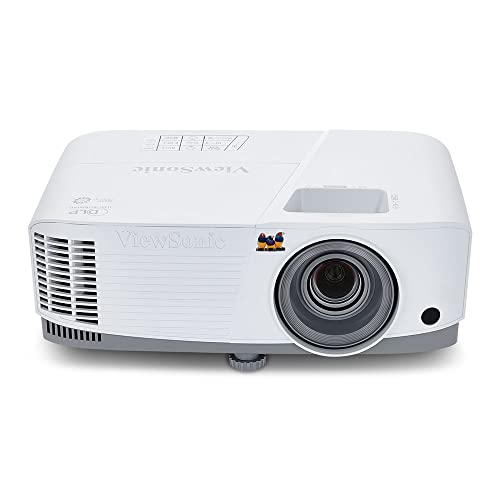
ViewSonic PA503W 4000 Lumens — WXGA Budget Route
The PA503W shares its sibling’s 4,000 stated lumens and lamp-based DLP design, and differs in the one specification this article refuses to blur: its resolution is WXGA, a widescreen format below 1080p. For the avoidance of all doubt — the HD in the other model’s name is not in this one, and a committee comparing the pair side by side should see the letters clearly. What WXGA means at the screen is equally clear: hymn lyrics in large type, announcement slides and video all present perfectly well, while fine text and detailed graphics carry visibly less sharpness than the 1080p and WUXGA machines deliver.
That makes the PA503W a pick with a defined parish: the fellowship hall, the youth room, the overflow space, the chapel whose screen is modest and whose content is bold. Its title adds the practical furniture of its class — vertical keystone, optical zoom, VGA and USB alongside HDMI, ceiling-mount positioning — and a low-latency line inherited from its classroom heritage. Churches sometimes buy a machine like this as the sanctuary’s second projector or the hall’s first, and in those roles its resolution is a reasonable economy rather than a compromise. Installed as the main sanctuary machine under a committee that believed it was buying Full HD, it would be a disappointment — which is a failure of reading, not of the projector, and this review exists partly to prevent it.
- Brightness: 4,000 lumens, as stated in the title
- Resolution: WXGA — not Full HD, stated plainly
- Technology: DLP, lamp-based, per the title
- Geometry: vertical keystone and optical zoom named in the title
- Connections named in the title: HDMI, VGA and USB
Strengths
- Widescreen format suits slides and video in halls and overflow rooms.
- The full practical kit — zoom, keystone, legacy VGA — is present.
- An economical way to put 4,000 stated lumens into a secondary space.
Trade-offs
- WXGA resolution shows on fine text at sanctuary distances.
- Lamp care applies, as with its PA503HD sibling.
- Committees must not mistake it for the Full HD model beside it here.
Best for: fellowship halls, youth rooms and overflow spaces with bold content. Not suited for: a main sanctuary where fine lyric text must carry forty feet.

Panasonic PT-VMZ61 6200 Lumens — Brightest in the Room
The PT-VMZ61 tops this table on both axes the title offers: 6,200 lumens and WUXGA resolution, from a Panasonic LCD laser projector. WUXGA’s extra pixels over 1080p are not a brochure nicety in a sanctuary — they are the difference between a dense scripture slide that resolves cleanly at the back and one that merely gestures at its own text. Pair that with the highest stated brightness in the roundup and the laser source’s freedom from lamp errands, and the VMZ61 is the pick for the rooms that defeat everything else here: the large modern sanctuary with a wall of glass, the traditional nave whose screen must compete with a bright chancel, the multi-purpose worship centre that hosts conferences all week.
Panasonic’s professional heritage is the subtext of this listing, and it shows in what the title does not need to shout about. Machines from this line are bought by venues that run them daily and service them rarely, and a church stepping up to this tier is buying that operational temperament as much as the lumens. The committee conversation should be equally grown-up: this is the most serious machine in the guide, it will still be the right machine after the building’s next two AV volunteers have come and gone, and its brightness headroom means it can be run with restraint in ordinary weeks — which is kinder to the picture and to the congregation’s eyes than a lesser projector straining at its ceiling every Sunday.
- Brightness: 6,200 lumens, as stated in the title
- Resolution: WUXGA, per the title
- Technology: LCD laser projector, per the title
- Class: professional installation machine
- Colour: white finish, as stated in the title
Strengths
- The highest stated brightness here, with headroom for glass-heavy sanctuaries.
- WUXGA resolution keeps dense text honest at the back pew.
- Laser source removes lamp changes from a high, busy mount.
Trade-offs
- The most serious deliberation in the roundup for a church budget.
- Overwhelming for small rooms, where its headroom would never be used.
- Professional class rewards a proper installation rather than a hopeful one.
Best for: large, bright sanctuaries and worship centres with weekday venue use. Not suited for: a small chapel, where the LS740HD already answers every real need.

Panasonic PT-VMZ50 5000 Lumens — Established WUXGA Step
The PT-VMZ50 is the VMZ61’s elder: a Panasonic LCD projector at 5,000 stated lumens and WUXGA resolution, its title adding front and ceiling positioning, HDMI and USB, and a 20,000-hour normal-mode figure that speaks to the light source’s long service design. Churches that want the Panasonic optical character and the WUXGA text advantage, but whose sanctuary does not demand the flagship’s extra brightness, will find this the considered middle of the range — a professional machine at a gentler tier of deliberation.
Read it against its younger sibling honestly. The VMZ61 is brighter and newer; the VMZ50 is the established design whose behaviour in real venues is a matter of long record. For a sanctuary of moderate size and moderate light — the commonest kind, whatever committees fear — five thousand lumens at WUXGA is a complete answer, and the money not spent chasing the flagship’s headroom can fund the screen, the mount and the cabling that this guide keeps insisting are part of the same purchase. That is not a consolation argument; it is how AV budgets actually succeed, by balancing the glamorous component against the unglamorous ones that decide what the congregation sees.
- Brightness: 5,000 lumens, as stated in the title
- Resolution: WUXGA (1920 x 1200), per the title
- Technology: LCD projector, per the title
- Service figure in the title: 20,000-hour normal mode
- Connections named in the title: HDMI and USB
Strengths
- WUXGA text quality at a friendlier tier than the flagship.
- Five thousand stated lumens answer the common sanctuary completely.
- Long-service design suits a mount the team visits rarely.
Trade-offs
- An earlier generation than the VMZ61 beside it.
- Less brightness headroom for very bright or very large rooms.
- Professional class still expects a deliberate, measured installation.
Best for: mid-sized sanctuaries wanting Panasonic WUXGA quality without flagship deliberation. Not suited for: the largest glass-fronted rooms, which should take the VMZ61’s headroom.
Brightness, Resolution and Light Source: The Six in One View
Every figure below is the listing title’s own. Keep the resolution column in sight — it is where this category’s quiet compromises live.
| Pick | Stated lumens | Resolution | Light source | Sanctuary it suits |
|---|---|---|---|---|
| ViewSonic LS740HD | 5,500 | 1080p | Laser | Bright mid-sized sanctuary, volunteer-run |
| ViewSonic LS741HD | 5,000 | 1080p | Laser | Fixed mount position, multi-use building |
| ViewSonic PA503HD | 4,000 | 1080p | Lamp (DLP) | Modest shaded sanctuary, careful budget |
| ViewSonic PA503W | 4,000 | WXGA | Lamp (DLP) | Hall, youth room or overflow space |
| Panasonic PT-VMZ61 | 6,200 | WUXGA | Laser (LCD) | Large bright sanctuary, venue use |
| Panasonic PT-VMZ50 | 5,000 | WUXGA | Long-service design (LCD) | Mid-sized sanctuary, Panasonic optics |
A caution belongs under any brightness table, and this guide states it in class terms: lumen figures are the makers’ own measurements under their own conditions, and the industry’s history includes optimistic labelling that a committee cannot audit from a listing. The defence is not cynicism but proportion — buy headroom where the room is bright, prefer the projector whose stated figure clears your need with room to spare, and remember that a good screen and sensible light control routinely contribute as much to the perceived picture as the next thousand lumens would. Our best 5000 lumen projectors roundup applies the same caution across the wider brightness class.
How Do You Work Out Throw, Screen Size and Mount Position?
Start from the screen, because the congregation reads the screen and not the specification. The furthest viewer should sit no more than roughly six times the image height away when fine text matters — a rule of thumb that converts the back pew’s distance into a minimum screen size before any projector is chosen. Then work backwards to the mount: the projector’s zoom range, stated in its listing, defines the corridor of distances from which it can fill that screen, and the sanctuary’s beams, balcony and existing cabling choose the point inside the corridor. This is the arithmetic that makes the LS741HD’s 1.6x zoom a sanctuary feature rather than a statistic.
Light control deserves the same practicality. Nobody is asking the church to brick up its windows; the honest tools are blinds that actually get used, a screen surface chosen for ambient light, and seating of the screen away from the window wall’s direct glare. Churches also project at their brightest against their own habits — a white slide at full brightness in a dimmed room is a torch, not a text — so teach the volunteers the picture modes and let ordinary Sundays run the machine with restraint. The headroom is for the Easter morning sun, not for every ordinary week, and a projector treated that way will look better and last longer in the congregation’s esteem.
What Should the Installation Weekend Actually Involve?
Plan it as a commissioning, not a fitting. Day one is mechanical: the mount — an accessory, chosen for this projector’s weight and the ceiling’s structure — goes up, cables are run with a spare pulled alongside for the future, and the projector is aligned to the screen with the lens centred before any keystone is touched, because optical alignment beats digital correction every time it is available. Keystone and corner tools are for the last few degrees of a real building’s imperfection, not for rescuing a mount placed by optimism.
Day two is pastoral, and it matters more. Build the Sunday templates with the worship team: the lyric layout at the size the back pew can read, the scripture template, the announcement loop, the pre-service countdown the stewards like. Set the machine’s start-up behaviour, label the remote and its spare, and write the one-page guide that lives in the AV cupboard — how to start, how to switch sources, who to call. Then run a full rehearsal with the band, the readers and the sun in the windows. A projector is not installed when it shows a picture; it is installed when a volunteer who was not on the ladder can run a whole service from that one page.
Lyrics, Scripture and Video Make Three Different Demands
A sanctuary projector serves three masters with different eyesight. Lyrics are the forgiving one: large type, high contrast, read at a glance by a congregation standing and singing — every pick here, WXGA included, serves lyrics honourably on a sensible screen. Scripture is the strict one: a full passage in a readable face, often smaller type held on screen for a minute of silence, and this is where resolution stops being a specification and becomes a pastoral matter, because the back pew’s ability to follow the reading is the entire point of putting it on the wall. WUXGA and 1080p earn their places on scripture duty.
Video is the third master and the most deceptive, because video looks acceptable on almost anything in a showroom and reveals its truths at distance in daylight. A film clip in a bright sanctuary needs brightness headroom more than pixel count, and a machine run at its limit for video will look tired at exactly the moment the room is fullest. The balanced reading of this roundup follows: choose resolution for the text you show, choose brightness for the light you cannot control, and let video — which flatters every projector — cast no vote at all. Committees that score the candidates against a hymn, a passage and a photograph, in that order, will rank these six the way their congregation’s eyes will.
From the Sound Desk: Control, Cabling and the Volunteer’s Morning
Picture the volunteer’s Sunday at half past nine: the projector must wake, show the pre-service loop, accept the worship laptop, and behave — operated from the sound desk at the back, by a person who also has three other jobs before the first hymn. Every feature that serves that half hour is worth money. LAN control, the LS741HD’s stated strength, lets the desk check and wake the machine without a ladder or a prayer. A remote that is labelled, tethered and has a spare in the drawer prevents the small panic that congregations remember longer than any sermon. Auto keystone on the PA503 pair forgives the mount that has drifted a degree since its installation.
Cabling is the unglamorous half of the same morning. Run the signal cable with headroom in its specification, pull a spare alongside it while the access is open, and terminate at a wall plate near the desk rather than a tail dangling from the ceiling. Wireless presenting has its place for a visiting speaker’s laptop, but the service itself should ride the cable, because a congregation is the least forgiving audience a dropped connection will ever meet. None of this appears in a lumens table. All of it decides whether the projector is loved or endured by the people who actually operate it.
Two Sanctuaries, Talked Through Honestly
The first is a Victorian parish church: stone walls, tall windows along the south side, a screen above the chancel arch, the back pew a long way from it, and a volunteer team of two. The room’s demands are brightness against the windows and resolution for the readings, with a mount that can only go where the previous machine’s fixings are. The honest shortlist from this guide is the VMZ61 if the budget stretches — its headroom answers the windows outright — or the LS741HD, whose zoom fits the inherited mount and whose laser source suits a team of two. The screen gets sized from the back pew, the blinds on the south windows get repaired in the same project, and the commissioning templates are built around the readings, not the notices.
The second is a modern church plant meeting in a converted retail unit: blackout blinds fitted, a wide shallow room, a young congregation, a band, and a screen used as much for video as for words. This room forgives brightness and rewards value and simplicity — the LS740HD’s laser headroom is more than sufficient, the PA503HD is a defensible economy, and even the PA503W could serve the overflow corner. The money saved against the flagship goes, correctly, into the screen and the sound. Two buildings, both called churches, with almost opposite correct answers — which is why this guide measures rooms before it ranks machines.
Looking After the Machine Across a Decade of Sundays
A sanctuary projector is a ten-year relationship, and the care it needs is mostly calendar rather than craft. Keep a simple log in the AV cupboard: installation date, lamp or service events for the lamp-based picks, filter cleans, and the name of the volunteer who holds the knowledge this year. Clean or check filters on the rhythm the building’s dust dictates — a church that hosts a weekday playgroup lives a dustier life than its Sunday face suggests — and glance at the picture monthly with a critical eye, because brightness fades gradually enough that a congregation adapts to a tired image without ever deciding to.
Plan the succession before it is urgent. When the machine’s age, the room’s growth or a change in the building’s use says the next projector conversation is coming, the log and the templates from commissioning day make it a short conversation: the screen size is known, the mount corridor is known, the brightness the room actually needed is a matter of record rather than folklore. Churches buy projectors rarely and use them constantly; the ones that keep the paperwork buy well twice in a row.
What Mistakes Do Churches Make When Buying a Projector?
The recurring tragedy is brightness bought by headline and resolution bought by assumption — a committee that compared lumens for a month and never noticed the letters WXGA, or that chose a fine machine and paired it with a screen sized for the previous decade’s congregation. Close behind: the mount positioned for the installer’s convenience rather than the lens’s corridor, leaving keystone to perform surgery that placement should have prevented; and the forgotten accessories budget, where the projector consumes the whole fund and the screen, mount and cabling are improvised from what remains.
The quieter mistakes are administrative. No lamp or service log, so nobody knows the machine’s age in hours. One volunteer who alone understands the system, unrecorded. A remote control whose loss would cancel a service. Every one of these is prevented by the commissioning habits above, and none of them appears on any specification sheet — which is precisely why this guide spends its words there.
The Screen Is Half the Picture Nobody Budgets For
A projector throws light; the screen decides what the congregation receives, and the two are bought as one system or suffered as two strangers. Screen size was covered by the back-pew rule earlier; surface is the other half of the craft. In ambient light, the screen’s surface — its gain, its viewing angle, its behaviour with light arriving from the windows as well as from the lens — can matter as much as the difference between two of these projectors. A bright machine aimed at a wall, or at a screen chosen for a dark cinema, returns a fraction of its promise; the same machine on a surface chosen for a lit room looks like a different, better projector.
The committee discipline follows: choose the projector and the screen in the same conversation, from the same measurements, and let neither be the other’s afterthought. If the budget forces a sequence, install the projector first and the proper screen within the same season, and be honest with the congregation that the interim wall is an interim. Churches are patient institutions, good at phased projects — but a phase that is never scheduled is just a compromise with good intentions.
Lamp Fading and Laser Steadiness, in Plain Terms
The light-source choice deserves one more plain pass, because it shapes the picture across years rather than on delivery day. A lamp is brightest in its youth and dims gradually across its working life, so a lamp projector’s sanctuary slowly, almost imperceptibly, grows a little greyer — until the lamp change restores it, and the congregation remarks that the new lamp is marvellous without ever having complained about the old one’s decline. A laser source holds its output far more steadily across a much longer service life, which is why laser machines suit mounts that are expensive to visit and teams that are small.
Neither behaviour is a scandal; they are different maintenance philosophies with different cost shapes. The lamp’s costs arrive as small, plannable events. The laser’s arrive as a longer silence followed, eventually, by a machine-level conversation. A church with an active fabric team and a maintenance calendar may genuinely prefer the lamp’s rhythm; a church whose AV cupboard is one volunteer deep should let the laser’s silence cast the vote. The roundup contains both philosophies at several brightness levels precisely so that this decision — not the sales literature — does the choosing.
How Should a Committee Actually Run This Decision?
Committees buy projectors badly when they buy them as a specification contest, and well when they buy them as a room improvement. The working method is short. One member measures the room: screen position, back-pew distance, window orientation, mount constraints. One member lists the content honestly: how much scripture text, how much video, how much weekday hire. The treasurer prices the whole system — projector, mount, screen, cabling, installation — for each serious candidate, because comparing projector prices alone compares the wrong totals. Then the committee looks at the candidates in that light, and the answer is usually visible without a vote.
Two procedural habits protect the decision. Write the resolution requirement down in the minutes — the WXGA-versus-1080p distinction has embarrassed more than one church after delivery — and keep one dissenting question alive until the end: what will we wish we had bought, on the brightest Sunday of the year, in five years’ time? The picks in this guide were shortlisted so that a committee asking those questions lands on a machine it can defend to the congregation, which is the real acceptance test every church purchase eventually faces.
The Building Works Weekdays Too
Most sanctuaries in this category’s audience are not Sunday-only rooms. The same space hosts the toddler group, the lunch club, the evening classes, the weddings and the funerals — and the projector serves all of them, which changes what “the right pick” means in two ways. First, duty: a machine rated and built for long, frequent use — the LS741HD’s 24/7 line, the Panasonics’ professional class — matches a building that earns its keep six days a week. Second, custody: weekday users are not the AV team, so the one-page guide, the labelled remote and the locked-in templates stop being Sunday conveniences and become the building’s operating system.
There is also a welcome financial honesty here. A projector that serves a hired hall is partly a venue asset, and its cost can be argued across the building’s whole life rather than the worship budget alone. Committees sometimes find the flagship becomes affordable the moment the weekday diary is allowed into the calculation — or, equally, that the modest pick is vindicated because the weekday use is two slide decks a month. Either way, the diary is evidence, and evidence is what this entire guide has been asking committees to gather.
Reading a Projector Listing Like a Treasurer
Projector titles reward a particular reading order. Find the lumens first, and note they are the maker’s own figure. Find the resolution second, and translate the letters without mercy: WXGA is not HD, WUXGA is a step above 1080p, and a title that says 1080p in one breath and “supports” a higher input in another is describing a 1080p machine. Find the light source third — laser or lamp — because that word predicts the maintenance decade. Only then read the comfort features: zoom range, keystone, corner adjustment, LAN control, each of which answers a question about your building rather than about the projector’s quality.
Apply the same order to your own building’s brief and the two documents start to rhyme. Lumens against the windows, resolution against the readings, light source against the volunteer team’s size, lens against the mount the ceiling permits. The six titles in this roundup were read in exactly that order when the shortlist was built, and the reviews above repeat only what those titles claim — a discipline worth borrowing for any AV purchase the church makes after this one.
The First Month With the New Machine
Expect a settling month, and plan to enjoy it. The templates will be adjusted twice — the lyric size that looked right on Thursday evening will be judged by the back pew on Sunday, and it is the pew that is correct. The picture settings will be tuned once for the bright morning and once for the evening service, and both tunings will be written into the cupboard guide rather than left in the installer’s memory. A hirer will ask for something nobody anticipated, and the answer will be added to the guide as well. None of this is teething trouble; it is a building and a machine being introduced properly.
By the second month the projector should have achieved the only state that matters: nobody mentions it. The words are simply readable, the volunteer simply runs the service, and the committee’s decision recedes into the building’s furniture. Every pick in this guide is capable of that quiet success in the right room — which is why the guide has spent so many of its words on rooms, and so comparatively few on the machines’ photographs.
Overflow Rooms, Cry Rooms and the Second Screen
Many sanctuaries quietly run a second visual space: the overflow hall at Easter, the parents’ room where the service is watched through glass, the foyer screen carrying the notices. The picks here divide naturally across that geography. A main-sanctuary machine chosen from the top of this list frees the church’s thinking about the second room, which rarely needs the same brightness or resolution — a PA503W-class machine, honestly labelled and correctly placed, serves an overflow congregation whose content is the same bold lyrics and whose screen is half the size. Planning both rooms in one project, with the resolutions written down for each, prevents the classic muddle in which the second room inherits whatever was cheapest that week and spends a decade apologising for it.
Feeding the second screen is a cabling decision made at installation, not an improvisation made at Easter. While the main run is open, the spare cable this guide keeps recommending can become the overflow feed, and the one-page guide gains a paragraph: how the second room joins, who switches it, and what it shows during the notices. Churches that grow into their buildings this way — one system, two rooms, documented — get the benefit of the flagship’s brightness where it matters and honest economy where it does not.
A Brief Note on Sound, Since the Projector Will Be Blamed for It
Several listings here mention built-in speakers or carry the audio alongside the picture, and a word of pastoral realism is required: a projector’s own speaker is a convenience for a meeting room, not a sanctuary sound system. The congregation’s experience of the service’s audio belongs to the building’s PA, and the projector’s job is to hand the sound across cleanly from the source. Committees occasionally discover, mid-project, that the video upgrade has exposed an audio system that was ageing in private; if the budget conversation opens that door, walk through it deliberately rather than bolting a speaker purchase onto the projector vote. The picture and the sound are one experience at the pew, but they are two systems in the cupboard, and each deserves its own honest line in the budget.
Funerals, Weddings and the Services Nobody Rehearses
The truest test of a sanctuary system is not the planned Sunday but the Thursday funeral arranged on Tuesday, run by a deputy, showing a family’s photographs to a full and emotional room. In that hour the projector’s virtues are entirely operational: it starts without ceremony, it shows the laptop it is handed, the photographs are bright enough to do the family justice, and the one-page guide carries a volunteer who has never run this service before. Brightness headroom earns a new meaning here — a photograph montage in a sunlit nave needs the lumens nobody budgeted for lyrics — and the machines at the top of this list repay their deliberation in exactly these unrepeatable hours.
Prepare for that day while the installation is fresh: a standard photo-slide template in the cupboard guide, the spare cable tested with a stranger’s laptop, and the deputy’s name beside the main volunteer’s in the log. Churches cannot rehearse grief, but they can rehearse the machine, and the difference shows.
Why Four Thousand Lumens Became This Category’s Threshold
The figure in this article’s title is not arbitrary, and understanding it helps a committee defend its shortlist. Below this class live the home and classroom machines, designed for darkened rooms and modest screens, whose pictures wash to grey the moment a sanctuary’s windows join the conversation. At four thousand stated lumens and above, a projector can hold text legibly on a worship-sized screen in a lit room — the defining sanctuary task — and the category above that line divides by headroom rather than by competence. The PA503 pair sit on the threshold and serve the rooms that respect it; everything above them buys insurance against sun, size and time.
That framing also explains why this guide refuses to apologise for its entry picks. A threshold machine in a threshold room is a correct purchase, and a flagship in the same room is an indulgence the congregation paid for. The sin in sanctuary AV is never economy — it is mismatch, in either direction, between the room that exists and the machine that was bought for a different one.
Odd Angles: When the Projector Cannot Hang Level and Square
Real ceilings impose real compromises — a chandelier where the mount belongs, a beam that dictates a sideways position, a gallery that puts the projector off the screen’s centre line. Two listings here name 360-degree projection, a capability worth translating: the machine can be mounted at unconventional angles, including tilted and portrait orientations, without the light source objecting. For most sanctuaries that freedom is insurance rather than a plan — the correct mount is level, centred and boring — but buildings with one impossible ceiling will find it the difference between a workable installation and a structural argument. Corner adjustment and generous keystone ranges, named across the ViewSonic picks, then square the picture that the awkward angle produces. Use them in that order: position as well as the building allows, correct what remains, and never ask digital correction to perform the whole installation, because every degree of keystone spends a little of the resolution the committee paid for.
Final Recommendation
Measure the room, then choose by its demands. The large bright sanctuary takes the PT-VMZ61 and stops worrying; the mid-sized room takes the LS740HD for laser brightness or the PT-VMZ50 for WUXGA text, and the building with an awkward mount takes the LS741HD and its generous zoom. The careful budget in a shaded room takes the PA503HD, and the hall or overflow space takes the PA503W with its resolution understood in writing. Whichever the committee chooses, fund the screen and the mount in the same motion, commission the system with templates and a one-page guide, and rehearse a full service before the first real one. A sanctuary projector succeeds quietly, Sunday after Sunday and at the unrehearsed services in between, in words that everyone in the room can read without leaning forward or asking a neighbour.
Frequently Asked Questions
How many lumens does our sanctuary really need?
Work from the room itself, and not from the catalogue’s idea of a room. A shaded, modest sanctuary is honestly served at this category’s 4,000-lumen floor; a bright or large one should buy headroom — the 5,500 and 6,200-lumen picks exist for those rooms. Screens, blinds and even the colour of the wall behind the screen shift the answer as much as projectors do, so assess the whole picture the congregation will actually see on a bright morning rather than the one in a darkened demonstration.
Is WXGA good enough for hymn lyrics?
For large-type lyrics on a modest screen, yes — that is the PA503W’s legitimate parish, and many halls and overflow rooms live their whole lives in exactly that content without a single complaint from the back row. For dense scripture slides, small print or a long throw to a big screen, the sharpness gap to 1080p and WUXGA becomes visible from the back pews. The distinction is about content and distance, not about one format being respectable and the other not.
Laser or lamp for a ceiling-mounted church projector?
Laser removes the lamp-change errand from a mount that is awkward to reach, and holds its brightness with less fuss across years of Sundays. It also wakes to full brightness without the lamp’s warm-up ceremony, a small mercy that matters at funerals and weekday hires when the machine is started by whoever arrives first rather than by the regular volunteer. Lamp machines spread their cost into small planned visits and suit churches that maintain on a calendar. Both are defensible; the mount’s accessibility usually casts the deciding vote.
Can one of these run our weekday conferences too?
Yes — that duty is written into several listings here, from the LS741HD’s 24/7 operation rating and LAN control to the Panasonics’ professional class. Weekday use argues for the machines with control and duty features, and for commissioning templates for both congregations: Sunday’s worship layout and the weekday meeting layout are different documents.
How long should a church projector last?
Plan in decades of Sundays rather than in product cycles. The laser picks are built around light sources designed for very long service, and the lamp picks around a rhythm of lamp changes across a similarly long life. In practice the building usually retires a projector for reasons of resolution, connectivity or the room’s own growth before the machine itself gives out — one more argument for keeping the installation log, so the next committee inherits facts instead of folklore.
What else must we budget besides the projector?
The mount rated for the machine and the ceiling, the screen sized from the back pew’s distance, cabling with a spare run, and the installer’s time to align it optically. Those accessories are never the pick, but they are always part of the purchase, and committees that fund them in the same vote avoid the classic half-finished installation.
Related Guides
Committees weighing the wider field should also read our best 4000 lumen plus projectors roundup and the best ceiling mounted projectors guide, and for the weekday side of the building’s life, the best business conference room projectors comparison in this same cluster.
The camera feeding that projector deserves an honest monitor, and our guide to the best 4k broadcast monitors separates native UHD panels from 4K-signal ones.


