What's inside
- Key Takeaways
- Quick Picks: RAID-Worthy SSDs at a Glance
- How Did We Choose Drives for Company Rather Than Solitude?
- What Happens Inside an Array on the Day a Drive Fails?
- Comparison Table: Six Ways to Keep Company
- How Do the Array Levels Treat SSDs Differently?
- Field Notes: Three Arrays in the Wild
- How Do You Set Up an SSD Array Without Regretting It?
- Which RAID Mistakes Do SSD Buyers Keep Making?
- How Do You Decide Whether a Volume Deserves an Array at All?
- How Do You Watch an Array’s Health Without Becoming Its Servant?
- Final Recommendation
- Frequently Asked Questions
- Related Guides
As an Amazon Associate I earn from qualifying purchases. This post may contain affiliate links at no extra cost to you.
gizmoverdict.com is reader-supported. When you buy through links on our site, we may earn an affiliate commission.
Where to buy: each drive below links to its Amazon listing, and array builders should read those listings with a particular discipline — you are buying matched sets, not singles, so confirm the model code and capacity are identical across every unit in your basket, then check price on Amazon for the full set before you commit to a shelf’s worth of hardware.
The best ssds for raid are not simply the best SSDs bought twice. An array changes what a drive’s life looks like: writes arrive mirrored or striped across partners, a failed member must be rebuilt under load while its siblings carry the service, and the whole set ages in lockstep in a way no single-drive machine ever experiences. Drives that shine alone can sulk in company, and drives built for company — NAS-rated lines, enterprise classes, honest matched pairs — earn their place here on evidence that has nothing to do with a benchmark chart.
Three ideas organise this guide. The first is the matched set: an array is only as predictable as its least predictable member, so identical models, bought together, from listings whose model codes match character for character, are the professional starting point. The second is endurance under rebuild: the day a member fails, the survivors must read their entire contents while the replacement absorbs a full write of itself, and that day — not the calm years around it — is what endurance ratings in an array are really for. The third is TRIM, the housekeeping command that keeps SSDs fast, whose behaviour inside RAID depends on your controller and chipset in ways this guide will teach you to verify rather than promise.
The field spans the two WD Red lines built for NAS duty in both SATA shapes and in NVMe, Samsung’s 870 EVO in its familiar role as the mirrored boot and system drive of a thousand small servers, a Gigastone two-pack that sells the matched pair as the product itself, and Kingston’s enterprise DC600M bringing power-loss protection to write-heavy arrays. One honest paragraph near the end addresses the spinning alternative, because some arrays should still be hard drives, and a guide that cannot say so is selling something.
Read the guide in the order its ideas depend on each other: the rebuild day first, because it explains the endurance thinking; the matched-set discipline second, because it explains the buying; the levels and deployments third, because they explain the design. By the time the individual drives arrive, each one should read less like a product and more like an answer to a question you have already asked — which is how array hardware is actually chosen by the people who answer for it.
Key Takeaways
- Buy arrays as matched sets: identical model codes, bought together in one order, so every member ages and behaves the same way.
- Rebuild day is the real endurance test — the survivors read everything while the replacement writes everything, all under live load.
- TRIM inside RAID is controller-dependent; verify your platform’s behaviour in its documentation instead of assuming a single drive’s manners carry over into the set.
- NAS-rated lines like WD Red are engineered for 24/7 multi-drive environments, including the vibration, heat and thermal company of neighbouring drives.
- RAID is an uptime tool, not a backup: an array that mirrors a deletion mirrors it instantly, and your backup plan must live elsewhere, on a different device, ideally in a different building.
- Size the set for the rebuild as well as the workload: free space is structural in an array, because the set’s hardest day is worked at whatever fullness you left it.
- For bulk capacity tiers, NAS hard drives remain the rational economics by a wide margin; SSD arrays earn their place on working tiers, not archives.
Quick Picks: RAID-Worthy SSDs at a Glance
| Pick | Badge | Why it made the cut |
|---|---|---|
| WD Red SA500 2TB 2.5-inch | NAS-rated capacity | Western Digital’s NAS SSD line at the size working tiers are built from, in the bay-friendly 2.5-inch shape. |
| WD Red SA500 M.2 500GB | Cache and boot in M.2 | The Red line in stick form, for NAS units whose M.2 slots take cache or mirrored system volumes. |
| WD Red SN700 1TB NVMe | NVMe working tier | The Red family’s NVMe member, rated up to 3,430 MB/s for arrays that feed virtual machines and databases. |
| Samsung 870 EVO 1TB | The mirrored-boot classic | The drive small servers have mirrored for years: polished, predictable and supported everywhere. |
| Gigastone 1TB high-endurance 2-pack | The honest matched pair | Two identical high-endurance drives sold as one product, with RAID named in the listing itself. |
| Kingston DC600M 480GB | Enterprise array member | Kingston’s mixed-use data-centre drive at boot-array size, carrying power-loss protection into the set. |
How Did We Choose Drives for Company Rather Than Solitude?
We started from the array’s day, not the drive’s. Each candidate was asked three questions. Does its line engineer for continuous multi-drive duty — the NAS ratings on the WD Red family, the data-centre class of the DC600M, the 24/7 high-endurance brief printed on the Gigastone listing? Does it behave predictably under the rebuild load that defines array life? And can it be bought as a genuine matched set, in the quantities and model consistency an array demands?
One more filter deserves daylight: availability as a set. An array drive that can only be bought singly, sporadically, or in drifting variants fails the fleet test no matter how fine its specifications, because its second, third and spare members must exist on demand across years. Every line in this guide passes that test through ordinary retail channels — a modest-sounding qualification that eliminates more drives than any benchmark would.
Consumer flagships were not excluded on snobbery; several would perform beautifully as array members. They were passed over where a NAS-rated or enterprise line answered the same role with engineering aimed at the environment — vibration tolerance in a populated enclosure, firmware tuned for array behaviour, endurance classing stated for professional duty. The 870 EVO is the exception that proves the rule’s honesty: its ubiquity as a mirrored boot drive in real small servers is itself the evidence, accumulated across years of exactly this work.
Figures in this guide come from the listings: the SA500 family’s 560 MB/s SATA ceiling, the SN700’s Gen3 rating up to 3,430 MB/s, the Gigastone pack’s 550 MB/s and its TLC-with-SLC-caching description. Endurance is discussed as class and behaviour rather than invented numbers, because an array buyer deserves reasoning that survives contact with their own controller, their own workload and their own rebuild day.
What Happens Inside an Array on the Day a Drive Fails?
Walk the day slowly, because it explains every recommendation in this guide. A member drive fails — suddenly, as SSDs prefer — and the array degrades: your data survives on the remaining members, but the redundancy is gone and the clock starts. You fit the replacement, ideally from the matched spare already on your shelf, and the rebuild begins. Now the survivors must read their entire contents, sector by sector, while continuing to serve the live workload, and the new drive must absorb a complete write of itself. A multi-terabyte array can spend many hours in this state, running hotter and working harder than on any ordinary day of its life.
Three consequences follow. First, endurance: a rebuild is a full-drive write event for the replacement and a full-drive read event for every survivor, so arrays consume endurance in pulses that single drives never see, and drives classed for the duty absorb those pulses as routine. Second, consistency: members with even, predictable latency keep the array’s behaviour civilised during the rebuild, while a drive whose firmware stumbles under sustained mixed load makes the whole shelf stumble with it. Third, the second failure: during the rebuild window, another member’s failure is the catastrophe, which is why matched ages, monitored wear and a spare on the shelf are not paranoia but arithmetic.
There is a fourth consequence, quieter than the other three: the rebuild is the moment your purchasing discipline is audited. The spare that matches, the wear records that predicted the failure’s season, the monitoring that caught the divergence early — all of it either exists on rebuild day or does not, and no expedited shipping can retroactively create it. Arrays forgive many things across their calm years. They forgive nothing on that one day, which is why this guide spends so many words preparing for it.
TRIM threads through this story quietly. In a single drive, TRIM tells the SSD which blocks the filesystem has abandoned, keeping write performance and wear management healthy. Inside an array, whether that message reaches the drives depends on the controller, the chipset, the array level and the operating system — a matrix no guide can honestly collapse into a promise. The practical craft is verification: check your platform’s documentation for TRIM or UNMAP support at your array level, confirm it is enabled, and where the platform cannot pass it, favour drives whose own garbage collection is known to cope gracefully — another quiet argument for the NAS and enterprise lines gathered here.

WD Red SA500 2TB 2.5-inch — NAS-rated capacity
The WD Red name is the NAS world’s oldest promise: hardware engineered to live in a populated enclosure, spinning — or now, silently working — beside its neighbours around the clock. The SA500 carries that promise into SATA SSD form, and this 2TB 2.5-inch version, listing up to 560 MB/s on SATA III with model code WDS200T2R0A, is the size working tiers are actually built from: large enough that a mirrored pair or a small RAID set holds a real workload, standard enough that every NAS enclosure and server sled on earth accepts it.
What does NAS-rated buy an SSD, in an enclosure with no moving parts to vibrate? More than the marketing suggests. The rating speaks to firmware tuned for array membership — error-handling behaviour that cooperates with controllers rather than stalling them, thermal design for bays packed shoulder to shoulder, and a duty brief written for continuous operation rather than a desktop’s evenings. In a RAID set, a drive that pauses to wrestle its own errors can be voted out of the array by an impatient controller; NAS firmware is written by people who know that, and it shows in the only test that matters, which is years of unremarkable service in other people’s enclosures.
As a mirrored pair for a home or small-business server’s working tier, or as members of a larger SATA set, these are the default-shaped answer: right form, right class, right size. The cautions are the class’s usual ones — SATA’s ceiling is the set’s ceiling, and bulk archive tiers will outgrow 2TB economics — plus the matched-set discipline this guide preaches: buy the members together, verify the model code on every label, and put one more on the shelf as the spare your future self will thank you for.
Owners graduating from WD Red hard drives will find the family logic familiar and the silence startling. The SA500 line is where that family’s promise learned to speak SSD, and for SATA arrays it remains the dialect’s most fluent speaker.
One deployment pattern suits this size particularly: the three-member set, two in the array and one on the shelf, rotated into service at the first sign of wear so the array never waits on a delivery. At 2TB the arithmetic of that pattern stays sane for home and small-business budgets, which is part of why this capacity, in this line, is the guide’s centre of gravity.
- Form factor: 2.5-inch, 7mm, SATA III 6 Gb/s
- Maker-rated speed: up to 560 MB/s (from the listing)
- Model code: WDS200T2R0A
- Capacity in this guide: 2TB
- Line brief: WD Red NAS rating for 24/7 multi-drive environments
Strengths
- NAS-rated firmware behaviour designed for array membership.
- The working-tier size in the universal 2.5-inch shape.
- A line whose entire reputation rests on enclosure service.
Trade-offs
- SATA ceiling governs the whole array’s pace.
- Archive-scale capacity economics still belong to hard drives.
- Premium over consumer SATA drives of similar headline speed.
Best for: SATA RAID sets and mirrored working tiers in NAS and small servers. Not suited for: bulk media archives, where the honest paragraph later in this guide points elsewhere.

WD Red SA500 M.2 500GB — Cache and boot in M.2
Modern NAS units increasingly offer M.2 slots alongside their bays, and they ask those slots to do two jobs: cache duty in front of a hard-drive array, or a mirrored pair of system volumes that keeps the operating system off the data drives entirely. The SA500 in M.2 2280 form — 500GB, SATA III, up to 560 MB/s per its listing, model WDS500G1R0B — is WD’s Red line shaped for exactly those assignments.
The cache role deserves an honest paragraph, because it is the most oversold idea in home NAS. A cache tier accelerates the working set — the files in active rotation — and does nothing for the archive that constitutes most of a media library’s bytes. Owners whose NAS life is a working set of projects, virtual machines and shared documents will feel an SA500 cache daily; owners whose NAS is a film shelf will feel it rarely, and should spend the slot’s budget on the mirrored-boot role instead, where the benefit — a system volume with a partner — never depends on workload fashion.
That second role is this drive’s finest hour. Two of these in mirror give a NAS or small server a system volume with enterprise manners at a modest total outlay, sized correctly at 500GB for an operating system, its applications and its logs. The Red line’s array-tuned firmware behaviour applies in the stick exactly as in the sled, and the SATA protocol — slower than NVMe, irrelevant at boot duty — keeps the pairing compatible with the many NAS M.2 slots that speak SATA only, a compatibility trap our M.2 SATA guide explores from the other side.
Verify that protocol before ordering, because NAS M.2 slots are as divided as laptop ones. Where the slot speaks SATA, this drive is the natural, rated, right-sized answer for the two jobs those slots exist to do.
A word for the mirrored-boot sceptic, who asks why a NAS needs its system volume mirrored at all: because the system volume holds the configuration, the shares, the users and the services’ state, and rebuilding those from memory after a lone boot drive dies is a weekend of archaeology. The mirror converts that weekend into a drive swap, which is the entire argument, and at this size it is an inexpensive one to accept.
- Form factor: M.2 2280, SATA III 6 Gb/s
- Maker-rated speed: up to 560 MB/s (from the listing)
- Model code: WDS500G1R0B
- Capacity in this guide: 500GB
- Line brief: WD Red NAS rating in stick form
Strengths
- Purpose-shaped for NAS cache and mirrored system volumes.
- Red-line array behaviour in the M.2 slots NAS units actually offer.
- Right-sized capacity for boot duty without waste.
Trade-offs
- SATA M.2 only — NVMe-only slots cannot use it at all.
- Cache benefits depend entirely on your working set’s shape.
- Too small for data-tier membership.
Best for: NAS and small-server M.2 slots assigned to cache or mirrored boot. Not suited for: NVMe-only slots or data-tier arrays, which have their own picks here.

WD Red SN700 1TB NVMe — NVMe working tier
When the array’s job stops being storage and starts being service — virtual machines contending, databases transacting, many hands writing at once — SATA’s ceiling becomes the bottleneck and the tier moves to NVMe. The SN700 is the Red family’s member for that tier: a Gen3 PCIe M.2 2280 drive rated up to 3,430 MB/s on its listing, model WDS100T1R0C, engineered under the same NAS brief as its SATA siblings.
The Gen3 rating deserves defence rather than apology, because in array service it is close to a virtue. A working tier’s life is random, mixed and sustained — the pattern where interface generation matters least and firmware behaviour matters most — and Gen3 drives deliver that pattern with less heat and less cost per member than their faster-interface cousins, which matters in an enclosure where several members run shoulder to shoulder through a rebuild. WD built the SN700 for NAS duty cycles rather than benchmark podiums, and the specification tells that story honestly to anyone who reads it as an array buyer rather than a spec tourist.
Endurance thinking dominates this tier’s buying, for the rebuild reasons this guide opened with: NVMe working tiers churn, and their members absorb full-write rebuild events against a background of constant service. The Red brief — continuous duty, array-cooperative firmware — is the qualification that matters, and buyers should size the set’s capacity for the working set plus the free-space margin that keeps every member in its happiest wear territory.
Against the SATA Reds, the SN700 trades enclosure universality for pace: it needs NVMe M.2 slots, which NAS units offer in growing numbers and which small servers increasingly provide. Where those slots exist and the workload is genuinely a service rather than a shelf, this is the tier’s natural citizen.
Thermal planning deserves its sentence at this tier: several NVMe members rebuilding together in a closed NAS chassis is the hottest hour of the array’s life, and enclosures with honest airflow — or slots spaced to breathe — protect the very rebuild the tier exists to survive. Choose the enclosure with the same care as the drives, because in an array the environment is a member too.
- Form factor: M.2 2280, Gen3 PCIe NVMe
- Maker-rated speed: up to 3,430 MB/s (from the listing)
- Model code: WDS100T1R0C
- Capacity in this guide: 1TB
- Line brief: WD Red NAS rating for working tiers
Strengths
- Array-tuned NVMe pace for VM and database tiers.
- Gen3 thermal and cost manners suit populated enclosures.
- Red-line continuous-duty brief in the fast form factor.
Trade-offs
- Requires NVMe M.2 slots, which older NAS units lack.
- Gen3 ceiling is real for sequential-heavy transfers.
- One terabyte per member asks larger tiers to buy more members.
Best for: NVMe working tiers in NAS and small servers running real services. Not suited for: SATA-only enclosures or pure archive duty, where its pace is wasted.
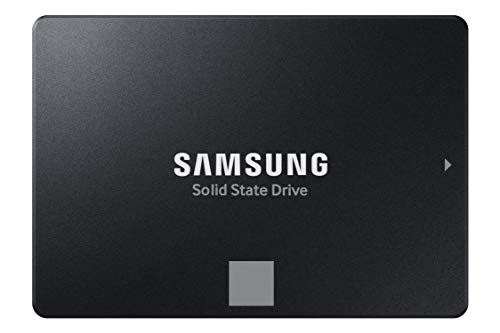
Samsung 870 EVO 1TB — The mirrored-boot classic
Ask a room of small-server administrators what their boot volumes are and a striking number will name this drive, usually in pairs. The 870 EVO — SATA III 2.5-inch, 1TB here, read speeds up to 560 MB/s per its listing, model MZ-77E1T0B/AM — became the default mirrored system drive of the small-server world on the strength of everything around the silicon: Samsung’s firmware polish, Magician’s health reporting, and a compatibility record that spans effectively every controller ever bolted into a server.
Its role in this guide is specific and should not be inflated. As a data-tier member it is a fine consumer drive in professional company; as a mirrored boot and system volume it is close to the reference implementation of the idea. Boot duty is read-mostly, uptime-critical and utterly unforgiving of eccentricity, and the 870 EVO’s entire career has been a demonstration of the required virtues: it starts every morning, reports its health honestly, and cooperates with RAID controllers without the error-handling sulks that get consumer drives ejected from arrays.
The honest caveats belong to its class. It is a consumer drive — no power-loss protection of the enterprise kind, no NAS rating on the box — and a write-heavy data tier should look to the DC600M below or the enterprise guide’s shelves instead. Its endurance story is a consumer story, entirely adequate for system duty and ordinary working tiers, and its price of admission reflects Samsung’s polish rather than any professional certification.
Buy it as the classic uses it: in identical pairs, for the volumes the whole machine stands on, where the cost of the second drive is the cheapest uptime in the building. In that role it has no superior in this guide, only more specialised colleagues.
There is also a procurement comfort unique to this drive: because it is sold everywhere, in volume, a matched replacement bought years later is a realistic expectation rather than a hope. Arrays outlive product cycles, and a boot pair whose twin can still be sourced in the machine’s middle age is a quieter thing to administer than an orphaned exotic.
- Form factor: 2.5-inch, SATA III
- Maker-rated read: up to 560 MB/s (from the listing)
- Model code: MZ-77E1T0B/AM
- Capacity in this guide: 1TB
- Software: Samsung Magician support
Strengths
- The proven mirrored-boot drive of the small-server world.
- Controller compatibility and firmware polish beyond the class norm.
- Health reporting an administrator can actually read.
Trade-offs
- Consumer class: no enterprise power-loss protection.
- Not the pick for write-heavy data tiers.
- Polish carries a positioning premium over NAS-rated rivals.
Best for: mirrored boot and system volumes in small servers and serious labs. Not suited for: write-churned data tiers, which belong to the enterprise member below.

Gigastone 1TB high-endurance 2-pack — The honest matched pair
The other five picks ask you to assemble a matched set yourself; this one sells the set as the product. The Gigastone listing offers two identical 1TB drives — up to 550 MB/s, TLC flash with SLC caching, a 24/7 high-endurance brief, a five-year warranty stated on the listing, and the word RAID printed in the product description itself — packaged as a pair for buyers building mirrored volumes and small arrays. In a category where matching is the first commandment, a bundle that obeys it by construction deserves respect.
The use cases write themselves. A mirrored boot pair for a small server, bought in one box with one order and zero risk of a model-code mismatch. A two-bay NAS’s working tier, filled in one gesture. A photographer’s mirrored project volume, where the pair’s identical ageing is worth more than a spec-sheet edge. The 24/7 high-endurance framing — the listing’s own words — aligns the pair with the array duty cycle rather than a desktop’s, and the TLC foundation keeps sustained behaviour honest in the way this guide’s endurance sections keep demanding.
Caveats, plainly: Gigastone is a value maker, not a Samsung or a WD, and its support ecosystem is correspondingly thinner; the rated ceiling sits a fraction below the SATA majors’ printed figures; and a two-pack commits you to one capacity decision for both members. For a flagship array in a business that cannot blink, this guide’s enterprise and NAS-rated names remain the recommendation. For the enormous population of two-drive mirrors in homes, studios and small offices, the pair is the most honestly packaged answer in the entire article.
One buying note: a matched pair bought together should also be installed together and monitored together, so their wear story stays one story. The bundle makes the first step easy; the administrator’s habits do the rest.
Studios should note the pair’s fit with a particular rhythm: project drives that fill, are mirrored for the project’s life, and are then archived whole and replaced as a pair. The bundle’s economics suit that consumable rhythm far better than flagship singles do, and the matched ageing that array purists demand arrives free with the packaging.
- Form factor: 2.5-inch SATA, sold as a 2-pack
- Maker-rated speed: up to 550 MB/s (from the listing)
- Flash description on the listing: TLC with SLC caching
- Brief printed on the listing: high endurance, 24/7 reliable, RAID named
- Capacity in this guide: 1TB per drive, two drives
Strengths
- Matched-set discipline delivered by construction, not by shopping care.
- High-endurance, 24/7 brief aimed squarely at array duty.
- One order fills a mirrored pair completely.
Trade-offs
- Value maker’s support depth trails the majors.
- Rated ceiling a touch below the big brands’ figures.
- The bundle fixes both members’ capacity in one decision.
Best for: two-drive mirrors in homes, studios and small offices. Not suited for: large arrays or flagship deployments standardising on a major line.

Kingston DC600M 480GB — Enterprise array member
The DC600M appears in this guide at its boot-array size — 480GB, model SEDC600M/480G — carrying the two credentials write-heavy arrays care about most: a mixed-use endurance class printed in its name, and the data-centre brief of power-loss protection that our enterprise guide examines in full. In an array, that protection acquires a second meaning: when power fails mid-rebuild or mid-write, the member that protects its in-flight data protects the whole set’s integrity story.
Why put an enterprise drive in a guide that also contains a value two-pack? Because arrays stratify. The boot pair of a serious small server, the journal or metadata volume of a larger set, the working tier of a machine whose writes never sleep — these are memberships where class outranks capacity, and 480GB of mixed-use, power-protected drive is worth more to them than terabytes of consumer storage. Kingston’s channel breadth, discussed in the enterprise guide, adds the practical virtue that replacements and matching spares are genuinely orderable when a member eventually retires.
The sizing counsel is strict: this capacity is for system volumes, journals and compact working tiers, bought in matched sets of two or more, and it is wasted — expensively — on bulk storage. Buyers whose arrays are archives should close this review and open the honest hard-drive paragraph below. Buyers whose arrays are engines will recognise exactly the member they have been missing.
Paired with its 3.84TB sibling from the enterprise guide, the small DC600M also offers a one-maker array strategy: enterprise class at the boot shelf and the data shelf alike, one support story across the whole machine. For administrators who think in systems, that coherence is a feature no benchmark prints.
Journal and metadata volumes deserve a specific mention in this drive’s favour, because they are the array members nobody shops for and everybody depends on: tiny, frantic, write-forever volumes whose failure modes corrupt far beyond their size. A mixed-use, power-protected 480GB drive is almost comically well matched to that invisible labour, and fleets that assign it there rarely think about it again — the highest praise this guide bestows.
- Form factor: 2.5-inch SATA
- Model as printed: SEDC600M/480G
- Endurance class printed on the listing: mixed-use
- Capacity in this guide: 480GB
- Class brief: power-loss protection with data-centre firmware
Strengths
- Enterprise protection and class inside an array membership.
- Mixed-use endurance for write-active small tiers.
- One-maker coherence with the DC600M capacity sizes.
Trade-offs
- Capacity is a system volume’s, bought at an enterprise tier.
- Overkill for read-mostly or archive arrays.
- Bare-drive channel packaging, as in the enterprise class generally.
Best for: boot pairs and write-active small tiers in serious servers and labs. Not suited for: bulk storage arrays, where its class premium buys nothing the workload can spend.
Comparison Table: Six Ways to Keep Company
| Drive | Shape / protocol | Capacity | Maker-rated pace | Array role it owns |
|---|---|---|---|---|
| WD Red SA500 | 2.5-inch SATA | 2TB | Up to 560 MB/s | The working-tier standard member. |
| WD Red SA500 M.2 | M.2 SATA | 500GB | Up to 560 MB/s | Cache and mirrored system slots. |
| WD Red SN700 | M.2 NVMe Gen3 | 1TB | Up to 3,430 MB/s | The service-tier engine. |
| Samsung 870 EVO | 2.5-inch SATA | 1TB | Up to 560 MB/s read | The mirrored-boot classic. |
| Gigastone 2-pack | 2.5-inch SATA ×2 | 1TB each | Up to 550 MB/s | The pair that arrives matched. |
| Kingston DC600M | 2.5-inch SATA | 480GB | Enterprise class | Protection for write-active sets. |
Notice, before the promised paragraph, how the table’s roles interlock: the same household server can honestly contain four of these six picks at once — M.2 Reds on its system mirror, SA500s on its working tier, a DC600M pair under its database, hard drives behind them all — and that interlocking, not any single row, is what a designed storage system looks like. Single-drive thinking buys products; array thinking buys a structure in which each product has one job and does it surrounded by colleagues chosen for theirs.
The honest hard-drive paragraph, as promised. For the archive tier — the media library, the backup target, the data that is written once and read on anniversaries — NAS hard drives in the IronWolf mould remain the correct economics by a wide margin, offering multiples of these capacities per unit of currency with their own mature array manners. A wise storage design is usually a marriage: SSD arrays where the work lives, spinning arrays where the history sleeps, and no embarrassment in either direction.
How Do the Array Levels Treat SSDs Differently?
Mirroring — RAID 1 — is the SSD array’s home ground, and the reasons are structural. Writes duplicate simply, reads can draw from either member, and a rebuild is a straight copy from the survivor to the newcomer: the fastest, gentlest resurrection in the catalogue. Its cost is equally simple — half the capacity you bought serves as the other’s shadow — which is why mirroring rules the volumes where the data is precious and the size is modest: boot volumes, working tiers, the small engines of a household or a business.
Striping for pure speed — RAID 0 — deserves an honest sentence rather than a section: it sums the members’ pace and multiplies the failure probability, offering no redundancy at all, and in the SSD era its honest uses have narrowed to scratch volumes whose contents are disposable by design. A guide about arrays as protection mentions it so that nobody mistakes its presence in a controller’s menu for a recommendation.
Parity arrangements — RAID 5 and 6 and their kin — trade capacity economics against rebuild character. They store redundancy as mathematics rather than copies, so more of the shelf is usable, but every write carries a calculation and every rebuild becomes an exercise in reading all survivors and recomputing the missing member, a longer and more write-intensive convalescence. SSDs have softened parity’s historic penalties — no seek delays, fast reads — without abolishing its rebuild arithmetic, which is why parity sets in SSD form belong to capacity tiers with class-matched endurance, and why the endurance sections of this guide keep returning to rebuild day.
Nested and pooled approaches — mirrored stripes, storage pools with redundancy policies, the software-defined arrangements modern NAS platforms favour — blend these characters rather than escaping them. Whatever the brochure calls it, ask the three questions this guide has taught: what does a write cost, what does a rebuild demand, and whose endurance pays for both. The answers, not the label, decide whether the arrangement deserves your data.
Field Notes: Three Arrays in the Wild
The photographer’s mirror is the smallest honest array in this guide’s world: two drives, one volume, a working life of shoots that cannot be re-staged. Its owner chose the matched pair as a single purchase, keeps the backup on a separate device in a separate building, and thinks about the array exactly twice a year — when the wear check comes due. That is the design working as intended: the array’s silence is the sound of a promise being kept in the background of a creative life.
The family-server array is the middle case: a NAS whose bays hold spinning archive drives, whose M.2 slots hold a mirrored system pair, and whose working tier — the photos being edited, the documents being shared, the virtual machine hosting the household’s services — lives on SSD members chosen from the Red family. Its owner’s education arrived via one degraded weekend, after which a shelf spare and a monitoring alert became permanent residents. Most real arrays are designed exactly this way: once by intention, once by experience.
The small-business array is the grown-up: boot pair in enterprise class, working tier mirrored or pooled on NAS-rated members, archive on hard drives, backup leaving the building nightly. Nothing in it is exotic, and every component was bought as a set with a spare. Its administrator’s review of this guide would be boredom, which the administrator would correctly identify as the highest grade available. Arrays are not supposed to be interesting. They are supposed to make other things interesting safely.
How Do You Set Up an SSD Array Without Regretting It?
Start on paper. Write down what each volume is for — system, working tier, archive — and which failure each volume must survive, because the array level follows from those sentences: mirroring for the volumes that must never stop, wider parity sets for capacity tiers that can rebuild at leisure, and no array at all where a single drive plus a real backup serves better. More arrays than the plan needs is not safety; it is surface area.
Buy the members as one act. Same listing, same model code, same capacity, quantity equal to the array plus one shelf spare, all verified on arrival against the labels before a single screw turns. If a member arrives as a different variant, the time to discover it is at the bench, not at the rebuild. Format and build the array with the drives empty of other duties, let the initial synchronisation complete before loading real data, and record every serial and its slot position in the same register habit the enterprise guide preaches.
Then set the monitoring before you set the workload. Enable the platform’s drive-health reporting, schedule the wear check, and decide in advance what a degrading member triggers: which spare, which window, whose hands. An array’s first rebuild should be a procedure executed calmly, not an improvisation performed at midnight, and the difference is entirely in preparation made while nothing was wrong.
Finally, rehearse the sentence until it is boring: the array is not the backup. Keep the backup — separate device, separate location ideally, tested by an actual restore — and let the array do the one job it is for, which is keeping the service alive through a drive’s death. Designs that respect that division survive their bad days; designs that blur it eventually hold a seminar on the difference.
Which RAID Mistakes Do SSD Buyers Keep Making?
Mismatching members leads the list. An array assembled from whatever was on sale across three months — different models, different firmware, different wear — behaves like its least predictable member and ages like its oldest. The Gigastone pair exists because this mistake is so common; the discipline of one order, one model code, one shelf spare is the entire vaccine, and it costs nothing but attention.
Assuming TRIM follows the drives into the array is the second. As this guide’s opening explained, TRIM’s journey through a RAID set depends on controller, chipset, level and operating system, and the assumption that it “just works” has quietly aged many arrays. Verify your platform’s documented behaviour, enable what it offers, and where the answer is no, lean on the array-friendly firmware of the NAS and enterprise lines rather than hoping.
Third is neglecting the rebuild in the capacity plan. An array run at the brim rebuilds slowly, wears its survivors harder and leaves no room for the volume’s own growth during the window when it is most fragile. The free-space margin that every SSD appreciates becomes, in an array, a structural material: keep it, and rebuild day is an procedure; spend it, and rebuild day is a vigil.
Last is the backup confusion, repeated here because it outranks every technical error: owners who believe the mirror is the backup discover, on the day of a deletion, a corruption or a fire, that the array faithfully protected them against exactly one failure mode. Drives die singly; data dies in dozens of ways, and only the backup answers the others.
A fifth, gentler mistake deserves recording because it wastes money rather than data: over-arraying the archive. Mirroring a media library that could be re-downloaded, or parity-protecting a backup target that is itself the copy, spends drives on volumes whose loss would be an inconvenience dressed as a tragedy. Audit each volume’s true cost of death — the decision section above exists for this — and let the archive be a single honest tier with a backup, while the array budget concentrates where death is genuinely expensive.
And a sixth, born of enthusiasm: rebuilding a healthy array to change its level, its members or its platform on a whim, thereby spending the set’s calmest asset — its proven stability — on novelty. Arrays reward conservatism the way gardens reward patience. Change them when the workload changes, when wear dictates, or when the platform retires, and leave them entirely alone in between.
How Do You Decide Whether a Volume Deserves an Array at All?
Not every volume earns redundancy, and pretending otherwise wastes drives. Ask what the volume’s death would cost in the currency that matters: hours, money or memories. A scratch volume whose contents are regenerated by the next render deserves a single fast drive and no ceremony. A cache whose loss means a slower week deserves the same. The array budget belongs where death is expensive — the system volume the machine stands on, the working tier the business bills from, the library that cannot be re-downloaded or re-shot.
Ask next how the volume would be restored if it vanished tonight. If the honest answer is “from the backup, within the hour, without tears”, a single drive plus that backup may be the rational design, and the array money belongs in a second backup instead. If the answer involves a business closed, a household’s services dark or a professional’s deadline missed, the array is buying the hours the restore would consume, and it should be bought without guilt.
Finally, ask whether the platform deserves the data. An array built on an elderly NAS with no monitoring, no spare and no backup is a promise written on water; the same drives in a maintained platform are infrastructure. Sequence the purchases honestly — platform, backup, then array — and the RAID set becomes the final storey of a sound structure rather than a decoration on a shaky one. The drives in this guide reward that sequencing every rebuild day of their lives.
How Do You Watch an Array’s Health Without Becoming Its Servant?
Monitoring an array is a rhythm, not a vigil. The drives report wear, temperature and error counts through SMART and the platform’s own tooling; the administrator’s job is to look at those reports on a schedule — monthly for a home set, weekly for a business engine — and to let the platform’s alerts carry the days in between. What you are watching for is divergence: one member wearing faster than its siblings, one member’s temperature drifting above the set’s, errors appearing where the log used to be silent. Divergence is the array’s early language, and it almost always speaks before it shouts.
Act on the language proportionally. A member wearing ahead of its partners earns a planned replacement at a calm window, with the shelf spare, rather than a dramatic one during a rebuild it started. A set wearing evenly and faster than expected is a workload confession — the tier’s class was underbought — and the correction belongs in the next purchase’s class, not in blame. Keep the register habit from the enterprise guide: serials, slots, install dates, wear readings. Five lines per drive per quarter is the entire paperwork burden of professional array care, and it converts every future incident from archaeology into arithmetic.
And test the backup, because the array’s health reports say nothing about it. A restore rehearsed once a year — one folder, one volume, actually recovered — is worth more than a dashboard of green lights, because it verifies the system that answers the failures RAID does not. The array keeps the service alive; the backup keeps the data alive; the monitoring keeps both promises honest.
Final Recommendation
Build the array your volumes describe. For most NAS and small-server working tiers, matched WD Red SA500s in the 2.5-inch shape are the default this guide would defend in any room, with the M.2 SA500 handling cache and mirrored system slots and the SN700 stepping in where the tier becomes a genuine service engine. Mirror the boot volumes on 870 EVOs if polish and track record calm you, or on the DC600M pair if the machine writes hard and answers for money. Take the Gigastone two-pack when a two-drive mirror is the whole project and honest packaging beats brand heraldry. Whatever you choose, buy it as a set, spare it as a set, monitor it as a set — because an array is not a pile of drives but a promise they make together, and promises, unlike benchmarks, are kept on the worst day or not at all. Fit the spare before you need it, write the register before you forget it, and test the backup before you trust it; do those three unglamorous things and the array will repay you with the rarest experience in all of computing, which is a hardware failure that turns out to be a minor event in an ordinary week.
Frequently Asked Questions
Does RAID make my data safe?
It makes your service survive a drive failure, which is a different and narrower promise. Deletion, corruption, theft, fire and ransomware all pass through an array untouched. Keep a genuine backup — separate, and tested by restoring from it — and let RAID do its one job well.
Can I mix different SSD models in one array?
You can, and this guide advises against it wherever the array matters. Mixed members give you the set’s pace from its slowest, its capacity from its smallest and its behaviour from its least predictable. Emergencies justify a temporary mismatch; design never does.
Does TRIM work in RAID?
Sometimes, and the honest answer lives in your platform’s documentation. Controller, chipset, array level and operating system all vote. Modern platforms increasingly pass TRIM or UNMAP at common levels, but verification — not assumption — is the professional habit, and array-tuned drives cope best where the platform cannot pass it.
How long does an SSD array rebuild take?
Far less time than the spinning arrays of memory, and still long enough to respect. A mirrored SSD pair resynchronises at something approaching the drives’ write pace, so a terabyte-class mirror can recover in well under an hour of gentle duty — but the window is never zero, the survivors are working throughout it, and larger parity sets stretch the arithmetic considerably. Plan as though the window matters, because the second failure does not check the clock.
Which RAID level should a small server use?
Mirroring for boot and small working volumes, because it is simple, fast to rebuild and survives the failure that actually happens. Larger capacity tiers can justify parity arrangements, accepting slower rebuilds for better capacity economics. The right level follows the volume’s job, not fashion.
Are NAS hard drives ever the better array choice?
Yes — for archive and bulk tiers, decisively. Their capacity economics are multiples better, their array manners are a decade mature, and the wise design marries them to SSD working tiers rather than forcing one technology to do every job in the box.
Should both members of a mirror be the same age?
Ideally, yes — bought together, installed together, wearing together, so the set’s remaining life is one readable number. Rotating a fresh drive into an old mirror is sometimes necessary after a failure, and it is safe; it simply makes the pair’s story two stories, which the register should record. Design for matched ages, accept honest exceptions, and never let a temporary mismatch become the set’s permanent character by neglect.
Can I build an array from drives I already own?
You can, and for low-stakes volumes it is a reasonable economy, provided the drives match in capacity and you accept the set’s behaviour will be its least predictable member’s. For volumes the household or business leans on, the matched-set discipline in this guide is worth its modest premium — it is the difference between an array with one story and an anthology.
How many spare drives should I keep?
One matched spare per array is the professional minimum, bought with the set so its model code and age match the membership. A spare on the shelf converts rebuild day from a procurement emergency into a procedure, and it is the cheapest component in the entire design relative to what it protects.
Related Guides
The drives behind this guide’s enterprise member are surveyed in full in Best Enterprise SATA SSDs; readers speccing the fast tier should compare against Best PCIe 4.0 SSDs, and those whose NAS slots speak only SATA will find their map in Best M.2 SATA SSDs.
Related guides
- Best 4K UHD HDR HDMI Extenders: 4K60, Long-Run and 4K120 Kits Compared
- Best 25–35 Inch Monitors With Lowest Display Lag: An Honest Ranking Without Invented Numbers
- Best Color Product Label Printers: Six Desktop Machines for Short-Run Product Labels
- Best Enterprise SATA SSDs: Endurance Classes, Power-Loss Protection and Fleet Sense



[…] natural companion to this guide is Best SSDs for RAID, which covers the mirrored and striped deployments these drives so often join; builders refreshing […]