Our Top Picks
 Yamaha NS-AW390 All Weather Indoor/Outdoor 6.5-inch 2-Way SpeakersPair14.2 x 8.8 x 17.6 inches8.3 poundsCheck on Amazon
What's inside
- Start With the Receiver: What the RX-V473 Can Actually Deliver
- Sensitivity: The Number That Decides How Loud 80 Watts Feels
- Impedance and the 6-Ohm Setting on the Receiver
- Bookshelf Speakers: The Natural Fit for This Power Envelope
- Tower Speakers: When Floorstanders Still Make Sense
- The Centre Channel and Timbre Matching
- Surround Speakers and the 5.1 Layout
- Adding a Powered Subwoofer and Setting the Crossover
- YPAO Calibration: Giving the Receiver Good Measurements
- Speaker Wire, Terminals and the Details of Connection
- The Front Bi-Amp Option and What It Really Offers
- Putting Together Balanced Systems at Several Levels
- Questions Owners Ask Before Buying
- Reading Specification Sheets Without Being Misled
- Room Acoustics: The Component Nobody Buys
- Longevity, Servicing and Living With a 2012 Receiver
- Check prices on Amazon
- A Short Pre-Purchase Checklist
As an Amazon Associate I earn from qualifying purchases. This post may contain affiliate links at no extra cost to you.
This guide may earn the site a commission when readers buy through links on the page, and that support keeps the buying guides free to read without changing which speaker families earn a place in the line-up below. Every recommendation here rests on published manufacturer specifications, receiver manuals and aggregated owner feedback rather than on any claim of first-hand product evaluation, so the numbers quoted can be checked against the documents that produced them.
The Yamaha RX-V473 belongs to the 2012 generation of network AV receivers, a five-channel design rated at 80 watts per channel into 8 ohms with two channels driven across the 20 Hz to 20 kHz band at 0.09 percent total harmonic distortion. That single rating shapes everything that follows, because passive loudspeakers draw whatever current the amplifier can supply and return either comfortable headroom or audible strain depending on how their sensitivity and impedance interact with those 80 watts. Choosing speakers for this receiver is therefore less about seeking flagship towers and more about matching electrical behaviour to a modest, honest power supply. A well-matched bookshelf pair will sound larger, cleaner and more relaxed on this unit than an inefficient floorstander that spends its life near the volume ceiling.
Yamaha also publishes a 6-ohm figure for the RX-V473, quoted at 105 watts per channel under the looser JEITA measurement with one channel driven at 1 kHz and higher distortion, plus dynamic power figures that climb as impedance falls. Those larger numbers describe short bursts rather than sustained output, and treating them as continuous ratings leads buyers toward speakers the receiver cannot truly support. The useful planning figure remains the 80-watt stereo rating, derated further when all five channels work together during a film soundtrack. Realistic sustained output with five channels driven sits noticeably below the two-channel figure, which is precisely why sensitivity matters so much in a surround system built around this receiver.
Start With the Receiver: What the RX-V473 Can Actually Deliver
The power supply inside the RX-V473 is shared across every channel, so a demanding action sequence that asks the front trio and both surrounds to play loudly at once divides a finite reservoir rather than multiplying it. Owners who understand that division choose speakers that reach satisfying levels early on the volume control, leaving the remaining travel as insurance against clipping on peaks. Clipping, not raw wattage shortage, is what damages tweeters, because a strained amplifier produces flattened waveforms rich in high-frequency energy. Keeping the receiver inside its comfortable range protects both the electronics and the loudspeakers connected to them.
On the rear panel the receiver provides spring-clip and binding-post style connections appropriate to its class, a dedicated subwoofer pre-out, and a front-panel headphone socket that mutes the speakers when used. Network features such as AirPlay, internet radio and Yamaha’s AV Controller app made the model attractive in 2012, yet none of those conveniences change the acoustic equation. The room correction system, YPAO, measures each connected speaker and applies distance, level and limited equalisation corrections, and later sections explain how to give that system clean data to work with. Four HDMI inputs handle the video switching duties, while the speaker configuration menu decides how the five amplifier channels are assigned.
One configuration option deserves early attention because it changes buying decisions: the front channels can be reassigned to bi-amplify compatible front speakers, sacrificing the surround channels to do so. That trade suits a two-channel music listener far better than a film fan, since a 5.1 layout disappears the moment bi-amping is enabled. Buyers who know they will always run surround sound can ignore bi-amp terminals on candidate speakers entirely. Buyers torn between music and movies should decide before shopping, because the answer determines whether rear speakers belong in the budget at all.
Sensitivity: The Number That Decides How Loud 80 Watts Feels
Sensitivity expresses how much sound pressure a speaker produces at one metre when fed one watt, and manufacturers usually print it as a figure such as 86 dB or 90 dB referenced to 2.83 volts. Each 3 dB increase in sensitivity halves the amplifier power needed for the same loudness, which makes sensitivity the most powerful lever available to an RX-V473 owner. A speaker rated at 90 dB reaches a given level with roughly one quarter of the power demanded by an 84 dB design. In a living room where the receiver must also power a centre and surrounds, that difference decides whether dialogue stays intelligible at modest settings or dissolves into strain.
The headroom arithmetic is worth doing explicitly. Doubling amplifier power adds only 3 dB of output, so moving from a 40-watt receiver to this 80-watt unit gains a single small step in loudness. Raising speaker sensitivity by 6 dB, by contrast, delivers the same loudness with one quarter of the power, a far larger practical gain than any receiver upgrade in this price class could offer. At a typical listening distance of three metres, sound pressure falls by roughly 9 to 10 dB compared with the one-metre figure, before room reflections return some of that energy. A 90 dB speaker fed 10 watts therefore produces peaks near 90 dB at the sofa after distance losses and boundary gains roughly balance out, which covers most film listening without stressing the amplifier.
Peaks matter more than averages. A soundtrack mastered with dialogue near 75 dB may reserve 20 dB for explosions and orchestral swells, and the system must reproduce those peaks cleanly rather than merely reach the average level. Ten times the power is required for each additional 10 dB, so the last few decibels before clipping consume most of the amplifier’s output. Efficient speakers preserve that peak capacity because their average demand sits so low. Inefficient speakers eat the reserve during ordinary scenes and leave nothing for the moments that need it most.
Shoppers should also read sensitivity claims critically. Some brands quote figures measured in-room rather than anechoic, adding several decibels of boundary gain that flatter the specification. Others reference 2.83 volts into a 4-ohm load, which actually delivers two watts and inflates the number by 3 dB relative to a true one-watt figure. Comparing sensitivity across brands therefore requires checking the measurement basis in the manual or specification footnote. Where the basis is unclear, owner communities and independent measurement sites usually reveal the honest figure quickly.
Impedance and the 6-Ohm Setting on the Receiver
Nominal impedance is an average rather than a fixed value, and a speaker labelled 8 ohms may dip toward 4 ohms in the bass region where current demand peaks. The RX-V473 includes an impedance selector in its advanced setup menu, offering an 8-ohm default and a 6-ohm position intended for speakers rated 6 ohms or lower. Yamaha’s manual directs owners of 6-ohm front speakers to engage that setting before connecting them. The 6-ohm position limits rail voltage slightly, trading a little maximum output for cooler, safer operation into heavier loads.
Practical guidance follows from that design. Speakers rated at a genuine 8 ohms with gentle phase angles run happily on the default setting and extract the receiver’s full output. Mainstream 6-ohm models from Japanese and European brands also pair well, provided the selector is set correctly and ventilation above the chassis stays clear. True 4-ohm speakers, especially large towers whose impedance minima fall below 3.5 ohms, ask more current than this receiver class was built to supply. Such pairings may play quietly without incident yet run hot and trigger protection during demanding passages.
Protection shutdowns are the receiver defending itself, and repeated shutdowns signal a mismatch rather than a faulty unit. Owners reporting thermal cut-outs in forums almost always trace them to low-impedance speakers, blocked ventilation or both. Giving the RX-V473 at least ten centimetres of open space above its vents costs nothing and removes one variable from the diagnosis. Stacking other components directly on the receiver traps heat against the amplifier’s heatsinks and shortens component life even when no shutdown occurs.
Mixed impedances across a surround system are acceptable within limits. An 8-ohm centre with 6-ohm fronts and surrounds presents no problem once the selector acknowledges the lowest-rated speakers in the set. The setting applies globally rather than per channel, so the most demanding speaker dictates the choice. Sensitivity differences between channels, unlike impedance, are handled automatically by YPAO level trims and need no manual planning beyond avoiding extremes.
Bookshelf Speakers: The Natural Fit for This Power Envelope
Compact two-way bookshelf speakers dominate sensible RX-V473 systems for straightforward physical reasons. A single woofer of five or six inches presents a moderate load, reaches useful sensitivity in the high eighties, and hands deep bass to a subwoofer rather than demanding it from the receiver. Freed from reproducing the lowest octave, both the amplifier and the small woofer work inside their comfortable ranges. The result is cleaner midrange, where voices and most instruments live, than a budget tower straining to produce bass it cannot control.
Placement flexibility reinforces the case. Bookshelf models sit on stands, shelves or media consoles, and their smaller cabinets excite fewer room resonances than large enclosures placed in the same spots. In the small and medium rooms where this receiver usually serves, that control matters more than the last few hertz of extension. A pair of stands that place tweeters at ear height when seated typically improves clarity more than spending the same money on a larger speaker set on the floor. Foam bungs supplied with many models tame bass bloom when cabinets must sit close to a rear wall.
Rear-ported designs need breathing room, generally twenty to thirty centimetres from the wall behind them, before their bass stays even. Front-ported and sealed designs tolerate tighter placement and suit rooms where furniture dictates position. Buyers measuring a shelf should confirm cabinet depth plus connector clearance, since binding posts and banana plugs add several centimetres behind the enclosure. Speaker wire with right-angle plugs can rescue a tight installation, although bare wire into the posts occupies the least depth of all.
As front left and right channels, look for sensitivity of 87 dB or higher, a nominal impedance of 6 or 8 ohms, and a frequency response that stays composed down to roughly 60 to 80 Hz before rolling away. That lower reach allows an 80 Hz crossover to the subwoofer without a gap in the upper bass. Models from long-running ranges by makers such as Wharfedale, Q Acoustics, ELAC, Polk, Klipsch and Dali populate this territory densely, with horn-loaded designs at the efficient extreme and compact sealed designs at the other. Higher sensitivity designs around 92 to 93 dB, typified by horn tweeters, make the RX-V473 sound startlingly muscular, though their tonal balance tends toward forward treble that YPAO can only partly soften.
Tower Speakers: When Floorstanders Still Make Sense
Floorstanding speakers tempt buyers with scale and bass extension, and a carefully chosen tower can work well on the RX-V473 provided its electrical demands stay moderate. The qualifying conditions are strict: sensitivity at or above 89 dB, a nominal impedance of 6 or 8 ohms without savage minima, and a room large enough that the cabinets sit away from corners. Towers meeting those conditions deliver a broad, relaxed presentation for stereo music and give film soundtracks a physical foundation even before a subwoofer joins. Towers failing them turn the receiver into the weakest link and expose its limits on every loud passage.
Multiple large woofers are the usual reason towers strain modest amplifiers. Each additional bass driver wired in parallel lowers impedance in the region where music carries the most energy, and three-way designs with complex crossovers can present awkward phase angles as well. A slim two-way or two-and-a-half-way tower with a pair of modest drivers behaves far more kindly than a flagship-style cabinet with four large woofers. Specification sheets that publish a minimum impedance figure deserve more trust than those printing only a nominal average. A minimum near 4 ohms on an 8-ohm nominal speaker is normal; a minimum below 3.2 ohms warns of a difficult load regardless of the headline rating.
Room size arbitrates the bookshelf-versus-tower question as much as budget does. In rooms under roughly fifteen square metres, towers often overload the space with bass energy that small dimensions cannot absorb, producing boom that no calibration system fully removes. Bookshelf speakers plus a well-placed subwoofer give the listener a separate control for that lowest energy, positioned where the room responds most evenly. In larger rooms approaching thirty square metres, the tower’s extra cone area and sensitivity begin to pay, filling the volume without the receiver approaching its ceiling. The same speaker can therefore be the wrong choice in one home and the right choice in another, with the room casting the deciding vote.
Owners set on towers should budget for the matching centre from the same range, because a tower purchase usually signals a serious surround build rather than a stereo stopgap. Mixing a large tower pair with an unrelated compact centre produces the tonal mismatch described in the next section, magnified by the towers’ broader output. Planning the front trio as a single purchase, even if the centre arrives a month later, preserves coherence across the soundstage. Retailers frequently discount complete front-stage bundles from one range, which rewards that patience financially as well.
The Centre Channel and Timbre Matching
Dialogue carries most films, and the centre speaker reproduces the majority of it, which makes the centre the hardest-working channel in a 5.1 system. Timbre matching means the centre shares the front pair’s driver materials, tweeter design and crossover philosophy, so a voice panning from left to centre to right keeps the same character instead of changing identity mid-sentence. Manufacturers engineer matching centres for exactly this reason, using the same tweeter and similar midrange drivers in a horizontal cabinet. A matched centre from the same product range is the single safest purchase in the entire system after the fronts themselves.
Horizontal centre cabinets involve a compromise worth understanding. Placing two woofers side by side with a tweeter between them creates lobing, where off-axis listeners hear comb-filtered response as the woofers’ outputs interfere. Centres with a vertical midrange and tweeter array, or a coaxial driver, hold their clarity across a wider seating area. Households where viewers sit well off to the sides should favour those designs or a single bookshelf speaker used vertically as the centre when space allows. A vertical bookshelf identical to the front pair is acoustically the ideal centre, and some ranges sell single speakers for precisely that purpose.
Sensitivity matching across the front stage matters less than tonal matching, because YPAO trims channel levels to a common reference. A centre a decibel or two quieter than the fronts simply receives a higher trim. What calibration cannot repair is a centre whose midrange voicing differs fundamentally from its partners, such as a bright metal-dome centre flanked by soft-dome fronts. Owner forums for every major brand carry threads from buyers who mixed ranges to save money and then spent months adjusting settings to disguise a mismatch that settings cannot fix. Buying within one range from the outset avoids that entire category of frustration.
Placement of the centre influences dialogue clarity as much as model choice. The cabinet belongs as close to the screen’s height as furniture allows, angled toward ear level, and pulled to the front edge of any shelf so its output does not reflect off the surface beneath it. A centre buried inside a closed cabinet loses the intelligibility it was bought to provide. If the television sits on the centre itself, confirm the cabinet’s rated load capacity and add isolation pads to stop vibrations colouring the sound during loud passages.
Surround Speakers and the 5.1 Layout
Surround channels carry ambience, effects and the occasional dramatic voice, and their demands on the amplifier are lighter than the front stage’s. Small satellite or compact bookshelf models with sensitivity in the mid-to-high eighties serve perfectly here, and many owners redeploy an older pair of bookshelf speakers to surround duty when upgrading fronts. Matching the surround brand to the fronts is a refinement rather than a necessity, because panning effects reveal tonal differences far less than sustained dialogue does. Budget saved on surrounds is better spent on the centre or the subwoofer, where every listener notices the improvement on every film.
Positioning follows the classic 5.1 geometry: surrounds at roughly 90 to 110 degrees relative to the main seat, slightly above ear height, angled inward. In rooms where the sofa sits against the rear wall, bipole or dipole designs spread effects diffusely and avoid the hotspot that a direct-radiating speaker inches from a listener’s ear would create. Where space allows a metre or more behind the seating, conventional direct radiators give more precise localisation for games and modern object-heavy mixes downmixed to 5.1. Wall brackets rated for the cabinet weight, with tilt adjustment, make the final aiming straightforward.
Because the RX-V473 stops at five channels, there is no provision for rear surrounds or height speakers, and buyers should resist buying extra pairs in hope of expansion. A future receiver upgrade would unlock those channels, but speakers bought today for a layout the current receiver cannot run simply gather dust. The disciplined path is a complete, well-matched 5.1 set sized to the room, enjoyed fully, and reconsidered only when the receiver itself changes. That discipline also keeps the total electrical load within what the amplifier was designed to drive simultaneously.
best 5 1 home theater speakers without receiver
Adding a Powered Subwoofer and Setting the Crossover
A powered subwoofer transforms an RX-V473 system more dramatically than any speaker swap, because it removes the deepest bass from the receiver’s workload entirely. The subwoofer carries its own amplifier, often several hundred watts dedicated to a single driver, so every hertz below the crossover point stops drawing current from Yamaha’s shared power supply. Front speakers set to Small in the receiver’s configuration menu redirect their bass to that subwoofer, and their midrange clarity improves audibly as their woofers stop attempting large excursions. Even owners who listen mainly to music benefit, since most bookshelf speakers roll off well above the lowest notes of piano, organ and electronic bass.
The standard crossover setting of 80 Hz suits the majority of bookshelf-based systems and aligns with long-established home theatre practice. Smaller satellites with limited output below 100 Hz may need 100 or 120 Hz, accepting slightly more localisable bass in exchange for protecting their drivers. Large towers run as Small still usually cross best at 60 or 80 Hz, because a single optimally placed subwoofer reproduces those frequencies more evenly than two towers fixed by the front wall. Setting any speaker to Large sends it full-range signal and should be reserved for genuinely full-range towers in stereo listening without a subwoofer involved.
Subwoofer placement governs the result more than subwoofer price within the mainstream class. Corners maximise output but excite every room mode, often producing one-note boom at the seat. A position along the front wall, roughly a third of the way across the room, frequently balances output and evenness. The familiar technique of placing the subwoofer at the listening seat and crawling around the room’s perimeter to find where bass sounds tightest, then swapping positions, remains effective because it exploits acoustic reciprocity. Once placed, the subwoofer’s own phase control or the receiver’s distance setting aligns its arrival time with the main speakers around the crossover region.
Level calibration deserves patience. A subwoofer set too hot impresses for ten minutes and fatigues for the rest of the film, masking dialogue and flattening dynamics. YPAO sets a starting level, and most owners find a small reduction or increase of a decibel or two suits their taste and room. Music with acoustic bass provides the sternest examination: the subwoofer should extend the double bass downward without drawing attention to its own location. When the crossover is right and the level honest, the system sounds like full-range speakers rather than small boxes plus a separate bass box.
YPAO Calibration: Giving the Receiver Good Measurements
YPAO, Yamaha’s parametric room acoustic optimiser, plays measurement tones from each speaker, records them with the supplied microphone, and calculates distance, level and basic equalisation for the listening position. The single-point version fitted to the RX-V473 measures one seat, so that seat should be the household’s main viewing position rather than a compromise between several. Placing the microphone at ear height on a tripod or the back of the sofa, exactly where a listener’s head rests, gives the system data that matches reality. Holding the microphone by hand introduces body reflections and small movements that corrupt the measurement.
Room conditions during measurement matter. Silence the room as far as possible: pause heating or air conditioning, close windows against traffic noise, and keep people and pets out of the space while tones play. Any noise captured during a sweep becomes part of the room’s supposed response and distorts the corrections. Run the measurement with speakers in their final positions and the subwoofer connected, with its own volume knob near the midpoint and any onboard crossover bypassed or set to maximum so the receiver controls the handover. Measuring before furniture settles or with a rug still to arrive wastes the exercise, since soft furnishings change the room’s absorption significantly.
After measurement, inspect the results rather than accepting them blindly. YPAO sometimes reports a subwoofer distance longer than the physical distance, which is normal because subwoofer electronics add delay that the system expresses as distance. It occasionally sets large bookshelf speakers to Large, and owners should change those to Small with an 80 Hz crossover to protect them and engage the subwoofer properly. Level trims should sit within a few decibels of zero; a channel trimmed to an extreme suggests a placement problem or a microphone error worth correcting and remeasuring. Saving the configuration after manual adjustments preserves the hybrid of machine measurement and human judgement that usually sounds best.
Equalisation choices follow measurement. The receiver offers YPAO response options that broadly target a flat result, a result following the speakers’ natural character, or a front-matched curve that voices everything toward the front pair. Listeners who chose their speakers for a particular tonal balance often prefer the natural or front options, keeping the house sound while retaining distance and level corrections. Re-running YPAO after any speaker move, furniture change or subwoofer relocation keeps the corrections honest. Calibration is a snapshot of one room arrangement, not a permanent property of the equipment.
Speaker Wire, Terminals and the Details of Connection
Wire gauge requirements follow run length. For the short front-stage runs typical of a media console, 16-gauge oxygen-free copper handles the current without meaningful resistance, while surround runs of ten metres or more justify 14-gauge to keep resistance low relative to the speaker’s impedance. Resistance in a too-thin cable acts in series with the speaker, wasting a fraction of the amplifier’s output as heat and slightly altering the crossover’s designed response. The effect is small at sane lengths, which is why exotic cable claims deserve scepticism, but basic adequacy costs little and removes the variable entirely.
At the receiver end, the RX-V473’s terminals accept bare wire securely, and careful termination matters more than connector fashion. Twist strands tightly, insert them fully so no stray filament can bridge to the neighbouring terminal, and tug each connection to confirm it holds. A single stray strand touching the adjacent post creates a short circuit that triggers protection the moment volume rises, and forum troubleshooting threads identify that fault again and again. Banana plugs speed reconnection and reduce the stray-strand risk where the terminals accept them, and they make the inevitable re-cabling after a furniture move far less tedious.
Keeping polarity consistent across all five channels preserves imaging and bass summation. Wire with a printed stripe or ribbed insulation identifies one conductor; adopt a convention, such as stripe to red, and follow it at both ends of every run. A speaker wired out of phase with its partner produces thin bass and a vague, wandering centre image that calibration cannot repair. YPAO can detect and warn about phase errors on some channels, yet a two-minute visual check during installation prevents the problem outright. Labelling each run near the receiver with tape pays off the first time anything is disconnected.
Cable routing deserves a final thought. Keep speaker runs away from mains cables where practical to minimise hum pickup on long parallel paths, and avoid coiling excess wire tightly, which adds a small inductance and creates a trip hazard besides. Surround cables routed under rugs should be flat-profile types rated for that use, since ordinary round cable underfoot wears its insulation over time. None of these details changes a specification sheet, yet together they separate systems that behave flawlessly for a decade from systems with intermittent faults that defy diagnosis.
The Front Bi-Amp Option and What It Really Offers
The RX-V473 allows its surround amplifier channels to be reassigned to bi-amplify the front speakers, feeding each front cabinet’s woofer and tweeter sections from separate amplifier channels through the speaker’s dual terminal pairs. The configuration requires removing the metal links between the speaker’s two terminal sets, running two cable pairs per speaker, and selecting the bi-amp setting in the receiver’s speaker configuration menu. In exchange, the system drops from 5.1 to 2.1 or plain stereo, since no amplifier channels remain for surrounds. That exchange defines who should consider it: dedicated music listeners with bi-amp-capable fronts and no surround ambitions.
Expectations should stay measured. Both amplifier channels in a bi-amp pair draw from the same shared power supply, so total available power does not double, and the passive crossover inside the speaker still divides the frequencies. Any gains are subtle: slightly cleaner treble at high levels because the tweeter’s amplifier never sees the woofer’s current demands, and a small increase in control during demanding stereo passages. Owners in Yamaha forums who try the configuration typically report differences ranging from inaudible to mildly worthwhile, with nobody describing a transformation. The option costs only cable, so experimenting is harmless for stereo listeners, provided the terminal links are removed before powering up, since leaving them in place while driving both sections can damage the amplifiers.
For film-focused households the calculation is simpler: surround channels contribute far more to the experience than any bi-amp refinement. A complete 5.1 layout immerses in a way no stereo refinement matches, and the receiver’s five channels exist precisely to build that layout. Bi-amping belongs on the checklist only when the household is certain surround speakers will never arrive. Even then, spending the second cable run’s budget on better front speakers or a subwoofer usually returns more audible benefit per unit of money.
Putting Together Balanced Systems at Several Levels
A sensible entry system pairs sensitive bookshelf fronts in the 88 to 91 dB range with their matching centre, compact surrounds and a sealed or ported subwoofer of modest size, all chosen from ranges with long production runs and plentiful owner documentation. Such a system asks little of the receiver, calibrates predictably and leaves upgrade paths open, since the surrounds can later move or the subwoofer can grow. Its defining virtue is balance: no single component outclasses the others enough to expose them. First-time builders consistently report more satisfaction from balanced sets than from one glamorous component surrounded by compromises.
A music-leaning system shifts money toward the front pair, perhaps efficient towers meeting the impedance conditions described earlier or standmount speakers with notably refined midrange, while retaining the matched centre for film nights. The subwoofer remains valuable even here, crossed at 60 or 80 Hz, because few passive speakers at sane prices reproduce the lowest octave with authority in real rooms. Stereo listeners who omit the centre and surrounds entirely can consider the bi-amp assignment, though the subwoofer usually contributes more. Either way, sensitivity remains the gatekeeper specification that decides whether the receiver sounds relaxed or strained.
A small-room system prioritises control over scale: sealed or front-ported bookshelf speakers that tolerate wall proximity, a compact subwoofer that can sit beside the console without dominating the room, and surrounds small enough to mount where the geometry demands. In such spaces the RX-V473’s modest output is no handicap at all, because the listening distance is short and the room itself reinforces bass. Money saved by not buying towers funds acoustic basics such as a thick rug, curtains and speaker stands, which improve clarity more reliably than electronics at this level. Small rooms reward restraint, and this receiver rewards it too.
Across all three sketches the same exclusions recur. Avoid low-sensitivity designs under 85 dB unless the room is tiny and listening levels gentle, because they consume the receiver’s headroom as a matter of arithmetic. Avoid nominal 4-ohm speakers with deep impedance minima, however glowing their reputation with powerful amplifiers, because the pairing asks this chassis for current it was never built to deliver. Avoid mixing a centre from an unrelated range to chase a bargain, since dialogue exposes that economy nightly. Those three avoidances, plus an honest subwoofer crossover and a careful YPAO run, capture most of what separates a satisfying RX-V473 system from a frustrating one.
Questions Owners Ask Before Buying
Can the receiver drive speakers rated for more wattage than it produces?
Yes, and the concern behind the question rests on a misunderstanding. A speaker’s power rating describes how much it can tolerate, not how much it requires, so a bookshelf rated to handle 120 watts works contentedly on the 25 or 30 watts a typical listening level actually draws from this receiver. Damage arises from clipping distortion when an amplifier is driven beyond its clean output, not from a modest amplifier feeding a robust speaker at sane levels. The volume control, not the rating printed on the cabinet, decides how much power flows.
Should the impedance selector stay at 8 ohms for 6-ohm speakers to gain output?
Some owners experiment with leaving the selector at 8 ohms while running 6-ohm speakers, hoping for extra output, but Yamaha’s manual directs the 6-ohm setting for such speakers and the safer course follows the manual. The output difference is small, the thermal margin difference is real, and warranty and longevity both favour the documented configuration. Receivers of this era run warmly by design, and preserving their cooling headroom matters more than a fraction of a decibel. Set the selector before connecting the speakers, as the manual instructs, and leave it there.
Is a subwoofer still necessary with tower speakers?
For film soundtracks, almost always yes. The low-frequency effects channel contains energy that even capable towers reproduce with less authority and more amplifier strain than a dedicated powered subwoofer, and routing that energy to the subwoofer lightens the load on every other channel. Music-only listeners with genuinely full-range towers in a suitable room may reasonably skip one. The deciding factors are programme material and how much deep bass the room supports without boom, not the towers’ brochure extension figure, which is usually measured under flattering conditions.
How loud will the system play before strain appears?
With 90 dB sensitivity fronts, a powered subwoofer handling the bass and a listening distance near three metres, clean peaks around reference-adjacent levels are achievable in small and medium rooms, which is louder than most households comfortably sustain. Dropping to 85 dB speakers costs roughly two thirds of that headroom in power terms and brings audible strain into loud passages. This is the arithmetic that makes sensitivity the first specification to check on any candidate speaker for this receiver. Loudness capability is bought with sensitivity far more cheaply than with amplifier power.
Reading Specification Sheets Without Being Misled
Manufacturer literature mixes honest engineering data with marketing emphasis, and learning to separate the two protects an RX-V473 buyer from the most common mismatches. Frequency response figures illustrate the problem neatly: a bookshelf speaker claiming extension to 45 Hz may reach that frequency only at a level ten decibels below its midrange output, which in practice means the note is present on paper and absent in the room. The meaningful figure carries a tolerance, such as plus or minus 3 dB, and a speaker rated 65 Hz to 20 kHz within that window will integrate with an 80 Hz crossover far more predictably than one boasting deeper but unqualified extension. Where no tolerance is printed, independent measurements published by review laboratories and hobbyist measurement communities usually supply the missing honesty.
Power handling figures mislead in the opposite direction, inviting buyers to believe a speaker needs the wattage printed on its label. That number describes a thermal and mechanical ceiling under standardised programme material, and it says nothing about how much power ordinary listening consumes. A household watching a film at a comfortable level typically draws between one and ten watts from each front channel, with brief peaks multiplying that figure. The RX-V473 therefore spends its working life far below its rating, and its limits appear only during the loudest seconds of the loudest scenes. Choosing speakers that keep even those seconds within the clean range is the entire game, and sensitivity plus subwoofer support accomplish it jointly.
Cabinet and driver descriptions deserve a calmer reading than brochures encourage. Soft dome tweeters tend toward a smoother presentation, metal domes toward extra sparkle that can turn hard when an amplifier approaches clipping, and horn-loaded compression drivers deliver the high sensitivity this receiver loves at the cost of a more directional character. None of these technologies is inherently superior; each interacts with room acoustics and listener taste differently. Paper, polypropylene, woven fibre and aluminium woofers similarly trade stiffness, damping and cost rather than ranking in a simple hierarchy. A buyer who understands those trade-offs reads a specification sheet as a description of choices, not a scorecard.
Weight and dimensions, the least glamorous lines on the sheet, predict ownership satisfaction surprisingly well. A bookshelf cabinet too deep for the intended shelf, or a centre too tall for the gap beneath a television, creates daily friction that no sonic virtue offsets. Measuring the furniture before ordering, and adding clearance for connectors and port airflow, prevents the most avoidable returns in the category. Standmount speakers also need stands whose top plates suit the cabinet footprint and whose height places the tweeter near seated ear level. These mundane checks belong in the same notebook as the sensitivity arithmetic, because a system that fits the room physically gets listened to, while one that fights the furniture gets resented.
Room Acoustics: The Component Nobody Buys
Every loudspeaker review implicitly describes a room, and the RX-V473 owner’s room will shape the sound at least as much as the speaker choice does. Hard parallel surfaces, bare floors and large windows reflect energy that smears imaging and exaggerates treble, while soft furnishings absorb that energy and let the direct sound dominate. A thick rug between the speakers and the sofa, curtains over glass, and a sofa against the rear wall rather than floating in open space collectively improve clarity more than stepping up one speaker range. Owners often describe such changes as lifting a veil, which is an apt metaphor for removing reflected energy that was never part of the recording.
Bass behaves according to room dimensions, standing waves reinforcing some notes and cancelling others at the listening seat. This is why a subwoofer that measures flat in a laboratory can boom or vanish in a particular chair, and why moving the seat even half a metre sometimes cures a problem that equalisation could not. YPAO applies limited correction in the bass, but its single measurement point means it optimises one seat at the expense of others, and deep cancellations cannot be filled by boosting because the room absorbs whatever extra energy is supplied. Placement and seating position remain the primary tools; calibration polishes what placement achieves rather than replacing it.
Speaker positioning within the room follows a few durable principles. Front speakers form a triangle with the main seat, their spacing roughly equal to the listening distance, toed in so their axes cross near or just behind the listener’s head. Pulling them away from the front wall reduces boundary reinforcement of the bass, while moving them closer increases it, giving owners a crude but effective tone control for small speakers that need support. Experimenting in small increments, and re-running YPAO after settling on a position, costs an afternoon and frequently delivers the improvement a buyer was about to purchase with new hardware. Photographing or taping the floor at the chosen positions preserves the result against cleaning days and curious children.
Listening level habits interact with the room as well. Smaller rooms reach satisfying loudness with less power, which flatters the RX-V473, while large open-plan spaces swallow energy and expose its limits sooner. Households in open-plan homes should weight sensitivity even more heavily and consider the subwoofer essential rather than optional, because the volume of air to be energised resembles a much larger dedicated room. Conversely, a bedroom or study system built around this receiver can use smaller, less sensitive speakers without penalty, since the seat sits close and the walls return energy generously. Matching ambition to architecture is the quiet skill behind every successful budget system.
Longevity, Servicing and Living With a 2012 Receiver
Choosing speakers for a receiver of this vintage includes a practical consideration newer equipment avoids: the RX-V473 will eventually need service, and the speaker system should outlive it gracefully. Passive loudspeakers have no firmware, no codecs and no network stack to become obsolete, so a well-chosen 5.1 set remains fully useful when a future receiver replaces the Yamaha. That longevity argues for buying speakers on their own merits within the electrical limits described throughout this guide, rather than compromising toward something so specialised that only this receiver could drive it. Mainstream impedances and sensitivities guarantee compatibility with whatever amplifier arrives next.
Heat is the long-term enemy inside the receiver, and speaker choice influences it directly. Efficient speakers played at a given loudness draw less current, generate less heat in the output stage and ease the thermal cycling that ages capacitors over years. Keeping the impedance selector honest, the vents clear and the cabinet out of enclosed furniture with closed doors all extend the same courtesy. Owners who treat the amplifier kindly in these small ways routinely report a decade or more of service from this generation of Yamaha hardware, which was built during a period when mainstream receivers still carried substantial heatsinking.
When faults do appear, their symptoms often masquerade as speaker problems. A channel that crackles at certain volumes may trace to a worn volume control or a dry solder joint rather than a damaged driver, and swapping speakers between channels isolates the culprit in minutes: if the fault follows the speaker, the speaker is guilty; if it stays with the channel, the receiver is. Keeping one spare length of wire and knowing this swap procedure saves diagnostic fees and prevents the purchase of replacement speakers for a healthy set. Community knowledge for this receiver generation is deep, and most failure patterns have documented remedies.
Finally, resale and hand-me-down value favour complete matched sets. A front trio from one range, with their original packaging and grilles intact, transfers to a second household as a coherent system, while a miscellany of unrelated cabinets transfers as a puzzle. Buyers who keep boxes in the loft and receipts in a folder preserve options they may never use but will appreciate having. None of this changes what plays tonight, yet it reflects the same philosophy as the sensitivity arithmetic: decisions made calmly, from specifications and evidence, keep paying long after the purchase excitement fades.
Check prices on Amazon
Live listings for the shortlist in this guide are pulled from Amazon below, so prices and availability are always current at the moment you look.

Yamaha NS-IC600 110 Watt 6.5-Inch 2-Way In-Ceiling Speakers – Pair (White)

Yamaha NS-IW470 3-Way In-Wall Speaker For Custom Install (White, Pair), 6"

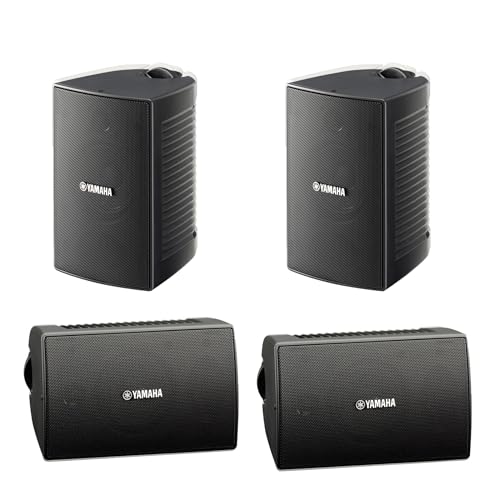
YAMAHA NS-AW150BL 2-Way Indoor/Outdoor Speakers (Pair, Black) – Wired

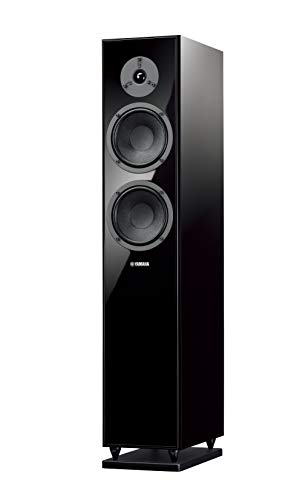
YAMAHA Audio NS-F150 Floor Standing Speaker – Each (Black)

Yamaha True X Speaker 1A Wireless Surround Speaker for True X Sound Bars (Black)

Yamaha GNSMS01 3-piece Speaker System for Genos Arranger Workstation Black
A Short Pre-Purchase Checklist
Before ordering anything, write down the five numbers that govern the decision: the front speakers’ sensitivity, their nominal and minimum impedance, the centre’s sensitivity, the subwoofer’s driver size and amplifier rating, and the longest wire run the surrounds require. Checking those figures against the guidance in this article takes ten minutes and eliminates the pairings that generate most returns. Sensitivity at or above 87 dB for the fronts, impedance the receiver’s 6-ohm setting can serve, and a centre drawn from the same range as the fronts form the core of the list. The subwoofer should offer a variable crossover or a dedicated low-level input that bypasses its internal filter, plus a phase control, because those features determine how cleanly it integrates.
Add the physical measurements to the same page: cabinet widths against shelf spaces, centre height against the gap below the screen, stand heights against seated ear level, and subwoofer footprint against the floor positions the room allows. Confirm that the television’s stand or wall mount leaves the centre a home, since improvising one after delivery leads to the buried-cabinet mistake described earlier. Verify also that the receiver’s ventilation path survives the final furniture arrangement, with open space above the chassis and no closed door trapping its heat. A system planned on one sheet of paper, numbers and dimensions together, arrives as a set of confirmations rather than surprises.
Order of purchase matters when the budget arrives in stages. Buy the front pair first and enjoy stereo while saving, then add the subwoofer, whose contribution to both music and film exceeds its cost, then the matched centre while the range remains in production, and finally the surrounds. That sequence front-loads the components that carry the most programme material and protects the timbre match, because current ranges are revised every few years and a centre bought late risks arriving in a successor’s voicing. Photographing the system and saving the YPAO results after each stage gives later troubleshooting a baseline. Patience staged this way builds the same system as a single splurge, with less financial strain and more time to learn each addition’s effect.
One last habit separates owners who keep improving their systems from owners who keep replacing parts of them: change a single variable at a time and live with each change for several days before judging it. Moving the front speakers, adjusting the subwoofer level by one decibel, or switching the YPAO curve each alters the balance in ways that first impressions misjudge, because familiarity makes the previous setting sound correct by default. A notebook recording dates, positions and trim values turns those impressions into evidence and prevents circular adjustments. The receiver rewards that patience exactly as it rewards sensitive speakers, quietly and cumulatively.
Taken as a whole, the RX-V473 rewards speakers chosen by specification rather than by showroom impression: sensitivity in the high eighties or better, impedance the 6-ohm setting can serve without complaint, a centre that shares the fronts’ voice, and a powered subwoofer absorbing the depths the receiver should never be asked to reproduce. Build on those four pillars and this 2012 receiver still anchors a system whose dialogue is clear, whose peaks stay clean and whose music fills an ordinary room without a hint of effort, and that quiet competence is the real legacy of matching speakers to the amplifier honestly rather than hopefully.

