What's inside
- Key Takeaways
- Quick Picks
- How Did We Choose These Picks?
- What Does “Without a Receiver” Actually Require Inside the Box?
- How Do the Receiver-Free Routes Compare?
- How Do You Connect a Receiver-Free System to a Modern TV?
- How Should You Place and Balance a Receiver-Free 5.1?
- What Mistakes Do Receiver-Free Buyers Make?
- What Does Receiver-Free Ownership Cost Over Time?
- Which Rooms Suit Receiver-Free Surround, and Which Outgrow It?
- How Should You Judge a Receiver-Free System in Its First Week?
- What About Control — Remotes, Apps, and the One-Remote Test?
- How Do Receiver-Free Systems Handle Music and Games?
- Final Recommendation
- Frequently Asked Questions
- Related Guides
As an Amazon Associate I earn from qualifying purchases. This post may contain affiliate links at no extra cost to you.
gizmoverdict.com is reader-supported. When you buy through links on our site, we may earn an affiliate commission.
Where to buy: The three linked systems below are sold through Amazon, with availability shown before checkout. The other three picks are deliberately prose-only: two are routes rather than single products, and one is a warning that will save you more money than any discount — passive speaker packages always need a receiver, whatever the search term that brought you here implies.
Every 5.1 system needs amplification and decoding somewhere. That sentence is the whole guide to the best 5.1 home theater speakers without a receiver, because “without a receiver” never means “without electronics” — it means the electronics live somewhere else: inside the subwoofer, inside a Blu-ray player’s main unit, inside a soundbar. Shoppers who understand that trade shop well. Shoppers who miss it buy a handsome passive package — five silent speakers and a subwoofer with no amplifier anywhere in the shipment — and discover the missing component only when the room stays quiet. So this guide is organized by where the amplification lives. Only three linked products qualify as genuinely receiver-free systems, and each is labeled with exactly how its power and decoding are arranged, including the Monoprice HT-35, whose powered subwoofer carries the system’s amplification story and whose listing title says so. The remaining three picks are prose-only: the 5.1 soundbar route, the powered-speaker route, and a plain warning about the passive packages — the Klipsch and Energy class of speaker sets — that are excellent products and categorically not receiver-free, and which therefore carry no links in this article.
Why go receiver-free at all? The honest reasons are space, simplicity, and total cost. A receiver is a large, warm, expensive box that demands ventilation, a shelf, and a remote-control ecosystem of its own. An apartment dweller, a bedroom theater, a dorm, a second room, or a minimalist living room may rationally trade the receiver’s flexibility for a system that arrives complete: plug in power, connect the TV, run the speaker wire that comes in the box, watch a film tonight. The trade is real in both directions — you give up upgrade paths, format headroom, and usually some refinement — and this guide prices it openly for each pick rather than pretending the receiver-free route is either a scam or a free lunch. One more reason deserves naming because it decides real purchases: time. A component system is a project with a parts list, a wiring weekend, and a calibration evening. A receiver-free system is an evening. Households differ in which currency they are rich in, and a guide that only respects money will mislead the ones spending weekends.
Key Takeaways
- “Without a receiver” means the amplifier and decoder live inside the system — in the subwoofer, a main unit, or a bar — never that they do not exist.
- Only three linked systems here are genuinely receiver-free: the self-powered Logitech Z906, Samsung’s HT-J4500 home-theater-in-a-box from 2015, and the Monoprice HT-35 with its powered subwoofer.
- Passive packages — the Klipsch and Energy class — always need a receiver; they appear in this guide as a prose-only warning and carry no purchase links.
- A 5.1 soundbar system is the receiver-free route with the least wiring and the most modern TV manners, at the cost of a narrower, processing-assisted soundstage.
- Receiver-free systems are finished systems: when a format, a port, or a component ages out, the whole set retires together.
Quick Picks
| Pick | Badge | Why it is here |
|---|---|---|
| Logitech Z906 5.1 Surround Sound Speaker System | The complete powered answer | Amplification and Dolby Digital/DTS decoding built into the system — the most capable genuinely receiver-free 5.1 you can buy as one product. |
| Monoprice HT-35 Premium 5.1-Channel Home Theater System | Powered-subwoofer package | A compact 5.1 set built around a powered subwoofer, as its listing title states — the budget shape of receiver-free surround. |
| Samsung HT-J4500 5.1 Channel 3D Blu-Ray Home Theater System (2015 Model) | HTIB with the amp in the player | A 2015 all-in-one whose Blu-ray main unit houses the amplification — receiver-free by design, bought with its age understood. |
| 5.1 soundbar route (prose-only) | Least-wire modern route | A bar, wireless subwoofer, and in better kits wireless rears: receiver-free surround that a TV remote can run. |
| Powered-speaker route (prose-only) | Stereo-first flexibility | Active speakers plus processing cover rooms where surround matters less than simplicity and music. |
| The passive-package warning (prose-only) | Read before buying anything | Klipsch/Energy-class packages are superb with a receiver and silent without one — no links here, on purpose. |
How Did We Choose These Picks?
The selection test was a single question, applied without mercy: does this product, alone in its box, contain everything needed to turn a TV’s audio output into five-channel surround sound? Amplification for the speakers, decoding for the formats, a volume control a human can reach — all present, or the product failed the test. That test admitted exactly three linked systems and exiled some excellent hardware to the warning section, which is the correct outcome for a guide with this title. Within the admitted three, we graded the usual ownership virtues — input selection, setup burden, subwoofer competence, how the system behaves at the low volumes of weeknight viewing — and we weighted honesty of labeling as a virtue in itself: the Samsung’s 2015 vintage is printed wherever its name appears in this guide, and the Monoprice’s powered-subwoofer design is described as its listing describes it. We also applied the test symmetrically to the fashionable end of the market, which is why the soundbar pick carries its own condition — physical rear speakers — in bold terms: a category does not become honest by being new, and a bar with a subwoofer is held to the same standard as a speaker package with a missing receiver.
The prose-only picks were chosen to cover the decisions the linked three cannot. The soundbar route is what most receiver-averse buyers actually purchase in this decade, and excluding it would make the guide technically pure and practically useless. The powered-speaker route answers the smaller question — a room that wants better TV sound and music more than it wants rear channels. And the warning exists because the single most common receiver-free shopping accident is a passive package bought in good faith; a guide that did not spend a full pick on it would be negligent.
What Does “Without a Receiver” Actually Require Inside the Box?
Three jobs must be done by something. Decoding turns a Dolby Digital or DTS bitstream from your TV or streamer into five channels and a subwoofer feed. Amplification turns those channels into power that moves speaker cones — the job whose absence makes passive packages silent. And control — volume, input selection, level balancing — must live where your hand or your remote can reach it. A receiver does all three in one chassis. Receiver-free systems redistribute them: the Z906 puts amplification in its subwoofer enclosure and control in a desktop console; the Samsung puts everything in its Blu-ray main unit; the HT-35 builds its design around a powered subwoofer, as its listing title states, so the low-frequency heavy lifting is self-amplified within the package. Soundbars fold all three into the bar. When you evaluate any system claiming this category, ask where each job lives; a product page that cannot answer is a product page hoping you will not ask.
There is one more quiet requirement: the connection to the TV. Modern televisions hand audio out over HDMI ARC or eARC, or over optical. A receiver-free system must accept one of those and, ideally, obey the TV’s volume commands so one remote runs the evening. Older systems — and the 2015 Samsung is the example in this guide — predate some of these manners and may ask you to juggle remotes or accept optical with its own limits. None of this is fatal; all of it belongs in the decision.
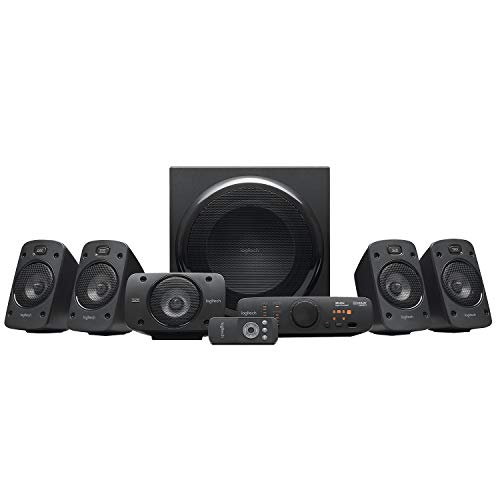
Logitech Z906 5.1 Surround Sound Speaker System — The complete powered answer
The Z906 is what a receiver-free 5.1 system looks like when the idea is executed completely. The subwoofer enclosure houses the amplifiers for all channels; a control console — wired, desktop-friendly, with an infrared remote alongside — runs volume, input selection, and levels; and decoders for Dolby Digital and DTS sit inside, so a TV’s optical output or a console’s digital feed becomes genuine surround without any other box in the chain. Logitech rates the system at 500 watts RMS in total, it carries THX certification, and its input panel is the most generous in this guide: multiple optical inputs, coaxial, six-channel analog, and stereo analog. That generosity is why the Z906 keeps serving in rooms whose sources keep changing — the system absorbs a new streamer, a console, a PC, without demanding a new architecture.
In a living room, its character is cinematic confidence. The subwoofer produces the kind of low-end weight that makes action mixes physical, the satellites are voiced to keep dialogue forward, and the whole system plays loudly enough for small-to-medium rooms without audible distress. Setup is an afternoon’s unhurried work: satellites on stands, shelves, or mounts, wire runs to the subwoofer hub, one digital cable from the TV. There is no calibration microphone and no menu labyrinth; levels are set from the console by ear, which most owners finish faster than they expect and revisit rarely.
What holds it back is simply its design generation. There is no HDMI input, so the TV connection is optical in most homes — fine for the Dolby Digital and DTS it decodes, but a ceiling on formats: the newer object-based and lossless codecs have no path in, and none can be added. The system is also sealed as a set; a failed amplifier retires the speakers with it. Buyers choosing it are choosing completeness and simplicity over headroom, and for the rooms it suits, that choice has kept it in production while rivals came and went.
- Configuration: Self-powered 5.1 — all amplification inside the system
- Decoding: Dolby Digital and DTS built in
- Inputs: Two optical, coaxial, six-channel analog, stereo analog
- Control: Desktop console plus infrared remote
- Receiver-free status: Fully — nothing else to buy for surround from a TV
Strengths
- The most complete receiver-free 5.1 in a single box, by a wide margin.
- Input selection swallows TVs, consoles, PCs, and streamers together.
- Bass weight and dialogue clarity suit films at real living-room volumes.
Trade-offs
- No HDMI input and no support for newer lossless or object-based formats.
- Manual, by-ear level setting instead of microphone calibration.
- A sealed set — components cannot be upgraded or replaced individually.
Best for: Small-to-medium living rooms wanting true 5.1 tonight with no receiver shelf. Not suited for: Format collectors or anyone planning to grow the system later.

Monoprice HT-35 Premium 5.1-Channel Home Theater System — Powered-subwoofer package
The HT-35 represents the budget architecture of receiver-free surround, and its listing title carries the key fact in plain sight: this is a 5.1-channel home theater system with a powered subwoofer. In this design the subwoofer is not a passive box waiting for an amplifier — it carries its own amplification for the low frequencies that dominate power demands, which is the heavy half of driving any small speaker system, and the five compact speakers are voiced and matched to work with it as a set. The result is a package that brings genuine five-channel layout and real bass to rooms and budgets where a receiver-based build was never going to happen: the second TV room, the bedroom setup, the apartment whose lease and layout both discourage a rack of electronics.
Expectations should be set by the system’s scale, and set cheerfully. The satellites are small; they image well at the distances of modest rooms and keep dialogue intelligible at the modest volumes those rooms allow, and the powered sub fills in the foundation that speakers this size cannot reach. What the HT-35 does not attempt is the large-room, high-volume performance of tower-based systems, and it does not pretend otherwise in its design. Its virtues are proportion and completeness: matched voicing across all five positions, a footprint that disappears into ordinary furniture, and an entry cost that leaves the rest of the entertainment budget alive.
Ownership notes are simple. Place the subwoofer with the usual care — near a wall for support, not buried in a cabinet — because in a system of this scale the sub’s placement is the largest single sound-quality decision you will make. Keep the satellites at ear height when seated, angled at the listening position; small speakers forgive placement sins less than large ones. And understand the set as a set: its components are designed for each other, and the upgrade path, when the day comes, is a new system rather than a transplant. For the buyer it targets, that is not a flaw but a description of the deal — complete, compact, receiver-free surround at the gentlest price on this page.
- Configuration: Compact 5.1 system built around a powered subwoofer, per its listing title
- Subwoofer: Powered — self-amplified low-frequency section
- Speakers: Five compact matched speakers for front, center, and surround duty
- Room fit: Small rooms, bedrooms, apartments, secondary setups
- Receiver-free status: Presented as a powered-subwoofer system — the budget receiver-free shape
Strengths
- The gentlest entry cost among this guide’s linked systems.
- Matched voicing keeps the surround field coherent at modest volumes.
- Compact speakers suit rooms that cannot host larger enclosures.
Trade-offs
- Small drivers set a firm ceiling on volume and scale.
- Subwoofer placement carries unusual weight in the final sound.
- A closed set — upgrades mean replacement, not extension.
Best for: Budget receiver-free surround in small rooms and second setups. Not suited for: Large rooms, high-volume film nights, or component-by-component builders.

Samsung HT-J4500 5.1 Channel 3D Blu-Ray Home Theater System (2015 Model) — HTIB with the amp in the player
The HT-J4500 is the purest historical expression of the receiver-free idea: a home-theater-in-a-box from 2015 in which the Blu-ray player is the receiver — amplification, decoding, and control all live in that one main unit, and the five speakers plus subwoofer connect to it and only to it. Samsung rated the system at 500 watts in the optimistic arithmetic of its category and era. For a household with a shelf of Blu-rays and DVDs, a TV, and no appetite for a component rack, it was — and for the right used or old-stock price, remains — a complete answer: discs play in 5.1, the TV’s audio can feed through its inputs, and the whole installation is one unit, six speaker connections, and an afternoon.
The year in its name is not a footnote; it is the review. A 2015 main unit carries 2015 assumptions: its smart features belong to a discontinued app ecosystem and should be treated as absent, its connectivity predates the eARC era, and its format support stops where that decade’s discs stopped. None of that prevents it from doing its core job — playing discs and simple digital audio in genuine surround — but it defines the terms of purchase: price and condition, verified in person or from a seller you trust, with working remote and intact speaker connectors, because a system-bound set with a missing proprietary piece is a sculpture.
Against the Z906, the Samsung trades input generosity and ongoing production for disc playback and, often, a lower secondhand cost. Against the soundbar route below, it trades modern manners for true discrete rear speakers. Its buyers should be specific people: disc collectors furnishing a secondary room, gift-buyers solving a simple problem simply, anyone whose sources are a player and a TV and whose ambitions end there. Streaming-first households and format upgraders should pass it by with respect — it is a finished answer to a 2015 question, and it answers that question completely.
- Configuration: HTIB — Blu-ray player main unit with built-in amplification and decoding
- Model year: 2015 — smart features are of their era and best treated as absent
- Speakers: Five speakers and subwoofer bound to the main unit
- Sources: Discs first; TV/streamer audio through its inputs
- Receiver-free status: Fully — the player is the receiver
Strengths
- Disc playback and 5.1 amplification in a single unit — nothing else to buy.
- True discrete rear speakers, which no soundbar in its class can claim.
- Simple installation and a single remote for the whole system.
Trade-offs
- A discontinued 2015 design; buy strictly on price and verified condition.
- Connectivity and formats end where its decade ended.
- System-bound speakers — a failed main unit retires the set.
Best for: Disc collectors and secondary rooms at an age-appropriate price. Not suited for: Streaming-first homes or anyone paying a modern premium for it.
The 5.1 Soundbar Route — Least-wire modern route (prose-only)
For most receiver-averse buyers in this decade, the actual purchase is a 5.1 soundbar system: a bar carrying the front channels, a wireless subwoofer, and — in the configurations that deserve the 5.1 name — a pair of wireless rear speakers for true surround positions. Decoding and amplification live in the bar; the TV connects over HDMI ARC or eARC; the TV’s remote usually runs the volume; and the entire installation, rears included, involves power outlets rather than speaker-wire runs. This pick is prose-only because the right model depends on your TV’s ports and room dimensions, and this site’s dedicated soundbar guides carry the linked specifics. Its place in this guide is earned by fit: it is the receiver-free route that behaves most like a modern appliance.
Judge soundbar systems by their rears. A bar and subwoofer alone, however skillful the processing, deliver a wide front stage with simulated surround — pleasant, and not 5.1. The systems with physical rear speakers deliver the genuine article: effects placed behind you by speakers actually behind you, with the bar’s processing freed to handle the front stage it is good at. Also judge by the subwoofer’s substance and by dialogue handling, because bars sit close to the TV’s own speakers in many buyers’ comparisons and must win on clarity at low volume, not just on spectacle at high volume.
The route’s ceiling is the front stage’s physical width: drivers separated by the length of a bar cannot match the spaciousness of separated front speakers, and critical music listening exposes the processing. Its floor, though, is high and rising — for films and television in ordinary rooms, a good 5.1 bar system is the receiver-free answer most households will be happiest living with, and choosing it over a rack of components is a preference, not a compromise to confess.
- Configuration: Bar, wireless subwoofer, and — in true 5.1 kits — wireless rear speakers
- Electronics: Decoding and amplification inside the bar
- TV connection: HDMI ARC/eARC with TV-remote volume control in most setups
- Surround honesty: Genuine 5.1 only when physical rear speakers are included
- Coverage: Prose-only here; linked models live in this site’s soundbar guides
Strengths
- Fastest installation of any route in this guide — outlets, not wire runs.
- Modern TV manners: one remote, automatic power and volume harmony.
- True surround available in kits with wireless rear speakers.
Trade-offs
- Front soundstage width is bounded by the bar’s physical length.
- Bar-plus-sub kits without rears are simulated surround, not 5.1.
- Music reproduction trails comparably priced speaker systems.
Best for: Main living rooms that want receiver-free surround with appliance simplicity. Not suited for: Listeners who prioritize music or a wide, separated front stage.
The Powered-Speaker Route — Stereo-first flexibility (prose-only)
Some rooms asking this search’s question do not actually want surround; they want the TV to stop sounding thin and music to stop sounding small, without a receiver’s bulk. The powered-speaker route answers that real desire: a pair of active speakers — amplification built into the enclosures — flanking the TV, fed by its optical or analog output, often with a small subwoofer added when the room asks for one. This pick is prose-only because the right pair depends on the room and the listener’s music habits, and because its honest framing matters more than any single model: it is a stereo solution presented to a surround search, and it belongs here only because for a meaningful share of readers it is the correct purchase.
What it does better than every 5.1 system in this guide is music and simplicity. A good powered pair images beautifully, needs no calibration beyond placement, and turns a bedroom or study into a listening room that also does television. What it cannot do is place a sound behind you or anchor dialogue to a dedicated center channel; films remain a stereo experience, wider and richer than TV speakers but categorically different from surround. Buyers who watch mostly dialogue-driven content and listen to music daily are often better served here than by a budget 5.1 set whose rears they will never place properly.
The shopping discipline for this route: choose speakers with a digital input for the TV and an analog or Bluetooth path for everything else, insist on a remote or accept reaching for a knob, and place the pair at ear height with the same care you would give front speakers in a surround layout — the geometry of stereo is older than surround and no less strict. Add the subwoofer only after living with the pair; many rooms and many listeners discover they never needed it.
- Configuration: Active stereo pair, optional subwoofer — amplification in the enclosures
- Surround honesty: None — this is a stereo route, recommended openly as one
- TV connection: Optical or analog from the TV, model-dependent
- Best content: Music, dialogue-driven television, small-room viewing
- Coverage: Prose-only — a route, matched to rooms rather than to a single listing
Strengths
- Best music performance per unit of complexity in this guide.
- Two boxes, two cables, no calibration ritual.
- Doubles as a genuine listening setup, not just TV sound.
Trade-offs
- No rear channels and no dedicated center — films stay in stereo.
- Volume control convenience varies by model.
- Not an answer for buyers who truly want surround effects.
Best for: Music-first rooms and dialogue-heavy viewing. Not suited for: Anyone whose goal is genuine surround placement.
The Passive-Package Warning — Read before buying anything (prose-only, no links on purpose)
This pick has no link, and the absence is the content. The finest 5.1 speaker packages on the market — the Klipsch Reference Theater Pack class, the Energy Take Classic class, Fluance’s tower systems, Monoprice’s larger passive sets — are passive. Their boxes contain speakers and a subwoofer (sometimes a powered subwoofer, which amplifies only itself), and no amplification or decoding for the five channels. Connect them to a TV and the result is silence, because a television’s audio output is a signal, not power. Every season, buyers searching for receiver-free surround buy one of these packages — drawn by reviews that assume a receiver the buyer does not own — and meet an unplanned second purchase or a return. This guide links those packages in its other articles, where the receiver is part of the plan; here, they are named as a category and deliberately not sold.
Learn the tells so the warning outlives this page. A package is passive if its description speaks of speaker power handling rather than system power, if its connections are binding posts and spring clips rather than HDMI and optical, and if its setup diagrams show a box labeled AVR or receiver between the source and the speakers. A powered subwoofer in the package does not rescue it — the sub amplifies its own driver while the five speakers still wait for power that never comes. None of this makes passive packages bad products; with a receiver they are the best-sounding and most upgradeable route in home audio, which is exactly why they dominate this site’s other guides. It makes them wrong for this search, and a guide that blurred that line for the sake of a longer list would be selling you the silence described above.
If you already own such a package — bought in error or inherited — the paths are three: buy the receiver and join the component world properly, return the package while the window stands, or, if the subwoofer is powered and the speakers must stay, accept that amplification is the missing purchase and shop for it as the system’s heart rather than as an accessory. What you cannot do is wish the speakers into self-powered life. Physics keeps the books in this category, and it does not extend credit.
- Configuration: Passive speakers — no amplification or decoding for the five channels
- Receiver-free status: Never — a receiver or amplifier is mandatory
- Telltale signs: Binding posts, power-handling language, an AVR in the setup diagram
- Powered-sub trap: A powered sub amplifies only itself, not the speakers
- Coverage: Prose-only warning — no links in this article, deliberately
Strengths
- With a receiver, this class offers the best sound and upgrade path in home audio.
- Speakers themselves are long-lived, format-proof components.
- Huge selection across sizes and budgets — once a receiver is in the plan.
Trade-offs
- Silent without a receiver — the single most expensive misunderstanding in the category.
- Total system cost is always package plus electronics.
- Exactly wrong for the search that led to this guide.
Best for: Component builders — in this site’s other guides. Not suited for: Any receiver-free shopping list, including this one.
How Do the Receiver-Free Routes Compare?
| Route | Where the amp lives | True 5.1? | Wiring burden | Upgrade path |
|---|---|---|---|---|
| Logitech Z906 | Subwoofer enclosure | Yes | Speaker wire to the hub | None — sealed set |
| Monoprice HT-35 | Powered subwoofer design | Yes | Speaker wire within the set | None — closed set |
| Samsung HT-J4500 (2015) | Blu-ray main unit | Yes | Speaker wire to the unit | None — system-bound |
| 5.1 soundbar route | The bar | Yes, with physical rears | Power outlets only | Replace the bar |
| Powered-speaker route | The speaker enclosures | No — stereo | Minimal | Swap the pair |
| Passive packages | Nowhere — needs a receiver | Only with a receiver | Full home theater wiring | Excellent — with a receiver |
The second column is the guide in one column. Every row answers the amplification question differently, and the last row answers it with an absence — which is why it is a warning rather than a recommendation. Choose your row by deciding where you are willing to house the electronics, and the rest of the decision mostly makes itself. Notice, too, the pattern in the final column: upgrade paths exist exactly where the electronics are separate, and vanish where they are integrated. That is not a conspiracy by manufacturers; it is the geometry of integration itself, and it is the single most predictable fact about owning any of these systems. Buy the row whose future you can picture yourself enjoying, not merely the row whose present is cheapest to start.
How Do You Connect a Receiver-Free System to a Modern TV?
Start at the TV’s audio output menu, because the television is now your system’s source and switcher. The cleanest path is HDMI ARC or eARC from the TV to a system that accepts it — the soundbar route’s home ground — because it carries the audio and lets the TV remote govern volume. Optical is the universal fallback: nearly every TV and most receiver-free systems speak it, and for the Dolby Digital and DTS formats these systems decode, it is fully sufficient; its known limit is that it carries nothing newer, which matters only if the system could decode newer formats, and in this guide only future purchases are affected by that. Analog output, where a TV still offers it, is stereo and should be treated as a last resort for surround purposes.
Two settings decide success after the cable. First, the TV’s digital audio output format: set it to bitstream/pass-through for a decoding system, or to PCM if the system asks for decoded audio — the wrong choice typically yields stereo or silence, and it is the first thing to check when a new setup disappoints. Second, disable the TV’s own speakers in the menu rather than merely muting them, because many sets otherwise play both, and the television’s speakers duetting with your system smears dialogue beyond recognition. Finish by testing with a film scene you know, from the actual app or input you will use nightly — a setup verified on a menu screen has verified nothing. Keep the cable itself short and ordinary; the exotic, stiff, over-built cable is harder to route, no better at carrying these signals over living-room distances, and a recurring source of connectors worked loose by their own weight — the humblest troubleshooting step in this category is pushing every connector home again, firmly, before changing a single setting.
How Should You Place and Balance a Receiver-Free 5.1?
The geometry does not change because the electronics moved. Front speakers flank the screen at seated ear height, angled toward the main seat; the center sits at the screen, as close to ear height as the furniture allows; surrounds go slightly behind and beside the listening position, a little above ear level. Receiver-free systems tempt owners to cluster everything near the TV — all six boxes in a media console constellation — which produces loud stereo with decorations. Resist it: the rear speakers’ location is the difference between surround and a rumor of surround, and every system in this guide ships with enough wire to do the job properly.
Balancing without a calibration microphone is an ear skill worth learning. Use the system’s test tones or a familiar film: set the center for dialogue intelligibility at your normal volume, bring the surrounds up until ambience envelops without announcing itself, and set the subwoofer where its absence is more noticeable than its presence. Then live with it a week and trim once more — new owners set rears and sub too hot almost without exception, seduced by finally hearing them. The week-later adjustment, made on ordinary content, is the one that lasts. Distances deserve thirty seconds of the same attention: systems that ask for speaker distances are estimating arrival times so that a sound mixed to reach you from all channels at once actually does, and a surround speaker two meters closer than its setting claims will pull the whole field toward itself. Measure with a tape, enter honest numbers, and let the arithmetic work — it is the cheapest calibration in audio, and the one most often skipped because the tape measure lives in another room.
What Mistakes Do Receiver-Free Buyers Make?
The champion mistake is buying a passive package — the warning pick above exists because of it. Second is assuming a soundbar labeled 5.1 includes rear speakers when the box holds a bar and sub; read the contents list, not the channel count. Third is the TV setting error: PCM where bitstream belongs, or TV speakers left playing alongside the system. Fourth is clustering all speakers at the front and concluding surround is a gimmick. Fifth is ignoring the subwoofer’s placement because the system was “simple,” when sub placement remains the largest single quality lever in any small system. Sixth is buying the 2015-class HTIB at a modern price without verifying the remote, the connectors, and the disc mechanism — condition is the product at that age. Each mistake is a reading or placement error, not a product defect, and each is avoidable in the time it takes to read the box twice.
There is a seventh mistake, made at the planning stage rather than the wiring stage: measuring the room for the system you want instead of the seating you have. Surround geometry is referenced to where people sit, and a receiver-free system arranged around a sofa that will be replaced by a sectional “soon” is arranged around a fiction. Place for tonight’s furniture, keep wire runs forgiving enough to adjust, and let future furniture earn a future rearrangement. The systems in this guide are light, quick to move, and forgiving of revision — one more quiet advantage of the receiver-free shape, provided the owner treats placement as a draft rather than a monument.
What Does Receiver-Free Ownership Cost Over Time?
The purchase price of these systems is unusually close to their total cost — cables are included or trivial, no receiver lurks in a second cart — and that honesty is part of the appeal. The deferred cost is replacement shape. A component system ages in pieces: the receiver’s formats date in a decade, the speakers serve for three. A receiver-free set ages as a unit; when its decoding, its ports, or its amplifier reaches the end, the speakers it drove retire with it, because they were voiced and powered as a set. Neither shape is wrong. Buyers who replace technology eagerly will barely notice the sealed-set cost; buyers who keep equipment for decades should weigh it, and for them the receiver route’s separability — argued in this site’s other guides — may be worth the shelf space after all. The soundbar route sits between: bars age like electronics, but their subwoofers and rears sometimes carry across generations within a brand’s ecosystem, and sometimes pointedly do not — check before assuming your rears have a future.
Which Rooms Suit Receiver-Free Surround, and Which Outgrow It?
Room size is the quiet spec behind every pick in this guide. Receiver-free systems are engineered for the rooms most people actually have: living rooms in apartments and smaller houses, bedrooms pressed into theater service, dens, dorm rooms, and second spaces. In those volumes, their amplifiers are sufficient, their subwoofers are proportionate, and their simplicity compounds — a system that turns on with the TV and behaves will be used nightly, which is the entire point of owning it. The failure mode appears when the room grows: a large open-plan space with a kitchen at one end and a sofa at the other asks for air movement and headroom that compact powered systems cannot supply, and no setting changes that arithmetic. Owners in such rooms who buy receiver-free for its simplicity often end up buying twice, arriving at the receiver they avoided by the expensive road.
The second room question is acoustic rather than geometric. Hard, reflective small rooms flatter modest systems; soft, absorptive ones — heavy curtains, deep sofas, carpet — drink power and ask more of amplifiers. A receiver-free set that sounded ample in a showroom’s lively space can feel restrained in a furnished den, which is why the week-one test below matters and why return windows are part of the buying plan. None of this argues against the category; it argues for matching the system’s scale to the room’s volume and furnishings with the same honesty this guide applies to amplification. The Z906, the strongest of the linked systems, covers the widest range; the HT-35 is frank about its small-room brief; the soundbar route scales by model. Choose the row whose room description sounds like your address.
How Should You Judge a Receiver-Free System in Its First Week?
Do not judge it by the demo scene you played in the first ten minutes, when novelty is doing half the listening. Judge it across a week of ordinary use, against four tests that predict long-term satisfaction. First, dialogue at your real evening volume: a conversation-heavy episode, no subtitles, remote untouched — if you reach for the volume during quiet lines and back down for action, the center channel and the system’s dynamic behavior are failing the only test that matters nightly. Second, the remote census: count how many controllers a normal evening required. Receiver-free ownership promises few; if the answer is three, the setup — usually the TV’s ARC and CEC settings — needs the attention described in the connection section, because the hardware can almost always be taught better manners.
Third, the quiet-hours test: at low volume late at night, does the system keep dialogue intelligible without the subwoofer announcing itself through the floor? Small systems with thoughtful night modes and well-set sub levels pass; systems whose bass is a single enthusiastic note fail, and in apartments that failure has social consequences. Fourth, the source shuffle: play a disc, a streaming app, a game if you game, and broadcast or a PC feed, and confirm each arrives in surround without a settings expedition. A receiver-free system earns its premise when the format machinery disappears and only the content remains. If yours passes all four by week’s end, keep it and stop reading reviews. If it fails one, fix the setup before blaming the hardware — in this category, configuration errors outnumber product defects by a wide margin, and most of the fixes live in the TV’s audio menu.
What About Control — Remotes, Apps, and the One-Remote Test?
Receiver-free systems live or die by an unglamorous metric: whether the household accepts them. The mechanism of acceptance is control. The best outcome is the one-remote evening — the TV remote powers everything, governs volume, and the system wakes and sleeps with the screen. HDMI ARC with CEC is how that outcome is usually achieved on the soundbar route; on the Z906, the infrared remote and console do the work and a universal or learning remote can fold them into one wand; the Samsung’s own remote runs its system completely but asks the TV to be managed separately unless the television’s remote can be taught. Before buying, decide which outcome your household will tolerate, because a system that needs a second remote and a spoken explanation will be quietly bypassed by everyone except its purchaser, and bypassed systems get returned or gather dust at equal rates.
App control, where offered, is a supplement rather than a foundation: useful for setup, EQ trims, and firmware, no substitute for a physical path to volume. Also consider the humans beyond the purchaser — partners, parents, guests, children. A receiver-free system’s great social advantage over a component rack is that a guest can operate it without a briefing. Test yours that way during the first week: hand the remote to someone who did not read the manual and watch a film start. If it starts, the system has passed the test that decides whether it will still be the room’s default in a year. If it does not, the fault is usually one setting — an input that does not auto-switch, a power mode that sleeps too deeply — and it is worth the ten minutes to find, because the alternative is a technically superior system that the household routes around.
How Do Receiver-Free Systems Handle Music and Games?
Films dominate this category’s marketing, but households spend their hours elsewhere, and the other two uses deserve a hearing. Music through a receiver-free 5.1 is a matter of taste and mode: most systems offer a mode that spreads stereo across all speakers, which fills a room pleasantly for gatherings and offends purists in proportion to their purism, and a stereo mode that respects the recording and reveals the front pair’s true quality — modest on the compact systems here, respectable on the Z906, and frankly the powered-speaker route’s home advantage, since a good stereo pair with no surround duties outperforms surround sets at music within this guide’s prices. The honest summary: if music is half your listening, weight the powered-speaker pick heavily; if music is background to films and games, any system here serves.
Games make different demands — low latency above all. A receiver-free system fed over optical or ARC adds negligible delay in most implementations, but televisions vary, and the TV’s game mode should govern the whole chain; if your set offers a low-latency path for audio as well as video, use it, and prefer direct connections from console to system where the system’s inputs allow, as the Z906’s panel does. Positional performance in games rewards the discrete systems: rear speakers behind you deliver cues that soundbar virtualization approximates, which is why competitive players in this guide’s audience should weight the true-5.1 rows of the comparison table. Casual and narrative gaming, by contrast, asks mainly for scale and dialogue clarity, and every route here supplies both. Match the system to the play you actually do, not to the tournament you imagine.
Final Recommendation
Choose by where the electronics may live. If a complete, capable, one-purchase 5.1 is the goal, the Z906 is the receiver-free benchmark and the safest recommendation on this page. If the budget is the binding constraint, the HT-35’s powered-subwoofer design puts genuine surround in a small room for the least money. If discs rule your shelf and the price respects its year, the Samsung HT-J4500 remains a complete answer. If modern manners matter most — one remote, no wire runs — take the soundbar route and insist on physical rears. And whatever you choose, let the warning pick do its work: the passive packages are wonderful machines that belong to a different guide, and the buyer who understands why will never stand in a silent room holding a speaker that was only ever half a system.
Frequently Asked Questions
Can I connect passive 5.1 speakers directly to my TV?
No. A TV outputs a signal, not speaker power. Passive speakers need an amplifier between them and any source — that amplifier is a receiver, or it is built into a powered system. A powered subwoofer in a passive package amplifies only itself.
What is a home-theater-in-a-box?
A system whose main unit — often a disc player — contains the amplification and decoding, with speakers designed to connect only to it. Samsung’s HT-J4500 in this guide is the type example: receiver-free by design, and bound together as a set for its whole life.
Is a 5.1 soundbar really 5.1?
Only when the kit includes physical rear speakers. A bar and subwoofer alone produce a wide, processed front stage — often very good, but the rear channels are simulated rather than played by speakers behind you.
Does the Monoprice HT-35 need a receiver?
The HT-35 is built around a powered subwoofer, as its listing title states, and is presented in this guide among the receiver-free systems on that powered-subwoofer basis. It is a compact, closed set voiced to work as a package in small rooms.
Will a receiver-free system work with streaming apps on my TV?
Yes — the TV sends the app audio out over ARC/eARC or optical like any other source. Set the TV’s digital output to bitstream for a decoding system, disable the TV’s own speakers, and the apps behave exactly as discs and broadcast do.
If my receiver-free system sounds thin, what should I check first?
In order: that the TV speakers are disabled, that the TV’s digital output is set to bitstream for a decoding system, that the subwoofer is awake and its level is sane, and that the front speakers are at ear height and angled at the seat. Thin sound in this category is a settings or placement finding far more often than a hardware verdict.
What do I give up by skipping the receiver?
Upgrade paths, the newest audio formats, microphone-based room calibration in most cases, and the ability to replace one aging component instead of the whole set. In exchange you get completeness, simplicity, and a total price you can see in one number.
Related Guides
Weighing the other side of the trade? See our guides to the best 5.1 speakers overall, the best 5.1 Atmos speakers and what the label really means, and the best 5.1 computer speakers. Two-channel listeners building around a turntable should compare the best powered bookshelf speakers for vinyl.


