What's inside
- Key Takeaways
- Quick Picks
- How Did These Six Earn Their Slots?
- What Does an Impedance Class Actually Promise Your Amplifier?
- The Six Pairs, Reviewed One at a Time
- Reading the Six Cabinets Against Each Other
- How Should You Set Up a Small Passive Pair Once It Arrives?
- Which Pairing Mistakes Catch Buyers of Small Passive Speakers?
- How Much Amplifier Power Does a Bookshelf Pair Actually Use?
- What Changes When the Same Pair Moves From Desk to Lounge?
- How Can You Compare Two Pairs at Home Without Fooling Yourself?
- What About Pairing These Speakers With a Second-Hand Amplifier?
- Should the System Start as Stereo or as the Front of a Theatre?
- What Do Stands, Cable and Small Hardware Actually Contribute?
- How Do These Pairs Handle the Music You Actually Play?
- What Should the Pre-Order Manual Check Actually Involve?
- Which of These Voicings Suits the Room You Actually Have?
- Where Does a Subwoofer Fit Into a Bookshelf System?
- Final Recommendation
- Frequently Asked Questions
- Related Guides
As an Amazon Associate I earn from qualifying purchases. This post may contain affiliate links at no extra cost to you.
gizmoverdict.com is reader-supported. When you buy through links on our site, we may earn an affiliate commission.
Where to buy: Five of the six pairs below link to the exact listings checked while this guide was assembled. The sixth, Micca’s MB42X G2, is covered without a link, and its section explains why: the stock behind that listing is renewed, which changes the sensible way to buy it.
People searching for the best 8 ohm bookshelf speakers usually want a simple promise — a small passive pair that any ordinary receiver can drive without complaint. That promise is mostly real. The eight-ohm nominal class is the load mainstream stereo receivers and integrated amplifiers were designed around for decades, so a speaker that honestly belongs to it asks little of the electronics and behaves predictably when you swap amplifiers later. But the number is a label for a class, not a measurement that holds still. Impedance moves with frequency in every loudspeaker ever built, sagging in the bass region and climbing through the treble, and two cabinets wearing the same nominal badge can present noticeably different loads at the frequencies where music actually gets loud.
A second complication sits right on this shelf of the market. A handful of well-regarded small speakers are documented by their own makers in a different nominal class, and a few listings never mention impedance anywhere in their titles at all. Rather than pretend otherwise, this guide separates two questions. The first is which six small passive pairs are worth your shelf space and your money. The second is what each listing actually tells you about impedance, and where you need to check a manufacturer’s own documentation before trusting a pairing. Every spec box below answers that second question in plain language, pick by pick, because a blanket disclaimer pasted under six different speakers would tell you nothing useful about any one of them.
Everything reviewed here is passive, which means none of it makes sound on its own. Each pair presumes an amplifier you already own or plan to buy, speaker cable, and a source — a streamer, a turntable with a phono stage somewhere in the chain, a television, a disc player. If your plan involves plugging a phone straight into a speaker, this is the wrong shelf; powered models live in a different guide. What the passive route buys you is longevity and flexibility: amplifiers and speakers age on different schedules, fail on different schedules, and can be upgraded one side at a time.
Key Takeaways
- Nominal impedance is a class label, not a constant; the class matters mainly at the extremes of amplifier quality and listening volume.
- Only one listing here, the Polk T15, carries any electrical figure in its title at all — the rest require a manual check, and each review says exactly where to look.
- The Sony SS-CS5 is the honest exception in the group: superb value, but Sony’s documentation places it in a lower nominal class than this search implies.
- Sensitivity and cabinet size will change your daily listening more than the impedance class ever will at normal volumes.
- The Micca MB42X G2 is renewed stock behind its listing, so it appears as guidance rather than a linked recommendation.
- Five linked pairs span bright and forward (Klipsch), warm and forgiving (Fluance), and polished modern (Polk Signature Elite) voicings.
Quick Picks
| Pick | Badge | Why it is here |
|---|---|---|
| Klipsch R-41M | Small box, big voice | Horn-loaded efficiency that fills a room from modest amplifier power, in the most compact cabinet of the six. |
| Polk Audio T15 | The easy first pair | A wall-mountable, home-theatre-friendly starter pair whose title even states its power handling class. |
| Sony SS-CS5 | Three-way overachiever | A genuine three-way design with a dedicated super tweeter at a price point where most rivals are simple two-ways. |
| Fluance Elite SX6 | Stereo listener’s walnut pair | A larger, furniture-finished cabinet voiced for two-channel music rather than effects channels. |
| Polk Signature Elite ES15 | The refined step up | Polk’s contemporary line, with smoother treble manners and a cabinet that looks at home in a living room. |
| Micca MB42X G2 | Prose-only: renewed listing | The classic budget passive route, covered without a link because the verified stock is renewed, not new. |
How Did These Six Earn Their Slots?
The starting filter was availability with a clean listing: a pair you can actually order, described by a title that matches the product, from a maker with a real support trail. That sounds basic, yet it removed a surprising number of small speakers whose listings had drifted into renewed stock, accessory bundles, or single cabinets sold in wording that reads like a pair. The Micca survived that filter as a discussion pick rather than a linked one, because the model itself remains relevant to anyone shopping this class on a tight budget — it simply has to be bought through the renewed channel with open eyes, or sourced new through another seller.
Sound character came next. A guide that recommends six speakers with identical voicing has failed even if every individual pick is competent, so the six were chosen to disagree with each other in useful ways. Klipsch and Sony lean forward and detailed, Fluance leans warm, the two Polks sit at different heights of the same brand’s ladder, and the Micca represents the crossover-equipped budget school. Whatever your room and taste, one of these disagreements should land on your side.
The third filter was the theme itself, handled honestly. Listings were read for what they state, and manufacturer documentation was treated as the authority where a title stays silent. Where a maker’s own documents place a speaker outside the nominal class in the search phrase, the review says so in words, because the practical consequence — a moment’s care with very cheap amplifiers — is real even if it is small. What this guide will not do is print electrical figures a listing never provided, or borrow numbers from a sibling model and present them as this model’s own.
What Does an Impedance Class Actually Promise Your Amplifier?
An amplifier does not see a resistor; it sees a load that changes with every note. When a maker assigns a nominal class, they are summarising that wandering curve into one honest shorthand: across the audible band, this speaker behaves roughly like a load of that size, with dips the amplifier must tolerate. Receivers are built and rated around the mainstream class, which is why speakers in it are the safe default for mixed-brand systems, older amplifiers of unknown health, and the surround channels of home theatre receivers that already share one power supply across many cabinets.
Where the class genuinely bites is at the margins. A very inexpensive amplifier with a small power supply, asked to play loudly into a speaker whose impedance dips low through the bass, may run hot, compress, or shut itself down in protection. A speaker from a lower nominal class is not badly behaved — it simply draws more current for the same volume, and the amplifier has to be willing. Modern mid-priced receivers shrug at this. Budget stereo amplifiers from reputable brands usually cope too, at sane volumes. The pairing that deserves real caution is a low-class speaker, a bargain amplifier, and a large room played loud: two of those three is fine, all three together is where trouble lives.
Sensitivity is the quieter half of the matching story and the half you will actually hear. It describes how loud a speaker plays from a given amount of power, and the spread between an efficient horn design and a small sealed cabinet can be larger than the difference between two amplifier classes. If your amplifier is modest, an efficient speaker in the right class is doubly kind to it. If your amplifier is muscular, sensitivity matters less and you can choose purely on voicing. Keep both halves in view and the matching question mostly answers itself.
The Six Pairs, Reviewed One at a Time

Klipsch R-41M — Small box, big voice
The R-41M is the pair that makes guests ask where the bigger speakers are hidden. Klipsch builds it around a horn-loaded tweeter, and the horn is not decoration: it couples the small dome to the room efficiently, so the speaker plays noticeably louder from the same amplifier than its size suggests. Vocals sit forward, dialogue in films cuts through at low evening volumes, and the whole presentation has a live, unbuttoned energy that suits rock, podcasts, and sport. In a bedroom or a study, a modest integrated amplifier is genuinely all it needs.
That efficiency is also the pick’s dividing line. Forward treble flatters dull recordings and punishes bright ones; a harshly mastered album will sound harsher here than through the Fluance below. The small woofer keeps bass tidy rather than deep, so low strings and kick drums arrive as shape more than weight, and anyone building toward home theatre should budget for the subwoofer the design quietly assumes. Placement helps: a little distance from the rear wall keeps the port’s contribution from blooming, and toe-in is worth experimenting with because the horn’s dispersion rewards a few degrees of patience.
- Design: two-way pair with a horn-loaded tweeter and a rear-firing port
- Sold as: one pair in a single carton, black finish
- Impedance: the title text leaves this blank — check Klipsch’s own R-41M documentation before pairing
- Amplification: passive; a separate receiver or integrated amplifier is essential
- Connections: binding posts accepting bare wire or banana plugs
Strengths
- Plays loud from little power, which flatters small amplifiers
- Dialogue clarity that serves film and spoken word at low volume
- Compact cabinet that fits real shelves rather than showroom plinths
Trade-offs
- Treble energy can turn edgy with bright recordings
- Bass depth is limited by the small woofer, as physics insists
- Grille-off horn styling divides opinion in formal rooms
Best for: a small room, a modest amplifier, and listening that prizes presence and clarity over warmth. Not suited for: bass-led music played loud, or ears that prefer a laid-back treble.

Polk Audio T15 — The easy first pair
The T15 has introduced more people to component audio than almost any speaker of its generation, and the reasons are practical rather than romantic. It is small, it mounts on a wall with a keyhole bracket, its title openly states a power handling figure so amplifier matching starts from a fact instead of a guess, and Polk voices it to be agreeable with everything from game consoles to Sunday-morning radio. As front speakers in a compact room it is pleasant; as surround speakers in a growing theatre system it is arguably even better, which is why so many T15 pairs end up migrating to the back of the room when their owners upgrade.
Expectations should be set by its station. The cabinet is light, the bass is modest, and at high volumes in a big room the sound thins out in the way small inexpensive speakers do. None of that is a flaw at its tier — it is the honest trade that keeps the pair affordable and easy to place. What surprises people is the midrange: voices are clear and unforced, which is the quality that matters most across the films, calls, and streams that dominate real listening. If your system will grow, buy the T15 as a citizen of that future system, not as a final destination.
- Configuration: two-way bookshelf pair, wall-mountable cabinet
- Sold as: one pair, black finish
- Power handling: stated in the listing title — the only pick here that offers an electrical figure up front
- Impedance: absent from the title wording; Polk’s T15 manual is the document to confirm it in
- Amplification: passive; needs an external receiver or amplifier
Strengths
- Wall-mount keyhole makes surround placement genuinely simple
- Friendly voicing that flatters mixed, everyday sources
- Title states its power class, easing first-time amplifier matching
Trade-offs
- Lightweight cabinet limits bass and high-volume composure
- Finish and fittings are functional rather than luxurious
- Outgrown quickly by listeners who catch the upgrade bug
Best for: first component systems, dorm rooms, and surround duty in a theatre that will grow around it. Not suited for: filling a large open-plan space with music on its own.

Sony SS-CS5 — Three-way overachiever
Most speakers at this level are two-way designs: a woofer, a tweeter, a simple crossover. The SS-CS5 adds a dedicated super tweeter above the main tweeter and gives the woofer its own carefully shaped cone, making it a genuine three-way in a class of two-ways. The payoff hears itself out in the details — cymbal shimmer that extends rather than stops, strings with air around them, and a soundstage that stays organised when recordings get busy. As a stereo pair for a desk or a small lounge, it remains one of the easiest recommendations in budget audio.
Now the candour this guide promised. Sony’s own documentation for the SS-CS5 places it in a lower nominal impedance class than the theme of this search. That does not disqualify it — the overwhelming majority of modern receivers and integrated amplifiers drive it without any drama at domestic volumes — but it does mean the one pairing to avoid is a rock-bottom amplifier of unknown provenance played very loud. Treat the SS-CS5 as the exception that proves why the manual check matters, buy it for its sound, and simply know which class you actually own.
- Configuration: three-way, three-driver bass-reflex pair, as its title describes
- Sold as: one pair, black finish
- Impedance class: Sony’s documentation assigns a lower nominal class than this guide’s theme — read the SS-CS5 manual rather than the shelf label
- Amplification: passive; a receiver or integrated amplifier must feed it
- Terminals: push-style speaker connections on the rear panel
Strengths
- Three-way design with extended, airy treble unusual at its tier
- Detailed, organised soundstage for near-field and small-room listening
- Part of a matching Sony speaker family for later theatre expansion
Trade-offs
- Documented class sits below this guide’s nominal theme
- Bass is articulate rather than generous; a subwoofer completes it
- Cabinet styling is plain beside the walnut-finished rivals here
Best for: detail-hungry stereo listening on a budget, driven by any mainstream receiver. Not suited for: pairing with the cheapest no-name amplifier you can find and playing it at party volume.
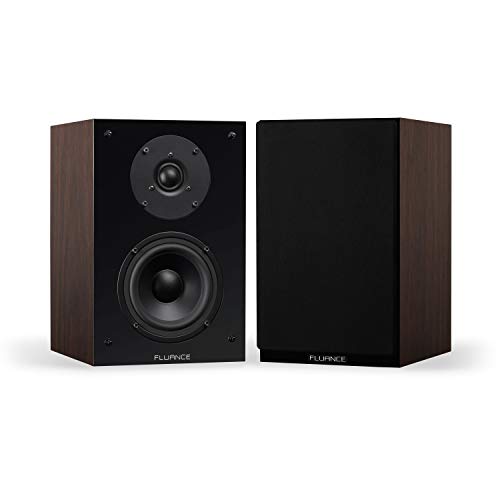
Fluance Elite SX6 — Stereo listener’s walnut pair
Fluance sells the SX6 in the natural walnut finish of this listing, and that choice signals the intended home: a living room where the speakers are furniture as well as equipment. The cabinet is larger than the Klipsch and Sony here, and the extra volume shows in the midrange, which carries voices and acoustic instruments with a warmth the smaller boxes cannot quite reach. This is the pair in the group most clearly voiced for two-channel music — long sessions, full albums, the radio left on through a slow afternoon.
The trade for that warmth is a softer attack. Drums and plucked strings arrive rounded rather than snapped, and listeners raised on the Klipsch school may find the SX6 polite. Its size also needs honest measuring before ordering: it is a bookshelf speaker in the traditional sense, which means a sturdy shelf or stands, not a narrow mantel. Fluance’s own line lets the pair graduate into a theatre later with matching centres and surrounds, but judged purely as a stereo pair — which is how its title frames it — the SX6 is the comfort choice of the six.
- Build: two-way design in a larger cabinet, natural walnut finish as titled
- Sold as: one pair
- Impedance: the listing headline does not give a figure, so Fluance’s SX6 product documentation is the place to verify it
- Amplification: passive; bring your own receiver or integrated amplifier
- Placement note: allow shelf depth for the bigger enclosure
Strengths
- Warm, full midrange that suits long music sessions
- Real-wood-look walnut finish that earns its place in a living room
- Larger cabinet gives bass more body than the compact picks
Trade-offs
- Bigger footprint rules out shallow shelves and tight desks
- Relaxed treble may underwhelm fans of bite and sparkle
- Less at home as a discreet surround speaker than the T15
Best for: a stereo-first living room where finish matters and sessions run long. Not suited for: cramped shelving, or listeners who want maximum treble incision.

Polk Signature Elite ES15 — The refined step up
The ES15 is what the T15’s owner buys a few years later. Polk’s Signature Elite line reworked the cabinet, the drivers, and the voicing targets of its mainstream range, and the result is a small speaker with noticeably smoother manners: treble that stays composed on female vocals and violins, a midrange with more body, and a contemporary walnut finish that looks deliberate next to a television. It also shares the family’s matching centre and surround models, so it can anchor a theatre that assembles itself gradually.
Refinement costs money, and the ES15 asks the highest commitment among the linked five — a fair exchange, but one that makes its advantages worth verifying against your priorities. If the speakers will live on a desk two feet from your ears, the Sony’s detail may serve you as well for less. If they will sit across a living room and carry both film nights and records, the ES15’s composure at distance is where its price goes. Polk positions the line for home entertainment broadly, and the ES15’s balance — neither shouty nor sleepy — is exactly that brief executed well.
- Layout: two-way pair from Polk’s Signature Elite line, contemporary walnut as titled
- Sold as: one pair
- Impedance: not given in the title — verify with Polk’s Signature Elite documentation for the ES15
- Amplification: passive; an external amplifier or receiver is required
- System path: matching Signature Elite centre and surround models exist
Strengths
- Smooth, composed treble that stays pleasant over long sessions
- Modern cabinet and finish that suit visible living-room placement
- Clear upgrade path within a matching home theatre family
Trade-offs
- Priciest of the linked pairs in this guide
- Still a small cabinet, so deep bass remains a subwoofer’s job
- Balanced voicing may feel restrained to fans of the Klipsch sound
Best for: a living-room system meant to grow, where polish matters as much as punch. Not suited for: the tightest budgets, which the T15 and Sony serve better.
Micca MB42X G2 — Prose-only: renewed listing
The MB42X G2 earned its reputation honestly. Where the cheapest small speakers once used a capacitor and hope, Micca fitted a proper crossover network, and the G2 generation tidied the design further — the result is a compact pair that sounds composed and coherent in desktop systems and small rooms, which is why it keeps appearing in budget recommendations year after year. As a route into passive speakers for very little money, the model’s logic remains sound.
The listing behind it, however, sells renewed units, and this guide does not attach purchase links to renewed stock. Renewed means the pair you receive has been returned, inspected, and resold; condition grading, accessory completeness, and warranty terms all differ from a new pair, and they differ between sellers. None of that makes the MB42X G2 a bad buy — it makes it a deliberate one. If you pursue it, buy through a channel with a clear returns policy, inspect the cabinets and drivers on arrival, and confirm the crossover-era model is the G2 rather than the earlier generation. Alternatively, treat this section as a pointer: the model is the recommendation, the renewed listing simply is not the way this guide will send you to it.
- Configuration: compact two-way pair with a real crossover network
- Sold as: renewed stock through the verified listing — no link provided here
- Impedance: check Micca’s MB42X G2 documentation directly; do not rely on marketplace summaries
- Amplification: passive; a small desktop or stereo amplifier is the usual partner
- Buying note: inspect on arrival and keep the returns window in mind
Strengths
- Proper crossover design rare among budget compact speakers
- Small footprint made for desktops and near-field listening
- Long track record with a large base of owner experience
Trade-offs
- Available listing is renewed, with the condition lottery that implies
- Limited bass, as with every cabinet of this size
- Warranty and accessories vary by renewed seller
Best for: a desktop system assembled patiently, by a buyer comfortable judging renewed condition on arrival. Not suited for: anyone who wants the certainty of a new pair with a full manufacturer warranty.
Reading the Six Cabinets Against Each Other
| Pick | Character | Cabinet | Impedance story | Natural home |
|---|---|---|---|---|
| Klipsch R-41M | Forward, lively, efficient | Smallest of the linked five | Confirm in Klipsch documentation | Study, bedroom, small lounge |
| Polk T15 | Agreeable all-rounder | Small, wall-mountable | Power figure in title; class in manual | First system, surround duty |
| Sony SS-CS5 | Detailed, airy, three-way | Compact, plain finish | Documented in a lower class by Sony | Desk and small-room stereo |
| Fluance SX6 | Warm, relaxed, full | Largest here, walnut finish | Verify in Fluance documentation | Music-first living room |
| Polk ES15 | Polished, balanced, modern | Compact, contemporary walnut | Verify in Polk’s ES documentation | Growing living-room theatre |
| Micca MB42X G2 | Coherent budget near-field | Very compact | Check Micca documentation directly | Desktop, bought as renewed |
Read the table as a map of temperaments rather than a league ladder. The Klipsch and the Fluance are almost opposite answers to the same question, and choosing between them is choosing how you like music presented: lit from the front, or settled into the sofa. The two Polks bookend a budget — the T15 spends its money on placement flexibility, the ES15 on finish and refinement — while the Sony is the technician’s favourite, the design that does the most engineering per unit of money. The Micca stands apart for a commercial reason rather than a sonic one: its stock status, not its sound, dictates how it should be bought.
How Should You Set Up a Small Passive Pair Once It Arrives?
Begin with geometry before touching a single setting. Tweeters belong roughly at ear height for your main seat, which usually means stands or a shelf that puts the cabinet’s top third near your head when seated. Form a triangle: the distance between the speakers should be close to the distance from each speaker to your chair, then adjust in small steps. A pair pushed into room corners gains boom and loses clarity; a pair given a hand’s breadth or more from the wall behind it usually breathes better, though rear-ported designs like the Klipsch appreciate the space most.
Cable is simpler than the internet suggests. Ordinary copper speaker wire of sensible thickness, cut to equal lengths for both channels, with clean bare-wire or banana connections, is all any speaker here requires. What matters is polarity: wire the red terminal to red at both ends, on both speakers, every time. A pair wired out of phase sounds strangely hollow in the centre, and it is the single most common cause of a new system disappointing its owner on the first evening. Check that before blaming the speakers.
Finally, give the system a week before judging it harshly. Part of that is the equipment settling, but most of it is your ears recalibrating from whatever you listened to before. Keep a few familiar recordings as references, change one variable at a time — toe-in, then distance from the wall, then height — and write down what you changed. Small passive speakers reward this patience disproportionately, because their limitations are mostly about placement physics rather than quality.
Which Pairing Mistakes Catch Buyers of Small Passive Speakers?
The classic error is shopping by the headline class alone and never opening the manual. As this guide’s six spec boxes show, titles routinely omit impedance, and the figure lives in manufacturer documentation. Two minutes there prevents the one genuinely bad pairing in this market: a low-class speaker on a feeble amplifier, played loud. The second error is the mirror image — fearing a documented lower class so much that a fine speaker like the Sony gets rejected for a system that would have driven it happily for a decade.
Power figures mislead in both directions. A speaker’s stated handling describes what it can survive, not what it needs, and an amplifier’s headline output describes one condition, not its character into real loads. Small speakers in normal rooms at normal volumes use very little power; damage comes from distortion when an undersized amplifier is pushed past its clean range, not from a modest amplifier used sensibly. The third recurring mistake is buying a pair when the listing sells a single cabinet, or the reverse — which is why every spec box above states the sales unit in words.
The last mistake is skipping the subwoofer question until after the speakers disappoint. Small cabinets cannot move much air, and no voicing trick repeals that. If your listening leans on film soundtracks, electronic music, or organ and orchestral weight, plan the subwoofer as part of the system from the start, and judge these pairs on the clarity and character they bring above the bass line — which is, in the end, the work they were designed to do.
How Much Amplifier Power Does a Bookshelf Pair Actually Use?
Less than the marketing on either box implies. In a typical room, at a volume you could hold a conversation over, a bookshelf pair draws a trickle of power — the loud passages and bass transients are where demand spikes, briefly, and amplifiers are built with headroom for exactly those moments. This is why the Klipsch, with its horn efficiency, can sound genuinely lively on a small amplifier while a less sensitive cabinet on the same amplifier feels restrained: the efficient speaker converts that trickle into more sound, leaving the amplifier further from its limits when a drum hit arrives.
The practical matching rule follows from that. Choose the amplifier for its features, its input count, its remote, and its behaviour into real speaker loads — not for the biggest number on its carton. Then choose the speaker for its voicing and its documented class. If the documented class is low and the amplifier is a featherweight budget model, keep your volume ambitions modest and your ventilation generous. Every other combination in this guide’s territory is, in practice, a non-event, and owners tie themselves in knots over a pairing question their equipment settled years ago.
What Changes When the Same Pair Moves From Desk to Lounge?
Distance rewrites a speaker’s character. At a desk, you hear mostly the speaker itself; across a lounge, you hear the speaker plus the room’s reflections, and the room’s share grows with every step back. Forward designs like the Klipsch and Sony hold their clarity over distance because their treble energy survives the journey. Warmer designs like the Fluance can seem to lose definition across a big room while sounding perfect near-field in reverse — the ES15’s treble, so polite up close, is the one that may feel restrained from the sofa.
Volume demands shift with distance too. Doubling the listening distance costs far more loudness than most people expect, which is where sensitivity and amplifier composure stop being spec-sheet trivia. A pair that delights at a desk on a compact amplifier may need a receiver with real substance to fill a lounge at film-night levels. None of this argues for buying the biggest speaker; it argues for buying for the seat you actually sit in, and for being honest about whether that seat is a desk chair or a sofa.
How Can You Compare Two Pairs at Home Without Fooling Yourself?
Level matching is the whole secret. The louder speaker in a quick comparison almost always sounds better — clearer, fuller, more exciting — regardless of its actual quality, so before judging anything, match the two pairs’ volumes on a familiar passage as closely as your equipment allows. Then listen longer than feels necessary. First impressions reward treble sparkle and bass emphasis; the qualities that matter over months — fatigue, vocal naturalness, how a speaker handles a bad recording — only surface across full albums and ordinary evenings.
Use the same placement for both pairs, the same recordings, and the same seat. Swap in days rather than minutes where you can, and note which pair you reach for when nobody is testing anything. That instinct, recorded honestly, is worth more than a spreadsheet of adjectives. If a retailer or marketplace returns window is part of your plan, keep packaging intact until the comparison ends — a small discipline that keeps your options genuinely open.
What About Pairing These Speakers With a Second-Hand Amplifier?
The used market is where passive speakers make their strongest economic case, because good amplifiers age slowly and sell cheaply. A decade-old receiver from a serious brand will drive every linked pair here without strain, and its documented behaviour into different load classes is usually a matter of public record in old manuals and reviews. That documentation matters more with used gear, not less: an ageing amplifier’s power supply is not what it was when new, so the marginal pairings — low documented class, high volumes — deserve extra respect.
Inspect before you trust. Scratchy volume controls, one channel quieter than the other, a protection relay that clicks during loud passages: each is a small symptom with a repair bill behind it. Buy from sellers who describe faults plainly, test at home volume first, and remember that the speaker cannot damage a healthy amplifier at sane levels — the risk in a used pairing runs almost entirely the other way, from a sick amplifier’s distortion into your new tweeters.
Should the System Start as Stereo or as the Front of a Theatre?
A pair of bookshelf speakers is rarely the end of a system; it is the first decision the rest of the system inherits. If films dominate your evenings, buy with the matching centre channel in mind, because dialogue pans across the front three speakers and a mismatched centre makes voices change character as they cross the screen. On that path, the two Polks and the Sony have the clearest family stories here: each sits inside a wider range with centres and surrounds voiced to match, so the system can grow one payday at a time without a tonal seam opening across the front.
If music dominates, the centre channel question evaporates and the choice narrows to voicing and room. Stereo also forgives mixing in a way theatre does not — a stereo pair answers only to your taste, not to a centre speaker’s timbre. The Fluance makes its strongest case in exactly this world, and the Klipsch’s efficiency flatters the small integrated amplifiers that stereo listeners favour. Decide which world you live in before ordering, because it quietly determines which of these six is the sensible first purchase and which are detours.
There is a third path worth naming: the desktop. Near-field listening at a desk is stereo in its purest modern form, and it rewards small cabinets, controlled dispersion, and detail at low volume. The Sony and the Micca were practically designed for that seat. A desktop system also sidesteps the room-filling question entirely, which is why a modest amplifier and a compact pair can outperform, in daily satisfaction, a larger system bought for a room it never quite suited.
What Do Stands, Cable and Small Hardware Actually Contribute?
Stands contribute height and stability, which is another way of saying they contribute correct tweeter placement and freedom from shelf resonance. A bookshelf speaker on a flimsy shelf shares its vibrations with everything else on that shelf; on a rigid stand at the right height, the same speaker sounds cleaner through the midrange in a way visitors notice without knowing why. If stands are impossible, isolation pads under the cabinets are a respectable second best, and they cost little.
Cable contributes reliability when it is adequate and nothing when it is extravagant. For the runs in a normal room, ordinary copper wire of sensible gauge, terminated cleanly, is the complete answer; money beyond that buys appearance and peace of mind rather than sound. Spend the difference on the unglamorous hardware that actually changes evenings: a subwoofer cable long enough to place the sub where it sounds best rather than where the short cable reaches, banana plugs if you swap equipment often, and a surge protector for the whole rack.
The last hardware item is the room itself. A rug between the speakers and the listening seat, soft furnishings on the wall behind the seat, and curtains over bare glass each do more for clarity than any accessory sold in a blister pack. Small speakers in a bare, echoing room will sound thin and aggressive no matter which of the six you choose; the same speakers in a furnished room sound like a considered system. Budget a thought for the room before budgeting for a replacement pair.
How Do These Pairs Handle the Music You Actually Play?
Streaming has quietly changed what speakers are asked to do. Much of modern listening is compressed, dynamically flattened, or mastered hot, and a ruthlessly revealing speaker makes those flaws the headline of every song. This is where the group’s temperaments sort themselves by playlist. The Klipsch and Sony present the recording as it is, which rewards well-made music and exposes the rest. The Fluance and the ES15 apply a measure of mercy, rounding the edges that streaming carves into recordings, and for many listeners that mercy is the difference between a system used daily and one admired occasionally.
Vinyl listeners face a different balance: surface noise and the occasional worn pressing benefit from the same forgiving voicings, while a clean pressing through the Sony’s extended treble can be genuinely thrilling. Podcast and radio listening — a larger share of real usage than audiophiles admit — rewards midrange clarity above everything, which is the T15’s home ground and the Klipsch’s party trick at low volume. Match the speaker to the library you have, not the library you describe at dinner parties, and the pairing tends to last.
What Should the Pre-Order Manual Check Actually Involve?
Five minutes with a manufacturer’s PDF will tell you more about living with a speaker than an hour of marketplace reviews. The manual confirms the nominal class in the maker’s own words, states the recommended amplifier range, gives the cabinet’s true dimensions and weight, and shows the rear panel — which settles whether the terminals take banana plugs, whether a wall bracket is expected, and where the port fires. Every surprise owners complain about in first-week reviews — the cabinet deeper than the shelf, the port booming against a wall, the amplifier pairing the maker never endorsed — is printed in that document before money changes hands.
Work through it in a fixed order. Dimensions first, because a speaker that does not fit is not a bargain at any price. Class and amplifier guidance second, against the amplifier you own rather than the one you might buy someday. Terminal and port details third, against the wall and shelf the pair will actually occupy. Then read the placement diagram, because makers draw the triangle they designed for, and their distances are a better starting point than forum folklore. Save the PDF with your receipt; if the system ever misbehaves, that document is the first thing support will ask about.
This habit also protects you from listing drift. Marketplace titles get edited, bundles change, and a model’s specification can be summarised wrongly by a seller who never opened the box. The manual is versioned, dated, and written by the company that warranties the product. When a title and a manual disagree, believe the manual — a principle this guide applied to every pick above, most visibly to the Sony, whose documentation tells a more interesting story than its listing ever will.
Which of These Voicings Suits the Room You Actually Have?
Rooms have temperaments just as speakers do. A small, furnished bedroom absorbs treble and flatters forward speakers; the Klipsch’s energy arrives there as clarity rather than glare. A large, hard-surfaced lounge does the opposite, multiplying reflections until a bright speaker sounds relentless — the Fluance and the ES15 were made for that room, their restraint turning into composure at distance. Kitchens and open-plan spaces add noise floors of their own, from appliances and conversation, and there the efficient, projecting Klipsch and the clear-voiced T15 cut through in a way a subtle speaker cannot.
Volume habits matter as much as surfaces. Quiet listeners should weight low-level detail: the Sony’s super tweeter earns its keep precisely at the volumes where other speakers go dull, and the Klipsch’s efficiency keeps dynamics alive without waking the house. Listeners who regularly fill a room for guests should weight composure instead — the ES15 and Fluance stay graceful as the dial climbs, while the smallest cabinets announce their limits. None of these judgements require golden ears; they require only that you describe your room and your evenings honestly before the boxes arrive.
Where Does a Subwoofer Fit Into a Bookshelf System?
Every speaker in this guide hands over the lowest octave to someone else, and in most rooms that someone should be a subwoofer. The handover matters more than the subwoofer’s size. Set the crossover where the bookshelf pair begins to fade — most receivers handle this with a setup routine and a microphone — and the subwoofer takes the strain that small woofers handle worst. The audible reward is not simply more bass; it is cleaner midrange, because the little cabinets stop wasting their limited excursion on frequencies they were never going to reproduce anyway.
Placement decides whether that reward arrives. A subwoofer in a corner gains output and loses definition; along a wall, pulled slightly into the room, it usually balances the two. The old advice to put the subwoofer in your listening chair and crawl around the room listening for the spot where bass sounds tightest is undignified and completely effective. One well-placed modest subwoofer beats a larger one parked wherever the furniture allowed, every time.
Do you need one at all? For a desk system playing music at arm’s length, honestly, no — the Sony and the Micca were voiced for exactly that life, and their owners rarely miss the bottom octave. For film nights, gaming, and any room where the speakers sit more than a couple of metres away, the subwoofer stops being an accessory and becomes the foundation the rest of the system stands on. Judge these six pairs on what they do above the handover, plan the subwoofer as a separate decision with its own placement experiment, and the system will sound like one instrument instead of two arguing.
Final Recommendation
For most people building a first or second passive system, the Polk Signature Elite ES15
is the pair to beat: composed, well finished, and ready to anchor a theatre that grows piece by piece. The Sony SS-CS5 is the value champion and the detail lover’s choice, bought with the single awareness that Sony documents it in a lower class than this search’s headline. The Klipsch R-41M wins small rooms and modest amplifiers outright, the Fluance SX6 owns the long, warm music session, and the T15 remains the easiest first step into component audio. The Micca is a fine model travelling through a renewed channel — respect the distinction and it can serve a desktop well. Whichever pair you choose, open its manual before its first loud evening, and let the documentation — not the shelf label — have the last word on matching.
One last word on sequencing. If you are buying the amplifier and the speakers together, choose the speakers first and the amplifier second: speakers determine the sound of the system and stay in service longest, while amplifiers are comparatively interchangeable and frequently discounted. If you already own the amplifier, let its documentation set the boundaries of the speaker search and then forget about matching entirely — within those boundaries, every linked pair above is a legitimate choice, and the decision returns to voicing, finish, and room, which is where it belonged all along.
Frequently Asked Questions
Why do so few of these listings state impedance in the title?
Marketplace titles are written to sell, and sellers lead with finish, driver counts, and use cases. Electrical details migrate to the product page’s specification table or the manufacturer’s manual, which is why this guide treats the maker’s documentation as the authority and tells you, for each pick, exactly which document settles the question.
Can one receiver drive a lower-class pair like the Sony alongside the others?
In a typical home theatre, yes. Mainstream receivers are designed with tolerance for mixed loads at domestic volumes, and the Sony’s class is a consideration for amplifier quality rather than a prohibition. Keep volumes sane, ensure ventilation, and the combination behaves.
Do any of these speakers work without an amplifier?
No. All six are passive designs without internal amplification, so each needs a receiver, an integrated amplifier, or a compact desktop amplifier between the source and the speakers. If wires to an amplifier are a deal-breaker, look at powered bookshelf models instead.
Is renewed audio equipment a sensible buy?
It can be, when the discount is real and the returns policy is strong. Speakers are comparatively simple devices, and a renewed pair that arrives clean and working will likely stay that way. The risk concentrates in cosmetics, missing accessories, and shortened warranty — all checkable within a returns window, which is how the Micca above should be approached.
How far from the wall should a bookshelf pair sit?
Start with the cabinet’s rear panel a moderate distance from the wall and experiment in small steps while listening to a familiar recording. Rear-ported models generally want more breathing room than sealed or front-ported ones; corners exaggerate bass in all of them. Your room’s answer will differ from any printed number, so trust the experiment over the estimate.
Does the nominal class affect sound quality by itself?
No. The class describes the load a speaker presents, not the quality of the sound it makes; excellent and mediocre speakers exist in every class. Judge a pair by its voicing, its drivers, and its behaviour in your room, and treat the class purely as a matching note between speaker and amplifier.
Can two different pairs from this guide share one system?
Yes, and it is a common growth path: a detailed pair at the front, an affordable pair as surrounds. Keep the front and centre channels from the same family where possible for film work, since voices pan across them; surround channels are far more forgiving of a different brand and class.
Related Guides
Building out the rest of the system? These companion guides cover the neighbouring shelves: our roundup of Bluetooth bookshelf speakers for wire-free rooms, the tower speaker picks that anchor a larger lounge, and complete 7.1 home theatre systems for film-first setups.


