What's inside
- Where to buy
- Key Takeaways
- Quick Picks
- How did we choose these add-on Atmos speakers?
- Upfiring or direct: which physics does your ceiling allow?
- Which add-on Atmos speakers belong in the same comparison?
- How do you set up height channels so they actually work?
- What mistakes do first-time Atmos buyers make?
- What does a .2 setup give you, and when is .4 worth it?
- How do height speakers behave across different kinds of content?
- What should you check on your receiver before any of these arrive?
- Final Recommendation
- Frequently Asked Questions
- Related Guides
As an Amazon Associate I earn from qualifying purchases. This post may contain affiliate links at no extra cost to you.
gizmoverdict.com is reader-supported. When you buy through links on our site, we may earn an affiliate commission.
Where to buy
All six height speakers in this guide are sold in pairs through Amazon’s US store, which suits the job: Atmos height channels are bought two at a time for a 5.1.2 layout, or four at a time for 5.1.4. Before ordering, confirm the one piece of hardware none of these speakers can replace — an AV receiver that actually decodes Dolby Atmos and offers height-channel outputs or assignable amplification. These are add-on speakers in the literal sense: they add the overhead layer to a system that already works, and connected to a stereo amplifier they add nothing at all.
The best add on atmos speakers divide into two families that solve the same problem with opposite physics, and this guide’s first job is to keep that divide honest. Upfiring modules sit on top of your existing front speakers and bounce the height channels off the ceiling toward your seat; they ask nothing of your walls and everything of your ceiling. Direct height speakers mount high on the wall or on the ceiling itself and fire straight at the listening position; they ask for cable runs, brackets and a little courage, and in return they work in rooms where a bounce never could. Rain in a film scene should fall from above you, not from somewhere vaguely in front — which family achieves that in your room depends on the ceiling over your sofa, and no product page will tell you. This guide will try.
A second honesty note: two of the six picks are Sony models from different generations, the original SSCSE and the newer SS-CSEM2. They are not a listing error, and they are not the same speaker. The newer model belongs to Sony’s current CS home-theatre series and is the better-matched partner for recent Sony speakers; the older one survives in this guide because it remains the cheapest credible way to test whether Atmos height effects matter to you before spending real money. Everything else here — Polk, Klipsch, SVS, JBL — stakes out a different point on the effort-versus-effect curve, and the right answer moves along that curve with your room, not with any ranking we could impose.
Key Takeaways
- An Atmos-capable AV receiver is non-negotiable: these speakers are passive height channels, and a stereo amp or a non-Atmos receiver gives them nothing to play.
- Flat, hard, standard-height ceilings are the upfiring family’s home turf — Polk XT90, both Sonys and the Klipsch in bounce mode all depend on that reflection behaving.
- Vaulted, beamed, very high or acoustically treated ceilings break the bounce; that is when the wall-mounted direct approach of the SVS Prime Elevation or JBL 240H stops being optional.
- The SVS Prime Elevation is the purist’s pick: a real speaker aimed at your seat, mountable on wall or ceiling, and convincing as a main or surround channel in its own right.
- Klipsch’s RP-500SA is the two-jobs pick — an upfiring Atmos module that can re-deploy as an angled wall surround if your layout changes.
- Buy the pair that matches your front speakers’ family where you can; height effects pan across the front stage, and a shared voicing keeps those pans seamless.
Quick Picks
| Pick | Badge | Why it earns its place |
|---|---|---|
| Polk Monitor XT90 | Best matched-system value | Height pair shaped to sit on Polk’s Monitor XT towers or wall-mount, bringing Atmos to an XT front stage without a voicing mismatch. |
| Sony SS-CSEM2 | Best current Sony upfiring pair | The newer-generation Sony bounce module, voiced for the current CS-series speakers, with a reinforced cellular cone build. |
| Klipsch RP-500SA | Most versatile pair | Reference Premiere build that works as an upfiring Atmos module today and an angled wall surround tomorrow. |
| SVS Prime Elevation | Best direct height speaker | A genuine full-range speaker that mounts high and fires at your seat — the answer for ceilings a bounce cannot use. |
| JBL Stage 2 240H | Best compact height module | A 4.5-inch height module from JBL’s Stage 2 line that mounts on the wall or partners the Stage 2 towers, in a warm espresso finish. |
| Sony SSCSE | Best budget experiment | The original Sony upfiring pair: the lowest-stakes way to discover whether ceiling-bounced Atmos earns a permanent place in your room. |
How did we choose these add-on Atmos speakers?
We judged these speakers against the rooms they will actually enter, which meant weighting placement honesty as heavily as sound. A height module that sounds superb in a demo room with a nine-foot plaster ceiling can be a pointless purchase in a loft with exposed beams, so every pick below is assessed with its placement conditions attached. Where a speaker only makes sense inside one manufacturer’s family — Polk’s XT90 on XT towers, JBL’s module in a Stage 2 system — we say so plainly, because an add-on that mismatches the front stage it sits on undermines the effect it was bought for.
Sound character still matters, differently than it does for main speakers. Height channels carry rain, aircraft, ricochets, the upper harmonics of a score and a great deal of a mix’s sense of space — material that is mostly transient and atmospheric. What we listen for is cleanliness at the top, freedom from boxiness when an effect swells, and enough sensitivity to keep up with the front speakers without the receiver’s calibration having to strain. None of these pairs needs to produce real bass; the receiver’s bass management hands everything low to the speakers and subwoofer that already handle it.
We also kept the upgrade path in view. Many readers are buying their first pair of height speakers with a second pair pencilled in for a future .4 layout, and a sensible add-on choice is one that can move — from front-height duty to rear-height duty, or from bounce duty to surround duty — when that day comes. The Klipsch and SVS picks score heavily there. The Sonys score on a different axis: being the rational first step, cheap enough to be an experiment and good enough that the experiment is fair.
Upfiring or direct: which physics does your ceiling allow?
The upfiring idea is elegant. A speaker angled upward from the top of your front tower fires the height channel at the ceiling, and the ceiling — flat, hard and reflective — mirrors it down to your seat, rather as a bank shot in pool uses the cushion. Dolby’s own guidance for these modules assumes a ceiling that is flat, made of a reflective material such as plaster or drywall, and roughly eight to fourteen feet high. Inside that envelope, the illusion can be startlingly good: the brain locates the sound where the reflection arrives from, which is above, and asks no further questions. Outside that envelope — vaulted ceilings that throw the reflection past the sofa, beams that scatter it, ceiling fans parked in the bounce path, heavy acoustic treatment that swallows it — the bank shot misses, and no calibration microphone can call it back.
Direct height speakers refuse the gamble. Mounted high on the front wall, angled down at the listening position — or mounted on the ceiling itself — they deliver the height channel on a straight line, and straight lines do not care about your architecture. The cost is installation: cable must climb a wall, brackets must hold, and the speakers remain visible as speakers, which some rooms welcome as intent and others resent as clutter. There is also a character difference even in perfect rooms. A bounced effect arrives diffuse, spread by the ceiling, which suits ambience and weather. A direct effect arrives with a location you can point at, which suits flyovers and anything the mixer placed deliberately. Many enthusiasts who try both end up preferring direct for precision and keeping an affection for bounce as the zero-effort miracle it can be in the right room.
One more variable belongs in this section because it quietly decides real purchases: viewing distance. The bounce geometry works best when the seat is neither jammed under the speakers nor so far back that the reflection lands behind the listener. Long rooms favour direct mounting for the same reason short, tidy rooms flatter upfiring modules. Measure your ceiling height, look up at what is actually up there — fans, beams, coffers, a chandelier with ambitions — and the family choice usually makes itself before any brand enters the conversation.

Polk Monitor XT90 — Best matched-system value
The XT90 is the height channel Polk built for its own Monitor XT ecosystem, and that parentage is its argument. The cabinet is shaped to sit neatly on top of the XT60 and XT70 towers, angled to throw the bounce at the ceiling, and the voicing is drawn from the same family as those towers and the XT centre — so when an effect climbs from the front stage into the ceiling and back down, it crosses between speakers without changing accent. In Atmos, that continuity is not a luxury. A helicopter that changes tone as it rises sounds like two helicopters; the XT90’s job is to make sure Polk owners never hear the join.
Wall mounting is the second string: the XT90 can go high on the wall as a direct height speaker, which rescues it from the bounce family’s ceiling dependency and makes it a reasonable buy even for XT owners whose ceilings will not cooperate. As a pure product it sits in the sensible middle of this guide — not the cheapest experiment, not the premium statement — and its sound follows that brief: clean, unfussy height effects that integrate rather than show off. Owners of other brands’ towers can of course perch a pair on top too, since a flat cabinet bottom is a flat cabinet bottom, but the voicing argument weakens and the visual fit may wobble; this pick’s value is concentrated where its surname matches the speakers beneath it.
There is a quieter virtue worth naming: the XT line is one of the most common first serious home-theatre purchases, which means the XT90 is, for a large population of readers, the add-on that arrives with the least research debt. The receiver settings, the placement guidance, the matching centre and surrounds all come from one coherent system design. Atmos upgrades fail socially more often than sonically — a tangle of mismatched boxes that never quite gets calibrated and quietly gets sold. A matched module that goes in on a Saturday morning and simply belongs is a genuine defence against that fate.
Calibration notes for XT90 owners are reassuringly dull, which is a compliment. The module’s sensitivity and voicing sit comfortably alongside the towers beneath it, so receiver room-correction typically lands the height channels near the front stage’s levels rather than dragging them up or down by large margins. That balance shows in use: effects leave the front speakers and arrive overhead without a volume step at the border. Systems that need heroic calibration to integrate a height pair are telling you the pair does not belong; the XT90, on its own family’s towers, raises no such complaint.
- Configuration: height speaker pair for Dolby Atmos systems
- Placement: sits atop Monitor XT towers, or wall-mounted
- Family: Monitor XT series, voiced to match XT fronts and centre
- Finish: midnight black
- Power: unpowered cabinet — your Atmos receiver supplies the height channels
Strengths
- Voicing continuity with XT front speakers keeps pans and flyovers seamless across the front stage.
- Dual placement — tower-top bounce or wall-mounted direct — covers both ceiling situations for XT owners.
- Sized and styled to disappear on the towers it was designed for, rather than perch awkwardly.
Trade-offs
- The value case is strongest inside the Polk XT family; owners of other towers get a good speaker but not the matching argument.
- As a bounce module it still obeys ceiling physics — a vaulted room needs it wall-mounted, with the cable work that implies.
- Mid-priced positioning means budget experimenters should look at the Sony SSCSE first.
Best for: Monitor XT owners adding Atmos the way the system designer intended. Not suited for: anyone without an Atmos receiver, or bounce use under a beamed or vaulted ceiling.

Sony SS-CSEM2 — Best current Sony upfiring pair
The SS-CSEM2 is Sony’s current-generation answer to the bounce module, part of the CS home-theatre speaker series, and it supersedes the older SSCSE elsewhere in this guide in the ways that matter to a new buyer: it is the model voiced and styled to sit with Sony’s present-day CS front speakers, and its reinforced cellular cone construction speaks to a stiffer, cleaner driver than its price-class ancestor. Upfiring modules live or die on the clarity of their upper registers — the reflection off a ceiling strips energy, so what leaves the speaker must start clean — and that is exactly where a newer driver design earns its keep.
Placement is the classic recipe: the pair sits on top of your front left and right speakers, angled up, and the ceiling does the rest, subject to all the ceiling conditions laid out earlier. Sony’s CS ecosystem is one of the most widely owned entry routes into component home theatre, so for a large readership this is the no-asterisk recommendation among the bounce modules: current model, matching family, no discontinued-stock detective work. It will also sit happily on non-Sony towers in a purely physical sense, but the same surname logic as the Polk applies — buy the module that matches your fronts when a matching module exists.
Compared directly with its own ancestor, the buying logic runs like this. If you are building or refreshing a Sony CS system now, the CSEM2 is the correct purchase and the price gap buys you the current voicing and a long production life ahead of it. If you already own the older SSCSE, nothing about the newer model obliges an upgrade — height channels are the most forgiving seats in the house, and the generational gap is refinement, not transformation. This guide lists both because both situations walk through the door every week, and pretending the older speaker vanished would serve neither reader.
One practical detail deserves daylight: because the CSEM2 exists to top a pair of front speakers, its footprint and weight are proportioned for that perch, sitting stably on tower and larger bookshelf cabinets alike. Bookshelf-front systems are common in Sony CS setups, and a module that only balanced on a wide tower top would exclude them. Check your front speakers’ top surface for depth and any slope before ordering any bounce module — most are flat, some are styled — because a module that cannot sit flat cannot aim its bounce, and no driver quality compensates for a crooked launch angle.
- Configuration: Dolby Atmos enabled upfiring height speakers, pair
- Series: Sony CS home-theatre speaker family, current generation
- Driver construction: reinforced cellular cone design
- Placement: atop front left and right speakers, ceiling-bounce
- Power: passive design, driven from the receiver’s height outputs
Strengths
- The current Sony module: voicing and styling matched to today’s CS front stage.
- Clean, stiff driver design suits the bounce path, which punishes muddy treble.
- Zero-installation placement — set them on the towers, run the cable, calibrate, done.
Trade-offs
- Pure bounce design: no wall-mount second life if your ceiling refuses to cooperate.
- Costs more than the older SSCSE while doing the same fundamental job.
- Owners of non-Sony fronts lose the matching argument that justifies choosing it over rivals.
Best for: Sony CS system owners adding Atmos with the current, matched module. Not suited for: vaulted-ceiling rooms, where a direct-firing pick is the honest answer.

Klipsch RP-500SA — Most versatile pair
The RP-500SA is the overachiever of this guide: a Reference Premiere speaker in a wedge cabinet that begins life as an upfiring Atmos module sitting on your front towers, and can be reborn — via its switchable design and wall-mounting provision — as an angled surround or height speaker firing directly at the room. That dual citizenship changes the long-term maths. A bounce module that stops suiting your room is a sunk cost; the Klipsch simply changes jobs. In a hobby where layouts churn — new house, new sofa position, a receiver upgrade that unlocks more channels — a speaker with two careers is worth a premium over one with a single trick.
Klipsch’s house character rides along: horn-loaded treble with the efficiency and snap that make effects feel immediate. Height material is full of transients — the crack of thunder, the tick of rain on a roof in the mix, a rotor’s edge — and the RP-500SA renders them with a clarity that survives the ceiling bounce better than mellower designs. The Reference Premiere build is also a cut above the entry class in cabinet and finish; in ebony, these look like furniture-grade objects on top of a tower rather than accessories, which matters in living rooms that are not dedicated theatres.
The cautions are the honest Klipsch ones. That lively top end, in a small hard room, can tip from vivid to insistent if the receiver’s calibration is left to defaults and forgotten; run the room correction, then listen and trim. And the price of versatility plus brand plus build is a price — this is among the more expensive pairs here, bought with money that a pure bounce buyer could save with the Sonys. The Klipsch case is not “best bounce module”; it is “the height speaker least likely to be made redundant by your next decision,” and for serial upgraders that is the correct thing to buy.
The switchable crossover at the heart of the RP-500SA’s double life is worth understanding before purchase, because it is a setting, not a spell. In Atmos mode the speaker is configured for the bounce role; in surround mode it is reconfigured for direct duty on the wall. The change takes moments, but it does mean the speaker should be installed where its rear remains reachable, and that owners should note which mode each unit is in when a system is re-calibrated months later. Treated as a deliberate feature rather than a party trick, it is the most grown-up piece of engineering in this guide.
- Configuration: Dolby Atmos / surround speaker pair, switchable role
- Placement: atop front speakers for bounce, or wall-mounted as direct surround/height
- Series: Klipsch Reference Premiere
- Finish: ebony
- Amplification: passive — needs Atmos AVR channels
Strengths
- Two careers in one cabinet — bounce module today, direct surround or height speaker tomorrow.
- Horn-loaded clarity keeps height transients distinct after a ceiling reflection.
- Reference Premiere cabinet and finish stand up to living-room scrutiny.
Trade-offs
- Premium pricing for flexibility a settled, never-changing system may never use.
- Lively treble demands proper calibration in small, reflective rooms.
- Heavier and more visually assertive on a tower top than the low-profile modules.
Best for: upgraders and room-changers who want height speakers that survive their own future plans. Not suited for: the strict budget experiment, where the SSCSE answers the same question for less.
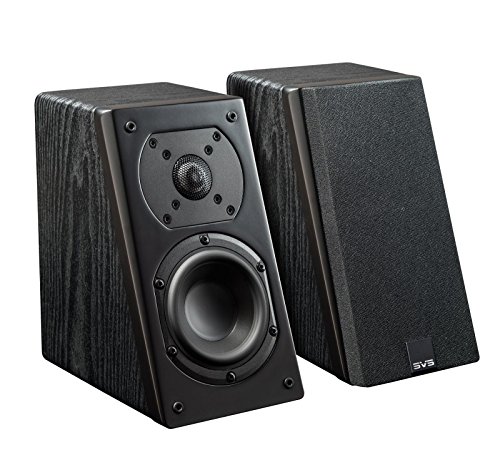
SVS Prime Elevation — Best direct height speaker
SVS looked at the bounce compromise and declined it. The Prime Elevation is a complete, full-range speaker in an angled cabinet, designed to mount high on a wall — or on the ceiling — and fire the height channel directly at the listeners. No reflection, no ceiling conditions, no geometry prayer. In a room with a vault, beams, a fan or heavy treatment, this is not the premium option; it is the only option among these six that keeps its promise. Its angled baffle aims the drivers down the wall toward the seats, and SVS supplies the mounting thinking to make that installation tidy rather than improvised.
Because it is a real speaker rather than a module, the Prime Elevation keeps being useful in configurations the bounce boxes cannot touch. It serves as a front height, a rear height, a surround in a system short on floor space, even a main speaker in a compact setup — and it sounds like one, with the composure at volume that SVS’s subwoofer fame sometimes makes people forget the company also builds into its speakers. Height effects delivered this way have an address: a plane crosses at a place, not in a region. Mixers who place objects precisely reward that directness, and action films are full of their work.
The bill arrives as installation. Cable must reach the top of a wall; brackets must be fixed into something solid; a pair of visible speakers joins the room’s architecture. Renters and the drill-averse should weigh that honestly against the bounce family’s five-minute placement. There is also a system-planning subtlety: direct heights this capable invite being fed properly, so receiver calibration and sensible crossover settings matter more, not less. But for the reader whose ceiling disqualifies bounce, or whose standards simply do, this is the pick the rest of the guide has been pointing at — the height speaker with no asterisk.
Mounting confidence is part of what the Prime Elevation’s price buys. A speaker intended to live at the top of a wall, angled down, must hold its aim for years through door slams, bass and building movement, and SVS designs the mounting interface as part of the speaker rather than leaving owners to improvise with generic brackets. That matters more than it sounds: a height speaker that has sagged five degrees over two years is quietly mis-aimed, and the owner blames the format. Buy the speaker whose maker sweated the bracket, and check the aim whenever the room is redecorated or the speakers are dusted down and remounted.
- Configuration: direct-radiating height speaker pair
- Placement: high wall mount or ceiling mount, angled toward seats
- Series: SVS Prime
- Finish: premium black ash
- Power: no built-in amplification; an Atmos AVR channel pair is required
Strengths
- Direct delivery ignores ceiling shape, height and material entirely.
- A genuine full-range speaker: redeploys as surround or compact main without apology.
- Precise localisation of placed effects — flyovers land where the mixer put them.
Trade-offs
- Real installation: wall cable runs, solid fixings, visible cabinets.
- Among the pricier pairs here, reflecting that it is a full speaker, not a module.
- Its capability is wasted as a casual experiment — buy it when you mean it.
Best for: difficult ceilings, dedicated rooms and anyone who wants height channels done definitively. Not suited for: renters or minimalists who need placement to be reversible in minutes.

JBL Stage 2 240H — Best compact height module
JBL’s Stage 2 240H takes the direct approach at a smaller scale and a friendlier footprint. It is a 4.5-inch height module from the Stage 2 speaker family, designed to mount high on the wall and aim the height channel at the listening area, and styled — in its espresso finish — to sit with the Stage 2 towers and bookshelf speakers as part of one designed system. Where the SVS is a full speaker moonlighting in height duty, the 240H is a specialist: compact, purposeful, and easy to place in pairs without the front wall turning into a speaker showroom.
That specialisation suits the most common real-world upgrade: a Stage 2 owner with a normal room who wants Atmos without rethinking the front stage. Wall-mounting frees the 240H from the bounce family’s ceiling demands while keeping the cabinet small enough that two of them read as an intentional detail rather than an invasion. Sound follows the module brief — height material is effects and atmosphere, and a well-behaved compact driver, crossed over to the system’s larger speakers and subwoofer by the receiver, covers that brief cleanly. Expecting it to double as a main speaker would misunderstand it; the SVS exists for readers who want that.
JBL’s long cinema heritage is worth a sentence here, because height channels are cinema technology arriving home. The company voices its consumer lines with a confidence that effects will be played at real levels in real rooms, and the Stage 2 system as a whole is tuned as a set. Bought as the matching module for Stage 2 fronts, the 240H inherits that set logic: calibration behaves, pans cohere, and the upgrade feels like completing the system rather than bolting on a stranger. Bought standalone for another brand’s fronts, it remains a tidy, capable little height speaker — the surname logic is a bonus, not a barrier.
Scale is the 240H’s quiet argument. In flats and smaller living rooms, a pair of full-size direct speakers at the top of the front wall can dominate the room’s visual field out of all proportion to the seconds of overhead audio in an evening’s viewing. The JBL modules keep the promise — real, direct, ceiling-independent height — at a size the room can absorb. There is a system-design honesty in that: the height channels carry the least audio information of any in the layout, and a module sized to that truth, voiced to match its fronts, is engineering proportioned to the job rather than to a showroom.
- Configuration: Dolby Atmos height module, pair
- Driver: 4.5-inch module design
- Placement: high wall mount, direct-firing
- Series: JBL Stage 2, matched to Stage 2 fronts
- Finish: espresso
Strengths
- Direct-firing certainty in a compact cabinet that suits ordinary living rooms.
- Designed as the Stage 2 system’s own height channel — matching voicing for JBL owners.
- Wall placement keeps tower tops clear and the look deliberate.
Trade-offs
- A specialist module: not a candidate to redeploy as a main or surround speaker later.
- Wall mounting still means cable up a wall, even if the cabinets are small.
- Its best case is inside a Stage 2 system; other owners should compare the SVS’s flexibility.
Best for: JBL Stage 2 owners and compact rooms wanting direct height without full-size speakers. Not suited for: buyers who want one pair of speakers to cover several future roles.

Sony SSCSE — Best budget experiment
The SSCSE is the speaker that introduced a generation of living rooms to Atmos, and its role in 2026 is clear-eyed: it is the experiment pair. Four-inch-class upfiring modules, sold as a pair, voiced for Sony’s earlier CS-era systems, they sit on your front speakers and answer the only question a first-time buyer truly has — does height audio matter in my room, with my ceiling, for the films I actually watch? Answering that question with the cheapest credible hardware is not settling; it is good method. If the answer is no, little is lost. If the answer is yes, you now know your ceiling cooperates, and every future upgrade decision gets easier.
Within its brief, the SSCSE is a respectable performer: height effects arrive with the diffusion that bounce does well, dialogue-adjacent material stays clean, and the modules are light, small and visually negligible on a tower top. Its limits are the limits of its generation and price — less refinement in the driver than the newer CSEM2, a plainer cabinet, and a voicing match aimed at older Sony fronts rather than the current line. None of that prevents it from doing the experiment honestly, which is precisely why this guide keeps it listed alongside its successor instead of quietly replacing one with the other.
There is also a secondhand-economics angle worth stating for completeness: long production life means wide availability and a gentle used market, which suits the experiment framing perfectly. Buy the pair, live with them through a dozen films — a storm scene, a flyover, a quiet scene where the room tone itself seems to gain a ceiling — and then decide with evidence whether Atmos is a permanent layer of your system or a curiosity you have satisfied. Few purchases in home theatre offer that clean a trial, and none of the other five pairs here is priced to be one.
Expectations, set correctly, are the SSCSE’s best accessory. These modules will not turn a stereo-era soundtrack into a cathedral, and they will not match the placed precision of the SVS firing straight at you. What they do — reliably, in suitable rooms — is lift the ceiling off a film. First-time owners consistently describe the same surprise: not a dramatic effect, but scenes feeling taller and weather feeling like weather. Judged as the purchase of that sensation at the lowest fair price, rather than against speakers costing several times more, the little Sonys remain an easy recommendation after all these years.
- Configuration: Dolby Atmos enabled upfiring speakers, pair
- Driver: 4-inch class module
- Placement: atop front left and right speakers, ceiling-bounce
- Series: earlier Sony CS-era home theatre family
- Power: passive, fed by assigned height channels on an Atmos receiver
Strengths
- The lowest-stakes fair test of Atmos height in your own room and ceiling.
- Small, light and visually quiet on top of existing front speakers.
- Long production run means easy availability, new or used.
Trade-offs
- Superseded by the SS-CSEM2 for buyers building a current Sony CS system.
- Bounce-only: a non-cooperative ceiling defeats it completely.
- Plainest cabinet and least refined driver of the six picks.
Best for: first-time Atmos buyers running the experiment, and owners of older Sony CS systems. Not suited for: new Sony builds, where the CSEM2 is the matched current model.
Which add-on Atmos speakers belong in the same comparison?
| Speaker | Family | Placement | Ceiling demands | Signature strength |
|---|---|---|---|---|
| Polk Monitor XT90 | Upfiring or wall | On XT towers, or wall-mounted | Moderate — wall option escapes them | Matched voicing for Polk XT systems |
| Sony SS-CSEM2 | Upfiring | Atop front speakers | Flat, reflective, standard height | Current-generation Sony CS match |
| Klipsch RP-500SA | Upfiring or direct | Tower top, or wall as surround/height | Low — role switch escapes them | Two careers in one cabinet |
| SVS Prime Elevation | Direct | High wall or ceiling mount | None | A real speaker aimed at the seat |
| JBL Stage 2 240H | Direct | High wall mount | None | Compact matched module for Stage 2 |
| Sony SSCSE | Upfiring | Atop front speakers | Flat, reflective, standard height | The low-cost Atmos experiment |
The ceiling-demands column is the one to read first, because it eliminates picks honestly: if your ceiling cannot bounce, three of the six leave the conversation and the direct trio remains. Only after that cut does family matching — Polk with Polk, Sony with Sony, JBL with JBL — and budget decide among the survivors.
How do you set up height channels so they actually work?
Placement first. Bounce modules sit flat and secure on the front speakers, as close to the front edge as their design intends, with nothing above them but ceiling — check for a ceiling fan or a low beam parked in the reflection path before blaming the speakers. Direct heights mount as high as the front wall allows, angled toward the main seat, far enough apart to mirror the front speakers’ spread. In both families, the pair should be roughly above the front left and right speakers for a .2 layout; a .4 layout adds the second pair above or behind the listening position, following your receiver’s layout diagram rather than improvisation.
Then hand the system to calibration, and actually let it finish. Modern room correction measures distance, level and the peculiar way your ceiling returned the bounce, and it sets crossovers that hand the height channels only what they should carry. After calibration, verify with material you know: a rain scene should build a ceiling of weather, not two speakers clearing their throats; a flyover should travel. If a bounce setup sounds localised at the tower tops, the reflection is not arriving — experiment with a few inches of module position and seat position before concluding the ceiling has failed you. If a direct setup sounds harsh, check the aim: a height speaker firing over your head into the back wall is a placement error, not a character trait.
Levels deserve a calm word. New owners often bump height channels up several decibels to “hear the Atmos,” which turns a mix into a demonstration and ruins the envelopment that is the actual point. Run calibrated levels for a week of normal viewing. Height audio done right is noticed in aggregate — scenes feel taller, rooms feel larger — far more than in isolated effects. If, after that week, a specific kind of content feels under-served, a single decibel of trim is a tuning choice; five is a different mix, and it is rarely the one the film’s makers signed off.
What mistakes do first-time Atmos buyers make?
The expensive mistake is sequence: speakers first, receiver second. Add-on height speakers are passive and specific — they need height-channel amplification and Atmos decoding, which means a receiver that offers both, with enough powered channels for the layout you plan. A 5.1 receiver with pre-outs it cannot decode is not a shortcut. The second mistake is ceiling denial: buying bounce modules for a cathedral ceiling because the modules were on sale, then concluding Atmos is a gimmick when the geometry never had a chance. The technology is honest; the match was not.
Third, mismatching by indifference. Height modules are voiced as parts of systems, and while cross-brand experiments can work, the front stage is where pans live; a module from the same family as your fronts removes a variable you do not need. Fourth, judging Atmos by a single scene in a single film on the first night. Mixes vary enormously — some films live overhead, others visit twice. A fair trial is a shelf of films across a fortnight, at calibrated levels, which is exactly the trial the SSCSE’s price exists to make affordable.
What does a .2 setup give you, and when is .4 worth it?
A single pair of height speakers — the .2 in 5.1.2 — creates the ceiling. Weather gains altitude, large rooms in films gain their upper half, and flyovers acquire a genuine overhead moment as they cross. For most living rooms and most film libraries, that is the majority of what Atmos promises, delivered for one pair of speakers and two channels of amplification. It is not a teaser version of the real thing; it is the real thing at its most efficient, which is why every pick in this guide is sold as a pair and why we keep recommending the staged approach: one pair, properly placed and calibrated, lived with honestly.
The second pair, making .4, adds travel. With heights front and rear, an overhead effect can move — a plane does not just appear above you, it crosses the ceiling from the screen to behind your seat, and rain becomes a volume rather than a layer. The gain is real but narrower than the first pair’s: you are refining motion, not adding a dimension. It also costs more than speakers; the receiver must power or provide for four height channels, which pushes some buyers up a receiver tier. The sensible sequence is to choose first-pair speakers that can become the rear pair later — the Klipsch and SVS redeploy gracefully, matched modules simply repeat — and let a year of .2 viewing tell you whether your film habits justify the travel upgrade.
There is one layout trap to name: placing a single pair in the middle of the ceiling’s possibilities, neither clearly front nor rear, hoping to average the benefit. Receiver layouts are written for defined positions — front height or top front, in the usual terminology — and calibration assumes the speakers are where the layout says they are. A pair fudged into an in-between position confuses the mapping and smears exactly the localisation Atmos exists to create. Pick the position your receiver offers, mount or place for that position, and let the object-based mix do its work as designed.
How do height speakers behave across different kinds of content?
Action cinema is the demo case, and it flatters every pick in this guide. The subtler tests are more informative. A drama set in a real location — a farmhouse in a storm, a city apartment with traffic below and weather above — uses height channels for room tone, and a good height setup makes the space feel built rather than described. Bounce modules, with their diffuse arrival, are quietly excellent here: the ceiling of sound has no edges. Direct heights answer with definition; the same storm has individual gusts. Neither is wrong, and living with both styles across friends’ systems is how most listeners discover their own preference, which is a taste, not a measurement.
Sport and games divide differently again. Broadcast sport uses height sparingly, mostly crowd envelopment, where diffusion wins and even modest modules shine. Modern games, by contrast, place objects with intent — aircraft, weather, threats above — and reward the direct speakers’ precision, provided the game’s audio mode and the receiver agree on the layout. Music is the honest footnote: most recordings have no height content at all, and upmixing modes that borrow the height speakers are a matter of taste, to be auditioned rather than assumed. Buy height speakers for film and games, let music be a bonus if your ears like the upmix, and no pick here will disappoint you.
What should you check on your receiver before any of these arrive?
Receivers describe their abilities in a shorthand that rewards slow reading. The channel notation — 5.1, 7.1, 5.1.2 — counts powered speaker outputs and the subwoofer, and the final number in an Atmos layout is the height count the receiver can actually drive. Some receivers process more channels than they power, offering pre-outs for the difference; that is a legitimate path, but it means an external amplifier joins the shopping list, and it should join it knowingly. Check, too, that the receiver’s assignable channels can be configured as heights in the layout you intend, because flexibility on paper sometimes means a choice between rear surrounds and heights rather than both.
Room correction deserves its own line in the checklist, because with height speakers it stops being a convenience and becomes part of the product. The calibration microphone is what tells the receiver where the bounce actually lands, how far the direct heights really are, and how the ceiling has coloured everything. A receiver whose correction system you trust, run carefully — microphone at ear height at the main seat, room quiet, measurements at the positions the manual asks for — will make modest height speakers sound integrated. Skipped or sloppy calibration will make excellent ones sound like a novelty. Budget the twenty minutes; it is the highest-value step in the entire upgrade.
Finally, confirm the content path end to end. Atmos arrives from streaming services, discs and games through specific apps, tiers and settings, and a television’s audio return settings can quietly fold it back to plain surround. None of that is the speakers’ fault, but the speakers will be blamed for it on the first night. A ten-minute audit — source, app tier, TV audio setting, receiver display reading the format you expect — before the first film turns the unboxing into a premiere instead of a troubleshooting session, and it costs nothing but the decision to do it first.
Final Recommendation
One closing observation from years of watching these upgrades land: nobody who placed a suitable pair carefully, calibrated honestly and lived with the result for a month has ever described the height layer as a gimmick. The regrets cluster entirely around the avoidable errors — the wrong receiver, the impossible ceiling, the module bought for a system it did not match. This guide has tried to route you around each of them in turn.
Start with your ceiling, not with a brand. Under a flat, ordinary ceiling, the bounce family is legitimate and the choice narrows to family matching: Polk XT90 for XT owners, Sony’s current SS-CSEM2 for CS owners, the older SSCSE when the honest goal is a low-cost trial. If your layout may change or your tastes run lively, the Klipsch RP-500SA buys insurance in both directions. Under any ceiling that will not bounce — vaulted, beamed, treated or simply very tall — stop shopping modules and mount real speakers: the SVS Prime Elevation for the definitive version, JBL’s compact 240H where a Stage 2 system and a smaller footprint point that way. In a rented flat with a plaster ceiling and a curious owner, though, the wisest first move in this whole guide remains the humble one: a pair of SSCSE, a fortnight of films, and a decision made with your own ceiling’s evidence.
Frequently Asked Questions
Do add-on Atmos speakers work with any receiver?
No. They are passive speakers that need an AV receiver with Dolby Atmos decoding and powered height channels (or assignable channels configured as heights). A stereo amplifier or a non-Atmos surround receiver gives them nothing to reproduce. Check your receiver’s channel count and layout support — 5.1.2, 5.1.4 — before choosing how many pairs to buy.
Is upfiring or direct height better?
Direct is more certain and more precise; upfiring is far easier and, under a suitable ceiling, genuinely convincing. The deciding factor is the room: flat, reflective ceilings of ordinary height flatter bounce modules, while vaulted, beamed or treated ceilings make direct mounting the only honest route. Neither family is a universal winner.
How high should my ceiling be for upfiring speakers?
The bounce works best with ceilings roughly in the eight-to-fourteen-foot range, flat and made of a sound-reflective material. Much lower and the reflection arrives too hot and localised; much higher and it disperses before it reaches you. Ceiling fans, beams and coffers in the reflection path are each capable of spoiling the effect on their own.
Can I use these as regular surround speakers?
Some can. The SVS Prime Elevation is a full-range speaker that serves as a surround without qualification, and the Klipsch RP-500SA is designed to switch into surround duty. Pure bounce modules — the Sonys and, in tower-top mode, the Polk — are voiced and angled for the ceiling trick and make poor surrounds. Check the individual pick sections before planning a redeployment.
Do I need two pairs for a full Atmos setup?
One pair gives a .2 layout, which delivers most of the overhead effect and is the sensible starting point. A second pair, for .4, adds front-to-back overhead movement and smoother flyovers. Many listeners start with one pair, confirm the ceiling and the receiver cooperate, and add the second pair later — the speakers in this guide are sold in pairs precisely to allow that path.
Can I start with height speakers at the rear instead of the front?
Most receiver layouts expect the first height pair at the front, and front placement is the right default: the screen is where the mix anchors its world, and overhead effects relate to it. Some layouts and direct-mount speakers permit rear-first arrangements, but follow your receiver’s defined positions rather than improvising — calibration assumes the speakers occupy a position the layout knows about.
What cable do height speakers need?
Ordinary speaker cable, run within walls or along them according to your local codes and your tolerance for visible runs. Direct heights need the longest runs in most systems, since the cable climbs a wall; measure with slack for the mounting position before cutting. Bounce modules need only short runs to the front speakers’ neighbourhood, one more point in their favour for tidy rooms.
Should the height speakers match my front speakers’ brand?
Where a matching module exists, yes — pans across the front stage stay seamless when the voicing is shared, which is why the Polk, Sony and JBL picks are framed around their own ecosystems. Cross-brand setups can still work after careful calibration, but matching removes a variable from a system that already has several.
Related Guides
Height speakers complete a system whose foundation is the front pair, so the best floor standing stereo speakers guide is the natural companion read. For rooms where speakers must cover space rather than surround a sofa, our best 70v ceiling speakers roundup covers the commercial distributed-audio approach instead.



[…] a stereo pair anchors the room, height channels are the usual next step — see the best add on atmos speakers guide for the module and direct-mount options. For sound that leaves the living room entirely, the […]