Our Top Picks
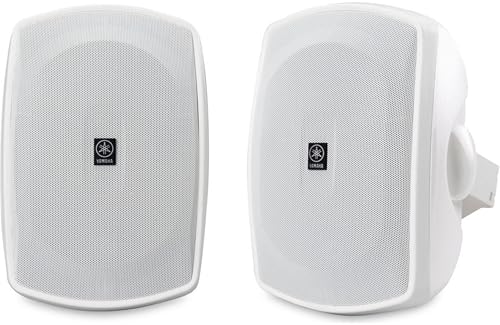 Yamaha NS-AW390 All Weather Indoor/Outdoor 6.5-inch 2-Way SpeakersPair14.2 x 8.8 x 17.6 inches8.3 poundsCheck on Amazon
 Yamaha NS-IC800 140 Watt 8-Inch 2-Way In-Ceiling Speakers8-Inch4.3 x 11 x 11 inches4.2 poundsCheck on Amazon

What's inside
- What the R-N602 actually delivers
- Sensitivity arithmetic: turning decibels into listening levels
- Impedance behaviour: the load the amplifier actually sees
- The bookshelf class: stand-mount speakers with this amplifier
- Floor-standing speakers: when towers earn their space
- Matching tonal balance to a neutral receiver
- The subwoofer pre-out: building a 2.1 system
- A/B switching: two pairs, one amplifier
- Speaker wire: gauge, length and terminations
- Phono and streaming sources: how much resolution is worth buying
- Placement and room: the cheapest component in the system
- Check prices on Amazon
- Shortlist logic: three listener profiles
As an Amazon Associate I earn from qualifying purchases. This post may contain affiliate links at no extra cost to you.
The Yamaha R-N602 occupies a useful middle ground in two-channel audio. It is a network receiver rather than a surround processor, so its amplifier budget goes into two channels instead of seven, and its feature list reads like a summary of how people actually listen now: MusicCast streaming over wired and wireless networks, internet radio, a moving-magnet phono input for a turntable, digital inputs for a television or disc player, and a front panel that still offers tone controls and a headphone socket. Published specifications rate the amplifier at 80 watts per channel into 8 ohms with 0.04 percent total harmonic distortion, and that single line, read carefully, determines almost everything about which passive speakers will suit it.
Some links in this guide are affiliate links, and a purchase made through one may pay the publisher a small commission without changing what the reader pays. Everything that follows rests on manufacturer specification sheets, receiver and loudspeaker manuals, and aggregated owner feedback, and readers should confirm any figure that matters to a purchase against the current manual for the exact model under consideration.
Speaker matching is often presented as a matter of taste, as if any box could be bolted to any amplifier and the result settled by preference alone. The electrical reality is narrower and more interesting. A loudspeaker is a load whose resistance changes with frequency, whose appetite for current peaks exactly where music gets difficult, and whose loudness per watt varies by a factor of four across common designs. The R-N602, like every amplifier, has a finite power supply, a finite ability to deliver current into awkward loads, and protection behaviour that intervenes when those limits are crossed. Choosing well means reading three numbers on the speaker’s specification sheet — sensitivity, nominal impedance, and the shape of the impedance curve where it is published — and translating them into the listening distance and room size at hand.
This guide works through that translation in order. It begins with what the receiver genuinely delivers, moves through the arithmetic of sensitivity and impedance, compares the bookshelf and floor-standing classes, and then covers the subwoofer output, the A/B speaker switching, wire gauge, sources, and placement. The closing section reduces the whole discussion to three listener profiles, because the right answer for a desk in a small study is not the right answer for a long living room, even when the amplifier in the middle never changes.
What the R-N602 actually delivers
The headline rating deserves unpacking, because power figures are only comparable when their conditions match. Eighty watts per channel into 8 ohms at 0.04 percent THD describes a measurement taken with a resistive 8-ohm load, both channels driven, across a stated frequency range. A resistive load is the kindest possible burden: its voltage and current stay in step, and it never asks the amplifier for more current at one frequency than at another. A real loudspeaker is not resistive. Its impedance may sit at 8 ohms through the midrange, dip toward 4 ohms in the upper bass, and rise past 20 ohms at a resonance peak, while its phase angle swings so that current and voltage fall out of step and the amplifier’s output devices work harder for the same delivered watts. The 80-watt figure is therefore a benchmark of capability, not a promise that every speaker will receive a clean 80 watts at every frequency.
Dynamic headroom matters as much as the continuous figure, because music is not a steady tone. A recording with a 15 dB crest factor — the gap between average level and the loudest peaks — asks for roughly thirty times the average power on its peaks. If a listener’s average level at the seat needs 2 watts, the peaks need about 63 watts, which sits inside the R-N602’s rating with little to spare. If the average needs 4 watts, the peaks ask for about 126 watts and the amplifier will clip or compress them no matter how the volume control is set. This is why sensitivity, covered in the next section, dominates real-world matching: a speaker that reaches the target level on 2 average watts leaves the receiver comfortable, while one needing 8 average watts pushes the same receiver into audible strain on every chorus.
Current delivery is the second half of the power story. Power into a load equals voltage multiplied by current, and halving the load impedance from 8 ohms to 4 ohms doubles the current demanded at the same output voltage. An amplifier that can swing enough voltage for 80 watts into 8 ohms would theoretically deliver 160 watts into 4 ohms, but only if its power supply and output stage can supply twice the current without sagging or triggering protection. Most receivers in this class cannot do that indefinitely, which is why their manuals steer owners toward higher-impedance speakers and why the impedance selector exists. The selector, discussed in detail below, typically lowers the amplifier’s rail voltage in its low setting, trading peak output for cooler, safer operation into low-impedance loads.
Damping factor, the ratio of load impedance to the amplifier’s output impedance, describes how firmly the amplifier controls woofer cone movement after the signal stops. A high damping factor means the amplifier acts as a near short circuit to the back electromotive force the moving cone generates, so bass notes start and stop cleanly. In practice, once damping factor exceeds a few dozen, the resistance of the speaker cable and the voice coil itself dominate the total, and further increases bring little audible change. The practical lesson for R-N602 owners is not to chase a specification but to keep cable runs reasonably short and thick enough that the cable does not become the weakest link in cone control, a point the wire section quantifies.
The receiver’s remaining specifications shape speaker choice in quieter ways. Its phono stage expects a moving-magnet cartridge, so the turntable side of a system is conventional and forgiving. Its subwoofer pre-out is a line-level mono feed, which means bass management happens in the subwoofer rather than in the receiver, with consequences the subwoofer section explores. Its A/B switching lets two pairs share one amplifier, which sounds simple until parallel impedance enters the picture. And its tone controls, loudness function and streaming sources all interact with speaker voicing, because a speaker chosen to flatter one source may expose the weaknesses of another.
Sensitivity arithmetic: turning decibels into listening levels
Sensitivity is the most useful number on a speaker’s specification sheet and the most frequently misread. The usual form, such as 88 dB at 2.83 volts and 1 metre, states the sound pressure level the speaker produces on axis at a distance of one metre when fed 2.83 volts. That voltage is chosen because it delivers exactly 1 watt into an 8-ohm load: power equals voltage squared divided by resistance, and 2.83 squared divided by 8 is almost exactly one. Into a 4-ohm speaker, however, the same 2.83 volts delivers 2 watts, so a 4-ohm speaker rated by voltage rather than by watt appears about 3 dB more sensitive than an 8-ohm speaker of identical true efficiency. Careful comparison therefore converts every rating to a per-watt basis before ranking anything, subtracting roughly 3 dB from voltage-based figures for 4-ohm models.
From the one-metre figure, two rules generate every estimate a buyer needs. First, each doubling of power adds 3 dB, so 2 watts gives 3 dB more than the sensitivity figure, 10 watts gives 10 dB more, and the full 80 watts gives about 19 dB more. Second, in free space each doubling of distance subtracts 6 dB, although a normal room returns some of that loss through reflections, typically softening the real penalty to roughly 3 to 4 dB per doubling at the listening seat. Applying both rules to an 88 dB speaker at a 3-metre seat: the free-field distance loss from 1 to 3 metres is about 9.5 dB, room reflections return perhaps 3 dB of it, and 80 watts adds 19 dB, giving a peak capability near 100 dB at the seat before the amplifier runs out of voltage. Average listening at 80 dB then leaves about 20 dB of headroom, enough for almost any recording.
Repeat the same arithmetic across the sensitivity range and the matching logic becomes obvious. An 86 dB bookshelf speaker at 3 metres reaches peaks near 98 dB on the full output and needs about 8 watts to hold an 85 dB average with peaks intact only if those peaks stay modest; demanding programme will clip. An 89 dB model gains a full power doubling over the 86 dB design, needing half the watts for every level, and a 92 dB floor-stander needs half again, reaching the same seat levels on a quarter of the power the 86 dB speaker requires. Six decibels of sensitivity is not a small refinement. It is the difference between an amplifier cruising and an amplifier straining, multiplied across every note the system ever plays.
Distance punishes complacency just as reliably. Moving the seat from 2 metres to 4 metres costs roughly 6 dB in free-field terms and perhaps 4 dB in a furnished room, which is equivalent to throwing away three quarters of the amplifier’s power. A pairing that sounds effortless across a small room can therefore feel thin in a long one even at identical volume settings, and the cure is sensitivity or proximity rather than a bigger receiver. Nearfield listeners enjoy the opposite bargain: at a 1-metre desk distance, even an 85 dB speaker needs only a fraction of a watt for an 80 dB average, and the R-N602’s reserves become almost irrelevant beside tonal balance and placement.
Manufacturer sensitivity figures carry their own caveats. Some are measured in an anechoic chamber, others are calculated from driver parameters, and a few are quoted in-room, which flatters the number by several decibels. Bandwidth matters too, because a speaker can post a healthy midrange sensitivity while its bass output falls away early, leaving it sounding smaller than the figure suggests. The sensible approach treats published sensitivity as accurate to within about 2 dB, compares models measured the same way where possible, and leaves headroom in the budget of power rather than planning to use the receiver’s last watt as a matter of routine. Readers comparing the broad class should start with best 8 ohm bookshelf speakers, where the 8-ohm stand-mount field is laid out on a consistent basis.
A worked example ties the rules together. Take a speaker rated at 87 dB with 2.83 volts at 1 metre and a nominal impedance of 6 ohms. Because 2.83 volts into 6 ohms delivers about 1.33 watts rather than 1 watt, its per-watt sensitivity is closer to 85.8 dB. Fed the receiver’s full 80 watts — a power gain of 19 dB — it would reach about 105 dB at 1 metre in free space, and at a 3-metre seat, after roughly 9.5 dB of distance loss softened by perhaps 3 dB of room return, peaks near 98 dB are realistic. An owner listening at an 82 dB average therefore holds about 16 dB of headroom, which suits most rock and jazz recordings, whose crest factors commonly sit between 12 and 18 dB, while the widest-range orchestral material will occasionally ask for more and briefly clip. Swapping to a 90 dB speaker of similar impedance restores that margin entirely, which is why experienced buyers treat a 3 dB sensitivity advantage as equivalent to doubling the amplifier, because in power terms that is exactly what it is.
Impedance behaviour: the load the amplifier actually sees
Nominal impedance is a label, not a measurement. A speaker sold as 8 ohms may measure anywhere between about 6 and 30 ohms depending on frequency, and standards permit the minimum impedance to fall to roughly 80 percent of the nominal figure, so a nominal 8-ohm design may dip to about 6.4 ohms and a nominal 6-ohm design to about 4.8 ohms. What matters to the R-N602 is where those dips occur and what the phase angle is doing at the same frequencies. A dip to 5 ohms at 200 hertz, where music carries substantial energy, asks for heavy current. A dip to the same value at 15 kilohertz, where programme energy is tiny, is nearly irrelevant. Published impedance curves, available for many models in manufacturer data and independent measurement reports, reveal this geography at a glance.
Phase angle is the hidden multiplier. Where the phase angle reaches 40 or 50 degrees near an impedance minimum, the load becomes partly reactive, and the amplifier must supply current at moments when its output voltage is high, which stresses output devices far more than the wattage alone implies. A useful rule of thumb treats a speaker whose minimum impedance coincides with a steep phase angle as one nominal class harder to drive than its label claims. An 8-ohm speaker with a 6-ohm minimum and gentle phase is an easy load for this receiver. A 4-ohm speaker dipping to 3.2 ohms with a 45-degree phase swing in the bass is a genuinely difficult one, whatever the brochure calls it.
The R-N602’s impedance selector exists to manage exactly this risk. In its higher setting the amplifier runs full rail voltage and delivers its rated output into 8-ohm loads. In the lower setting the rails drop, peak power falls — often by a third or more into higher impedances — but the amplifier runs cooler and its protection intervenes later into low-impedance speakers. Owners sometimes treat the selector as a quality switch and leave it high with 4-ohm speakers attached, reasoning that more voltage must sound better. The manual’s guidance points the other way: the low setting is the honest match for low-impedance loads during sustained loud listening, while the high setting with an easy 8-ohm speaker preserves full dynamics. The audible difference at moderate levels is small either way; the thermal difference during a long, loud session is not.
Six-ohm speakers, a common category among Japanese and European designs, sit comfortably with this receiver. A 6-ohm nominal model with a minimum near 4.5 ohms draws about a third more current than an 8-ohm speaker at the same voltage, which the R-N602 can supply for programme material without complaint, particularly at the listening levels most rooms allow. Four-ohm speakers deserve case-by-case reading of the impedance curve rather than a blanket verdict. A 4-ohm design with a benign curve and high sensitivity may ask for less current at real listening levels than a low-sensitivity 6-ohm design played louder to compensate, because current follows the level actually demanded, not the label on the box.
Two practical checks close the subject. First, ventilation: current becomes heat, and a receiver driving low impedances at high level needs clear space above its vents regardless of selector position. Second, protection behaviour: if the receiver shuts down at levels that should be comfortable, the cause is usually a difficult load, a strand of wire shorting at a terminal, or both, and the remedy is diagnosis rather than a higher volume setting. Impedance problems announce themselves as heat, distortion that arrives suddenly rather than gradually, or shutdown, and each symptom maps to a specific fix.
The bookshelf class: stand-mount speakers with this amplifier
Bookshelf speakers, more accurately called stand-mounts, are the natural first consideration for the R-N602 because their typical sensitivity and impedance suit its output and because most listening rooms in apartments and smaller houses cannot exploit what a tower adds. The common formats divide by woofer diameter. Models built around a 5.25-inch woofer balance cabinet size against bass reach, usually rolling off somewhere between 55 and 70 hertz in-room, while 6.5-inch designs extend perhaps 5 to 10 hertz lower and move more air at the cost of a wider baffle and a larger box. The receiver’s 80 watts drive either size without strain at desk and small-room distances, so the choice turns on placement and bass expectations rather than power.
Rear ports define the placement rules for most of this class. A ported cabinet tunes its enclosure by letting the port radiate the woofer’s rear energy in phase near the tuning frequency, and that output needs room to develop. Placed within a few centimetres of a wall, a rear-ported speaker gains boundary reinforcement that can add several decibels in the upper bass, which some listeners enjoy as warmth and others hear as boom, while the port itself may produce audible chuffing on bass-heavy material if its airflow is obstructed. Manufacturers commonly suggest 20 to 50 centimetres of clearance behind rear-ported designs. Front-ported and sealed models tolerate shelves and wall proximity far better, which is why the port location on a specification sheet deserves as much attention as the frequency response line. Shoppers focused on the smaller format will find the field organised in best 5 25 bookshelf speakers.
Stands are not furniture in this context; they are part of the speaker. A stand-mount performs as designed when its tweeter sits near ear height at the seat, typically 90 to 110 centimetres from the floor depending on seating, and when the cabinet is coupled to something rigid enough not to store and re-radiate energy. Hollow stands can be filled with dry sand or similar ballast to lower their resonance and add stability. Placing stand-mounts directly on a bookshelf or sideboard invites the supporting surface to join in as an unintended sounding board, muddying the lower midrange, although dense foam isolation pads under the cabinets reduce that coupling substantially when shelves are the only option.
Desk use is a distinct discipline within the class. At a 1-metre listening distance the inverse-square arithmetic is so favourable that sensitivity almost stops mattering, and the deciding factors become nearfield smoothness, controlled dispersion so that small head movements do not swing the tonal balance, and freedom from port noise at close range. Raising desk speakers on small stands or wedges so the tweeters aim at ear level, rather than at the listener’s chest, recovers treble detail that no tone control can restore. The R-N602 serves a desk system well, although its full-size chassis needs a home beside rather than on most desks, with the speakers cabled back to it.
Owner feedback on this pairing pattern is consistent: small speakers on proper stands, given a little air behind them, satisfy most listeners in rooms up to about 15 square metres, and dissatisfaction usually traces to bass quantity rather than quality. That is precisely the gap the subwoofer output exists to fill, and a stand-mount plus subwoofer combination, covered below, often outperforms a similarly priced tower in a small room because the subwoofer can sit where the bass works best instead of where the stereo image demands the speakers stand.
Floor-standing speakers: when towers earn their space
Floor-standers justify themselves through physics rather than presence. A taller cabinet offers internal volume that a stand-mount cannot match, and volume is what lets a ported design tune lower without heroic driver excursion. Towers also stack drivers vertically: a dedicated midrange unit relieved of bass duty, one or more woofers sharing the low-frequency work, and a tweeter placed at ear height by the cabinet’s own stature, with no stand to buy or topple. Many towers post sensitivity figures of 89 to 92 dB, several decibels above typical stand-mounts, because larger enclosures and multiple drivers convert watts into sound more efficiently. For the R-N602 that efficiency is valuable, since a 91 dB tower needs roughly a quarter of the power an 85 dB bookshelf speaker needs for the same seat level.
The counterweight is load complexity. A three-way tower with twin woofers can present a lower and more reactive impedance curve than a simple two-way bookshelf design, particularly where the woofers are wired in parallel and their impedance minima coincide. Twin-woofer models with a nominal 6-ohm rating and a minimum near 3.5 ohms exist and sound excellent on amplifiers built for them, but they ask more of the R-N602 than its selector setting and power supply prefer during loud listening. Reading the impedance curve matters more, not less, as speakers grow. A benign 8-ohm tower with a 90 dB sensitivity is one of the easiest loads this receiver will ever meet; a low-impedance tower can be the hardest.
Room size draws the practical boundary. Below about 18 to 20 square metres, a tower’s extended bass excites room modes — the standing waves set by the room’s dimensions — more strongly, and the lowest octave can arrive unevenly, booming at some seats and vanishing at others. In larger rooms the same extension fills the space evenly and the tower’s headroom advantage becomes real, because the seat is farther away and the distance losses computed earlier must be repaid in watts or sensitivity. Ceiling height plays a supporting role: tall rooms dilute bass reinforcement from boundaries, favouring speakers that generate their own low-frequency output rather than borrowing it from walls.
Multi-way designs also change the crossover geography. A two-way stand-mount crosses from woofer to tweeter somewhere between 1.8 and 3 kilohertz, in the region where hearing is most sensitive, and the quality of that handover defines the speaker’s midrange coherence. A three-way tower inserts a midrange driver and moves the lower crossover down to a few hundred hertz, freeing the woofer from midrange duty and the tweeter from the lower treble, at the cost of a more complex network that must keep three drivers in agreement. Neither approach is inherently superior at this receiver’s level; execution decides, and published measurements of off-axis response reveal execution more honestly than driver counts do. The tower field for stereo receivers is surveyed in best floor standing stereo speakers.
Budget logic, expressed without figures, runs as follows. A tower consumes more of any budget in cabinet, drivers and shipping, leaving less for the refinement of each component, while a stand-mount concentrates spending on two drivers and a smaller box but then asks for stands. At the level of system the R-N602 anchors, the stand-mount plus subwoofer route and the moderate tower route converge in capability from opposite directions, and the room, not fashion, should arbitrate between them.
Matching tonal balance to a neutral receiver
Yamaha’s two-channel receivers have a long-standing reputation for a neutral, comparatively uncoloured presentation, and the R-N602 follows that house pattern according to its published response figures and owner reports. A neutral amplifier neither warms nor brightens what passes through it, which transfers the voicing decision entirely to the speakers and the room. That transfer is liberating and dangerous in equal measure: the speaker’s own balance will be heard plainly, and any treble emphasis or midrange dip designed into it will survive to the seat undiluted by amplifier character.
Treble energy deserves the closest scrutiny because rooms treat it asymmetrically. Hard surfaces — bare floors, plaster walls, large windows — reflect high frequencies efficiently, so a speaker with a rising treble response can sound progressively more aggressive as the room gets more reflective, while carpets, upholstered furniture and bookshelves absorb treble and leave the same speaker sounding balanced. Published on-axis and off-axis response plots predict this interaction: a design whose off-axis treble falls smoothly tends to sound even in lively rooms, because much of what reaches the ear in a real room is reflected sound carrying that off-axis signature. A design with a narrow treble peak on axis and ragged off-axis behaviour is the one that draws complaints about brightness that no specification headline warned about.
The midrange is where this receiver and its likely speakers spend their working lives. Voices, piano, acoustic guitar and the fundamental range of most instruments sit between roughly 200 hertz and 3 kilohertz, and a speaker that keeps that span level within a couple of decibels will sound natural on the widest range of recordings. Some designs deliberately recess the presence region slightly, which flatters harsh recordings and widens the perceived soundstage, while others lift it, bringing vocal detail forward at the risk of hardness on close-miked material. Neither voicing is a defect; the match depends on the listener’s catalogue. A collection dominated by modern, brightly mastered recordings usually pairs better with the gentler presentation, while older, softer recordings reward the more explicit one.
Tone controls on the receiver offer a final trim rather than a rescue. Bass and treble shelves of a few decibels can compensate for a room’s broad tendencies or a speaker’s mild excess, and the variable loudness control exists to restore low-level bass and treble audibility at quiet listening levels, when human hearing naturally loses sensitivity at the frequency extremes. What tone controls cannot do is repair a narrow response peak, a port resonance or a crossover discontinuity, because those faults occupy thin slices of frequency that broad shelves overshoot on both sides. The buying rule follows directly: choose the speaker whose native balance suits the room, then trim with the controls, never the reverse.
Break-in claims deserve a calm word here. Drivers’ suspensions do loosen slightly over early use and some manufacturers acknowledge small parameter shifts across the first hours of playing, but the large tonal transformations sometimes described in owner forums exceed anything those shifts can explain; listener acclimatisation does most of that work. A speaker that sounds harsh on day one in a reflective room will, in all probability, sound harsh on day thirty in the same room, and buying decisions should be made on that assumption.
The subwoofer pre-out: building a 2.1 system
The R-N602 provides a dedicated subwoofer pre-out, a line-level feed that lets a powered subwoofer take over the lowest frequencies the main speakers cannot reproduce cleanly. The receiver itself applies no crossover to its main speaker outputs, which continue to receive a full-range signal, so bass management in an R-N602 system happens entirely inside the subwoofer: its low-pass filter sets how high it plays, its gain sets how loud, and its phase control aligns its output with the main speakers at the crossover region. Understanding that division of labour prevents the most common setup error, which is expecting the receiver to relieve the main speakers of bass duty automatically. It does not, unless the owner inserts an external high-pass arrangement, and most systems instead let the mains roll off naturally while the subwoofer fills beneath them.
That natural-roll-off method works best with stand-mount speakers, whose own bass decline begins between about 60 and 80 hertz in-room. Setting the subwoofer’s low-pass filter near the mains’ roll-off point — often 60 to 80 hertz for larger stand-mounts, 80 to 100 hertz for compact ones — lets the subwoofer take over where the mains fade, and a slope of 24 dB per octave, common on plate amplifiers, keeps the overlap region narrow. Towers that already reach 35 to 45 hertz need the subwoofer only for the deepest content in film soundtracks and electronic music, and their owners can set the crossover lower, near 40 to 50 hertz, or leave the subwoofer off for most stereo listening.
Phase and placement decide whether the addition integrates or merely accumulates. At an 80-hertz crossover the wavelength is about 4.3 metres, so moving the subwoofer half a metre changes its phase relationship with the mains substantially at the seat, which is why subwoofers offer a phase dial or polarity switch and why small placement adjustments produce outsized differences. The practical method uses familiar music with steady bass lines: adjust the crossover first, then the phase for the fullest response at the seat, then the gain last, lowering it until the subwoofer stops announcing its location and the bass simply seems to belong to the main speakers. Bass that draws attention to a corner of the room is bass set too high or crossed too high, because localisation cues return as the subwoofer plays into the lower midrange.
The benefits compound beyond deeper notes. A subwoofer’s dedicated amplifier absorbs the most power-hungry frequencies in music, and although the R-N602 still drives its mains full-range, the perceived headroom of the system rises because the small woofers of stand-mount speakers stop distorting on deep bass they were never built to reproduce; their cones no longer flap at the limits of excursion, and the midrange clears audibly on bass-heavy material. Intermodulation distortion falls for the same reason: a cone reproducing a loud 50-hertz note while also tracing a 500-hertz signal modulates the higher frequency with the lower, and removing the deep bass from that cone removes the mechanism.
Single versus dual subwoofers is a question of seat count. One subwoofer, carefully placed, can be evened out at a single listening position, but room modes guarantee that other seats hear a different bass balance. A second subwoofer, placed asymmetrically, smooths the response across a wider area because the two excite the room’s modes differently and their errors partially cancel. The R-N602’s single pre-out feeds two subwoofers through a simple splitter cable without difficulty, since the input impedance of subwoofer plate amplifiers is high and the receiver’s output drives the combined load easily. For a single-seat stereo system the second subwoofer is a refinement; for a sofa of listeners it is closer to a necessity.
A/B switching: two pairs, one amplifier
The A/B speaker switching on the R-N602 invites a second pair of speakers — in another room, on a patio run, or simply a second set in the same room for a different seat — and the invitation conceals an electrical condition that the manual states plainly and owners overlook regularly. When both A and B pairs play simultaneously, the receiver connects them in parallel across the same amplifier channels. Parallel impedance follows the reciprocal rule: two 8-ohm pairs present 4 ohms, two 6-ohm pairs present 3 ohms, and an 8-ohm pair beside a 6-ohm pair presents about 3.4 ohms. Each of those combined loads sits below what the amplifier prefers, which is why receiver manuals of this class specify higher minimum impedances for speakers intended to run together, commonly 8 ohms per pair when both pairs will play at once.
The consequences scale with volume. At background levels a 4-ohm combined load draws modest current and the receiver copes indefinitely. At party levels the same load asks for current the power supply cannot sustain, heat accumulates, and protection eventually intervenes — correctly, since it exists to save the output stage. Owners planning simultaneous pairs should therefore choose 8-ohm speakers for both locations, keep the impedance selector in the position the manual prescribes for the combined load, and ensure ventilation. Pairs used strictly one at a time face no such constraint, and the switch then becomes what it appears to be: a convenient selector between two systems sharing one set of sources.
Wire runs to a second zone introduce their own arithmetic, because a pair in another room may sit 12 or 15 metres of cable away from the receiver, and cable resistance rises with length. The wire section below gives the gauge calculations; for a second-zone run the sensible habit is to step one gauge thicker than the same speakers would need beside the amplifier. Volume balance between zones also needs thought, since the receiver offers one volume control for both pairs. A more sensitive second pair will play louder than the main pair at every setting, so matching sensitivities within a couple of decibels keeps both rooms at civilised relative levels, and an in-line volume control in the second zone restores independent adjustment where the mismatch matters.
Same-room dual pairs are a different hobby entirely. Running two pairs together in one room for a bigger sound usually produces comb filtering, as the same signal arrives from two locations with slightly different path lengths and cancels at frequencies whose wavelengths match the difference. The result measures and sounds worse than either pair alone at most seats. The A/B switch serves comparison and distribution, not summation, and owners curious about a fuller presentation will get it more honestly from the subwoofer route or from larger main speakers.
Speaker wire: gauge, length and terminations
Speaker cable has one job that matters electrically: to present a resistance low enough that it neither wastes amplifier power nor disturbs the speaker’s frequency response by interacting with its varying impedance. The governing figure is the loop resistance of the full run — out and back — and a widely used target keeps that loop below about 5 percent of the speaker’s minimum impedance, which for an 8-ohm speaker means roughly 0.4 ohms and for a 4-ohm speaker roughly 0.2 ohms. Copper wire of 16 gauge has a resistance of about 13 milliohms per metre per conductor, so a 5-metre run forms a 10-metre loop of about 0.13 ohms, comfortably inside the target for 8-ohm speakers. Fourteen gauge, at about 8 milliohms per metre, extends the same comfort to roughly 8 metres, and 12 gauge, near 5 milliohms per metre, covers runs beyond 12 metres or low-impedance speakers at moderate distances.
The frequency-response mechanism deserves explanation because it converts a vague warning into a checkable prediction. The cable’s resistance sits in series with the speaker, forming a divider whose ratio changes as the speaker’s impedance changes with frequency. Where the speaker’s impedance peaks at 25 ohms, a 0.2-ohm cable steals almost nothing; where the impedance dips to 5 ohms, the same cable steals about 4 percent of the voltage, roughly a third of a decibel. Thin cable over long runs therefore tilts the response in sympathy with the impedance curve, dipping exactly where the speaker dips. Keeping loop resistance low keeps that tilt below audibility, and no exotic construction is required to achieve it — ordinary oxygen-free or even standard electrolytic copper of adequate gauge performs identically at audio frequencies, because skin effect at 20 kilohertz in these gauges is negligible.
Terminations are about reliability over years rather than sound over minutes. The R-N602’s binding posts accept bare wire, spade lugs and banana plugs. Bare wire, freshly stripped and tightly clamped, makes excellent contact on day one and oxidises thereafter, so it rewards an annual loosening and retightening. Banana plugs trade a whisper of contact area for the ability to disconnect and reconnect without fraying, which suits anyone who moves speakers for cleaning or comparison, and they reduce the stray-strand short circuits that bare wire invites at crowded rear panels. Spades suit permanent installations where the posts can be tightened down hard. Whichever method is chosen, the discipline that matters is inspecting that no stray strand bridges the two terminals, because a single whisker of copper across the outputs is a short circuit the protection circuit will meet at the worst moment.
Length discipline completes the subject. Excess cable should not be coiled tightly behind the receiver, since a coil adds a small inductance and, more practically, a tangle that traps heat and frustrates fault-finding; gentle folds or a shortened run are both better. The two channels’ cables need not match to the centimetre — a metre’s difference changes resistance by about a hundredth of an ohm in 14 gauge, which is inaudible — but wildly different lengths with thin cable can unbalance the channels slightly, one more reason to buy adequate gauge once and cut it sensibly.
Phono and streaming sources: how much resolution is worth buying
The R-N602 gathers sources of very different inherent quality, and speaker resolution only pays where the sources can feed it. Its moving-magnet phono input serves a turntable directly, and a vinyl front end of ordinary competence delivers a signal whose noise floor, channel separation and high-frequency reach are all modest beside digital sources: surface noise sits perhaps 55 to 65 dB below programme, separation is commonly 25 to 35 dB in the midrange, and cartridge and pressing limitations soften the top octave. A highly revealing speaker will render those limitations faithfully, which some vinyl listeners love as atmosphere and others hear as a spotlight on every tick. Readers weighing a self-amplified route for a record-focused setup should also look at best powered bookshelf speakers for vinyl, while remembering that powered speakers bypass the R-N602’s amplifier entirely and belong on a line-level output rather than its speaker terminals.
Streaming through MusicCast spans an equally wide range. Lossless files and high-quality streams from a home network carry the full resolution of their masters, internet radio may arrive heavily compressed, and Bluetooth from a phone applies its own codec compromises. The receiver handles the decoding competently in each case, so the speaker becomes the honest reporter of whatever arrived. A system used mainly for background radio and compressed streams gains little from the most resolving speakers in its class, whose extra clarity mostly documents the compression. A system fed lossless files and well-recorded material repays that same resolution every day, because the information the fine speakers reveal is actually present to be revealed.
The practical synthesis is to budget resolution against the dominant source. Vinyl-led systems often pair happiest with speakers whose balance is slightly forgiving in the top octave and whose midrange is generous, since the format’s strengths are tonal and rhythmic rather than microscopic. Streaming-led systems built on lossless libraries can exploit neutral, extended speakers fully. Mixed systems, which describe most R-N602 installations, point to the middle path: an even midrange, a treble that extends without emphasis, and bass managed by placement or a subwoofer rather than by a built-in lift that flatters one source and bloats another.
Placement and room: the cheapest component in the system
Placement changes a speaker’s measured response at the seat by more decibels than separate the cheapest and dearest models in this class, and it costs nothing but attention. Three relationships govern it. Distance to the wall behind the speakers controls bass reinforcement and the timing of the first reflection off that wall, which combs into the direct sound. Distance to side walls sets the strength and delay of lateral reflections, which shape both tonal balance and image precision. And the triangle formed by the two speakers and the listener — their separation against the listening distance — decides whether the stereo image locks into a stable centre or dissolves into two separate boxes of sound.
Workable starting geometry for a living room places the speakers 1.8 to 2.5 metres apart, the seat a similar distance away, and the cabinets 30 to 60 centimetres from the rear wall for rear-ported designs, less for front-ported or sealed ones. Toe-in then tunes the treble and the image together: aiming the speakers straight at the listener maximises treble energy and sharpens the central image, while reducing toe-in so the cabinets fire nearly straight ahead softens the top octave and widens the stage at some cost to focus. Because off-axis response differs between models, the correct angle is the one found by small experiments with familiar recordings, moving in increments of a few degrees and listening for the point where voices sit centred and stable without turning hard.
The seat itself needs the same care as the speakers. A listening position hard against the rear wall sits in a zone of reinforced bass and strong reflections, and moving a sofa even 40 centimetres forward can clean up both. Symmetry matters more than perfection: a system centred on a room’s axis, with roughly equal distances to the side walls, images predictably, while a system shoved into a corner inherits one close wall and one distant one and smears its image toward the nearer side. Where asymmetry is unavoidable, the balance control and slightly unequal toe-in recover part of the loss.
Isolation and support close the subject. Spikes couple a floor-standing cabinet to a solid floor and can tighten bass on concrete or tile, while on suspended wooden floors they may transmit energy into the boards and excite them, in which case compliant feet or isolation pads that decouple the cabinet often measure and sound better. Stand-mount speakers benefit from a rigid, filled stand and a thin layer of damping material between cabinet and top plate. Rugs between speakers and listener, and soft furnishings on the first-reflection points of the side walls, tame the treble reflections discussed earlier without any electronic correction, and they do so in the order a thoughtful owner should try things: geometry first, furnishings second, tone controls last.
Check prices on Amazon
Live listings for the shortlist in this guide are pulled from Amazon below, so prices and availability are always current at the moment you look.

Yamaha NS-AW150WH 2-Way Indoor/Outdoor Speakers (Pair, White) with Yamaha R-S202BL Stereo Receiver
Yamaha NS-AW390 All Weather Indoor/Outdoor 6.5-inch 2-Way Speakers includes Wall/Ceiling Mounts - Pair (White)

YAMAHA NS-AW190WH 2-Way Indoor/Outdoor Speakers (Pair, White) R-S202BL Stereo Receiver Bundle


Shortlist logic: three listener profiles
The small-room and desk profile begins with the distance arithmetic: at 1 to 2 metres the receiver’s power is abundant for any sane speaker, so sensitivity drops down the priority list and placement behaviour rises to the top. A compact stand-mount with a front port or a sealed cabinet, smooth nearfield manners and an impedance curve that never troubles the amplifier is the correct shape of answer, raised to ear height and, if the room allows, joined later by a small subwoofer crossed near 90 hertz to supply the bottom octave the little cabinets cannot. This profile values coherence over spectacle and gets it.
The medium living-room profile, a seat at 2.5 to 3.5 metres in a room of roughly 15 to 25 square metres, is the R-N602’s home ground and the profile where the sensitivity arithmetic bites hardest. The target is a speaker of at least 87 to 89 dB sensitivity with a benign 6- or 8-ohm load, in stand-mount form with a subwoofer or as a moderate tower, placed with air behind it and toed to taste. Such a pairing holds an 80 to 85 dB average at the seat with 15 dB of headroom in reserve, which covers orchestral peaks and film transients without the protection circuit ever entering the story.
The large-room profile must be honest about limits. Beyond 4 metres of listening distance in a room past 30 square metres, the distance losses demand either high sensitivity — 90 dB and upward, which points to larger towers — or acceptance that peak levels will sit lower than in a smaller room. The R-N602 can serve such a space gracefully at moderate levels with efficient speakers, and a pair of subwoofers will even out the bass across a wide seating area, but a listener whose habit is sustained high volume in a big room has outgrown the receiver rather than the speakers, and no speaker choice repeals that arithmetic.
Across all three profiles the same verification habit protects the purchase: read the sensitivity on a per-watt basis, read the impedance minimum and its frequency, confirm the port location against the intended placement, and check the manual’s guidance for the impedance selector and for simultaneous A/B use. Those four checks, none of which requires hearing a note, eliminate nearly every mismatch that owners later describe as a disappointing amplifier or a disappointing speaker, when in truth it was only an unexamined pairing.
For the listener who measures the room first, runs the sensitivity sums honestly, and lets the R-N602 drive speakers chosen for its actual current and voltage rather than for their brochure superlatives, the reward is a system whose limits sit far outside daily listening — and whose next upgrade, when it comes, will be chosen for pleasure instead of rescue.

