What's inside
- Key Takeaways
- Quick Picks
- How Did We Sort Sound Bars From Speaker Packages?
- Why Is the Handlebar the Hardest Seat in Audio?
- How Do the Six Compare Side by Side?
- How Do You Fit Bar Audio Without Wiring Regrets?
- What Mistakes Do Harley Riders Make With Handlebar Audio?
- What Should You Check on Your Own Bike First?
- How Do You Judge the Result at Speed?
- How Do Helmets and Screens Rewrite the Answer?
- What Does a Season of Ownership Teach?
- How Do You Read These Six Titles Like a Wrench Would?
- What About the Passenger, the Luggage and the Long Tour?
- Where Does Handlebar Audio Sit in a Bigger Plan?
- What Source Will Actually Feed the System?
- Can the Next Owner Thank You for This Installation?
- Final Recommendation
- Frequently Asked Questions
- Related Guides
As an Amazon Associate I earn from qualifying purchases. This post may contain affiliate links at no extra cost to you.
gizmoverdict.com is reader-supported. When you buy through links on our site, we may earn an affiliate commission.
Where to buy: Amazon lists every bar, pod set and speaker package reviewed below. Names in the Quick Picks table and in the review headings link to the exact listings whose titles supplied the watt figures, weather claims and package descriptions used in this guide, so confirm your handlebar diameter and clamp space on the detail page before ordering.
The best handle bar speakers for Harley Davidson riders divide along a line this guide will keep bright from the first paragraph: three of these picks are self-contained sound bars with their amplification built in, and three are speaker packages that pair separate pods with a separate amplifier. A sound bar is one object, one clamp story, one wiring run. A pod-and-amp package is a small system — speakers at the bars, an amplifier hidden elsewhere on the bike, and the placement decisions that come with it. Neither philosophy is superior in the abstract; they answer different appetites for simplicity, volume and tinkering, and confusing them at checkout is how a rider ends up with speakers and no way to power them, or with two amplifiers and no plan.
The riding environment does the rest of the framing. A handlebar speaker works in the worst acoustic postcode in motorcycling: inches from the rider’s ears, yes, but also inches from the wind, in front of an engine and exhaust that compete across the whole frequency range, on a machine with no doors, no roof and no cabin gain to help. What wins in that environment is clean output at the rider’s head, weather resistance that survives real rain rather than showroom drizzle, and controls that a gloved hand can operate without a prayer. The six picks below are judged against that reality and against their own titles — every watt figure, weather claim and package description in this guide comes from the listing’s own words.
Key Takeaways
- Three picks are integrated sound bars — the two Kuryakyn Road Thunder Sound Bar Plus listings at a stated 300 watts, in two model numbers — and one is Kuryakyn’s 100-watt handlebar-mounted speaker set.
- Two BOSS packages pair speakers with a separate Class D amplifier, as their titles state; the amp needs a home on the bike, which is part of the purchase whether the listing says so or not.
- Weather language matters: Kuryakyn’s titles say weather resistant, the GoHawk title says waterproof — different words, different promises, and this guide keeps them distinct.
- The GoHawk title claims a 10-speaker motorcycle radio arrangement and Bluetooth; it is the only pick whose title leads with a radio rather than with speakers alone.
- Bar diameter and clamp space are the fitment facts of this category; no title here states them, so the detail page measurement is part of every purchase.
- Only the Kuryakyn and BOSS names carry long Harley-specific track records in this pool; the GoHawk is the feature-led outsider.
Quick Picks
| Pick | Badge | Why it is here |
|---|---|---|
| Kuryakyn 2720 MTX Road Thunder Weather Resistant Motorcycle Sound Bar Plus: 300 Watt | Best integrated bar | A weather-resistant sound bar with a stated 300 watts and amplification inside the bar — the simplest route to serious handlebar sound. |
| Kuryakyn 2719 MTX Road Thunder Weather Resistant Motorcycle Sound Bar Plus: 300 Watt | Sibling model number | The same Road Thunder Sound Bar Plus promise under model 2719; the two listings differ by model number, and fitment details live on their pages. |
| Kuryakyn 2712 MTX Road Thunder Weather Resistant Motorcycle Speakers: 100 Watt Handlebar | Compact Kuryakyn pods | A 100-watt handlebar-mounted speaker set from the same weather-resistant Road Thunder family, for riders who want pods rather than a bar. |
| BOSS Audio Systems MC420B 3 Inch Motorcycle Speakers, Class D Amp Package | Small-pod amp package | Three-inch speakers with a separate Class D amplifier in the box — compact pods, system flexibility, more installation decisions. |
| BOSS Audio Systems MCBK470B Motorcycle ATV Speakers & Class D Amp Package | Second BOSS package | BOSS’s other speaker-and-amp package in the pool, titled for motorcycle and ATV use, for riders comparing within the brand. |
| GoHawk Bluetooth Motorcycle Speakers Waterproof 10-Speaker Motorcycle Radio | Feature-led radio pick | A Bluetooth, waterproof-titled motorcycle radio claiming a 10-speaker arrangement — the most feature-dense title in the guide. |
How Did We Sort Sound Bars From Speaker Packages?
By asking one question of every title: where does the amplification live? In the three Kuryakyn sound-bar and speaker listings, the watt figures attach to self-contained handlebar hardware — the bar or pods arrive as the system. In the two BOSS listings, the title itself separates the cast: speakers, and a Class D amp package, two objects with two homes. In the GoHawk, the title describes a radio — a source and speaker arrangement in one product idea. That sorting matters because installation, wiring and failure diagnosis all follow it. A bar fails as a unit and is replaced as a unit; a package fails in parts and rewards an owner who knows which part is which.
Within each family we weighed the title’s candour. Kuryakyn prints watts and weather language and model numbers; BOSS prints speaker size on one package and the amp’s class on both; GoHawk prints the boldest claims in the pool — waterproof, Bluetooth, a ten-speaker count — and therefore carries the boldest verification duty, because a claim that large should be read on the detail page with care rather than repeated with enthusiasm. This guide repeats each title’s words exactly and lets the reader see which are modest and which are not.
Why Is the Handlebar the Hardest Seat in Audio?
Because everything conspires at once. Wind noise at highway speed is not background; it is the main event, a broadband roar that masks exactly the frequencies where music keeps its detail. The engine and exhaust add a second, rhythmic competitor. The rider’s helmet — half, three-quarter or full — filters what remains through foam and shell. Against that, a handlebar speaker has two allies: proximity, since it sits closer to the rider’s ears than any car speaker ever sits to a driver’s, and focus, since it serves an audience of one or two rather than a cabin. The systems in this guide that satisfy their owners are the ones designed around proximity and focus rather than around raw specification — clean, forward sound delivered a short distance, at levels the rider can use without distortion arriving first.
That is also why this guide refuses to convert watt figures into volume promises. A stated 300 watts in a bar and a stated 100 watts in a pod set describe their manufacturers’ ratings, not a measured loudness at your ears on your bike at your speed, and no decibel figure appears in any of these titles — so none appears in this guide. What can be said honestly is structural: integrated bars concentrate their hardware where the rider sits, pod packages let the amplifier live somewhere sheltered, and both approaches have carried riders happily across continents when matched to the right expectations.

Kuryakyn 2720 MTX Road Thunder Weather Resistant Motorcycle Sound Bar Plus: 300 Watt — Best integrated bar
The Road Thunder Sound Bar Plus, model 2720, is the reference object for this entire category: a single bar that clamps to the handlebars, carries its speakers and its stated 300 watts of amplification inside one housing, and wears its weather resistance in its name. Kuryakyn built its reputation on Harley-Davidson fitment specifically, and MTX supplies the audio engineering — a partnership the title announces by carrying both names. For a rider whose Harley has no fairing and no factory audio, this is the shortest distance between silence and a proper soundtrack: one product, one mounting story, one power connection, and the music lives exactly where the rider’s ears spend the day.
The integrated design cuts both ways, and this guide will say so plainly. Everything in one housing means nothing to hide, nothing to route, nothing to mount under a seat — and it also means the bar’s size is the system’s size, sitting in your field of view and your cockpit layout, asking for clamp space among mirrors, mounts and controls. Riders should picture it on their own bars before ordering: the detail page’s dimensions against the actual real estate between the risers. Where it fits, it tends to delight; the weather-resistant construction suits a bike that lives outdoors in its working clothes, and the self-contained format makes the whole upgrade reversible in an afternoon.
Its stated wattage is the largest in this guide and this guide treats it as what it is — the manufacturer’s figure for the system — rather than as a promise about loudness at speed, a promise no title in this pool makes in measurable terms. Judge the 2720 instead by its architecture and its maker: the right shape of answer, from the two names a Harley rider would write down first.
- Format: integrated sound bar, handlebar mounted
- Power figure: 300 watts, as stated in the listing title
- Weather claim: weather resistant, as stated in the listing title
- Amplification: integrated in the bar (Sound Bar Plus format)
- Bar diameter fitment: Not stated in the listing title — verify with Kuryakyn documentation
Strengths
- One self-contained object: speakers and amplification in a single bar
- Harley-focused brand paired with an established audio maker
- Weather resistance declared in the product’s own name
Trade-offs
- The bar occupies cockpit real estate that crowded handlebars may not spare
- An integrated unit is replaced as a unit if one element fails
- Clamp diameter must be confirmed on the detail page before ordering
Best for: a fairing-less Harley rider who wants the simplest serious handlebar audio in one purchase. Not suited for: a cockpit with no spare clamp space, or a rider who wants components they can upgrade separately.
Kuryakyn 2719 MTX Road Thunder Weather Resistant Motorcycle Sound Bar Plus: 300 Watt — Sibling model number
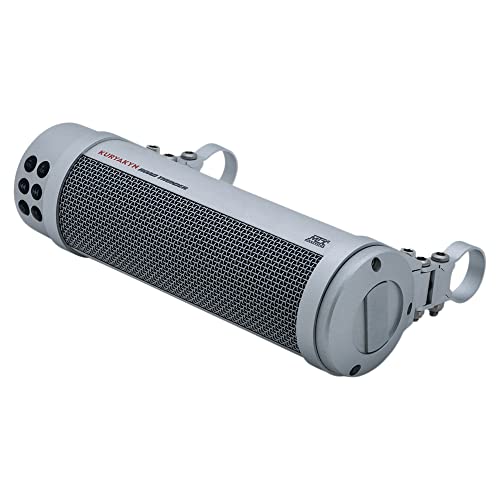
Model 2719 carries a title identical to its sibling’s in every word that matters — Kuryakyn, MTX Road Thunder, weather resistant, Sound Bar Plus, 300 watts — and differs, on the evidence of the titles, by its model number alone. This guide lists both because the pool verified both, and because pretending the two numbers describe two different experiences would be fiction. Model-number siblings in a range like this typically divide by a fitment or finish detail that titles are too short to carry; the difference, whatever it is, lives on the detail pages, and the rider’s job is to read both pages and discover which number belongs to their bars.
That may sound like a shrug, but it is actually the most useful paragraph a comparison can offer here: do not shop 2719 against 2720 as rival products, shop them as one product with a fork in its part number. Check the mounting specification, the finish and any stated bar-diameter range on each listing, and let those facts — not a imagined hierarchy — choose between them. Everything else this guide says about the 2720’s architecture applies here unchanged, because on the titles’ own evidence, the architecture is the same.
There is even a practical blessing in the duplication: two listings mean two stock pools and two seller sets, and a part in demand during riding season is easier to find when it wears two doors. Take whichever door opens onto the correct fitment for your handlebars.
- Format: integrated sound bar, handlebar mounted
- Power figure: 300 watts, as stated in the listing title
- Weather claim: weather resistant, as stated in the listing title
- Model: 2719 (sibling of the 2720 listing above)
- Differences from 2720: Not stated in the listing title — verify with Kuryakyn documentation
Strengths
- The same integrated Sound Bar Plus architecture as the guide’s lead pick
- A second listing widens stock and seller choice in peak season
- Weather resistance and wattage declared identically in the title
Trade-offs
- The titles give no way to tell the siblings apart — both detail pages must be read
- Shares the integrated format’s all-or-nothing replacement logic
- Clamp fitment still requires the rider’s own measurement
Best for: a rider whose fitment check points to the 2719’s specification rather than its sibling’s. Not suited for: a shopper hoping the second number hides a different or better bar.

Kuryakyn 2712 MTX Road Thunder Weather Resistant Motorcycle Speakers: 100 Watt Handlebar — Compact Kuryakyn pods
The 2712 takes the Road Thunder family’s weather-resistant promise and divides it into handlebar-mounted speakers at a stated 100 watts. The format shift is the story: pods instead of a bar. A pair of speaker pods spreads the soundstage wider across the bars, leaves the centre of the cockpit free, and suits riders whose bars already carry a phone mount, a cup holder or a small screen exactly where a sound bar would want to live. The lower stated wattage belongs to a smaller physical package, and this guide reads it that way — as the rating of a compact set — rather than as a defeat in a numbers contest the titles never entered.
Pods ask slightly more of an installer than a bar does, because two objects must be aimed as well as mounted, and aim matters at handlebar distances: a few degrees of toe can decide whether the sound meets the rider’s ears or entertains the mirrors. That adjustability is also the pods’ quiet advantage, letting a rider tune the delivery to a helmet, a screen or a seating position that a fixed bar must accept as given.
Choose the 2712 when the cockpit says pods — when space is spoken for, when a wider spread appeals, or when the Road Thunder name and weather promise matter more to you than the bar format’s simplicity. It is the same family honesty at a smaller scale: watts printed, weather printed, mounting in the name.
- Format: handlebar-mounted speaker set (pods)
- Power figure: 100 watts, as stated in the listing title
- Weather claim: weather resistant, as stated in the listing title
- Series: Kuryakyn MTX Road Thunder, model 2712
- Bar diameter fitment: Not stated in the listing title — verify with Kuryakyn documentation
Strengths
- Pods leave the centre of the cockpit free for mounts and screens
- Two aimable sources can be tuned to the rider’s actual ear line
- Road Thunder weather promise in a smaller, lighter package
Trade-offs
- A smaller stated watt figure than the Sound Bar Plus listings
- Two objects to mount and aim instead of one bar to clamp
- Fitment dimensions still live on the detail page, not the title
Best for: a rider whose bars lack sound-bar space but who wants the Kuryakyn weather-resistant family. Not suited for: a rider seeking the largest stated output in this guide.
BOSS Audio Systems MC420B 3 Inch Motorcycle Speakers, Class D Amp Package — Small-pod amp package
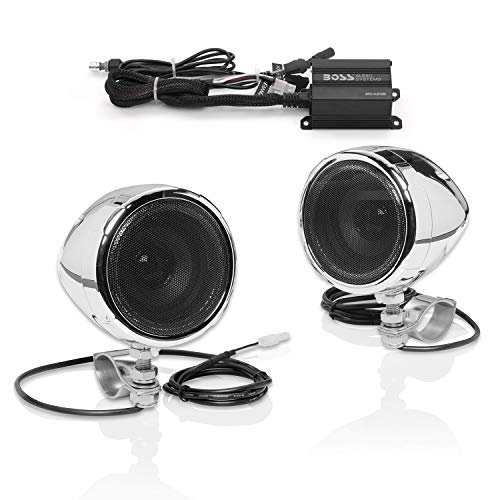
BOSS builds the opposite philosophy from Kuryakyn’s bars: small speakers, separate amplifier, system thinking. The MC420B title declares its cast precisely — 3-inch motorcycle speakers and a Class D amp package. Three-inch pods are the discreet end of handlebar audio, small enough to tuck beside mirrors without redrawing the cockpit, and the separate Class D amplifier — compact and efficient by design, which is why the class dominates motorcycle audio — hides under a seat or in a sheltered corner and does its work out of the weather and out of sight.
The package format buys flexibility at the price of decisions. The amplifier needs a mounting home, a power run to the battery with proper fusing, and a signal source, and the speakers need aiming like any pods. None of that is difficult, but all of it is yours, and riders should count it honestly against the sound bar’s single-clamp simplicity. In exchange, a package can be serviced in parts, its amplifier can live somewhere kinder than a handlebar, and its small speakers ask the least of crowded bars.
The title states no watt figure and no weather claim, and this guide marks both as unstated rather than borrowing promises from the Kuryakyn shelf. What the title does state — size, class, package — is exactly what a system buyer needs to begin, and BOSS’s long presence in powersports audio means the detail page and the questions beneath it carry deep, specific folklore from riders who have fitted this exact kit to bikes like yours.
- Format: speaker pods plus separate amplifier package
- Speaker size: 3 inches, per the listing title
- Amplifier: Class D, included per the listing title
- Power figure: Not stated in the listing title — verify with BOSS Audio Systems documentation
- Weather claim: Not stated in the listing title — verify with BOSS Audio Systems documentation
Strengths
- Compact 3-inch pods ask the least of crowded handlebars
- A separate Class D amp can live somewhere sheltered and serviceable
- Package format allows part-by-part diagnosis and replacement
Trade-offs
- More installation decisions than any integrated bar: amp home, power run, routing
- No watt or weather claims in the title to plan around
- Small pods trade sheer acoustic presence for discretion
Best for: a rider comfortable with light system installation who wants compact pods and a hidden amplifier. Not suited for: a rider who wants one clamp, one cable and no decisions.

BOSS Audio Systems MCBK470B Motorcycle ATV Speakers & Class D Amp Package — Second BOSS package
The MCBK470B is BOSS’s second package in the pool, titled for motorcycle and ATV speakers with a Class D amp package. That dual citizenship is its character: a kit voiced for open-air machines generally rather than for Harley-Davidson specifically. For a rider whose garage holds a Harley and an ATV in adjoining bays, a package fluent in both is a genuine convenience; for the Harley-only rider, it simply means the fitment homework — bar diameter, clamp style, mounting room — rests a little more heavily on the detail page, since the title’s promise was written for a wider fleet.
Against its sibling MC420B, the title trades the declared speaker size for the declared dual application; neither states watts or weather language. Read the two BOSS listings as a fork inside one philosophy: both separate the amplifier from the speakers, both ask the rider to house the amp and route the wiring, and both reward that effort with placement freedom the integrated bars cannot offer. The detail pages will separate them on dimensions and contents, and that separation — not the titles — should make the choice.
What this package shares with its sibling is the honest system bargain. More work on Saturday, more freedom forever: speakers where ears want them, amplification where weather cannot reach it, and parts that can be replaced one at a time when the road eventually files a claim.
- Format: speaker set plus separate amplifier package
- Application in title: motorcycle and ATV
- Amplifier: Class D, included per the listing title
- Speaker size: Not stated in the listing title — verify with BOSS Audio Systems documentation
- Power figure: Not stated in the listing title — verify with BOSS Audio Systems documentation
Strengths
- One package philosophy serving both motorcycle and ATV duties
- Separate amplifier placement keeps electronics out of the weather’s front line
- A second BOSS route when the MC420B’s specification does not suit
Trade-offs
- Generic application means Harley-specific fitment is entirely the rider’s homework
- Speaker size unstated in the title, unlike its sibling’s 3-inch declaration
- Full package installation effort, with amp housing and wiring runs to plan
Best for: a rider with both a Harley and an ATV, or a BOSS package fan whose fitment check favours this kit. Not suited for: a rider wanting Harley-specific mounting promises in the title.

GoHawk Bluetooth Motorcycle Speakers Waterproof 10-Speaker Motorcycle Radio — Feature-led radio pick
The GoHawk title is the loudest sentence in this guide, and it should be read at the volume it was written: Bluetooth motorcycle speakers, waterproof, a 10-speaker motorcycle radio. Three claims, each larger than the last, and this guide’s treatment of them is to repeat them exactly, attribute them to the title, and direct the rider to verify them on the detail page with the seriousness that large claims deserve. A ten-speaker count in a handlebar product is a claim about arrangement that only the listing’s own description can unpack; waterproof is a stronger word than the weather resistant printed on the Kuryakyn shelf, and stronger words carry stronger burdens of proof.
Underneath the volume, the product idea is genuinely distinct. This is a radio — a source with Bluetooth reception built around the speaker arrangement — rather than speakers awaiting a source, and for a rider whose phone is the music library and whose Harley predates factory infotainment entirely, that integration has real charm. No separate head unit, no additional source hardware: pair the phone, ride, and let the handlebar hardware be the stereo.
The risk profile is the mirror of the Kuryakyns’. A newer, feature-led brand offers less accumulated fitment folklore, fewer years of forum verdicts on the exact model, and claims that must be taken as claims until the detail page substantiates them. Riders who enjoy being early, who prize the integrated radio idea, and who read listings carefully can find real value here. Riders who want the known quantity should stay on the weather-resistant shelf above, where the promises are smaller and the paper trail is longer.
- Format: motorcycle radio with integrated speakers, per the listing title
- Connectivity: Bluetooth, per the listing title
- Weather claim: waterproof, as stated in the listing title (a stronger claim than weather resistant — verify on the listing)
- Speaker count claim: 10-speaker, as stated in the listing title — verify the arrangement with GoHawk documentation
- Power figure: Not stated in the listing title — verify with GoHawk documentation
Strengths
- An integrated radio concept: source and speakers in one handlebar product
- Bluetooth pairing suits a phone-as-library rider with an older Harley
- The boldest weather wording in the guide, for riders who prioritise it
Trade-offs
- The largest claims in the pool carry the largest verification duty
- A thinner long-term fitment track record than the Kuryakyn and BOSS names
- No watt figure in the title for output planning
Best for: a rider who wants a Bluetooth radio at the bars and will verify the big claims on the listing first. Not suited for: a preference for modest promises backed by a decade of evidence.
How Do the Six Compare Side by Side?
| Pick | Format | Amplification | Title’s weather words |
|---|---|---|---|
| Kuryakyn 2720 Sound Bar Plus | Sound bar | Integrated, 300W stated | Weather resistant |
| Kuryakyn 2719 Sound Bar Plus | Sound bar | Integrated, 300W stated | Weather resistant |
| Kuryakyn 2712 Speakers | Pods | Handlebar set, 100W stated | Weather resistant |
| BOSS MC420B | 3-inch pods | Separate Class D amp | Not stated in title |
| BOSS MCBK470B | Speaker set | Separate Class D amp | Not stated in title |
| GoHawk Radio | Radio with speakers | Integrated radio format | Waterproof (as titled) |
Three architectures, three bargains: the bar sells simplicity, the package sells flexibility, the radio sells integration. Choose the bargain that matches the rider, then verify the fitment facts the titles leave open.
How Do You Fit Bar Audio Without Wiring Regrets?
Measure before you mount. Handlebar diameter and free clamp space decide this category, and both are knowable in five minutes with a caliper or a strip of paper and a ruler: wrap, mark, measure the circumference, divide. Compare that truth against the detail page of the bar or pods you favour, and photograph your cockpit as it stands — mirrors, risers, phone mounts, switch housings — because the product photographs were taken on bars with nothing else to do. Plan the power run before the first clamp tightens: a fused connection at the battery, a route that avoids steering movement and hot surfaces, and slack that lets the bars swing lock to lock without tugging a single terminal.
For the BOSS packages, choose the amplifier’s home with the weather in mind — under a seat or in a sheltered frame pocket, connectors facing down where gravity helps rather than accuses. For every format, test at the kerb before the final tidy: pair the source, play a voice and then music, swing the bars, work every control with gloves on. A volume control you cannot find at sixty miles an hour wearing winter gloves is a design flaw you can still return on Saturday; discovered on the motorway, it is merely a fact. Route, test, tidy, in that order, and keep the factory bar area reversible — the next owner of a Harley inherits its cockpit, and clean wiring is part of the inheritance.
What Mistakes Do Harley Riders Make With Handlebar Audio?
The first is shopping by the watt column. This guide contains a stated 300, a stated 100 and three silences, and none of those numbers, alone or compared, predicts how a given rider on a given bike at a given speed will judge the result; they are manufacturers’ ratings for different architectures, not a league table. The second mistake is blurring the weather words — reading waterproof and weather resistant as synonyms because both sound reassuring. They are different promises printed by different makers, and the rider who rides in real rain should honour the distinction by reading the detail page of whichever product earns the shortlist.
Third, buying speakers and forgetting the system. A pod package’s amplifier needs a home and a fused power run; a sound bar needs clamp space that a crowded cockpit may not have; a radio needs a phone that pairs happily. The product is never just the product. Fourth, aiming pods at the mirrors and judging them harshly for it — handlebar speakers are near-field instruments, and five minutes of aim adjustment at the kerb is worth more than a tier of specification. Fifth, wiring without a fuse or routing across the steering’s moving parts, the two errors that turn an audio upgrade into an electrical story. None of these mistakes requires talent to avoid — only the decision to measure, read and test before tidying.
What Should You Check on Your Own Bike First?
Start with the bars themselves: their diameter, their rise, and the honest inventory of what already clamps to them. A bike running a phone mount, a drink holder and auxiliary lamps may have room for pods and no room for a bar, and that fact should choose the format before brand loyalty gets a vote. Next, the electrical reality: a healthy battery and charging system, a sensible place to take fused power, and — on older Harleys especially — wiring that has not already been creatively revised by previous owners. Handlebar audio is a modest electrical load, but it is a load added to a system that deserves a glance first.
Then the rider’s own truth: helmet style, typical speed, typical journey. A rider whose miles are boulevard and back-road, at speeds where wind is a companion rather than an opponent, will be served by any pick here and should choose by cockpit fit and simplicity. A rider whose miles are motorway hours needs the strongest, cleanest near-field delivery the shortlist offers and should weight the integrated bars and their stated figures accordingly — while keeping the guide’s standing caution that no title here promises a measured loudness, and ears at the kerb with the engine running are a better audition than any paragraph, including these.
How Do You Judge the Result at Speed?
Audition in layers. At the kerb, engine off: clarity, pairing, controls. At the kerb, engine running: whether the music holds its shape against the idle’s rhythm. In town: whether voices and lyrics survive real acceleration. At cruising speed: the only verdict that finally counts, taken on a familiar road with familiar material, gloves on and helmet as you actually wear it. Listen for intelligibility rather than spectacle — a podcast followed without strain, a chorus that arrives intact — and for the absence of distortion at the volume you actually choose, which is a more honest specification than any maximum.
Give the system a month before the final grade. Riders recalibrate; controls become muscle memory; aim and equalisation get their final tweaks. What remains after that month is the product’s true character, and in this category it is usually kinder than the first ride suggested — because handlebar audio, fitted carefully and aimed honestly, solves the problem it was bought for every single time the bike rolls out.
How Do Helmets and Screens Rewrite the Answer?
No handlebar speaker performs into a vacuum; it performs into a helmet, behind a screen, on a particular bike. A full-face helmet is a filter with opinions — it admits the midrange that carries voices and trims the extremes — so a system that sounds bright at the kerb in a cap may sound exactly right at speed inside a full-face, and a system voiced mellow for open ears may vanish inside one. A windscreen rewrites the wind’s contribution entirely: behind a good screen, the roar drops, the pocket of still air grows, and modest systems suddenly sound generous; on a naked bike, the same hardware fights the full weather. This is why universal rankings fail in this category and why this guide ranks architectures and honesty instead of pretending to a single sonic podium.
The practical consequence is a fitting-room rule: audition your shortlist, where you can, in the configuration you actually ride — your helmet, your screen, your typical posture — and distrust any verdict gathered in a different costume. Riders who tour behind tall screens can weight the pod packages and their placement freedom more heavily; riders who run naked bars and half helmets should weight the integrated bars’ concentrated delivery. The motorcycle you own is the listening room. Furnish the room you have.
What Does a Season of Ownership Teach?
The first month with bar audio is adjustment: aim, levels, the choreography of gloves and controls, the discovery of which pocket the phone prefers. By the third month the system has either become furniture — present, unremarkable, exactly as it should be — or it has become a grievance with a specific name, and the name is almost never the brand. It is the clamp that creeps on rough roads because it was tightened hopefully rather than correctly. It is the power run that chafes where it crosses the steering’s travel. It is the amplifier mounted where a saddlebag’s contents lean on its connectors. Every one of those is an installation echo, curable in an hour with the tools that fitted the system, which is why this guide treats installation as part of the product.
Weather writes the second lesson. A system that survives its first real storm — not a shower, a storm, with the bike parked in it and ridden through its aftermath — earns a trust no specification can confer. The weather words in these titles are claims at purchase time; the season converts them into knowledge. Riders who ride all year should keep connectors clean, check clamp torque when the seasons turn, and treat a five-minute inspection as the whole maintenance liturgy. Handlebar audio that is still working, still tight and still clear at the end of its first winter has told you everything about itself that matters.
How Do You Read These Six Titles Like a Wrench Would?
Architecture first: bar, pods, package or radio — the title’s nouns decide your Saturday and your failure modes for years. Amplification second: integrated and stated, as the Kuryakyns declare theirs, or separate and classed, as the BOSS packages declare theirs, or folded into a radio concept, as the GoHawk declares its own. Weather words third, read literally and never upgraded in translation: resistant is resistant, waterproof is a bigger word with a bigger burden, and silence on the subject — the BOSS titles’ position — is also information, directing you to the detail page before the first wet ride rather than after it. Watt figures last, inside their frames, as ratings attached to architectures rather than as a ladder the six products are climbing together.
Read in that order, the shortlist stops being a contest and becomes a matching exercise — your bars, your weather, your appetite for installation, your helmet and screen — against six honest descriptions of six different bargains. That is the most a guide can do for a motorcycle, and a rider who does the matching carefully will not need the guide twice.
What About the Passenger, the Luggage and the Long Tour?
Handlebar audio is aimed at the rider, and a guide should admit what that means for everyone else. A passenger sits behind the rider’s body, in a different wind shadow, further from the bars; on most setups the passenger hears the system’s spill rather than its focus, and couples who tour together learn quickly whether that spill suffices or whether the passenger’s musical vote will eventually demand a fairing bike or a helmet-based solution instead. Neither outcome indicts the handlebar system — it was aimed honestly — but naming the geometry before the purchase prevents the specific disappointment of a system bought for two and aimed at one.
Luggage and touring kit join the negotiation too. Tank bags compete for the cockpit’s centre, which can settle the bar-versus-pods question by simple occupation; bar-end luggage and tall screens alter clamp space and wind alike. The touring rider should mock up the full travel configuration — bags on, screen set, phone mounted — before choosing a format, because the cockpit that exists on tour is the only cockpit the audio will ever perform in. A system that fits the Sunday bike but not the touring bike fits neither, in the end, since the touring miles are precisely the miles where music earns its keep.
Where Does Handlebar Audio Sit in a Bigger Plan?
For many Harley riders, bar audio is the first chapter of a longer electrical story: heated grips, auxiliary lighting, a phone that charges as it navigates. Each addition draws on the same battery and charging system and competes for the same tidy wiring routes, so a rider with expansion plans should fit bar audio with the future in mind — fused distribution rather than a thicket of individual taps, routes documented with photographs, connectors chosen for serviceability. None of the six picks here is electrically extravagant, but the discipline of fitting the first accessory as though a third were coming is what separates a clean bike from a archaeology site at trade-in time.
And if no bigger plan exists, bar audio is a complete answer in itself, which is its charm. A fairing-less Harley with a well-chosen bar, pods or package has everything its rider asked the category for: music at the ears, weather kept at bay, controls under gloved thumbs. The category’s best outcome is not a system that invites the next purchase. It is a system that makes the next purchase unnecessary, ride after ride, season after season.
What Source Will Actually Feed the System?
Every architecture in this guide presumes a source, and the source deserves a paragraph of its own because it quietly governs daily satisfaction. Most riders will feed these systems from a phone — the library, the navigation voice and the streaming services already live there — which makes pairing behaviour, reconnection manners and glove-friendly control the real interface of the product. The GoHawk builds Bluetooth into its radio concept outright; the other systems’ source arrangements live on their detail pages, and a rider should confirm how each expects to receive music before assuming a favourite app will simply appear at the bars. A wired auxiliary feed, where offered, trades elegance for certainty; a wireless feed trades certainty for elegance. Neither trade is wrong, but it should be made knowingly.
Volume discipline belongs in this conversation too. Handlebar systems can play loud enough to damage hearing inside a helmet over long exposures, and the rider who sets a sane cruising level at the kerb — then resists creeping upward as fatigue dulls perception — will enjoy the system longer in every sense. The best handlebar audio is not the system that can go loudest on the one afternoon you test it. It is the system that stays clear, controlled and pleasant at the level you will actually use for four hours on a Saturday, and every architecture here can be that system when it is fitted and aimed with care.
Can the Next Owner Thank You for This Installation?
Harleys outlive their riders’ plans, and handlebar audio joins the bike’s permanent record. A clean installation — fused power, reversible clamps, no drilled holes, wiring that follows the factory’s own routes — reads to the next owner as care, and to a dealer as a bike that was owned by an adult. A careless one reads as a warning. The integrated bars score well on this ledger by design, since their footprint is a clamp and a cable; the packages ask for more craftsmanship to reach the same verdict, and reward it. Photograph your routing, keep the instructions with the bike’s papers, and leave the system demonstrably working at handover. In a marque where provenance is half the value, a tidy cockpit is not vanity. It is equity.
Final Recommendation
For most fairing-less Harleys, the Kuryakyn Road Thunder Sound Bar Plus — 2720 or 2719, whichever model number your fitment check favours — is the answer this guide would fit first: integrated, weather resistant, and built by the two names this category trusts most. The 2712 pods serve the crowded cockpit, the BOSS packages serve the rider who thinks in systems and wants the amplifier sheltered, and the GoHawk serves the Bluetooth-first rider willing to verify its bold claims. Measure your bars, choose your architecture, and the next on-ramp will sound like the reason you bought the motorcycle in the first place.
Frequently Asked Questions
What is the difference between the Kuryakyn 2720 and 2719?
On their titles, nothing but the model number — both are MTX Road Thunder Sound Bar Plus listings, weather resistant, at a stated 300 watts. Any fitment or finish difference lives on the detail pages, so read both and let the mounting specification choose.
Do the BOSS packages include an amplifier?
Yes — both BOSS titles describe a Class D amp package, meaning a separate amplifier is part of the purchase. Plan a sheltered mounting home and a fused power run for it; that planning is the package format’s price of admission.
Is weather resistant the same as waterproof?
No, and this guide keeps the words separate because the makers do. Kuryakyn’s titles say weather resistant; the GoHawk title says waterproof. Treat each as its maker’s own claim and read the detail page of the product you choose for what the claim covers.
Which pick is loudest?
No title in this pool states a measured loudness, so this guide does not crown one. The Kuryakyn sound bars carry the largest stated watt figure at 300 watts, but a rating is not a volume measurement — judge by architecture, fit and a kerbside audition with your own helmet on.
How do I know what fits my handlebars?
Measure your bar diameter and free clamp space, then compare against the mounting specification on the detail page of the bar or pods you favour. No title in this guide states bar diameters, so that measurement is the rider’s essential homework.
Can I fit a sound bar if my bars already carry a phone mount?
Possibly, but space is the deciding fact. If the centre of your cockpit is spoken for, the Kuryakyn 2712 pods or the compact 3-inch BOSS MC420B pods ask for less room and may be the honest fit; measure the actual clamp space rather than hoping.
How long does a sound bar take to fit?
For a rider with the bar diameter already confirmed, the mechanical work is an unhurried hour or two: clamps, a fused power run, a pairing, an audition. The pods-and-amplifier packages take longer, because the amplifier’s home and the wiring routes are decisions as well as tasks. In both cases the schedule should include the kerbside test with gloves and helmet before anything is tidied away, since that test is where aim, controls and routing earn their final adjustments.
Will handlebar audio drain my battery?
These systems are modest electrical citizens, designed for motorcycle charging systems, but the standing rule of accessory fitting applies: take power through a fuse, prefer a switched feed where the product’s instructions allow it, and never leave a system able to sip from a parked bike for a fortnight. Fitted that way, bar audio and a healthy battery coexist without conversation.
What if I sell the Harley — does the system come off cleanly?
The integrated bars come off about as cleanly as they went on, which is part of their design appeal. Packages take more patience to extract, since the amplifier and its wiring were placed deliberately. Either way, a documented, reversible installation is a selling point rather than a deduction, and keeping the instructions and your routing photographs with the bike’s papers turns the audio into part of its provenance.
Should I choose a bar or pods if I ride in the rain often?
Let the weather words guide the shortlist and the architecture follow. The Kuryakyn family’s titles carry the weather-resistant claim across both its bar and its pod formats, so a wet-climate rider can choose between those two by cockpit space alone. The GoHawk’s title makes the stronger waterproof claim, which a rain rider should verify on its detail page with particular care, since the claim is doing real work in the decision. The BOSS titles are silent on weather, so their detail pages carry the whole answer — ask the question there, in writing, before the first wet season rather than during it.
Do I need to remove the system in winter?
No — a correctly fitted system winters on the bike, which is rather the point of weather claims and sheltered amplifiers. The winter duties are inspection rather than removal: clamps still tight, connectors clean, the power feed’s fuse intact, and a battery tender’s lead not competing with the audio’s wiring for the same untidy corner of the frame.
Related Guides
Handlebar audio is the open-cockpit end of a spectrum that continues into the fairing. The method, though, is identical at every point on that spectrum: decide the architecture before the brand, read the title for exactly the promises it prints and no others, measure the machine in your own garage rather than the machine in the photograph, and let weather words keep their literal meanings from the first click to the first storm, from the first clamp you tighten in the garage to the last mile of the longest tour you will ever ride behind them, in any season, in any state, on any road the map still bothers to name, in any company you would ever choose to keep, on any morning the road calls early, in any year of the bike’s long life. See best loudest speakers for Harley-Davidson Street Glide, best plug and play speakers for Jeep Wrangler and best replacement speakers for 2004 Toyota Tundra for the same fitment-first method in three other wind-blown cabins.