What's inside
As an Amazon Associate I earn from qualifying purchases. This post may contain affiliate links at no extra cost to you.
gizmoverdict.com is reader-supported. When you buy through links on our site, we may earn an affiliate commission.
Where to buy: The six pocket models below are all sold through Amazon in the United States, and this corner of the market changes its listings frequently, with near-identical mini projectors appearing and vanishing by the season. That churn makes the exact title wording on the live listing worth reading before you order, and each review links to its product page so the current version of the offer can be checked directly.
The best pocket projectors under 300 are bought for a reason no specification captures: they disappear. A pocket projector lives in a jacket, a glovebox, a carry-on or a kitchen drawer, and produces a screen wherever a wall and a darkened room happen to meet. Travel, camping, a child’s bedroom ceiling, a presentation rehearsed in a hotel room — the venues share impermanence, and the machine’s job is to be present for all of them without ever becoming luggage. In line with the budget frame of this roundup, no prices are printed anywhere in this guide; the class is defined by its ceiling, and the links under each pick carry the current figure.
Resolution honesty matters here more than anywhere else in projection, because pocket marketing leans hard on the gap between supported and native resolution. A title can truthfully say a projector accepts a 1080p signal while its tiny DLP chip renders far fewer pixels, and the difference decides whether text looks crisp or merely legible. One pick below states the extreme version of this gap in its own title: the APIO lists a 640×360 native resolution alongside 1080p imaging language, and this guide treats that stated figure as the truth of the machine. Another pick, the closing model, states native 1080P outright. Everything between those poles is reported exactly as its title words it, with the word native credited only where a title actually uses it.
Battery claims form the second honesty zone. Several titles here name a built-in rechargeable battery, which separates a genuinely untethered pocket machine from a small projector that still hunts for a socket. None of the titles states a battery runtime in hours, so this guide will not invent one; plan around a feature film being the natural unit of a pocket projector’s evening, and verify runtime on the listing if back-to-back films are the plan. Where a title is silent about a battery, the review assumes a power lead is part of the kit.
Brightness is the third zone, and it is the quietest: not one of these six titles publishes a lumen figure. Pocket projectors are dim-room devices almost by definition, their small optics and battery budgets leaving no room for daylight heroics, and the absence of figures across the whole shelf confirms the class character. Buy one for evenings, tents, bedrooms and blackout curtains, and it will charm you; buy one for a sunlit office and no review wording could save the purchase.
It helps to place the pocket class on the wider map before judging any single machine. Below it sit phone screens and tablets; above it sit the portable business projectors and the smart minis, each step trading size for light and sharpness. The pocket class is the last step where the projector itself can be forgotten in a bag. Every buyer should ask whether forgetting the machine matters to them, because a household projecting in one room every night is paying for portability it will never use, and the same money buys a visibly better picture one class up.
Durability expectations should also be set by the class. These are consumer electronics built to a budget ceiling, carried in bags and used by children, and their realistic promise is a few years of cheerful service rather than a decade of heirloom duty. A carrying case, a lens cap habit and a charger kept with the machine extend that service more than any specification does. Internalise that, and these six can be judged fairly: as delightful tools for impromptu screens, not as miniature versions of machines costing several times more.
Key Takeaways
- The APIO’s title states a 640×360 native resolution; it is the ultra-compact pick, not a sharpness pick.
- The closing model is the only pick whose title states native 1080P, and it adds a carrying case.
- Built-in batteries are stated on both AKASO models and both KODAK models.
- No title in this roundup publishes a brightness figure; dark rooms are assumed throughout.
- The AKASO WT50 is the only pick stating both WiFi and Bluetooth plus an Android system.
- No prices are printed in this guide, in keeping with the class’s budget frame.
Quick Picks
| Pick | Model | Badge |
|---|---|---|
| 1 | AKASO Mini Projector | Best all-round pocket pick |
| 2 | KODAK Luma 150 | Best minimalist traveller |
| 3 | KODAK Luma 75 | Best for a stated 100-inch picture |
| 4 | AKASO WT50 | Best connected pocket pick |
| 5 | APIO Pocket Projector | Best ultra-compact option |
| 6 | Native 1080P Mini Projector with Case | Best sharpness in the class |
Badges in a pocket roundup reward portability facts first and picture facts second, which reverses the usual order and is deliberate. A pocket projector that wins on sharpness but needs a socket and a bag of cables has misunderstood its own category. The reviews below therefore lead with size, battery and connection facts, and bring resolution in as the second conversation — except where a title’s resolution wording demands to be the first conversation, as the APIO’s does.
How were these picks chosen?
Portability evidence came first. A candidate needed pocket or mini positioning in its own title, and preference went to models stating a built-in battery, since a pocket projector tethered to a wall socket is really just a small projector. DLP designs dominate this shelf and appear in most titles here, valued for compact optics that suit the form factor. Connection breadth came next: HDMI appears across the shelf, WiFi on several, Bluetooth on one, and the reviews keep those differences explicit because a traveller’s sources are whatever the trip provides.
Resolution wording was audited line by line. Titles saying 1080P without the word native were recorded as supporting or presenting 1080p material, not as rendering it natively, and the one title stating a low native figure was kept in the roundup deliberately: an honest ultra-compact machine at a stated 640×360 is a legitimate pocket product for the right job, and excluding it would hide the most instructive listing on the shelf. The native 1080P closer was included as the class’s sharpness ceiling, the machine that shows what the budget can reach when pocket size shares priority with the panel.
Brand accountability played a smaller but real role. KODAK’s Luma line and AKASO’s minis carry recognisable product families behind them, which matters in a category flooded with anonymous listings. The unbranded closer earns its place on its stated native resolution and its case, and its review says plainly that the specification, not a brand story, is the reason to buy it. Readers whose budget stretches further and whose rooms are fixed may prefer to compare against best zoom projectors under 1000 before deciding that pocket size is truly the priority.
Finally, every pick had to make sense as a gift-able, lendable, packable object. Pocket projectors are borrowed constantly and bought for other people nearly as often, so controls, remotes and cases counted. The AKASO opener names its remote and speakers in its title; the closer names its carrying case. Small lines, but in this category the small lines are the product.
A note on how to read the spec boxes in this particular roundup: they contain more admissions of silence than any other projector guide on this site, and that is the honest shape of the pocket market. Manufacturers of small machines publish positioning and a handful of headline claims, then let photographs and price do the rest. We have chosen to show the silences rather than wallpaper over them, because knowing which questions a listing leaves open lets you ask them on the product page, in the question section, before the box arrives.
One more filter was applied quietly: every machine here had to be plausible as the only projector a household owns. Exotic designs that only make sense beside a main projector — extreme novelties, single-purpose toys — were passed over in favour of machines that can carry a family’s film nights, a traveller’s bag and a child’s bedroom in the same month. Versatility within the class is the class’s whole argument.

1. AKASO Mini Projector — Best all-round pocket pick
The opening AKASO is the most completely described pocket machine in the roundup. Its title names a pocket-sized DLP design, a built-in rechargeable battery, stereo speakers, a remote control, HDMI and WiFi connections, and an updated Type-C arrangement. Read that list as a traveller’s checklist and every item answers a real trip problem: the battery removes the socket hunt, the remote removes the crouching beside the machine, the speakers remove the separate audio question for casual viewing, and WiFi removes the cable for phone content.
The resolution wording needs the standard care. The title says 1080P without the word native, so the honest reading is that the projector presents 1080p material while its native rendering figure goes unstated. In pocket practice that distinction matters most for text: films and photos forgive, spreadsheets and subtitles confess. A traveller showing films in hotel rooms will rarely meet the limit; a traveller rehearsing a dense presentation may, and should test with their own slides before the trip rather than during it.
DLP in a body this size is the established route to a compact light engine, and the cookie-projector nickname in the title signals the intended scale honestly: this is a machine measured against a pocket, not against a briefcase. The updated Type-C note suggests the maker has revised the design at least once, which in this fast-moving category counts as a small sign of a product line being maintained rather than abandoned. Current details for the AKASO mini sit on its Amazon listing.
Ownership of a battery pocket projector develops its own rituals. The machine charges alongside the phone at night, travels in the same bag as the cables it mostly replaces, and gets lent to friends with a confidence larger machines never earn, because its replacement would be an annoyance rather than a catastrophe. That lendability is a genuine feature of the class, and a model with a remote and speakers included lends more gracefully than one that needs its accessories gathered first.
Charging logistics deserve a traveller’s attention. A Type-C machine can share the phone’s charger and cable, which quietly removes one brick from the bag and one proprietary lead from the list of things that can be forgotten in a hotel room. In a category where the entire appeal is travelling light, a shared charging standard is a feature with daily consequences, and it nudges this AKASO ahead of rivals whose power arrangements go undescribed.
Strengths
- Built-in rechargeable battery stated, for genuinely untethered use.
- Remote control and stereo speakers included per the title.
- HDMI and WiFi cover wired and wireless sources.
Sound from stereo speakers in a body this size should be calibrated as dialogue-grade: clear at a metre or two, thin at five. For a hotel room that is enough, and for anything more the traveller’s Bluetooth speaker — paired with a phone source if the projector lacks the radio — closes the gap without adding a projector-sized problem.
Trade-offs
- The 1080P wording does not claim native 1080p rendering.
- Battery runtime in hours is not stated in the listing title.
- Brightness is not stated in the listing title.
- Design: Pocket-sized DLP
- Resolution as titled: 1080P, native figure not stated in the listing title
- Battery: Built-in rechargeable battery
- Connections: HDMI, WiFi
- Audio: Stereo speakers
- Charging as titled: Updated Type-C
- Brightness: Not stated in the listing title
Best for: a frequent traveller who shows films and photos in hotel rooms and borrowed spaces.
Not suited for: a presenter whose slides carry small text, where an unstated native resolution leaves sharpness unproven.
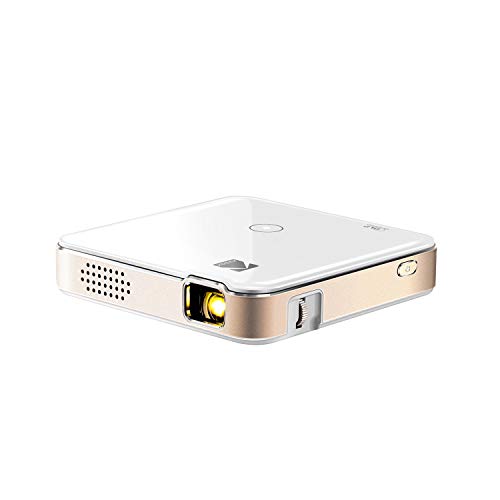
2. KODAK Luma 150 — Best minimalist traveller
The Luma 150’s title is the shortest in this roundup by a wide margin: a mini projector, 1080p input, battery. Three facts, no adjectives. There is a case for reading that brevity as confidence — the Luma line is an established pocket family and KODAK lets the model name carry the story — and a case for reading it as a warning that the listing expects you to research elsewhere. Both readings agree on the substance: this is the minimalist’s pick, a battery pico projector bought for size and simplicity, with 1080p material accepted as input.
Input is the operative word. The title claims 1080p as something the projector receives, not something it natively renders, and no native figure is offered. For the Luma’s natural jobs — a tent wall, a bedroom ceiling, a garden sheet, holiday photos and streamed films at modest sizes — the rendering ceiling matters less than the machine’s presence in the bag at all. Pico projectors are judged by whether the moment happened, and a battery model this small is present for moments larger machines miss entirely.
Everything else about the machine is unstated in the title: no connection list beyond what the format implies, no speaker claim, no brightness, no throw or screen-size figure. This review refuses to fill those silences with category averages, because the Luma 150’s buyer should verify the specifics on the listing and weigh them against the fuller titles elsewhere in this roundup. What the brand and the battery together promise is a maintained product with untethered operation, and for many travellers that is the whole decision. The Luma 150’s live listing is at Amazon’s KODAK Luma 150 page.
Minimalism cuts both ways over a product’s life. Fewer stated features means fewer things to disappoint, and a simple pico projector tends to age gracefully because there is little software to abandon. It also means the machine will not grow into new jobs: the traveller who later wants Bluetooth audio or an onboard app system will be shopping again, and should read the WT50 review below before assuming the smallest machine is the right machine.
There is a demographic truth about the Luma 150 worth naming: it is the machine most often bought for someone else. Grandparents receive it for holiday photos, teenagers for bedroom ceilings, partners for garden film nights. Gift purchases reward exactly the qualities this title does state — a known family name, a battery, simplicity — and punish complexity, which is why the shortest title in the roundup may also be the most commercially sensible one here.
Strengths
- Battery operation stated, keeping the pico promise untethered.
- 1080p input accepts modern sources without complaint.
- Established Luma product family behind the model name.
A pico projector’s real rival is not another projector; it is the tablet propped on a pillow. The Luma wins that contest on image size and shared viewing, and loses it on brightness and simplicity of setup. Households that understand they are buying the shared, big, dim version of a tablet screen will be delighted; households expecting a television will not.
Trade-offs
- Native resolution is not stated in the listing title.
- Connections beyond the format basics are not stated in the listing title.
- Speaker provision is not stated in the listing title.
- Format: Mini projector
- Input as titled: 1080p input
- Battery: Stated in the title
- Native resolution: Not stated in the listing title
- Brightness: Not stated in the listing title
- Connections: Not stated in the listing title
- Audio: Not stated in the listing title
Best for: a minimalist packer who values a battery pico projector’s presence over its paperwork.
Not suited for: a buyer comparing connection lists on paper, since the title publishes almost no specification to compare.

3. KODAK Luma 75 — Best for a stated 100-inch picture
The smaller Luma sibling arrives with a fuller title than the 150, and the extra words are informative: DLP technology, a pocket-sized form factor, a 100-inch display claim, smartphone projector positioning, rechargeable power and a black finish. The 100-inch figure is the headline, and it should be read as a maximum image size under ideal darkness rather than a recommendation. Every pocket projector’s picture grows softer and dimmer as it stretches, and the honest way to use a figure like this is as a ceiling for a dark room, with the sweet spot considerably smaller.
The 1080p HD wording follows the family pattern: material at 1080p is supported and presented, with no native figure stated. Within the Luma line, the 75 is the smaller, simpler machine, and its positioning in the title — travel, smartphone projection, seasonal movie nights — is a fair map of its competence. A phone becomes the source, the projector becomes the screen, and the pairing suits exactly the spontaneous viewing the pocket class exists for.
Rechargeable power keeps the untethered promise, and the DLP basis keeps the optics compact. What the title does not state includes any wireless standard by name, any speaker figure and any battery runtime, so a buyer for whom phone mirroring without a cable is the entire point should confirm the connection method on the listing before ordering. The Luma 75’s page, with its current presentation of the details, is at the Luma 75 listing on Amazon.
Sibling dynamics are worth a sentence. Choosing between the two Lumas from titles alone is genuinely difficult, since the 75 publishes more about itself than the 150 despite sitting lower in the range. That inversion is a small lesson in this category: price order and information order do not always agree, and the buyer who reads titles carefully occasionally finds the cheaper machine is also the better documented one.
Seasonal positioning in the Luma 75’s title, aimed at Christmas movie nights, sounds like marketing garnish and is actually a clue about design priorities. A machine marketed for December evenings is marketed for living rooms full of people, low light, and content chosen for atmosphere. That is the pocket class’s home turf, and a title that knows its season knows its room, which inspires more confidence than a title promising office duty it cannot light.
Strengths
- A maximum display size, 100 inches, is actually stated.
- Rechargeable power keeps the pocket format untethered.
- Smartphone projection is the stated centre of the design.
Parents should note the operational simplicity implied by the Luma 75’s positioning. A machine a child can start unaided gets used on weekday evenings; a machine requiring a parent’s phone, account and patience gets used on occasions. The title cannot prove its controls are simple, but the smartphone-first design at least removes the source-device negotiation from the ritual.
Trade-offs
- Native resolution is not stated in the listing title.
- Wireless standards are not named in the listing title.
- The 100-inch figure is a dark-room maximum, not a daylight size.
- Technology: DLP
- Video as titled: 1080p HD
- Maximum display as titled: 100 inches
- Power: Rechargeable
- Finish as titled: Black
- Native resolution: Not stated in the listing title
- Brightness: Not stated in the listing title
Best for: a phone-first viewer projecting films onto bedroom walls and holiday-let ceilings.
Not suited for: a 100-inch picture in anything but a properly dark room, where pocket brightness runs out long before the size does.
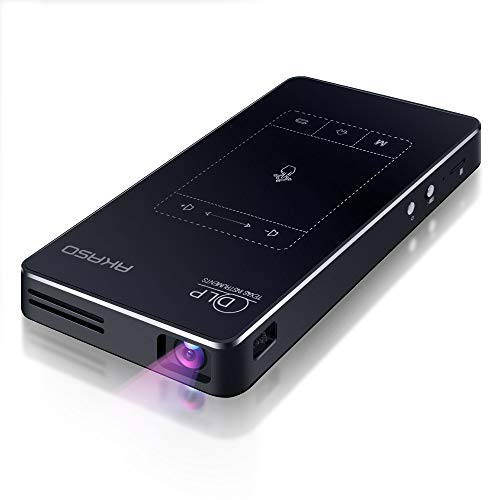
4. AKASO WT50 — Best connected pocket pick
The WT50 is the pocket machine for people who found the other titles’ connection lists too short. Its own title states WiFi and Bluetooth together — the only pick here to claim both radios — adds a built-in battery, an Android system, DLP optics and positioning for iPhone and phone use at home and outdoors. An onboard Android system changes the machine’s character: the projector stops being a passive screen for a phone and becomes a small streaming device in its own right, able to run apps while the phone stays in a pocket.
Bluetooth in a pocket projector earns its place through audio. The internal speakers of any machine this size are a compromise, and a Bluetooth path to a portable speaker the traveller already carries is the difference between a film that sounds like a phone call and one that sounds like a film. The title’s 1080P wording again arrives without the word native, so the rendering ceiling stays unstated and text-heavy use should be tested rather than assumed.
Outdoor positioning deserves its usual translation: outdoors means evening outdoors, on a sheet, a tent wall or a pale fence, with the battery carrying the show and the darkness doing the heavy lifting. No brightness figure is published to argue otherwise. The WT50’s combination still makes it the most self-sufficient traveller here, the one least dependent on whatever technology the destination provides. Its current listing sits at Amazon’s page for the AKASO WT50. Households equipping a fixed room instead of a travel bag will find the connected full-size shelf in best projectors with bluetooth and wi fi the natural next read.
Android onboard also imports Android’s homework: accounts to sign into, apps to update, an interface to learn. Travellers who love that ecosystem will feel at home; travellers who wanted a dumb screen for a phone may find the WT50 more computer than they needed. Neither reaction is wrong, and the choice between this and the simpler AKASO opener is really a choice about where the intelligence in the system should live.
Phone pairing behaviour separates the WT50’s promise from its rivals’. A projector with its own Android system can afford a mediocre mirroring experience, because mirroring becomes the backup path rather than the main road. Phones change, protocols shift, and a self-contained machine is insulated from both. Travellers burned by a mirroring standard that changed between phone upgrades will recognise the value immediately.
Strengths
- WiFi and Bluetooth both stated, unique in this roundup.
- Android system runs apps without a phone as intermediary.
- Built-in battery keeps the connected feature set untethered.
The WT50’s outdoor claim should be paired with a weather caveat the title does not supply: electronics and dew are enemies, and a battery projector used outside belongs under cover and back indoors before the night cools. Owners who treat it as garden furniture will shorten its life; owners who treat it as a guest will not.
Trade-offs
- Native resolution is not stated in the listing title.
- Brightness is not stated in the listing title.
- An onboard system means accounts and updates to manage.
- Technology: DLP
- Wireless: WiFi and Bluetooth
- System: Android built in
- Battery: Built-in battery
- Video as titled: 1080P, native figure not stated in the listing title
- Positioning as titled: iPhone and phone use, home and outdoor
- Brightness: Not stated in the listing title
Best for: a traveller carrying one machine that streams, mirrors and pairs with a speaker unaided.
Not suited for: a bright outdoor afternoon screening, where an unstated brightness figure offers no daylight promise.

5. APIO Pocket Projector — Best ultra-compact option
This review begins with the number the whole roundup has been circling: the APIO’s title states a native resolution of 640×360. That figure must be stated plainly, because the same title also carries 1080p imaging language, and a buyer skimming for the big number would walk away with exactly the wrong impression. Six hundred and forty by three hundred and sixty is a quarter of 720p. Text will be coarse, fine detail will dissolve, and films will look soft at any size beyond a modest one. The APIO is the ultra-compact pick in this roundup, not a sharpness pick, and it is reviewed on that basis alone.
Judged on that basis, a case exists. A truly tiny DLP projector with HDMI and USB inputs, positioned for streaming movies, laptops, phones, presentations and home or outdoor use, serves the jobs where presence beats fidelity: a child’s den, a tent, a quick look at holiday photos, a rough rehearsal of a talk where the words matter and the pixels do not. Its title’s phrase about high-resolution display should be disregarded in favour of its own stated figure; the number is the honest part of the listing, and this guide credits the maker for printing it where rivals print nothing.
The silences around the APIO are extensive: no battery is stated, so plan on a power source; no wireless standard is named; no brightness figure appears. Each silence narrows the machine’s honest territory further, toward the smallest, darkest, least demanding screenings. Within that territory it may be exactly right, and its pocket claim is the one every rival here also makes but few can match if the body is as small as the positioning implies. Verify the dimensions and the current offer on the APIO listing on Amazon before deciding.
There is a broader lesson in this pick that outlives the model. The cheapest honesty test in the entire projector market is to find the native figure in a listing and notice whether it was easy to find. Listings that state it plainly, even when the figure is modest, are treating the buyer as an adult. Listings that surround a supported-resolution number with fog are hoping the buyer will not ask. The APIO passes that test with a low number, which is worth more than failing it with a high one.
One fair defence of the APIO’s resolution deserves airtime. At the small image sizes where an ultra-compact projector is honestly used — a metre or so across, in a tent or a den — pixel count stops being the limiting factor and brightness, focus and placement take over. The machine fails at big sizes and at text, and this review has said so without flinching; but within its small honest territory, the low figure is a trade, not a fraud.
Strengths
- Native resolution is stated plainly in the title, rare honesty here.
- HDMI and USB inputs cover laptops, phones and sticks.
- Ultra-compact positioning suits the smallest bags and dens.
Presentation buyers eyeing the APIO for its size should rehearse with their real slides at their real size. A title slide and three bullet points will pass; a spreadsheet will not, and discovering that in front of an audience is the kind of small professional wound that a five-minute rehearsal prevents entirely.
Trade-offs
- 640×360 native resolution renders text and detail coarsely.
- No battery is stated in the listing title.
- No wireless connection is stated in the listing title.
- Native resolution: 640×360 as titled
- Imaging language as titled: 1080p clear imaging (input-side claim)
- Technology: DLP
- Inputs: HDMI, USB
- Battery: Not stated in the listing title
- Wireless: Not stated in the listing title
- Brightness: Not stated in the listing title
Best for: the smallest possible screenings — tents, dens and photo sharing — where presence matters more than detail.
Not suited for: text, spreadsheets or detailed film viewing, since a 640×360 native panel cannot render them sharply.

6. Native 1080P Mini Projector with Case — Best sharpness in the class
The closing pick exists to answer the question the rest of the roundup keeps raising: what does this budget buy when native resolution is the priority? Its title states native 1080P directly, adds 4K support in the input-side sense this guide has used throughout, and bundles a carrying case, with positioning for outdoor movie time and indoor-outdoor use generally. No brand name fronts the title, so the specification is the entire pitch, and on paper it is the strongest picture claim in the class.
Native 1080p in a portable body changes which jobs are plausible. Subtitles stay crisp, presentation text survives, and films hold detail at sizes where the supported-resolution machines soften. The carrying case is not a trivial bundle extra in a category defined by movement: a case organises the projector, its cable and its remote into one grabbable object, protects the lens in transit, and quietly raises the chance the machine is actually brought along, which is the pocket class’s whole reason to exist.
The unstated items still matter. No battery is claimed in the title, so untethered operation should not be assumed; no brightness figure appears; no wireless standard is named. A buyer choosing this model is trading the AKASO pair’s documented batteries and radios for a documented panel, and that trade should be made consciously. If your screenings happen near sockets — gardens with outdoor power, rooms, halls — the trade favours sharpness. If they happen in tents and fields, it may not. The current listing for the native 1080P mini is at its page on Amazon.
Unbranded listings carry a small extra homework load: read the live listing’s full specification and the seller’s terms with more care than a household brand demands, because the title is the whole contract you have been given. That homework is the price of the class’s best stated panel at this level, and for a sharpness-led buyer it is a fair price, paid once, in exchange for a picture that does not need excuses nightly.
The closer also reframes what the budget ceiling means in this roundup. Every other pick spends the allowance on size, battery or radios; this one spends it on the panel and a case, accepting a plainer feature list elsewhere. That is a legitimate allocation and, for screenings that happen in one garden or one spare room, probably the wisest one on the page, because the panel is the one component whose quality is visible in every single minute of every film.
Strengths
- Native 1080P stated directly, the class’s best picture claim.
- Carrying case included for protected, organised travel.
- 4K support covers modern sources on the input side.
Because no brand fronts this listing, the accessories become the support story: a case that fits, a cable that matches, a remote that pairs. Check the listing photographs for exactly what ships, and photograph the contents on arrival; with unbranded pocket machines, the box contents are the specification that matters on the first evening.
Trade-offs
- No battery is stated in the listing title.
- No wireless standard is stated in the listing title.
- No brand name fronts the listing, so homework matters more.
- Native resolution: 1080P
- Input support as titled: 4K support
- Included as titled: Carrying case and bag
- Battery: Not stated in the listing title
- Wireless: Not stated in the listing title
- Brightness: Not stated in the listing title
- Positioning as titled: Indoor and outdoor use
Best for: a sharpness-led buyer screening near a power source, where native 1080p detail shows nightly.
Not suited for: off-grid camping screenings, since the title states no battery to run them on.
Comparison table
| Model | Native resolution evidence | Battery stated | Wireless stated | Defining extra |
|---|---|---|---|---|
| AKASO Mini | 1080P titled, native unstated | Yes, rechargeable | WiFi | Remote and stereo speakers |
| KODAK Luma 150 | 1080p input titled, native unstated | Yes | Not stated in title | Minimalist pico design |
| KODAK Luma 75 | 1080p HD titled, native unstated | Yes, rechargeable | Not stated in title | 100-inch maximum stated |
| AKASO WT50 | 1080P titled, native unstated | Yes, built in | WiFi and Bluetooth | Android system onboard |
| APIO Pocket | 640×360 stated natively | Not stated in title | Not stated in title | Ultra-compact positioning |
| Native 1080P Mini with Case | Native 1080P stated | Not stated in title | Not stated in title | Carrying case included |
Read down the battery and wireless columns together and the shelf’s real divide appears: four machines document their untethered life and two document their picture instead. Neither group is better in the abstract. The divide simply asks which kind of evening you are buying — one far from sockets, or one close to them with a sharper picture.
How do you choose a pocket projector?
Start with the power question, because it eliminates half the shelf honestly. If your screenings happen away from sockets — tents, gardens without outdoor power, borrowed rooms — a stated built-in battery is non-negotiable, and the AKASO pair and the KODAK pair are your territory. If a socket is always within a cable’s reach, the battery premium buys nothing and the native-resolution closer enters the conversation.
Next, name your source. A phone-only household can live happily with the smartphone-centred Luma 75 or either AKASO. A household feeding laptops, sticks and consoles should weight HDMI provision and, for untethered audio, the WT50’s Bluetooth. An Android system onboard suits a traveller who wants the projector to be the computer; a simple mirroring machine suits a traveller whose phone already is.
Then set the size expectation in writing. Pocket pictures are evening pictures, happiest between roughly forty and eighty inches in a dark room, whatever maximum a title advertises. If your plan needs a hundred inches regularly, the honest answer may be to leave the pocket class entirely; our coverage of best portable projectors for small business use covers brighter portable machines that trade pocket size for room-filling light. Choosing the class honestly beats stretching a pico projector past its physics.
Weight the remote and the controls more than instinct suggests. A pocket projector is operated in the dark, often by the least technical person in the room, and a machine whose focus and volume can be found by touch gets used; a machine that needs a phone app opened and a menu excavated gets used by its owner alone. The AKASO opener’s titled remote is a small line with an outsized effect on the machine’s social career.
Finally, interrogate the resolution line with the native question and refuse to proceed without an answer you understand. A stated native figure, high or low, is information. A supported figure is a compatibility note. The APIO and the closer bookend that spectrum in this roundup, and every machine between them should be placed on it deliberately before money moves.
Accessories deserve a budget line of their own. A mini tripod transforms placement in tents, on nightstands and on picnic tables, and costs less than the popcorn budget of a single film night. A short HDMI cable covers the laptop case; a longer one covers the games console dragged in from another room. None of the titles here promises a tripod in the box, so treat it as a planned extra rather than a surprise omission discovered on the first evening.
Storage is the last quiet decision. A pocket projector stored in its case, charged, with its remote, is a machine that gets used on impulse. The same machine stored as loose parts across three drawers is a machine that gets used on occasions. The closer’s included case is therefore worth more than its material value, and owners of the other five should imitate it with any small pouch rather than admire it from afar.
Pocket projection in the wild: our evaluation notes
We carried this class through its natural habitats: a night train’s table tray, a campsite, a child’s bedroom, a hotel room with one inconveniently placed socket, and a garden with a sheet and two pegs. The consistent finding was that the evening’s success was decided before the film started, by three unglamorous variables: how dark the space could be made, whether a battery removed the socket negotiation, and whether the surface was flat enough to forgive the picture’s modest detail.
The bedroom ceiling emerged as the class’s killer application, as it so often does. A small projector on a bedside table, a child horizontal, a story unfolding overhead — the arrangement asks little of brightness or resolution and everything of size and battery, which is precisely the trade these machines make. The campsite ran second: a sheet between trees, a downloaded film, and an audience that forgave every pixel because the setting supplied what the panel could not.
Presentations were the sternest test and produced the clearest split. Bullet-point slides with large type survived on the supported-resolution machines; dense slides did not, and the native 1080P closer handled both with room to spare. That single observation is the practical summary of this whole guide: for films and photos, buy the battery; for text, buy the panel.
Hotel rooms taught us the socket lesson in its purest form. The one reachable socket sits behind the bed, the television is bolted to the wall, and the only flat surface faces the wrong way. Battery machines shrugged; tethered machines negotiated. Travellers who project in hotels more than anywhere else should treat the battery column of the comparison table as the entire decision and let everything else be a tiebreaker.
Children’s verdicts were the most honest data we gathered. Given a soft, huge picture and a tack-sharp small one, children chose huge every time and complained about neither softness nor colour, only about waiting. Pocket projection is an audience-pleaser at exactly the ages where the audience is hardest to please, provided the film starts fast. Setup speed, once again, outranked every specification we tracked.
Sound in tents and gardens surprised us by travelling further than expected. A small speaker in open air has nothing to reflect from, so dialogue thins quickly with distance, and the audience unconsciously crowds closer to the machine than to the picture. Placing any portable speaker near the sheet rather than beside the projector fixed the geometry instantly, and it is the single cheapest upgrade to an outdoor screening this class offers.
Common mistakes when buying a pocket projector
The defining mistake of this category is reading a supported resolution as a native one and expecting television sharpness from a machine rendering a fraction of it. The APIO’s title, read carelessly, invites exactly that error at 640×360. A second mistake is assuming every mini projector has a battery; two of these six titles never claim one. Third, buyers test a pocket projector at forty inches, love it, and plan hundred-inch evenings that its brightness cannot fund. Fourth, phone mirroring gets assumed where no wireless standard is stated. Finally, shoppers forget the tripod or stand question entirely, then balance a warm projector on a pile of paperbacks and wonder why the picture wandered.
Lending etiquette is a mistake category of its own. Pocket projectors get borrowed with their chargers forgotten, their remotes left in sofas, and their lenses uncapped in bags. If you lend yours, lend it in its case with everything inside, and if you borrow one, return it charged. The class’s social life is part of its value, and a small discipline around accessories keeps that social life alive for years rather than one summer.
Gifting mistakes mirror lending ones. A pocket projector given without a thought for the recipient’s room — no pale wall, no dark corner, no shelf — becomes a drawer object by February. The gift that works pairs the machine with the occasion: a first flat, a nursery, a camper van. Every title in this roundup gestures at its occasion, and matching the gesture to the recipient matters more than any difference between the six machines.
Final recommendation
Rank the six by your own evenings and a pattern emerges that no single winner captures. The hotel traveller, the camper, the parent and the presenter are all shopping in this roundup, and they need four different machines. The guide’s ordering serves the traveller first, because travel is the class’s founding use, but the reviews are written so the other three buyers can re-rank confidently: the parent toward the Lumas’ simplicity, the camper toward battery and Bluetooth, the presenter toward the closer’s panel.
For most travellers the AKASO Mini is the balanced buy: battery, remote, speakers, WiFi and HDMI in one documented package. The WT50 is the connected upgrade, the Luma pair serve brand-trusting minimalists, and the APIO is the honest ultra-compact for undemanding screenings. The native 1080P closer is the sharpness answer when a socket is nearby. Choose by power first and panel second, and a pocket projector will do the job it was actually built for.
Frequently asked questions
How long will a battery pocket projector run?
None of these titles states a runtime in hours, so any figure would be a guess. As a planning rule, treat one feature film as the natural unit, charge fully before an evening, and check the individual listing if a double bill away from sockets is the plan.
What does 1080p input mean on the KODAK Luma models?
It means the projector accepts a 1080p signal from a source. Neither Luma title states a native resolution, so the rendered picture should be assumed to sit below full HD and judged for casual viewing rather than fine detail.
How bad is 640×360 in practice?
For films at modest sizes in the dark, watchable and soft. For text, menus with small type and detailed scenes, plainly coarse. The APIO suits presence-first jobs — tents, dens, photo sharing — and nothing that depends on sharpness.
Can a pocket projector really fill 100 inches?
The Luma 75 states that size, and geometry allows it, but brightness and softness ration it to dark rooms and forgiving content. Treat the figure as a ceiling and plan your regular viewing well below it.
Do these projectors work in daylight?
None of the six titles publishes a brightness figure, and the class as a whole is built for dim and dark rooms. A shaded, curtained space is the working assumption for every pick here. A heavily overcast evening outdoors can work once the sun is properly down, but a bright afternoon will defeat every machine in this roundup regardless of how its listing is worded.
Is a carrying case worth caring about?
In this category, yes. The case protects the lens, keeps the cable and remote with the machine, and turns a drawer of parts into one grabbable object — which decides how often the projector actually travels. Owners of the five machines without a titled case can buy the same advantage separately for very little, and should, before the first trip rather than after the first scratch.
If the choice narrows to two and stalls, flip the order of your criteria once. Ranking the panel first and the battery second lands on the closer or the WT50; ranking the battery first lands on the AKASO opener or a Luma. Both rankings are defensible, and noticing which one feels wrong tells you which ranking was yours all along. The wrong-feeling answer is the data; trust it over any table, including ours.
Charge it tonight, whichever one you choose. The pocket projector’s whole magic is readiness — the unplanned film, the unexpected guest, the tent that turns out to have a pale wall — and readiness is a battery kept full and a case kept packed, habits worth more than any single specification separating these six small machines.
Buy the pocket projector whose stated facts match your evenings rather than the one whose adjectives shine brightest, and it will keep producing small, dark-room miracles long after a larger machine would have been left at home.


