What's inside
- Key Takeaways
- Quick Picks
- How Did We Choose These Picks?
- What Do ANSI, ISO and “Daylight Bright” Actually Mean?
- The Six Projectors, Pick by Pick
- How Do You Actually Get a Watchable Picture Outdoors Before Dark?
- What Role Do Stands, Focus and Audio Play Outside?
- How Do Season, Weather and Time of Day Rewrite the Daylight Brief?
- A Worked Example: Reading Two Titles Side by Side
- Portable Rigs Versus Semi-Permanent Outdoor Installs
- What Happens to Colour and Contrast When Ambient Light Joins In?
- How Should You Test a Daylight Projector While Returns Are Still Easy?
- The Second Job: Bright Rooms Indoors
- Side-by-Side Comparison
- What Are the Most Common Mistakes When Buying a Daylight Projector?
- A Note on the Wall, Sheet and Screen You Already Own
- Final Recommendation
- Frequently Asked Questions
- Related Guides
As an Amazon Associate I earn from qualifying purchases. This post may contain affiliate links at no extra cost to you.
gizmoverdict.com is reader-supported. When you buy through links on our site, we may earn an affiliate commission.
Where to buy: all six models below are listed on Amazon, and each product name in this guide links to its listing so the exact brightness wording — the single most important phrase on the page — can be read in the manufacturer’s own words before any money moves. Screenshots and summaries blur precisely the distinctions this category lives on, so go to the source titles.
Shopping for the best daylight outdoor projectors means stepping into the most inflated numbers game in home electronics. The six titles in this guide advertise figures from 2,700 up to 8,000, and those numbers do not measure the same thing. Some are ANSI lumens, a standardized method with defined test conditions. Some are ISO lumens, a different standard with its own discipline. And some are phrases like “Daylight Bright,” which no standards body defines at all. Comparing an 8,000 “Daylight-Bright” claim against a 3,000 ANSI figure as though they were the same currency is the foundational mistake of this category, and this guide refuses to make it: every pick is judged against the standard its own title names, and unstandardized figures are labelled as unstandardized wherever they appear.
There is a second honesty line to draw before the shortlist. No projector in this guide — and none at any sane budget — produces a good picture in direct, full sunlight. Sunlight on a screen is an overwhelming amount of light, and a projected image is, physically, a modest amount of light spread across a large surface. What the stronger machines here can do is hold a watchable image in shade, under a porch roof, on a bright overcast day, or in the long twilight before true dark. That is a genuinely useful capability, and it is the capability being ranked. Anyone promising a cinema at noon in an unshaded yard is selling something other than optics.
With those two ground rules set, the ranking logic becomes clearer. Standardized brightness counts most, because it can be trusted and compared. Native resolution counts next, stated exactly as titled — one pick here claims native 4K, others describe 4K decoding or support, and those are different machines wearing similar words. Focus automation, stand design and audio output follow, because outdoor setups are temporary by nature and get rebuilt every time the yard hosts a movie.
Key Takeaways
- The headline numbers in these six titles mix three different things — ANSI lumens, ISO-style standardized figures and undefined “Daylight Bright” marketing units — and only the standardized ones can be compared across brands.
- The AuKing is the sole pick whose title claims native 4K resolution; the HAPPRUN title describes 4K decoding, and several others use plain “4K” language that should be read as support rather than native panels.
- The 5000ANSI model carries the highest standardized brightness claim in the group, ahead of the HAPPRUN at 3000 ANSI and the Smart Daytime at 2700 ANSI.
- None of these projectors will defeat direct sunlight on the screen; shade, cloud cover and dusk are the realistic daylight scenarios.
- Auto focus appears in every title here, reflecting how often outdoor setups are assembled, moved and rebuilt.
- Audio gets unusual emphasis in these titles — 80W Dolby claims recur — because outdoor sound has no walls to help it.
Quick Picks
| Pick | Badge | Why it made the list |
|---|---|---|
| AuKing Outdoor (Native 4K) | Native 4K claimant | The only title here claiming a native 4K panel, paired with an 8000 Daylight-Bright figure that must be read as marketing units. |
| HAPPRUN Outdoor (3000 ANSI) | Standardized mid-brightness | Its 3000 ANSI figure comes from a defined standard, and the title is candid that the 4K side is decoding. |
| VISSPL 6000 Daylight Bright | Big unstandardized claim | A 6000 Daylight Bright headline with AI auto focus, included so readers can see how the unstandardized tier presents itself. |
| 7000 Daylight Bright 4K Outdoor | Loudest audio claim | 80W Dolby Cinema audio and AI autofocus ride along with its 7000 Daylight Bright headline figure. |
| Daylight 5000ANSI 4K Outdoor | Highest standardized claim | 5000 ANSI is the strongest standardized brightness figure in this guide, with a foldable rotating stand for yard placement. |
| Smart Daytime Projector (2700 ANSI) | Licensed streaming, shorter throw | A Netflix licence, 2700 ANSI and a shorter throw suit porches and patios where distance is scarce. |
How Did We Choose These Picks?
The shortlist was built to represent the category as it actually presents itself to a shopper: a spread of standardized and unstandardized brightness claims, one native-4K claim, and several decoding-based 4K descriptions. Excluding the marketing-unit models would have produced a tidier guide and a less truthful one, because those are the listings a real search returns first. They are included here with their claims labelled for what they are, so the comparison teaches the category’s language while it ranks the hardware.
Within that spread, preference went to titles that disclose more. A title that names its brightness standard, distinguishes decoding from native resolution, or specifies its audio system in watts is giving the buyer verifiable threads to pull. Titles that stack adjectives while withholding the standard were ranked on the strength of their remaining concrete claims — focus automation, stand design, licensed apps — and their brightness figures were treated as directional hints rather than measurements.
Outdoor suitability itself was read from the titles’ own framing: outdoor or daytime positioning, stands built for repositioning, and throw distances suited to yards and patios. Indoor-only models with a brightness claim were left out, however large the number, because brightness without the outdoor brief usually means a machine designed for a boardroom rather than a backyard.
What Do ANSI, ISO and “Daylight Bright” Actually Mean?
ANSI lumens come from a measurement procedure maintained by a standards body: the projected image is sampled at defined points under defined conditions, and the results are averaged into the published figure. The value of the method is not that it flatters or punishes any brand — it is that two projectors measured the same way can be meaningfully compared. When the HAPPRUN title says 3000 ANSI and another title in this guide says 5000ANSI, the gap between those numbers is a real gap, whatever else differs between the machines.
ISO lumens follow a different standard’s procedure, also defined and repeatable, though not numerically interchangeable with ANSI results. A figure quoted in ISO lumens is a measurement; a figure quoted with no standard attached is a claim. That distinction — measured versus merely claimed — is the most useful lens a daylight-projector shopper can carry. The phrase “Daylight Bright,” used by three of the six titles here, attaches to no published procedure at all. It signals the manufacturer’s intent that the projector be used in lit environments, and nothing more precise. An 8000 Daylight-Bright unit is not thereby brighter than a 3000 ANSI unit; in standardized terms it may be brighter, similar, or dimmer, and the title alone cannot tell you.
Practical translation for the yard: trust the ordering inside a standard, distrust ordering across standards, and treat unstandardized numbers as unranked. If two finalists quote different standards, the deciding evidence has to come from elsewhere — native resolution, focus behaviour, the realism of the rest of the title — which is exactly how the detailed sections below handle the mixed field. Readers surveying the wider landscape of high-output machines can cross-check against our roundup of best 5000 lumen projectors, where the same standards discipline applies.
The Six Projectors, Pick by Pick
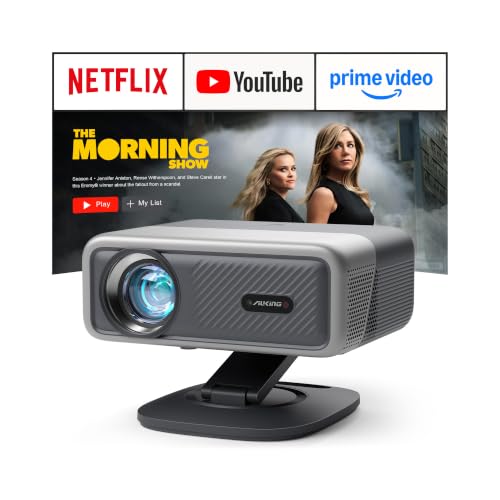
AuKing Outdoor (Native 4K) — Native 4K claimant
The AuKing’s title leads with its two biggest claims in brackets: 8000 Daylight-Bright and Native 4K. Those two claims deserve opposite treatments. The brightness figure belongs to the unstandardized family — a marketing unit with no published test behind it — so it should be filed as “the maker positions this as a bright machine” and nothing stronger. The native 4K claim, by contrast, is a concrete statement about the imaging panel, and it makes this the only pick in the guide whose title promises true 4K resolution rather than decoding of a 4K signal. For a viewer projecting onto a large outdoor screen, that panel difference is real resolution on the sheet, not a compatibility footnote.
Around those headlines the title assembles a credible outdoor package: Netflix named outright, a maximum image size quoted at 500 inches, 80W Dolby audio, auto focus, and a stand that rotates through 360 degrees. The rotating stand matters more than it sounds — outdoor screens move with the sun’s angle and the seating arrangement, and a projector that re-aims on its own base gets repositioned in seconds. The 500-inch figure should be read as an optical maximum rather than a recommendation; at anything like that size, in anything like daylight, no projector in this class holds a satisfying picture, and the realistic daylight image is far smaller.
- Resolution as titled: Native 4K
- Brightness as titled: 8000 Daylight-Bright (unstandardized marketing unit)
- Audio as titled: 80W Dolby
- Maximum image as titled: 500 inches
- Stand as titled: 360-degree rotatable, with auto focus
Strengths
- Only native-4K claim among the six titles, a concrete panel statement.
- Netflix is named in the title, simplifying the streaming side of setup.
- The fully rotating stand suits yards where the screen position migrates.
Trade-offs
- The brightness headline is unstandardized, so true output cannot be compared from the title.
- No ANSI or ISO figure appears anywhere in the title to anchor expectations.
- The 500-inch maximum invites image sizes far beyond what daylight allows.
Best for: shaded evening yards and covered patios where a big native-4K image after dusk is the goal, with the daylight claim treated as dusk insurance. Read the listing on Amazon closely for the full title wording before deciding.
Not suited for: unshaded midday viewing — the unstandardized brightness figure offers no verified defence against direct sun, and no projector in this guide can supply one.

HAPPRUN Outdoor (3000 ANSI) — Standardized mid-brightness
HAPPRUN’s title is the most candid in this guide, and candour is a feature. It quotes 3000 ANSI — a measured figure from a defined standard — and then, where a lesser title would print “4K” and move on, it specifies “4K Decoding.” That phrase tells the truth about the machine: it can accept and process a 4K signal, while its native panel resolution is a separate matter the title does not claim as 4K. Buyers cross-shopping this against the AuKing should understand they are comparing a decoding machine with an honest brightness figure against a native-4K machine with an unmeasured one. Neither is automatically the better buy; they are different bets.
The rest of the title is workmanlike in a good way: auto focus billed as AI-assisted, built-in apps, HDR10, and Dolby Audio without a wattage claim attached. For a shaded porch or a bright room opening onto a patio, 3000 ANSI is a meaningful amount of verified light — the kind of figure that survives a cloudy afternoon and owns the twilight completely. What it will not do is fight a sunbeam landing directly on the screen, and HAPPRUN’s title, to its credit, never quite says it will.
- Brightness as titled: 3000 ANSI lumens
- 4K handling as titled: 4K decoding
- Focus as titled: AI auto focus
- Format as titled: HDR10
- Native resolution: Not stated in the listing title — verify with the maker’s documentation
Strengths
- Brightness is quoted in ANSI, the comparable, standardized unit.
- The title distinguishes decoding from native resolution instead of blurring them.
- Built-in apps and auto focus keep the temporary-setup routine short.
Trade-offs
- 3000 ANSI is the second-lowest standardized figure in this guide.
- No audio wattage is stated, so outdoor sound output is unquantified in the title.
- Native panel resolution goes unstated and must be confirmed in documentation.
Best for: covered porches, shaded patios and bright rooms, where a verified 3000 ANSI can be trusted to hold the picture. The Amazon listing carries the complete title for a final check.
Not suited for: large screens in open yards at dusk, where the 5000ANSI pick’s standardized headroom covers the bigger image with lumens verified rather than advertised.

VISSPL 6000 Daylight Bright — Big unstandardized claim
The VISSPL represents the marketing-unit tier at full volume: 6000 Daylight Bright, Smart 4K, WiFi and Bluetooth, 3D Dolby Audio, AI auto focus, and positioning that stretches from portable outdoor use to bedroom and ceiling duty. Read with the standards lens from earlier in this guide, the 6000 figure cannot be ranked against the ANSI numbers here — it might describe a genuinely bright machine or a modest one wearing a large number, and the title provides no way to tell. That uncertainty is the product’s defining trait, and any honest review has to put it first.
What can be assessed is the surrounding package. AI auto focus suits a projector that will be set up on a patio table and struck again the same night. The “Smart 4K” phrasing, absent any native or decoding qualifier, should be read in the conservative direction — as 4K support — until documentation proves otherwise. The 3D Dolby Audio wording is similarly loose; it names a brand and a dimension, not a wattage. None of this makes the VISSPL a bad machine; it makes it an unverifiable one from the title alone, which is a different and important judgement.
- Brightness as titled: 6000 Daylight Bright (unstandardized marketing unit)
- 4K handling as titled: Smart 4K (no native or decoding qualifier stated)
- Focus as titled: AI auto focus
- Audio as titled: 3D Dolby Audio
- Native resolution: Not stated in the listing title — verify with the maker’s documentation
Strengths
- AI auto focus supports the set-up-and-strike rhythm of outdoor movie nights.
- WiFi and Bluetooth are both stated, covering streaming and external speakers.
- Positioning spans outdoor, bedroom and ceiling use in one portable body.
Trade-offs
- The headline brightness uses an undefined unit and cannot be cross-checked.
- Neither native resolution nor decoding is specified in the title.
- Audio is described without wattage, leaving outdoor volume unquantified.
Best for: casual evening projection where the picture is judged by eye at dusk rather than against a specification, and where focus automation earns its keep weekly. Verify the documentation linked from the Amazon listing before relying on any single figure.
Not suited for: bright-room daytime use as the primary job — an unstandardized brightness claim is exactly the wrong foundation for a purchase whose whole point is performance in light.

7000 Daylight Bright 4K Outdoor — Loudest audio claim
This model declines to give itself a brand-forward name in its title and instead leads with the number: 7000 Daylight Bright. The standards warning applies with full force — the figure is a marketing unit, not a measurement — and it should be compared only against the other Daylight Bright figures in this guide, where it sits between the VISSPL’s 6000 and the AuKing’s 8000. Within that family it is a mid-pack claim, whatever the absolute number suggests to a first-time reader.
The more concrete claims sit further along the title: 80W Dolby Cinema audio, matching the AuKing’s wattage as the strongest sound claim here, plus AI autofocus and keystone, WiFi and Bluetooth. Outdoor audio is a legitimate differentiator — yards swallow sound, neighbours’ fences reflect it oddly, and a projector’s small internal speakers usually lose to a summer evening. An 80W claim, if borne out, addresses the half of the outdoor-cinema problem that brightness arguments ignore. The 4K in the name carries no native or decoding qualifier, so it reads as support-level language until the documentation says more.
- Brightness as titled: 7000 Daylight Bright (unstandardized marketing unit)
- Audio as titled: 80W Dolby Cinema
- Focus as titled: AI autofocus and keystone
- Connectivity as titled: WiFi and Bluetooth
- Native resolution: Not stated in the listing title — verify with the maker’s documentation
Strengths
- 80W Dolby Cinema is tied for the strongest audio claim in this guide.
- Autofocus and keystone are both automated, speeding up yard setup.
- Its Daylight Bright figure sits mid-family, a less extravagant claim than the 8000.
Trade-offs
- Brightness remains an unstandardized claim with no ANSI or ISO anchor.
- The 4K language carries no native or decoding qualifier in the title.
- No streaming licence or named app platform appears in the title.
Best for: movie nights where sound carries half the experience and the screen sits in shade or twilight, letting the audio claim do the differentiating. Check the full listing on Amazon to see the title’s complete wording.
Not suited for: daytime sports in an open yard — the unverified brightness figure cannot promise a watchable picture once sunlight reaches the screen, whatever the headline number implies.

Daylight 5000ANSI 4K Outdoor — Highest standardized claim
Here is the strongest verified-brightness statement in the guide: 5000ANSI, printed without a space in the title and all the more welcome for being a standardized unit at all. Five thousand ANSI lumens is serious output — the class of figure associated with large, lit rooms — and in a yard it buys the most realistic daylight-adjacent performance available here: bright shade, heavy cloud, and the long evening before sunset all fall within its plausible territory. It still does not buy direct sun, and this review will not pretend otherwise, but the margin between “watchable in shade” and “washed out in shade” is exactly what standardized lumens purchase.
The supporting title is equally concrete: autofocus, a removable foldable stand that rotates 360 degrees, Netflix named, HDR10+ — a step beyond the HDR10 quoted elsewhere here — and 80W Dolby Audio matching the group’s best sound claims. The foldable stand is a thoughtful touch for a machine whose home is a yard: it stores flat, deploys fast, and the rotation handles screens that cannot sit dead ahead. The 4K in the name again arrives without a native or decoding qualifier, so resolution expectations should be set by the documentation, while brightness expectations can be set by the title with unusual confidence.
- Brightness as titled: 5000 ANSI lumens
- Format as titled: HDR10+
- Audio as titled: 80W Dolby Audio
- Stand as titled: removable, foldable, 360-degree rotatable
- Native resolution: Not stated in the listing title — verify with the maker’s documentation
Strengths
- Highest standardized brightness in the guide, quoted in ANSI lumens.
- HDR10+ exceeds the HDR10 claims of the other picks here.
- Foldable rotating stand is purpose-built for temporary yard placement.
Trade-offs
- Native resolution is not stated despite the 4K in the product name.
- Even 5000 ANSI does not make direct sunlight on the screen watchable.
- The stand-based design suits tables and patios more than permanent mounts.
Best for: the brightest realistic brief — big screens in bright shade, overcast afternoons, and twilight sessions that start before dark. The listing on Amazon reproduces the title in full for a last verification pass.
Not suited for: a screen placed where afternoon sun lands directly on its surface — that geometry defeats every projector in this guide, and the fix is moving the screen, not buying more lumens.

Smart Daytime Projector (2700 ANSI) — Licensed streaming, shorter throw
The Smart Daytime Projector makes the most modest standardized claim in this guide — 2700 ANSI — and surrounds it with the most domestic set of features. Netflix is not merely named but described as licensed, a distinction that matters for streaming quality and app support. The throw is described as shorter, suiting porches and patios where the projector cannot retreat far from the screen. HDMI eARC with CEC appears in the title, which is living-room language: this machine expects to hand its audio to a soundbar and take commands from a single remote when it works indoors.
That dual citizenship is the honest way to read the whole title. At 2700 ANSI it is the least equipped here for open-yard brightness battles, and its “Bright Room/Outdoor Party Night” positioning quietly concedes the point — party night, not midday. What it offers instead is integration: WiFi 6 and Bluetooth 5.4 in current versions, 70W Dolby Audio that nearly matches the group’s best, auto focus with a lens cap for protection between uses. On a covered porch, feeding a modest screen from a short distance, those are the traits that decide satisfaction long after the brightness argument is settled.
- Brightness as titled: 2700 ANSI lumens
- Streaming as titled: Netflix licensed
- Audio as titled: 70W Dolby Audio, HDMI eARC with CEC
- Throw as titled: shorter throw
- Connectivity as titled: WiFi 6, Bluetooth 5.4
Strengths
- A Netflix licence is stated, not merely app compatibility.
- Shorter throw fits porches and patios with limited placement depth.
- eARC and CEC support proper soundbar integration indoors.
Trade-offs
- 2700 ANSI is the lowest standardized brightness figure in this guide.
- The title’s own positioning targets bright rooms and party nights, not open daylight.
- No native resolution is stated for its 4K branding.
Best for: covered porches and patio rooms where the screen is modest, the distance is short and streaming convenience matters daily. Browse the Amazon listing to confirm the app list against the services your household uses.
Not suited for: large open-yard screens — 2700 ANSI spread across a big image in ambient light thins out fast, and the 5000ANSI pick exists precisely for that geometry.
How Do You Actually Get a Watchable Picture Outdoors Before Dark?
Start by surrendering the patch of yard where the sun lands. The single most effective brightness upgrade available is a screen position in shade — under a porch roof, on the shadow side of the house, beneath a mature tree’s canopy — and it costs nothing. A projector rated at half the lumens will beat a brighter rival when the first screen sits in shade and the second bakes in sun, because the sun’s contribution to the screen dwarfs anything a lens can add. Scout the yard at the hour you plan to watch, not at noon, since shadows migrate across the afternoon and a shaded six o’clock spot may be a sunlit eight o’clock one.
Screen choice comes second. A matte white surface is the safe default; grey surfaces can deepen perceived contrast in ambient light by rejecting some of it, at the cost of peak brightness. Size is the third lever, and it pulls against instinct: in daylight, a smaller image is a brighter image, because the same lumens land on less area. Dropping from a huge picture to a moderate one is often the difference between squinting and relaxing. The AuKing’s 500-inch optical maximum makes the point by exaggeration — daylight images in this class live at a fraction of that.
Then manage expectations by content. A bright football match or a vivid animated film tolerates ambient light far better than a moody drama whose important scenes happen in a cellar. Schedule the dark material for after sunset and let the daylight hours carry sport, news and bright programming. Finally, run the projector’s brightest picture mode for daytime sessions even if its colours run cooler than the calibrated evening mode; accuracy is a luxury that belongs to darkness, and output is the currency of the afternoon. Our companion roundup of best projectors for daytime outdoor use explores the same trade-offs from the scheduling side.
What Role Do Stands, Focus and Audio Play Outside?
Indoors, a projector is installed once and forgiven its setup quirks for years. Outdoors, setup is a recurring event — the machine comes out of a cupboard, lands on a table or its own stand, gets aimed at a screen that may have moved since last weekend, and is expected to be showing a film twenty minutes later. That rhythm explains why every title in this guide mentions auto focus, and why stand design earns spec-box space here: the 360-degree rotating stands on the AuKing and the 5000ANSI model, one of them foldable and removable, are answers to a real weekly friction.
Keystone and focus automation deserve one caution. Auto focus genuinely saves time; heavy digital keystone, used to correct a badly angled placement, reshapes the image by discarding pixels and can soften it visibly. The better habit is to place the projector square to the screen — stands that rotate help exactly here — and let keystone handle only the last degree of correction. A minute spent repositioning beats a season spent watching a corrected-but-soft picture.
Audio, meanwhile, scales differently outdoors. Indoors, walls return sound to the listener; outdoors, sound disperses into the garden and the street, which is why these titles advertise 70W and 80W Dolby systems where indoor models might boast about a modest built-in speaker. Even so, treat the built-in claim as the starting point: for a crowd spread across a yard, a Bluetooth speaker placed near the seating — every title here lists Bluetooth — usually serves the audience better than any speaker built into the projector behind them. And be a decent neighbour: outdoor bass travels, and the film’s second hour lands differently on the house next door at eleven than it does at eight.
How Do Season, Weather and Time of Day Rewrite the Daylight Brief?
“Daylight” is not one condition, and a projector that fails in one version of it may succeed comfortably in another. A clear June evening at high latitude stays bright until late, with low sun raking sideways across gardens — the hardest common case, because the light is strong and angled to find screens. A humid, overcast afternoon diffuses the same daylight through cloud, dropping its intensity dramatically while keeping the day feeling bright to human eyes; projectors cope far better than the sky’s appearance suggests. Winter afternoons compress the problem into a short window: the light is weaker, the dusk arrives early, and a modest ANSI figure can own a late-afternoon screening that would defeat it in July.
This is why honest buying in this category starts with a calendar rather than a spec sheet. Households that project mostly for autumn sports, under cloud and early darkness, are shopping for a different machine than households planning midsummer garden parties. The first group can prioritise resolution, audio and convenience, letting a 2700 or 3000 ANSI figure suffice. The second group should concentrate its budget on standardized brightness and shade infrastructure — a pergola, a sail, a screen wall — because those purchases defend the image at exactly the hours it is most threatened.
Weather adds one more practical layer: none of these machines should be treated as weatherproof on the strength of an outdoor label in a title. Outdoor positioning means the design anticipates yards and patios; it does not promise survival in rain, and dew alone can end an evening’s electronics. The portable, stand-based designs in this guide have the right instinct built in — they come inside when the session ends — and owners should honour that instinct even when the sky looks merely threatening.
A Worked Example: Reading Two Titles Side by Side
The standards discipline becomes concrete when two titles are placed next to each other. Consider the AuKing against the HAPPRUN. The AuKing prints the larger brightness number by far — 8000 against 3000 — and a first-time shopper’s eye stops there. Read properly, though, the comparison is: an unmeasured marketing figure plus a native-4K panel claim, against a measured ANSI figure plus an honestly-labelled decoding arrangement. The first title tells you more about resolution and less about brightness; the second tells you more about brightness and less about resolution. Neither title is lying. They are simply answering different questions, and the buyer has to notice which question each one answered.
Now place the 5000ANSI model beside the 7000 Daylight Bright machine. Here the raw numbers suggest a close contest, 7000 against 5000, perhaps even an edge to the larger figure. The standards reading dissolves the contest: one figure is a measurement, the other is a claim, and a measured 5000 ANSI is a heavyweight output by any reckoning in this class. The unstandardized 7000 might describe a brighter projector in practice — nothing in this guide can rule that out — but a purchase cannot be founded on a possibility when a certainty is sitting beside it at the same decision point.
The habit generalises beyond this guide. Whenever a title offers a number, ask what produced it: a named standard, a named component, or an adjective wearing a number’s clothing. Wattage claims for audio, hour claims for light sources and inch claims for maximum image size all reward the same question. Titles that survive the question earn trust; titles that dissolve under it have told you something valuable anyway.
Portable Rigs Versus Semi-Permanent Outdoor Installs
Two distinct lifestyles hide inside the phrase “outdoor projector.” The portable rig is assembled per event: projector from a cupboard, screen unrolled or inflated, seating dragged into a rough arc, everything struck before midnight. The semi-permanent install keeps a fixed screen or a painted wall, a weather-sheltered shelf or mount for the projector, and outdoor power already in place, so a screening starts with a remote rather than a half-hour of logistics. The six titles here lean portable — stands, rotation, auto focus, apps built in — but several can anchor a semi-permanent setup happily, and the choice of lifestyle changes which traits matter.
For the portable rig, setup automation is king. Auto focus that lands in seconds, a stand that rotates instead of a stack of books, built-in apps that remove the streaming stick from the kit list — these decide whether the rig gets used on a whim or only on planned occasions. Weight, handle-friendly shapes and a lens cap, as the Smart Daytime title mentions, all serve the same master. For the semi-permanent install, by contrast, brightness headroom and audio integration matter more, because the machine may serve larger gatherings on a fixed, possibly bigger screen, and features like eARC let it join a proper outdoor sound system instead of improvising nightly.
Either way, power deserves a thought before the first screening. Outdoor sockets, extension leads rated for exterior use, and a cable route that guests will not trip over in the dark are unglamorous purchases that separate a relaxed evening from an interrupted one. Projectors with generous built-in audio, like the 80W claims here, reduce the peripheral count; projectors feeding a Bluetooth speaker add one more battery to remember. Small frictions, honestly counted, are what buying guides are for.
What Happens to Colour and Contrast When Ambient Light Joins In?
Brightness arguments tend to dominate daylight discussions, but the first casualty of ambient light is not brightness — it is contrast. A projector cannot project black; the darkest part of the image is simply the screen with no light added, which outdoors means the screen lit by the sky itself. As ambient light rises, the floor of the image rises with it, shadows turn to grey, and scenes shot at night or in interiors lose their depth first. This is why content choice matters so much in daylight sessions: bright, high-key material — sport, animation, daytime television — carries its information in the mid-tones and highlights, where the projector still has authority, while a murky thriller surrenders its plot to the glare.
Colour shifts follow. To squeeze maximum output, bright picture modes typically push the image cooler and greener than the calibrated evening settings, and daylight itself adds its own tint depending on whether the screen sits in blue-ish open shade or warm reflected light from a brick wall. None of this is a defect in any particular model here; it is the physics of the setting, and it explains why chasing colour accuracy in a daylight brief is misplaced effort. Judge a daylight projector on legibility — faces readable, scores and captions crisp, the ball visible against the grass — and save the colour-critical viewing for the same machine’s evening shift, where several of these titles’ HDR claims get their proper stage.
HDR deserves its sentence in this context. HDR10 and HDR10+ labels, which appear across these titles, describe how the projector maps high-dynamic-range sources; in darkness they can add real depth, while in daylight the ambient floor compresses most of that advantage away. Treat HDR support as an evening feature that happens to ride along, not as part of the daylight case for any pick.
How Should You Test a Daylight Projector While Returns Are Still Easy?
Test at the worst hour you realistically plan to use, not the most flattering one. If the ambition is Saturday-afternoon sport, run the first session then, in the actual screen position, with the actual seating. Play the content classes you care about — a match, a film scene with dark passages, a bright animated feature — and judge each separately, because the projector may pass two tests and fail the third, and the verdict depends on which content your household actually watches.
Run the comparison that matters: shade versus no shade, and large image versus moderate. Moving the screen into shadow for one session teaches you more about your yard’s potential than any figure in any title, and shrinking the image by a fifth shows how much brightness headroom size alone was eating. Note the audio at the same time, from the farthest seat, with ordinary evening garden noise around you — dialogue intelligibility at distance is the outdoor audio test that counts, not volume at arm’s length.
Finally, time the setup. From cupboard to picture, and from final whistle to everything back indoors, the minutes involved predict how often the rig will be used in October as faithfully as in June. A projector that tests brilliantly but takes forty minutes of fussing will become a special-occasions device; one that is merely good but ready in ten will host a season of impromptu screenings. In this category, convenience is a performance specification.
The Second Job: Bright Rooms Indoors
Most of these machines will spend the majority of their hours indoors, whatever the outdoor branding says, and the bright-room brief indoors is a gentler cousin of the yard brief. A living room with the curtains open at midday is a controlled environment compared with a garden: the light is strong but stable, it never lands as a direct sunbeam unless the room is arranged carelessly, and the screen position is fixed. In that setting the standardized figures here translate more predictably — 2700 ANSI is a credible bright-room output for a moderate screen, and the Smart Daytime Projector’s eARC, CEC and licensed streaming read like a specification written for exactly this room.
The indoor second job also reframes the unstandardized picks. A VISSPL or a 7000 Daylight Bright model that cannot be ranked for the yard can still be perfectly satisfactory on a bedroom wall or a kitchen-adjacent screen, judged by eye in the room it will serve. The buyer’s risk concentrates in the outdoor daylight scenario, where the gap between claim and performance is widest and least testable in a shop. Indoors, the same uncertainty shrinks, because the environment is forgiving and the return-window test described above is easy to run honestly.
Ceiling duty blurs the line further — two titles here mention ceiling or overhead use — and households short on surfaces may end up mounting a daylight-branded machine permanently. If that is the plan, the comparison should borrow criteria from the permanent-install world: throw distance measured to the fixed screen, cable runs concealed, and a mount matched to the unit. The portable virtues of stands and rotation then matter less, and the standardized brightness and resolution language matters more, because a fixed install cannot be repositioned when the picture disappoints.
Side-by-Side Comparison
| Projector | Brightness as titled | Standard | Resolution language as titled |
|---|---|---|---|
| AuKing Outdoor | 8000 Daylight-Bright | Unstandardized | Native 4K claimed |
| HAPPRUN Outdoor | 3000 ANSI | ANSI | 4K decoding |
| VISSPL | 6000 Daylight Bright | Unstandardized | Smart 4K, unqualified |
| 7000 Daylight Bright 4K Outdoor | 7000 Daylight Bright | Unstandardized | 4K, unqualified |
| Daylight 5000ANSI 4K Outdoor | 5000 ANSI | ANSI | 4K, unqualified |
| Smart Daytime Projector | 2700 ANSI | ANSI | 4K, unqualified |
The table’s middle column is the one to shop by. Within the ANSI rows, the ordering is meaningful: the 5000ANSI model leads, the HAPPRUN follows, the Smart Daytime trails with the strongest streaming credentials as compensation. Within the unstandardized rows, the numbers describe each maker’s confidence, not a measured ranking, and the AuKing’s native-4K panel claim is a more solid reason to shortlist it than its 8000 figure. Shoppers whose yards are large and whose evenings run late may also weigh the machines in best backyard projectors, where dusk performance rather than daylight is the entry ticket.
What Are the Most Common Mistakes When Buying a Daylight Projector?
The first mistake is the raw-number reflex: seeing 8000 beside 3000 and concluding the first machine is nearly three times as bright. Without a shared standard, that arithmetic is fiction. The second mistake is testing in the wrong light — unboxing at dusk, being delighted, and then discovering the Saturday-afternoon reality a week later. If daylight use is the point of the purchase, evaluate in daylight, in the actual screen position, during the return window.
The third mistake is oversizing the screen. Daylight punishes area; every extra foot of width dilutes the same lumens further. The fourth is ignoring the audio half of the experience until the first screening, when dialogue dissolves into the garden. The fifth is believing any title’s implication that direct sun is a solved problem — it is not solved here or anywhere in this class, and the honest fix is shade, scheduling and screen size. A final, quieter mistake is overlooking the streaming licence question: a title that names a licensed Netflix app, as two here do, promises a smoother path than generic compatibility language, and discovering the difference after purchase is needlessly annoying.
A Note on the Wall, Sheet and Screen You Already Own
Plenty of daylight setups begin with whatever surface is already in the yard — a pale wall, a garage door, a bedsheet on a line — and there is no shame in that apprenticeship; it teaches the household whether outdoor projection earns a permanent place before any screen budget is spent. But surface quality quietly caps every projector in this guide. A wrinkled sheet ripples the geometry that auto focus just corrected, a textured wall scatters the brightness the lumens were bought for, and an off-white surface tints everything projected onto it. The upgrade path that seasoned outdoor viewers recommend is boring and correct: first the projector, judged by the standards discipline above; then a flat, matte, purpose-made screen sized for the daylight image rather than the midnight one. Each step is visible, neither is wasted, and the order matters because the screen decision depends on knowing the projector’s honest output — which is, in the end, the entire argument of this guide in miniature.
Final Recommendation
Choose by the standard before the number. For the strongest verified daylight-adjacent performance, the Daylight 5000ANSI model leads this guide: its brightness is measured, its HDR10+ and 80W audio claims are concrete, and its folding stand suits the yard it was built for. For a covered porch with honest shade, the HAPPRUN’s 3000 ANSI and candid decoding language make it the trustworthy middle. The Smart Daytime Projector serves the porch-and-patio brief best where streaming polish matters more than raw output. Among the unstandardized claims, the AuKing earns attention for its native-4K panel rather than its headline figure, while the VISSPL and the 7000 model ask you to trust adjectives. One more consideration belongs in the final reckoning: buy for the light you have, not the light in the advertisement photographs, which are invariably shot at a dusk so deep it barely qualifies as daylight at all. Your yard at four in the afternoon in June is the reference condition, and the projector that respects it is the one that will still be earning its place in September. Whichever name survives your shortlist, put the screen in shade first — that single free decision will do more for your Saturday matinee than any figure printed on any box in this category.
Frequently Asked Questions
Can any of these projectors work in direct sunlight?
No — and that answer applies well beyond this shortlist. Direct sun delivers far more light to a screen than a projector can overcome, so the image washes out regardless of the headline figure. Shade, cloud cover, dawn and dusk are the working conditions; within them, the standardized-brightness picks, led by the 5000ANSI model, hold the most convincing pictures.
Why do the brightness numbers vary so wildly between models?
Because they are produced by different methods, or by no method at all. ANSI figures follow a defined measurement procedure and can be compared with each other. “Daylight Bright” figures follow no published procedure, so a larger one does not establish a brighter projector. The number’s unit matters more than the number.
Is native 4K worth prioritising for outdoor viewing?
At large screen sizes and close seating, yes — the AuKing’s native-4K claim promises genuine detail the decoding models cannot reproduce. At modest sizes, or when the audience sits well back, brightness and contrast usually shape the experience more, and a decoding machine with a verified ANSI figure can be the smarter allocation.
What screen size is realistic for daylight use?
Smaller than the evening instinct suggests. Concentrating the available lumens on a moderate image is the most reliable daylight strategy; the huge maximum sizes in some titles are optical limits for dark rooms, not daylight recommendations. Let the twilight sessions, not the spec sheet, set the biggest size you regularly use.
Do I need external speakers for a yard screening?
Not strictly — several titles here claim 70W or 80W Dolby systems, unusually strong for built-in audio — but placement matters as much as power. Sound thrown from the projector’s position has to cross the whole audience before it arrives, losing clarity to distance, breeze and garden noise on the way, whereas a speaker placed among the seats starts its work where the listeners actually are. A Bluetooth speaker near the seating, which every pick here can feed, often serves a spread-out audience better than louder sound from behind the screen line.
How much brightness is enough for a shaded porch?
A shaded porch is the friendliest daylight scenario, and the standardized figures here bracket it well: 2700 ANSI handles modest screens in genuine shade, 3000 ANSI adds margin for brighter surroundings, and 5000 ANSI covers large images or partial shade. The unstandardized figures cannot be slotted into that ladder, which is precisely the practical cost of an undefined unit.
Should I buy a grey screen for daytime viewing?
A grey screen can help perceived contrast in ambient light by absorbing some of the stray illumination that lifts black levels, and many outdoor viewers prefer the trade. It costs peak brightness, though, so pair it with one of the stronger standardized picks rather than the weakest, and treat it as an optimisation for shade — not as a licence to project into sunshine.
Related Guides
Daylight is one end of the brightness spectrum; the other decisions continue indoors and after dark. Our guide to best bright projectors applies the same standards-first reading to lit-room models generally, and the best ceiling projectors roundup covers the permanent-install alternative for rooms where a fixed mount replaces the portable stand.
Related guides
- Best 1080p IP Cameras: PoE Domes, Turrets, Bullets and a PTZ That Earn Their Cable
- Best 43 1080p TVs: Why 43 Inches Went 4K — and Where True Full HD Survives
- Best Doorbell Cameras No Subscription: Local Storage Picks, and the Ring/Blink Truth
- Best AC Powered Wireless Security Cameras: Wi-Fi Data, Mains Power, Zero Sleep


