What's inside
- Key Takeaways
- Quick Picks
- How Did We Compare Televisions That Want to Be Paintings?
- What Makes Art Mode Convincing — and What Gives the Game Away?
- The Gallery Subscription, Priced Honestly Across Five Years
- On the Wall for a Month: How Each Pick Settles Into a Room
- Your Own Photographs Are the Gallery You Already Own
- Where Else Does a Frame Television Earn Its Keep?
- And When the Art Goes Off: How Do They Perform as Televisions?
- Installation Realities: Studs, Sockets and the Sun’s Timetable
- How Does a Frame Television Age?
- Which Art Suits Which Room? A Short Course in Hanging Pixels
- Six Ways to Hang a Picture That Plays Films
- How Do You Install a Frame Television So the Illusion Holds?
- What Mistakes Ruin the Frame-TV Effect?
- What Should You Check on the Listing Before the Frame Is Priced In?
- Final Recommendation
- Frequently Asked Questions
- Related Guides
As an Amazon Associate I earn from qualifying purchases. This post may contain affiliate links at no extra cost to you.
gizmoverdict.com is reader-supported. When you buy through links on our site, we may earn an affiliate commission.
Where to buy: Frame-style televisions are sold in more pieces than ordinary sets, so read each Amazon listing’s “what’s included” line as carefully as its headline: some picks below bundle the decorative frame and the flush wall mount in the box, others assume you will choose a frame finish separately, and one is listed with no frame included at all. The television is the same purchase either way; the wall-ready total is not, and the time to discover that is before checkout, not on installation day.
The best picture frame tvs exist because of a simple domestic truth: a television spends most of its life switched off, and a switched-off ordinary television is a black rectangle dominating the room it was bought to entertain. Frame televisions refuse that bargain. They hang flush against the wall inside a decorative bezel, and when the programme ends they become the artwork — a print, a photograph, a painting — with a matte, paper-like surface that sells the illusion. Done well, guests ask where the television is. Done badly, you have paid a premium for a screensaver.
This guide judges the category on its own axes, and they are not the usual ones. Art mode quality comes first: how convincing the image is at conversational distance, in daylight, from an angle. The bezel system comes second — what frame finishes exist, whether they are included, and how they attach. Flush mounting is third, because a frame television protruding four inches from the wall is a television wearing a costume. Gallery economics run fourth: which art is free, which lives behind a subscription, and whether your own photographs are welcome. Ordinary television competence — 4K picture, HDR, a sane platform — is the entry ticket underneath it all.
Six sets compete here, all at 55 inches, which has become the category’s standard canvas. Samsung invented this market and fields two entries, its mainstream Frame and the step-up Frame Pro with a wireless connection box. Hisense and TCL have arrived with value challenges that bundle frames and mounts Samsung sells separately, and Amazon’s Ember Artline brings Fire TV and its own art offering. The differences are in the details of art, wood and money — exactly where this guide will live.
Key Takeaways
- Samsung’s The Frame LS03F remains the category reference: mature Art Mode, a deep bezel catalogue and a Slim Fit mount in the proposition.
- The Frame Pro LS03HW adds a Wireless One Connect box, so the only thing reaching the screen is power — the cleanest installation in the class.
- Hisense’s CanvasTV S7 bundles frame and ultra-slim mount in the box and adds a 144Hz panel for when art hour ends.
- TCL’s two entries compete on the art library: free curated art and AI-generated art are included rather than subscribed.
- Amazon’s Ember Artline is the Fire TV route into the category, listed with no frame included — budget for the bezel separately.
- Gallery subscriptions are the hidden running cost of this category; the picks differ sharply on how much art is simply free.
Quick Picks
| Pick | Badge | Why it earns its place |
|---|---|---|
| Samsung The Frame LS03F 55″ | Best overall | The original formula perfected: Art Mode, Modern Frame Design and a slim-fit wall presence. |
| Samsung The Frame Pro LS03HW 55″ | Premium pick | Neo QLED picture, a glare-free surface and a Wireless One Connect box for a cable-free wall. |
| Hisense CanvasTV S7 55″ | Best value | Frame and ultra-slim mount included, an art mode of its own and a 144Hz panel underneath. |
| TCL NXTVISION 55″ | Best art library bundle | Free art library plus AI art generation, with frame and flush mount in the box at 1.1-inch depth. |
| TCL Designer Series A300L 55″ | Best flush design | TCL’s design-led variant: curated free art, matte screen and the same ultra-slim flush profile. |
| Amazon Ember Artline 55″ | Best Fire TV art pick | Fire TV, free art and photos, and custom frame options — with the frame itself sold separately. |
How Did We Compare Televisions That Want to Be Paintings?
By spending the evaluation on the hours when the sets are art, not the hours when they are televisions. For art mode we weighted the matte surface quality, the brightness behaviour that lets a displayed painting hold its own in a lit room without glowing like a screen, and the breadth of the built-in collection. A frame television that cycles twelve images is a novelty; one with a serious gallery, plus your own photographs handled gracefully, is furniture.
Hardware honesty formed the second pass. We checked what each listing actually includes — frame, mount, connection boxes — because the category’s pricing games are played with accessories. Samsung’s ecosystem sells frames as separate choices in many finishes; Hisense and TCL bundle theirs; Amazon’s Ember listing states plainly that no frame is included. None of those strategies is wrong, but they make headline comparisons meaningless unless the box contents are compared too, which the reviews below do explicitly.
The third pass was the television test, because a frame set still shows films on Friday. All six picks are 4K with HDR support and a mainstream smart platform, but refresh rates, panel types and gaming features vary, and a household buying one screen for a room deserves to know which art piece is also an athlete and which is a portraitist only.
What Makes Art Mode Convincing — and What Gives the Game Away?
Texture is the first tell. A real print does not emit light evenly, and the matte, anti-reflective surfaces across this category scatter ambient light the way paper does, so the image sits in the room’s light rather than shining against it. The second tell is brightness discipline: art modes that auto-dim to match the room, so a painting at dusk looks like a painting at dusk, separate the serious implementations from the slideshow features. Samsung’s maturity shows here, but Hisense’s Hi-Matte panel and TCL’s matte screens are built on the same insight.
Content is the third tell. A convincing gallery rotates slowly through a collection with range — photography, classical works, modern pieces — and lets you crop, mat and frame your own photographs with digital mounts that mimic real framing. The fourth tell is the bezel itself: a frame with depth, a finish with grain, and a shadow gap against the wall reads as joinery; a flat plastic border reads as a television that has been to a costume shop. This is why frame inclusion and finish choice get so much attention in the reviews — the bezel is half the illusion.
And the final tell is the cable. A painting has no HDMI leads. Sets that route connections to a separate box — Samsung’s One Connect approach, wireless on the Pro — keep the wall clean in a way no cable channel fully imitates. Buyers planning a truly gallery-grade installation should weight that architecture heavily; buyers in rented rooms with a media unit beneath will care less, because the cables have somewhere honest to go.

Samsung The Frame LS03F 55″ — Best overall
The Frame is the product that created this category, and the 2025 LS03F shows what a decade of iteration buys. The proposition is complete in a way rivals still chase: a 4K QLED panel with the matte art surface, a Modern Frame Design bezel system with a wide catalogue of finish options, the Slim Fit Wall Mount that pulls the set nearly flush, and an Art Mode backed by the deepest gallery ecosystem in the business — Samsung’s Art Store, a subscription catalogue of serious breadth, alongside your own photographs.
As a television it is fully house-trained: the NQ4 AI Gen2 processor, Samsung Vision AI features and Alexa built in, with picture quality that holds up on film night rather than merely posing by day. The honest costs are the category’s founding ones — the Art Store’s best content sits behind a subscription, and decorative frames beyond the standard offering are separate purchases. But the whole, taken together, remains the benchmark: the set interior designers specify and the one every rival in this guide is priced against.
- Panel: 55-inch 4K QLED with matte art surface
- Art: Art Mode with Samsung Art Store gallery (subscription catalogue) plus personal photos
- Mounting: Slim Fit Wall Mount design for near-flush hanging
- Bezel: Modern Frame Design, interchangeable finish options
- Processing: NQ4 AI Gen2 with Samsung Vision AI
Strengths
- The most mature art ecosystem — curation, rotation behaviour and photo handling are a generation deep
- Bezel catalogue breadth lets the set match real joinery, from pale oak looks to gallery black
- resale and accessory support are the strongest in the category, which matters for a furniture-grade purchase
Trade-offs
- The gallery’s best rooms are subscription rooms; the free tier is a taster by design
- Frame finishes beyond the basics add up, so the wall-ready total exceeds the headline
- Gaming specifications are respectable rather than class-leading
Best for: design-led living rooms where the television must disappear into the décor between viewings. Not suited for: subscription refuseniks, whose art budget ends at the purchase price.
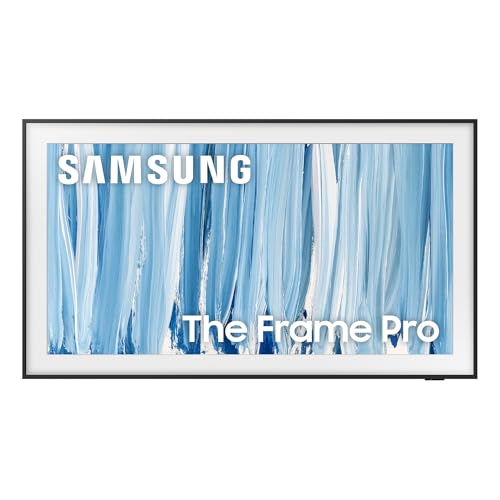
Samsung The Frame Pro LS03HW 55″ — Premium pick
The Frame Pro asks what the concept becomes when Samsung stops compromising. The panel steps up to Neo QLED with a glare-free finish, the processing moves to the flagship tier, and — the decisive architectural change — the connections move off the set entirely into a Wireless One Connect box, which is included along with the Slim Fit Wall Mount. The screen on the wall needs only power. Every source, console and cable lives in a cupboard across the room, and the gallery illusion survives contact with a full entertainment system.
For installations where the television hangs on a chimney breast or a feature wall with no media unit beneath, that wireless architecture is not a luxury; it is the difference between a painting and a painting with umbilical cords. The Pro also buys picture headroom — Neo QLED brightness and contrast for the film nights — that the standard Frame cannot match. It is the most expensive route in this guide and the most complete one, aimed at buyers furnishing a room for a decade rather than refreshing a screen for a season.
- Panel: 55-inch Neo QLED, glare-free finish
- Connections: Wireless One Connect box included — sources live away from the wall
- Mounting: Slim Fit Wall Mount included
- Art: Art Mode within Samsung’s gallery ecosystem
- Model: LS03HW (2026)
Strengths
- Wireless connection architecture delivers the only truly cable-free wall in this guide
- Neo QLED picture quality means film night is an upgrade, not a compromise
- Included mount and connection box make the box contents match the premium promise
Trade-offs
- The premium is substantial, and the standard Frame covers most households for less
- The Art Store subscription economics still apply on top of the hardware premium
- Wireless boxes need their own placement thought — line of sight and ventilation still matter
Best for: feature walls, chimney breasts and design projects where any visible cable fails the brief. Not suited for: renters and the commitment-shy, whose walls and budgets both argue for the standard model.

Hisense CanvasTV S7 55″ — Best value
Hisense read Samsung’s accessory economics and chose violence: the CanvasTV S7 includes the frame and the ultra-slim wall mount in the box. The set itself is a 55-inch Hi-QLED panel with an anti-glare Hi-Matte display, its own Art Mode, Dolby Vision HDR and — the surprise — a 144Hz refresh rate, making it secretly the best gaming television in this guide. Google TV runs the platform, so the app story is the broad one.
The value argument is about totals. A Frame buyer pricing bezels and mounts separately watches the gap narrow; the CanvasTV’s wall-ready figure is its headline figure. Hisense’s art catalogue is younger than Samsung’s subscription library, and the bezel ecosystem is narrower — the frame you get is the frame in the box, in the finish offered. For households whose priority is the flush, framed look without an accessories spreadsheet, that simplicity is not a limitation but the entire sales pitch, and it is a persuasive one.
- Panel: 55-inch Hi-QLED 4K, 144Hz, anti-glare Hi-Matte display
- Art: Art Mode with Hisense’s gallery offering
- Included: frame and UltraSlim Wall Mount in the box
- Formats: Dolby Vision HDR
- Platform: Google TV
Strengths
- Frame and mount included — the wall-ready price is the price, a rarity in this category
- 144Hz panel makes it the frame set a gamer can buy without a second thought
- Google TV’s openness suits households with broad or unusual app needs
Trade-offs
- Art catalogue depth trails Samsung’s subscription library, especially for classical collections
- Bezel choice is limited to what Hisense offers, with no third-party frame market of note
- The brand’s art-mode polish — rotation behaviour, matting finesse — is a step behind the originator
Best for: buyers who want the framed look at an honest all-in figure and a real television underneath. Not suited for: art devotees who will graze a subscription gallery nightly and notice its absence.

TCL NXTVISION 55″ — Best art library bundle
TCL’s NXTVISION attacks the category’s running cost head-on: its listing leads with a free art library and AI art generation, a matte screen, and a frame plus flush mount included, all wrapped around a QLED 4K panel just 1.1 inches deep. The free library changes the ownership experience fundamentally — the gallery is a feature of the television, not a subscription relationship — and the AI art tool, whatever one thinks of generated imagery, lets a household conjure a piece to match a room’s palette on a whim.
The television underneath is no prop: Google TV, Dolby Vision and up to 144Hz variable refresh support give it genuine range from film to gaming. TCL’s matting and presentation options are improving quickly, and the flush mount in the box keeps the profile honest. Where Samsung still leads is curation prestige — museum-grade collections with names attached — and bezel ecosystem depth. Where TCL leads is the feeling that the art was included in the purchase, which for many buyers will settle the argument.
- Panel: 55-inch QLED 4K, matte screen, 1.1-inch depth
- Art: free art library plus AI art generation included
- Included: frame and flush mount in the box
- Formats/gaming: Dolby Vision, up to 144Hz VRR
- Platform: Google TV
Strengths
- No subscription stands between the buyer and a full gallery — the category’s cleanest running-cost story
- Ultra-slim depth and an included flush mount deliver the gallery profile without extras
- AI art generation is a genuinely playful answer to the “we need something teal” problem
Trade-offs
- Curated prestige collections are thinner than Samsung’s Art Store at its best
- Generated art will not satisfy buyers who want recognised works by recognised artists
- Frame finish options are limited compared with Samsung’s catalogue
Best for: households that love the rotating-gallery idea and refuse to rent it monthly. Not suited for: collectors of specific artworks, who will find the famous names behind Samsung’s paywall.

TCL Designer Series A300L 55″ — Best flush design
The A300L is TCL’s design-forward sibling to the NXTVISION, and the overlap is deliberate: the same 55-inch QLED 4K formula, a free curated art library with AI art, a matte screen, 144Hz capability, Dolby Vision, and a frame plus flush mount included at the same 1.1-inch ultra-slim depth. The Designer Series badge signals where TCL aims it — rooms where the object’s industrial design is part of the purchase, and buyers comparing it against furniture rather than against other televisions.
Choosing between TCL’s two entries comes down to the listing-level details: the exact frame finish bundled, the current generation of the line — the A300L is presented as the 2026 version — and whichever represents better value on the day. Both deliver the essential Designer proposition: a set that arrives with everything needed to hang as a picture, art included, at a depth that keeps the profile believable from the side of the room. In a category built on illusion, arriving complete is a design statement of its own.
- Panel: 55-inch QLED 4K, matte screen, UltraSlim 1.1-inch depth
- Art: free curated art library plus AI art
- Included: frame and flush mount in the box
- Formats/gaming: Dolby Vision, HDR, 144Hz
- Series: Designer Series A300L (2026 version)
Strengths
- The joint-slimmest profile in this guide, and it arrives with its mount included
- Curated free library gives the gallery a considered feel from the first evening
- Design-led positioning shows in the details a spec sheet cannot capture
Trade-offs
- Substantial overlap with its NXTVISION sibling makes the choice between them a listing-reading exercise
- Bezel ecosystem remains TCL-only, without Samsung’s aftermarket depth
- As a design-led line, availability of specific finishes can vary
Best for: interiors-first buyers who want the slimmest complete package TCL offers. Not suited for: bargain hunters indifferent between the two TCLs, who should simply take the keener listing on the day.

Amazon Ember Artline 55″ — Best Fire TV art pick
Amazon’s Ember Artline is the category’s newest flag planted, and it waves Fire TV colours: a 55-inch 4K QLED smart TV with an anti-glare display, free art and photos built into the proposition, Dolby Vision, and Alexa+ woven through the experience for finding programmes by conversation. For households already fluent in Fire TV and Alexa, it is the frame television that speaks their language natively, remote and all.
The listing carries one phrase that demands translation: “No Frame.” The Ember is listed without a decorative frame included, with custom frames offered as the separate choice they are. That is not a defect — Samsung’s frames are largely separate purchases too — but it must enter the budget honestly, because an Ember on the wall without its bezel is a slim television, not yet a picture. Price the frame you want into the comparison and the Ember stands as a credible, ecosystem-native entry whose art offering leans on free content and your own photographs, an emphasis many households will prefer to a subscription gallery.
- Panel: 55-inch 4K QLED, anti-glare display
- Art: free art and photos included in the offering
- Frame: not included — custom frames are a separate purchase
- Formats: Dolby Vision
- Platform: Fire TV with Alexa+
Strengths
- Fire TV households get the category without learning a new platform or remote
- Free art and photo emphasis avoids subscription dependence for the gallery
- Alexa+ conversational search genuinely helps households that browse by mood
Trade-offs
- The frame is a separate purchase, so the wall-ready total needs honest arithmetic
- As the newest line here, its bezel ecosystem and art curation are still growing
- Fire TV’s promotional home screen is the least gallery-minded interface of the group
Best for: Alexa-and-Fire-TV households adding a frame set to an ecosystem they already run. Not suited for: buyers who want everything in one box on one invoice — TCL and Hisense own that brief.
The Gallery Subscription, Priced Honestly Across Five Years
No figure in this guide is printed for any television, and gallery subscriptions deserve the same discipline — their prices change, and regions differ. But the structure of the cost can be priced in attention even when it cannot be priced in currency. A subscription gallery is a magazine that never stops arriving: over a five-year ownership it will cost a meaningful fraction of the television itself, and in return it delivers rotating, curated, licensed art at a depth no bundled library matches. Whether that trade delights or offends you is a question about your relationship with subscriptions generally, and it should be answered before the television is chosen, because it quietly determines which half of this guide you are shopping in.
The bundled-library picks invert the proposition. TCL’s free library and AI generation, Hisense’s included gallery and Amazon’s free art and photos cost nothing after the purchase, and their collections, while narrower, refresh often enough for the rotation most households actually maintain. The honest middle truth is that most owners, on any platform, settle into a few dozen favourite images and a folder of family photographs; the thousand-work catalogue is grazed in the first month and revisited at holidays. Buy the depth if you are the grazer who will keep grazing. Buy the bundle if you know — honestly, from your behaviour with every other subscription — that you are not.
One more economic detail hides in the bezel. Samsung’s interchangeable frames are a pleasure and a product line; changing a room’s décor can mean buying the television a new frame, and the catalogue’s breadth makes that tempting. Hisense and TCL include one frame and largely end the conversation. Amazon’s Ember starts the conversation at zero and lets you choose. None of these is the wrong model — but the household that redecorates should budget its taste, and the household that does not should not pay for flexibility it will never use.
On the Wall for a Month: How Each Pick Settles Into a Room
Samsung The Frame LS03F 55″ — The first week is curation: the household browses the Art Store like a gallery on opening night. By the fourth week a rhythm has formed — landscapes on weekdays, family photographs at weekends, one dramatic piece for guests — and the set has stopped being a purchase and become a wall that happens to change its mind. That settling-in is the product Samsung actually sells, and a decade of iteration shows in how little friction attends it.
Samsung The Frame Pro LS03HW 55″ — The Pro’s month is defined by an absence: nobody has thought about cables since installation day. The connection box lives its life in the cupboard, the wall stays a wall, and the household’s only recurring decision is what hangs there. Visitors ask the question the category exists to provoke — where the television is — more often with this set than with any other in the guide.
Hisense CanvasTV S7 55″ — The CanvasTV settles fastest, because it arrived complete. Frame on, mount up, gallery running, and the household’s attention moves immediately to the discovery that the art piece is also the room’s best gaming screen. Its month is the story of a value purchase that keeps being mistaken, pleasantly, for a more expensive decision.
TCL NXTVISION 55″ — The NXTVISION’s month belongs to the AI art tool, which turns out to be less a gimmick than a household toy of real staying power: a piece generated for a birthday, a colour field matched to new cushions, a joke image for a visiting friend that stays up a week too long. The free library carries the serious rotation; the generator carries the conversation.
TCL Designer Series A300L 55″ — The A300L’s month is the quietest of the TCL pair — chosen for a room where design was the brief, it spends its weeks being looked at rather than operated, its curated library rotating at gallery pace. Its owners tend to be the ones who measured the wall twice and the specifications once, and the set rewards exactly that temperament.
Amazon Ember Artline 55″ — The Ember’s month has a prologue the others lack: choosing the frame. Once chosen and fitted, the set settles into the Fire TV household’s routines — Alexa calls up programmes, the free art and the family photographs rotate, and the television’s identity as the ecosystem’s picture frame is complete. The separate frame, resented at checkout, is usually forgiven by the second week, because it was the household’s own choice of finish.
Your Own Photographs Are the Gallery You Already Own
Every platform in this guide accepts personal photographs, and for many households they quietly become the main collection — which makes the handling of photographs a first-order feature rather than a footnote. The questions that matter are curatorial. Does the system let you crop for the screen’s shape without butchering the composition? Does it offer digital matting — the border that makes a photograph look mounted rather than displayed — and in tones that suit real rooms? Does rotation treat a folder with respect, or shuffle it like a playlist?
The craft advice is the same a framer would give. Choose images with a clear subject and calm edges; busy snapshots dissolve at 55 inches. Favour photographs with a limited palette that harmonises with the room rather than competing with it. Edit ruthlessly — a rotation of twenty strong images feels like a collection, while two hundred unedited ones feel like a backup drive. And respect the verticals: family portraits in landscape frames crop awkwardly on every platform, so shoot and select with the wall in mind. The households whose frame televisions draw compliments are, without exception, the households that curated.
Where Else Does a Frame Television Earn Its Keep?
The living room is the category’s showcase, but its second acts are persuasive. In a bedroom, a frame set replaces both the television and the awkward blank wall above the dresser, and its art mode at low brightness is a gentler presence than a black rectangle in a room meant for rest. In a hallway or dining room — spaces with no seating arranged for viewing — the art proposition inverts entirely: the gallery is the product and the television is the bonus, used for a recipe demonstration, a slideshow at a gathering, the news during a long lunch. In a rental or a staged home, a frame set photographs like furniture, which is a mercenary virtue and a real one.
Commercial-adjacent uses follow the same logic: the café wall, the salon, the small hotel room where a television must not shout its nature. Everywhere the pattern repeats — a screen that is looked at when off more than when on is a screen whose off-state deserves a budget. That is the category’s whole thesis, and it is why these six sets, judged as televisions alone, would be an incomplete review of what their owners actually bought.
And When the Art Goes Off: How Do They Perform as Televisions?
It is possible to buy a frame television so completely for its off-state that its on-state surprises — in both directions. The pleasant surprise is how much television the category now contains. The Hisense CanvasTV’s 144Hz panel and the TCL pair’s high-refresh support make them credible gaming screens, the Frame Pro’s Neo QLED panel is a genuine film-night instrument, and every pick here is a 4K HDR set with a mainstream platform and the full streaming catalogue of its ecosystem. A household replacing an ageing mid-range television with any of these will experience the swap as an upgrade in both states, not a trade of one for the other.
The sterner truth is about priorities under a fixed budget. Money spent on flush architecture, bezels and matte art surfaces is money not spent on backlight zones, and a pure television at a similar figure — the kind covered in this site’s other roundups — will generally out-contrast a frame set in a dark room. That is not a criticism; it is the category’s physics, and it defines the honest buyer: someone whose room punishes a black rectangle daily and rewards a picture always, in exchange for a small concession on the dozen darkest film nights of the year. If your viewing is ninety percent cinema in the dark, buy the cinema television. If your room is a room first and a cinema occasionally, this guide’s trade is the right one.
Sound follows the same pattern. Slim, wall-hugging cabinets leave little room for speakers, and while all six sets are perfectly intelligible, none is the last word in audio. The frame-TV household should think of a discreet soundbar as part of the installation’s second phase — several are designed in finishes that sit quietly under a framed screen — and should run its cable while the wall work is being done, not after the gallery is hung.
Installation Realities: Studs, Sockets and the Sun’s Timetable
A flush mount is a promise the wall must keep. Plasterboard over studs, solid masonry and dot-and-dab each demand different fixings, and a 55-inch set’s weight, while modest by historical standards, concentrates on a bracket with almost no standoff to forgive a poor fixing. Find the structure honestly, use the hardware rated for your wall type, and if the wall is a chimney breast, confirm the heat story of the flue behind it before drilling — a working fireplace and a flush television can coexist, but only with the clearances the manuals specify.
Power is the second reality. The gallery-clean wall needs a socket where the frame will hide it, or a connection-box architecture that relocates the problem, and both solutions are electrician-scale decisions in many homes rather than weekend improvisations. Plan the socket when you plan the wall, because the visible cable that survives an otherwise perfect installation will be the only thing you see for a year. The third reality is the sun’s: observe the chosen wall across a full day before committing. A wall that takes direct sun for an hour will bleach the art illusion for that hour on any matte screen, and rotating the room’s arrangement by one wall is a free fix available only before the holes are drilled.
Renters face a filtered version of all this: landlord permission for fixings, walls that must be made good, and installations that may move within a tenancy. For them the category still works — a frame set on its stand feet, bezel on, art running, loses the flush perfection but keeps most of the décor benefit, and travels to the next home intact. Buy the mount when the wall is yours; buy the television whenever the room needs it.
How Does a Frame Television Age?
Gracefully, in the ways that matter, because its core proposition is not a specification. Panels in this class are mature LED designs whose picture will look much the same in year six as in year one; the art proposition does not depreciate at all, since a well-chosen gallery is not improved by next year’s model in any way its owner can see from the sofa. What ages is the software layer — the familiar story — and a frame set accepts the familiar remedy of a streaming device, hidden, in this case with unusual elegance, behind or beneath the frame itself.
The second-hand and hand-me-down life is stronger than for ordinary sets, because the object remains furniture. A frame television moving to a bedroom, a study or a child’s first flat carries its décor value with it, and the bezel system means the next room’s finish can be matched with a frame swap on the Samsung line. Buyers who keep boxes should keep the frame’s packaging too; the accessory is half the resale story. In a market of disposable screens, a television designed to be looked at for a decade is a quietly radical object, and its ageing curve is the final argument for the category.
Which Art Suits Which Room? A Short Course in Hanging Pixels
Galleries hang by rules that frame-TV owners can steal wholesale. Large, calm images — landscapes, seascapes, colour fields, architectural photography — hold big walls and busy rooms, because they read at distance and forgive glancing attention. Detailed works — engravings, botanical plates, dense abstracts — reward the smaller, quieter wall where viewers stand close: the hallway, the study, the dining room’s end wall. Portraits command a room in a way that startles first-time owners; a face at 55 inches is company, and households either love the presence or rotate it away within the week. Neither reaction is a failure of taste — it is the oldest fact in hanging, rediscovered by a new medium.
Colour discipline matters more than subject. A piece whose dominant tones rhyme with the room — not match, rhyme — looks curated; a piece at war with the sofa looks like a television showing a picture. The digital mat is the owner’s secret instrument: a generous off-white mat calms a loud photograph, a dark mat gives a pale print gallery gravity, and consistency of matting across a rotation is what separates a collection from a slideshow. Change the art with the seasons if the habit appeals — the category’s owners consistently report that four considered rotations a year delight them more than a daily shuffle ever did.
Six Ways to Hang a Picture That Plays Films
| Pick | Frame included? | Art economics | Flush story |
|---|---|---|---|
| Samsung The Frame LS03F | Bezel system; finishes largely separate | Art Store subscription plus own photos | Slim Fit mount, near-flush |
| Samsung The Frame Pro LS03HW | Bezel system; mount included | Art Store subscription plus own photos | Slim Fit included; Wireless One Connect clears cables |
| Hisense CanvasTV S7 | Yes — frame in the box | Built-in gallery, no subscription emphasis | UltraSlim mount included |
| TCL NXTVISION | Yes — frame in the box | Free library plus AI art | Flush mount included; 1.1-inch depth |
| TCL Designer A300L | Yes — frame in the box | Free curated library plus AI art | Flush mount included; 1.1-inch depth |
| Amazon Ember Artline | No — custom frames separate | Free art and photos | Slim profile; mount choice is yours |
Two philosophies divide the table. Samsung sells a platform — deep art, deep bezels, à-la-carte totals. Hisense, TCL and, on art at least, Amazon sell a package — the gallery arrives with the television. Neither is wrong; they suit different relationships with subscriptions and shopping.
How Do You Install a Frame Television So the Illusion Holds?
Start with the wall and the light. A frame set wants a wall it can sit truly flush against, so check for skirting, sockets and uneven plaster before choosing the exact position, and observe the wall at the hours the room is used: a painting lit by a raking window looks like art, while a screen catching a direct reflection looks like a screen. Hang at gallery height — centre of the image around standing eye level for art, a touch lower if the room’s primary life is seated viewing — and live with the compromise consciously rather than discovering it.
Cable discipline makes or breaks the result. Route power and sources through the wall where regulations and your tenancy allow, use the connection box architecture if your pick has one, and keep every visible run intentional. If cables must surface, a painted channel aligned with the frame’s edge disappears far better than a loose drop. Then set the art behaviour: rotation interval slow enough to feel like a gallery rather than a slideshow, brightness matched to the room, and motion sensing — where offered — enabled so the art sleeps when the room empties.
Finally, curate like a framer. One strong image per period beats a frantic rotation; digital matting in a tone drawn from the room makes photographs look mounted rather than displayed; and family photographs deserve the same editing ruthlessness as purchased art. The television has done the engineering. The last ten percent is taste, and it is the ten percent guests notice.
What Mistakes Ruin the Frame-TV Effect?
Buying the television and forgetting the wall-ready total is the financial classic: frames, mounts and subscriptions are part of this category’s real price, and the picks differ by hundreds in either direction once everything is counted. Read the box contents. The aesthetic classic is mounting too high — a television hung like a smoke alarm looks like neither art nor a comfortable screen — and its cousin is the visible cable bundle, which collapses the illusion faster than any panel limitation.
Content neglect is the slow failure. A frame set left on one default landscape for a year becomes wallpaper the household stops seeing, and the category’s joy drains away. Rotate the gallery, add your own photographs seasonally, and use the art the purchase included. And do not neglect the television half: these are the room’s only screen in most homes, so confirm the platform and gaming features suit your evenings before the décor argument wins by default.
A closing observation from the households that have lived with these sets longest: the art stops being a feature and becomes a habit of the house, like a plant that gets watered or a shelf that gets rearranged. The television’s success is measured in the moments nobody mentions it — the dinner where the wall simply looked right, the morning the photograph rotation surfaced a forgotten holiday. Buy the set whose absences you will never notice and whose presence you will notice daily, and you will have understood the category better than most of its advertising does.
Children, once again, deliver the category’s most reliable verdicts. A child who points at the wall and names the picture — who asks for the lighthouse one, or the one with the horse — has accepted the illusion completely, and a child who asks why the television is showing a photograph has identified, with an engineer’s precision, exactly which detail of the installation still needs work.
Take that child’s audit seriously during the return window. Walk the room’s entrances — the angles from which the wall is first seen are the angles where a gap, a cable or a tell-tale glow announces itself — and fix what the entrances reveal before the window closes and the fix becomes a project.
The entrances test has a companion at night: view the wall from the doorway after dark, when the room’s lamps draw the eye and any unevenness in the set’s hang — a degree of tilt, a shadow line that leans — becomes impossible to unsee.
A spirit level, a tape measure and ten unhurried minutes are the whole toolkit of that evening audit — the frame television’s last installation secret is that it rewards patience more than equipment.
What Should You Check on the Listing Before the Frame Is Priced In?
Three listing details decide whether the price in your head is the price of the wall. The first is the box contents, already flagged in this guide’s introduction and worth repeating at the point of purchase: frame, mount and connection hardware are included, separate or absent in patterns that differ by brand and sometimes by listing of the same brand, and the only safe source is the listing’s own inclusion list read line by line. The second is the exact model code — LS03F against LS03HW is the difference between Samsung’s two tiers, and the TCL pair’s codes separate two very similar propositions — because frame televisions attract lookalike listings the way all design-led products do.
The third is the frame finish’s availability in the size. Bezel catalogues are size-specific in places, and the finish that sold the concept in a photograph may be a different size’s option. Choose the finish on the listing for the 55-inch set itself, confirm it as you would a variant on any television page, and the installation day will contain no surprises except the pleasant one of the wall coming together.
Final Recommendation
Buy Samsung’s The Frame LS03F for the complete, mature version of the idea — the deepest art ecosystem and the bezel catalogue to match real furniture. Buy the Frame Pro when the wall must be cable-free and the budget allows the category’s flagship. Take the Hisense CanvasTV when you want the look with everything in one box and a gamer’s panel hiding beneath, the TCL pair when free art matters more than famous art, and the Ember Artline when Fire TV is your household’s native tongue. Whichever hangs on your wall, hang it flush, hide its cables and feed it beautiful things — a frame television is a promise that a screen can be gracious, and these six all keep it in their own dialect.
Frequently Asked Questions
Do frame TVs look like real art when switched to art mode?
Convincingly, at conversational distance, when three conditions hold: a matte surface that behaves like paper in the room’s light, a bezel with genuine depth and finish, and flush mounting with hidden cables. Every pick here meets the first condition; they differ on bezels and box contents, which is why this guide compares inclusions so closely. Your own curation — image choice, matting, rotation pace — supplies the rest.
Is the art free, or will I pay a subscription forever?
It depends on the flag. Samsung’s deepest catalogue, the Art Store, is a subscription, with a free tier and your own photographs always available. TCL builds a free library and AI art into both its picks, Hisense emphasises its built-in gallery, and Amazon’s Ember leads with free art and photos. Readers who refuse subscriptions on principle should shop the TCL, Hisense and Ember rows first.
Are frame TVs good televisions, or only good pictures?
Both, with variation. All six picks are 4K with HDR and mainstream platforms. The Hisense CanvasTV’s 144Hz panel and the TCL pair’s high-refresh support make them genuinely capable gaming screens, while the Frame Pro’s Neo QLED panel is the film-night champion. The standard Frame prioritises the art proposition and remains a perfectly capable everyday set beneath it.
Can I use my own photographs as the artwork?
Yes — every ecosystem here accepts personal photographs, and for many households they become the point: family pictures with digital matting, hung at gallery scale, rotated slowly. Photographs with strong composition and restrained colour survive the translation best; busy snapshots at 55 inches can overwhelm a room, so curate as firmly as you would for printed framing.
What size do frame TVs come in, and why does this guide use 55 inches?
The category spans smaller bedroom sizes to very large statement pieces, but 55 inches is its centre of gravity — the size at which every manufacturer in this guide fields its current model, and the closest analogue to the framed prints these sets replace. It is also the size where the comparison of frames, mounts and galleries is most honestly apples-to-apples.
Does art mode use much electricity if it is on all day?
Art modes are designed to sip rather than drink: the panel runs at reduced brightness matched to the room, and motion or ambient sensors on the leading implementations sleep the display when the room empties. It is still a 55-inch screen lit for hours, so the cost is not zero — households that display art around the clock should enable every sensor and timer the set offers, and treat the gallery like lighting: on for the room’s waking life, off for the night.
Can I change the frame later if I redecorate?
On Samsung’s system, yes — interchangeable bezels are the ecosystem’s founding pleasure, and swapping finishes is a minutes-long, tool-free job. On the Hisense and TCL picks the included frame is the frame, with replacement and alternative finishes far more limited. On the Ember, the frame is a separate purchase from the start, so the first choice is yours and later changes follow Amazon’s accessory range. Households that redecorate often should weight that flexibility at purchase, not discover its absence at the makeover.
Related Guides
Rooms where the screen stays a screen may prefer the survey of large televisions that survive bright, glassy living rooms, while platform-first shoppers can compare the guide to Android and Google TV sets across every size, and anyone furnishing a smaller wall should see the roundup of 50-inch 4K televisions that balance picture and presence before committing to a size.


