What's inside
- Key Takeaways
- Quick Picks
- What Did We Look for on a Canon-Only Shelf?
- The Canon Line-Up at a Glance: Which Body Fits Which Filming Life?
- Why Does Dual Pixel Autofocus Matter So Much to Solo Creators?
- How Should a Canon Creator Plan the Lens Path From Here?
- Which Canon-Buying Mistakes Show Up Again and Again?
- How Does Audio Work Across the Canon Shelf?
- What Should Canon Creators Know About Long Takes and Warm Rooms?
- How Does Canon Colour Behave for Creators Who Do Not Grade?
- Which Canon Pick Suits Vertical and Short-Form Filming?
- What Does the First Month on a Canon Creator Body Teach?
- How Steady Is Handheld Canon Footage, Really?
- How Should You Read a Renewed or Refurbished Camera Listing?
- How Do the Canon Picks Handle a Creator’s Second Job: Family Photography?
- What Does a Sensible Canon Vlogging Kit Add After the Camera?
- Final Recommendation
- Frequently Asked Questions
- Related Guides
As an Amazon Associate I earn from qualifying purchases. This post may contain affiliate links at no extra cost to you.
gizmoverdict.com is reader-supported. When you buy through links on our site, we may earn an affiliate commission.
Where to buy: Five of the six cameras below carry links verified against this site’s product pool. The sixth, the EOS R8, is discussed without a link on purpose: the body listing currently circulating is a renewed unit, and this guide will not send you to a renewed full-frame body dressed as a straightforward purchase. Read its section for how to approach it instead.
Choosing among the best Canon vlogging cameras is really choosing which Canon you already are. The brand’s creator range is unusually complete — a pocket camera with its own stand, a pocket camera with a proper zoom, two APS-C mirrorless bodies at different heights of ambition, a travel zoom that reaches further than any of them, and a full-frame flagship step-up that hovers over the whole shelf as the eventual destination. Brand loyalty in cameras is not sentimentality; it is lenses, menus and colour habits compounding over years, and Canon owners filming video today inherit one of the deepest systems in the business.
What unifies the shelf is a particular approach to being filmed. Canon’s Dual Pixel autofocus, in its various generations, treats a face as a contract: find the eye, keep the eye, and do not go wandering to the bookshelf when the speaker turns in profile. Canon colour, meanwhile, has a long-standing reputation for flattering skin straight out of camera, which matters enormously to creators who would rather publish this week than learn colour grading this month. Screens flip, microphones plug in, and the menus stay consistent enough that moving from a PowerShot to an EOS body feels like changing rooms in the same house.
The six below are ordered by the shape of a Canon creator’s journey rather than by price. The EOS R50 V leads because it was designed from a blank page for video-first creators. The PowerShot V10 and G7 X Mark III cover the two pocket philosophies. The EOS R10 is the hybrid with a viewfinder and stills ambitions, the SX740 HS is the reach specialist, and the EOS R8 closes the guide as the full-frame horizon — present, respected, and deliberately unlinked until a clean new listing makes it a straightforward recommendation.
Key Takeaways
- The R50 V is Canon’s purpose-built vlogging body: no viewfinder, a vertical tripod mount and controls arranged around video.
- Dual Pixel autofocus runs through the mirrorless picks and is the main reason Canon loyalists stay for video.
- The PowerShot V10 builds its own stand and stereo microphone into the body; the G7 X Mark III answers with a zoom and a mic socket.
- The SX740 HS trades sensor size for a 40x zoom — the pick for filming subjects you cannot walk up to.
- The EOS R8 is prose-only here because its current body listing is renewed; treat it as a research project, not an impulse click.
- Every linked pick shoots 4K, so the Canon decision turns on size, screens and lenses rather than resolution.
Quick Picks
| Pick | Badge | Why it earns its place |
|---|---|---|
| Canon EOS R50 V | Best overall | Canon’s video-first mirrorless body, with fast autofocus and a design that assumes the screen, not a viewfinder, is home. |
| Canon PowerShot V10 | Best pocket pick | A 1-inch vlogging camera with a built-in stand, wide lens and stereo microphones that needs no accessories to start. |
| Canon PowerShot G7 X Mark III | Best compact | The pocket zoom with a microphone input and live-streaming talent, for creators who outgrew the fixed wide view. |
| Canon EOS R10 | Best hybrid | An APS-C body with a viewfinder, deep stills ability and 4K options that suit a channel plus a photography habit. |
| Canon PowerShot SX740 HS | Best zoom | A 40x travel zoom that films wildlife, stages and sport from seats where other cameras see only dots. |
| Canon EOS R8 | Full-frame step-up | The destination body for Canon creators going full-frame — researched carefully, not linked, for reasons explained below. |
What Did We Look for on a Canon-Only Shelf?
With the brand fixed, the judging turns inward: how well does each model serve the person filming alone? Flip and vari-angle screens were the first test, because a Canon creator working solo composes from in front of the lens. Autofocus behaviour came second, judged by the standard Canon itself set — Dual Pixel systems that hold an eye through movement — with the compacts’ contrast-based focus marked honestly against that benchmark. The third test was the audio story: a microphone socket, a credible built-in array, or, in the V10’s case, a stereo pair designed for voices at arm’s length.
We also weighed each camera against its Canon siblings rather than against the whole market. The R50 V and R10 overlap enough that choosing between them is a genuine decision about viewfinders and video-first controls. The two PowerShots divide the pocket between them. And the R8’s presence is handled the way a good shop assistant would handle it: acknowledged as the finest filming tool with Canon written on it in this guide, and flagged clearly where its current listing demands caution. A renewed body can be a fine purchase when it is labelled, inspected and priced as one; it is simply not something a guide should link to silently.
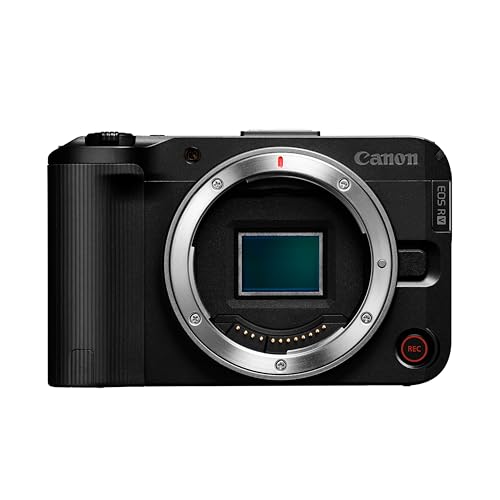
Canon EOS R50 V — Best overall
Most vlogging cameras are stills cameras that learned video manners. The R50 V reverses the inheritance: Canon designed it video-first, deleting the viewfinder entirely and spending the space and money on the things a creator touches hourly. The 24.2-megapixel APS-C sensor pairs with fast, confident autofocus that detects people, animals and vehicles, and the vari-angle screen is treated as the main viewfinder because, for its intended owner, it is. A dedicated live-streaming button, a movie mode dial position and a tripod socket on the side for native vertical mounting all announce that this body was specced by watching creators work.
The footage holds up its end. Oversampled 4K at mainstream frame rates looks crisp after platform compression, Canon colour keeps faces honest, and the RF-S lens range gives the body a growth path from the compact kit zoom toward brighter primes. There is no in-body stabilisation, so handheld walking leans on lens stabilisation and technique, and stills photographers will feel the missing viewfinder on bright days. Those are deliberate trades rather than oversights: this is the camera for someone whose channel is the point and whose photographs are a supporting habit. Within a Canon-only shortlist, it is the easiest first place this guide has awarded.
Small design decisions keep revealing the brief. The tally lamp faces forward so the subject — usually you — can confirm recording without breaking eye contact with the lens. The grip is shaped for one-handed holding at arm’s length rather than for two-handed stills posture. Cooling is arranged for the long, seated recording sessions that are a creator’s bread and butter. Even the product showcase behaviour, which pulls focus smoothly to an object presented to the camera, feels tuned rather than inherited. Buyers cross-shopping the R10 below should ask themselves one question: how often will I honestly use a viewfinder? If the answer is rarely, the R50 V spends your money where your filming actually happens.
- Sensor: 24.2MP APS-C
- Video: 4K, oversampled at mainstream rates
- Autofocus: Dual Pixel with people, animal and vehicle detection
- Screen: vari-angle touchscreen; no viewfinder by design
- Mounting: tripod sockets for horizontal and vertical shooting
- Mount: Canon RF, using RF-S and RF lenses
Strengths
- Purpose-built video ergonomics, not adapted stills ones
- Autofocus that handles solo filming without supervision
- Vertical mounting treated as a native orientation
Trade-offs
- No viewfinder for stills in harsh sunlight
- Stabilisation depends on the lens fitted
- Body-only listing means choosing a first lens too
Best for: Canon creators whose work is video first and who film themselves daily.
Not suited for: photographers who compose through a viewfinder as a matter of religion.

Canon PowerShot V10 — Best pocket pick
The V10 is the most conceptually honest camera in this guide. Canon asked what a vlogging camera would look like if every accessory were deleted, and the answer is a small slab with a 1-inch sensor, a wide fixed lens, a stereo microphone pair on its face and a stand that flips out of its own body. Set it on a café table, tilt the screen up, press record: the entire ritual takes seconds, and the footage — 4K from that large-for-a-compact sensor — looks like it came from a far more elaborate rig.
The wide lens is the creative signature. It captures the speaker and a generous slice of the room at arm’s length, which suits the confessional, talk-to-the-camera style that built a generation of channels. Image stabilisation smooths hand-held clips, the built-in microphones are voiced for speech rather than ambience, and the whole thing slips into a pocket when the conversation ends. The limits are the concept’s limits: no zoom to speak of, autofocus that is competent rather than relentless, and a battery sized for outings of short clips rather than conference days. As a second camera for R-system owners or a first camera for the tripod-averse, it is a delightfully single-minded tool.
It also makes an unusually good travel diary camera precisely because it asks for nothing. There is no lens to cap, no microphone to mount, no cage to assemble at the hotel desk; the stand handles the tabletop shot, and the wide lens forgives approximate framing when you are filming yourself against a landmark with one eye on the crowd. Creators who shoot in public often will appreciate how un-camera-like it looks — closer to a small phone on a kickstand than to a production rig — which lowers the social friction of filming in cafés and markets. That discretion, paired with 4K and real stereo sound, is a combination none of its larger siblings can imitate.
- Sensor: 1-inch CMOS
- Video: 4K streaming and recording
- Lens: built-in wide-angle zoom, fixed
- Audio: built-in stereo microphone pair
- Screen: flip LCD for self-framing
- Stand: integrated tilt stand in the body
Strengths
- Stand, screen and microphones all built in
- Wide lens frames face and room at arm’s length
- Starts filming faster than any system camera here
Trade-offs
- Fixed wide view, so reach means walking closer
- Battery life suits clips, not marathons
- No microphone socket for an external upgrade
Best for: spontaneous creators who film at tables, desks and street corners without a kit bag.
Not suited for: filming distant subjects or day-long events on internal power.

Canon PowerShot G7 X Mark III — Best compact
On a Canon-only shelf the G7 X Mark III plays a specific role: it is the pocket camera for the creator who found the V10’s fixed wide lens too confining. Its 24-100mm equivalent zoom covers the room-wide shot and the tighter, more flattering framing across a table, and its bright maximum aperture keeps the 1-inch sensor useful as rooms dim. The screen flips up for self-framing, the body feels like a serious compact rather than a gadget, and Canon’s colour keeps skin looking like skin under household light.
Two features keep it in professional company. The microphone socket on the side — still rare among compacts — lets a small external mic transform the audio, and the camera’s live-streaming support makes it a genuine desk-streaming tool rather than a recorder that streams as an afterthought. Autofocus is contrast-based and can deliberate in low light where the mirrorless Canons simply lock, and 4K recording stops at 30 frames per second. Battery endurance asks for a spare on filming days. None of that dents its position as the most complete traditional compact Canon makes for creators, and for V10 owners who graduate, it is the natural next pocket.
There is a workflow argument for it as well. Because it behaves like a conventional camera — dials, a zoom ring habit, familiar Canon menus — it teaches the fundamentals that transfer directly to the EOS bodies when a creator upgrades, making it a better apprenticeship than its novelty-shaped sibling. Its stills are the strongest among the compacts in this guide, with a lens sharp enough to reward a photography habit on rest days. And its vertical-video support acknowledges where much of its footage will live. Taken together, it is the Canon compact to buy when the plan is serious but the bag must stay small.
- Sensor: 1-inch, 20.1MP
- Lens: 24-100mm equivalent, bright aperture
- Video: 4K up to 30fps, vertical video support
- Screen: tilts up for self-framing
- Audio: 3.5mm microphone input
- Streaming: live streaming support built in
Strengths
- Real zoom range in a jacket-pocket body
- Microphone input lifts the audio ceiling
- Stills quality that justifies carrying it daily
Trade-offs
- Low-light autofocus less decisive than Dual Pixel
- Spare battery is near-mandatory on shoot days
- Screen flips up, so a top-mounted mic can intrude
Best for: pocket-camera creators who need framing choice and a microphone upgrade path.
Not suited for: long continuous recording sessions away from power.

Canon EOS R10 — Best hybrid
The R10 is the Canon in this guide for the creator who refuses to choose between a channel and a camera club. It shares the 24.2-megapixel APS-C class and Dual Pixel autofocus with its R50 V sibling, then adds the things a hybrid shooter demands: an electronic viewfinder for composing stills in glare, a mechanical shutter personality, and burst shooting quick enough for school sport and wildlife opportunism. The listing pairs it with the RF-S 18-45mm kit zoom, so both halves of its personality work from the first day.
Video is a first-class citizen rather than a mode: 4K oversampled at 30 frames per second for maximum quality, with higher frame rates available at a crop for smoother motion, and the same face-and-eye tracking that makes solo filming civilised. The vari-angle screen handles the vlogging posture, the microphone socket handles the audio future, and the body stays small enough to travel in a sling bag. Against the R50 V, the trade is explicit — you give up some video-first furniture and gain a complete stills camera. For the household that will own one Canon body for everything, this is the balanced answer.
Longevity argues for it too. The R10 sits in the part of Canon’s range where enthusiast features arrive early: deeper customisation, a joystick-style controller for moving the focus point, and compatibility with the full RF lens catalogue including the fast primes that transform low-light video. Its menus reward the owner who learns them, and its stills files hold up to cropping and printing in ways the compacts cannot match. A creator whose channel involves photographing what they review — food, crafts, products, places — gets both instruments in one body, and that consolidation is worth more than the small ergonomic sacrifices against its video-first sibling.
- Sensor: 24.2MP APS-C
- Video: 4K oversampled 30fps; higher rates with crop
- Autofocus: Dual Pixel CMOS AF II, subject detection
- Viewfinder: electronic, plus vari-angle touchscreen
- Kit: RF-S 18-45mm zoom in this listing
- Audio: microphone input fitted
Strengths
- Complete stills camera alongside the video talent
- Viewfinder keeps photography alive in bright light
- Deep RF lens catalogue to grow into
Trade-offs
- Fewer video-first touches than the R50 V
- Higher 4K frame rates come with a crop
- No in-body stabilisation
Best for: hybrid shooters splitting time between a channel and serious photography.
Not suited for: pure video creators who would never touch the viewfinder they paid for.

Canon PowerShot SX740 HS — Best zoom
Every camera so far assumes you can walk toward your subject. The SX740 HS exists for the seats where you cannot: the school concert filmed from row twelve, the safari vehicle that keeps its distance, the pitch-side parent, the cruise-deck whale. Its 40x zoom reaches a 960mm equivalent, turning distant dots into framed subjects, while the 20.3-megapixel sensor and DIGIC 8 processor deliver 4K video and continuous shooting that a travel zoom of its era had no right to offer. It is the oldest design in this guide and still the only one that does its particular job.
The compromises are the physics of reach in a small body. The sensor is far smaller than the 1-inch compacts, so low light is its weakness and image stabilisation works hard at the long end where every tremor is magnified forty times. The screen tilts for self-framing, Wi-Fi and Bluetooth handle transfers, and the whole camera remains genuinely pocketable, which no interchangeable-lens route to 960mm will ever claim. Judge it as a specialist: for the vlogger whose content lives at a distance — wildlife, travel, events, ceremonies — it captures footage the rest of this shelf simply cannot reach, and it does so at a size that invites being carried to exactly those occasions.
Its vlogging manners are better than its travel-zoom label suggests. The tilting screen supports the occasional piece to camera, the zoom’s wide end covers a hotel-room update, and the stabilisation keeps mid-range footage civilised. What it asks in return is light: plan distant filming for daylight, accept grain as the sun drops, and let the closer-range cameras in your household handle the evening. Owners who understand that bargain describe it with real affection, because a camera that brings a stage or a shoreline close earns its pocket space on trips where a system camera would have stayed in the safe. It is the guide’s reminder that the best vlogging camera is sometimes the one that can see the subject at all.
- Sensor: 20.3MP CMOS, DIGIC 8 processor
- Lens: 40x optical zoom, 24-960mm equivalent
- Video: 4K recording
- Screen: tilting LCD for self-framing
- Stabilisation: optical, tuned for long reach
- Connectivity: Wi-Fi and Bluetooth
Strengths
- Reach no other pick here can approach
- Pocketable despite the enormous zoom range
- Strong daylight video and continuous shooting
Trade-offs
- Small sensor struggles as light falls
- Long-end footage demands steady hands or support
- No microphone socket for audio upgrades
Best for: travel, wildlife and event vloggers filming subjects across real distance.
Not suited for: dim indoor filming where the small sensor is exposed.
Canon EOS R8 — Full-frame step-up (prose-only)
The R8 belongs in this guide because every ambitious Canon creator eventually looks at it: a compact full-frame body with the 24.2-megapixel sensor lineage of Canon’s professional line, superb Dual Pixel autofocus, and 4K video oversampled from 6K that gives footage a depth the APS-C picks cannot counterfeit. As the destination at the top of the Canon vlogging ladder, it deserves its place in the conversation — and it is presented here without a purchase link, deliberately.
The reason is stated plainly so you can act on it: the R8 body listing currently available through the usual marketplace route is a renewed unit, and new stock of this body has been scarce. A renewed full-frame camera is not automatically a bad buy — reputable refurbishment programmes inspect, grade and warranty their bodies — but it is a different purchase from a new camera, with questions a careful buyer should ask directly: who refurbished it, what warranty stands behind it, what is the return window, and is the price honest against new stock through Canon’s own store and specialist retailers? Treat the R8 as a research project conducted at Canon dealers and authorised refurbishers, compare the answers, and buy it with your eyes open. When a clean new listing becomes the norm, it will earn a link; until then, this guide would rather explain the detour than profit from your confusion.
For creators planning toward it, the practical notes still apply. Your RF-S lenses will work on the R8 with an automatic crop, so budget for at least one full-frame RF lens to unlock what you paid for. Its low-light video and background separation are the genuine article, its stills are professional grade, and its compact body keeps a vlogging rig portable. Think of it as the guide’s horizon: the R50 V and R10 will teach you everything needed to deserve it, and by the time the channel justifies full-frame, you will know exactly which questions to ask of any listing — renewed or new — before money moves.
- Sensor: 24.2MP full-frame
- Video: 4K oversampled from 6K
- Autofocus: Dual Pixel CMOS AF II
- Body: compact full-frame, weather-sealed class
- Status: prose-only — current body listing is renewed
- Route: research via Canon and authorised retailers
Strengths
- Full-frame depth and low-light ability
- Professional autofocus and oversampled 4K
- Small body for its sensor class
Trade-offs
- Current marketplace body listing is renewed stock
- Needs full-frame lenses to justify itself
- No in-body stabilisation at this tier
Best for: established Canon creators researching the full-frame move with care.
Not suited for: anyone who wants a one-click purchase without reading the listing’s fine print.
The Canon Line-Up at a Glance: Which Body Fits Which Filming Life?
| Camera | Sensor | Lens situation | Screen | Mic input | Character |
|---|---|---|---|---|---|
| EOS R50 V | 24.2MP APS-C | Interchangeable RF | Vari-angle | Yes | Video-first system body |
| PowerShot V10 | 1-inch | Fixed wide | Flip LCD | No | Self-standing pocket studio |
| PowerShot G7 X Mark III | 1-inch 20.1MP | 24-100mm zoom | Tilts up | Yes | Traditional premium compact |
| EOS R10 | 24.2MP APS-C | Interchangeable RF | Vari-angle + viewfinder | Yes | Hybrid all-rounder |
| PowerShot SX740 HS | 20.3MP small sensor | 40x zoom | Tilting | No | Distance specialist |
| EOS R8 | 24.2MP full-frame | Interchangeable RF | Vari-angle | Yes | Full-frame horizon (prose-only) |
The pattern across the table is a ladder with two pocket rungs. Canon’s mirrorless pair split on a single question — viewfinder or video-first furniture — while the compacts split on zoom philosophy: the V10 refuses to zoom, the G7 X zooms modestly with a bright lens, and the SX740 HS zooms to the horizon through a smaller sensor. The R8 waits at the top as the full-frame argument, available to the patient researcher. A Canon creator can climb this ladder for a decade without wasting a lens or relearning a menu, which is the quiet economic case for staying inside one brand’s garden.
Why Does Dual Pixel Autofocus Matter So Much to Solo Creators?
Autofocus is invisible when it works and fatal when it does not, and solo creators have no operator to rescue a wandering focal plane. Dual Pixel systems read focus information from the sensor itself at every pixel, which is why Canon’s mirrorless bodies in this guide track an eye smoothly instead of pulsing around it. The practical difference shows up in the edit: fewer soft sentences, fewer ruined gestures, and the confidence to move naturally while speaking instead of performing the statue-stillness that nervous focus systems impose on their owners.
The compacts tell the honest counter-story. Contrast-detection focus, as in the G7 X Mark III and SX740 HS, is accurate once settled but can hesitate visibly in dim rooms, hunting for the contrast edge it needs. For seated filming in decent light that hesitation rarely appears; for a candlelit restaurant review it might. Knowing which system lives in which camera — and matching it to your typical room — is worth more than any resolution comparison on this page, and it is why the guide names the autofocus type wherever it shapes the experience.
How Should a Canon Creator Plan the Lens Path From Here?
Owners of the R50 V and R10 hold the valuable asset in this guide: the RF mount. The sensible sequence begins with the kit zoom, which covers the wide room shot and the seated frame while you learn your distances. The second lens should be chosen by your footage’s loudest complaint — dim rooms point to a fast prime, distant subjects point to a telephoto zoom, and product work points toward a macro-capable option. Because RF-S lenses serve the APS-C bodies and full-frame RF lenses serve both those bodies and a future R8 (with the crop logic reversed), money spent on good glass is rarely wasted inside this system.
One discipline protects the budget: buy lenses for the channel you publish, not the one you describe at parties. A creator filming seated commentary gains nothing from an exotic telephoto, and a wildlife vlogger gains nothing from a portrait prime. The compacts, meanwhile, ask a different discipline — acceptance. Their lenses are fixed because their size is the feature, and the day their range limits your work is the day the mirrorless conversation legitimately begins. Canon’s ladder is designed so that day feels like a promotion rather than a restart.
Which Canon-Buying Mistakes Show Up Again and Again?
The most expensive mistake is buying a body for its badge and a lens by accident — pairing a fine camera with whatever glass was bundled cheapest, then blaming the sensor for flat footage that the lens authored. Second comes ignoring the listing’s condition: the R8’s renewed situation is the standing example in this guide, but the same care applies to any marketplace camera, where words like renewed, refurbished and open-box describe different purchases wearing similar photographs. Read the condition line as carefully as the model name.
A third pattern is subtler: creators buy for the sensor and forget the screen, then discover that a camera they cannot monitor comfortably is a camera they frame badly. Every model in this guide was screened, literally, on that point before its sensor was discussed — and a buyer comparing in a shop should perform the same test, flipping each screen into the filming posture and judging the posture, not the brochure.
Two quieter errors follow. Creators buy the viewfinder model out of habit and never use it, paying for glass they ignore — or buy the video-first body and then mourn the viewfinder on every sunny holiday. And many new Canon owners film their first month entirely on the kit zoom’s dim maximum aperture indoors, concluding that mirrorless video looks murky, when one fast prime or one inexpensive lamp would have rewritten the conclusion. The cameras are rarely the problem; the unexamined default usually is.
How Does Audio Work Across the Canon Shelf?
Canon divides its creator range by audio philosophy as cleanly as by sensor. The mirrorless pair and the G7 X Mark III carry microphone sockets, which makes them growth platforms: start on internal sound, add a shotgun or lavalier when the channel earns it, and monitor levels on screen while filming. The R50 V and R10 also expose manual audio level control, the unglamorous feature that separates creators who check their sound from creators who discover it in the edit. A voice peaking into distortion cannot be rescued later, and a voice recorded too quietly drags room hiss up with it when amplified — manual levels, set once with a test sentence at performance volume, prevent both failures.
The V10 and SX740 HS take the closed route, and they should be judged on their internal microphones as finished products. The V10’s stereo pair is voiced for a speaker at conversational distance and performs that job with real competence, especially indoors. The SX740’s microphones serve its distance brief — ambience and commentary at the wide end — rather than studio voice work. Neither camera is broken by the omission; both are simply honest about being complete, sealed tools. The buyer’s task is to decide whether audio is a chapter they intend to keep writing, because that decision, more than any sensor argument, separates the socketed cameras from the sealed ones.
What Should Canon Creators Know About Long Takes and Warm Rooms?
Long-form Canon filming — podcasts, lessons, services, interviews — rewards the bodies designed for it. The R50 V’s video-first layout and the R10’s oversampled 4K30 both suit seated recording sessions, and filming at 30 frames per second rather than chasing higher rates keeps heat and file sizes in the realm of the manageable. The compacts record happily in shorter patterns; a G7 X Mark III filming a day of clips is in its element, while a single two-hour continuous take is a job description written for the mirrorless pair on mains power.
Practical habits matter as much as model choice. Power the camera from USB or a mains adapter for static long takes so the battery stops being a countdown. Open the screen away from the body to let the chassis breathe. Give any camera a full-length rehearsal in your actual room before an unrepeatable event, because a warm afternoon and a south-facing window have ended more recordings than any specification gap. Canon’s creator bodies are honest tools in this respect: treated within their design brief, they record for as long as the card and the power supply allow, and the rehearsal is how you learn where your own room sets the boundary.
How Does Canon Colour Behave for Creators Who Do Not Grade?
Canon’s reputation among creators rests substantially on a mercy: faces look right without intervention. Skin tones from the standard picture style lean warm and forgiving, white balance under mixed household lighting errs toward pleasant rather than accurate, and the resulting footage can be published by someone who has never opened a colour panel. For channels whose economics depend on volume — daily commentary, teaching, community updates — that mercy is a production feature as real as any autofocus system, because grading time is the silent tax on every upload.
The headroom exists for those who want it. The mirrorless bodies offer flatter profiles that hold highlight and shadow detail for later shaping, and the R8’s oversampled footage grades with a richness the smaller sensors approach but do not equal. The sensible path for most Canon creators is staged: publish on the standard look while the channel finds its audience, then experiment with a flatter profile on one low-stakes video and compare honestly. Colour should become a creative decision at the moment it interests you, not a toll gate standing between you and your first fifty uploads.
Which Canon Pick Suits Vertical and Short-Form Filming?
Short-form video rearranged camera design, and Canon’s shelf shows the rearrangement at different stages. The R50 V is the native: a side tripod socket for vertical mounting, screen information that rotates, and a design that assumes a large share of output will be taller than it is wide. The R10 and the compacts shoot vertical perfectly competently when turned, with the G7 X Mark III explicitly supporting vertical recording for direct posting. The V10’s wide lens, interestingly, forgives the vertical crop better than most, because its horizontal view starts wide enough that a tall slice of it still contains a face and context.
The working habit that matters more than any feature is deciding the destination before the take. Film a vertical-native version for the short platforms rather than cropping a horizontal master whenever the short version is the primary product, because faces framed for a tall screen hold attention in ways a centre-crop rarely does. When one event must serve both shapes, keep the subject centred and the important action away from the edges — the old broadcast discipline of protecting the middle of the frame — and both edits will survive. Canon’s vari-angle screens make the vertical posture comfortable on the mirrorless pair, which is half the battle: a format you can monitor properly is a format you will actually use.
What Does the First Month on a Canon Creator Body Teach?
The first week is for trust exercises: film daily on full automation and confirm with your own eyes that the autofocus holds your eye through gestures, head turns and the moment you hold a product toward the lens. Canon’s tracking earns confidence quickly, and confidence changes how naturally a new creator performs. The second week adds one craft at a time — locking white balance for your room so skin stays constant between clips, setting audio levels manually with a rehearsal sentence, learning where the exposure compensation lives for backlit windows.
By the second half of the month, the productive discovery is personal: the specific way your own footage fails. Perhaps the kit zoom’s aperture makes your evening room murky, which names a fast prime or a lamp as the next purchase. Perhaps the screen disappears in garden sunlight, which names the viewfinder conversation honestly. Perhaps the internal microphone flatters your voice and the audio chapter closes early, to your wallet’s relief. A Canon body bought from this guide will support years of that learning, because the system’s depth — lenses, profiles, accessories — is arranged so that each answer you need tends to exist inside the same brand’s catalogue.
How Steady Is Handheld Canon Footage, Really?
None of the Canon bodies in this guide carries in-body stabilisation, so steadiness is a system decision rather than a body feature. Canon answers with stabilised lenses: the RF-S kit zooms and many RF lenses carry optical stabilisation that, combined with the cameras’ digital movie stabilisation, produces seated and slow-walking footage that looks composed rather than rescued. The compacts build their stabilisation into their fixed lenses, with the SX740 HS working hardest at the long end of its zoom where physics is least forgiving. The honest boundary is energetic movement: running, stairs and enthusiastic walking will defeat lens-based systems, and the creator whose format demands that energy should budget for a compact gimbal as an accessory rather than blaming the camera.
Technique closes much of the remaining gap for free. A camera held in two hands with elbows tucked and the strap taut behaves like a different instrument from one waved at arm’s length on one wrist. Walking heel-to-toe, leaning on doorframes for static shots and letting the vari-angle screen keep your posture upright all show up in the footage. Canon’s digital stabilisation crops the frame slightly when engaged, so compose a touch wider than the final frame you imagine. Master those habits on any pick here and your handheld work will pass the only test that matters: viewers stop noticing the camera’s movement and start watching the person.
How Should You Read a Renewed or Refurbished Camera Listing?
The R8’s situation deserves a general lesson, because marketplace camera listings speak a dialect worth learning. New means factory-sealed with the manufacturer’s full warranty. Renewed and refurbished describe previously owned or returned units inspected and restored by a programme whose standards vary — the manufacturer’s own refurbishment store sits at the trustworthy end, with graded condition, tested function and a stated warranty, while anonymous marketplace renewals ask more questions than they answer. Open-box usually means a returned new item with its life barely begun. None of these words is a synonym for broken, and none is a synonym for new.
The buyer’s checklist is short and decisive. Identify who performed the refurbishment and whether their name carries a reputation to protect. Confirm the warranty in writing, its length and who honours it. Confirm the return window, because a camera’s faults announce themselves in the first fortnight of real use. Compare the price against the new price through authorised channels; a renewed body priced near new money is a bad bargain regardless of condition. Apply that checklist and a renewed R8 from a proper programme can be a rational, even shrewd purchase — which is exactly why this guide insists on the research rather than issuing a blanket refusal.
How Do the Canon Picks Handle a Creator’s Second Job: Family Photography?
Most vlogging cameras lead double lives, and the Canon shelf divides honestly on photographic ambition. The R10 is the complete family camera: viewfinder for bright playgrounds, fast bursts for school sport, and files that print beautifully at sizes a wall will notice. The R50 V photographs with the same sensor and autofocus but asks you to compose on the screen, which suits deliberate photography better than reactive photography. The R8, when properly sourced, is a professional stills instrument by any measure. Among the compacts, the G7 X Mark III makes the strongest everyday photographs thanks to its bright zoom, while the SX740 HS owns the distant occasions and the V10 owns the candid table.
There is also a resale-and-keep logic to the double life. A camera that photographs the family earns its cupboard space in the quiet months between channel pushes, staying charged, familiar and close at hand — and familiarity is the hidden variable in vlogging quality, because the camera you handle weekly is the camera whose buttons you find without looking when a moment starts without you.
The practical advice is to let the second job break ties rather than lead the purchase. A creator whose family photography is phone-satisfying should buy purely for the channel. A creator who already reaches for a real camera at birthdays and matches will find the R10’s premium over its sibling repaid in a single season of photographs. Either way, the Canon you buy for video will not embarrass you as a stills camera — the brand’s photographic heritage is the floor under every model in this guide, and it is one of the strongest reasons the Canon-only shortlist exists at all.
What Does a Sensible Canon Vlogging Kit Add After the Camera?
The supporting purchases follow the same order whatever Canon you chose. Support first: a compact tripod whose head tilts for vertical work turns the R50 V’s native vertical mounting and every other camera’s screen into a proper studio. Power second: a spare battery for the compacts, a USB power bank or mains adapter for the mirrorless pair’s long sessions. Storage third, sized generously, because Canon’s 4K files are not small and a card that fills mid-interview teaches the lesson at the worst possible tuition.
One more unglamorous line belongs in the budget: a cleaning kit and a decent strap or hand loop. Creator cameras live on desks, in kitchens and at the bottom of tote bags, and a sensor or front element wearing a fingerprint films the whole day at reduced contrast before anyone notices. Two minutes of care a week protects every other pound spent on the kit.
Then the expressive purchases. One soft light transforms evening filming on every sensor in this guide, including the full-frame R8. One microphone, on the models with sockets, transforms the voice. One fast prime transforms the mirrorless pair after dark. Notice that none of these is a second camera: the Canon system rewards depth in a single body far more than breadth across two, and the creator who equips one camera completely will out-produce the collector of bare bodies on any realistic schedule. Buy the camera, then finish the kit, then film — in that order, the money keeps showing up on screen.
Final Recommendation
Start where your filming life actually is. The EOS R50 V is this guide’s answer for the committed Canon creator: video-first design, autofocus you can lean on and a lens mount with years of road ahead. The R10 takes the same foundation and adds the stills photographer’s viewfinder. In the pocket class, the V10 serves the spontaneous and the G7 X Mark III serves the deliberate, while the SX740 HS remains the distance specialist nothing else here replaces. And the EOS R8 stands where it should — admired, explained and approached through channels where its condition is stated as carefully as its specification. Buy the Canon that matches your next hundred videos, and the brand’s ladder will be waiting, rung by rung, for the hundred after that.
Frequently Asked Questions
Is the EOS R50 V or the EOS R10 better for a new channel?
Choose by viewfinder honesty. If your filming is screen-based and your stills are casual, the R50 V’s video-first design spends the budget on your actual workflow. If photography matters in its own right — family, travel, a portfolio — the R10’s viewfinder and deeper stills controls repay their cost every bright day. The sensors and autofocus are close enough that the decision is ergonomic, not photographic.
Why is the EOS R8 not linked in this guide?
Because the body listing currently available through the marketplace is a renewed unit, and new stock is scarce. A renewed camera can be a sound purchase from a reputable refurbisher with a clear warranty, but it should be bought knowingly, after comparing Canon’s own channels and authorised retailers. This guide describes the camera fully and links nothing, so the research happens with your eyes open.
Can the PowerShot V10 really replace a mirrorless camera?
For one style of channel, yes: seated or tabletop talking, travel diaries and spontaneous clips where its stand, wide lens and stereo microphones cover the whole job. It cannot zoom meaningfully, accept a microphone or change lenses, so channels built on reach, low light or shallow depth of field will outgrow it. As a first or second camera for the right format, though, its simplicity is a genuine production advantage.
Do Canon’s compacts here work for live streaming?
The G7 X Mark III was built with streaming in its brief and handles it directly, while the V10’s 4K streaming support suits casual broadcasts from a desk. The mirrorless pair serve as high-quality streaming cameras over USB with far better lens choices. In every case a wired connection and a test stream before the real one will save the embarrassment that no camera specification can.
Which Canon pick is best for filming wildlife or school events?
The SX740 HS, without a contest inside this guide. Its 40x zoom exists precisely for subjects separated from the camera by law, water or seating plans. Film in daylight where its smaller sensor is comfortable, support the camera at long focal lengths, and it will return footage the larger-sensor picks cannot frame at all from the same seat.
Will RF-S lenses bought for the R50 V or R10 work later on full-frame?
Yes, with an automatic crop that uses the APS-C-sized centre of the full-frame sensor — useful, but not the full-frame experience. Full-frame RF lenses work natively on both APS-C bodies today and on an R8 tomorrow, which is why creators planning the eventual step-up often buy RF glass from the start and accept its larger size on the smaller bodies.
Is Canon’s kit lens enough to start a channel on the R50 V or R10?
Yes. The RF-S 18-45mm covers the establishing wide shot and the seated frame, focuses closely enough for desk work and carries stabilisation the bodies lack. Its modest maximum aperture shows indoors after dark, which is a lighting problem before it is a lens problem. Film the first season on it, and let your own footage nominate the second lens — the catalogue will still be there, and you will shop it with evidence instead of guesses.
How does the V10 compare with using a phone?
The V10 wins on the things phones compromise: a larger sensor for cleaner low-light video, a lens designed for the arm’s-length framing vloggers use, stereo microphones aimed at a voice, a stand built into the body and recording that no notification can interrupt. A phone wins on connectivity and the screen you already own. Creators who film daily tend to prefer a device whose only job is filming, and the V10 is the purest expression of that preference in this guide.
Related Guides
Broaden the comparison beyond one brand with beginner vlog cameras ranked for first-time creators, the autofocus-led vlogging cameras judged purely on focus and GoPro-led action cameras for vlogging on the move.
Related guides
- Best Balancing Stabilizers for Mirrorless Cameras: Payload, Balancing and Native Vertical Shooting
- Best Basic Phones Camera Buyers Can Trust: Flip Phones and Simple Handsets That Still Take a Photograph
- Best Kids Smartwatches for Texting and Calling: Six Watch-Phones Under Parent Control
- Best Airbnb Security Cameras: Compliant Outdoor Cameras and Noise Sensors for Hosts



[…] building the kit around your first camera with our companion reading: the autofocus vlogging cameras ranked by focus reliability, lightweight vlogging cameras for all-day carrying and Canon-only vlogging cameras for RF-system […]