What's inside
- Key Takeaways
- Quick Picks
- How Did We Weigh Cameras Meant to Be Carried All Day?
- Why Does the Lens Matter More Than the Body on the Road?
- How Do the Six Travel Systems Compare in the Bag?
- How Does the Kind of Trip Rewrite the Ranking?
- How Do You Photograph People and Places Respectfully Abroad?
- How Do You Keep Cameras Charged and Safe Across Borders?
- How Do You Pack a Camera Kit for a Real Journey?
- Which First Lens Should the Body-Only Picks Wear?
- How Much Video Does a Traveller Actually Need?
- How Does a Travel Day Test a Camera From Dawn to Midnight?
- What Should You Do With the Photographs While Still on the Road?
- Should You Rent Lenses or a Second Body at the Destination?
- What Do Travellers Get Wrong When Choosing a Camera?
- Final Recommendation
- Frequently Asked Questions
- Related Guides
As an Amazon Associate I earn from qualifying purchases. This post may contain affiliate links at no extra cost to you.
gizmoverdict.com is reader-supported. When you buy through links on our site, we may earn an affiliate commission.
Where to buy: The six listings below arrive in three different forms, and the differences matter to a traveller’s budget: the Fujifilm X-T50 and Sony a7C II are body-only listings, the Canon R8, OM System OM-5 Mark II and Sony a6700 are kits with a travel zoom included, and the Ricoh is a complete fixed-lens camera that needs nothing. Compare them as journeys, not as boxes — what else must be bought before the plane leaves is part of each pick’s true shape.
The best cameras for travel photography are not the best cameras. They are the best cameras that are actually there — in the bag that made the flight’s weight limit, in the hand at hour nine of a walking day, in the rain at the viewpoint everyone else abandoned. Travel photography’s first law is that the finest camera in the hotel safe takes no photographs at all, and this guide is built on it: every pick here was chosen for the ratio between what it can capture and what it costs to carry, in grams, in bulk, in charging cables and in the low-grade anxiety of expensive equipment in unfamiliar places.
That law produces a list with real range. At one end sits a pocket camera with an APS-C heart that disappears into a jacket; at the other, full-frame bodies shrunk to sizes their ancestors would not believe, with a weather-sealed kit built for mountain weather between them. Two of the six arrive ready to shoot with travel zooms in the box, and the kit question is treated as a travel question — a lens that covers a city’s whole vocabulary, from the cathedral’s interior to the castle across the river, is worth more on the road than a theoretically finer lens that covers half of it and stays in the room for the other half.
One pick needs its variant named precisely, because Ricoh sells two near-identical cameras. The pocket pick here is the GR IIIx HDF, whose built-in Highlight Diffusion Filter softens bright highlights with a glow that suits travel’s harsh noon light and neon nights, and which differs in that filter — in place of the standard model’s neutral-density filter — from the regular GR IIIx that appears in this site’s concert guide. Travellers choosing between them are choosing a look, and this guide has chosen the glow.
Key Takeaways
- The best travel camera is the one that leaves the hotel; weight and bulk are image-quality features on the road.
- Three picks are ready-to-shoot kits, two are body-only, and the Ricoh needs nothing added, ever.
- The OM-5 Mark II kit is the weather pick: IP53 sealing on body and a sealed travel zoom in the box.
- Full frame travels lighter than it used to — the a7C II and R8 are proof — but its lenses still set the bag’s size.
- The Ricoh here is the GR IIIx HDF variant, with a highlight-diffusion filter in place of the standard model’s ND filter.
- One versatile zoom plus discipline beats a bag of primes for most journeys; add a fast prime only for the nights.
Quick Picks
| Pick | Badge | Why it made the list |
|---|---|---|
| Fujifilm X-T50 (body, silver) | Best overall | Forty megapixels, film simulations and classic dials in a body sized for a day bag, in silver. |
| Sony a7C II (black) | Best compact full frame | Full-frame quality and Sony autofocus in a rangefinder-sized body that hides in a small bag. |
| Canon EOS R8 24-50mm kit | Best lightweight full frame | The lightest route to full frame here, with a collapsible kit zoom in the box for the road. |
| OM System OM-5 Mark II 14-150mm kit | Best weather-sealed kit | IP53 sealing and a 28-300mm equivalent zoom: the mountain and monsoon answer. |
| Sony a6700 18-135mm kit | Best one-lens kit | AI subject recognition behind an 18-135mm zoom that covers a whole trip in one lens. |
| Ricoh GR IIIx HDF | Best pocket camera | An APS-C sensor and a 40mm lens in a pocket, with the HDF filter’s glow for travel light. |
How Did We Weigh Cameras Meant to Be Carried All Day?
Carry was scored as a system weight — body, the lens it will actually wear, a spare battery and its charger — because travellers do not carry specification sheets. Image quality was then judged per gram with deliberate unfairness to bulk: a camera that produces slightly finer files at twice the carried weight loses, because the heavier kit gets left behind on the third day and its files for the rest of the trip are zero. Weather sealing was scored for the journeys that need it, in-camera charging for the journeys that reward it, and the screen and viewfinder for noon light and night markets alike.
We also scored the journey home. A travel camera’s files should arrive intact and organised, which favours bodies whose naming, dating and connectivity habits play well with phones and drives, and whose batteries survive the long transfer day when the camera doubles as the trip’s last documentarian — the departure lounge, the train window, the first sight of home. It is a small criterion with an outsized emotional yield, because the journey’s final chapter is the one travellers most often fail to photograph with a depleted, packed-away camera.
Two philosophies contend in this list and both were honoured. The one-lens kits — the OM-5 with its enormous zoom range, the a6700 with its 18-135mm — argue that travel photography is a documentary act best served by never changing a lens in the street. The body-only picks argue that a traveller with a chosen prime or a compact zoom of their own travels lighter in spirit. The guide’s ranking puts the X-T50 first because it serves both philosophies gracefully: small with a pancake prime, capable with a travel zoom, and possessed of a look — dials, simulations, that silver finish — that makes its owner pick it up in the morning, which is where travel photography is truly decided.
Why Does the Lens Matter More Than the Body on the Road?
Because the lens decides what the day can contain. A travel zoom in the 24-200mm class of range — the OM kit’s equivalent span is wider still — photographs the square, the detail above the door, the mountain across the valley and the face across the table without a bag opening in public. A fast prime photographs the evening: the restaurant, the night market, the blue hour in the old town, at sensitivities and shutter speeds a travel zoom cannot reach. Most journeys contain both days, which is why the classic travel kit is one zoom plus one small prime, and why the kits in this guide were judged on how gracefully that prime could join them later.
There is a discipline that makes either lens strategy work, and it is compositional rather than financial: commit to the lens that is mounted for the whole chapter of the day. The zoom traveller who zooms with the ring for every frame produces a diary of distances rather than a set of photographs, and the prime traveller who keeps swapping back to a zoom at every viewpoint has packed two kits and enjoyed neither. Mount the lens at breakfast, let it teach you its way of seeing until lunch, and change it only when the day itself changes character. Travel albums with a point of view are built exactly this way, one committed chapter at a time.
The mounts here answer the prime question at different prices and sizes. Micro Four Thirds primes are tiny and affordable enough to carry two without a thought. Sony’s E-mount offers compact primes across every budget and a used market of real depth. Canon’s RF and Fujifilm’s X ranges each hold a beloved small prime or two that owners describe the way other people describe good boots. And the Ricoh answers the question by refusing it: the lens is fixed, the decision is made, and the photographer’s whole attention goes to where to stand — which, experienced travellers will confirm, was always the variable that mattered.
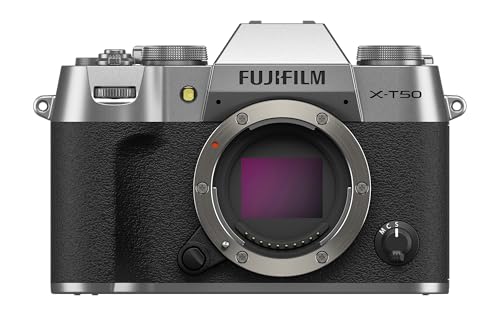
Fujifilm X-T50 (body, silver) — Best overall
The X-T50 in silver is the travel camera as an object of desire that also happens to be an instrument: a 40-megapixel APS-C sensor — the highest resolution in this guide — behind Fujifilm’s film simulations, in a compact body with proper dials for shutter and exposure and a dedicated simulation dial that invites the traveller to choose the trip’s colour character the way film photographers chose a stock. Those simulations are a travel feature in disguise: they produce finished, characterful JPEGs at the moment of shooting, which means the journey’s photographs can be shared from the train that evening rather than edited in a hotel at midnight, and the trip stays a trip.
Capability runs underneath the charm. In-body stabilisation steadies dawn viewpoints and museum interiors, the autofocus is modern and subject-aware, video is strong enough for the journey’s moving record, and the X-mount lens range offers everything from a pancake that makes the camera coat-pocketable to travel zooms that cover a continent. This listing is body-only, so the first lens is your decision — make it deliberately, because the X-T50 will wear it for years. The debits are a traveller’s usual ones: no weather sealing to boast of, a battery that rewards a spare, and a price that buys capability you must actually use. For the photographer whose trips are also their photography’s main subject, this is the complete answer.
- Sensor: 40MP APS-C X-Trans class
- Stabilisation: in-body image stabilisation
- Colour: film simulations on a dedicated dial
- Controls: traditional shutter and exposure dials
- Finish: silver, as listed
- Listing format: body only — the first X-mount lens is a separate choice
Strengths
- Resolution that turns one viewpoint into several compositions by cropping.
- Finished-looking files straight from the camera, every evening of the trip.
- A body small enough for the day bag and serious enough for the portfolio.
Trade-offs
- No meaningful weather sealing for mountain storms.
- Body-only listing means the lens budget starts immediately.
- Forty-megapixel files fill cards and drives at travel speed.
Best for: photography-led travellers who want one beautiful, capable main camera. Not suited for: expedition travellers who need published weather sealing above all.
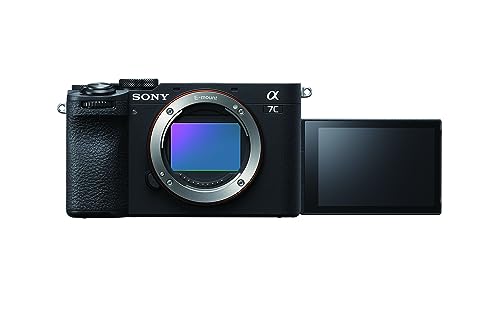
Sony a7C II (black) — Best compact full frame
The a7C II performs the neatest trick in modern camera design: a full-frame 33-megapixel sensor and Sony’s AI-driven autofocus inside a body the size of a rangefinder, light enough that the full-frame traveller’s traditional complaint — the bag — loses its force. What remains is the full-frame substance: low-light files that hold night markets and cathedral interiors together, dynamic range that forgives the noon contrast of southern squares, and depth of field control for the portraits that travel is secretly about. The autofocus finds eyes, animals and vehicles with the product line’s usual certainty, stabilisation lives in the body, and the video specification serves the traveller who films as fluently as the one who photographs.
The compromises are the miniaturisation’s own. The viewfinder is small and sits at the corner, which some eyeglass wearers love and others tolerate; a single card slot asks the traveller to back up nightly, a discipline this guide recommends on every system anyway; and full-frame lenses, even Sony’s admirably compact ones, remain larger than the crop systems’ equivalents — the body shrank, the physics of glass only partly followed. This listing is the black body only. Pair it with one of the small primes or compact zooms the mount is rich in, and you own the most quality per litre of bag space that full frame currently offers.
- Sensor: 33MP full-frame
- Autofocus: AI-based subject recognition
- Stabilisation: in-body, 5-axis
- Video: 4K with high-quality modes
- Build: rangefinder-style compact body, single card slot
- Listing format: body only, in black
Strengths
- Full-frame night and interior files from a day-bag body.
- Autofocus certainty in crowds, markets and motion.
- The deepest lens ecosystem in this guide behind it.
Trade-offs
- Small viewfinder and single slot are the size’s price.
- Full-frame lenses rebuild some of the bulk the body saved.
- Premium pricing for the miniaturisation itself.
Best for: travellers who refuse to leave full-frame quality at home. Not suited for: ultra-light packers, for whom the OM kit or Ricoh answers better.

Canon EOS R8 24-50mm kit — Best lightweight full frame
The R8 is the lightest full-frame body in this guide, and its kit form is the gentlest possible introduction to full-frame travel: body and the collapsible RF 24-50mm zoom in one box, a combination that rides in a small sling and produces the full-frame look — the subject separation, the dusk cleanliness — from the first evening. The 24.2-megapixel sensor is shared with Canon’s respected hybrid line, autofocus is the full Dual Pixel subject-detecting system, and video runs to high-quality oversampled 4K for the traveller’s film as well as their album.
The kit lens defines the honest boundary: it is a daylight and good-light companion, compact to the point of cleverness, and neither fast nor long. The R8 traveller’s classic upgrade is one of Canon’s small fast primes for the evenings, at which point the kit becomes a genuine two-register system — zoom by day, prime by night — for less carried weight than most crop kits managed a generation ago. There is no in-body stabilisation, so stabilised lenses do the work, and battery life asks for the usual spare. Judged as a doorway, it is the widest and lightest one into full-frame travel that Canon has ever built.
- Sensor: 24.2MP full-frame CMOS
- Kit lens: RF 24-50mm collapsible zoom included in this listing
- Autofocus: Dual Pixel CMOS AF II with subject detection
- Video: 4K, oversampled quality modes
- Build: the lightest full-frame body in this guide; no in-body stabilisation
- Cards: single slot
Strengths
- Full-frame travel at a carried weight rivals quote for crop kits.
- A complete kit in the box, ready for the first trip.
- Canon’s colour flatters people and places alike.
Trade-offs
- Kit zoom is a fair-weather, modest-range companion.
- No in-body stabilisation; lenses must carry the feature.
- Single card slot makes nightly backup a rule, not a tip.
Best for: travellers stepping up to full frame who count every gram. Not suited for: one-lens maximalists who need a long zoom’s range in the box.

OM System OM-5 Mark II 14-150mm kit — Best weather-sealed kit
Some trips are not city breaks. For the traveller whose itinerary reads like a weather forecast — highlands, coasts, monsoon season, the waterfall trail — the OM-5 Mark II kit is the guide’s expedition answer, and its credentials are printed rather than implied: an IP53 weather-sealing rating on the body, a sealed 14-150mm zoom in the box whose equivalent range runs from wide 28mm to a genuinely telephoto 300mm, and a total carried weight that undercuts every full-frame kit here by a margin your shoulders will itemise gratefully at altitude. The 20.4-megapixel Micro Four Thirds sensor sits behind 5-axis stabilisation strong enough to leave the travel tripod at home for most viewpoints.
OM’s computational toolkit is a traveller’s quiet superpower: handheld high-resolution modes for the viewpoint where a tripod is banned or impractical, in-camera neutral-density simulation for silky waterfalls in bright light, and focus tools that macro travellers use on the small life of foreign gardens. The format’s debits are the familiar pair — low-light files a step behind the full-frame bodies, and depth of field that stays deep unless fast primes are fitted — and the kit zoom is a fair-weather aperture story like all its kind. For weather, weight and range in one sealed decision, nothing else in this guide is close.
- Sensor: 20.4MP Micro Four Thirds
- Kit lens: 14-150mm (28-300mm equivalent) included in this listing
- Sealing: IP53-rated weather sealing
- Stabilisation: 5-axis in-body
- Video: 4K
- Computational modes: handheld high-res and Live ND among them
Strengths
- Published sealing for the trips where weather is the itinerary.
- One lens from wide square to distant peak, in the box.
- The lightest complete system in this guide by a distance.
Trade-offs
- Low-light ceiling sits below the full-frame picks.
- Kit zoom’s aperture asks for daylight or stabilisation’s help.
- Shallow depth of field requires deliberate prime purchases.
Best for: outdoor, mountain, coast and wet-season travellers. Not suited for: night-market specialists whose trips happen after dark.

Sony a6700 18-135mm kit — Best one-lens kit
The a6700 kit is the thinking traveller’s single-lens manifesto. The body brings Sony’s AI subject recognition — the autofocus that classifies birds, animals, people and vehicles and holds them through a crowd’s chaos — and a 26-megapixel APS-C sensor with video up to high-frame-rate 4K and log profiles for the traveller who grades. The lens in this listing is the argument’s completion: an 18-135mm zoom, a 27-202mm equivalent span that covers the square, the portrait, the detail and the far shore without the lens ever leaving the body in a dusty street. One camera, one lens, no decisions at the kerb — for many travellers that simplicity is the entire luxury.
Stabilisation in the body steadies the zoom’s long end and the evening’s slow shutters, the build is compact and serious, and the E-mount behind it means the kit is a beginning rather than a cul-de-sac: the fast prime for night markets, the ultra-wide for interiors, both exist at every price. The debits are a single card slot and a viewfinder sized for the body’s compactness. Neither troubles the traveller this kit was designed for, who backs up to a phone or drive each night and composes on the excellent rear screen as often as at the eye. As a one-lens answer, it is the most complete in the guide.
- Sensor: 26MP APS-C
- Kit lens: 18-135mm zoom included in this listing
- Autofocus: AI-based subject recognition
- Video: 4K up to 120p in its high modes, log profiles
- Stabilisation: 5-axis in-body
- Build: compact body, single card slot
Strengths
- A whole trip’s focal lengths in one mounted lens.
- Subject recognition that works in crowds, wildlife stops and streets alike.
- Video capability no other kit here exceeds.
Trade-offs
- Single slot; nightly backup is the traveller’s ritual.
- The zoom’s aperture is a daylight-first design.
- Compact body can feel small with larger future lenses.
Best for: one-lens travellers who mix stills and serious video. Not suited for: prime-only purists, or two-card professionals on assignment.

Ricoh GR IIIx HDF — Best pocket camera
The GR IIIx HDF is the camera that is there. It lives in a jacket pocket or the smallest corner of a day bag, starts in a blink, and puts a 24-megapixel APS-C sensor behind a superb fixed 40mm f/2.8 lens — a focal length that matches how travellers actually see: the street, the table, the companion against the view. This HDF variant’s defining feature is its built-in Highlight Diffusion Filter, switchable in the menu, which blooms bright highlights into a soft glow; on travel subjects — noon harbours, neon districts, backlit portraits, wet streets at night — that glow is not a defect but a signature, the difference between a record and a memory.
Everything else about the GR serves the same philosophy of presence. In-body stabilisation steadies the unposed frame, snap-focus modes let the practised traveller shoot by distance and instinct, and the camera’s utter plainness draws no attention in markets, museums and metros where a serious-looking camera changes the room. The limits are the design’s own: no zoom, no viewfinder, a battery sized for a day’s shooting with a spare in the other pocket, and weather sealing that does not pretend to the OM’s standard. Travellers who add it beside a main system call it the camera that took the trip’s best photographs, because it was the one in the hand when the light did something unrepeatable for four seconds. As a sole camera it asks commitment; as a philosophy it is unbeatable.
- Lens: fixed 40mm equivalent f/2.8, behind the HDF filter
- Sensor: 24MP APS-C CMOS
- Filter: built-in Highlight Diffusion Filter (HDF), switchable
- Stabilisation: in-body shake reduction
- Build: true pocket size, touchscreen control
- Video: modest; stills are the instrument’s purpose
Strengths
- Present for the moments every larger camera misses.
- The HDF glow flatters travel’s hardest and prettiest light.
- Image quality that embarrasses cameras three times its size.
Trade-offs
- A fixed lens frames by walking, never by zooming.
- Battery life is a day, with a spare as standard kit.
- No sealing claims for expedition weather.
Best for: pocket-first travellers and street photographers. Not suited for: travellers who need zoom reach, wildlife range or weatherproofing.
How Do the Six Travel Systems Compare in the Bag?
| Camera | Format | Sold as | Carry character | Signature |
|---|---|---|---|---|
| Fujifilm X-T50 | APS-C | Body only, silver | Day-bag body, dial-led | Film looks, 40MP detail |
| Sony a7C II | Full frame | Body only, black | Rangefinder-sized full frame | Night files, AI focus |
| Canon EOS R8 kit | Full frame | Kit with 24-50mm | Lightest full-frame route | Complete, collapsible start |
| OM-5 Mark II kit | Micro Four Thirds | Kit with 14-150mm | Sealed and featherweight | IP53, huge zoom span |
| Sony a6700 kit | APS-C | Kit with 18-135mm | One-lens completeness | Recognition focus, video |
| Ricoh GR IIIx HDF | APS-C compact | Complete camera | Jacket pocket | HDF glow, fixed 40mm |
The bag test sorts travellers faster than any specification: if the kit must survive weather, the OM row wins; if it must vanish, the Ricoh row wins; if it must do everything with one lens, the a6700 row wins; and if the files must be the finest a day bag can carry, the argument runs between the Fujifilm’s resolution and the Sony’s full frame, with the Canon as the lightest way into that same conversation.
How Does the Kind of Trip Rewrite the Ranking?
The city break is a walking exam with evenings attached. Days are measured in tens of thousands of steps between interiors and squares, and the cameras that thrive are the ones whose weight disappears — the X-T50 with a small zoom or prime, the a7C II with a compact lens, the Ricoh above all — while the evenings reward exactly the low-light strength the full-frame pair and the Fujifilm’s simulations bring. A city traveller should read this guide’s ranking almost as printed, because the list was secretly written for them.
The landscape expedition reorders everything. Viewpoints are earned on foot, weather is a co-author, and the OM-5 kit’s sealing and range stop being features and become the itinerary’s permission slip; the X-T50’s resolution argues back for the tripod-carried dawn, and the full-frame bodies justify themselves in the blue hour rather than the market. The family holiday rewrites the list a third way: autofocus that finds children’s eyes without a negotiation, a zoom that covers the pool and the castle, and a camera simple enough to hand to a partner — the a6700 kit’s home ground, with the R8 kit as the full-frame alternative for the family that also wants its evenings back in quality.
The slow journey — the month in one rented apartment, the rail pass with no fixed end — rewards the camera that becomes a habit. This is the Ricoh’s deepest argument and the X-T50’s second one: a camera carried daily for thirty days photographs the place’s actual life, while a system carried on excursion days photographs its monuments. Travellers planning the slow kind should weight this guide’s carry scores double and its ceiling scores half, because familiarity compounds like interest and the thirtieth day’s photographs are always the ones that matter.
How Do You Photograph People and Places Respectfully Abroad?
Travel photography’s ethics are practical before they are philosophical, because a traveller’s welcome is a resource every later traveller spends. Ask before the close portrait — a gesture toward the camera and a smile cross every language barrier in this guide’s scope — and accept a refusal as gracefully as the photograph would have deserved. Markets, ceremonies and places of worship each carry local rules that outrank any itinerary: some welcome cameras, some license them, some forbid them, and the traveller’s job is to learn which room they are standing in before the camera leaves the bag. The discreet cameras here — the Ricoh supremely, the rangefinder-styled pair behind it — earn part of their ranking honestly on this ground: they change the room less.
Children, sacred moments and grief are the bright lines where the answer is simply to lower the camera, and no guide that sends people into the world should leave them unstated. The other half of respect is return: show the photograph to its subject on the screen, offer to send it, and keep the promise when you do. Travellers who practise that small economy come home with portraits no specification can buy, because the portraits were collaborations. The camera’s part in the collaboration is to be quick, quiet and unthreatening — which is, not coincidentally, a fair summary of this entire list.
How Do You Keep Cameras Charged and Safe Across Borders?
Power is the traveller’s quiet logistics. Cameras that charge in-body over USB — most of this list — collapse the charging kit into the cable you already carry for a phone, and a modest power bank becomes the universal spare battery for the camera, the phone and the journey’s morale. Spare cells still matter, because a charged camera at the viewpoint beats a charging one at the café, and they travel in hand luggage by regulation as well as by sense, in a case that keeps their contacts covered. Learn your camera’s appetite at home: how many frames a battery honestly gives in your shooting style is a number no review can supply, because it is a property of the partnership, not the product.
Security is a design problem solved before departure. A bag that does not advertise its contents, a strap that keeps the camera on the body in a crowd, a hotel routine that puts equipment out of sight rather than on display, and insurance or a rider whose paperwork you have actually read — these unglamorous arrangements protect more photographs than any specification in this article. Backups complete the system, as the FAQ below insists: the traveller whose files exist twice can lose a camera and keep the journey, which is the correct order of values, and the one this guide has argued from its first paragraph.
How Do You Pack a Camera Kit for a Real Journey?
Start from the days, not the gear. List the trip’s actual chapters — city walking, a mountain day, evenings in restaurants, a boat, a market at dawn — and let each chapter nominate its equipment; the chapters that nominate nothing are the ones the Ricoh was invented for. Pack the camera where a hand reaches it without unpacking, because a camera at the bottom of a bag photographs the inside of a bag. Batteries and cards live in one small pouch that moves between bags as a unit, chargers consolidate to USB wherever the camera allows in-body charging, and a microfibre cloth and a zip bag ride along as the entire weather department for systems without the OM’s sealing.
Build the bag around access in motion. The camera rides at the top or in its own side pocket, the lens you will not use until evening rides deeper, and nothing about the arrangement requires a pavement unpacking ceremony that announces itself to a whole square. Sling bags suit the city chapters, backpacks the mountain ones, and the Ricoh renders the entire question optional — which is, for a certain kind of traveller, the most persuasive sentence in this article.
Then rehearse the carry. Walk your own neighbourhood for a full day with the exact kit before the trip, and notice what your shoulders report by evening; that report, not a forum, decides whether the second lens earns its ticket. The travellers whose albums are full are not the ones who packed for every possibility. They are the ones whose kit was light enough to forget, ready enough to trust, and present — the whole argument of this guide, reduced to a packing list.
Which First Lens Should the Body-Only Picks Wear?
The X-T50 and a7C II arrive as bodies, and their first lens is the most consequential purchase in this guide after the cameras themselves. For the Fujifilm, the traveller’s fork is between the compact standard zoom that keeps the system day-bag honest and the small fast prime that turns it into an evening instrument; photographers who know their trips are daylight-led take the zoom, and those whose memories happen after dinner take the prime and let their feet do the zooming. Fujifilm’s range is unusually rich in both, and the pancake options make the X-T50 the only interchangeable-lens camera here that can genuinely rival the Ricoh for pocket space on a light day.
For the Sony, the same fork is softened by the mount’s depth: compact zooms and small primes exist at every level of ambition, and the used market lets a traveller assemble the two-lens answer — zoom for the days, prime for the nights — in stages across a year of trips. The principle governing both bodies is the one this guide keeps returning to: buy the lens for the trip you have booked, not the catalogue you have browsed, and let each journey’s photographs nominate the next purchase. A first lens chosen that way is never wasted money, because it was tuition as well as glass.
How Much Video Does a Traveller Actually Need?
Enough to hold the journey’s motion: the train window, the market’s river of people, the musician on the corner, the weather arriving over the harbour. Every camera here records 4K of a quality that serves those memories, and the ranking between them for video turns on stabilisation and autofocus rather than resolution — the a6700’s recognition focus and high frame rates make it the keenest filmmaker of the six, the a7C II brings full-frame depth to the same work, and the OM’s stabilisation keeps walking footage civilised without a gimbal. The Ricoh is the honest exception, a stills instrument whose video is a notebook rather than a cinema, and travellers for whom film is half the point should let that sentence steer them.
The traveller’s video discipline mirrors the stills one: short, deliberate clips beat the continuous rolling that fills cards with the inside of a bag; a beginning and an end chosen in the moment beat an hour trimmed in regret; and the sound of the place, captured by simply standing still and letting the camera listen for ten seconds, is the footage the future will thank you for. None of that requires a specification beyond the ones already ranked here. It requires the camera to be present and ready — which is where this guide came in, and where every one of its six picks, in its own dialect of size and sealing and glow, makes the same promise.
How Does a Travel Day Test a Camera From Dawn to Midnight?
Dawn is the stabilisation and resolution hour: empty streets, long light, viewpoints that reward the X-T50’s megapixels and every body’s in-body steadiness as you shoot at the slow speeds the quiet allows. Midday is the honesty hour, when harsh light punishes dynamic range and the traveller’s craft — shade, interiors, the HDF’s glow on the Ricoh, a siesta’s respect for the light — matters more than equipment; the cameras with the deepest highlight manners, the full-frame pair and the Fujifilm, earn their keep by holding a white square and a shaded face in the same frame. Afternoon belongs to the zooms, as the light lengthens and the details across the valley ask for the OM’s reach and the a6700 kit’s long end.
Evening is the examination the rankings were built around. Blue hour flatters every camera here; the night that follows sorts them. Markets, restaurants and old-town streets under lamps are where the a7C II’s sensor and the fast primes on any system stop being specifications and become the difference between the photograph and the anecdote about the photograph. A traveller choosing between these six should perform one honest act of imagination — picture the trip’s three best evenings, and ask which camera is in the hand for them — because the day’s other hours will forgive almost anything on this list, and the evenings will forgive almost nothing.
What Should You Do With the Photographs While Still on the Road?
Less than you think, and more than most travellers do. The essential on-the-road workflow is protective, not creative: copy the day’s card to a second home each night, glance through the take at full size often enough to catch a creeping fault — a dirty sensor announces itself on one sky and ruins forty — and share a small, joyful selection while the journey is still the conversation. The cameras that produce finished files in the moment, the Fujifilm with its simulations and the Ricoh with its glow, exist partly to make that sharing honest rather than laborious; a trip documented nightly in twelve good frames is a better souvenir than a hard drive interrogated in November.
Resist the full edit on the road. Distance is an editor’s instrument that only time can operate, and the traveller who grades every frame in the hotel is spending the journey’s scarcest resource — attention to the place — on a task that home does better. Cull the accidents, protect the files, keep a one-line note of where each day was spent, and let the album assemble itself in the weeks after return, when the photographs have become memories and can finally be judged as the records they were always meant to be.
Should You Rent Lenses or a Second Body at the Destination?
For the one-chapter need, renting is the traveller’s cheat code. The safari extension, the aurora weekend, the regatta in the harbour — each wants a lens or a capability for three days that the other twenty do not, and the major systems in this guide are stocked by rental houses in the cities travellers pass through. Rent the long lens for the safari and hand it back before the beach; hire the fast wide prime for the northern lights and travel home with the kit that fits the bag. The discipline is to rent within your own mount, so the borrowed glass arrives as a dialect you already speak, and to insure the hire with the same seriousness as the owned kit it joins.
A second body is the other rental that earns its fee, on the trips where a failure would be a story told with bitterness for decades — the honeymoon, the expedition, the assignment. It need not be a twin; the Ricoh beside any main system in this guide is the classic traveller’s insurance, covering the everyday entirely if the main camera fails and covering the main camera’s blind spots even when it does not. Redundancy, like the nightly backup, is invisible in the album and decisive in the anecdote, and travellers who have needed it once never travel without it again.
What Do Travellers Get Wrong When Choosing a Camera?
Bringing the best camera instead of the carried one is the founding error, and its monument is every flagship that has ever toured a continent from inside a hotel safe. The second error is the opposite vanity: travelling with only a pocket camera to a once-in-a-decade landscape trip whose viewpoints begged for range and resolution. The third is lens sprawl — four lenses, each used twice, whose combined weight taxed every day of the journey — and the fourth is neglecting the unglamorous system: no spare battery, one card, no backup habit, in the places where replacement is hardest.
There is a sixth, quieter mistake: photographing the trip for an audience instead of for the travellers. It produces the postcard angles at the expense of the family’s own story — the wrong café, the lost hour, the companion laughing in unflattering, unforgettable light. Every camera here is capable of both albums, and the one worth filling is decided by the photographer, not the equipment. Check, once a day, that the people you travelled with appear in the photographs as often as the places you travelled to.
The fifth mistake is buying the week before departure. A travel camera should be boring by the time it boards: its menus learned, its quirks known, its battery appetite measured on home ground. Every camera in this guide rewards a month of local walking before it is asked to perform on the far side of the world, and the travellers who give it that month come home with the albums the rest are still promising themselves.
Final Recommendation
For most photography-led travellers the Fujifilm X-T50 is the journey’s camera: resolution, finished colour and a body that begs to be carried, with a lens decision as its only homework. Choose the Sony a7C II if full-frame nights are the trip’s point, the Canon R8 kit if you want full frame complete in one light box, the OM-5 Mark II kit if the itinerary is weather with scenery attached, the Sony a6700 kit if one lens must do everything including serious video, and the Ricoh GR IIIx HDF if the honest truth is that your best travel photographs happen when no one — including you — notices a camera at all. Whichever you pack, walk a month of home streets with it first, and let the trip find you already fluent, because the light in the far square will not wait while you learn the menus.
Frequently Asked Questions
Is full frame worth the extra bulk for travel?
For night, interior and portrait-led trips, yes — and the a7C II and R8 have shrunk the penalty to the size of their lenses. For daylight, landscape and weather-led trips, the crop and Micro Four Thirds systems here give up little and carry much less. The itinerary, not the internet, should decide.
Which of these is best for a backpacking trip with strict weight limits?
The OM-5 Mark II kit for a complete sealed system at the lowest weight, or the Ricoh alone for the ultralight extreme. Between them sits the a6700 kit for the backpacker who also films seriously.
How is the GR IIIx HDF different from the regular GR IIIx?
The HDF variant replaces the standard model’s built-in neutral-density filter with a Highlight Diffusion Filter that softens bright highlights into a glow. Sensor, lens and body are otherwise the same camera family, so the choice is purely about the look you want from bright travel light.
Do I need a travel tripod with these cameras?
Rarely. In-body stabilisation across this list, plus walls, rails and beanbags, covers most viewpoints; the OM’s computational modes remove even the long-exposure excuse. Carry a mini tripod only if night cityscapes are a stated project of the trip.
Which kit is best for a safari or wildlife side trip?
The OM-5 kit’s zoom reaches a 300mm equivalent in a sealed, light package, and the a6700’s recognition focus with its 18-135mm covers nearer encounters; serious wildlife deserves a dedicated longer lens on either system, rented at the destination where possible.
How should I back up photos while travelling?
Nightly, to a second place: a phone, a tablet, a portable drive or the cloud where bandwidth allows. Single-slot cameras make the ritual essential rather than optional, and the travellers who keep it are the ones whose lost card is an anecdote instead of a tragedy.
Which of these handles museums and indoor sights best of all?
The a7C II and X-T50, for their high-sensitivity cleanliness and their stabilisation in the low, mixed light of galleries and old buildings — always where photography is permitted, and always without flash. The Ricoh is the discreet alternative for the rooms where a small, silent camera is the difference between welcome and refusal.
Do I need to declare camera gear or worry about it at borders?
For ordinary personal equipment, travel is routine in most destinations, but keep proof of ownership or purchase for expensive bodies on long trips, photograph your kit’s serial numbers before departure, and check the specific rules anywhere a journey involves professional assignment work, drones or restricted sites — the camera in this guide is a personal traveller, and it should be documented as one.
What is the best single upgrade for a travel kit?
The lens your last trip’s photographs kept asking for — wider for the interiors that cropped themselves, longer for the details that stayed small, faster for the evenings that blurred. If the photographs are silent on the question, the upgrade is not glass at all but a better bag, because the kit that is carried more is the kit that improves most.
How many batteries does a travel day really use?
Plan around one full battery for a stills-led day on the mirrorless bodies, two for a video-heavy one, and a spare always in the bag regardless of the plan — cold mornings, long viewpoints and an evening that refuses to end all draw more than the brochure’s optimism. The Ricoh’s smaller cell makes its spare a pocket item rather than a bag item, which suits its philosophy exactly.
Should I shoot RAW or JPEG while travelling?
Both, if your camera offers the combination: RAW for the dawns, evenings and once-only viewpoints, JPEG for the day’s diary, with the Fujifilm’s simulations making the JPEG half a pleasure rather than a compromise. Storage is cheaper than regret, but a card filled by lunchtime helps nobody, so let the light decide the format rather than a rule.
Can I charge these cameras from a power bank?
Most of them, yes — in-body USB charging is now common across this list and is one of the great unadvertised travel conveniences of the current generation. Confirm your specific body’s behaviour before departure, carry the right cable, and the café stop that charges your phone can quietly return the camera to full as well.
Is one memory card enough if I back up every night?
Two cards rotated daily is the safer rhythm even with nightly backups, because the day’s shooting deserves a home that is not the same piece of plastic being written to tomorrow. Cards are the cheapest component in every kit here; treat them with a generosity the rest of the budget would envy.
Which of these would you take on a honeymoon?
The camera the couple will actually carry together: the a7C II for its quality in the evenings that honeymoons are made of, or the Ricoh for the couple who want the trip to feel unmediated and the photographs to feel like memory. The wrong answer is the biggest system either partner resents by day three.
Related Guides
Pack smarter from the start with our guide to camera bags and carry systems for long walking days, shoot the evenings well with night and low-light techniques for travellers without tripods, and compare the pocket class in full in the best compact cameras that still comfortably beat a phone.


