What's inside
- Key Takeaways
- Quick Picks: The Best 16 Mp Cameras Worth Shortlisting
- How Did We Choose These Best 16 Mp Cameras?
- How Do the Six Picks Compare Side by Side?
- Is 16 Megapixels Still Enough, and What Else Should You Check?
- How Should You Set Up and Use Your Choice Well?
- Putting It Into Practice, Week by Week
- What Mistakes Do Buyers Keep Making?
- Final Recommendation
- Frequently Asked Questions
- Related Guides
As an Amazon Associate I earn from qualifying purchases. This post may contain affiliate links at no extra cost to you.
gizmoverdict.com is reader-supported. When you buy through links on our site, we may earn an affiliate commission.
Where to buy: the four linked picks below go to their Amazon listings, where you can check colours, bundles and battery types. The final two picks are covered in prose only — they are real alternatives worth researching, but they carry no link in this guide.
The best 16 mp cameras occupy the most honest corner of the camera market. Sixteen megapixels is not a boast; it is a sweet spot — enough detail for sharp prints, easy cropping and clear screens, without the bloated files and diminishing returns of the megapixel race. The cameras built around it tend to be equally sensible: compacts that run on AA batteries, bridge cameras with enormous zooms, tools for people who want photographs rather than a hobby’s worth of settings. If your phone’s zoom has started to embarrass you, or you want a camera a child can be trusted with, this is your territory.
Four of our six picks carry verified links — two Kodak compacts, a Kodak bridge with a zoom that reaches across lakes, and an Olympus bridge with a feature birdwatchers quietly love. The remaining two are prose-only recommendations, described fully but linked nowhere, because this guide only links what it has verified. Together they cover the realistic 16MP landscape: pocketable, long-reaching, simple and cheap to feed. Judge them by the photographs you actually take, and sixteen megapixels will look less like a compromise and more like a decision.
Key Takeaways
- Sixteen megapixels is a genuine sweet spot: plenty for prints and cropping, with modest file sizes that keep cards and computers happy.
- Four picks here are linked and verified; two are prose-only alternatives, included because a buyer’s guide should describe the real landscape, not just its links.
- AA batteries are a feature, not a compromise — two of these cameras can be revived in any corner shop on earth.
- The bridge cameras trade pocket size for zooms that make distant subjects — birds, boats, stage performers — actually photographable.
- At this level, the lens and the handling decide your pictures far more than the sensor count on the box.
Quick Picks: The Best 16 Mp Cameras Worth Shortlisting
| Pick | Badge | Why it made the cut |
|---|---|---|
| KODAK PIXPRO FZ45 | Best simple compact | A friendly 16MP compact running on AA batteries with a wide 27mm lens — the camera you hand to anyone and get good pictures back. |
| KODAK PIXPRO FZ55 | Best pocketable step-up | The FZ45’s slightly longer-legged sibling — 5x zoom and a rechargeable battery in a slimmer body for everyday carry. |
| KODAK PIXPRO AZ528 Astro Zoom | Best long-zoom 16MP bridge | A 52x optical zoom on a back-illuminated 16MP sensor with Wi-Fi — the reach pick for birds, boats and the far end of the pitch. |
| Olympus Stylus SP-100EE | Best for tracking moving subjects | A 16MP bridge with a red-dot sight built in — Olympus’s clever answer to the hardest problem in long-zoom photography: finding the subject. |
| Panasonic LUMIX ZS-series 16MP travel zooms (prose-only) | Best travel-zoom alternative — prose-only | Panasonic’s pocketable travel zooms of the 16MP era paired a long zoom with a viewfinder in a jacket-pocket body. |
| Canon PowerShot SX-series 16MP bridges (prose-only) | Best familiar-name alternative — prose-only | Canon’s 16MP PowerShot SX bridges offered long zooms and friendly handling under the most familiar name in cameras. |
How Did We Choose These Best 16 Mp Cameras?
We chose these six by asking what sixteen megapixels is actually for in 2026: family photography, travel, school and club use, wildlife curiosity and a first real camera for younger photographers. Each pick had to be a genuine 16MP camera — the linked four verified against their listings on 2026-11-25 — and each had to offer something the others do not, whether that is pocket size, zoom reach, a viewfinder or a clever trick. The two prose-only picks fill real gaps in that picture; they are described from their known characteristics, without links or invented details.
We also refused to judge these cameras against flagship standards they never claimed. A 16MP compact is not trying to shoot a wedding in a candlelit barn; it is trying to make your holiday, your child’s match and your garden birds look properly good in daylight and decent light. Within that mission, the differences that matter are lens quality, zoom honesty, battery logic and whether the camera encourages you to carry it. The reviews below score exactly those things, in the order a real owner would discover them.

KODAK PIXPRO FZ45 — Best simple compact
The FZ45 is the camera equivalent of a reliable hatchback: it does the ordinary things properly and asks for nothing exotic in return. Sixteen megapixels behind a 4x optical zoom that starts at a genuinely wide 27mm means group photos in small rooms and landscapes with room to breathe, and the whole camera is small enough to live in a coat pocket or a glovebox so it is present for the moments that matter. Kodak’s menus are written for humans, and a first-time user can be taking decent pictures within minutes.
Its AA batteries deserve defending, because reviewers love to call them old-fashioned. On a trip, AA cells are freedom: every airport shop, petrol station and supermarket on earth can resurrect this camera, and a set of rechargeable AAs at home makes running costs trivial. There is no proprietary charger to forget, no ageing lithium pack to replace at brand prices. For a family camera, a club camera or a spare that lives in a drawer for years, that resilience is worth more than slimness.
Know its edges and you will love it within them. The 4x zoom will not isolate a bird or a striker — walk closer or choose a bridge camera from this list. Low light stretches it, as it stretches every small compact. But for daylight family life, travel and the general photography most people actually do, the FZ45 is the easiest recommendation in this guide: honest resolution, honest lens, honest batteries.
- Sensor: 16 megapixels — the genuine article for this guide
- Lens: 4x optical zoom starting at a wide 27mm equivalent
- Power: AA batteries, replaceable anywhere
- Video: 1080p Full HD recording
- Screen: 2.7-inch rear display
Strengths
- AA power can be replaced anywhere in the world
- Wide 27mm start suits groups and landscapes
- Simple menus make it a true anyone-can-use-it camera
Trade-offs
- 4x zoom is short for wildlife or sport
- Small compact sensor limits dim-light quality
- No viewfinder for bright-sun composition
Best for: families, travellers and anyone wanting a dependable pocket camera.
Not suited for: distant subjects or serious low-light photography.
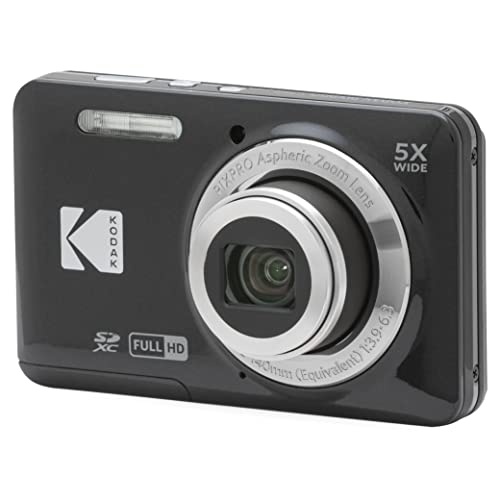
KODAK PIXPRO FZ55 — Best pocketable step-up
If the FZ45 is the family drawer camera, the FZ55 is the one that lives in your own pocket. It keeps the honest 16-megapixel sensor and adds a 5x optical zoom starting at 28mm, in a slimmer body built around a rechargeable lithium battery. That combination — a little more reach, a little less bulk, no pocketful of AAs — suits the everyday-carry photographer: the parent at the park, the commuter who photographs the city, the traveller who wants a real zoom without a camera bag.
The extra zoom step is worth more than the numbers suggest. At the long end you can frame a portrait without standing in someone’s personal space, pick out a detail on a building, or follow a child across a playground while staying on the bench. Sixteen megapixels leaves sensible cropping room afterwards, and 1080p video covers the clips most people actually share. In daylight, which is where compacts earn their living, results are crisp and colourful in the Kodak manner.
The rechargeable battery cuts both ways, so plan for it: it is slimmer and cheaper to run at home, but on a long trip the charger becomes essential luggage and a spare battery is a wise purchase. Low light remains compact-camera territory — good at dusk, strained in dark interiors. As the step-up compact in this guide, though, the FZ55 is the balanced choice: the one most buyers picturing a 16MP camera are actually picturing.
- Sensor: 16 megapixels for prints and cropping headroom
- Lens: 5x optical zoom from a 28mm wide angle
- Power: rechargeable lithium battery
- Video: 1080p Full HD recording
- Body: slim compact for pockets and small bags
Strengths
- 5x zoom adds real framing flexibility
- Slim body genuinely fits everyday carry
- Rechargeable battery keeps home running costs low
Trade-offs
- Charger and spare battery needed for long trips
- Low-light results are typical small-sensor fare
- Zoom still short for serious wildlife
Best for: everyday carry, travel and family photography with a bit more reach.
Not suited for: AA-battery loyalists or distant-subject specialists.

KODAK PIXPRO AZ528 Astro Zoom — Best long-zoom 16MP bridge
The AZ528 exists for the subjects the compacts above cannot touch. A 52x optical zoom is a transformative figure: it brings a heron across a lake, a striker at the far end of a pitch and the moon’s craters into genuine photographic range, on a 16-megapixel sensor with a back-illuminated design that handles lower light more gracefully than older bridge cameras. This is the camera that turns a casual interest in wildlife into a hobby, because suddenly the distant speck becomes a portrait.
Kodak dresses that reach in a proper bridge body — a deep grip, a control layout that invites you to learn aperture and shutter rather than fear them, and Wi-Fi to move pictures to your phone without a cable ceremony. Sixteen megapixels proves well judged here: at extreme zoom, stability and light matter more than pixel count, and the files stay manageable even after a day of enthusiastic birding. Optical stabilisation does heavy, honourable work at the long end.
Respect the physics and the AZ528 rewards you. At full zoom, use a fence, a monopod or a tripod; in dull light, accept that the smallest sensors gather less light and keep expectations daylight-shaped. It is also, self-evidently, not a pocket camera — it travels in its own bag and announces itself as a hobby. For the buyer whose 16MP search really means how do I photograph things that are far away, this is the answer in this guide, finished in a rather handsome midnight blue.
- Sensor: 16MP back-illuminated CMOS for better low-light behaviour
- Lens: 52x optical zoom — reach measured in fields, not metres
- Video: 1080p recording
- Connectivity: Wi-Fi for transferring images to a phone
- Body: bridge styling with a proper grip and controls
Strengths
- 52x optical zoom reaches genuinely distant subjects
- Back-illuminated sensor helps in poorer light
- Bridge controls encourage learning real photography
Trade-offs
- Too large for pockets or casual carry
- Full-zoom shots demand support and good light
- Small sensor still limits night photography
Best for: wildlife curiosity, sport from the stands and travel with distant views.
Not suited for: anyone wanting a discreet, pocketable everyday camera.

Olympus Stylus SP-100EE — Best for tracking moving subjects
Every long-zoom owner knows the moment: a bird crosses the sky, you zoom to full reach, and the view through the lens becomes a magnified confusion in which the bird no longer exists. The SP-100EE’s answer is so sensible it is a wonder more cameras lack it — a built-in red-dot sight, the Eagle Eye, that pops up and lets you track the subject with both eyes open at natural field of view, while the lens stays zoomed and ready. It turns long reach from a frustration into a tool, especially for birds in flight and fast sport.
Beneath the trick, it is a thoroughly specified 16MP bridge of its era: a long optical zoom, an electronic viewfinder for bright days when screens wash out, and Olympus image processing that was well regarded for colour and stabilisation. The substantial body is a feature at long focal lengths — two hands, elbows tucked, a camera with enough mass to sit still. For wildlife watchers graduating from binoculars, the SP-100EE was designed by people who clearly watched birds themselves.
Two honest notes. This is an older model, so listings vary in condition and completeness — buy carefully, confirm what is included, and test on arrival. And like every small-sensor bridge, it is a daylight instrument first. Neither caveat dents its distinction: among 16MP cameras, nothing else here solves the finding-the-subject problem so elegantly. If your photography chases things that move, the dot sight alone justifies its place in this guide.
- Sensor: 16 megapixels
- Lens: long optical zoom in the 50x class
- Sight: built-in red-dot sight for tracking at full zoom
- Viewfinder: electronic viewfinder alongside the rear screen
- Body: substantial bridge grip for two-handed stability
Strengths
- Dot sight transforms long-zoom tracking
- Electronic viewfinder helps in bright sunlight
- Solid body steadies long-zoom shooting
Trade-offs
- Older model — condition varies by listing
- Bridge bulk rules out pocket carry
- Low-light ability is modest, as with all its class
Best for: birdwatchers and sports parents fighting the lost-subject problem.
Not suited for: buyers who want the newest model with a warranty-first purchase.
Panasonic LUMIX ZS-series 16MP travel zooms (prose-only) — Best travel-zoom alternative — prose-only
This pick is deliberately prose-only: no verified listing sits in this article’s pool, so it carries no link and no image marker beyond its placeholder. It earns its place anyway, because any honest map of 16MP cameras includes Panasonic’s travel-zoom compacts of that generation — cameras that squeezed a genuinely long optical zoom and, on many models, an electronic viewfinder into a body that still fitted a jacket pocket. For travellers, that combination was close to perfect: one small camera for the cathedral square and the distant castle alike.
What to look for if you research them: the zoom range and viewfinder separate the good ones, battery condition matters on any used example, and the 16MP generations are the ones to seek for this guide’s purposes rather than the later higher-resolution models, which trade a little low-light grace for their extra pixels. Prices on the used market vary enormously with condition, so judge each listing on its own photographs and description.
Why include an unlinked pick at all? Because a guide that only mentions what it can link quietly distorts your choices. The travel-zoom idea — reach plus pocket size — is the gap between the FZ compacts and the big bridges in this list, and Panasonic’s versions defined it. If that gap is exactly your need, the research is worthwhile; just buy with the used-market care this guide recommends for every older model.
- Sensor: 16 megapixels in the classic travel-zoom generations
- Lens: long optical zoom far beyond the FZ compacts, in a pocketable body
- Viewfinder: electronic finder on many models, rare in this class
- Power: rechargeable lithium battery
- Status in this guide: prose-only, no verified link in this article’s pool
Strengths
- Long zoom and viewfinder in a pocketable body
- Travel-friendly single-camera solution
- Strong used-market availability in many regions
Trade-offs
- No verified link here, so research is on you
- Used examples vary in battery and cosmetic condition
- Small sensor shares the class’s low-light limits
Best for: travellers wanting reach without a camera bag.
Not suited for: buyers who want a new, warranted, click-and-done purchase.
Canon PowerShot SX-series 16MP bridges (prose-only) — Best familiar-name alternative — prose-only
The second prose-only seat goes to Canon’s 16MP PowerShot SX bridges, the cameras many families actually bought when they wanted more than a compact. They paired long optical zooms with Canon’s approachable menus and well-liked colour, in bodies that felt like proper cameras without demanding proper-camera knowledge. For a buyer who trusts the Canon name and finds one in good condition, they remain a perfectly rational 16MP choice — which is precisely why a guide that omitted them for lacking a link would mislead you.
Research notes, since the legwork is yours: the SX line spans many models and years, so pin down the exact generation, its zoom range and its battery type before comparing prices — some run on AAs, which this guide counts as a virtue for travel and longevity. Check the lens for dust and the zoom for smoothness on any used example, and favour listings with returns. The 16MP models sit in a sweet spot of capability and price on the used market.
Set against the linked Kodak AZ528, a good SX offers similar reach with Canon’s polish; set against the Olympus, it lacks the dot sight but often wins on familiarity. That is a fair, complete picture of the 16MP bridge landscape — four linked picks you can buy from this page, and two respected alternatives you can hunt with your eyes open. A buyer’s guide owes you both halves.
- Sensor: 16 megapixels across the relevant SX generations
- Lens: long optical zooms, model-dependent
- Handling: Canon menus and colour that beginners find friendly
- Power: varies by model — AA on some, lithium on others
- Status in this guide: prose-only, no verified link in this article’s pool
Strengths
- Familiar Canon handling and colour
- Long zooms in beginner-friendly bodies
- Wide used availability at gentle prices
Trade-offs
- No link or verification provided in this guide
- Model sprawl makes like-for-like comparison work
- Condition and battery age vary on used examples
Best for: Canon loyalists comfortable buying used with care.
Not suited for: anyone who wants the certainty of a verified new listing.
How Do the Six Picks Compare Side by Side?
| Pick | Type | Headline strength | Watch out for |
|---|---|---|---|
| KODAK PIXPRO FZ45 | Compact, AA-powered | Simplicity and anywhere batteries | Short 4x zoom limits distant subjects |
| KODAK PIXPRO FZ55 | Compact, rechargeable | Slimmer body with 5x optical zoom | Proprietary battery needs its charger on trips |
| KODAK PIXPRO AZ528 Astro Zoom | Bridge camera, 52x zoom | Huge optical reach with BSI sensor | Bridge size — no longer a pocket camera |
| Olympus Stylus SP-100EE | Bridge camera with dot sight | Eagle-eye dot sight for subject acquisition | An older model — check listing condition carefully |
| Panasonic LUMIX ZS-series 16MP travel zooms (prose-only) | Travel zoom compact (prose-only) | Long zoom plus viewfinder in a small body | Covered without a link — research current listings yourself |
| Canon PowerShot SX-series 16MP bridges (prose-only) | Bridge camera (prose-only) | Long zoom with Canon handling and colour | Prose-only — verify any listing you find independently |
The pattern across the six is a lesson in what sixteen megapixels can wear: a pocket compact, a travel zoom, two styles of bridge. Sensor count stayed constant while the cameras changed completely, which is the healthiest reminder in this guide — you are choosing a lens, a body and a battery philosophy that happen to share a resolution, and those choices will shape your photographs far more than the number they share.
Is 16 Megapixels Still Enough, and What Else Should You Check?
Do the print maths and the anxiety dissolves. Sixteen megapixels produces files that print sharply at sizes far beyond the family album — large wall prints included — and fill modern screens with detail to spare. It also leaves real cropping room: you can trim a quarter of the frame away and still hold a file most people would call high resolution. Where extra megapixels help is extreme cropping and enormous prints; where they hurt is file size, card capacity and, on small sensors, low-light behaviour, because more pixels on the same sensor means each one gathers less light. Sixteen is not a leftover figure — on compact sensors it is close to the engineering sweet spot.
So judge these cameras on everything except the number. Lens first: a wide starting point for rooms and landscapes, an optical zoom matched to your subjects, and honest glass matter daily. Handling second: will you carry it, can your family operate it, does it have a viewfinder for bright days? Battery philosophy third: AA freedom or lithium slimness, each genuinely right for different lives. A camera that wins those three arguments at 16MP will out-photograph a neglected 24MP camera in a drawer, because the best resolution is the one present at the moment.
Finally, buy the condition as much as the model. Several cameras in this class are older or sold through varied listings, so read what is included — battery, charger, card, strap — and favour sellers who describe honestly and accept returns. Test any arrival across a full day: every zoom position, flash, screen, a video clip, a full battery cycle. Sixteen-megapixel cameras are durable, simple machines, and a good example of any pick here should give years of service; your job is simply to confirm you have a good example while confirming is easy.
How Should You Set Up and Use Your Choice Well?
Get more from sixteen megapixels with habits, not settings. Fill the frame optically rather than cropping later — walk closer, zoom properly — and your files keep their full strength. In low light, brace the camera or rest it on a wall and let slower shutter speeds work, instead of forcing sensitivity upward. Use the flash as a daylight tool for backlit faces rather than a night-time floodlight. These are the techniques that separated good compact photographers from frustrated ones in every era, and they cost nothing.
For the bridge cameras, learn the long-zoom discipline early: support the camera, exhale, squeeze rather than jab the shutter, and take three frames of any distant subject because one will be sharpest. Keep the lens clean — at 50x, a fingerprint is weather. And whatever you buy, set the date, format the card in the camera, and file your pictures off the card weekly. Sixteen-megapixel files are small enough that storage is never an excuse, and an organised archive is the difference between a camera that builds a family record and one that fills a card with mysteries.
Putting It Into Practice, Week by Week
Test your new camera’s resolution honestly in the first week. Photograph a detailed scene — a bookshelf, a garden hedge, a street of signs — then print or view the centre and a corner at full size. Sixteen megapixels should look crisp and confident. Then crop the image to half its area and look again: that remaining quality is your real-world headroom for the shots where you could not get closer, and knowing it precisely stops both over-cropping and needless megapixel envy.
Devote a session to the zoom’s story. On the compacts, photograph the same subject at the wide end, mid-zoom and full zoom from one spot, and notice how the wide frames tell context while the long frames tell character. On the bridges, extend the exercise across a field or a lake until the subject is genuinely far. This single exercise teaches the core skill of this entire camera class: choosing a focal length on purpose instead of accepting the one the camera happened to be left at.
Practise the battery philosophy you bought. AA owners: learn how many shots a set of your rechargeables delivers, and keep a labelled spare set in the bag. Lithium owners: time a full charge and note real shot counts across a day out. Either way, the goal is a camera whose power you never think about mid-occasion — and a written note of your real figures, because manufacturer estimates and February temperatures are distant cousins.
Low light deserves a rehearsal too, in the room where your family actually gathers. Photograph people by lamplight with and without flash, braced and hand-held, and study which approach flatters your subjects. Small-sensor cameras all have a low-light personality; the owners who learn theirs produce warm, honest evening pictures, while the owners who fight it produce either blur or flash-lit startlement. Your camera’s personality is knowable in one evening — spend it.
If you bought a bridge, dedicate a morning to moving subjects: birds at a feeder, dogs in a park, traffic from a bridge. This is where the Olympus’s dot sight proves itself and where every long-zoom user learns anticipation — following through the movement, shooting in short bursts, accepting a keeper rate that improves with practice. Keep the best frame of each sequence and delete the rest without sentimentality; curation is half of wildlife photography at any budget.
Make one photograph a week deliberately: a portrait of someone at home, using window light and the zoom set to a flattering mid-range rather than the wide end’s distortion. Sixteen megapixels rewards this care with files that print beautifully, and a year of such portraits becomes the most valuable thing the camera ever makes. The megapixel debate fades quickly when the pictures on the wall are good — and they can be, from every pick in this guide, in hands that practise.
Start a small project in your first month, because projects teach cameras faster than wandering does. Photograph every doorway on your street, every bench in the park, every shopfront on one road — the subject barely matters. What matters is repetition with variation: the same camera, the same resolution, twenty different lights and distances. By the project’s end you will know your 16MP files intimately — how they crop, how they print, where they soften — and that knowledge transfers to every photograph you take afterwards, whatever the subject.
Print something early, and print it larger than feels sensible. A sixteen-megapixel file on paper behaves differently from the same file on a screen: paper forgives noise and rewards composition, and a big print on the wall teaches you what your camera actually resolved far more honestly than pixel-peeping at a monitor. Many owners of far more expensive cameras never learn this lesson. Hang the print where you will see it daily; it will quietly set the standard your next photographs try to meet.
Learn your camera’s colour personality by photographing the same scene across one day. Dawn, noon, dusk and lamplight each ask different questions of a small sensor, and Kodak, Olympus and the rest answer with different accents — some warm, some cool, some punchy. None is wrong; each is a signature. Once you know your camera’s accent, you can lean into it for subjects it flatters and correct for it in the scenes it does not, which is the beginning of having a style rather than a device.
For family photography, position beats everything. Put the window light beside your subjects rather than behind them, step back and use a little zoom to flatter faces, and take the photograph at the moment after the posed smile relaxes — that unguarded second is the one families frame. A 16MP compact in the hands of someone who understands light and timing will out-photograph a flagship in careless hands at every birthday, every single year, and the prints will prove it on the wall.
Children with cameras deserve their own paragraph, because this class serves them uniquely. A robust, inexpensive 16MP camera can be a child’s own in a way a phone or a flagship cannot — carried, dropped, experimented with, learned on. Set one challenge a week: something red, something reflected, something from knee height. Review the results together with genuine attention. You are not really teaching photography; you are teaching looking, and a camera that costs little enough to be trusted is the perfect instrument for it.
Travel with a small camera is a discipline of availability. The compact in the jacket pocket photographs the alley, the market stall and the sudden rainbow; the bridge in its bag photographs the planned excursion. Decide each morning which camera the day deserves, and resist carrying both unless the day truly splits in two. Sixteen megapixels travels light in every sense — small files, easy backups to a phone or a café computer, no laptop full of enormous archives waiting for a theft to ruin the trip.
Backup habits for small files should be embarrassingly simple, because the files are small. Copy the card to the computer weekly, let your ordinary photo library absorb the pictures, and keep one copy somewhere that is not the house — a cloud folder, a drive at a relative’s home. Sixteen-megapixel archives grow slowly enough that generosity is affordable: keep the near-misses as well as the keepers for family subjects, because the photograph nobody rated in 2026 becomes the treasure of 2046 with a reliability that borders on comedy.
Street photography suits these cameras better than their owners expect. A small compact is unthreatening, quick and quiet; people relax around it in a way they never do before a large system camera. Work at the wide end, pre-set the camera before raising it, and photograph scenes rather than singling out strangers. The 16MP file is plenty for the prints street work traditionally becomes. Several celebrated documentary projects were made on far lesser equipment — the genre rewards nerve and timing, neither of which is sold by the megapixel.
Garden and nature close-ups are the compacts’ secret talent. Small sensors give generous depth of field at close distances, so a flower, a bee or a frost pattern can be sharp front to back without specialist technique. Get close — closer than feels reasonable — fill the frame, and let the wide end of the zoom do the work. Morning light and a steady hand complete the recipe. A 16MP file of a well-seen close subject prints beautifully, and the garden offers a new subject every week of the year.
For the bridge owners, moon photography is the gateway exercise. The long zoom frames the moon properly, and the attempt teaches support, exposure and patience in one evening. Use the steadiest rest you can find, delay the shutter or use a timer to let vibrations settle, and bracket exposures because the moon is brighter than intuition suggests. Your first crater-detailed frame, from a camera at this class’s prices, delivers a disproportionate joy — and a permanent respect for what sixteen megapixels and a long lens can jointly do.
Sports from the stands follow their own arithmetic. You cannot have the professional’s position, so make the crowd’s position work: shoot at the moments of stillness inside the action — the set piece, the serve, the corner — rather than chasing open play, and favour the near side of the pitch without shame. Crop modestly afterwards; sixteen megapixels allows it. The resulting photographs, imperfect and heartfelt, are exactly the ones families keep, because they were taken by someone who was actually there and actually cared.
Learn to delete. A 16MP card holds thousands of frames, which tempts owners to keep everything and value nothing. Review each outing once, keep the photographs that earn it, and let the rest go. The kept set — a few dozen per event — becomes the family record people actually browse, print and share. Curation is not ingratitude toward the camera; it is the second half of photography, and small-file cameras make it painless enough that there is no excuse for skipping it.
Share the camera deliberately. Lend the FZ45-class compact to a parent for their holiday, hand the bridge to a teenager for their match, let a friend document the working day you never see. Photographs taken by other eyes, on your camera, in your archive, widen the family record in ways your own perspective cannot. These are inexpensive, durable tools built to be used by everyone; a camera that only one person may touch is a camera half wasted, whatever its resolution.
Seasonal light is the long teacher. Photograph one fixed subject — your street, a tree, a harbour — in every month of the year, same position, same camera. The set that results teaches more about light, colour and your own developing eye than any course, and sixteen megapixels renders each season with complete adequacy. By the twelfth frame you will be seeing like a photographer, which was the real product being sold all along; the camera was merely the honest instrument that got you there.
And when the upgrade itch eventually arrives, as it does for everyone, let this camera’s archive argue its case first. Spread your best year of prints on a table and ask which of them failed for want of megapixels. The honest answer, almost always, is none — they failed, where they failed, on light, timing and nerve. Keep the 16MP camera for the purposes it serves perfectly, and let any future purchase be for a named new capability rather than a larger number. That is how sensible kits, and sensible photographers, are made.
Experiment with the flash as a creative tool rather than an emergency light. A gentle fill flash on a bright day lifts shadows from faces under hats and trees, turning a squinting group portrait into a relaxed one. Most compacts here let you force the flash on for exactly this purpose. Practise on a willing subject at noon, comparing flash and no-flash frames side by side; the difference will convert you in one session, and your family portraits will improve every sunny day for the rest of the camera’s life.
Night street scenes reward the patient compact owner more than expected. City light is plentiful light — shopfronts, lamps, wet pavements doubling every source — and a braced camera with a modest sensitivity can render it atmospherically at sixteen megapixels. Rest the camera on a wall, use the self-timer to avoid touching it during exposure, and let the scene’s own light do the painting. The results will not match a flagship’s, and they will not need to: atmosphere forgives what detail would condemn.
Keep a tiny field kit with the camera: a microfibre cloth, a spare card, spare batteries in their right form, and a mini tripod if your subjects justify one. The kit weighs nothing and rescues everything — the smeared lens, the full card, the flat battery at the exact wrong moment. Photographers at every level learn this eventually; owners of inexpensive cameras sometimes skip it because the camera felt too cheap to deserve a kit. It deserves one precisely because it gets carried into real life.
Photograph your own hands at work — cooking, mending, building, playing an instrument — because a camera this available can document skill as well as faces. Set the self-timer or ask a companion, fill the frame with the hands and their materials, and repeat across the years as the skills grow or the hands age. Such photographs become unexpectedly moving in an archive, and they are the kind a phone, for all its power, somehow rarely gets asked to take in the households that own both.
Use the video mode without embarrassment. Sixteen-megapixel compacts and bridges record perfectly serviceable 1080p clips, and the short film of a birthday song or a first bicycle ride belongs in the same archive as the stills. Keep clips short, hold them steady, and file them with the day’s photographs. The mixed archive — stills for the wall, clips for the voice and movement — is the honest record of a family’s life, and these cameras are quietly built to make both halves of it.
When you photograph documents, artwork or items for sale, this class is in its element: even light, a square-on position, the zoom set mid-range to avoid distortion, and sixteen megapixels resolves every detail a buyer or an insurer could ask for. A consistent setup — same corner, same light, same distance — turns a chore into a system. Many small sellers run their entire visual operation on cameras like these, and their listings look it: clear, honest and adequately detailed.
Defend your archive against its only real enemy, which is not failure but indifference. A camera this easy produces photographs faster than households organise them, so set the weekly rhythm while the camera is new: copy, name, back up, delete the obvious failures, print one favourite a month. The print habit matters most — a shoebox or an album that grows monthly keeps photography a household pleasure rather than a digital chore, and it is the surest guarantee that these sixteen megapixels become a legacy instead of a folder.
Finally, remember that this class of camera is where photography’s democracy lives. Not everyone can or should buy a system camera; everyone in this guide’s audience can own a real lens, a real zoom and sixteen honest megapixels. The photographs that result — of birthdays, bridges, birds and grandparents — are not lesser photographs for their equipment. They are the medium’s mainstream, its family album and its memory, and a camera that serves them faithfully has nothing to apologise for, to anyone, ever.
Try a self-imposed lens discipline for a week: choose one zoom position — the wide end for context, the middle for portraits, the long end for details — and make every photograph of the week at that setting, moving yourself instead of the zoom. The constraint feels artificial for a day and revelatory by the week’s end, because it teaches what each focal length actually sees. Photographers trained on fixed lenses learned this by necessity; zoom owners must choose it, and those who do develop an eye that zooming alone never teaches.
Photograph the weather, not just in it. Fog at the wide end, rain on a window at the long end, frost patterns close up, the first snow on the familiar street — a small camera that is always carried is the perfect weather instrument, and sixteen megapixels renders atmosphere with complete conviction. A year of weather photographs from one doorway becomes a portrait of a place that no holiday album can match, and it costs nothing but the habit of stepping outside with the camera when the sky does something interesting.
And give the camera a rest day in your affections occasionally: leave it home, look at the world unmediated, and notice what you reach for it to capture. The absences teach as much as the archives — they show you your true subjects, the ones your hand misses the camera for. Return the next day and photograph exactly those. A 16MP camera used with that kind of intention is not a compromise instrument at all; it is a diary that happens to be written in light, and diaries are judged by honesty, not by the price of the pen.
Notice how the camera changes your walking. Owners of pocketable 16MP cameras consistently describe the same side effect: routes lengthen, pauses multiply, and ordinary streets acquire the status of subject matter. That is not a specification, and no review can score it, yet it may be the most valuable thing in this entire guide — a small machine that makes its owner look at the world with more attention than the day before it arrived. Cameras are sold as recording devices; the good ones are really attention devices.
When the year turns, make the album. Choose the best photograph of each month — from whichever pick in this guide you own — and print the twelve together. The set will show you your subjects, your seasons and your improving eye in a single glance, and it will settle, more persuasively than any argument, the question this article began with. Sixteen megapixels, honestly used, is not a compromise anyone needs to defend. It is a year of your life, seen clearly, and that has always been enough.
What Mistakes Do Buyers Keep Making?
The standing mistake with this class is megapixel snobbery in both directions: dismissing 16MP as obsolete without doing the print maths, or assuming any 16MP camera equals any other. The six here differ enormously — in zoom, handling and purpose — while sharing a number, which proves the number is the least interesting thing about them. The second mistake is judging a compact or bridge by nightclub standards. These are daylight-first instruments; condemning them for dim interiors is like faulting a bicycle for motorway manners.
Buyers also fumble the practicalities. Used and older models arrive without chargers or with tired batteries that sour the first week; cards from other devices carry old formats that confuse simple cameras; lenses on long-zoom bridges get pocket-lint and fingerprints that masquerade as camera faults. Buy the accessories with the camera, format cards in-camera, clean the lens before the first test shot, and test everything during the easy-return window. None of this is glamorous, and all of it decides whether a good camera gets a fair chance.
Final Recommendation
For most buyers, the decision resolves quickly. The FZ45 is the family-proof compact, the FZ55 its slimmer everyday sibling, the AZ528 the reach champion among the linked picks, and the Olympus SP-100EE the tracker with the clever sight. The Panasonic travel zooms and Canon SX bridges stand as prose-only alternatives for hunters of the used market. Every one is a genuine sixteen-megapixel camera judged on what that resolution does best: everyday photographs, taken easily, printed proudly.
Choose the body that fits your subjects and your pockets, then go and fill its card with the people and places in front of you — because sixteen honest megapixels, present at the right moment, have always beaten a finer camera left at home.
Frequently Asked Questions
Is 16 megapixels enough for printing large photos?
Yes, for the sizes most households actually print and hang. Sixteen megapixels holds sharp detail at large wall-print sizes when the photograph is well taken, and it fills modern displays completely. Extreme cropping or truly enormous prints are where higher counts earn their keep. For family, travel and hobby photography, technique and lens quality will limit your prints long before the pixel count does.
Why do some picks here have no purchase link?
Because this guide only links listings it has verified, and two respected alternatives — Panasonic’s 16MP travel zooms and Canon’s 16MP SX bridges — had no verified listing in this article’s pool. Rather than invent links or omit real options, we describe them in prose with research guidance. You get the complete landscape; the linked four are simply the ones you can buy directly from this page.
Are AA batteries a disadvantage in a modern camera?
They are a trade, not a flaw. AA-powered cameras like the FZ45 can be revived anywhere on earth and never suffer an obsolete proprietary pack, at the cost of a slightly chunkier body and carrying spare cells. Rechargeable lithium models are slimmer and cheaper to run at home but depend on their charger. Frequent travellers and drawer-camera households often prefer AAs; daily carriers often prefer lithium. Neither answer is wrong.
Bridge camera or compact — which 16MP style suits me?
Ask where your subjects live. If they are across rooms and streets, a compact’s size means the camera is with you, and that presence wins. If they are across fields, lakes and stadiums, only a bridge’s long optical zoom reaches them, and its size is the admission price. Many households end up with one of each over time — the compact for life, the bridge for occasions — and at 16MP prices that pairing is entirely reasonable.
What should I check when buying an older 16MP model?
Condition and completeness: lens cleanliness and zoom smoothness, screen and viewfinder function, battery health, and whether charger and cables are included. Buy from sellers with honest descriptions and returns, then test the camera thoroughly on arrival — every zoom position, flash, video mode and a full battery cycle. These are durable machines, and a verified good example should serve for years.
Related Guides
Once your camera is chosen, these guides will help you make the most of it: Getting sharper photos from a compact camera, Long-zoom technique for birds and sport and Printing your photos at home, properly.
Related guides
- Best Balancing Stabilizers for Mirrorless Cameras: Payload, Balancing and Native Vertical Shooting
- Best 1080p IP Cameras: PoE Domes, Turrets, Bullets and a PTZ That Earn Their Cable
- Best Basic Phones Camera Buyers Can Trust: Flip Phones and Simple Handsets That Still Take a Photograph
- Best Sony Full Frame Cameras for Astrophotography: Sensitivity vs Resolution


