What's inside
- Key Takeaways
- Quick Picks: The Best All-Around Headsets for Gaming and Music at a Glance
- How Did We Weigh Game Sense Against Musical Sense?
- The Six Headsets in Detail
- How Do the Six Compare Side by Side?
- What Does the Double Life Actually Demand, Hour by Hour?
- How Should You Set Up One Headset for Both Play and Playback?
- How Does the Music Half Behave Across Genres?
- What Happens to an All-Rounder After a Year of Tuesdays?
- What Are the Common Mistakes When Buying an All-Rounder?
- Final Recommendation
- Frequently Asked Questions
- Related Guides
As an Amazon Associate I earn from qualifying purchases. This post may contain affiliate links at no extra cost to you.
gizmoverdict.com is reader-supported. When you buy through links on our site, we may earn an affiliate commission.
Where to buy: the six headsets below are all sold through Amazon, each name links to its own listing, and the listing page is where you can check price on Amazon and confirm the connector and platform details against your own setup before ordering.
The best all-around headsets for gaming and music have to survive a double life that most audio gear never attempts. At seven in the evening the same headset is a tactical instrument, carrying footsteps, callouts and a team channel; at nine it becomes a music headphone, judged on whether a favourite album still sounds like itself. Those two jobs pull in opposite directions. Games reward exaggerated spatial cues and a microphone that survives shouting; music rewards tonal honesty and comfort across a whole record. A headset that only does one of those jobs well is easy to find, and the shelves are full of them. This shortlist is for the harder brief: one headset, both lives, no swapping hardware when the session changes from ranked matches to records.
Read the six titles as a set and a pattern emerges. Connectivity is the real dividing line. Two picks are wired with a choice of USB or a 3.5 mm jack, two more are wired to the universal 3.5 mm plug alone, one USB model ties itself to computers and consoles through a single digital lead, and one wireless flagship abandons cables entirely with simultaneous 2.4 GHz and Bluetooth connections plus a battery figure — 250 hours, as titled — that changes how a person thinks about charging altogether. Microphones divide the list too: flip-to-mute designs on the two Logitech models, noise-cancelling claims on the three value-tier models, and the wireless HyperX taking a different route through its base station arrangement.
One honesty note belongs at the top. Several titles advertise 7.1 surround sound or DTS processing. Those phrases are the listings’ own framing for virtual surround delivered over two earcups, and this guide repeats them only as listing claims, attributed as such. Virtual surround can widen a game’s soundstage convincingly, but no two-driver headset places physical speakers around your head, and positional accuracy in a match depends on the game’s own audio engine as much as on the headset. Where a pick’s surround claim matters to its case, the sections below say whose claim it is.
Music performance is graded here on a deliberately plain standard: does the headset present a recording recognisably, with vocals forward, bass present without swamping, and enough comfort that a long album is a pleasure rather than an endurance test. None of these six is an audiophile instrument, and none pretends to be; the question is which ones respect music rather than merely tolerating it between matches. Readers who already know they lean toward the games side of the balance will also find the cluster companion on the best affordable headsets for pc and xbox useful, since it grades a neighbouring shelf purely on platform fit and value.
Key Takeaways
- The HyperX Cloud Alpha 2 Wireless is the only wireless pick, and its title claims simultaneous 2.4 GHz and Bluetooth plus a 250-hour battery — a different ownership proposition from every wired rival here.
- Both Logitech models mute by flipping the microphone up, a gesture that works mid-match without hunting for a switch.
- The G432 is the connectivity diplomat of the wired group, offering USB and a 3.5 mm jack in one title, while the G335 commits to the 3.5 mm plug alone and the widest console list.
- Three picks — the EKSA, the Ozeino and the Jimonyer — carry 7.1 surround claims in their titles; those are the listings’ framing for virtual surround, not physical speaker arrays.
- Platform breadth is widest on the value tier: the Ozeino and Jimonyer titles name Switch and Xbox Series machines alongside PC and PlayStation.
- Every pick is over-ear and every pick includes a microphone, which separates this list from pure listening headphones entirely.
Quick Picks: The Best All-Around Headsets for Gaming and Music at a Glance
| Pick | Badge | Why it made the cut |
|---|---|---|
| Logitech G432 | The wired all-rounder | DTS Headphone:X 2.0 as titled, 50 mm drivers and both USB and 3.5 mm connections make it the flexible wired centre of the list. |
| HyperX Cloud Alpha 2 Wireless | The wireless flagship | Simultaneous 2.4 GHz and Bluetooth, a 250-hour battery claim and dual-chamber drivers for the desk that is done with cables. |
| Logitech G335 | The light traveller | A single 3.5 mm plug, memory foam earpads and a titled platform list spanning PC, PlayStation, Xbox and Switch. |
| EKSA E1000 USB | The USB specialist | USB connection, a 7.1 surround claim and a noise-cancelling microphone pitched at PC play and call-centre duty alike. |
| Ozeino Gaming Headset (7.1) | The white-finished generalist | Platform breadth across consoles, laptop and mobile, with a noise-cancelling mic and LED light in a white shell. |
| Jimonyer Gaming Headset | The colour-forward value pick | Blue finish, RGB lighting, memory earmuffs and a titled platform list covering the current console generation. |
How Did We Weigh Game Sense Against Musical Sense?
By scoring each title on the evidence it prints in four columns: how it connects, how it talks, how it claims to handle space, and how it proposes to stay comfortable. Connection came first because an all-rounder that cannot plug into the machine in front of you is not an all-rounder at all. The G432’s dual USB and 3.5 mm arrangement and the HyperX’s simultaneous wireless pair both scored heavily here, for opposite reasons — one covers legacy and modern sockets with wire, the other covers a PC and a phone at the same time without wire.
The microphone column mattered more than in most round-ups, because the double life includes being heard. Flip-to-mute is a genuinely useful mechanic in a home where a parent, partner or doorbell interrupts mid-match; noise-cancelling microphone claims, printed by three of the titles, speak to open-plan rooms and shared desks. Those claims are the manufacturers’ own and are reported as such, since microphone noise handling cannot be verified from a title page. The space column held the surround claims, again attributed: DTS Headphone:X 2.0 on the G432 is a named, licensed processing system, while the 7.1 labels on the value tier are broader marketing language, and the guide treats them with correspondingly different confidence.
Comfort closed the scoring. Memory foam appears in the G335 and Jimonyer titles, the HyperX leans on its dual-chamber driver design for a cleaner low end during long sessions, and the wired models trade on lightness of a different kind — no battery to carry on the head. Music grading stayed qualitative throughout, because no title in this set prints the data that would justify anything more precise, and pretending otherwise would be invention. One further filter ran quietly beneath the four columns: every pick had to remain purchasable as a single, complete product — no required accessory, no mandatory subscription, no second purchase hiding behind the first. An all-rounder that demands an amplifier, a proprietary dongle sold separately or a paid application tier before it performs its advertised trick has failed the brief before the first match starts, and the six survivors were checked against their titles for exactly those traps. The result is a list where the price on the listing, whatever it is on the day you look, buys the whole proposition the title describes.
The Six Headsets in Detail
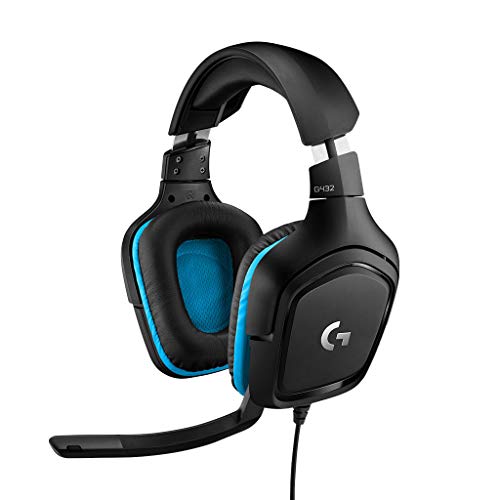
Logitech G432 — The wired all-rounder
The G432’s title is a small essay in flexibility: DTS Headphone:X 2.0, 50 mm drivers, USB and a 3.5 mm jack, a flip-to-mute microphone, PC compatibility. Start with the connections, because they define the ownership experience. The USB route carries the digital processing — the DTS surround claim lives there — while the 3.5 mm route turns the same headset into a plain analogue device for a controller, a laptop or anything else with a headphone socket. A headset that can be both things is genuinely rarer than it should be, and it means the G432 can follow a player from a desktop battlestation to a sofa controller without an adapter hunt.
The 50 mm driver figure is the largest explicit driver size among the wired picks, and in practice it underwrites the headset’s double life: games get the low-end weight that makes explosions physical, while music keeps enough body that bass-led genres do not sound like they are being played through a intercom. The DTS Headphone:X 2.0 claim deserves its attribution — it is Logitech’s listing claim for a licensed spatial processing system — and within those terms it is one of the more credible virtual surround implementations in this price neighbourhood, widening game worlds without smearing dialogue. The flip-to-mute microphone completes the practical picture: mute becomes a gesture, visible to the player and obvious to teammates when it has been forgotten.
For music specifically, the G432 asks to be judged as a competent generalist rather than a specialist. Its presentation is lively rather than analytical, which flatters playlists and film scores and asks less of poor recordings than a studio-tuned headphone would. Long sessions are its natural habitat, and the wired connection means the only endurance limit is the player’s. In a list built around the double life, the G432 is the pick that takes both halves seriously at a wired tier, and that balance — not any single headline feature — is why it leads the page.
A word about the black finish and the general presentation, because all-rounders live visible lives. The G432 looks like what it is — a gaming headset of its generation, angular and unapologetic — and on a video call that reads as enthusiast rather than executive. Players whose work calls involve clients rather than colleagues sometimes keep a plainer headset for those hours, yet the flip-to-mute discipline and the voice quality the G432 delivers usually matter more to how a call lands than the silhouette does. It remains the wired pick this guide would hand to a friend with one desk, one PC and a record collection, and tell them to stop shopping.
- Connection: USB and 3.5 mm jack, as titled
- Drivers: 50 mm audio drivers, as titled
- Spatial claim: DTS Headphone:X 2.0, the listing’s own framing
- Microphone: flip-to-mute, as titled
- Titled platform: PC
- Wireless capability: Not stated in the listing title — verify with the maker’s documentation
Strengths
- Two connection routes in one headset, digital processing on USB and universal analogue on the jack.
- Flip-to-mute is the fastest, least ambiguous mute mechanic in this group.
- The 50 mm drivers give music and games a shared low-end foundation.
Trade-offs
- The title names PC alone, so console use runs through the 3.5 mm route and its limits.
- Wired means the cable crosses the desk for every session, forever.
- The surround experience depends on the USB route, not the analogue one.
Best for: a PC-centred desk where one wired headset covers matches, films and albums without hardware swaps. Not suited for: a sofa-first console setup across the room from the screen, because the wired connections tether the player to the machine’s immediate neighbourhood.
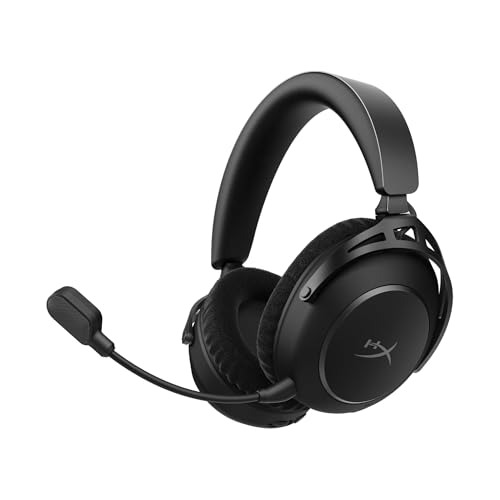
HyperX Cloud Alpha 2 Wireless — The wireless flagship
Every other pick on this page negotiates with a cable; the Cloud Alpha 2 Wireless deletes the negotiation. Its title leads with simultaneity — 2.4 GHz and Bluetooth at the same time — which is the feature that reorganises a desk. Game audio arrives over the low-latency 2.4 GHz link while a phone stays paired over Bluetooth, so a call can be answered without leaving the match or re-pairing anything. That is the all-rounder brief executed at the connection layer, and no wired model here can imitate it.
Then there is the battery claim: 250 hours, as titled. Even treated as a manufacturer’s best-case figure, a number of that size changes behaviour — charging stops being a weekly ritual and becomes an occasional errand, and the headset is simply always ready. The RGB base station in the title is the desktop half of the arrangement, a charging and control hub that gives the headset a home on the desk rather than a drawer. Dual-chamber drivers, the design HyperX built this line’s name on, aim to keep bass energy from muddying the midrange, which serves the music half of the brief directly: kick drums and vocals stop competing for the same space.
The music case rests on that driver architecture and on freedom of movement. A wireless headset gets worn for the album while cooking, for the podcast while tidying, in a way wired models rarely do, and hours of extra wear is its own kind of sound quality. The counterweights are tier and complexity: this is the flagship of the six, priced by its listing accordingly, and a base-station ecosystem is more hardware to house than a plug. For the reader whose double life is genuinely split between a gaming PC and everything else in the home, it is the most complete answer on the page.
The base station deserves a second look, because it changes the headset’s relationship with the desk. A headset with a home gets put away; a headset without one migrates — to the sofa arm, the floor, the tangle behind the monitor — and migration is where cables fray, earcups get sat on and batteries die unnoticed. The titled RGB element is decoration, but the docking habit it encourages is genuinely protective, and it makes the 250-hour claim easier to keep true, since a headset that sleeps in its charger wakes up full. Ownership details like these rarely headline a review, yet across a three-year span they decide whether a flagship still feels like one.
- Connection: simultaneous 2.4 GHz and Bluetooth, as titled
- Battery claim: 250 hours, the listing’s own figure
- Desk hardware: RGB base station, as titled
- Drivers: dual-chamber drivers, as titled
- Microphone arrangement: Not stated in the listing title — verify with the maker’s documentation
- Wired fallback: Not stated in the listing title — verify with the maker’s documentation
Strengths
- Two wireless links at once solve the game-plus-phone problem no wired pick can touch.
- A 250-hour titled battery figure makes charging a rare event rather than a routine.
- Dual-chamber drivers are a music-minded design inside a gaming flagship.
Trade-offs
- Flagship tier: the listing positions it far above the wired value picks.
- The base station claims desk space and a power outlet of its own.
- The title leaves microphone details unstated, so voice-chat specifics need the documentation.
Best for: a player whose gaming PC and phone both demand the same headset across a whole day, with music filling the hours between matches. Not suited for: a single-console household that would leave the second wireless link and the base station permanently idle, paying flagship money for features with no machine to serve.
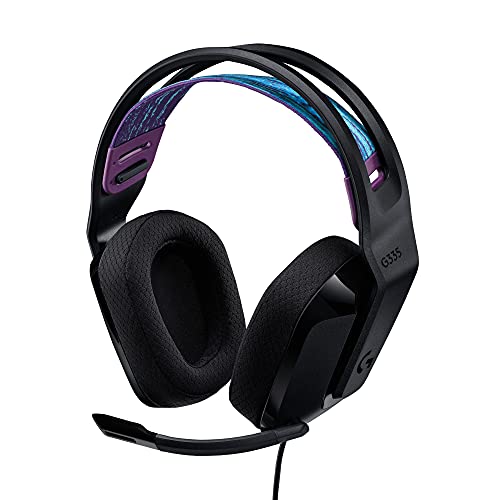
Logitech G335 — The light traveller
The G335 makes the opposite bet from the HyperX: one plug, every machine. Its title lists the 3.5 mm audio jack and then the platforms — PC, PlayStation, Xbox, Nintendo Switch — which between them describe nearly every gaming device a household owns. The flip-to-mute microphone it shares with its G432 sibling keeps the same party trick: silence is one upward flick away, a mercy in homes where matches share airspace with family life. Memory foam earpads, named in the title, are the comfort story, and they suit this model’s role as the headset that gets worn for a bit of everything rather than reserved for one battlestation.
Because the connection is purely analogue, the G335 carries no processing claims, and that plainness is a virtue worth naming. There is no surround mode to configure, no software suite to install, no battery to manage; the headset sounds like the device driving it, and it sounds the same on every device. For music that means honesty by default — a phone, a controller and a laptop each present the recording through the same unpretentious lens. Households with several platforms and several players will recognise the deeper appeal: this is the headset that lives in the shared space, gets borrowed constantly, and never needs its owner to explain how it works.
Its limits are the shadow of its simplicity. The title names no surround processing, so spatial drama comes only from the game’s own mix, and there is no USB route for PC features. Buyers cross-shopping the surround-heavy shelf surveyed in the guide to the best 7 1 gaming headsets should note the difference in philosophy: the G335 spends its budget on compatibility and comfort instead of processing claims. For the all-around brief — games on anything, music on everything, zero friction — that is a defensible, even elegant, allocation.
There is a travel argument for the G335 that its home-console framing undersells. A single 3.5 mm plug and no battery make it the headset that survives being thrown into a bag for a friend’s house, a tournament or a long train ride with a handheld console — no charger to forget, no pairing ritual on arrival, nothing to configure on an unfamiliar machine. It sounds the same in every postcode because there is nothing in it that can be set differently, and that consistency is a form of reliability the spec sheet cannot express. Households that already own one often end up buying a second, not because the first failed but because it kept being borrowed.
- Connection: 3.5 mm audio jack, as titled
- Microphone: flip-to-mute, as titled
- Cushions: memory foam earpads, as titled
- Titled platforms: PC, PlayStation, Xbox, Nintendo Switch
- Surround processing: Not stated in the listing title — verify with the maker’s documentation
- Battery: none implied by a wired analogue design; details Not stated in the listing title — verify with the maker’s documentation
Strengths
- The widest titled console compatibility among the wired picks, through one universal plug.
- Flip-to-mute and memory foam cover the two daily frictions of shared-house gaming.
- No software, battery or pairing routine stands between the box and the first match.
Trade-offs
- No titled surround processing, so spatial effects rest entirely on each game’s own audio.
- Analogue-only connection forfeits the PC-side features a USB route can carry.
- A shared-household headset at this tier is a compromise on outright music refinement.
Best for: multi-platform households where one headset must serve every console, a PC and the evening playlist without ceremony. Not suited for: a PC player determined to run virtual surround processing, because the analogue-only connection offers no digital route for it.

EKSA E1000 USB — The USB specialist
The EKSA E1000’s title tells an unusual double story: a gaming headset with a 7.1 surround claim and a noise-cancelling microphone, wired for PS4, PS5 and laptops, and also pitched at call centres. That last phrase is the interesting one. A headset marketed partly for call work is making a microphone promise its gaming-only rivals do not, and the all-around brief — which includes work calls, classes and team chat as surely as it includes matches — is exactly where that promise earns its keep. The USB connection is the enabler: digital audio in, processed sound out, one plug into the computer that anchors most people’s working and playing lives.
The 7.1 label needs its standard attribution. It is the listing’s framing for virtual surround generated from the USB feed, and it should be read as a widening effect for games rather than as a promise of precise positional measurement; the headset has two earcups, and the processing decorates what the game’s engine provides. Within those honest bounds, the package coheres: RGB light for the gaming shelf’s expected theatre, a microphone whose cancelling claim targets keyboard clatter and room echo, and console compatibility through the PlayStation line for the evenings. Music takes the third seat in this design’s priorities — the tuning conversation around this model is about game presence and voice clarity — yet a USB headset that handles a workday of calls and an evening of matches without changing hardware is serving the all-around brief in its most literal, schedule-shaped form.
Shoppers should register the boundary the title draws: USB ties the E1000 to machines with the right port and the drivers to feed it, which in practice means computers first and the named PlayStations second. A phone, a Switch in handheld mode or an Xbox controller is not its natural habitat. Within its habitat, though, it is the hardest-working pick on this page, and the call-centre line in its title is not an embarrassment to the gaming story — it is the second half of the all-around job description, printed in the manufacturer’s own words.
The call-centre phrase in the title also hints at durability expectations worth weighing. Headsets sold partly into call work are designed around eight-hour days and shared-desk abuse, and while this guide cannot test hinges, the positioning suggests a product built for hours rather than occasions. For a student or remote worker whose headset budget must cover employment and entertainment from the same purchase, that suggestion carries weight alongside the microphone claim. The RGB ring will read as gaming gear on a client call, admittedly — camera framing from the shoulders up usually crops it out, and voice, once again, is what the call actually judges.
- Connection: USB, wired, as titled
- Spatial claim: 7.1 surround sound, the listing’s own framing
- Microphone: noise-cancelling claim, as titled
- Lighting: RGB light, as titled
- Titled platforms: PS4, PS5, laptop; call-centre use named
- Analogue fallback: Not stated in the listing title — verify with the maker’s documentation
Strengths
- The only pick whose title names work duty alongside gaming, matching the true shape of an all-rounder’s week.
- USB delivery keeps processing and microphone handling inside one digital connection.
- A noise-cancelling microphone claim aimed at real rooms, not treated studios.
Trade-offs
- USB dependence shuts out devices that only offer an analogue socket.
- The 7.1 claim is virtual processing, to be valued as effect rather than measurement.
- Music refinement is not the design’s headline; game and voice clarity lead.
Best for: a computer-anchored routine that mixes matches, streamed music and a working day of calls on the same machine. Not suited for: handheld or phone-centred play, because the USB-only connection has no analogue route into those devices as titled.
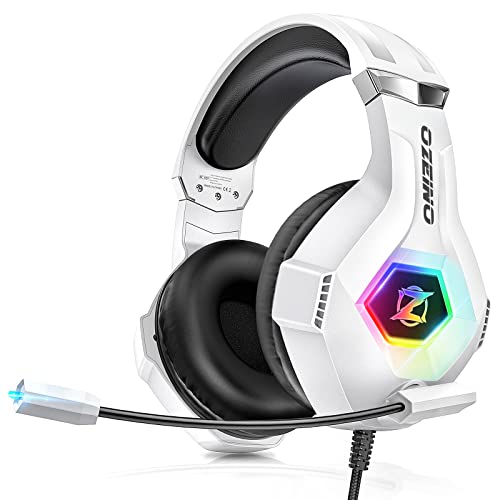
Ozeino Gaming Headset (7.1) — The white-finished generalist
White gaming headsets are rarer than they should be, and the Ozeino’s finish is the first thing its title wants noticed — but the platform list underneath is the substantive story. PC, PS4, PS5, Xbox, Switch, Xbox Series X/S, laptop and mobile all appear, the broadest titled reach in this group, which makes the Ozeino the generalist’s generalist: whichever machine a household buys next, this headset’s title already claims a relationship with it. The 7.1 surround label rides along as the listing’s framing for its virtual processing, subject to the same honest reading applied throughout this guide.
The noise-cancelling microphone claim and the LED light complete a familiar value-tier formula, yet the formula exists because it works for a particular buyer: the player whose gaming life is spread across a console under the television, a laptop at the desk and a phone on the train, and who would rather own one cheerful headset than three specialised ones. Music through such a design is a playlist-and-podcast affair — perfectly serviceable, tuned for presence rather than analysis — and the all-around brief at this tier is honestly more about coverage than about refinement. The Ozeino covers.
Two cautions belong in its file. First, platform breadth in a title is a claim to be verified against your specific machines on the listing page, particularly where console generations and controller sockets differ. Second, a white shell is a commitment: it shows a year of desk life that a black shell forgives, and players who eat at the desk know who they are. Neither caution dents the central case. As the one-headset answer for a many-machine household at the value end of the shelf, the Ozeino’s title makes the broadest promise here, and breadth is a legitimate form of all-around competence.
Music listeners should set expectations by the tier and be pleasantly surprised rather than the reverse. The Ozeino’s job at playlist volume is energy and clarity of line — vocals intelligible, choruses loud in the right way — and on those terms it performs its role. Where it cannot follow the Logitechs is in the quiet, detailed middle of a recording, the background vocal stack or the second guitar, and a listener whose evenings are mostly albums will hear the ceiling sooner than a listener whose evenings are mostly matches and streams. Knowing which evening is yours is the whole art of choosing at this tier, and the Ozeino is honest about which evening it was built for.
- Finish: white, as titled
- Spatial claim: 7.1 surround sound, the listing’s own framing
- Microphone: noise-cancelling claim, as titled
- Lighting: LED light, as titled
- Titled platforms: PC, PS4, PS5, Xbox, Switch, Xbox Series X/S, laptop, mobile
- Driver size: Not stated in the listing title — verify with the maker’s documentation
Strengths
- The broadest titled platform list in the group, spanning consoles, computers and phones.
- A white finish for setups tired of the universal black-and-RGB uniform.
- Noise-cancelling microphone claim aimed at ordinary, echoing rooms.
Trade-offs
- Each platform claim should be checked against the exact machine and controller you own.
- The light shell shows wear and desk grime that darker finishes conceal.
- Driver details are absent from the title, leaving music expectations to be set qualitatively.
Best for: a household whose games live on several different machines and whose headset budget is one purchase, not three. Not suited for: a tidy-desk perfectionist in a snack-heavy gaming space, because the white earcups will document every crumb-season faithfully.

Jimonyer Gaming Headset — The colour-forward value pick
The Jimonyer closes the list in blue, with RGB LED light, soft memory earmuffs and a platform list aimed squarely at the current generation: PS5, PS4, Xbox Series X|S, PC and Switch. Its title’s final phrase — for gaming or work — quietly repeats the EKSA’s double-duty theme at the value tier, and the 7.1 surround label appears here too, to be read with the same attribution used throughout: the listing’s framing for virtual processing, valued as atmosphere rather than as instrumentation.
What distinguishes the Jimonyer within its tier is the comfort-and-colour combination. Memory earmuffs are the one comfort feature the title prints, and they matter disproportionately at this end of the market, where clamp and thin padding are the usual reasons a cheap headset gets abandoned in a drawer by March. The blue finish and RGB ring serve younger players and shared family setups where a headset’s looks are part of its job. Music is, again, playlist duty — present, punchy, unpretentious — and the work mention suggests the microphone is expected to survive a school day of remote classes as well as a weekend of matches.
As with its tier-mates, the verification burden sits with the buyer: platform claims, and particularly the Xbox Series machines’ controller arrangements, should be confirmed on the listing against the exact hardware at home. Judged on what its title promises, the Jimonyer is the value tier’s most presentable all-rounder — the one that can sit on a desk visible to the whole household without looking like cockpit wreckage — and for many families that presentability, plus genuine cross-platform reach, is the all-around brief in full.
The work half of the Jimonyer’s title deserves the same serious reading given to its pricier rivals. A school-age player in remote classes, or a young worker in a first job with video stand-ups, presents themselves through this microphone several hours a day, and a noise-cancelling claim at the value tier — attributed to the listing, as throughout — at least shows the maker knows the assignment. Paired with memory earmuffs that survive a school day without a pressure headache, the package is more considered than its colour-forward marketing suggests. It is the pick this guide would choose for a teenager’s everything-headset, with the listing-page connector check as the one adult errand attached.
- Finish: blue, as titled
- Spatial claim: 7.1 surround sound, the listing’s own framing
- Microphone: noise-cancelling claim, as titled
- Cushions: soft memory earmuffs, as titled
- Titled platforms: PS5, PS4, Xbox Series X|S, PC, Switch
- Connection type: Not stated in the listing title — verify with the maker’s documentation
Strengths
- Current-generation console list with a finish a family desk can live with.
- Memory earmuffs address the comfort failure that kills most value headsets early.
- Gaming-or-work positioning in the title matches the double-duty reality of the tier.
Trade-offs
- The connection type goes unstated in the title, so compatibility checks are essential.
- RGB lighting is theatre, not sound, and its budget shows in the priorities.
- The surround label is virtual processing, as with its value-tier siblings.
Best for: a family or younger player covering current consoles and a school-or-work PC with one presentable headset. Not suited for: an order placed without verifying connector fit first, because the title leaves the connection type unstated and consoles differ.
How Do the Six Compare Side by Side?
| Pick | Connection as titled | Microphone as titled | Spatial claim |
|---|---|---|---|
| Logitech G432 | USB and 3.5 mm | Flip-to-mute | DTS Headphone:X 2.0 (listing claim) |
| HyperX Cloud Alpha 2 Wireless | Simultaneous 2.4 GHz + Bluetooth | Not stated in the title | Dual-chamber drivers instead of a surround label |
| Logitech G335 | 3.5 mm | Flip-to-mute | None claimed |
| EKSA E1000 USB | USB | Noise-cancelling claim | 7.1 surround (listing claim) |
| Ozeino Gaming Headset (7.1) | Multi-platform wired | Noise-cancelling claim | 7.1 surround (listing claim) |
| Jimonyer Gaming Headset | Not stated in the title | Noise-cancelling claim | 7.1 surround (listing claim) |
The table exposes the list’s real spectrum: at one end, connection certainty and processing pedigree; at the other, platform breadth and colour. The all-around crown depends on which machines dominate your week, a theme the guide sections below develop. Readers focused purely on spatial processing can also browse the wider survey of the best surround sound headsets, where that single quality is the whole subject.
What Does the Double Life Actually Demand, Hour by Hour?
Picture the headset’s real Tuesday. Morning: a work call where your voice must sound like a person in a room, not a pilot in a storm — microphone behaviour and a fast mute decide your professionalism. Midday: music while working, where comfort and an inoffensive tuning matter more than any processing badge. Evening: a match with friends, where directional cues and team chat dominate, followed by a film or an album where the same headset must stop shouting and start singing. No single specification wins that day. The winners are the headsets whose titles show they thought about transitions: the G432’s two plugs, the HyperX’s two simultaneous links, the G335’s one-plug universality, the EKSA’s call-centre second job. When you shop this keyword, shop the transitions, not the headline feature. That single habit will eliminate more bad purchases than any benchmark table published this year. Keep it beside the listing while you read.
Comfort deserves its own paragraph in that day, because the all-rounder is worn more hours than any specialist device. Memory foam, named by the G335 and the Jimonyer, spreads clamp pressure and seals gently; the HyperX’s answer is architectural, keeping low frequencies composed so volume can stay lower; the wired Logitechs benefit from carrying no battery weight on the head. Glasses wearers should weight this column heavily, since an all-rounder that pinches spectacle arms will be abandoned for earbuds by the second week regardless of its sound.
How Should You Set Up One Headset for Both Play and Playback?
Decide which connection is home base and keep the other as the travel route. On the G432 that usually means USB at the desk, where the DTS processing lives, and the 3.5 mm lead coiled for controllers. On the HyperX it means the 2.4 GHz link married to the gaming machine and Bluetooth married to the phone, both left paired permanently so the headset’s day is a series of non-events. Set game and music levels separately where the software allows: games mixed loud enough to bury quiet cues in music-level listening, and music loud enough to fatigue during matches. Most platforms remember per-application volume; an hour spent teaching them your preferences repays itself every day afterwards.
Microphone discipline is the other half of setup, and it is learned fastest in the first week, when every interruption is still a small rehearsal for the habits that will later run on reflex alone during the calls and matches that actually matter. Position any boom so it sits at the corner of the mouth rather than directly in the breath stream, run the platform’s own mic test before the first real call, and learn your mute mechanic — flip, switch or software — until it is reflex. Teammates forgive many things; an open microphone broadcasting a household does not make the list. Finally, give the headset a home: a hook or stand keeps cables un-kinked, pads un-crushed and the device charged or findable, and the all-rounder that is always where Tuesday needs it has already beaten a better-sounding rival lost in a drawer.
How Does the Music Half Behave Across Genres?
Genre exposes generalists. Electronic and hip-hop catalogues lean on the low end, where the G432’s 50 mm drivers and the HyperX’s dual-chamber separation give the double life its easiest wins — weight without the midrange fog that makes vocals sound like they are phoning in from the next room. Acoustic and folk recordings test the opposite virtue, restraint: the G335’s unprocessed plainness flatters them by adding nothing, while processing-heavy routes can smear finger noise and room tone into a generalised warmth. Rock sits between, asking for guitar presence and drum attack, and it is here that the value tier’s enthusiasm reads as fun rather than error. Classical is the sternest examiner and the one this shelf passes least completely; a full orchestra through any of these six is a good sketch rather than a portrait, and the listener whose double life is really symphonies-plus-matches should know that a dedicated listening headphone remains a separate, worthwhile purchase rather than a betrayal of the all-around idea.
The practical test mirrors the music test this site applies elsewhere: one track per genre you actually love, heard at the volume you actually use, with attention on the vocal first. If the singer stays a person — placed, intelligible, unexhausted by the arrangement around them — the headset passes the music half for your library. Every pick here passes that test for some libraries and fails it for others, which is why the per-pick sections above argue from use rather than from a single ranking, and why the final recommendation is written as a matching exercise instead of a coronation.
What Happens to an All-Rounder After a Year of Tuesdays?
Ownership sorts these six differently from the first-week reviews. Earpads are the first casualty everywhere: foam compresses, the seal changes, bass thins almost imperceptibly, and the headset gets blamed for ageing when a pad swap would restore it. Memory foam models announce their wear honestly by losing their plumpness; treat pads as consumables with a service life, not as part of the furniture. Cables come second. Wired picks live or die by how their leads are treated — a cable that drapes across a chair’s castor path will fail inside a year regardless of brand, while a routed, hooked cable on the same headset can last the product’s whole life. The wireless HyperX trades that failure mode for a battery’s slow arithmetic, though a titled figure of 250 hours implies a cell sized generously enough that a year of ordinary use barely registers against it.
Microphones age more gracefully than headbands, but hinges and yokes are where value-tier headsets eventually confess their price. The defence is boring and effective: a stand or hook, two hands when adjusting, no wearing around the neck as jewellery. Software is the final ageing factor for the processed picks — the G432’s DTS route and any companion applications depend on the maker’s continued support, while the G335’s analogue plainness will work identically in a decade, because there is nothing in it that can be discontinued. Longevity, weighed honestly, slightly favours the simple; the all-around art is deciding how much simplicity your Tuesdays can afford. A practical corollary follows for gift buyers, who populate this keyword every holiday season: the all-rounder that survives the year is the one matched to the recipient’s actual machines, verified against the listing before wrapping, rather than the one with the longest feature list. A headset returned in January teaches nothing except the cost of postage, while a verified G335 or G432, chosen against a written list of the consoles under the recipient’s television, is still being worn the following December.
What Are the Common Mistakes When Buying an All-Rounder?
The first is buying a surround label instead of a headset. The 7.1 and DTS phrases in these titles describe processing applied to two earcups, and treating them as physical speaker counts leads buyers to expect cinema geometry from stereo hardware. The second mistake is ignoring the microphone until the first important call, when a thin, echoing voice announces that the games half of the brief consumed the whole budget. Third: choosing by platform list length without checking your own controller’s socket and generation, a five-minute verification that prevents the commonest return in this category. Fourth is forgetting the music half entirely — buying for matches, then discovering the evening album sounds like it is being performed inside a wardrobe. Fifth, and most quietly expensive, is buying a second headset for work because the gaming one looks unprofessional on camera calls; the EKSA and Jimonyer titles both anticipate that problem, and a single presentable all-rounder is cheaper than two specialists resenting each other in a drawer.
Final Recommendation
Match the pick to the shape of your week. A PC-anchored player who values processing pedigree and plug flexibility should start with the G432; a player whose phone and PC genuinely compete for the same ears should save toward the Cloud Alpha 2 Wireless and be done with the question for years. Multi-console households get the most from the G335’s one-plug diplomacy, call-heavy remote workers from the EKSA’s USB work ethic, and value-tier generalists from the Ozeino’s breadth or the Jimonyer’s presentable blue. None of the six wins every column, which is the honest nature of the all-around brief. Before ordering, run one last check that costs nothing: list the machines the headset must serve this year, in the order you actually use them, and read your chosen pick’s title against that list word by word. Every mismatch you catch on paper is a return parcel you never pack. Pick the one whose compromises fall on the hours you care about least, and it will feel less like a compromise with every ordinary Tuesday it carries you through.
Frequently Asked Questions
Is virtual 7.1 surround on these headsets real surround sound?
It is processing, not furniture. The 7.1 labels in the EKSA, Ozeino and Jimonyer titles — and the DTS system in the G432’s — describe software that widens and reshapes a stereo signal across two earcups. The effect can be convincing and useful in games, but positional accuracy still depends on the game’s audio engine, and this guide attributes every surround claim to its listing rather than promising measurement-grade placement.
Can one headset really serve both gaming and music well?
Yes, within honest limits. None of these six replaces a dedicated listening headphone for critical sessions, but the double life most people actually live — matches, playlists, films, calls — is served well by the better generalists here, particularly the G432’s driver-and-processing balance and the HyperX’s dual-chamber design. The standard is a recording presented recognisably and a game presented spatially, not laboratory neutrality.
Which pick suits a household with PlayStation, Xbox and Switch?
The G335’s title names all three plus PC through its single 3.5 mm plug, and the Ozeino’s title claims an even broader list including mobile. Verify the exact controller socket on the listing page before ordering either, since console generations differ in their arrangements.
Does the HyperX’s 250-hour battery claim mean I never charge it?
It is the listing’s own figure and should be read as a best-case headline, but even discounted heavily it describes a headset charged occasionally rather than weekly. The base station in the title gives that charging a fixed home, which is how such claims translate into genuinely carefree ownership.
Why do two picks say nothing about their microphones in the spec box?
Because their titles say nothing the spec box can repeat — the HyperX’s title, for instance, spends its words on connectivity, battery and drivers. The standard caution line marks those gaps, and the maker’s documentation is the place to confirm microphone arrangement before relying on either for call-heavy work.
Wired or wireless for a headset that also plays music?
Decide by counting your rooms. A single-desk life loses nothing to a wire and gains the G432’s processing route and zero charging; a life spread across a home gains more from the HyperX’s freedom than it loses in absolute fidelity, because a wireless headset gets worn for the whole album instead of the first three tracks. Battery anxiety, the usual objection, is answered by the titled 250-hour figure — even heavily discounted, it describes charging as a monthly errand. The honest tiebreaker is the phone: if your music lives on a phone that also takes calls during matches, simultaneous Bluetooth is not a luxury but the entire point.
Do I need a separate headset for work calls?
Usually not, and this list was chosen with that in mind. The EKSA’s title names call-centre duty outright, the Jimonyer’s names work, and the Logitech pair’s flip-to-mute mechanic is a professional courtesy in hardware form. What a work call actually judges is voice clarity and mute discipline, both available here; what it rarely judges is the silhouette above your shoulders. Keep a separate headset only if your employer’s environment demands a certified device or your gaming model is genuinely uncomfortable across a full working day — and if comfort is the issue, the memory-foam picks above were shortlisted precisely for those hours.
Related Guides
Players grading voice clarity for competitive lobbies can continue to the best audio quality gaming headsets, and those whose all-around brief leans toward tournaments will find the best headsets for esports a sharper, narrower take on the same shelf.


