What's inside
- Key Takeaways
- Quick Picks: The Best Bluetooth Headsets for Calls and Music at a Glance
- How Did We Grade a Category Split Between Cab and Desk?
- The Six Headsets in Detail
- How Do the Six Compare Side by Side?
- Mono or Dual-Ear: How Do You Actually Decide?
- How Should You Set Up Multipoint and Adapters on Day One?
- How Does Voice Quality Actually Get Judged on a Call?
- What Should the First Week With a Call Headset Include?
- How Do the Two Professions — Desk and Road — Bend the Same Technology?
- What Are the Common Mistakes When Buying for Calls and Music?
- Final Recommendation
- Frequently Asked Questions
- Related Guides
As an Amazon Associate I earn from qualifying purchases. This post may contain affiliate links at no extra cost to you.
gizmoverdict.com is reader-supported. When you buy through links on our site, we may earn an affiliate commission.
Where to buy: all six headsets below are sold through Amazon, each name links to its own listing, and the listing page is where you can check price on Amazon and confirm the adapter type and pairing details against your phone and computer.
The best bluetooth headsets for calls and music live a double shift that full-size headphones rarely attempt. The first shift is voice: a working day of calls where the person at the other end must hear a human being, clearly, over whatever the room is doing. The second shift is everything else — music between calls, a podcast on the drive, an audiobook while the house gets tidied — where the same device must stop being office equipment and start being pleasant. Most Bluetooth headsets are built for one shift and tolerate the other. This shortlist grades both, using only what each listing title actually claims.
The six split into two families. The office family is led by Jabra’s Evolve2 65, which appears twice in this guide deliberately: once as the single-ear, mono variant with a USB-A adapter, and once as the dual-ear variant with a USB-C adapter. They are two configurations of one product line, labelled as such everywhere they appear, because the mono-versus-stereo choice is the single biggest decision in this category. The road family — the TECKNET trucker headset, two long-battery earpieces and a USB-dongle truck driver model — answers a different brief: enormous stated battery figures, mute buttons reachable without looking, and microphones whose noise-cancelling claims are aimed at cabs, motorways and kitchen-table offices.
Battery claims in these titles range from 37 hours to a headline 100 hours of playtime, and every figure on this page is reported as the listing’s own claim. Treat them as the manufacturers’ best-case arithmetic; the honest comparison is relative — a headset claiming 100 hours will outlast one claiming 37 in the same owner’s hands, whatever the absolute truth of either number. Microphone noise-cancelling claims receive the same treatment throughout: attributed to the listings, valued as intent, never upgraded into measured fact. Readers whose music listening happens under exertion rather than at a desk will find the companion survey of the best bluetooth headsets for exercise in the same cluster, where sweat and fit replace call clarity as the grading axes.
Key Takeaways
- The Evolve2 65 appears in two labelled variants: pick 1 is the mono, single-ear model with USB-A; pick 6 is the dual-ear model with USB-C. Same line, same 37-hour claim, different ears and adapters.
- The largest battery claim belongs to the Bluetooth Headset V6.1 at 100 hours of playtime as titled, with an LED battery display to keep the claim honest day to day.
- Mute buttons are named in two titles — the 5.3 earpiece and the dongle trucker headset — the feature drivers and call workers reach for without looking.
- Multipoint or dual-device pairing is claimed by both long-battery earpieces, letting a phone and a computer share one ear.
- The TECKNET is the only pick offering both single and dual ear configurations plus titled EQ music modes — three of them — for the music shift.
- Every noise-cancelling phrase in these titles describes the microphone, not the wearer’s own listening; none of the six claims to silence the room for you.
Quick Picks: The Best Bluetooth Headsets for Calls and Music at a Glance
| Pick | Badge | Why it made the cut |
|---|---|---|
| Jabra Evolve2 65 (mono, USB-A) | The office standard, one ear open | Single-ear Evolve2 65 variant with USB-A adapter, up to 37 hours claimed and Microsoft Teams named in the title. |
| TECKNET Bluetooth Trucker Headset | The shape-shifter | Single and dual ear configurations, a 50-hour battery claim and three EQ music modes for the hours between calls. |
| Bluetooth Headset V6.1 (100H) | The marathon battery | A 100-hour playtime claim, LED battery display and dual-device multipoint in a single-ear business design. |
| Bluetooth Headset 5.3 Earpiece (90H) | The pocketable professional | 90-hour claim, aptX HD audio, a mute button and dual noise-cancelling microphone claims in a grey earpiece. |
| Truck Driver Headset with USB Dongle | The dongle answer | Single-ear design with its own USB dongle for computers, an AI noise-cancelling microphone claim and 45 hours of talk time. |
| Jabra Evolve2 65 (dual-ear, USB-C) | The office standard, both ears | Dual-ear Evolve2 65 variant with USB-C adapter, the same 37-hour claim and noise-cancelling positioning for music focus. |
How Did We Grade a Category Split Between Cab and Desk?
On four columns drawn strictly from the titles: how the headset connects to a computer, how long it claims to run, how it proposes to keep your voice clean, and what it offers the music shift. Computer connection matters more than shoppers expect, because a phone pairs with anything while a work laptop can be locked down, old, or simply stubborn about Bluetooth. That is why the adapters and the dongle in these titles carry real weight — a USB adapter or dongle presents the headset to the computer as a dedicated audio device, sidestepping the laptop’s own Bluetooth entirely. Two picks carry USB-A or USB-C adapters as titled, one carries a USB dongle, and the earpieces rely on multipoint Bluetooth to serve the computer directly.
Battery grading stayed comparative, as the introduction promised: 37 hours claimed by both Jabra variants, 45 talk hours by the dongle model, 50 by the TECKNET, 90 and 100 by the two earpieces. The spread itself is the information — this category has quietly become a battery arms race, and the buyer should decide how many hours their real week consumes before paying for the largest number. Voice grading recorded each microphone claim with its attribution intact: noise-cancelling, dual noise-cancelling, AI noise-cancelling — three escalating phrases from three listings, none of which this guide can convert into a measured decibel.
The music column separated the field most honestly. The dual-ear Jabra and the TECKNET’s EQ modes make explicit music gestures; the single-ear models offer music as companionship — one ear entertained, one ear on the world — which is a legitimate and often preferable arrangement for drivers and parents, and is graded here as a different good rather than a lesser one.
The Six Headsets in Detail

Jabra Evolve2 65 (mono, USB-A) — The office standard, one ear open
Label first, because this guide insists on it: this is the mono variant of the Evolve2 65 — a single-ear headset with a USB-A adapter — and its dual-ear sibling closes this page as pick six. The mono arrangement is a philosophy, not a compromise. One ear takes the call; the other stays in the room, hearing the doorbell, the colleague, the child, the kettle. For office workers whose calls arrive unannounced among other duties, that open ear is the feature, and Jabra’s title aims the model squarely at that life: Bluetooth wireless, microphone for calls and music, up to 37 hours of battery as claimed, and Microsoft Teams named outright, which signals the certification-and-integration world this line inhabits.
The USB-A adapter is the quiet professional detail. It gives the headset a dedicated wireless path into a computer, independent of the machine’s own Bluetooth stack, which is how identical headsets behave identically across a whole team’s mixed laptops. Music on a mono headset is companionship listening — a playlist kept at conversational level in one ear while the room stays audible — and judged on those terms the Evolve2 65 mono is the reference the rest of this page is compared against: a known maker, a stated platform relationship, a battery claim measured in working weeks rather than days.
Its boundaries are the mirror of its virtues. One ear cannot deliver stereo music, full stop, and a listener whose music shift matters as much as the call shift should read pick six’s section before choosing between the siblings. The USB-A adapter also dates the variant: a laptop fleet that has gone USB-C-only will prefer the dual-ear model’s adapter, or an adapter of its own. Within its brief — the professional mono standard — nothing else in this six carries the same combination of platform naming and maker pedigree.
There is a meeting-culture detail worth adding: a visible, professional mono headset changes how a wearer is perceived on camera and in corridors. It signals availability rather than isolation — colleagues read a single earcup as a person who can be spoken to, which in collaborative offices is a social feature no specification captures. The Evolve2 65 mono has become visual shorthand for that stance in hybrid workplaces, and buyers choosing it are buying the signal along with the sound. For roles built on being interruptible, that is not vanity; it is equipment doing communication work before a word is spoken.
- Configuration: single-ear (mono) variant of the Evolve2 65 line, as titled
- Adapter: USB-A, as titled
- Battery claim: up to 37 hours, the listing’s own figure
- Platform naming: works with Microsoft Teams, as titled
- Colour: black, as titled
- Stereo music: not possible in a single-ear configuration — see the dual-ear variant below
Strengths
- One open ear keeps the wearer present in the room during a full day of calls.
- A USB-A adapter gives computers a dedicated, laptop-independent connection.
- Teams named in the title signals the office integration this line is built around.
Trade-offs
- Mono audio caps the music shift at companionship level by design.
- USB-A suits older fleets; USB-C-only laptops are the sibling variant’s territory.
- The 37-hour claim is the smallest battery figure in this guide’s six.
Best for: an office or home-office worker whose calls interleave with a room that also needs hearing. Not suited for: evening album listening in stereo from the same device, because a single earcup cannot present two channels.

TECKNET Bluetooth Trucker Headset — The shape-shifter
The TECKNET’s title contains the most interesting word in this guide: and. Single and dual ear. Every other pick commits to a configuration; this one declines to, offering both arrangements in one product — a mono headset for the road hours when the world must stay audible, and a dual-ear arrangement for the desk hours when music and focus matter. For the worker whose week genuinely contains both lives — driving days and office days, cab and kitchen table — that refusal to choose is the product’s whole argument, and it is a strong one.
The supporting claims line up behind the double life. A noise-cancelling microphone, the listing’s framing, aimed at the truck drivers, office staff and call-centre workers the title names. A 50-hour battery claim, mid-pack in this guide’s arms race and ample for a working week. And three EQ music modes — the only titled music customisation anywhere in the six — which acknowledges that the music shift deserves a setting or two rather than whatever the call tuning happens to produce. PC, phone and vehicle form its titled habitat, and the headset’s identity follows the wearer between them.
The honest caveat for a shape-shifter is that convertible designs ask the owner to manage the conversion: parts to keep track of, a configuration to choose each morning. A life that is only ever one configuration deserves the dedicated version of that configuration — the Jabra mono for pure office mono, the dual-ear Jabra for pure stereo. The TECKNET is for the genuinely divided week, and for that week it is the most thoughtful design on this page.
The EQ modes deserve a moment of their own, because they reveal how the maker imagines the music shift. A call-tuned headset pushes voices forward; music asks for a different balance, fuller at the edges. Three titled modes suggest the wearer can move between those worlds deliberately rather than accepting the call tuning as a life sentence — a small feature that acknowledges the second shift exists. Drivers who listen for hours between calls will feel that acknowledgement daily, and it is part of why this guide ranks the TECKNET as the road family’s most complete all-rounder rather than merely its most flexible.
- Configuration: single and dual ear arrangements, as titled
- Microphone: noise-cancelling claim, as titled
- Battery claim: 50 hours, the listing’s own figure
- Music: 3 EQ music modes, as titled
- Titled habitats: PC, truck drivers, office and call centre
- Computer adapter: Not stated in the listing title — verify with the maker’s documentation
Strengths
- Two ear configurations in one product match a week split between road and desk.
- EQ music modes are the only titled music tailoring in the group.
- A 50-hour claimed battery covers a working week without nightly charging.
Trade-offs
- Convertible hardware means parts and a daily configuration choice to manage.
- No computer adapter is named, so laptop pairing runs through Bluetooth itself.
- A divided design serves two lives well rather than one life perfectly.
Best for: a worker whose week alternates between driving days and desk days and who refuses to own two headsets for it. Not suited for: a single-configuration routine, because the convertible hardware’s extra parts solve a problem that routine never presents.

Bluetooth Headset V6.1 (100H) — The marathon battery
One hundred hours. The figure leads the title’s argument and this section alike, because in this category the battery claim is the product: a single-ear Bluetooth headset with a noise-cancelling microphone claim, an LED battery display, dual-device multipoint pairing, and a playtime claim of 100 hours. Read the number with the guide’s standing rule — it is the listing’s own best-case arithmetic — and then appreciate what even a heavily discounted version of it means in practice: a headset charged so rarely that charging stops being part of the routine at all, the way it was with the wired headsets this category replaced.
The supporting details are chosen with unusual coherence. The LED battery display exists because a 100-hour claim is only useful if the wearer can see the remaining charge without an app; multipoint pairing exists because a business headset’s day is split between a cell phone and a PC, both named in the title alongside driving and office work. The single-ear arrangement keeps the road-safe, room-aware philosophy of the mono Jabra, executed at the value end of the shelf by an unbranded design whose title spends its words entirely on function.
What an unbranded marathon pick asks in return is verification. Bluetooth version 6.1 leads its name, a recent standard on paper; the maker’s documentation and the listing’s detail sections carry the weight that a famous name would otherwise bear, and buyers should read them with the care this guide keeps recommending. Judged on titled evidence alone, the V6.1 is the battery maximalist’s answer: the longest claimed legs in the group, a display to prove them, and two devices paired at once.
Consider the arithmetic of the working month to see what the marathon claim really buys. A driver on ten-hour days, in calls and music for most of them, drains a 37-hour headset inside the week and a 100-hour claim somewhere near the month’s turn — even if real-world endurance lands well short of the printed figure, the difference between charging twice a week and charging twice a month is the difference between a routine and an afterthought. Devices that ask little attention get kept; devices that nag get replaced. The V6.1’s entire design, display included, is engineered around asking as little attention as possible.
- Configuration: single-ear, as titled
- Battery claim: 100 hours playtime, the listing’s own figure
- Display: LED battery display, as titled
- Pairing: dual-device multipoint pairing, as titled
- Microphone: noise-canceling claim, as titled
- Titled habitats: driving, office, work; cell phone and PC named
Strengths
- The largest battery claim in the group, with a display to track it honestly.
- Multipoint pairing serves the phone-and-PC day without re-pairing rituals.
- Single-ear awareness suits driving and shared-room working alike.
Trade-offs
- An unbranded listing places more verification weight on the buyer.
- Mono audio keeps music at companionship level, as with all single-ear picks.
- The headline figure is a best-case claim, to be read comparatively.
Best for: a driver or field worker who charges devices rarely and pairs with a phone and a PC in the same day. Not suited for: reliance on a famous maker’s support network, because this listing’s unbranded title offers no such institution behind it.

Bluetooth Headset 5.3 Earpiece (90H) — The pocketable professional
Where the V6.1 argues with a number, this earpiece argues with a feature list: 90 hours of claimed life, Bluetooth 5.3, aptX HD audio, a mute button, dual noise-cancelling microphones as claimed, dual-device connection, and a grey finish aimed at truckers and business users. The aptX HD mention is the music shift’s only codec claim anywhere in this guide — a higher-quality Bluetooth audio codec, named in the title, which at minimum signals that the maker expects the earpiece to be judged on playback as well as on calls. In a category where music is usually an afterthought, that signal counts.
The dual-microphone claim deserves its attributed reading: two microphones are the hardware basis on which noise-cancelling systems compare the voice against the room, and the listing claims dual noise-cancelling microphones outright. What that delivers on a motorway cannot be settled from a title, and this guide does not pretend otherwise; the claim’s presence, paired with a physical mute button — the control drivers reach for blind — sketches a design that has thought about the cab as a workplace. Dual-device connection repeats the multipoint theme, and the 90-hour claim sits just below its sibling earpiece’s headline while still describing a charge measured in weeks.
Form is the deciding factor against the V6.1: an earpiece rather than a headband headset, lighter on the ear across a long day and easier to pocket between duties, at the cost of the headband’s stability and presence on camera. The grey finish softens the look for business contexts. Buyers choosing between the two marathon earpieces are really choosing between a display and a codec, a headband and an earpiece — and either way, the road family’s battery arms race has produced two genuinely long-legged options.
The grey finish, easily overlooked, is a small act of audience awareness. The road family’s default black reads as gadgetry; grey reads as equipment, and in client-facing moments — a delivery confirmed by phone, a call taken in a customer’s office — the softer presentation travels better. Combined with the earpiece form, which vanishes into a pocket rather than hanging around a neck, the design understands that its wearer’s professionalism is partly visual. None of that appears in a specification table, yet it influences which of the two marathon earpieces a business user will still be wearing in year two.
- Form: single-ear earpiece, as titled
- Battery claim: 90 hours, the listing’s own figure
- Audio: aptX HD audio, as titled; Bluetooth 5.3
- Microphones: dual noise-cancelling claim, as titled
- Controls: mute button, as titled
- Pairing: dual-device connection, as titled
Strengths
- The only codec claim in the group gives the music shift a titled credential.
- A physical mute button serves drivers and callers without a glance.
- Earpiece form disappears into a pocket between duties.
Trade-offs
- An earpiece fit is personal; some ears simply refuse the style.
- No battery display is named, so charge awareness runs through the phone.
- Dual-microphone cancelling remains a listing claim until a real cab tests it.
Best for: a driver or mobile professional who lives on calls, pockets the device between them, and still cares how music sounds. Not suited for: a wearer whose ears reject earpiece fittings, because a 90-hour claim is worthless across a day the device cannot stay seated for.

Truck Driver Headset with USB Dongle — The dongle answer
This pick’s title is a small itinerary of its owner’s day: a single-ear Bluetooth headset for truck drivers, with a microphone and a USB dongle, an AI noise-cancelling microphone claim, a mute button, and 45 hours of talk time for office calls, call centres, phones and PCs. The dongle is the headline wherever a work laptop’s Bluetooth has proved stubborn. Plug the dongle into the computer and the headset appears as a dedicated audio device — no pairing menus, no corporate Bluetooth policy, no wondering which of the laptop’s radios is sulking today. At home the same headset pairs with the phone for the road. Two worlds, one ear.
The AI phrase in the microphone claim gets the guide’s standard attribution — it is the listing’s framing for its noise-handling, the current generation’s vocabulary for the same promise the other titles make in plainer words. What can be said from the title is that voice is this design’s obsession: the mute button is physical, the talk-time figure is quoted in talk rather than playtime hours, which is the honest unit for a device bought to speak through, and the named habitats — office calls, call centre, phone and PC — describe a speaking professional’s circuit rather than a listener’s.
Against the marathon earpieces, its 45-hour claim looks modest until the unit registers: talk time is the expensive kind of hour, microphone live and radio working both ways, and 45 of them still describe a working week and more between charges. The single-ear arrangement keeps the road philosophy. For the driver who also hot-desks, or the call worker whose laptop resists Bluetooth, the dongle is not an accessory — it is the reason this pick exists, and it earns the model its place in a guide that otherwise leans on adapters and multipoint to solve the same problem.
Hot-desking gives the dongle argument its sharpest form. A worker who lands at a different shared computer each morning cannot rebuild Bluetooth pairings as a daily ritual — the queue of colleagues behind the desk forbids it — but a dongle moves with the headset and presents it instantly, machine after machine. Call centres, named in this title, are exactly that environment, which is why the dongle appears here rather than in the office-flagship designs. The headset’s identity is bound to its small USB companion; keep them together, ideally on the same lanyard or in the same case, and the system works the way its title promises.
- Configuration: single-ear, as titled
- Computer route: USB dongle included in the title’s proposition
- Microphone: AI noise-canceling claim, as titled; mute button named
- Battery claim: 45 hours talk time, the listing’s own figure
- Titled habitats: office calls, call center, phone and PC
- Music features: Not stated in the listing title — verify with the maker’s documentation
Strengths
- A dongle dissolves work-laptop Bluetooth problems in one plug.
- Talk time quoted in the unit that matches a speaking professional’s day.
- A physical mute button suits both the cab and the call queue.
Trade-offs
- The dongle is a small part with a talent for being left in the other laptop.
- Music features go unstated, so the second shift is ungraded by the title.
- Single-ear audio caps music at companionship level, as throughout the road family.
Best for: a driver or call worker whose computer time happens on machines that fight Bluetooth pairing. Not suited for: a worker who rotates between many shared computers daily, because the dongle must travel with the headset to every single one of them.
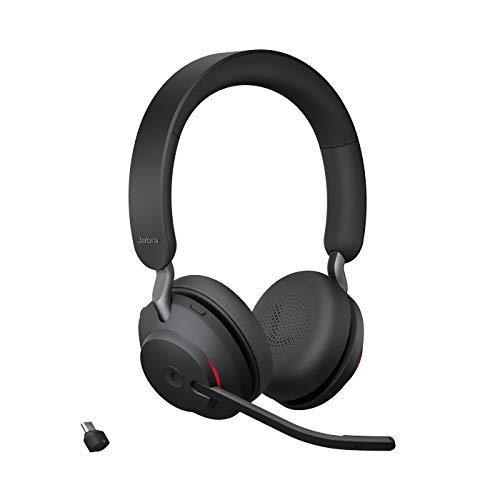
Jabra Evolve2 65 (dual-ear, USB-C) — The office standard, both ears
The second Jabra, labelled as carefully as the first: this is the dual-ear variant of the Evolve2 65, supplied with a USB-C adapter, carrying the same up-to-37-hours battery claim, with noise-cancelling named in its title and Microsoft Teams again in the platform line. Everything the mono variant leaves open, this one closes. Two ears mean stereo music in full, a room shut further out during focus work, and calls that occupy the whole head rather than sharing it with the office. It is the same professional line wearing its other face, and the pair of them together frame this category’s central choice better than any essay could.
The USB-C adapter modernises the connection story for current laptop fleets, keeping the dedicated-path advantage of pick one while matching the ports machines actually ship with now. The noise-cancelling phrase in this title attaches to the headset’s own positioning for calls and music — read it as the listing’s claim, as throughout — and in context it speaks to concentration: a dual-ear headset that helps a worker stay inside a call or an album while an open-plan room does its worst. Music is where this variant separates itself most from its sibling: the evening shift becomes real listening, and the headset can plausibly be the only one a desk worker owns.
Choose between the Jabras by the room, not by the spec sheet. A worker whose attention must stay split — supervising, caregiving, collaborating in person between calls — belongs in the mono. A worker whose day is deep-focus calls and music in a distracting space belongs here. The 37-hour claim, the Teams naming and the adapter philosophy are shared; the ears are the decision, and this guide has labelled the variants at every appearance so the decision is never made by accident.
Fleet buyers face the variant question at scale, and the dual-ear model’s case there is standardisation of experience: every worker hears calls and music the same way, support handles one behaviour, and the USB-C adapter matches the laptop refresh cycle most fleets are already living through. The mono sibling standardises the opposite virtue. A thoughtful fleet sometimes issues both — mono for floor roles, dual for desk roles — and the shared line, shared battery claim and shared platform naming across the two variants make that mixed fleet easier to support than two unrelated products would be. The variants are a system, and this guide’s insistence on labelling them is what lets a buyer use them as one.
- Configuration: dual-ear variant of the Evolve2 65 line, as titled
- Adapter: USB-C, as titled
- Battery claim: up to 37 hours, the listing’s own figure
- Positioning: noise-cancelling, as titled; works with Microsoft Teams
- Colour: black, as titled
- Open-ear awareness: not available in a dual-ear configuration — see the mono variant above
Strengths
- Stereo music and fuller focus make it a plausible only-headset for a desk worker.
- USB-C adapter matches current laptop fleets while keeping the dedicated path.
- The same professional line and Teams naming as its mono sibling.
Trade-offs
- Two covered ears shut out the room the mono variant keeps audible.
- The 37-hour claim trails the road family’s marathon figures by design.
- Adapter type differs from its sibling’s, so fleets must track which is which.
Best for: a desk-based professional in a distracting space whose music shift deserves stereo and whose calls deserve focus. Not suited for: a caregiver or supervisor who must hear the room between calls, because both earcups covered is precisely the wrong configuration for that vigilance.
How Do the Six Compare Side by Side?
| Pick | Ears | Computer route as titled | Battery claim |
|---|---|---|---|
| Jabra Evolve2 65 (mono, USB-A) | Single | USB-A adapter | Up to 37 hours |
| TECKNET Bluetooth Trucker Headset | Single and dual | Bluetooth (adapter unstated) | 50 hours |
| Bluetooth Headset V6.1 (100H) | Single | Multipoint Bluetooth | 100 hours playtime |
| Bluetooth Headset 5.3 Earpiece (90H) | Single earpiece | Dual-device Bluetooth | 90 hours |
| Truck Driver Headset with USB Dongle | Single | USB dongle | 45 hours talk time |
| Jabra Evolve2 65 (dual-ear, USB-C) | Dual | USB-C adapter | Up to 37 hours |
Read the battery column with the units in view: four claims are general hours, one is playtime, one is talk time, and all six are their listings’ own figures. The pattern beneath the numbers is a category serving two professions at once — the desk and the road — a split the guide sections below take up directly. Readers in genuinely loud workplaces may also want the neighbouring survey of the best bluetooth headsets for noisy office, where the room is the enemy in a different way.
Mono or Dual-Ear: How Do You Actually Decide?
Decide by what your free ear is for. The question sounds folksy and is in fact the most technical one in this guide, because every other specification — battery, codec, adapter, microphone array — serves whichever answer you give, and a headset bought against the wrong answer will feel wrong in a way no firmware update can repair. Answer it before the shortlist, not after the unboxing. In the mono philosophy, the uncovered ear is a safety and social instrument: it hears traffic, colleagues, children, announcements, the door. Professions built on interrupted attention — driving, supervising, caregiving, retail, any job where the world taps your shoulder — live naturally in mono, which is why four of this guide’s six picks are single-ear designs and why the mono Jabra is an office standard rather than a budget concession. In the dual-ear philosophy, the covered second ear is a concentration instrument: music gains its stereo body, calls gain separation from the room, and focus deepens. Knowledge workers in loud shared spaces, and serious music listeners on their second shift, belong there.
The TECKNET exists because some weeks refuse the question, alternating road days with desk days. Treat it as the honest third answer rather than a hedge. Whichever philosophy you choose, choose it deliberately: the commonest dissatisfaction in this category is a mono buyer mourning stereo in the evening and a dual-ear buyer missing every doorbell, both predictable from the configuration line of the title alone. The wider family of single-ear designs is surveyed in the guide to the best mono bluetooth headsets for readers who land on that side of the line.
How Should You Set Up Multipoint and Adapters on Day One?
Pair in the order of importance. Connect the phone first — it is the device that must never miss a call — then the computer route, whether that is the adapter, the dongle or a second Bluetooth pairing. Test the handover deliberately: start music on the computer, place a call to your own phone, and watch which device wins and how the headset announces it. That two-minute rehearsal, done on day one, prevents the month of small confusions that otherwise teaches the same lessons rudely. While you are in the settings, find the headset’s own voice prompts and volume behaviour and set them once, deliberately — the announcements that will interrupt your calls for years are chosen in this sitting, and a wearer who configures them owns a calmer device than the wearer who inherits the defaults and argues with them daily. Name the headset clearly in each device’s Bluetooth list if the platform allows it, particularly where two Jabra variants or several household headsets coexist.
Then set the mute habit before the first real call. Find the button by touch, practise it during a podcast, and learn the headset’s mute tone so your ears, not your eyes, confirm your state. Drivers should do this parked; desk workers should do it before the meeting that matters. Finally, place the charger where the headset’s day ends — cab, desk or hallway — because a 90-hour claim only stays theoretical if the charging spot is somewhere the headset never actually rests.
How Does Voice Quality Actually Get Judged on a Call?
Not by you — by the person at the other end, who cannot see your headset and does not care about its price. They judge three things: whether your voice sounds like you, whether the room behind you intrudes, and whether the call survives your movement between rooms, vehicles and desks. Every microphone phrase in this guide’s titles — noise-cancelling, dual noise-cancelling, AI noise-cancelling — is a manufacturer’s promise aimed at the second of those judgements, and the honest way to test any of them is the two-minute ritual this guide recommends for every pick: call a patient friend from the noisiest corner of your real life, ask what they hear, then walk to the quiet corner and ask again. The difference between those two answers is the only noise-cancelling measurement that will ever matter to your career. Repeat the ritual once more from the place you actually take most calls — the desk, the cab, the kitchen — because microphone systems behave differently against a wall of engine noise than against a wall of household quiet, and the corner that flatters the headset in a test may not be the corner your career is conducted from.
Movement is the third judgement and the Bluetooth part of the brief. A headset that crackles at the far end of the house, or drops the computer when the phone rings, fails the working day regardless of its microphone. Adapters and dongles exist to make the computer leg of that journey boring, and multipoint exists to make the phone handover boring, and boring — in call equipment — is the highest praise available. Judge the six above by how little drama their titles promise around your actual rooms, and the ranking for your life will assemble itself.
What Should the First Week With a Call Headset Include?
Deliberate introductions. Introduce the headset to each device separately, in the order described in the setup section, and resist pairing it to everything you own on day one — each additional pairing is a future moment of confusion about which device currently owns your ears. Introduce it to your noisiest hour on purpose, with the friend-call test, rather than discovering its limits during the interview call. Introduce the mute button to your fingers until the gesture is beneath thought. And introduce a charging place, fixed and boring, where the headset sleeps; the marathon batteries in this category forgive forgetfulness, but the habit is what turns a 37-hour headset into a never-dead one.
By the week’s end, keep a one-line verdict per shift — calls, music, comfort — written anywhere you will find it at replacement time. Add a fourth line for the computer connection, because that is the verdict owners most often forget they reached: whether the adapter lived permanently in the laptop, whether the dongle travelled faithfully, whether multipoint behaved when both devices rang at once. Those small operational truths, recorded once, are worth more at replacement time than any review written by a stranger — including, this guide cheerfully admits, the one you are reading. Your own logbook knows your rooms, your machines and your ears, and no title on any listing can speak for those. Headsets in this category are replaced on a cycle of years, and the buyer who documented what actually mattered buys the successor in ten confident minutes instead of repeating the whole research project. The six titles on this page will have successors by then; the discipline of judging them will not have changed.
How Do the Two Professions — Desk and Road — Bend the Same Technology?
The desk bends Bluetooth toward integration. Its ideal headset disappears into the computer’s audio settings, answers to the conferencing platform’s own buttons, and presents the wearer as a calm voice in a quiet room regardless of the actual room. Adapters, platform naming and dual-ear focus all serve that disappearance. The road bends the same technology toward survival: batteries measured in weeks, buttons findable with gloves or without glances, microphones asked to defeat an engine and a motorway simultaneously, and one ear always left open to the world the driver is moving through. The six picks divide along that bend almost perfectly — Jabra’s two variants at the desk pole, the earpieces and the dongle model at the road pole, the TECKNET straddling the fence with its two configurations.
Most real lives sit somewhere on the slope between the poles, which is why this guide refuses to crown a single winner and instead keeps asking the locating questions: where do your calls happen, what must your free ear hear, which machine misbehaves with Bluetooth, how many hours stand between your charging opportunities? A reader who can answer those four questions owns this category. Write the answers down, literally, before opening any listing — four short lines that will out-argue every marketing phrase in the category, including several quoted with admiration on this very page. Paper, in this one transaction, is the senior partner. Keep the note with the receipt, and the replacement purchase — years from now, against successors none of us has seen — starts from evidence instead of nostalgia. That is the whole method of this guide in miniature: claims attributed, variants labelled, and the reader’s own recorded experience promoted above every headline number, this page’s included. Apply it once, carefully, and this category will never confuse you again — not even its twins. The method travels well beyond headsets, into every category where a title’s boldest number is doing the selling. Keep it, and the next buying decision starts halfway solved already, whatever shelf it happens to live on. That, more than any single headset, is what this page hopes to leave behind. Everything above it was evidence; this sentence is the verdict on the evidence. The titles above then become a checklist rather than a mystery, and the purchase — whichever of the six it lands on — will feel less like a gamble and more like a form filled in correctly.
Should I buy the same headset my company issues?
Often, yes, and the Jabra variants show why: identical hardware at work and at home means one set of habits, one charger pattern, one behaviour in every meeting. Where the issued model is the mono and your evenings mourn stereo, the dual-ear sibling keeps the family habits while changing the ears — the gentlest possible upgrade path. Check only the adapter type against your own laptop before mirroring the fleet’s choice, since the two variants deliberately ship with different USB generations.
What Are the Common Mistakes When Buying for Calls and Music?
The first is confusing the two Jabra variants — ordering the mono and mourning stereo, or the dual-ear and missing the room — which is why this guide labels them at every single appearance. The second is reading a microphone’s noise-cancelling claim as if it silenced the room for the wearer; every cancelling phrase in these titles works on your outgoing voice, not on your listening. Third comes buying the biggest battery number for a desk life that charges nightly anyway, paying for weeks of capacity to serve a commute of minutes. Fourth is forgetting the computer: a phone pairs with anything, while the work laptop is where adapters and dongles earn their existence, and shoppers who skip that check meet it again as a return. The fifth is judging the music shift by the call shift’s standards — mono companionship listening is a feature for the right life, not a defect to apologise for. A sixth mistake hides in the pairing menu: connecting the headset to every device in the house on day one, then spending a month wondering why the tablet in another room keeps claiming the audio mid-call. Pair deliberately, in the order of your real priorities, and let the headset’s allegiance be a decision you made rather than a lottery it runs.
Final Recommendation
Let your room decide between the Jabras, let your laptop decide about dongles, and let your week decide about batteries. The mono Evolve2 65 remains the professional default for open-ear office life, its dual-ear sibling the default for focus and stereo, and choosing between them is choosing a philosophy, not a quality level. The TECKNET serves the genuinely split week with its two configurations and EQ modes; the two marathon earpieces serve the road, one with a display, one with a codec claim; and the dongle headset serves every computer that refuses to make friends with Bluetooth. A final practical word on ordering: where a pick exists in variants — and this page’s most famous name exists in two — read the variant words in the listing title itself, mono or dual, USB-A or USB-C, before the order button, because returning the wrong twin is the most preventable errand in the category. Then run the friend-call test in your noisiest corner during the first week, while the returns window is wide, and let a real voice in a real room cast the deciding vote on every microphone claim this guide has carefully attributed rather than endorsed. None of the six is the category’s single answer, because the category itself has two workplaces — but every answer a reader of this keyword could reasonably be looking for is on this page, labelled, attributed, and matched carefully, deliberately and honestly to the particular shape of the working life it fits best.
Frequently Asked Questions
What is the difference between the two Jabra Evolve2 65 picks?
Configuration and adapter. Pick one is the mono, single-ear variant with a USB-A adapter; pick six is the dual-ear variant with a USB-C adapter. Both claim up to 37 hours and name Microsoft Teams. Choose mono to keep one ear on the room, dual-ear for stereo music and deeper focus — and check the variant name on the listing before ordering, since the two are easy to confuse.
Are the battery figures — 37, 50, 90, 100 hours — believable?
They are the listings’ own claims, printed here with that attribution, and best read comparatively: a 100-hour claim will outlast a 37-hour claim in the same hands even if both are optimistic. Note the units differ too — the dongle headset quotes talk time, the V6.1 quotes playtime — and talk hours are the harder currency.
Does noise-cancelling on these headsets quiet my surroundings for me?
No. In every title here, the cancelling phrases describe the microphone’s treatment of your outgoing voice — reducing what callers hear of your room. None of the six claims active noise cancelling for the wearer’s own listening, and the single-ear designs deliberately keep the room audible.
Why would I choose a headset with a USB dongle or adapter?
Because computers are the unreliable half of Bluetooth. An adapter or dongle gives the headset a dedicated path that bypasses the laptop’s own Bluetooth stack, its drivers and its policies — the difference between a headset that pairs in seconds every morning and one that negotiates. The Jabra pair and the truck driver headset build their computer stories on exactly that idea.
Can a single-ear headset really be a music device?
As companionship, yes — a playlist in one ear at conversational level while the world stays audible is how drivers, parents and supervisors actually listen for much of the day. As a stereo listening session, no, and no mono title here pretends otherwise. The dual-ear Jabra and the TECKNET’s dual configuration exist for readers whose music shift deserves both channels.
Related Guides
Callers whose day is wall-to-wall meetings can continue to the best headsets for teams and zoom, and those whose calls happen over an engine will find the road’s own shelf surveyed in the guide to the best driving headsets.


