What's inside
- Key Takeaways
- Quick Picks
- How Did We Choose These Picks?
- What Actually Makes a Gaming Headset Sound Good?
- How Can You Get the Best Sound From the Headset You Choose?
- What Mistakes Ruin Good Headset Sound?
- Why Does Tuning Matter More Than Driver Size or Price?
- How Should You Test a Headset in the First Week?
- Which Sound Signature Suits the Games You Play?
- What Should You Know About Comfort, Build and Living With These Headsets?
- How Do Wired and Wireless Headsets Compare on Pure Sound?
- What About Microphone Quality as Part of Sound Quality?
- A Short Word on EQ, For Players Who Will Use It Anyway
- Final Recommendation
- Frequently Asked Questions
- Related Guides
As an Amazon Associate I earn from qualifying purchases. This post may contain affiliate links at no extra cost to you.
gizmoverdict.com is reader-supported. When you buy through links on our site, we may earn an affiliate commission.
Where to buy: All six headsets below link to listings verified in this site’s product pool, and each one earned its place on sound first and features second. Where a headset leans on virtual surround, the text says so plainly, because software widening is a taste, not a measurement.
Shoppers hunting for the best audio quality gaming headsets usually start in the wrong place: the feature list. Lights, chat-mix dials and app suites are easy to count, so they get counted, while the thing you actually live with for four hours a night — how a footstep separates from rain, how a voice sits in front of an explosion, how the bass behaves when a soundtrack swells — gets reduced to a driver diameter on a box. This guide reverses that order. Every pick here was chosen because its tuning, its driver design or its acoustic shape does something audible that a spec sheet cannot fake.
One honesty note before the picks. Three headsets in this guide advertise 7.1 surround, and in every case that surround is virtual: a stereo signal processed by software — DTS, Dolby or a vendor engine — into something that feels wider than plain stereo. Virtual surround can be enjoyable, and it can help some players read direction in some games, but it is not seven speakers and a subwoofer folded into two earcups. Where it appears below, it is described as processing you can switch off, never as hardware. The headsets that top this list mostly win on plain, unprocessed stereo done exceptionally well.
The field splits into three philosophies. Planar magnetic drivers, in the Audeze Maxwell 2, move air with a large, flat diaphragm that responds almost instantly, which is why transients — the crack of a rifle, the tick of a reload — sound carved rather than smeared. Carefully tuned dynamic drivers, in the beyerdynamic MMX 300 Pro and the Logitech G Pro X 2, trade a little of that speed for warmth, familiarity and easier driving. And the value end, led by the HyperX Cloud III, proves that a well-behaved 53mm dynamic driver with honest tuning beats a mediocre driver wearing a surround badge. Read the picks with your own games in mind: competitive shooters reward separation and restraint in the bass, while story games reward scale, texture and comfort over long sessions.
Key Takeaways
- Sound quality in a gaming headset is mostly tuning discipline: controlled bass, present mids and treble that informs without stabbing.
- The Audeze Maxwell 2’s planar magnetic drivers give it the clearest separation and fastest transients in this field.
- Every 7.1 claim in this guide is virtual surround — software processing on a stereo signal, useful to some ears, never hardware.
- The beyerdynamic MMX 300 Pro is the wired purist’s pick, with a condenser microphone that embarrasses most gaming booms.
- The HyperX Cloud III shows how far a sensibly tuned wired headset goes when the money is spent on drivers and pads instead of lights.
Quick Picks
| Pick | Badge | Why it is here |
|---|---|---|
| Audeze Maxwell 2 | Best sound overall | Planar magnetic drivers deliver separation and speed nothing else in this list quite matches. |
| beyerdynamic MMX 300 Pro | Best wired purist pick | Closed-back studio discipline with a broadcast-grade condenser microphone. |
| Logitech G Pro X 2 Lightspeed | Best wireless all-rounder | Graphene drivers, long battery life and three ways to connect without giving up clarity. |
| HyperX Cloud III | Best value wired | A clean, unfatiguing tune and a clear 10mm microphone at a sane rung of the ladder. |
| Razer BlackShark V2 Pro | Best for competitive play | FPS-tuned profiles and a 70-hour battery built around hearing the next move first. |
| SteelSeries Arctis Nova 7 Gen 2 | Best multi-device pick | Mixes 2.4GHz and Bluetooth at once, so game audio and a phone call can share your ears. |
How Did We Choose These Picks?
We weighted the listening first. A headset could only lead this guide if its stock tuning — no EQ rescue, no surround processing — kept dialogue intelligible inside a busy mix, placed directional cues where the game put them, and held together when a soundtrack and an explosion arrived in the same second. Headsets that needed their app open and three sliders moved before they sounded right were marked down, because most owners never open the app twice.
After tuning came the physical side of sound: driver type and size, how the earcups seal, and how the pads shape the bass over a long session. Then the microphone, judged as part of audio quality rather than an accessory — a headset that sounds wonderful but makes you sound like a radio dispatch from 1974 fails half its job. Wireless picks were checked for codec behaviour and battery claims we could state plainly, and every surround claim was traced back to whether it was processing or hardware. It was processing every single time.
What Actually Makes a Gaming Headset Sound Good?
Start with the frequency balance, because it decides almost everything you will feel. Bass that is boosted for trailer impact bleeds upward and fogs the midrange, and the midrange is where footsteps, reloads, callouts and dialogue live. The best-tuned gaming headsets keep the low end firm but fenced, so an explosion has weight without sitting on top of the teammate telling you where it came from. Treble is the other trap: a sharp peak makes detail feel exciting for ten minutes and exhausting for three hours, and it exaggerates sibilance in voice chat until every “s” arrives like a hiss of static.
Separation is the second quality, and it is the one demos never show. In a crowded scene — rain, an engine, two voices, distant gunfire — a good headset keeps each layer in its own space so your brain can attend to the one that matters. Planar drivers excel here because the diaphragm moves as one surface, and well-designed dynamic drivers approach it with stiff, light cones and careful damping. Soundstage, the sense of width and distance, matters most in open-world and story games; imaging, the precise left-right placement of a single sound, matters most in competitive ones. Closed-back designs like the MMX 300 Pro image tightly and isolate you from the room, while the Maxwell 2 manages an unusually open feel for a closed planar design.
Finally, remember that your chain matters. A wired headset fed by a noisy motherboard output will hiss and thin out no matter how good its drivers are, which is why several picks here carry their own USB path or DAC. Wireless headsets sidestep the motherboard entirely, substituting their own conversion — one more reason the better wireless models here sound consistent from a PC to a console to a laptop without changing character.

Audeze Maxwell 2 — Best sound overall
The Maxwell 2 is what happens when a company known for audiophile headphones builds a gaming headset and refuses to compromise the driver to do it. Its planar magnetic drivers use a broad, thin diaphragm driven across its whole surface, and you hear the difference in the first minute of a busy scene: the crack of a distant shot stays a crack instead of blurring into the rumble underneath it, and a whispered line of dialogue in a quiet corridor keeps its texture instead of turning to breath and guesswork. In competitive play that speed shows up as confidence — you react to the sound that happened, not to an averaged smear of three sounds that happened near each other.
Tonally it is the most even-handed headset in this guide. The bass reaches low and stays textured, so a sub-bass swell in a horror game feels like pressure rather than a one-note thud, and the midrange is plain-spoken in the best way: voices sound like voices, with chest and consonants in the right proportions. The treble informs without needling. Long sessions are helped by the roughly 80-hour battery claim, which in practice means charging becomes a monthly chore rather than a nightly one, and the closed-back shell keeps a household’s noise out of your game and your game’s noise out of the household. It is a heavy headset by gaming standards, and the weight distribution does most of the work of making that acceptable — but smaller heads should try before committing.
- Planar magnetic drivers, far larger than typical dynamic cones
- Wireless low-latency connection plus Bluetooth, with wired options
- Battery life rated around 80 hours per charge
- Detachable boom microphone plus onboard controls
- Closed-back design in a dark gray finish
The comfort question deserves its own paragraph because planar weight is the Maxwell 2’s one honest compromise. The headband spreads the load well and the earcups are roomy enough that ears sit inside rather than under pressure, so the first hour feels luxurious. By the third hour of a strategy session, though, you know you are wearing something substantial, and players who nod along to cutscenes will feel it in the neck before players who sit still do. Treat it like a good pair of boots: right for the long march, more than you need for a trip to the corner. The sound, notably, does not change as the pads warm and settle, which is more than can be said for softer-tuned rivals whose bass blooms as the seal softens.
Strengths
- Planar speed is audible: transients start and stop with unusual cleanliness
- Even, unhyped tuning that flatters dialogue and soundtrack alike
- Battery endurance that removes charging from your weekly routine
Trade-offs
- Heavier than every rival here, and some wearers will feel it by hour three
- The price of admission sits at the top of this guide
- Boom microphone is good rather than class-leading next to the beyerdynamic
Best for: players who want one headset that treats game audio with the seriousness of a music headphone, and who play long sessions where separation and stamina both matter.
Not suited for: shoppers who prioritise featherweight comfort, or anyone whose budget needs to cover the headset and the games this year.

beyerdynamic MMX 300 Pro — Best wired purist pick
beyerdynamic has been building studio headphones longer than the gaming headset category has existed, and the MMX 300 Pro feels like the studio walking into the games room without changing its shoes. The closed-back tuning is disciplined to a degree that initially reads as restraint: the bass does not grandstand, the treble does not sparkle for effect. Give it twenty minutes and the discipline becomes the point. In a tactical shooter, the quiet sounds — a door latch, gravel under a boot, the metallic tick before a grenade lands — arrive at their true size instead of being drowned by an engine the game mixed at half their volume. In a story game, the score sits behind the dialogue exactly where the mixer put it.
The microphone is the other half of this pick’s argument, and it is not close. The condenser boom captures a fuller, more natural voice than the small electret capsules in most gaming headsets, so teammates hear your actual tone — useful when a callout needs to sound calm, or urgent, and the difference matters. Being wired and unpowered, the MMX 300 Pro has no battery to age, no firmware to argue with and no wireless mode to drop mid-match; its sound is the sound of whatever you plug it into, which rewards a decent source and exposes a poor one. The isolation from the closed shell suits shared rooms, late nights and anyone whose gaming space doubles as a home office during the day.
- Closed-back wired design for PC, PlayStation and Switch
- Studio-style dynamic drivers tuned for clarity
- Condenser boom microphone of broadcast character
- Plush replaceable earpads and a firmly built frame
- No battery, no app dependency, no wireless modes
One practical note for owners of several machines: because the MMX 300 Pro asks for nothing but a jack, it becomes the household’s reference headset almost by accident. Plug it into a PC and it is a gaming instrument; plug it into a laptop for a work call and the condenser microphone makes you the clearest voice in the meeting; plug it into a controller at midnight and the closed backs keep the peace. There is no battery anxiety in any of those moments and no app demanding an update at the worst one. That dependability is a sound-quality feature in disguise — the headset always sounds exactly like itself, because nothing about its signal path ever changes.
Strengths
- Studio-honest tuning that keeps quiet cues at their true size
- The finest microphone in this guide, full stop
- Closed-back isolation that works in both directions
Trade-offs
- Wired only, in a guide where most rivals roam free
- Needs a reasonably clean source to show its best
- The restrained bass will disappoint players who want impact exaggerated
Best for: wired players who talk as much as they listen — shot-callers, streamers and anyone whose voice is part of their game.
Not suited for: wireless devotees, bass maximalists, and players who game from a couch far from any jack.

Logitech G Pro X 2 Lightspeed — Best wireless all-rounder
Logitech’s second-generation Pro X makes its case with a material: graphene. The 50mm drivers use a graphene diaphragm that is unusually stiff and light, and the audible result is control — bass notes stop when they should, so a rapid sequence of explosions reads as separate events, and the low end stops trailing into the footsteps you are trying to track. The tuning is cleaner and less theatrical than earlier gaming generations from the brand, which suits this guide’s purpose exactly: it is a headset that sounds right with the processing switched off, and treats its DTS Headphone:X 2.0 as an option rather than a crutch. That surround, to be explicit, is virtual — software processing over a stereo signal. Some players like the widened effect in single-player games; competitive players will mostly leave it off, and the headset is honest enough to sound better that way.
As a daily driver it is hard to fault the logistics. Lightspeed wireless for the PC or console, Bluetooth for a phone, a 3.5mm cable for everything else, and battery life that stretches across days of play rather than hours. The detachable boom keeps your voice clear in chat, and the whole package travels between a desk setup and a living-room console without adapters or drama. If the Maxwell 2 is the connoisseur’s wireless pick, the Pro X 2 is the professional’s: slightly less exotic in the driver, easier to live with in every other respect, and priced like it knows the difference.
- 50mm graphene drivers for a stiff, light diaphragm
- Lightspeed wireless, Bluetooth and 3.5mm wired modes
- DTS Headphone:X 2.0 virtual surround, switchable
- Detachable boom microphone
- Battery life suited to multi-day play between charges
Battery behaviour shapes sound more than owners expect, and the Pro X 2 handles it gracefully: the tuning does not shift audibly as the charge runs down, and the low-battery warning arrives with enough margin to finish a session rather than punctuating a final boss. The graphene drivers also make it the most forgiving pick here for mixed content. A film between matches keeps its dialogue warmth, a music break keeps its shape, and the headset never sounds like it is wearing a gaming costume it wants to take off. For players whose headset is also their desk’s only headphone, that versatility is worth real money.
Strengths
- Graphene drivers give bass unusual discipline for a gaming headset
- Three connection modes cover desk, couch and travel in one product
- Sounds correct with surround processing switched off
Trade-offs
- Virtual surround adds little for competitive play and is best left off
- Microphone is clear but not the equal of the beyerdynamic condenser
- The fit runs snug; large heads should check comfort carefully
Best for: players who want one wireless headset for PC, console and phone, and who value clean tuning over theatrical effects.
Not suited for: purists who want planar drivers, or wired players who refuse to manage a battery at any price.
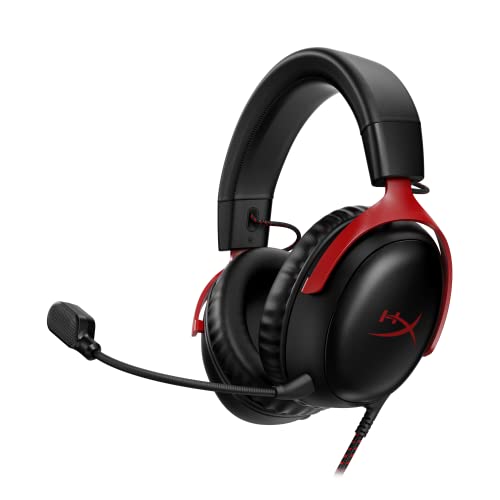
HyperX Cloud III — Best value wired
The Cloud III is the pick that makes the rest of this guide justify itself. HyperX spent the money where ears can tell: 53mm drivers with a tune that keeps the bass present but leashed, a midrange that puts voices in front of the mix, and treble that declines to punish you for a long session. In practice it is the least fatiguing wired headset here — the one you can wear through a full evening of mixed play, music and a call without the creeping sense that the headset is the loudest personality in the room. Its soundstage is modest rather than vast, which is the honest trade at this level, but imaging inside that stage is tidy: left, centre and right stay where the game puts them.
The connectivity story is quietly excellent. A USB-C lead, a USB-A adapter and a plain 3.5mm connection mean it plugs into a PC, a PlayStation controller, an Xbox controller, a Switch and a phone without a single extra purchase, and it sounds like itself on all of them because the tuning lives in the drivers, not in software. The detachable 10mm microphone is clear and natural enough that teammates will never comment on it — the highest praise a gaming mic usually earns — and the LED on its tip ends the eternal am-I-muted question at a glance. Nothing about the Cloud III chases a headline. It simply refuses to do anything badly, at a rung of the ladder where most rivals do at least one thing badly.
- 53mm drivers tuned for clarity across games, music and calls
- USB-C, USB-A and 3.5mm connectivity in the box
- Detachable 10mm microphone with an LED mute indicator
- Memory foam earcups and an aluminium-reinforced frame
- No battery and no required software
What elevates the Cloud III above the budget crowd is that its compromises are chosen rather than suffered. The soundstage is modest because the cups are compact, and the compactness is why it travels in a backpack without complaint and sits happily on a smaller head. The feature list is short because the budget went to drivers, pads and a frame that flexes instead of creaking. Even the microphone’s detachable design is a sound decision: unplug it and the headset becomes an anonymous pair of headphones for a train or a library, with no boom announcing that your other life involves ranked queues. It is a product designed by people who understood the assignment at this price.
Strengths
- Balanced, low-fatigue tuning that suits every genre
- Connects to essentially everything without extra purchases
- Clear detachable microphone with a visible mute indicator
Trade-offs
- Soundstage is cosier than the premium picks here
- No wireless freedom at any price in this model
- No surround processing of its own — stereo is the whole story
Best for: players who want genuinely good sound on a wired budget, and anyone buying a first serious headset they will not outgrow in a year.
Not suited for: players who need wireless, or who want the widest, most cinematic presentation for single-player epics.

Razer BlackShark V2 Pro — Best for competitive play
The BlackShark V2 Pro was built by people who watch esports for a living, and its priorities show in the first firefight. The tuning leans toward information: footsteps, weapon swaps and ability cues sit slightly forward, the bass is kept on a short lead so it cannot mask them, and the pro-tuned FPS profiles adjust that balance per game without turning the sound into a caricature. In plain stereo it is already a sharp competitive tool; the profiles are seasoning, not the meal. For battle royale and tactical shooter players, that forward, tidy presentation translates directly into earlier, more confident reads on where the next fight is coming from.
The endurance is the other headline: around 70 hours of battery means the headset effectively disappears from your charging routine, and the wireless link holds its nerve in the crowded RF environment of a desk full of dongles. The detachable microphone deserves its reputation — it rejects a good deal of room noise and keeps your voice present without the thin, telephonic quality that plagues lesser booms. Against the Maxwell 2 it loses on sheer resolution and musicality; against everything else here it wins on competitive focus per hour of battery. It is a specialist, and it knows it — players whose libraries are mostly cinematic single-player adventures will find its presentation a touch analytical, while ranked grinders will find it reads their mind.
- Wireless connection with Bluetooth 5.2 for a second device
- Battery life rated around 70 hours
- 50mm drivers with pro-tuned FPS profiles
- Detachable boom microphone tuned for voice clarity
- Memory foam earcups in a noise-isolating closed design
The BlackShark’s party trick in long tournaments is that it disappears. The clamp is calibrated to stay put through animated moments without the vice-grip that gives some players a headache by game three, and the memory foam keeps its seal when the room warms up. Its FPS profiles reward experimentation: spend a week on the profile tuned for your main title, then switch back to flat for an evening, and you will learn more about what competitive tuning actually does than any review can teach you. Most players keep the profile. The few who revert lose nothing, because the underlying headset was never relying on it.
Strengths
- Competitive tuning surfaces footsteps and cues early and clearly
- Around 70 hours of battery makes charging a rare event
- Strong detachable microphone that handles noisy rooms well
Trade-offs
- Presentation leans analytical for cinematic, score-heavy games
- No wired audiophile pretensions — it is a tool, tuned like one
- Isolation is good rather than total in loud households
Best for: ranked and tournament-minded players who want information first, atmosphere second, and a battery that keeps up with both.
Not suited for: story-first players chasing the richest, most musical presentation, who should look at the Maxwell 2 instead.
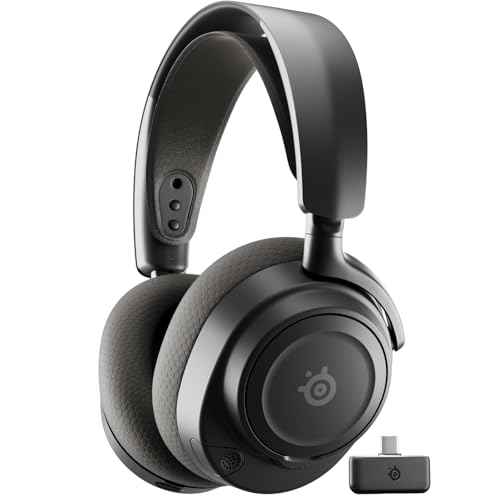
SteelSeries Arctis Nova 7 Gen 2 — Best multi-device pick
The Nova 7 Gen 2 solves a problem the other picks pretend does not exist: modern players live on two devices at once. Its 2.4GHz link carries the game while Bluetooth carries the phone, mixed simultaneously, so a call, a doorbell app or a podcast can share your ears without a cable swap or a settings dive. That alone would earn it a place in many homes, but the sound holds up its end — the neodymium drivers deliver a clear, contemporary tuning with enough low-end warmth for open-world wandering and enough midrange presence for competitive callouts, and the app’s real-time control lets you adjust the balance from the phone in your hand rather than a PC window buried under the game.
Battery life beyond 50 hours keeps the two-device lifestyle from becoming a two-cable lifestyle, and the headset moves between PC, PlayStation, Switch and mobile with the easy manners of a product designed by people who actually own all four. Set against the Maxwell 2, it gives ground on resolution and driver exoticism; set against the Pro X 2, it counters with the simultaneous mix that Logitech’s sequential switching cannot copy. For the player whose gaming happens in a living room, on a shared TV, with a phone that will not stop buzzing, this is the headset that fits the life first and the spec sheet second — while still sounding like it belongs in a guide with this title.
- Simultaneous 2.4GHz wireless and Bluetooth mixing
- Battery life rated beyond 50 hours
- Neodymium drivers with a clear, modern tune
- Real-time control through the companion app
- Works across PC, PlayStation, Switch and mobile
There is a subtle sound benefit to the Nova 7’s mixing that rarely gets mentioned: because the phone is already in your ears, you stop pausing the game and lifting a cup to check it, and your sense of the game’s acoustic space survives intact. Continuity is an underrated component of immersion. The headset also handles the handover between devices with unusual grace when you do switch fully — a film on the television, a handheld on the sofa — without the re-pairing rituals that make some wireless headsets feel like part-time jobs. It is the pick for the player whose technology serves a household rather than a battlestation.
Strengths
- Mixes game audio and Bluetooth at the same time, genuinely usefully
- Clear modern tuning that serves shooters and story games alike
- Long battery and broad platform manners
Trade-offs
- App-based control is one more piece of software to keep around
- Ultimate resolution sits below the planar and studio picks
- The simultaneous mix can tempt you into divided attention mid-match
Best for: players who split attention between a game and a phone, and households where one headset serves several machines.
Not suited for: single-device purists who would rather spend the same money purely on drivers.
How Can You Get the Best Sound From the Headset You Choose?
Begin by turning things off. Disable any surround processing, spatial enhancer or “game mode” EQ that your platform applies by default, and listen to the headset as its maker tuned it for at least a few sessions. Defaults pile up silently — a console setting here, a PC enhancement there — until you are hearing three processors argue with each other. Once you know the honest baseline, add back only what fixes a problem you can actually name: a small cut to a boomy low end, a gentle lift where dialogue hides. Small moves, one at a time, with a day of play between them.
Mind the fit, because fit is frequency response. Earcups that seal unevenly leak bass and shift the whole balance, so take ten seconds to seat the headset the same way every time, centred over the ears with the headband sharing the weight. Glasses wearers should check that the arms are not breaking the seal on one side. Then set volume by the quiet sounds, not the loud ones: if you can hear a soft footstep clearly, the explosions will take care of themselves, and your hearing will thank you across a long session. Finally, give a wired headset a clean source — a USB connection or the headset’s own DAC path will usually beat a front-panel jack that shares its wiring with a case fan’s worth of electrical noise.
What Mistakes Ruin Good Headset Sound?
The commonest mistake is buying the surround badge instead of the headset. Virtual surround is software, available to almost any stereo headset through a platform setting or an app, so paying a premium for it as though it were hardware buys you a toggle, not a transducer. The second mistake is judging by a ninety-second demo in a loud shop or a hype trailer soundtrack; bass that thrills in ninety seconds fatigues in ninety minutes. Judge on your own games, in your own room, across a full session.
Third, players chase driver size as though diameter were destiny. A disciplined 40mm driver in a well-sealed cup will out-image a sloppy 53mm one every time, and the picks above include both sizes at the top of the order for a reason. Fourth, do not ignore the microphone until your teammates do it for you — in team games your voice is half your equipment. And finally, do not let a headset’s app EQ become a second hobby; if a headset only sounds right after twenty minutes of slider work, the honest conclusion is that it did not sound right.
Why Does Tuning Matter More Than Driver Size or Price?
Because tuning is the decision about what the game should sound like, and every other specification merely executes that decision. Two headsets can share a driver diameter, a similar bill of materials and a similar factory, yet present the same scene completely differently: one pushes the low end until the mix turns to soup, the other keeps the layers apart. The tuning is set by people listening and choosing, which is why the heritage picks in this guide — a studio maker in beyerdynamic, an audiophile maker in Audeze — punch at or above their price. They employ listeners whose taste was trained on recordings where mistakes are permanent, and that discipline transfers.
Price interacts with tuning in a way shoppers rarely expect. The first stretch of spending buys real things: better drivers, better pads, a frame that will not creak through a cutscene. Beyond that, money increasingly buys features — wireless modes, microphones with more processing, apps, lights — which improve life around the sound more than the sound itself. That is why this guide’s order is not its price order. The Cloud III, the cheapest pick here, out-sounds headsets costing far more that spent their budget on spectacle; the Maxwell 2 justifies its summit price not with features but with a driver technology that audibly resolves more of the recording. When you audition, listen for the moment a busy scene stays legible. That moment is the product. Everything else is packaging.
How Should You Test a Headset in the First Week?
Use three scenes you know intimately. First, a quiet scene with a single voice — a tutorial, a campfire conversation — and listen for whether the voice sounds like a person in a space or a voice pasted onto silence. Second, a chaotic scene you have played for dozens of hours, where your memory knows exactly where every sound should be; a better headset will surprise you inside that familiarity, revealing a layer you had never separated before. Third, a long, ordinary session — the real test — after which you should notice your ears, or rather, fail to notice them. Fatigue is data: a headset that impresses in minute five and exhausts in hour two has told you its tuning is a performance, not a companion.
Test the microphone with equal seriousness, because your teammates will. Record yourself in the app your group actually uses, at your actual distance, with the room in its actual state — fan on, window open, household alive. Play it back on laptop speakers, the worst common denominator. If your words survive that chain intelligibly and without harshness, the microphone passes. Then play one match with surround processing on and one with it off, in the same title, and keep whichever setting lets you place sounds more confidently — not whichever sounds bigger. Bigger is a mood; placement is a result.
Which Sound Signature Suits the Games You Play?
Genre is the most honest buying guide, because different games ask opposite things of the same ears. Competitive shooters are information systems disguised as entertainment: the valuable sounds are quiet, brief and directional, and the dangerous sounds — your own weapon, nearby explosions — are loud enough to mask them. A signature with disciplined bass and a present, slightly forward midrange serves these games best, which is why the BlackShark V2 Pro and the MMX 300 Pro read a firefight so clearly. If your season is measured in ranks, weight those two heavily and treat cinematic warmth as a luxury you are deliberately declining.
Open-world and story games invert the priorities. Their soundtracks are mixed like films, with scores that carry emotion and environments that are meant to feel vast; here a wider stage, deeper and more textured bass, and treble that can shimmer without slicing will move you more than forensic cue separation. The Maxwell 2 was built for this brief and it shows in a thunderstorm rolling across a plain, or a string arrangement swelling under a reunion scene. Racing and flight titles sit between the poles: engine notes are bass-and-midrange events that must stay textured rather than boomy, while the cues that win races — a rival’s engine note at your shoulder, a spotter’s voice — need the midrange clarity of the competitive school. The Pro X 2 and Nova 7, the balanced all-rounders, exist precisely for libraries that refuse to pick a genre.
Horror deserves a sentence of its own, because it is the genre where sound quality stops being a preference and becomes the product. A horror game through a muddy headset is merely dark; through a resolving one, the scrape behind the door has a location, a distance and a texture, and your imagination does the rest. If horror anchors your library, separation and low-level detail — the planar Maxwell, the studio beyerdynamic — are not indulgences. They are the game, delivered as designed.
What Should You Know About Comfort, Build and Living With These Headsets?
Sound quality degrades in the real world through a mundane mechanism: discomfort makes you fidget, fidgeting breaks the seal, and a broken seal steals the bass and shifts the balance you paid for. So treat fit as an acoustic specification. Memory foam pads, shared by most picks here, seal well and forgive glasses; firmer pads hold their shape longer across years. Headband design decides where the weight lives — the Maxwell 2’s suspension approach spreads its considerable mass, while the lighter wired picks simply have less to spread. If you share a headset with a partner or a teenager, check that the size range covers both heads, because a headset worn at the end of its adjustment sounds and feels like a compromise.
Build quality is the second slow variable. Aluminium in the Cloud line’s frame, the beyerdynamic’s serviceable construction, and detachable cables and microphones across this guide all point the same way: the parts that fail first — cables, booms, pads — should be the parts you can replace. A headset that sounds superb for eighteen months and then dies at a soldered cable was not, in the end, a high-quality product. Wireless picks add a battery to that calculation; the long-life models here, at fifty to eighty hours per charge, will cycle their batteries far less often across their lives, which quietly extends their useful years. Buy the headset whose tenth year you can picture, and the sound you fell for will still be there to enjoy.
How Do Wired and Wireless Headsets Compare on Pure Sound?
The honest answer is that the gap has narrowed to the point where the question has changed. A decade ago, wireless meant a compressed, lagging approximation of the game, and wired won by default. Modern low-latency links, as used by the Maxwell 2, the Pro X 2, the BlackShark V2 Pro and the Nova 7, carry the game’s audio without audible compression artefacts in ordinary play, and they remove the weakest link in many wired setups — the noisy analogue output of a PC case — from the chain entirely. What wireless still asks in return is management: batteries to charge, firmware to maintain, and a radio link that shares a crowded band with every other device in the home. In a dense apartment building, a wired headset’s indifference to its neighbours remains a genuine, if unglamorous, virtue.
Wired keeps two cards that wireless cannot copy. The first is permanence: the MMX 300 Pro and Cloud III will sound identical in ten years, because nothing in them ages except pads and cables, both replaceable. A wireless headset’s battery is a countdown written into its finest feature, and when it fades, the headset’s character fades with it. The second card is the upgrade path. A wired headset can grow with its owner — a better DAC next year, a quieter source, a different cable — while a wireless headset is a sealed system whose sound is fixed at purchase. Neither card outweighs the freedom of standing up mid-match without removing anything or dragging a cable across a keyboard, which is why this guide refuses to crown a connection type. It crowns headsets. Choose the connection that matches your room, your habits and your patience, then choose the best-tuned headset that uses it — the picks above are arranged so that both roads lead somewhere genuinely good.
One more distinction belongs in this section because marketing works hard to blur it: the difference between a headset that is merely loud in the bass and a headset that is truthful in the bass decides more long-term satisfaction than any other single trait. Truthful bass has pitch — you can tell a large drum from a small one, an engine note rising from one holding steady — and it has edges, a beginning and an end. Boosted bass has only presence. In a trailer, presence wins. In hour three of a campaign, when the score’s low strings are carrying the emotion of a scene and a character is whispering over them, pitch and edges are what let both exist at once. Every pick in this guide was screened on exactly that test, and the ones that failed it are not here, whatever their other virtues or their popularity elsewhere.
What About Microphone Quality as Part of Sound Quality?
A gaming headset is a two-way instrument, and this guide has treated the microphone as half the product throughout, because your teammates experience your headset entirely through it. The differences are not subtle once you listen for them. A good boom, like the condensers on the beyerdynamic picks or the well-tuned detachable unit on the BlackShark, captures the chest resonance and consonant detail that make a voice sound like a specific person; a poor one flattens everyone into the same nasal dispatch-radio voice, stripping out the calm or urgency that team communication runs on. In a long campaign with friends, that difference is the difference between conversation and mere coordination.
Placement and rejection matter as much as the capsule. A boom that sits at a consistent distance from the corner of your mouth keeps your level steady when you turn your head, and a cardioid pattern that favours your voice over the room spares your team your keyboard, your fan and your household. Flip-to-mute and detachable designs, both represented in this guide, are worth more than software noise gates that clip the beginnings of words. If you stream, record or simply spend your evenings in voice chat, weight the microphone sections of the picks as heavily as the driver sections — the beyerdynamic MMX 300 Pro’s place near the top of this guide was earned as much at the microphone as at the earcup.
Finally, a word about listening at sane volumes, because the finest headset in this guide cannot protect you from yourself. Detail tempts players to turn up, chasing the quiet cue by raising the whole mix, until the loud moments are doing slow damage and fatigue is masquerading as immersion. The better path is the one this guide’s tuning philosophy already implies: choose a headset whose balance surfaces quiet sounds at moderate levels — disciplined bass, present mids, honest treble — and then keep the dial where conversation with a teammate needs no shouting. The players who still hear beautifully in ten years are the ones whose headsets never had to be loud to be clear.
A Short Word on EQ, For Players Who Will Use It Anyway
Equalisation is a scalpel that most players wield as a hammer, so here is the restrained method this guide endorses. Work in cuts before boosts: if the bass feels heavy, lower the low shelf a little rather than raising everything else to compete with it, because boosting invites distortion and eats the headroom your loudest scenes need. Move one band at a time, by small amounts, and live with each change for a full session before judging it — ears adapt within minutes and will call almost any change an improvement at first. Keep a written note of your starting point, because the most common EQ outcome is a slow drift into a strange, personal tuning that flatters one game and ruins three others, with no road back. And if you find a setting you love, save it per game rather than globally; a shooter and a symphony of an open-world score are different mixes asking different kindnesses. Used this way, EQ is the final polish on a well-chosen headset. Used as a rescue operation, it is a sign the headset was wrong — and no slider in this guide’s experience has ever rescued one.
One last practical habit separates satisfied owners from serial returners: give a new headset a full week before judging it, playing your ordinary rotation rather than a highlight reel. Ears need time to unlearn the old headset’s habits, pads need time to settle to your head, and the tuning that seemed merely polite on day one often reveals itself, by day seven, as the one you can live inside for years.
Final Recommendation
For the single best-sounding gaming headset in this guide, the Audeze Maxwell 2 stands apart: its planar drivers resolve detail, separate crowded scenes and sustain long sessions in a way no dynamic rival here fully matches. The beyerdynamic MMX 300 Pro is the wired connoisseur’s answer, pairing studio honesty with the finest microphone in the field, while the Logitech G Pro X 2 Lightspeed is the wireless all-rounder most players will be happiest living with. The HyperX Cloud III remains the value benchmark, the BlackShark V2 Pro the competitive specialist, and the Nova 7 Gen 2 the two-device household’s best friend. Choose by the games you actually play and the hours you actually play them — and if you take one idea from this guide, let it be that the quietest sound in the mix, heard clearly at the right moment, is worth more than every badge on the box combined.
Frequently Asked Questions
Is virtual 7.1 surround as good as real surround sound?
No, and the comparison itself is the misunderstanding. Virtual surround is software processing applied to a two-channel signal; it can widen the perceived stage and help some listeners, but it cannot place sound with the physical certainty of separate speakers. Judge any headset first on its plain stereo quality, because that is the foundation the processing decorates.
Do planar magnetic drivers really sound different?
Yes, most noticeably in speed and separation. The diaphragm moves as a single surface, so transients start and stop cleanly and overlapping sounds stay distinct. In the Maxwell 2 that shows up as clearer footsteps inside noise and dialogue that keeps its texture under a score. The trade is usually weight and price, both visible in that pick.
Does a bigger driver mean better sound?
Not by itself. Driver size sets potential, mostly for low-frequency output, while tuning, damping and the earcup seal decide what you actually hear. This guide’s picks range across sizes at every quality level, which is the pattern to trust: buy the tuning, not the diameter.
Should competitive players use surround processing or EQ?
Mostly no. Processing that widens the stage can smear the precise left-right imaging that competitive play depends on, and heavy EQ can bury one cue while flattering another. The BlackShark V2 Pro’s per-game profiles are the exception that proves the rule — they are restrained, purposeful adjustments, and even they should be tested against plain stereo in your own matches.
How much does the source matter for a wired headset?
Enough to hear. A noisy motherboard output adds hiss and thins the low end, while a clean USB path or DAC lets a headset like the MMX 300 Pro show what it can do. If a wired headset sounds disappointing, test it from a second source before blaming the drivers.
How long should a headset at this level last?
With replaceable pads and a detachable cable or boom, the wired picks here should serve for many years, and the wireless picks add a battery that will eventually set their horizon. Judge longevity by the parts you can replace rather than the parts you cannot: pads, cables and booms are consumables on any headset, so a maker who sells them separately is telling you the headset was designed to be kept. Store a headset on a stand or hook rather than draped over a monitor, keep the pads away from hair products that break down foam, and the sound you chose on day one is the sound you will still have when the next console generation arrives.
Related Guides
Keep exploring with best 7.1 sound cards for the desktop route to processed surround, best 3d sound cards for a closer look at spatial audio hardware, and best 5.1 sound cards pc when a speaker setup shares the same desk.


