What's inside
- Key Takeaways
- Quick Picks
- How We Chose These Picks
- What Does Open-Back Actually Do to Your Game Audio?
- Wired or Wireless in an Open-Back Headset?
- How Much Microphone Do You Actually Get?
- Will an Open-Back Headset Annoy Your Household?
- How Do You Get the Best From an Open-Back Setup?
- Which Games Gain the Most From an Open Soundstage?
- Do You Need an Amplifier or DAC for These Headsets?
- What About Long Sessions, Glasses, and Heat?
- Can You Take Work Calls on a Gaming Open-Back Headset?
- The Six Open-Back Headsets, Reviewed
- Switching From Closed-Back: What Will Surprise You?
- Open-Back, Side by Side: The Six at a Glance
- How Does Open-Back Fit Into a Household of Headphones?
- What Mistakes Send Open-Back Headsets Back to the Store?
- What Should You Spend, and Where Should the Money Go?
- Final Recommendation
- Frequently Asked Questions
- Related Guides
As an Amazon Associate I earn from qualifying purchases. This post may contain affiliate links at no extra cost to you.
gizmoverdict.com is reader-supported. When you buy through links on our site, we may earn an affiliate commission.
Where to buy an open-back headset: the six below are listed on Amazon under the exact titles we verified, and each linked name opens that listing. This is a niche shelf split between gaming brands and headphone brands, so search by model name — a generic search will drown you in closed-back headsets wearing open-back keywords.
The best open back headsets start with a trade most product pages mumble and this guide will state at full volume: an open-back headset lets sound pass through its earcups in both directions. Your game audio leaks out into the room, and the room’s audio leaks in to you. In exchange, the sound you hear gains the thing closed headsets struggle to fake — a sense of space, of sounds existing at distances and directions rather than inside your skull. Footsteps stop being events in your left ear and become events down a corridor. A soundtrack stops being a wall and becomes a landscape. For the right room and the right player, that trade is not a compromise at all; it is the entire reason to shop this category.
The wrong room ruins it, though, and honesty about that is what separates a guide from a sales pitch. Open-back headsets belong in reasonably quiet, reasonably private spaces: a home office with a door, a bedroom desk after hours, a living room where your audio leaking out bothers no one. They do not belong in a dorm room with a studying roommate, an open-plan apartment during a partner’s calls, or anywhere near a sleeping baby. Every review below keeps both halves of that sentence in view, because an open-back headset bought for the wrong room is a return label waiting to happen.
What follows are six genuinely open-back headsets with microphones — not headphones with a mic cable improvised, and not closed headsets with decorative mesh. They span wired and wireless, gaming brands and audio brands, and a wide spread of ambition from the beyerdynamic flagship down to a FIFINE that costs its way into contention on features. Judge them on the three axes this guide uses throughout: how they handle the open-back bargain, how their microphones serve real voice chat, and how their connection story fits the platforms on your desk.
Key Takeaways
- Open-back means leakage in both directions; the reward is soundstage — sounds placed in space rather than inside your head.
- Buy this category for a quiet, private room. In a shared or noisy space, every pick here is the wrong pick.
- Only the beyerdynamic MMX 130 is wireless, with a low-latency dongle for gaming and Bluetooth 6.0 for everything else; the other five are wired and proud of it.
- Driver facts come only from titles: 50mm graphene in the Corsair, 53mm in the FIFINE, and silence from several others — flagged, not filled in.
- Detachable microphones appear across the list, which matters for headsets that will double as listening headphones.
- Open earcups run cooler across long sessions, a comfort virtue marathon players feel in hour four.
Quick Picks
| Pick | Badge | Why it is here |
|---|---|---|
| Sony INZONE H6 Air | The featherweight from Sony | A wired open-back headset Sony frames as ultra-lightweight for all-day comfort, with a detachable high-fidelity microphone and a USB-C audio box for PC, PS5, and mobile. |
| beyerdynamic MMX 130 Wireless | The wireless flagship | Open-back beyerdynamic with Bluetooth 6.0, a sub-30ms low-latency dongle, an 80-hour replaceable battery, and a detachable META VOICE microphone at 265 grams. |
| Audio-Technica ATH-GDL3 | The audio brand’s purist entry | An open-back gaming headset from Audio-Technica with a deliberately minimal title — the headphone maker’s take on the category. |
| CORSAIR VIRTUOSO PRO | The graphene-driver wired set | A wired open-back headset with a detachable uni-directional microphone and 50mm graphene drivers rated in its title from 20Hz to 40 kHz. |
| FIFINE H18V Lite | The feature-stuffed value play | Open-back wired headset with 3.5mm and USB dual connectivity, 53mm drivers, 7.1 surround processing, airy mesh earmuffs, and a noise-canceling microphone claim. |
| PHILIPS Open-Back Studio/Gaming Headset | The studio crossover | Philips’ open-back over-ear design from its respected studio headphone line, with a detachable microphone and audio jack for PC, DJ, and music work. |
How We Chose These Picks
The first filter was structural honesty: the headset had to be a true open-back design with a microphone, verified as such in its own listing title. That sounds obvious and eliminates a surprising crowd — closed headsets with perforated trim, and excellent open-back headphones with no microphone at all, which would force buyers into a separate mic purchase this guide’s readers did not sign up for. The second filter was platform truth: each pick’s title had to say where it works, or the spec box had to flag the silence.
Within the survivors, we kept the category’s genuine diversity rather than cloning one formula six times: one wireless flagship, one ultra-light wired design, one audio-brand purist entry, one driver-forward gaming build, one value feature bundle, and one studio crossover. Open-back buyers are usually migrating from somewhere — from closed gaming headsets, from hi-fi headphones, from studio monitors — and a list that spans those origins serves more real desks than a list of six near-identical gaming SKUs.
What Does Open-Back Actually Do to Your Game Audio?
Picture a closed headset as a sealed room: sound reflects inside the cup, bass pressure builds, and the outside world is muffled by design. Now picture an open-back headset as a screened porch: air and sound move through, the pressure never builds, and what you hear is placed in a space that feels larger than your head. Game audio mixed with any care — footsteps on different surfaces, a reload behind a wall, rain arriving from a direction — becomes easier to locate and less fatiguing to follow. Players describe it as the difference between hearing a game and standing in one, and for single-player immersion and competitive awareness alike, that difference is the product.
The costs ride along honestly. Bass loses the sealed-cup slam; explosions will sound detailed rather than concussive, which some players love and some miss within a minute. Isolation is simply absent: the dishwasher, the doorbell, and the household all remain in your mix, and your squadmates’ callouts leak into your room at conversational clarity. If your microphone is sensitive and your room is lively, your teammates may also hear your game through your own open cups on a hot mic — a real phenomenon worth a mic-sensitivity check during setup.
There is a subtler benefit nobody puts on a box: your own voice sounds natural to you. Closed headsets make wearers shout without knowing it, because their ears are sealed off from their own speech. Open cups let you hear yourself as the room hears you, so voice chat stays at a civilized level and long sessions strain neither your voice nor your friendships. For streamers and anyone recording commentary, that natural self-monitoring is worth real money.
Wired or Wireless in an Open-Back Headset?
Five of these six are wired, and that ratio reflects the category rather than a lack of imagination. Open-back design grew up in the hi-fi world, where the cable is a non-issue and the amplifier is furniture. Wired picks like the Corsair and the Sony carry no battery, no pairing, no latency discussion at all — the signal simply arrives. The Sony adds a USB-C audio box to its wired story, which moves conversion out of the console or PC and gives one headset a consistent path across PC, PS5, and mobile, per its title.
The beyerdynamic MMX 130 is the exception that defines the wireless case, and its title reads like a rebuttal to every wireless objection: a dedicated dongle with latency under 30 ms for gaming, Bluetooth 6.0 for the phone-and-laptop hours, an 80-hour battery that is replaceable rather than sealed, and a weight of 265 grams that shames most wired rivals. That is what wireless open-back costs when it is done without apology. If your desk life includes standing, fetching, and wearing the headset to the kitchen between matches, it is the only pick here that follows you.
The decision is therefore lifestyle-shaped. A fixed battlestation with a good chair gains nothing from wireless except the absence of a cable it never noticed. A hybrid worker-gamer who wears one headset across a home all day gains everything. Do not let the flagship’s halo make the wired picks feel like compromises; on a stationary desk, a wire is the most reliable wireless technology ever made.
How Much Microphone Do You Actually Get?
Open-back headsets carry a reputation for treating the microphone as an afterthought, inherited from their hi-fi ancestry. This list pushes back unevenly, and the differences matter. Beyerdynamic names its microphone — META VOICE, detachable — and markets it as a designed component, which matches the maker’s broadcast heritage. Sony calls its detachable mic high-fidelity in the title, a claim aimed at players whose voice is content. Corsair specifies a detachable uni-directional microphone, and that directionality is the detail to notice: a uni-directional capsule rejects sound from behind it, which in an open-back setup means it rejects some of the very leakage your own earcups produce.
FIFINE claims an active noise-canceling microphone alongside its other features — a processing claim to be auditioned rather than assumed, like its 7.1 surround. The Philips and Audio-Technica titles say least about their microphones, and their spec boxes below say so plainly. The practical test for any of them is the same: record a minute of voice chat in your real room, with the game running at real volume, and listen to what your friends will hear. Open-back headsets ask slightly more of microphone discipline — boom close, gain moderate, push-to-talk in loud houses — and repay it with the most natural monitoring of your own voice in gaming.
Detachability deserves its own word, because four of these six picks offer it. A headset that sheds its microphone becomes a pair of open-back headphones for music, work calls on a laptop mic, or travel within the house. That second life matters in a category whose buyers often came from hi-fi: the headset is not a single-purpose toy but the household’s best pair of ears, moonlighting in games.
Will an Open-Back Headset Annoy Your Household?
Run the honest inventory before ordering. Who shares your walls during your longest sessions, and what are they doing? A partner on work calls in the next room will hear your boss fights as a murmur through the door; a roommate in the same room will hear them as a broadcast. Leakage at desk distance is roughly conversational — not a shout, not a whisper — and it is continuous. Households differ in tolerance, but the time to discover yours is before the headset arrives, ideally by playing game audio through your phone speaker at low volume in your chair and asking the room’s other citizens what they think.
The inbound direction deserves equal honesty. Open-back headsets will not rescue a session from a loud house. If your gaming hours overlap with toddlers, televisions, and kitchen life, the immersion you are buying evaporates into the noise floor, and a closed headset — absent from this guide on principle — is the truthful recommendation. Open-back rewards the player whose environment is already calm: the night-shift worker gaming at noon in an empty house, the home-office player behind a closed door, the apartment dweller whose walls and hours are their own.
Streamers and shared-desk couples sit in between. A streamer alone in a treated room is open-back’s ideal citizen. A couple sharing one desk in shifts can alternate happily. The category is not antisocial; it is simply honest about physics, and this guide would rather lose a sale to the truth than win one that ends in a return.
How Do You Get the Best From an Open-Back Setup?
Start with volume discipline. Open-back headsets tempt players to turn up against room noise, which defeats the design and tires the ears. Set the level in your quietest typical conditions and leave it there; if the room gets loud, that is a session to pause or relocate, not a knob to chase. Next, position the microphone and test it as described above, with the game loud and the room honest, and set your chat software’s gate so your own game’s leakage does not key your mic between sentences.
Give the soundstage a week before judging it. Players raised on closed headsets often hear open-back’s airier presentation as thinness at first, because the sealed bass they grew up with has been rebalanced into space. Play the games you know best — the ones whose maps live in your memory — and notice what the placement does to your awareness. Most converts report the same milestone: a sound they would previously have spun toward becomes a sound they simply know the location of, without thinking. That is the product working.
Session rituals help the category shine. Start each session with the room in its gaming state — door as it will stay, household warned or settled — because mid-session interruptions are costlier to an open-back player than to anyone; you have no isolation to hide behind when the door opens. Keep the volume where the quietest scene in your game stays audible, and let loud scenes be loud within that ceiling rather than re-riding the control. Players who adopt those two habits stop thinking about the headset’s openness as a condition to manage and start experiencing it as the medium itself, which is where this category wants to live.
Care is simple and specific. Open earcups admit dust and hair to the drivers’ neighborhood, so store the headset on a stand rather than face-down on a desk, and keep it away from kitchen grease and workshop air. Mesh earmuffs like the FIFINE’s and the pads on every pick here are consumables on a multi-year horizon; a headset whose pads you replace in year three will sound and feel like the one you bought. Treat the category’s openness as a maintenance note, not a flaw, and it will serve as long as any closed rival.
Which Games Gain the Most From an Open Soundstage?
Immersive single-player games are the obvious winners. A vast RPG’s weather, a horror game’s deliberate silences, a racing game’s field of engines spread around you — these mixes were built in three dimensions and are flattened by sealed cups. Open-back returns the depth the sound designers encoded, and exploration games in particular stop feeling like they are narrated into your ears and start feeling inhabited. Players who buy headsets primarily for story games will find the category’s promise kept most completely here.
Competitive shooters gain differently: not beauty but information geometry. Verticality is the test — a closed headset can smear the difference between a floor above and a floor below, while an open presentation keeps height cues cleaner for many listeners. Nobody’s headset wins gunfights for them, and this guide will not pretend a soundstage is a skill. What it does is remove ambiguity, so the decision you make from a sound is your own. Across a long ranked session, that reduction in listening effort is also a reduction in the fatigue that quietly degrades aim and temper by the final match.
Simulation and strategy sit between the poles. A flight or farming simulator’s ambient world becomes a place rather than a loop. A strategy game’s hours of music and interface sound sit lighter on the ears when they are not pressurized in a sealed cup. If your library leans long and slow rather than loud and fast, open-back’s endurance virtues may matter to you more than its spatial ones — and they are the same headsets either way.
Do You Need an Amplifier or DAC for These Headsets?
For most buyers, no — and the picks here are designed to that assumption. Headsets with microphones are built to run from controllers, consoles, and PC jacks, and the Sony removes even that variability with its own USB-C audio box. The FIFINE’s USB path similarly carries its processing on board. If a headset sounds loud enough and clean enough from your existing jack, an amplifier adds cost and desk clutter in search of a problem you do not have.
The exceptions are worth naming. A noisy motherboard jack — one that hisses between sounds or chirps when the GPU works — will be faithfully revealed by an open-back headset, because nothing is sealed away. In that case the cure is a clean source: the USB path or audio box several picks already include, or an inexpensive external DAC, before it is an amplifier. Volume is the other exception: if your jack cannot drive your headset to a comfortable level with headroom to spare, amplification is the honest fix. Beyerdynamic’s and Philips’ headphone heritage means their designs behave predictably with decent sources; feed them a clean one and they will show it.
One related trap deserves naming: equalizers. Every platform offers one, and new open-back owners often boost the bass to recreate their old closed headset’s pressure, defeating the design they just bought. Live with the native tuning for the first week. If a gentle adjustment still calls after that, make it small and make it once — the goal is a signature you forget about, not a settings screen you visit nightly.
Resist the upgrade spiral the hi-fi world is famous for. The open-back headset is the component that changes what you hear; sources merely decide whether you hear it cleanly. Buy the headset, live with your current source for a fortnight, and let an actual flaw — hiss, weakness, distortion — rather than forum enthusiasm, argue for the next purchase.
What About Long Sessions, Glasses, and Heat?
Open-back’s comfort story is thermal before it is anything else. Sealed earcups are greenhouses; open cups breathe, and across a four-hour session the difference is not subtle. Players who end closed-headset sessions with damp pads and a headache-shaped pressure will feel the category’s relief in the first evening. Weight multiplies the effect, which is why the Sony’s ultra-lightweight brief and the beyerdynamic’s stated 265 grams are headline facts in this guide rather than footnotes: grams and ventilation together decide whether hour four feels like hour one.
Glasses wearers should think about clamp and pad softness together. A firm clamp over glasses arms prints its presence within the hour; softer pads and a lighter clamp forgive. Open-back designs often run lighter clamps because they are not trying to maintain a seal — isolation was never the goal — and that accident of physics makes the category friendlier to glasses than most closed rivals. Try your frames with the headset in the first session, temples over the pads as you actually wear them, and judge by hour two rather than minute two.
Fit has one more open-back nuance: with no seal to maintain, small shifts in position change the sound less than they do on closed designs. The headset can sit slightly loose, slightly forward, without the bass vanishing — a forgiving quality for players who fidget, snack, and lean. Forgiveness, across a long session, is a specification too.
Can You Take Work Calls on a Gaming Open-Back Headset?
In a home office, yes — and the same natural self-monitoring that civilizes game chat makes you pleasant to work with. You will not be the colleague shouting into a sealed headset on the standup call. The detachable microphones across this list cut both ways here: attach for the call where your voice matters, detach when the headset is purely for focus listening. Beyerdynamic’s META VOICE and Sony’s high-fidelity mic are the two that present themselves most credibly in a professional room.
The cautions are the category’s eternal pair. Your call leaks into your room at conversational level, so a confidential call in a shared home needs a door, and your room leaks into your ears, so a call during the household’s loud hour will test your concentration. For the hybrid worker whose office is a real room with a real door, an open-back headset can be the single pair of ears for the whole day — games at night, calls at noon, music between — which is precisely the one-headset life the beyerdynamic flagship was built to sell.
The Six Open-Back Headsets, Reviewed

Sony INZONE H6 Air — The featherweight from Sony
Sony’s INZONE H6 Air makes weight its headline: a wired open-back gaming headset described in its title as ultra-lightweight for all-day comfort, for PC, PS5, and mobile, with a detachable high-fidelity microphone and a USB-C audio box. That combination sketches a specific user — the player whose sessions are long, whose platforms are several, and whose current headset’s clamp is the reason they take breaks. Sony’s INZONE line is its serious gaming-audio effort, and an open-back, weight-obsessed entry in it signals the maker believes the category’s center of gravity is moving toward endurance.
The USB-C audio box is the quiet star of the spec story. A consistent external path means the headset sounds like itself on every platform rather than inheriting each device’s audio compromises, and it gives the wired connection a modern, single-cable tidiness. The detachable high-fidelity mic serves the player who streams or records as well as the one who simply refuses to sound like a drive-through window to their squad. What the title withholds — driver size, weight in grams — the spec box flags rather than invents; Sony’s “ultra-lightweight” is a claim to verify against your current headset’s known weight if grams decide your purchase.
- Design: wired open-back gaming headset, per the listing title
- Positioning: ultra-lightweight for all-day comfort
- Platforms: PC, PS5, Mobile
- Microphone: detachable, high-fidelity
- Connection detail: USB-C audio box included in the title’s description
- Driver size: Not stated in the listing title — verify with the maker’s documentation
Strengths
- Weight-first design aimed squarely at marathon-session comfort.
- USB-C audio box gives one consistent sound across PC, console, and mobile.
- Detachable high-fidelity microphone suits players who also create.
Trade-offs
- Wired life: no following you to the kitchen between matches.
- The title gives no driver figure for spec-sheet comparisons.
- Open-back leakage rules out shared and noisy rooms, as with every pick here.
Best for: long-session players on PC and PS5 whose current headset’s weight is the complaint.
Not suited for: a shared room where your audio must stay your own.
If endurance is your buying brief, begin with the H6 Air’s Amazon listing and weigh its comfort claims against the headset you are replacing.

beyerdynamic MMX 130 Wireless — The wireless flagship
Beyerdynamic is a headphone aristocrat — the maker professionals have trusted for studio and broadcast work for generations — and the MMX 130 Wireless is what happens when that house builds an open-back gaming headset without cutting the wireless corner. The title is a spec sheet in miniature: open-back, Bluetooth 6.0, a low-latency dongle under 30 ms, an 80-hour replaceable battery, a detachable META VOICE microphone, and a total weight of 265 grams. Every one of those phrases answers an objection a serious buyer was about to raise, including the replaceable battery, which quietly promises this headset will not become e-waste the first time its cell tires.
Judge it as the category’s flagship and it holds up: the dongle makes it a gaming headset, the Bluetooth makes it an everywhere headset, and the open-back beyerdynamic tuning makes it a music headset in the hours between. The META VOICE mic carries the maker’s broadcast credibility into voice chat. Its honest costs are the flagship’s usual ones — it will be the most expensive way into this guide’s category, and wireless convenience still cannot repeal open-back physics in a loud house. For the player who wants one headset to rule desk, couch, and call, this is the pick the rest of the list is measured against.
- Design: wireless open-back gaming headset, per the listing title
- Wireless: Bluetooth 6.0 plus low-latency dongle, under 30 ms
- Battery: 80-hour, replaceable
- Microphone: detachable META VOICE mic
- Weight: 265 g, per the listing title
- Color: Black
Strengths
- The only wireless pick, with a gaming-grade dongle rather than Bluetooth alone.
- Replaceable 80-hour battery is a longevity feature almost no rival offers.
- Featherweight 265 g with a named, detachable broadcast-style microphone.
Trade-offs
- Flagship positioning means flagship money within this category.
- Bluetooth and dongle modes must be managed across devices.
- Open-back leakage still applies in full, wireless or not.
Best for: the one-headset household — gaming, music, and calls across a whole home.
Not suited for: a fixed desk that would never use the freedom it pays for.
Serious about going wireless in open-back? The MMX 130’s Amazon listing is the one to study, dongle and battery details first.

Audio-Technica ATH-GDL3 — The audio brand’s purist entry
The ATH-GDL3’s listing title is a study in restraint: Audio-Technica, the model name, “Open-Back Gaming Headset,” black. No driver diameter, no surround claim, no battery boast — because this headset’s pitch is its maker’s philosophy rather than a feature list. Audio-Technica’s open-back headphones are reference points in the hi-fi world, and the GDL3 is that lineage adapted to gaming with a microphone. Anyone arriving at this category from music, distrusting gaming-brand tuning on principle, is this headset’s natural constituency.
The restraint cuts both ways, and this guide keeps its discipline: connection details, microphone specifics, and weight are not in the title, so they are flagged below and must be confirmed in the full listing before the GDL3 is compared line-by-line with the Sony or Corsair. What can be said from the brand and the category is the shape of the experience — an open, spacious presentation from a maker that tunes for accuracy over spectacle, in a headset light on gimmicks. For the purist, that absence of noise is the loudest claim on this page.
- Design: open-back gaming headset, per the listing title
- Color: Black (ATH-GDL3BK)
- Connection: Not stated in the listing title — verify with the maker’s documentation
- Microphone: Not stated in the listing title — verify with the maker’s documentation
- Driver size: Not stated in the listing title — verify with the maker’s documentation
- Weight: Not stated in the listing title — verify with the maker’s documentation
Strengths
- Audio-Technica’s open-back pedigree aimed at gaming without gimmickry.
- A purist’s alternative for music-first players adding voice chat.
- No surround or processing claims to audition skeptically.
Trade-offs
- The sparse title forces a full-listing check for every practical detail.
- Buyers wanting stated driver or mic specifications must look elsewhere on this list.
- Tuning for accuracy may feel less theatrical to spectacle-seekers.
Best for: music-first players who want their gaming headset tuned like a headphone.
Not suited for: spec-sheet shoppers who decide by printed driver figures.
If pedigree is your shortcut, open the ATH-GDL3’s Amazon listing and confirm the connection and microphone details the title leaves out.

CORSAIR VIRTUOSO PRO — The graphene-driver wired set
Corsair’s VIRTUOSO PRO is the wired enthusiast’s entry: an open-back gaming headset in carbon finish, with a detachable uni-directional microphone and 50mm graphene drivers whose stated frequency response runs from 20Hz to 40 kHz. Graphene drivers are the headline technology — a material chosen for stiffness and lightness in the diaphragm — and the extended response figure signals a headset tuned to resolve detail well beyond the gaming minimum. In an open-back frame, that resolution serves the category’s core promise: placement, texture, and space.
The uni-directional microphone is the thoughtful half of the design. As this guide’s microphone section explained, an open-back headset’s own leakage is a voice-chat hazard, and a capsule that listens forward — toward your mouth — and rejects the rear is the correct engineering answer. Corsair’s VIRTUOSO line is its premium tier, and the PRO’s wired purity fits players who have already decided that their desk, their DAC or sound card, and their cable are a system they like. If the beyerdynamic is the flagship of freedom, this is the flagship of the fixed position: no battery, no modes, nothing between the game and the driver but wire.
- Design: wired open-back gaming headset, per the listing title
- Drivers: 50mm graphene drivers
- Frequency response: 20Hz–40 kHz, per the listing title
- Microphone: detachable, uni-directional
- Finish: Carbon
- Platform list: Not stated in the listing title — verify with the maker’s documentation
Strengths
- Graphene drivers with a stated wide response for detail-focused listening.
- Uni-directional mic is the right pattern for open-back voice chat.
- Wired purity: no battery, no pairing, no latency conversation.
Trade-offs
- The desk is its world; there is no wireless escape.
- Platform compatibility must be confirmed beyond the title.
- Premium tier pricing within the wired field.
Best for: fixed-desk enthusiasts who want driver technology to be the headline.
Not suited for: console players needing stated multi-platform support in the title.
Desk-bound and detail-hungry? Read the VIRTUOSO PRO’s full Amazon listing and confirm its cable and platform story against your setup.

FIFINE H18V Lite — The feature-stuffed value play
FIFINE built its name on affordable streaming microphones, and the H18V Lite applies that value instinct to open-back: a wired headset for PC, Xbox, and PlayStation, with dual 3.5mm and USB connectivity, large 53mm drivers, immersive 7.1 surround processing, airy mesh earmuffs, and an active noise-canceling microphone claim. On paper it offers the longest feature list in this guide, and the dual connectivity is genuinely practical — USB for the PC’s processing features, 3.5mm for a controller jack, one headset across the whole desk and couch.
The guide’s discipline applies to its processing claims: 7.1 surround in a headset is software spatialization, to be auditioned with your own games rather than taken as architecture, and an “active noise-canceling mic” is a claim your teammates will grade within one session. What does not need auditioning is the design sense in the details — mesh earmuffs are the correct material for open-back’s cool-running comfort story, and 53mm drivers are a generous stated size at this tier. For a first open-back purchase, or a household buying a second headset, the H18V Lite is the low-regret way to learn whether the category suits your room before flagship money enters the conversation.
- Design: wired open-back gaming headset, per the listing title
- Connectivity: 3.5mm and USB dual connectivity
- Drivers: large 53mm drivers
- Platforms: PC, Xbox, PS4/5
- Features in title: 7.1 surround, airy mesh earmuffs, active noise-canceling mic
Strengths
- Dual connectivity covers PC processing and controller jacks with one headset.
- Mesh earmuffs suit open-back’s long, cool sessions.
- The most features per commitment for a first open-back trial.
Trade-offs
- Surround and mic noise-canceling are processing claims to audition, not architecture.
- Value-tier materials should be expected at its position.
- Wired only, across all its platforms.
Best for: a first open-back experiment across PC and console on one cable budget.
Not suited for: audiophile buyers seeking a decade-long flagship.
Curious about open-back without flagship stakes? The H18V Lite’s Amazon listing lays out its dual-connection story in full.
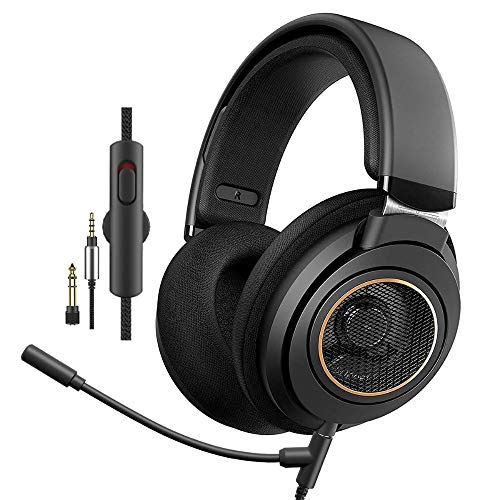
PHILIPS Open-Back Studio/Gaming Headset — The studio crossover
Philips’ entry carries one of open-back’s most respected bloodlines: its title describes over-ear studio headphones for recording, in an open-back gaming headset form with a microphone, aimed at PC, DJ, music, piano, and guitar use, with a detachable mic and audio jack. The SHP9600 family name — this is the SHP9600MB, the microphone-equipped variant — is spoken of warmly wherever headphone people gather, as the accessible face of open-back sound. That heritage is this pick’s argument: the tuning was finished by people who make studio headphones, and the microphone was added to a proven acoustic design rather than the reverse.
For the player whose hours split between games and instruments — the title literally names piano and guitar — a crossover headset ends the two-headphone shuffle at a music desk. The detachable mic keeps the silhouette honest for pure listening. Set expectations by its studio roots: the presentation will favor balance and space over gaming spectacle, the build favors lightness over tank-like drama, and platform language in the title is about music workstations as much as consoles. If your desk has a keyboard of the eighty-eight-key kind beside the other kind, this is your pick wearing its name tag.
- Design: over-ear open-back studio headphones / gaming headset with microphone, per the listing title
- Model: SHP9600MB
- Microphone: detachable, with audio jack
- Stated uses: PC, DJ, music, piano, guitar, recording
- Driver size: Not stated in the listing title — verify with the maker’s documentation
- Surround processing: Not stated in the listing title — verify with the maker’s documentation
Strengths
- A respected open-back studio lineage with a microphone added.
- Detachable mic converts it cleanly back to pure listening headphones.
- Speaks directly to musicians whose desk is also a battlestation.
Trade-offs
- Studio balance may feel restrained next to gaming-tuned rivals.
- Console-specific features are not its language.
- Several specifications are left to the full listing to confirm.
Best for: musicians and music-first listeners who game at the same desk.
Not suited for: console-only players wanting stated platform features.
If your desk holds both kinds of keyboard, view the Philips listing on Amazon and check its cable and mic details against your rig.
Switching From Closed-Back: What Will Surprise You?
The first surprise is how much of your old headset’s bass was pressure rather than information. Explosions will feel less physical, and some players read that as loss until a quiet scene reveals what replaced it: the low creak of a ship, the subterranean rumble placed beneath a room rather than inside your teeth. Give the trade a fair audition across genres before mourning the slam. Many switchers find they miss it in trailers and forget it in games.
The second surprise is social. You will hear the doorbell, the kettle, the person asking whether you want tea — and you will be heard. Households renegotiate small treaties around a new open-back headset in the first week: a door closed during ranked play, a tap on the shoulder instead of a shout. Players who game in the same room as a partner’s reading habit should expect the negotiation to be real, and should not mistake a partner’s honest annoyance for a lack of support for the hobby. The physics is the physics.
The third surprise is endurance. Sessions lengthen because nothing hurts and nothing overheats, and the headset disappears — which, for a piece of equipment worn on the head, is the final compliment. If your closed headset currently dictates your session length, the switch will rewrite your evenings more than any single game purchase this year.
Open-Back, Side by Side: The Six at a Glance
| Pick | Connection | Stated driver | Deciding detail |
|---|---|---|---|
| Sony INZONE H6 Air | Wired, USB-C audio box | Not stated in title | Ultra-lightweight brief for PC, PS5, and mobile |
| beyerdynamic MMX 130 Wireless | Bluetooth 6.0 + low-latency dongle | Not stated in title | 80-hour replaceable battery at 265 g |
| Audio-Technica ATH-GDL3 | Not stated in title | Not stated in title | Audio-brand purist tuning, minimal claims |
| CORSAIR VIRTUOSO PRO | Wired | 50mm graphene | 20Hz–40 kHz stated response, uni-directional mic |
| FIFINE H18V Lite | Wired, 3.5mm + USB | 53mm | Dual connectivity and mesh earmuffs at a value tier |
| PHILIPS SHP9600MB | Wired, audio jack | Not stated in title | Studio headphone lineage with detachable mic |
How Does Open-Back Fit Into a Household of Headphones?
Few players own exactly one headset, and open-back earns its shelf by complementing rather than replacing. The closed headset keeps the loud hours, the travel, the shared-room sessions. The open-back takes the sanctum hours — the door closed, the house calm, the long campaign session. Owning both is not extravagance; it is matching tools to physics, the way a kitchen owns both a chef’s knife and a paring knife without apologizing. If budget forces a sequence, buy for the room you use most hours first, and let the second pair arrive when the first one’s limits have a weekly appointment in your life.
There is also a handoff effect worth noticing: an open-back pair in the house tends to become the music pair everyone borrows, because it is the one that sounds like speakers. Expect the Philips or the beyerdynamic to migrate. Buy the household’s peace by accepting that the best-sounding object in a home gets shared, and set the borrowing rules while everyone is still smiling.
What Mistakes Send Open-Back Headsets Back to the Store?
Buying for a room you do not have. Measure your actual gaming hours honestly — the empty house at midnight is a different acoustic country from the busy house at seven in the evening, and your headset will live in whichever one your schedule truly gives it. Open-back needs quiet and privacy. A loud, shared space defeats the design no matter how good the headset is.
Expecting sealed bass. The open design trades concussive low end for space and detail. Players who need explosions in their sternum should shop closed-back.
Judging in the first hour. Ears raised on closed headsets hear openness as thinness initially. Give familiar games a week before the verdict.
Ignoring your own leakage on mic. Your game can key your microphone in a lively room. Set the gate, position the boom, and test with the game loud.
Cranking volume against household noise. That fight ends with tired ears and a worse mix. Pause, relocate, or switch sessions — do not chase the room with the knob.
Storing them face-down in dusty air. Open cups invite the room in even at rest. A stand and a calmer shelf keep drivers cleaner for years.
What Should You Spend, and Where Should the Money Go?
Without naming prices — listings move, and this guide does not print them — the category’s tiers are legible from the products themselves. The value tier, represented by the FIFINE, buys the open-back experience honestly: real open cups, real platform coverage, processing claims to audition. The middle, where the Sony, Corsair, Audio-Technica, and Philips live, buys materials, tuning pedigree, and microphones with names and specifications. The flagship tier, the beyerdynamic alone, buys the removal of the category’s last compromises: wireless without latency excuses, a battery that can be replaced, a microphone from a broadcast lineage.
The sensible spending rule is to pay for the compromise you actually feel. A wired-desk player gains nothing from the flagship’s freedom and should let the middle tier’s tuning compete for the money. A whole-house wearer gains nothing from a wired bargain that chains them to the desk they keep leaving. And a first-time buyer unsure whether the room suits the category should let the value tier answer that question cheaply, because the room — not the headset — is the variable most likely to say no.
Final Recommendation
Choose by room first, then by desk, and be ruthlessly honest about both — the finest headset in this guide cannot outperform a room that fights it, and a modest one in a calm room will delight you for years. If your space is quiet and yours, the category opens up: the beyerdynamic MMX 130 is the flagship for anyone whose headset travels the house, the Sony H6 Air is the endurance pick for long wired sessions across PC and PS5, and the Corsair VIRTUOSO PRO is the fixed-desk detail machine. The Audio-Technica and the Philips serve the two flavors of music-first buyer — gaming purist and studio crossover — while the FIFINE H18V Lite is the sensible first experiment for the open-back curious. Buy the one that matches your hours, give it a week of familiar games, and let the space in the sound make its own case. An open-back headset in the right room does not feel like a purchase; it feels like a renovation — the same games, the same desk, and a room inside the sound that was not there before — plus evenings that run longer simply because nothing on your head is asking you to stop.
Frequently Asked Questions
Can other people really hear my game through open-back headphones?
Yes — at roughly conversational clarity within the room, less through a closed door. That is the design working as designed. If your sessions share air with people who mind, this category is not for that room.
Is open-back better for competitive play?
It can be, where the room is quiet: positional information is presented with more space and less fatigue, which helps awareness across long sessions. In a noisy venue or a loud house, isolation beats soundstage, and closed headsets win by default.
Why are most of these wired?
Because the category descends from hi-fi, where cables are normal, and because wired removes battery and latency from the equation entirely. The beyerdynamic shows what proper wireless costs when no corners are cut.
Do open-back headsets work for music as well as games?
Several of these are music products at heart — the Philips is a studio headphone with a mic, and the beyerdynamic and Audio-Technica come from headphone-first makers. Detachable microphones across the list make the double life easy.
How long do open-back headsets last?
Years, with pad replacements treated as scheduled maintenance rather than decline. The open design spares drivers the pressure extremes of sealed cups, and the wear items are the consumables you would expect: earpads, headband padding, cables where they are detachable, and microphone booms handled roughly. The beyerdynamic’s replaceable battery removes the one built-in expiry date wireless headsets usually carry.
Will an open-back headset make my voice sound better to teammates?
It makes your voice sound more natural to you, which keeps your level honest, and several picks pair that with serious microphones. The recording test in your real room remains the only verdict that counts.
Are open-back headsets good for movies and streaming shows?
Very — dialogue sits naturally in space, scores breathe, and late-night viewing at moderate volume keeps the dynamic range intact without sealed-cup fatigue. The same household caveat applies: your film leaks into the room at conversational level, so the sleeping-household scenario still belongs to closed headphones or speakers at low volume.
Do open-back headsets need a break-in period?
The drivers are ready before you are. What changes across the first week is your own calibration — ears trained on sealed bass relearning what balanced, spacious sound is. Judge any pick here after several days of familiar content, not after an unboxing hour, and let your own adaptation finish before you grade the hardware.
Related Guides
Headset physics change with the job. For the opposite acoustic brief — sealed protection with audio — see best bluetooth headsets for mowing. For voice as a tool of trade rather than play, read best wireless headsets for dictation, and for the cockpit’s take on headsets, try best headsets for fixed wing student pilots.


