What's inside
- Key Takeaways
- Quick Picks
- How Did We Choose These Esports Headsets?
- Which Esports Headset Wins on Each Measure That Matters?
- Why Does the 2.4GHz Mode Matter More Than Bluetooth in Competition?
- How Should You Set Up an Esports Headset for a Scrim Block?
- What Mistakes Cost Players More Than Their Headset Choice?
- How Does Positional Audio Actually Reach Your Decisions?
- Which Pick Fits Which Competitive Genre?
- How Do Good Teams Build Callout Discipline Around the Hardware?
- What Should You Test in the First Week of Owning One?
- How Does Hearing Health Fit Into a Competitive Career?
- What Separates a Streamer Headset From a Competition Headset?
- How Should a Team Standardise Headsets Without Starting an Argument?
- Why Do Professionals Sound Different on the Same Game Audio?
- What Role Does the Room Itself Play in Your Results?
- Final Recommendation
- Frequently Asked Questions
- Related Guides
As an Amazon Associate I earn from qualifying purchases. This post may contain affiliate links at no extra cost to you.
gizmoverdict.com is reader-supported. When you buy through links on our site, we may earn an affiliate commission.
Where to buy: all six headsets here are sold through Amazon, and the linked names lead to the listings we verified. Check the exact variant in the title before ordering, because several lines sell wireless, wired, and platform-specific versions under nearly identical names.
Players hunting for the best headsets for esports usually arrive with a vague sense that they want something professional, then drown in surround-sound slogans and celebrity endorsements. In a ranked scrim, though, the headset is not an accessory. It is the channel your callouts travel on, the sensor that tells you a footstep came from the left stairwell rather than the right, and the weight sitting on your skull through hour five of a practice block. This guide cuts the category down to the four things that decide matches: a microphone your teammates can understand without effort, a connection that does not lag behind the game, positional audio honest enough to act on, and a fit that survives long sessions without becoming the reason you play worse in the final map.
Two honest warnings frame everything below. First, wireless freedom in esports means a dedicated 2.4GHz link, not ordinary Bluetooth, which was designed for phone calls and carries delay that competitive players can feel in fast exchanges. Every wireless pick here offers that low-latency class of connection, and the buying-guide sections explain how to tell the modes apart on your own machine. Second, no headset manufactures skill. A clearer microphone will not fix vague callouts, and crisper footsteps will not fix poor positioning. What the right headset does is remove equipment from the list of excuses, so the replay shows your decisions rather than your hardware’s limitations.
Key Takeaways
- Microphone clarity is the first esports specification, because four teammates make decisions from your voice under time pressure.
- For wireless play, the 2.4GHz mode is the competitive mode; Bluetooth is for phones and casual listening between sessions.
- The BlackShark V3 is the only pick whose listing title prints a latency figure, 10 ms, so every other model here is judged in latency class rather than invented numbers.
- Wired picks like the G432 and Arctis 1 remove latency and battery questions entirely, which is why tournament desks still love cables.
- Long scrims punish clamp force and heat more than they reward exotic audio tuning, so weight and headband design deserve real weight in the decision.
- Platform matters: check the exact console and PC compatibility in each title instead of assuming a gaming headset works everywhere.
Quick Picks
| Pick | Badge | Why it is here |
|---|---|---|
| Razer BlackShark V3 Pro | Flagship wireless for serious teams | Active noise cancellation, a full-band microphone, 50mm drivers, and three connection paths led by 2.4GHz for the player who wants one headset for everything. |
| Razer BlackShark V3 | The stated-latency specialist | The listing title itself claims 10 ms ultra-low latency on its 2.4GHz link, with the same 50mm driver family and a 70-hour battery claim. |
| Logitech G733 LIGHTSPEED | Comfort-first wireless | A suspension headband that floats the weight, a Blue VO!CE microphone, and LIGHTSPEED wireless for players whose sessions run long. |
| Logitech G432 Wired | Wired tournament simplicity | DTS Headphone:X 2.0, 50mm drivers, a flip-to-mute microphone, and both USB and 3.5mm connections with nothing to charge, ever. |
| HyperX Cloud Flight 2 | Endurance across platforms | Stated battery figures of up to 100 hours on 2.4GHz and 150 hours on Bluetooth, plus swappable earcup plates for team identity. |
| SteelSeries Arctis 1 Wired | The detachable-mic all-rounder | A steel-reinforced headband and a detachable ClearCast microphone that turns a wired gaming headset into plain headphones for travel. |
How Did We Choose These Esports Headsets?
We ranked microphones before drivers, which reverses the order most marketing uses. In team play your voice is a weapon system: a callout swallowed by a muffled microphone costs a round as surely as a missed shot, so every pick here carries a microphone design with a genuine competitive pedigree, whether that is a full-band broadcast-style capsule, a Blue VO!CE chain, or a detachable ClearCast boom. Players who stream or record reviews as well as competing may also want to compare the broadcast-first thinking in best headsets for podcasting wireless, where microphone fidelity is the entire argument.
Connections came second. Wireless picks had to offer a 2.4GHz gaming link, because that class of connection is the one built to keep audio delay beneath perception during play, while Bluetooth-only designs were excluded from the wireless slots no matter how fashionable. Wired picks earned their places by being excellent rather than by being cheap: zero connection delay, zero charging, and instant compatibility with tournament PCs and controllers. Finally we weighed session comfort and platform coverage, since an esports headset that excludes your console or crushes your temples by map three has failed at its actual job.

Razer BlackShark V3 Pro — Flagship wireless for serious teams
The V3 Pro is what happens when a maker decides the flagship should answer every objection at once. Its verified title lists active noise cancellation, a full-band microphone, 50mm drivers, and a connection menu of 2.4GHz, Bluetooth, USB, and 3.5mm, with a 70-hour battery claim and compatibility spanning PC, Mac, PlayStation 5, Switch, and smartphones. The ANC deserves attention first, because it addresses the environment esports actually happens in: a bedroom beside a busy road, a shared flat with a television through the wall, a team house where three other players are shouting their own callouts. Cancelling the room lets you run lower volume, hear detail earlier, and finish a block with less listening fatigue.
The full-band microphone claim is the other half of the flagship story. Wider-band voice capture aims to make a player sound like a person rather than a telephone, which matters more than vanity: consonants carry meaning in callouts, and the difference between fifteen and fifty, or between site A and site B, lives in exactly the frequencies cheap microphones smear. Paired with the 2.4GHz link for play and Bluetooth for everything else, the Pro becomes the headset a serious player buys once and stops thinking about. Its honest cost is complexity and flagship money; a player who competes only on one wired PC at a quiet desk is paying for answers to problems they do not have.
- Drivers: 50mm, per the listing title
- Microphone: full-band microphone, per the listing title
- Noise control: active noise cancellation, per the listing title
- Connections: 2.4GHz, Bluetooth, USB, and 3.5mm
- Battery claim: 70 hours, printed in the title itself
- Platforms named in title: PC, Mac, PS5, Nintendo Switch, smartphone
Strengths
- ANC directly attacks the noisy-room problem that ruins more home practice sessions than any driver specification.
- Four connection paths mean one headset covers tournament PC, console, and phone without adapters or compromises.
- The full-band microphone targets the intelligibility that callouts live and die by, not just loudness.
Trade-offs
- Flagship pricing buys features that quiet-desk, single-platform players may never switch on.
- More modes mean more settings to learn, and a misconfigured headset on match day is its own failure mode.
- Players sensitive to ANC pressure sensation should trial it before committing a season to it.
Best for: competitive players in noisy homes or team houses who want one flagship for every platform. Not suited for: wired purists, or quiet-room PC players who would leave half its systems unused.

Razer BlackShark V3 — The stated-latency specialist
Latency claims in gaming audio are usually fog, so the plainest thing about the standard V3 is refreshing: its listing title prints a number. Razer claims 10 ms ultra-low latency for this headset, and that figure appears in this guide because the title states it, under the same discipline that forbids us from inventing millisecond figures for the other five picks. Around that claim sits a familiar competitive recipe: 50mm drivers, a 2.4GHz link for play, Bluetooth for casual use, wired USB-C as the fallback, and a stated 70-hour battery. Think of the V3 as the Pro’s argument with the flagship extras stripped away, aimed at the player who cares about delay and endurance above ambience.
The comparison between the two BlackSharks teaches the right shopping lesson. If your room is quiet and your budget has limits, the V3 keeps the connection speed and driver size that matter during rounds while dropping ANC and the full-band microphone programme. If your room is loud or your voice carries tactical responsibility for a team, the Pro’s extras stop being luxuries. What the V3 refuses to compromise is the wireless discipline itself: play on the 2.4GHz link, treat Bluetooth as the phone mode, and plug in the USB-C cable when a final demands absolute certainty. That hierarchy, practised until it is habit, is worth more than any single specification on either box.
- Drivers: 50mm, named in the title
- Latency claim: 10 ms ultra-low latency, as stated in the listing title
- Connections: 2.4GHz, Bluetooth, and wired USB-C
- Battery claim: 70 hours, as stated in the listing title
- Platforms named in title: PC, Mac, PS5, Nintendo Switch, smartphone
- Noise control: no ANC claimed in the listing title
Strengths
- A printed latency figure lets buyers compare honestly instead of decoding marketing adjectives.
- The essential competitive recipe survives intact: fast link, large drivers, long stated battery, wired fallback.
- Three connection modes still cover the realistic life of a player across PC, console, and phone.
Trade-offs
- No active noise cancellation means a loud room stays in your ears at whatever volume you choose.
- The microphone programme is a step below the Pro’s full-band flagship treatment.
- Buyers wanting the complete BlackShark statement will feel the missing features every noisy evening.
Best for: latency-focused competitors in reasonably quiet rooms who want Razer’s speed without flagship extras. Not suited for: players in loud shared housing, who should fund the Pro’s cancellation instead.

Logitech G733 LIGHTSPEED — Comfort-first wireless
Ask a veteran what ended their longest practice blocks and few will name audio quality. They will name the headache ridge across the scalp, the ears cooked inside sealed cups, the clamp that turned concentration into endurance. The G733 attacks that failure mode with a suspension headband, a soft strap that floats the headset’s weight instead of parking it on one pressure line, paired with Logitech’s LIGHTSPEED wireless and a microphone running Blue VO!CE processing. Its title names PRO-G audio drivers and compatibility with PC, PlayStation 5 and 4, and Switch, sketching a headset designed for the player whose competitive edge is simply still being comfortable in hour six.
Blue VO!CE deserves explanation, because it changes what a microphone does. Rather than merely capturing voice, the processing chain shapes it: filtering, compression, and tuning intended to keep callouts consistent whether you whisper a rotation or shout over a final-round explosion. Players who have been told they sound distant, boomy, or harsh on lesser headsets often find software treatment like this more valuable than a bigger driver. The suspension strap has a social benefit too: the G733’s colourful, streamer-friendly styling suits players who appear on camera, though this guide judges it strictly as competition equipment. Comfort, credible voice processing, and a proven low-latency wireless family make it the thinking player’s alternative to the Razer pair.
- Headband: suspension design, per the listing title
- Microphone: Blue VO!CE mic, per the listing title
- Drivers: PRO-G audio, per the listing title
- Wireless: LIGHTSPEED, Logitech’s low-latency gaming link
- Platforms named in title: PC, PS5, PS4, Switch
- Battery figure: not stated in the listing title — check the listing for the current claim
Strengths
- The suspension strap directly addresses the fatigue that ends long scrims early.
- Voice processing gives quieter or less polished speakers a clearer channel to their team.
- LIGHTSPEED keeps the wireless link in the competitive latency class rather than phone territory.
Trade-offs
- Xbox players are absent from the title’s platform list and should look to the Arctis 1 instead.
- The playful styling will not suit every team’s or school’s idea of serious equipment.
- No battery figure in the title means endurance shoppers must verify the claim in the listing itself.
Best for: long-session PC and PlayStation players who value comfort and voice polish above raw flagship features. Not suited for: Xbox competitors, or players who prefer a traditional padded headband feel.
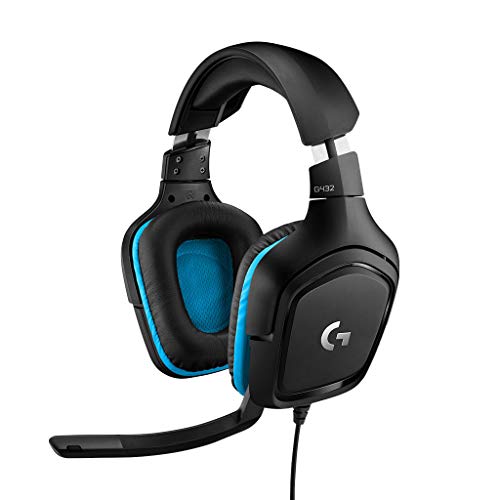
Logitech G432 Wired — Wired tournament simplicity
There is a reason the wired headset refuses to die in competitive play: it removes entire categories of failure. No battery dies before the final. No wireless interference appears in a venue full of radios. No pairing menu opens when the match is about to start. The G432 builds its case on that reliability, adding DTS Headphone:X 2.0 surround processing, 50mm drivers, a flip-to-mute microphone, and a choice of USB or 3.5mm connection, all named in its verified title. The flip-to-mute gesture deserves special praise in team settings, because muting becomes a physical act your hand remembers, ending the era of hot microphones broadcasting a sneeze, a doorbell, or a private complaint about the coach.
DTS Headphone:X 2.0 should be understood honestly. It is spatial processing that widens and positions the sound field from a stereo feed, and many players find its directional cues genuinely helpful for orientation. It is not a measurement of anything, and this guide treats surround branding on every pick as processing to be auditioned rather than as fact. The G432’s deeper virtues are duller and better: a known quantity on any PC, a microphone that mutes with a flick, and a purchase that keeps working for years because there is so little inside it that can become obsolete. For school teams, club programmes, and players furnishing a second setup, that durability of purpose is the whole argument. Readers furnishing several seats at once may also cross-check best affordable wireless gaming headsets for the wireless side of a club budget.
- Drivers: 50mm audio drivers, per the listing title
- Spatial audio: DTS Headphone:X 2.0, per the listing title
- Microphone: flip-to-mute, per the listing title
- Connections: USB and 3.5mm jack
- Wireless: none — zero connection latency and no battery by design
- Platforms named in title: PC compatible
Strengths
- Physical flip-to-mute is the fastest, clearest mute discipline a team can teach.
- Two wired connection options cover gaming PCs, laptops, and controller jacks without dongles.
- Nothing to charge means the headset is ready at every scrim, LAN, and borrowed desk.
Trade-offs
- The cable sets your movement radius and demands routing discipline at a crowded desk.
- Console coverage in the title is narrower than the wireless picks, so platform-check before buying.
- Spatial processing divides opinion; players who prefer plain stereo can leave it off, but should know it headlines the design.
Best for: PC competitors, school and club teams, and anyone who wants tournament reliability without charging rituals. Not suited for: players who pace, cast to a TV, or play far from the machine.

HyperX Cloud Flight 2 — Endurance across platforms
Battery anxiety is a quiet tax on wireless players: the headset on the charger during the first scrim, the warning tone during the last round, the cable deployed in surrender. The Cloud Flight 2 answers with the boldest endurance claims in this guide, stated in its own title as up to 100 hours on the 2.4GHz link and up to 150 hours on Bluetooth. Even read conservatively, as manufacturer claims under favourable conditions, figures of that scale change behaviour: charging becomes a weekly event rather than a nightly one, and a forgotten charge stops being an emergency. The title also names customisable RGB and removable earcup plates, features aimed at team identity rather than acoustics.
Platform breadth strengthens the case. The Flight 2 lists PlayStation 5 and 4, Switch, PC, Mac, and mobile in its title, making it the natural single purchase for the player whose competitive life is split between a console at home and a PC at a friend’s house or club. The removable plates are easy to dismiss as decoration until a team kits out five identical headsets and needs to tell them apart at a glance, or a school programme wants its colours on the gear students use. HyperX’s Cloud line built its name on comfort during long wear, and while this guide judges only what titles verify, the endurance-plus-platforms formula here is coherent: a headset bought to be lived in, across machines, for weeks between charges.
- Battery claims: up to 100 hours on 2.4GHz and 150 hours on Bluetooth, figures the title itself prints
- Connections: 2.4GHz wireless and Bluetooth named in the title
- Customisation: customisable RGB and removable earcup plates, per the listing title
- Platforms named in title: PS5, PS4, Switch, PC, Mac, and mobile
- Drivers: not stated in the listing title — verify in the listing before comparing driver size
- Microphone detail: not specified in the listing title — check the listing for the microphone design
Strengths
- Stated endurance in the title dwarfs the other wireless picks and rewrites charging habits.
- The widest platform list here suits players split between console and PC ecosystems.
- Swappable plates give teams and clubs a practical identity and spares system.
Trade-offs
- Title-silent driver and microphone details force extra homework for spec-led buyers.
- RGB lighting spends battery on decoration, so endurance chasers should keep it dim or off.
- Players wanting ANC for loud rooms are served by the BlackShark V3 Pro instead.
Best for: multi-platform players and team programmes that prize endurance and shared identity. Not suited for: spec-sheet shoppers who want every driver and microphone detail confirmed in the title itself.

SteelSeries Arctis 1 Wired — The detachable-mic all-rounder
The Arctis 1 makes a quietly radical suggestion: your gaming headset and your everyday headphones could be the same object. Its verified title names a detachable ClearCast microphone, so the boom comes off when the match ends, and a lightweight steel-reinforced headband, so the frame underneath the padding is built to survive being thrown in a bag daily. Compatibility in the title spans Xbox, PC, PlayStation 5 and 4, Switch, and mobile, the broadest wired platform list in this guide, which suits the player whose gaming happens wherever a screen happens to be. ClearCast carries a broadcast-style reputation in SteelSeries’ line, built around making voice the clearest element in the mix.
Wired discipline gives this pick its competitive licence. There is no latency class to discuss because there is no wireless link to delay anything, and no battery to manage across a tournament weekend. What the Arctis 1 adds over the G432 is mobility of identity: it can be the headset at the desk, the headphones on the train, and the voice of a handheld session without announcing itself as gaming gear once the microphone is pocketed. Spectacle wearers should note the lightweight frame as a starting point and then read best headsets to wear with glasses, where temple pressure gets the full treatment it deserves. For a first serious headset bought with limited money and unlimited platforms, this is the hardest pick here to outgrow quickly.
- Microphone: detachable ClearCast microphone, per the listing title
- Headband: lightweight steel-reinforced design, per the listing title
- Connections: wired — no latency class or battery to manage
- Platforms named in title: Xbox, PC, PS5, PS4, Nintendo Switch, mobile
- Drivers: not stated in the listing title — verify in the listing if driver size drives your choice
- Surround processing: none claimed in the listing title
Strengths
- A removable microphone converts it into discreet everyday headphones in seconds.
- Steel reinforcement addresses the snapping-headband failure that kills budget headsets.
- The platform list covers every major gaming ecosystem a wired player is likely to own.
Trade-offs
- A detachable microphone is also a losable microphone, and a small parts habit is required.
- Wired life means cable routing at the desk and no freedom to fetch a drink mid-queue.
- Buyers chasing stated driver sizes or surround branding must look beyond the title.
Best for: multi-platform players wanting one wired headset that also lives a normal life outside gaming. Not suited for: players who know a loose microphone would vanish within a month in their setup.
Which Esports Headset Wins on Each Measure That Matters?
| Pick | Connection | Microphone headline | Defining strength |
|---|---|---|---|
| Razer BlackShark V3 Pro | 2.4GHz, Bluetooth, USB, 3.5mm | Full-band mic | ANC for noisy rooms |
| Razer BlackShark V3 | 2.4GHz, Bluetooth, USB-C wired | Standard BlackShark mic programme | 10 ms latency claim in title |
| Logitech G733 | LIGHTSPEED wireless | Blue VO!CE processing | Suspension-strap comfort |
| Logitech G432 | Wired USB and 3.5mm | Flip-to-mute boom | Nothing to charge |
| HyperX Cloud Flight 2 | 2.4GHz and Bluetooth | Not specified in title | Stated 100-hour 2.4GHz endurance |
| SteelSeries Arctis 1 | Wired | Detachable ClearCast | Every platform, everyday use |
The table rewards reading by column rather than by row. If the microphone column decides your shortlist, the Pro, the G733, and the Arctis 1 argue loudest. If the connection column worries you, notice that every wireless pick leads with a gaming-class link and every wired pick deletes the question entirely. Endurance belongs to HyperX by a distance on stated figures, while noise belongs to Razer’s flagship alone. Players building a first setup around a handheld should detour through best headsets for gaming nintendo switch before finalising, since portable play rearranges several of these priorities.
Why Does the 2.4GHz Mode Matter More Than Bluetooth in Competition?
Bluetooth was engineered for convenience: pairing a phone to a car, a watch to a handset, a headset to a laptop for calls. Its audio path accepts delay as the price of that universality, and in a film or a phone call nobody notices. In a shooter, delay rearranges causality. The footstep you hear late is information about where an opponent was, and in fast exchanges the gap between a sound and its visual cause can be felt even by players who cannot name it. Dedicated 2.4GHz gaming links exist precisely to shrink that gap into the range where it stops influencing decisions, which is why every wireless pick in this guide carries one and why the single printed figure here, the BlackShark V3’s stated 10 ms, belongs to that class of link.
The practical rule is simple enough to tape to a monitor: compete on the 2.4GHz dongle, socialise on Bluetooth, and treat wired as the referee that settles arguments. Bluetooth still earns its place for music, calls, and casual sessions on a phone or handheld, and several picks include it for exactly that life outside the server. What it should never do is carry a ranked match because the dongle was left in another room. Teams should standardise the habit at the same time they standardise sensitivity settings, since connection discipline, like crosshair placement, is free performance.
How Should You Set Up an Esports Headset for a Scrim Block?
Begin an hour before the block, not during champion select. Charge or cable the headset, confirm the 2.4GHz dongle sits in a front port with line of sight rather than behind a metal case, and run one voice check with a teammate who will tell you the truth about how you sound. Set game and chat volumes separately so callouts can be raised without raising gunfire, then play one warm-up map listening specifically for direction: call out where you believe each sound originated before checking the replay, and note whether your errors lean left, right, or vertical. That tiny calibration habit teaches you your own headset’s sound signature faster than any review, including this one.
Microphone placement repays the same deliberate minute. A boom should hover beside the mouth, close enough that you can speak at conversation level, far enough that breathing and plosives stay out of the channel. Speak your standard callouts at match intensity and have a teammate flag any that clip or fade. Save the working configuration as a profile where the software allows it, photograph the physical settings where it does not, and resist mid-block tweaking unless something is genuinely broken. Consistency is a competitive resource: the player who hears the same mix every session builds instincts the player with new settings every week never can. Crews who also run disciplined voice procedure off the server may recognise the same habits in best headsets for ham radio, where clarity under pressure is likewise the entire culture.
What Mistakes Cost Players More Than Their Headset Choice?
Competing on Bluetooth because the dongle felt like a hassle is the classic unforced error, followed closely by buying surround branding instead of microphone quality. A third mistake is chasing a flagship for a noisy room while refusing to close the window, then blaming the headset for the traffic in the recording. Fourth, players set volumes loud enough to mask poor directional information, trading tomorrow’s hearing for today’s false confidence; if you must shout over your own game audio to hear a callout, the mix is wrong, not quiet. Fifth, teams let every player run different processing, sidetone, and chat mixes, then wonder why callout discipline feels inconsistent: standardise the boring settings so the only variable left is the playing.
Buying for the wrong platform completes the set. A headset whose title omits your console is not being modest; it is telling you something. Check the exact list, prefer the picks whose titles name your machines, and remember that a wired 3.5mm connection remains the closest thing gaming has to a universal translator. Finally, do not retire a good headset over a worn ear cushion or a tired cable where the design allows replacement. Competitive gear should be maintained like competitive gear, with consumables replaced on schedule rather than after failure.
How Does Positional Audio Actually Reach Your Decisions?
Every directional judgement you make in a game is assembled from timing and level differences between your ears, whether the source is a real room or a mix engine imitating one. A headset’s job is to deliver those differences without smearing them, which is why competitive players obsess over clarity in the midrange, where footsteps, reloads, and ability cues live, rather than over cinema-style bass. Excess low-end energy feels dramatic in a trailer and behaves like mud in a match: explosions bloom across the exact frequencies you needed for the quiet sound underneath them. When you audition any pick in this guide, resist the soundtrack test and run a listening drill instead, counting how early you can place a moving sound source with your eyes closed.
Game engines differ enough that no headset flatters them all equally. Tactical shooters reward restraint and precise left-right imaging at conversational volumes. Battle royale titles stretch the problem across distance, asking you to separate a far vehicle from a near footstep in the same second. Arena and hero shooters bury cues in ability noise, where a headset that keeps the mix separated at high density earns its keep. The honest conclusion is that players loyal to one title should tune and judge with that title’s replays, while multi-game players should favour the neutral, unshowy presentations over dramatic ones, because neutrality travels between engines without demanding relearning.
Sidetone, the sound of your own voice fed back into your ears, quietly governs how loudly you speak and therefore how clearly your microphone performs. Too little sidetone and players shout, clipping their own callouts; too much and they mumble to escape themselves. Most gaming software and several of these headset families allow adjusting it, and the correct setting is the one where your voice sounds like thinking aloud rather than broadcasting. Set it once during the calibration routine described earlier and then leave it alone, because a stable sense of your own voice is part of the instrument you are training.
Which Pick Fits Which Competitive Genre?
Tactical shooter players live and die by the microphone column. A five-stack running executes and retakes needs the clearest voice channel it can buy, which pushes the BlackShark V3 Pro and its full-band microphone to the front of the queue, with the G733’s processed voice as the comfort-conscious alternative for long VOD-review evenings after the server work ends. In this genre the wired G432 also thrives, because tactical titles are played at desks, in chairs, for hours, where a cable costs nothing and certainty is priceless.
Battle royale and extraction players should weight endurance and awareness together. Sessions sprawl, queues wander, and a headset that demands a charger between matches interrupts the social rhythm of a squad night. The Cloud Flight 2’s stated endurance speaks directly to that life, and its platform breadth covers the console-heavy audience these genres attract. Players in loud homes should still look hard at the Pro’s cancellation, because a sprawling session in a noisy flat is exactly where ANC converts from luxury to sanity.
Hero-shooter and MOBA-adjacent players occupy the middle: voice matters enormously, since ultimate tracking and cooldown calls are pure speech, but sessions are shorter and mixes are denser. The standard BlackShark V3 suits this middle ground well, keeping the fast link and a strong all-round presentation without flagship cost. Fighting-game and sports-title competitors, whose audio cues are simpler and whose events are often in person, are the natural audience for the Arctis 1: wired certainty, a microphone that detaches for travel, and a frame built for being carried to locals every weekend.
Student and school programmes deserve their own paragraph, because their constraints are institutional rather than personal. Shared headsets need mute gestures that supervisors can see, cables that cannot walk away paired to the wrong laptop, and parts that survive a term of mixed care. The G432’s flip-to-mute and wired simplicity fit that brief best in this guide, while the Flight 2’s plates help a programme brand and track its fleet. What a programme should not buy is a different model for every seat, since mixed fleets multiply chargers, dongles, and confusion in exact proportion to their variety.
How Do Good Teams Build Callout Discipline Around the Hardware?
Hardware delivers the voice; protocol decides whether the voice helps. Strong teams keep callouts short, standardised, and addressed: a place name, a number, a verb. They agree map vocabulary before the season rather than improvising synonyms mid-match, and they debrief communication with the same honesty they apply to aim, listening back to recordings to find the call that arrived late, twice, or not at all. A better microphone widens the channel, but discipline is what flows through it, and captains should treat a new headset purchase as the occasion to reset that discipline rather than as a substitute for it.
Recording your own scrims for communication review is easier than most teams realise, since every platform in this guide can capture team audio alongside gameplay with ordinary software. Listen for the patterns hardware reveals: the player whose microphone makes every call sound like a question, the one whose gain clips on excitement, the one whose room noise forces everyone else to work harder. Fix gain and placement first, processing second, and replacement last. Several famous upgrades in team performance have turned out to be a boom moved two centimetres and a sidetone setting corrected, which is why this guide keeps returning to setup rituals that cost nothing.
Care closes the loop. Ear cushions compress and absorb the evidence of long seasons, changing both comfort and sound; replace them when they stop springing back rather than when they disintegrate. Cables on wired picks should be inspected at the strain reliefs, dongles on wireless picks should live in labelled homes, and every headset in a team fleet should carry its owner’s name in a place that does not touch skin. None of this appears on a specification sheet, and all of it decides whether the headset you bought is still the headset you reviewed by the time the important matches arrive.
What Should You Test in the First Week of Owning One?
Treat the first week as an audition with a verdict at the end, not as a honeymoon. Day one belongs to setup: connection mode confirmed, firmware and software settled where applicable, microphone position marked, and one recorded voice sample saved at your normal settings. That recording is your baseline. By day three, play the loudest session your home offers, a full house, traffic at its worst, a sibling streaming through the wall, and judge whether the headset’s isolation or cancellation holds your concentration without forcing volume upward. By day five, run the longest block you realistically play and grade comfort at the end honestly, because a headset that wins the first hour and loses the fifth is a practice injury waiting for a tournament to expose it.
Close the week with the teammate test, the only microphone review that counts. Ask the players who hear you most to compare your new voice against the saved baseline without telling them which is which, and let their preference settle arguments your own ears cannot, since you hear your voice through bone as much as through air. If the new headset loses that blind comparison, the problem is usually gain or placement rather than the capsule, so adjust and repeat once before concluding anything. Keep notes from the week with the receipt; if a return or exchange becomes necessary, those notes are the difference between an informed swap and a second guess.
One further test separates competitive equipment from entertainment gear: the tilt test of a bad day. Play one session tired, one session after an argument with your settings, one session on a borrowed machine where your profiles do not exist. A good esports headset degrades gracefully, sounding respectable at defaults and recovering your configuration without a research project. The picks in this guide were chosen partly for that resilience, since a season contains far more imperfect days than perfect ones, and equipment should absorb chaos rather than amplify it.
How Does Hearing Health Fit Into a Competitive Career?
Esports careers are long now, and ears accumulate every loud season. The danger is rarely a single deafening moment; it is the daily habit of running game audio hot enough to drown a room, then adding callouts on top, for six hours, for years. Headsets with genuine isolation or cancellation break that arithmetic by letting detail survive at lower levels, which is a concrete competitive argument for the Pro’s ANC and for well-sealing cups generally. Volume discipline still belongs to the player: if a teammate’s voice in your headset would be uncomfortable across a table, the mix is too loud, whatever the scoreboard says.
Breaks are equipment too. Between maps, take the headset off rather than wearing it as a necklace with audio still running, because ears recover during silence in a way they cannot during quieter noise. Players who stream long sessions should be especially strict, since entertainment audio fills the gaps where scrim players rest. Anyone who notices ringing that lingers after sessions, or who keeps raising volume across a season to reach the same clarity, should treat that as a medical conversation rather than a settings problem. The goal of this entire guide is a headset you stop noticing; your hearing, unlike a headset, cannot be replaced when it wears out.
Younger players deserve a direct word, because school and academy programmes increasingly put serious headsets on young ears for adult-length sessions. Coaches and parents should set volume limits at the system level where possible, schedule silent breaks into practice plans, and prefer the picks here whose isolation reduces the temptation to compensate with level. Competitive advantage built on a teenager’s hearing damage is not an advantage any programme should be proud of, and the modest settings work involved is among the cheapest safeguarding in the whole sport.
What Separates a Streamer Headset From a Competition Headset?
The two categories overlap heavily in shops and barely at all in priorities. A streamer’s audience hears the microphone for hours, so voice richness, processing, and camera-friendly looks climb the list, while a competitor’s teammates hear the microphone in bursts, so raw intelligibility at speed outranks beauty. Several picks here serve both lives honestly: the G733’s voice processing and styling were plainly designed with creators in view, and the BlackShark V3 Pro’s full-band microphone flatters a broadcast as much as a callout. The trap is buying by audience metrics for a job measured in rounds. If nobody will ever hear you except four teammates, spend on clarity, delay, and comfort, and let the streamers fund the RGB.
Dual-purpose players should also think about what happens to game audio on a broadcast, since some processing chains that flatter voice do nothing for, or quietly flatten, the sound the audience hears. Test recordings before a season rather than discovering a strange mix during one. The Arctis 1 offers the simplest dual life of all: detach the microphone and it stops being content equipment entirely, becoming the headphones you wear to the venue, which for travelling players is a feature no software suite can imitate.
How Should a Team Standardise Headsets Without Starting an Argument?
Let the players trial, then let the captain decide, then stop relitigating. A sensible programme buys one each of two finalists, rotates them through the roster for a fortnight of scrims, collects blind voice comparisons and comfort scores, and commits to the winner as a fleet. Standardising buys shared chargers, interchangeable dongles, identical settings advice, and the quiet confidence that a callout problem is a player problem rather than a hardware lottery. Individual exceptions should exist for fit and hearing needs, granted without drama, because the point of a standard is a reliable baseline rather than uniformity for its own sake.
Budget the fleet as a system: one spare headset per five players, spare cushions in the team cupboard, and a labelled home for every dongle, since a lost receiver benches a wireless headset as completely as a snapped band. Record serial numbers and purchase dates in the same document that holds scrim schedules. Teams that treat audio equipment with the same administrative respect they give their PCs find that headset problems shrink to the occasional consumable, which is exactly where a competitive programme wants them.
Why Do Professionals Sound Different on the Same Game Audio?
Watch a professional’s replay with the sound up and a pattern emerges: they react to sounds you barely registered, a distant reload, a single step on a surface that should be empty, the particular hush before an execute. Part of that is experience, a library of cues built over thousands of hours. Part of it is setup discipline: a stable mix, a headset they have worn long enough for its presentation to become transparent, and volumes low enough that quiet information survives. Amateurs often chase that awareness by buying ever more dramatic audio, when the professionals’ actual secret is consistency. They hear the same presentation every day, so deviations from it carry meaning.
That is the deepest argument for choosing carefully and then stopping. Any pick in this guide, worn daily for a season with a settled configuration, will teach its owner more positional awareness than a flagship swapped monthly in search of a revelation. If you take one idea from this article into your next purchase, take that: the best esports headset is the one whose sound you have memorised, whose microphone your team trusts, and whose presence on your head you forget by the second round. The six here are simply the shortest honest route to that state of affairs, at six different balances of money, freedom, and certainty.
What Role Does the Room Itself Play in Your Results?
Players tune headsets obsessively and rooms never, which is backwards in one specific way: the room decides how much of the headset’s job is isolation. A soft, furnished room with curtains and a closed door hands any decent sealed headset an easy shift, while a bare room above a road turns the same headset into a negotiation with traffic. Before upgrading from the standard V3 to the Pro purely for cancellation, spend an evening improving the battlefield: close the door, hang the washing elsewhere, move the desk away from the window wall. If the room still shouts through, the flagship’s ANC has earned its audition. If the room quietens, you have saved the difference and learned something about your setup that no purchase could teach.
Desk geography matters at the margins where matches turn. A wireless dongle buried behind a metal tower, a cable draped across a keyboard, a headset stand placed where a returning elbow lands weekly: each is a small tax on attention. Route the wired picks so the cable falls behind your mouse arm rather than across it, give the dongle a front port and a clear view of your chair, and park the headset where your hand already goes at the end of a session. Competitive setups are ecosystems, and the headset is only the most audible part of one.
Final Recommendation
Most competitive players should start at the Razer BlackShark V3: its stated latency figure, honest connection menu, and long battery claim cover the ranked life without flagship excess, while the V3 Pro becomes the right answer the moment a noisy room or broadcast-grade voice enters the brief. Choose the G733 when comfort across marathon blocks and voice processing matter most, the G432 when wired certainty and a physical mute fit a club or tournament desk, the Cloud Flight 2 when stated endurance and platform-hopping define your season, and the Arctis 1 when one wired headset must also survive everyday life beyond the desk. Buy the microphone first and the delay class second, and your callouts will start arriving the way you meant them, half a breath before the round turns on them.
Frequently Asked Questions
Is Bluetooth good enough for ranked play?
It is the wrong tool for that job. Bluetooth serves phones, music, and casual sessions well, but its delay sits outside the class competitive players accept. Use the 2.4GHz mode your wireless headset provides for matches, and keep Bluetooth for everything that happens between them.
Why do only some headsets here list a latency figure?
Because only the BlackShark V3’s verified listing title prints one, 10 ms, and this guide repeats millisecond figures only where a title states them. The other wireless picks are described by latency class, 2.4GHz gaming links, which is the honest comparison available from their titles.
Does surround sound processing actually help in esports?
It can help some players interpret direction, and it hinders others who find processed sound less natural than clean stereo. Treat it as a preference to audition with your own games, never as a measured advantage, and never let it outrank microphone quality when choosing.
Wired or wireless for a tournament?
Wired removes battery, interference, and pairing from the day entirely, which is why so many tournament desks default to it. Wireless on a 2.4GHz link is entirely legitimate for team practice and online competition, provided the dongle setup and charging are handled before the block starts.
How long should an esports headset battery last?
Long enough that charging never enters match-day thinking. The stated claims here range from 70 hours on the Razer pair to the HyperX figures of up to 100 hours on 2.4GHz, all manufacturer claims to be read as scale rather than promise. Any of them, charged weekly, clears the bar comfortably.
What matters more, driver size or microphone quality?
Microphone quality, for team play, and it is not close. Your drivers inform only you, while your microphone informs four teammates making split-second decisions. Driver size appears in several titles here at 50mm, which is a fine competitive norm, but the voice channel should win every tie.
Should a beginner copy a professional player’s exact headset?
Copy the reasoning, not the shopping list. A professional’s choice reflects their room, their team’s standard issue, their sponsors, and a thousand hours of adaptation to one particular presentation. A beginner gains more from a pick matched to their own platform and budget, worn consistently, than from a flagship bought as a talisman. If the season goes well, the upgrade path inside this guide, from the wired pair toward the BlackShark tier, will still be waiting, and by then you will know exactly which limitation you are paying to remove.
Keep the box and the receipt until the first month has passed, along with the spare cable, the dongle, and any alternate ear cushions the maker included. Headsets reveal their true character slowly, and the player who can still exchange a poor fit in week three, with every accessory accounted for, holds an advantage that has nothing to do with audio and everything to do with ending up in the right equipment.
Photograph your finished setup once it works: dongle position, cable route, boom placement, and the settings screens that produced your best voice test. That single set of pictures rebuilds your configuration in minutes after any update, move, or borrowed machine threatens it.
Related Guides
Players equipping a whole station may also want best audiophile gaming headsets for the listening-first end of the hobby, and best wireless headsets for construction workers for a look at how another loud profession solves the problem of hearing voices clearly.


