What's inside
- Where to buy a phone that outlasts your day, and what this guide means by affordable
- Key Takeaways
- Quick Picks
- How did we choose these six phones?
- Why does battery life collapse on some phones by mid-afternoon?
- Which affordable phones last longest? The six picks in detail
- How do the six compare side by side?
- What should you check before choosing a battery-first phone?
- How can you make any of these phones last longer each day?
- What mistakes do battery shoppers keep making?
- How does charging speed change the battery equation?
- What does a genuinely heavy day look like, phone by phone?
- Should you pay more for storage, or put the money toward stamina?
- Why do two owners of the same phone report wildly different battery life?
- When is a power bank still worth carrying?
- Does a case or a screen protector change battery life?
- Final Recommendation
- Frequently Asked Questions
- Related Guides
As an Amazon Associate I earn from qualifying purchases. This post may contain affiliate links at no extra cost to you.
gizmoverdict.com is reader-supported. When you buy through links on our site, we may earn an affiliate commission.
Our Top Picks
Where to buy a phone that outlasts your day, and what this guide means by affordable
Every phone name below links to that model’s own Amazon listing, where you should check the storage variant and the condition note before anything else, because one of these six listings is a Renewed unit and the other five are new. The best affordable smartphones for battery life are not the phones with the longest spec-sheet endurance claims; they are the phones a delivery driver, a nurse on a twelve-hour shift, or a parent coordinating three school pickups can take off the charger at dawn and still trust at midnight without a battery pack in the other pocket. Affordable, in this guide, is a qualitative frame rather than a price tag: these are the lower-cost shelves of each maker’s range, the models bought by people who measure value in years of service rather than in benchmark charts.
Battery life is the one specification that punishes optimism. A camera you overrate costs you a few soft photographs; a battery you overrate costs you the last hour of a shift, the boarding pass at the gate, the map on the drive home. So this guide treats endurance as a system, not a number: cell size where that size is a matter of common knowledge, screen efficiency, processor behaviour on mobile data, and the software discipline that stops a phone from drinking its own charge while it sits in a pocket. Six phones survive that treatment here, and they survive it for genuinely different reasons — one is a specialist built around a huge cell, one is a mid-priced all-rounder whose battery happens to be the largest its line has ever carried, and one is an older budget handset whose modest screen and modest ambitions sip where thirstier phones gulp.
Key Takeaways
- Endurance is a system: a big cell behind an efficient screen and a restrained processor beats a big cell feeding a bright, hungry display every single week of ownership.
- The Moto G Power 2025 is the specialist here — Motorola’s Power line exists for exactly this brief, and it is the default answer for multi-day users.
- The Pixel 9a carries the largest battery the Pixel a-series has shipped, which turns Google’s value phone into a genuine two-day candidate for moderate users.
- Five of these six listings are new phones; the Nokia G310 is a Renewed listing, and its battery expectations should be set accordingly.
- Your charger habits matter as much as the phone: overnight slow charging and avoiding constant heat will preserve more capacity than any setting buried in a menu.
- Mobile data is the silent drain — a weak signal makes any phone burn charge hunting for towers, so carrier fit is a battery feature too.
Quick Picks
| Pick | Badge | Why it earns its place |
|---|---|---|
| Motorola Moto G Power 2025 | Best overall for endurance | The Power line’s whole reason to exist is battery life, and the 2025 model pairs that big-cell brief with a large, easy screen. |
| Google Pixel 9a | Best battery plus camera | The largest cell ever fitted to a Pixel a-series phone, wrapped around Google’s camera processing and long update support. |
| Samsung Galaxy A15 5G | Best Samsung value | A frugal processor and a big battery make Samsung’s entry 5G phone a calm, long-lasting everyday handset. |
| Motorola Moto G Stylus 5G 2024 | Best for note-takers | A built-in stylus and a generously sized battery for people whose phone doubles as a pocket notebook on long days. |
| TCL 50 XE NxtPaper 5G | Best for eye comfort | The matte NxtPaper display is gentle to read for hours, and the phone is unlocked across the three big US networks. |
| Nokia G310 5G (Renewed) | Best low-cost route | A simple, repairable-minded HMD-era Nokia offered as a Renewed listing — set honest expectations and it serves well. |
How did we choose these six phones?
We started from a single question: which affordable phones would we hand to someone whose job keeps them away from a socket? That question eliminates most of the budget shelf immediately, because plenty of inexpensive phones pair a modest battery with a bright screen and an inefficient chip, a combination that looks fine in a shop and wilts by late afternoon. The survivors had to clear three bars. First, the hardware had to be endurance-led — a large cell by the standards of its class, or a demonstrably frugal platform, or ideally both. Second, the phone had to be a sensible purchase in every other respect, because a battery champion with a miserable screen and abandoned software is a charger with a dialler attached. Third, every model had to be verifiable: each pick below is matched to a checked Amazon listing, and where a listing is a Renewed unit we say so in the pick’s own section rather than in a footnote.
We also weighted the unglamorous details. Charging speed matters to battery life in practice, because a phone that refills quickly during a lunch break forgives a heavy morning. Update support matters because a phone you keep for four years amortises its battery across far more days than one replaced in two. Repairability matters because the cheapest battery is the one you can replace instead of replacing the phone. And carrier fit matters most of all in weak-signal country: a phone straining for a distant tower can burn through charge at several times its idle rate, which is why the sections below keep returning to where and how each phone will actually be used.
One honesty note about numbers. Where a battery capacity is a matter of broad public knowledge for a model — the Moto G Power family’s big-cell identity, the Pixel 9a’s step up for its line — we discuss it plainly. Where a figure is variant-dependent or simply not something we can state with confidence, we talk about endurance in terms of behaviour instead: how the phone sips or gulps through a working day. A guide that invents precision it does not have is worse than one that reasons carefully from what is known.
Why does battery life collapse on some phones by mid-afternoon?
Before the picks, it is worth understanding the enemy, because the same knowledge will let you stretch any phone on this list further. The display is usually the largest single consumer of charge, and brightness is the dial that decides how much it takes: a screen pushed to full brightness outdoors can draw several times what it draws at the comfortable indoor level most people use at a desk. Behind the screen sits the modem, the most underestimated drain in the entire device. On a strong signal the modem whispers; on a weak one it shouts, repeatedly, and a commute through patchy coverage can cost more charge than an hour of video. Then come the background tenants — mail syncing, photo backup over mobile data, social feeds pre-fetching video — each small, together relentless.
Heat ties the whole system together, and not in your favour. A phone working hard in a hot car, or charging fast under a pillow, ages its battery chemistry faster than the same phone used gently at room temperature. Capacity loss is cumulative and permanent, which is why two identical phones bought on the same day can feel like different devices eighteen months later. The practical reading of all this: choose a phone with headroom. A handset that ends a normal day at forty percent will still end a bad day — weak signal, long navigation, a video call marathon — with something left, and it will still be usable in year three when its battery has faded to a fraction of its youth. Every pick below was chosen with that bad day, and that third year, in mind.
Which affordable phones last longest? The six picks in detail

Motorola Moto G Power 2025 — Best overall for endurance
Motorola’s Power line has spent years as the answer to a very specific prayer: a phone that simply refuses to die. The 2025 model, sold here as an unlocked US handset in Leaf Green with 8GB of memory and 128GB of storage, keeps that identity intact. The Power badge has always meant a large battery by class standards — the family is built around the 5,000mAh class of cell that became the industry’s big-battery benchmark — and Motorola tunes the rest of the phone to respect it: a processor chosen for competence rather than spectacle, a large display that does not chase flagship brightness, and software that stays close to plain Android without a layer of duplicate apps waking each other up all day.
What that means across a working week is calm. This is the phone for the contractor who leaves at six, photographs progress on site, navigates between jobs, fields calls in a noisy cab, and comes home with charge to spare rather than a cable hunt. Moderate users routinely stretch phones of this class into a second day, and even heavy users finish most days with a cushion — which, as the section above argued, is the real prize, because a cushion today is a working phone in year three. The big screen earns its keep for maps and documents, and Motorola’s gesture shortcuts — the chop for the flashlight, the twist for the camera — are the kind of small mercies you use daily without ever listing them as features.
Honesty requires the other side of the ledger. A battery-first phone spends its budget on the cell and the screen size, so the camera system is a competent daylight tool rather than a low-light artist, and the processor will not flatter demanding games. Motorola’s update cadence on the G line is also shorter than what Google and Samsung promise on the phones beside it in this guide. None of that dents the brief. If the question is which affordable phone you can forget to charge, this remains the most direct answer on the list — a new, unlocked, US-made-for-market handset whose priorities are printed in its name.
- Line: Motorola Moto G family, Power variant, 2025 model year
- Listing condition: New, unlocked, Made for US
- Memory and storage: 8GB RAM, 128GB storage as listed
- Battery character: Large cell in the 5,000mAh class the Power line is known for
- Software: Near-stock Android with Motorola gestures
Strengths
- Endurance is the design brief, not a side effect — the whole phone is tuned around lasting.
- Clean, light software leaves few background processes nibbling at the charge overnight.
- Large display suits navigation, documents and video without squinting on site or on the road.
Trade-offs
- Camera results are fine in daylight and ordinary after dark compared with the Pixel below.
- Shorter software update commitment than Google or Samsung offer at similar money.
- The big body that holds the big battery is a handful for small hands and tight pockets.
Best for: Workers, drivers, travellers and anyone whose day has no reliable socket in it. Not suited for: Mobile photographers and gamers, who should spend the same money on talent instead of stamina.

Google Pixel 9a — Best battery plus camera
The Pixel a-series spent years as the camera bargain with an asterisk: lovely photographs, modest stamina. The Pixel 9a removes the asterisk. It carries the largest battery Google has fitted to an a-series phone — a cell that steps past the 5,000mAh mark rather than merely reaching it — and that single change reorders this entire list, because it pairs the endurance brief with the best point-and-shoot camera in this price territory. This listing is a new, unlocked 256GB phone in Obsidian, so storage anxiety joins battery anxiety on the list of things you can stop thinking about.
Google’s advantage compounds quietly. The adaptive battery software learns which apps you actually open and starves the rest, so the phone’s real-world stamina improves across its first fortnight instead of merely holding steady. The update commitment stretches for years, which protects the battery in a subtler way: a phone that stays current, secure and compatible is a phone you keep, and a phone you keep is one whose cost per day keeps falling. On the road, the camera does the thing Pixels do — you point it at a dim restaurant, a backlit child, a grey city street, and it hands back the photograph you thought you saw. No other phone in this guide does that trick, and none pairs it with a cell this size.
The cautions are real but narrow. Charging is not the fastest in the class, so the top-up-over-lunch strategy works less dramatically here than on the fastest-charging rivals; plan around overnight charging and the big cell does the rest. The design is deliberately plain, and the bezels announce that this is the value model rather than the flagship. And while the battery is the line’s largest, the phone itself is mid-sized, so people who want the largest possible screen should look at the Motorolas. Judged as a whole, though, the 9a is the pick for the reader who refuses to choose between a camera and a battery — it is the only phone here that genuinely refuses to make you.
- Line: Google Pixel a-series, 9a generation
- Listing condition: New, unlocked
- Memory and storage: 256GB storage as listed, Obsidian finish
- Battery character: Largest cell in the a-series line, past the 5,000mAh mark
- Software: Google Android with long update support and adaptive battery learning
Strengths
- Camera quality that embarrasses phones costing far more, now backed by real stamina.
- Adaptive battery management genuinely improves endurance as it learns your habits.
- Years of updates keep the phone worth keeping, which is the cheapest battery strategy of all.
Trade-offs
- Charging pace is unhurried — overnight charging suits it better than emergency top-ups.
- Plain styling and visible bezels mark it as the practical sibling, not the showpiece.
- Screen size is moderate; media-first buyers may want a larger canvas.
Best for: Parents, travellers and everyday photographers who want one phone that does everything for years. Not suited for: Fast-charge devotees and big-screen media fans, who will feel both compromises daily.

Samsung Galaxy A15 5G — Best Samsung value
Quietly, the Galaxy A15 5G is the achiever of this list: an entry-level Samsung, sold here as a new unlocked 128GB US A-series phone, whose endurance comes from restraint rather than from a headline cell. Its processor asks for little, its screen is efficient, and the battery behind them is generously sized for the class — the combination yields the kind of two-day potential for light users that flagships with brighter screens and hungrier chips cannot match despite far higher prices. There is a lesson in that arithmetic, and the A15 teaches it cheaply: stamina is what is left after the rest of the phone has eaten, and this phone eats modestly.
Samsung’s ecosystem is the other half of the argument. The A15 inherits the same One UI software family as the expensive Galaxies, with Samsung’s battery care tools, a proper battery-health view, and customisable charging limits for people who keep phones a long time. Update support on the A line has become a genuine strength, stretching well beyond what budget phones offered a few years ago. For a buyer inside a Samsung household — a Galaxy tablet on the counter, a Samsung TV in the lounge — the A15 slots in without friction, and its cameras are tuned for the saturated, shareable look that family group chats run on.
Where does it fall short? Performance is honest rather than brisk: apps open with a small pause, multitasking shuffles rather than glides, and demanding games should lower their expectations along with their settings. The build is plastic and feels it, though a case erases that in a day. Charging is adequate, not rapid. But step back and the A15’s proposition is coherent — Samsung’s software care and support wrapped around a frugal platform that treats its battery gently. For the buyer who wants the badge, the ecosystem and the stamina without the flagship bill, this is the balanced ticket.
- Line: Samsung Galaxy A series, A15 5G, US version
- Listing condition: New, unlocked
- Memory and storage: 128GB storage as listed
- Battery character: Generously sized cell paired with a low-draw processor
- Software: Samsung One UI with battery care and charge-limit tools
Strengths
- Frugal hardware sips charge — light users can realistically see a second day.
- Samsung’s update support and battery-care features protect long-term ownership.
- Familiar One UI makes it the easiest upgrade inside a Samsung household.
Trade-offs
- Performance is patient rather than quick; heavy multitaskers will notice.
- Plastic construction feels a class below the Pixel’s fit and finish.
- Cameras serve daylight and social sharing better than dim interiors.
Best for: Samsung households, first 5G phone buyers and light users who charge twice a week by choice. Not suited for: Gamers and impatient multitaskers, whose usage will expose the modest processor.

Motorola Moto G Stylus 5G 2024 — Best for note-takers
Plenty of people work on their phones in the literal sense: marking up delivery notes, sketching measurements on a photograph, signing forms in a car park, keeping a running list through a stocktake. The Moto G Stylus 5G 2024 exists for them. Its built-in stylus slides out of the body — no charging, no pairing, no separate accessory to lose — and the phone around it is a full-sized Motorola with a generously sized battery, sold here as a new, unlocked, Made-for-US handset in Caramel Latte with 8GB of memory and 128GB of storage. The stylus is the headline, but the battery is why it belongs in this guide rather than a productivity round-up: a note-taking phone that dies at three in the afternoon is a notebook with a curfew.
The working pattern matters. Stylus work is bursty — screen on, annotate, screen off, walk to the next job — and bursty use is kind to batteries, because the display sleeps between tasks instead of streaming for hours. Motorola’s software leans into the rhythm with quick note capture the moment the pen leaves its silo, even from a locked screen, which saves both seconds and screen-on time. Across a long shift of lists, signatures and marked-up photos, the big cell and the intermittent workload combine into exactly the stamina this category promises, and the large display gives the pen room to be useful rather than fiddly.
The compromises echo its sibling above. Motorola’s update window is shorter than Google’s or Samsung’s, the camera is a fair-weather tool, and the stylus, while pressure-aware enough for notes and sketches, is not an artist’s instrument of the kind sold with flagship pen phones. The 2024 model year also means you are buying a mature, discounted design rather than the newest silicon. For the warehouse lead, the estate agent, the surveyor and the inveterate list-maker, none of that outweighs a phone that takes dictation all day and still has charge for the drive home. Buy it for the pen; keep it for the battery.
- Line: Motorola Moto G family, Stylus 5G variant, 2024 model year
- Listing condition: New, unlocked, Made for US
- Memory and storage: 8GB RAM, 128GB storage as listed
- Battery character: Generously sized cell suited to bursty, screen-off-between-tasks work
- Distinguishing feature: Built-in stylus with quick-note capture from the lock screen
Strengths
- The stylus turns dead minutes into captured notes, measurements and signatures.
- Bursty note-taking workloads are naturally gentle on the battery across a shift.
- Large screen and clean Motorola software make long days of lists comfortable.
Trade-offs
- The pen suits notes and mark-up, not fine art or heavy illustration.
- Update support trails the Pixel and Samsung entries on this list.
- A 2024 design means mature hardware rather than the latest efficiency gains.
Best for: Field workers, list-keepers and anyone who thinks with a pen in hand. Not suited for: Artists wanting a flagship-grade pen, or buyers who prioritise camera quality.
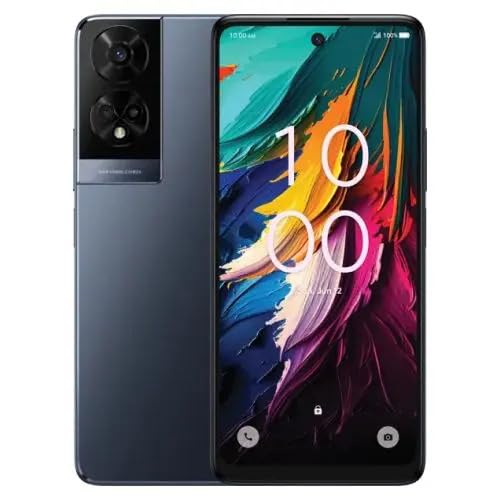
TCL 50 XE NxtPaper 5G — Best for eye comfort
The TCL 50 XE approaches battery life from an angle none of its rivals here consider: the screen itself. Its NxtPaper display has a matte, paper-like finish that cuts glare and reflections, and that finish changes how the phone is used across a day. Readers push brightness lower because the panel stays legible without it; commuters stop angling the phone against train windows; long documents, e-books and message threads stop feeling like staring into a torch. Lower brightness is lower draw, so a display technology sold on eye comfort quietly delivers an endurance dividend — and for people whose phone time is mostly reading, that dividend is the whole ballgame. This listing is the 128GB phone unlocked for Verizon, T-Mobile and AT&T, a genuinely multi-network budget handset.
TCL built its name on televisions, and the display-first thinking shows in the priorities: the panel is the product, the rest is sensible support. The battery is sized for the class and the processor is an efficiency-minded unit, so the phone’s stamina in reading-heavy use is stronger than its modest positioning suggests. It is also, frankly, the most pleasant phone here to hand to someone with tired eyes or a long commute — the paper texture is not a gimmick once you have read forty pages on it at midnight without the usual squint.
Balance demands the caveats. A matte paper-style panel trades away the punchy contrast and deep blacks that make video sparkle on glossy screens, so film fans will find the image softer than they expect. TCL’s software update track record is thinner than Samsung’s or Google’s, and the brand’s case and accessory ecosystem is smaller than the big names’. Performance is everyday-grade: fine for reading, messaging, browsing and video, unambitious for gaming. None of this matters to the reader this phone is for. If your battery dies because your screen never sleeps and your eyes ache before the charge does, the 50 XE is the most thoughtful answer in this guide.
- Line: TCL 50 series, XE NxtPaper variant
- Listing condition: Unlocked for Verizon, T-Mobile and AT&T as listed
- Memory and storage: 128GB storage as listed
- Battery character: Class-typical cell helped by a glare-free panel that runs comfortably at lower brightness
- Distinguishing feature: Matte NxtPaper display tuned for long reading sessions
Strengths
- Paper-like screen stays readable at lower brightness, stretching the battery for readers.
- Multi-network unlocked listing suits carriers across all three big US networks.
- Genuinely easier on the eyes during long text sessions than any glossy rival here.
Trade-offs
- Matte panel softens video contrast compared with conventional glossy displays.
- Update commitment and accessory choice lag the Samsung and Google entries.
- Everyday performance only — this is a reader’s phone, not a gamer’s.
Best for: Commuter readers, e-book devotees and anyone whose screen time is mostly text. Not suited for: Video-first users who want maximum contrast, or buyers wanting a long update runway.

Nokia G310 5G (Renewed) — Best low-cost route
Every guide needs its honest bargain, and this one arrives with its condition printed in its name: the Nokia G310 listing here is a Renewed phone, an HMD-built handset (model TA-1573, 128GB, in blue) that has been inspected and resold rather than shipped fresh from a factory line. That status changes the battery conversation in a way this guide will not fudge. A renewed battery is a used battery; its remaining capacity depends on the life it lived before you, so the right expectation is a solid day for a moderate user rather than the multi-day heroics of the new phones above. Priced as renewed phones are priced, that trade can be entirely sensible — you are buying dependable service, not a stamina record.
What the G310 brings beyond its price is the HMD philosophy at its best: a straightforward phone, a clean Android experience without bloat, and a design from the era when this maker talked seriously about repairability — screens and batteries that a careful owner could actually service rather than landfill. For a second phone, a teenager’s first 5G handset, a spare for the glovebox or a grandparent’s upgrade, that philosophy fits. The platform is modest, which cuts both ways: it will not thrill you, and it will not drain the battery chasing effects it cannot run. On light duties — calls, messages, maps, the occasional photograph — it simply gets on with it.
The cautions belong in plain sight. Check the Renewed grade and the battery-health terms on the listing itself before buying, and favour a seller whose renewed programme guarantees a minimum battery capacity. Software support for a phone of this generation is a short road now, so treat it as a purchase for the next couple of years rather than the next five. And the camera and screen are basic in the way budget phones of its year were basic. Held to the right standard — honest, simple, inexpensive service with a battery you verify on arrival — the G310 earns its place as this list’s low-cost route in.
- Line: Nokia G series by HMD, G310 5G (TA-1573)
- Listing condition: Renewed — inspected resale unit, not new
- Memory and storage: 128GB storage as listed, blue finish
- Battery character: Used cell — expect a dependable day, and verify health on arrival
- Software: Clean, near-stock Android with minimal bloat
Strengths
- The lowest-cost entry point in this guide to a big-name 5G phone.
- Uncluttered software and modest hardware sip rather than gulp.
- Repairable-minded design suits owners who fix rather than replace.
Trade-offs
- Renewed battery capacity varies by unit — stamina is a range, not a promise.
- Remaining software support is short at this point in the model’s life.
- Screen and camera are basic, even by the standards of this affordable list.
Best for: Second phones, first phones and spares bought with clear eyes about condition. Not suited for: Anyone needing guaranteed multi-day stamina or a long update future.
How do the six compare side by side?
| Phone | Condition | Endurance route | Watch out for |
|---|---|---|---|
| Moto G Power 2025 | New | Big-cell specialist tuning | Shorter update support |
| Pixel 9a | New | Largest a-series cell plus adaptive software | Unhurried charging |
| Galaxy A15 5G | New | Frugal platform, gentle draw | Patient performance |
| Moto G Stylus 5G 2024 | New | Big cell, bursty pen workload | 2024-era hardware |
| TCL 50 XE NxtPaper | New listing | Low-brightness matte display | Softer video contrast |
| Nokia G310 | Renewed | Modest hardware, low demands | Variable used-battery health |
Read the table as three different philosophies rather than a league ladder. Motorola and Google buy stamina with capacity — put a large cell in the phone and tune around it. Samsung and Nokia buy it with restraint — modest hardware that never asks the battery for much in the first place. TCL buys it with behaviour, a screen that lets you run dimmer for longer. All three philosophies work; the right one depends on whether your days are heavy, light or reading-shaped, which is a more useful question than which phone wins a laboratory drain test none of us lives in.
What should you check before choosing a battery-first phone?
Start with your signal, not the spec sheet. Look at the coverage where you actually live and work, and if your current phone spends its life on one or two bars, fix that first — a carrier change or a phone with the right band support will return more hours than any battery upgrade. Next, audit your screen habits honestly: the reader, the navigator and the video streamer are three different battery customers wearing one name. Readers should weight display efficiency, navigators should weight capacity plus charging speed for top-ups at stops, and streamers should weight capacity above all because the screen never sleeps.
Then think about year three on the day you buy. Ask how long the maker supports the phone with updates, whether the battery can be replaced and at what kind of cost, and whether the charging habits the phone encourages — fast top-ups, overnight slow fills — match your life. A phone with a replaceable or serviceable battery converts an eventual decline into a maintenance errand instead of a replacement purchase, and over a long ownership that difference dwarfs most launch-day distinctions. Finally, if you are considering the Renewed route, read the grade, the battery guarantee and the returns terms as carefully as the headline specifications; with used batteries, the paperwork is part of the product.
How can you make any of these phones last longer each day?
The highest-yield habit costs nothing: let the screen be dimmer. Auto-brightness with a manual nudge downward indoors, a shorter screen timeout, and a dark theme on OLED-family displays all shave the largest consumer in the system. The second habit is signal hygiene — download maps, music and podcasts over Wi-Fi before leaving, because a phone pulling media through a weak connection on a moving train is running its modem at full shout for hours. Aeroplane mode in genuinely dead zones is not defeat; it is refusing to pay charge for a connection that does not exist.
Third, discipline the background. Photo backup and app updates belong on Wi-Fi and, ideally, on charge. Location permissions should be audited seasonally, because apps accumulate them like pockets accumulate receipts. Fourth, treat heat as damage: no charging under pillows, no navigation mounts baking on a summer dashboard without shade, no fast charging when a slow overnight fill would do. And fifth, use the battery-care tools these phones already carry — charge limits and adaptive charging exist precisely to trade a few percent of today’s capacity for years of tomorrow’s. The goal is not to nurse the phone; it is to make the default settings do the nursing for you.
What mistakes do battery shoppers keep making?
Shoppers in this category most often go wrong by buying the biggest number and stopping there — choosing a phone for its cell size while ignoring the screen and processor that will spend it. Close behind comes judging endurance by the first week: new phones index, learn and settle, and a verdict formed on day two is a verdict about setup, not stamina. A third mistake is charging theatre — fast-charging several times a day because the phone allows it, cooking the cell in small daily instalments, then blaming the phone when year two disappoints.
Renewed buyers make a fourth mistake: reading the model name and skipping the condition terms, when the condition terms are the battery story. And nearly everyone makes the fifth — carrying a power bank habit from an old phone into a new purchase and buying stamina they then never use, paying in weight and cost for insurance against a day that no longer happens. Buy for the day you actually have, with headroom for the bad one, and the battery stops being a source of anxiety and becomes what it should be: the part of the phone you never think about.
How does charging speed change the battery equation?
Capacity is only half of stamina; the other half is how quickly a mistake can be undone. A phone that dies at four in the afternoon but refills meaningfully during a twenty-minute coffee stop lives a different life from one that needs an hour tethered to a wall. This is where the list quietly divides. The capacity-led Motorolas pair their big cells with charging brisk enough to make a lunch-break top-up a real strategy, and the restraint-led phones need charging less often in the first place. The Pixel 9a, as noted in its section, is the deliberate exception: Google tunes for longevity over refill drama, so its owners should build the overnight habit and let the large cell carry the day rather than planning around emergency stops.
There is a trade hidden inside fast charging that battery shoppers rarely hear about. Rapid charging generates heat, and heat is the battery’s long-term enemy, so a phone fast-charged twice daily for two years will usually show more capacity fade than the same phone slow-charged overnight. The sensible pattern for most owners is boring: slow charge overnight with adaptive features on, fast charge only when the day demands it. Think of fast charging as a spare tyre — invaluable when needed, a poor choice as the everyday wheel. The phones in this guide all support that pattern; the difference is how much you will need the spare, and that is decided by the headroom you bought.
Cables and bricks deserve one paragraph because they quietly decide whether the strategy works. Several makers now ship phones without a charger in the box, and an old low-power brick from a drawer can turn a capable phone into an overnight-only device. When you budget for any pick here, budget for one decent charger matched to the phone and one cable you trust, kept where the phone sleeps. It is the least glamorous purchase in this entire guide and the one most likely to be felt every single day.
What does a genuinely heavy day look like, phone by phone?
Imagine the same brutal itinerary handed to all six: off the charger at half past five, an hour of navigation through patchy suburbs, a morning of calls and hotspot-shared documents, photographs at a school sports day in hard sunlight, an afternoon of messaging storms, and a delayed train home navigated by live departure boards. The Moto G Power treats this as a Tuesday — its cushion is built for exactly this accumulation of small abuses. The Pixel 9a finishes the day with less drama than any a-series phone before it and the best photographs of the six by a wide margin, because its camera never asked the battery to fund a second attempt at any shot.
The Galaxy A15 survives the itinerary by never panicking: nothing in its workload spikes, its screen stays sensible, and it arrives at the delayed train with a calm reserve, though it will have taken its time opening the departure app. The Stylus spends the day differently — half its screen-on moments are thirty-second note captures — and bursty use flatters it, so it too reaches the evening intact, with the day’s measurements sketched on the photos to prove it. The TCL is the commuter’s friend on this route: the long reading stretches on the train cost it less than any rival because its matte screen never needed to fight the carriage lighting.
The Renewed Nokia asks for honesty here. On a unit with a healthy battery it completes the itinerary for a moderate user; on a tired unit, the hotspot hour and the navigation stretch will find the bottom of the cell before the train does. That is not a condemnation — it is the arithmetic of used batteries, and it is why this guide keeps steering heavy users to the new phones and keeps the G310 for the lighter duties where it serves happily. Match the phone to the day you actually have, and every pick on this list is the right pick for somebody.
Should you pay more for storage, or put the money toward stamina?
A quieter decision hides inside every listing here: the storage tier. Several of these phones are listed at 128GB and the Pixel at 256GB, and buyers often agonise over the gap. For battery purposes the answer is counterintuitive — storage you lack becomes battery you spend, because a phone perpetually full offloads photographs to the cloud over mobile data, re-downloads media, and nags you through your day. If you shoot video at family events or keep offline maps and music for poor-signal routes, the larger tier is a stamina feature wearing a storage costume. If your phone life is messages, browsing and streamed everything on strong Wi-Fi, save the money; the smaller tier will never make itself felt. Judge by your camera roll’s growth over the last year, not by the fear of a number on a box.
Why do two owners of the same phone report wildly different battery life?
Spend time in any phone forum and you will meet the paradox: one owner calls a model a two-day champion, another calls the identical model a by-lunch disappointment, and both are telling the truth. The gap is rarely the hardware. It is the accumulated difference between two digital lives — one lived on strong Wi-Fi in a temperate office, the other on fringe signal in a hot van; one with forty carefully chosen apps, the other with two hundred, a dozen of them phoning home hourly; one owner who reads, another who streams video at full brightness on a train that keeps handing the modem between towers. Battery life is a biography, not a benchmark, and the reviews that pretend otherwise are measuring the reviewer.
This is why the picks in this guide are described by behaviour and workload rather than by a single heroic number of hours. Screen-on time, the figure enthusiasts trade, depends on what the screen was doing — an hour of e-book reading and an hour of 3D gaming are both “an hour” the way a stroll and a sprint are both “a walk”. When you read any endurance claim, including the ones implied here, translate it into your own biography: your signal map, your apps, your brightness habits, your climate. The phone that wins your biography is the phone to buy, and it is frequently not the phone that wins a laboratory test conducted on aeroplane-mode video loops in a climate-controlled room.
There is a practical consequence for returns and regrets. If a new phone from this list disappoints in its first days, resist the instant verdict. Let it finish indexing, let adaptive systems learn, audit the battery page for the one app drinking out of proportion, and check whether your workplace sits in a coverage hole that no phone could survive gracefully. Most “bad battery” stories end as one rogue app, one fringe signal, or one brightness slider set by a shop display mode and never revisited. Fix those three and the phone you bought usually turns into the phone this guide described.
When is a power bank still worth carrying?
Even the best phone in this guide has a day that beats it: the festival weekend, the multi-leg travel day, the storm outage, the fishing trip where the camera never rests. A modest power bank remains honest insurance for those days, and buying one does not contradict anything above — it simply moves the headroom out of the phone for the rare occasion that needs it. What a power bank should not be is a daily prosthetic for a phone that cannot do its job; if you reach for it every afternoon, the phone was the wrong purchase, and the fix is a different phone from this list rather than a bigger brick. Buy the stamina first, the insurance second, and let each do the job it is good at.
Does a case or a screen protector change battery life?
Only at the margins, but the margins are real on hot days. A thick insulated case traps the heat a phone generates while charging or navigating, and a warm battery is a battery ageing in fast-forward; if your phone regularly charges in a hot car or works mounted on a summer windscreen, a slimmer case and a shaded mount are quiet battery investments. Glass protectors make no electrical difference at all, though a matte protector on a glossy phone can mimic a whisper of the TCL’s trick, letting you run a touch dimmer in glare. Treat accessories as thermal management, not decoration, and the cell inside will thank you across the years.
Final Recommendation
For most readers the Moto G Power 2025 is the answer this guide exists to give: a new, unlocked phone whose entire design brief is the thing you asked about, at the affordable end of the market. Choose the Pixel 9a instead if photographs matter as much as hours — it is the only phone here that tops both charts at once, and its update runway makes it the longest-lived purchase on the list. Samsung loyalists and light users should take the A15 5G and enjoy the quiet competence; pen workers should take the Stylus; readers should take the TCL and wonder why every screen is not matte. The Renewed Nokia is the right buy only with its condition understood and its battery verified on arrival — as a spare or a starter, it is honestly priced honesty. Whichever you choose, set it up gently, charge it kindly, and let the headroom you bought do its slow, invisible work across the years.
Frequently Asked Questions
Does a bigger battery always mean longer life?
No. Battery life is capacity divided by consumption, and consumption is set by the screen, the processor and the modem. A large cell behind a bright, hungry display can finish behind a smaller cell in a frugal phone, which is why this guide includes restraint-based picks like the Galaxy A15 alongside capacity-based picks like the Moto G Power.
How much does weak signal really cost?
More than most people expect. A phone straining to hold a distant tower raises its transmit power and retries constantly, and in genuinely poor coverage that behaviour can drain a battery several times faster than standby in good coverage. If your days are spent in low-signal buildings or rural routes, carrier fit is a battery specification.
Is a Renewed phone’s battery a gamble?
It is a range rather than a promise. Reputable renewed programmes test batteries and guarantee a minimum capacity, so read the grade and the guarantee on the listing, check the battery health when the phone arrives, and use the returns window if the unit falls short. The Nokia G310 in this guide is listed as Renewed, and we flag it wherever it appears.
Should I charge to 100 percent every night?
Batteries age slowest when they avoid living at the extremes, which is why several phones here offer charge limits or adaptive overnight charging that holds below full and tops up before your alarm. Using those features trades a sliver of daily capacity for a noticeably healthier battery in year two and three.
Does 5G drain more than 4G?
It can, particularly on weak 5G coverage where the phone works hard to hold the connection. In strong coverage the difference narrows. If stamina matters more than peak speed on a given day, most of these phones let you prefer LTE in settings — a legitimate trade for travellers crossing patchy country.
How long should an affordable phone’s battery last when new?
For the phones in this guide, a full working day is the floor, not the target. Heavy users should finish with a cushion on the capacity-led picks, and light users should see into a second day on the restraint-led ones. If a new phone cannot clear a normal day, the fault is usually signal, screen brightness or a runaway app — in that order.
Will a software update change my battery life?
Sometimes, in either direction. Updates can tighten background behaviour and improve efficiency, or briefly worsen drain while the phone re-indexes and relearns in the days after installation. Judge an update’s battery effect after a full week of normal use, not on the first anxious evening, and keep the phone on charge and on Wi-Fi overnight after a major update so the housekeeping happens while you sleep rather than out of your morning’s charge.
Related Guides
Keep exploring with our companion guides: best affordable unlocked smartphones for LTE buyers, Android phones built around a 5000mAh battery, and the best small Android smartphones for readers who want stamina without the slab.



[…] of virtues before the shopping begins — and our neighbouring smartphone guides frame it others: best affordable smartphones for the value field without a fixed frame, best affordable smaller smartphones if size competes […]