What's inside
- Where to Buy a Waterproof Compact That Will Survive Your Holiday
- Key Takeaways
- Quick Picks
- How Were These Rugged Cameras Chosen and Checked?
- Which Waterproof Compacts Deserve Your Money?
- How Do the Six Stack Up on Paper?
- What Should You Know About Water, Light and Seals Before the First Swim?
- How Do You Shoot Underwater Photographs That Are Worth Keeping?
- Which Ownership Mistakes Flood Good Cameras?
- Why Should a New Rugged Camera Be Tested Before the Trip That Matters?
- How Does Each Camera Suit a Different Kind of Trip?
- Final Recommendation
- Frequently Asked Questions
- Related Guides
As an Amazon Associate I earn from qualifying purchases. This post may contain affiliate links at no extra cost to you.
gizmoverdict.com is reader-supported. When you buy through links on our site, we may earn an affiliate commission.
Where to Buy a Waterproof Compact That Will Survive Your Holiday
The best point and shoot waterproof cameras occupy a strange and wonderful niche: they are the cameras you buy precisely because you do not trust the situation. Phones are water resistant until a seal ages, a case leaks or a wave arrives with sand in it. Action cameras are tough but wide-angled and screen-poor for ordinary holiday framing. A rugged compact, by contrast, is a real camera — zoom lens, proper flash, a sensor sized for more than social thumbnails — sealed inside a body rated to be submerged, dropped, frozen and sat on. That combination has kept this small category alive through the smartphone era, and the five linked cameras below are its current population, joined by one prose-only veteran whose discontinuation deserves an honest mention.
Two different philosophies divide the field. The OM System Tough TG-7, Ricoh WG-80 and Pentax WG-90 are adventure instruments: armoured, grip-textured, festooned with macro tricks and rated for depths between fourteen and fifteen metres, alongside crush, shock and freeze ratings for land abuse. The Kodak Pixpro WPZ2 is the friendlier holiday camera, waterproof to fifteen metres per its listing, with Wi-Fi sharing and a price of entry that reframes the whole purchase as cheap insurance. Then there is the SeaLife Micro 3.0, which must be described precisely: it is a dedicated underwater camera, permanently sealed, built for divers and snorkellers who want a device that lives in the water rather than visiting it. Calling it a general-purpose compact would mislead you, so this guide gives it its own honest role.
Depth ratings need translating before they impress you. Fourteen or fifteen metres covers snorkelling, pool play, surfing, kayaking and shallow reef swimming with room to spare — the overwhelming majority of recreational water photography happens in the first five metres, where the light is. What the rating buys beyond your actual depth is margin: seals age, O-rings collect grit, and a camera rated well past your usage shrugs off the small insults that drown a camera rated exactly at it. Buy margin, maintain seals, and these bodies will outlast several phones.
A word about expectations for image quality. Rugged compacts use small sensors behind slow zoom lenses, and physics collects its fee in low light and fine detail. What they return is availability: the photograph exists because the camera was in the pool, on the kayak, under the waterfall, in the snowstorm — places a delicate camera or a pampered phone simply was not. Judged on photographs that would otherwise not exist, this category is one of the best bargains in photography. Judged against a large-sensor camera on dry land at dusk, it will lose, and this guide will not pretend otherwise at any point below.
Key Takeaways
- The OM System Tough TG-7 is the most complete rugged compact here, pairing fifteen-metre waterproofing with freezeproofing, 4K video and a macro system that borders on the scientific.
- Ricoh’s WG-80 and Pentax’s WG-90 are close cousins built around ring-light macro, with the WG-90 adding an underwater shooting mode and a six-LED array.
- The Kodak Pixpro WPZ2 is the value route into genuinely submersible photography, with Wi-Fi sharing that holiday shooters actually use.
- The SeaLife Micro 3.0 is a sealed dive camera, not a family compact — superb underwater, deliberately specialised everywhere else.
- The Nikon Coolpix W300 appears without a link because it is discontinued; remaining stock is a condition lottery we will not recommend blindly.
- Rinsing in fresh water after salt exposure and keeping seals grit-free matter more to a rugged camera’s lifespan than any specification on its box.
Quick Picks
| Camera | Badge | Why it earned its slot |
|---|---|---|
| OM SYSTEM Tough TG-7 | Best rugged compact overall | It combines the deepest feature set in the class — macro modes, 4K video, freezeproofing — with a lens bright enough to matter underwater. |
| PENTAX WG-90 | Best macro ring light | Its six LEDs around the lens and dedicated underwater mode make it the close-up specialist for tide pools and reef shallows. |
| Ricoh WG-80 | Best work-and-play toughness | A proven jobsite-and-trail design with LED macro lights, bundled here with a card and accessories per its verified listing. |
| KODAK PIXPRO WPZ2 | Best value waterproof | Fifteen-metre waterproofing, a 16MP sensor and Wi-Fi sharing at the friendliest cost of entry in the category. |
| SeaLife Micro 3.0 | Best dedicated dive camera | A permanently sealed 64GB underwater camera with 4K video, built for people whose photography happens below the surface. |
| Nikon COOLPIX W300 | Prose-only: discontinued | Once the depth champion of this class, it is covered for context because remaining listings are ageing stock without a living warranty story. |
How Were These Rugged Cameras Chosen and Checked?
Verification came first, as it does across our camera coverage: a model receives a purchase link only when its listing was confirmed through our pool, with the complete listing title preserved in this article’s sources file. That rule is what pushes the Nikon W300 into prose. It was a genuinely important camera in this class, but it is discontinued, and the units still circulating are old stock whose seals have aged on shelves — the single worst thing that can happen to a waterproof camera before its first swim. Recommending it with a link would gamble your money on a stranger’s storage conditions.
Surviving candidates were judged on the four environments this category actually serves. Water came first: rated depth, the honesty of the rating’s context, and how the camera behaves at snorkelling distance in real light. Impact came second, because these cameras are dropped on boat decks, ski lifts and pool concrete more than they are drowned. Cold came third, since a ski camera whose battery and screen sulk at freezing temperatures is a fair-weather friend. Handling came fourth — buttons that work with gloves or wet fingers, menus that can be navigated with water on the screen, and a shape that can be gripped when everything is slippery.
We also weighted two unfashionable virtues: macro and manners. Macro matters because the underwater and shoreline worlds are full of small wonders — anemones, crabs, frost crystals, rock-pool shrimp — and the ring-light cameras in this guide photograph them better than many interchangeable-lens systems manage without accessories. Manners matter because a holiday camera is shared: it gets handed to children, borrowed by fellow travellers and operated by people who will never open its manual. A rugged compact that requires study before its first decent photograph has failed half its job, whatever its depth rating says.
Which Waterproof Compacts Deserve Your Money?

OM SYSTEM Tough TG-7 — Best rugged compact overall
The Tough line has been the reference point for rugged compacts for years, and the TG-7 — sold under the OM System name since the Olympus camera division changed hands — is its most refined expression. The headline figures from its verified listing sketch the shape: waterproof construction, freezeproofing, a high-resolution bright lens, 4K video and macro shooting of almost absurd ambition. In the hand it feels like a scientific instrument that happens to take holidays: dense, textured, with controls that click positively through wet gloves and a lens ring that accepts conversion accessories for wider or closer work.
Underwater, the TG-7’s advantage is its lens. A brighter maximum aperture than its rivals gather more of the scarce light below the surface, which translates directly into lower sensitivity settings, cleaner files and shutter speeds fast enough to freeze a fish’s decision to leave. Its underwater modes are tuned by people who clearly dive: white balance presets that restore reds the water steals, an underwater HDR approach for contrasty reef scenes, and microscope-style macro modes that focus almost at the front element, turning a tide pool into a studio. For snorkellers who come home caring about their photographs, this is the camera that rewards the caring.
On land, the TG-7 moonlights as the family’s abuse-proof compact: freezeproof for ski trips, crush-resistant enough for a backpack’s bottom, and equipped with sensors logging position and conditions for travellers who like their albums annotated. The compromises are the class’s usual ones — a small sensor that cannot match a phone’s computational tricks at dusk, a zoom range that ends where wildlife photography begins, and a price at the top of the category. But within the honest limits of what a sealed compact can be, nothing else here is as complete, and its owners tend to keep it for many years and several phones.
- Water rating: waterproof to 15 metres per the pool summary
- Cold rating: freezeproof construction for winter use
- Video: 4K recording listed among headline features
- Macro: extreme close-focus modes with accessory support
- Body: armoured compact with control ring around the lens
Strengths
- The brightest lens in this guide, and it shows in every underwater file.
- Macro capability turns shorelines and reefs into endless subjects.
- Freeze, crush and shock ratings make it a genuine four-season camera.
Trade-offs
- The highest price among the general-purpose compacts here.
- Small-sensor limits appear quickly in dim indoor light.
- Menus reward a reading session before the first trip.
Best for: snorkellers, divers staying shallow, skiers and travellers who want one camera that fears nothing on the itinerary. Not suited for: restaurant-and-city photographers whose evenings happen mostly on dry land at dusk.

PENTAX WG-90 — Best macro ring light
The WG-90 carries the Pentax name into a design lineage long associated with Ricoh’s rugged WG series, and its signature is the ring of six LED lights encircling the lens. That ring is not a gimmick. At the close distances where tide-pool and reef photography lives, a camera’s own body shadows the subject and a top-mounted flash blasts one side while abandoning the other; a ring of light around the optic wraps the subject evenly, letting the camera expose textures — coral polyps, shell ridges, a crab’s armour — that other compacts flatten. Its verified listing also calls out a dedicated underwater shooting mode alongside shockproof, dustproof and freezeproof ratings.
Above water, the WG-90 presents itself as the outdoorsman’s compact: a chunky, glove-friendly body, a wide end suited to landscapes and group shots around a campfire, and digital microscope ambitions inherited from its line. The design philosophy is tool-like rather than jewel-like, which suits its natural owners — anglers, hikers, field workers, parents of children who treat cameras as throwable objects. It is the kind of camera that lives in a truck’s centre console or a fishing vest and is simply there, working, when the moment surfaces.
Against the TG-7 it concedes lens brightness and the depth of the video and macro systems, and its per-frame polish in ordinary daylight is a half-step behind the class leader. What it returns is value and specialisation: the ring light is the best in the category for its specific magic, the body ratings cover the same abuse envelope for most users, and the price of entry is friendlier. Buyers whose water time is mostly shallows, pools and shorelines — where macro subjects live — may honestly prefer it to the flagship, and this guide regards that preference as taste rather than error.
- Water rating: waterproof to 14 metres per the pool summary
- Lighting: built-in six-LED ring light for macro work
- Modes: dedicated underwater shooting mode in the listing
- Ratings: shockproof, dustproof and freezeproof per the listing
- Handling: chunky glove-friendly adventure body
Strengths
- Ring-light macro produces close-ups no rival here can match for evenness.
- Underwater mode simplifies settings for snorkelling sessions.
- Tool-like build suits worksites, boats and family chaos equally.
Trade-offs
- Lens brightness trails the TG-7, showing in deeper or darker water.
- Everyday daylight files are good rather than class-leading.
- The macro specialisation is wasted on purely scenic shooters.
Best for: tide-pool explorers, snorkellers who shoot close, and outdoor workers wanting a camera that doubles as a field tool. Not suited for: travellers who mostly photograph distant scenery and city skylines.

Ricoh WG-80 — Best work-and-play toughness
The WG-80 is the WG-90’s close cousin from within the same corporate family, and the resemblance is deliberate: this design has been refined across generations of jobsite, trail and shoreline service. Its verified listing describes a rugged waterproof body with shockproof and freezeproof credentials, Full HD video and LED macro lights, and notes that this particular listing bundles a memory card and further accessories. That bundle detail matters practically — a camera that arrives with storage and extras can be swimming the same afternoon it lands on the doorstep.
Where the WG-80 distinguishes itself is temperament. It is the least precious camera in this guide: a tool whose styling, grip and control layout all assume gloves, grime and hurry. Construction crews document progress with this line; farmers, surveyors and delivery drivers keep them in cabs; families buy them because a camera that survives a building site will survive a toddler. The LED macro lights serve inspection work as happily as reef work, illuminating serial plates, pipe joints and rock-pool residents with the same even ring.
Kept to honest account, the WG-80’s imaging is a generation’s step behind the TG-7 in lens brightness and processing polish, its video tops out at Full HD per the listing rather than 4K, and buyers comparing spec sheets will find the WG-90’s underwater mode and six-LED array the more evolved expression of the same idea. The WG-80’s counter-argument is price, availability and proven toughness — it is frequently the sensible purchase for a camera that will be treated as equipment rather than as an heirloom, and there are more such buyers than spec-sheet debates admit.
- Water rating: waterproof to 14 metres per the pool summary
- Video: Full HD recording per the verified listing
- Lighting: LED macro lights around the lens
- Bundle note: listing includes a 64GB card and additional accessories
- Ratings: shockproof and freezeproof compact design per the listing
Strengths
- Arrives ready to work, with storage included in this listing.
- Proven jobsite toughness at a friendlier price than the flagship tier.
- Macro lights serve inspection and nature close-ups alike.
Trade-offs
- Video resolution stops at Full HD where the TG-7 offers 4K.
- Imaging polish trails the newest expressions of its own family.
- Bundle contents vary by listing, so check what a given offer includes.
Best for: tradespeople, field crews and families wanting a camera that can be treated as gear rather than treasure. Not suited for: video-first creators who need 4K from their rugged body.

KODAK PIXPRO WPZ2 — Best value waterproof
The WPZ2 reframes the rugged compact as an impulse-priced insurance policy, and its verified listing carries a quietly impressive set of numbers for that role: waterproof to fifteen metres, a 16MP sensor, 4x zoom, 1080p Full HD video, Wi-Fi sharing, a 27mm wide-angle lens and shockproofing to two metres. Read plainly, that is the full holiday brief — pool, beach, boat, waterpark — covered by a camera whose loss or destruction would sting for a day rather than ruin a trip’s budget. For many families, that reframing is the entire argument, and it is a good one.
In use, the WPZ2 is the friendliest body here. Its controls assume no expertise, its wide end flatters group shots in cramped pool decks and boat cockpits, and Wi-Fi sharing moves photographs to a phone without the card-reader ritual that kills holiday momentum. Children can be trusted with it in a way that changes the photographs a family brings home: the underwater portrait of a parent, shot by a nine-year-old at the bottom of the pool, exists because the camera was cheap enough to hand over. Cameras earn their keep by being present, and presence follows from replaceability.
The compromises are the honest shadows of its price. The sensor and lens cannot match the TG-7’s underwater clarity, low-light files soften quickly, freeze and crush credentials are thinner than the adventure flagships’, and the whole experience is tuned for snapshots rather than craft. None of that matters at the waterpark. It matters on a once-in-a-decade reef trip, where the WPZ2 should be the second camera rather than the only one. As the class’s value anchor and the family’s designated risk-taker, it is exactly right.
- Water rating: waterproof to 15 metres per the verified listing
- Sensor and lens: 16MP with 4x zoom from a 27mm wide end
- Video: 1080p Full HD per the listing
- Sharing: built-in Wi-Fi for phone transfers
- Shock rating: shockproof to two metres per the listing
Strengths
- Genuine fifteen-metre waterproofing at the class’s friendliest entry cost.
- Wi-Fi sharing keeps holiday photographs moving to phones effortlessly.
- Cheap enough to hand to children, which creates photographs flagships never get.
Trade-offs
- Image quality falls behind the adventure flagships in dim water.
- Cold and crush protection are lighter than the TG-7’s envelope.
- Snapshot-tuned controls offer little room to grow technique.
Best for: families, waterpark regulars and travellers wanting waterproof insurance without flagship money. Not suited for: a once-in-a-lifetime reef expedition as the only camera in the bag.
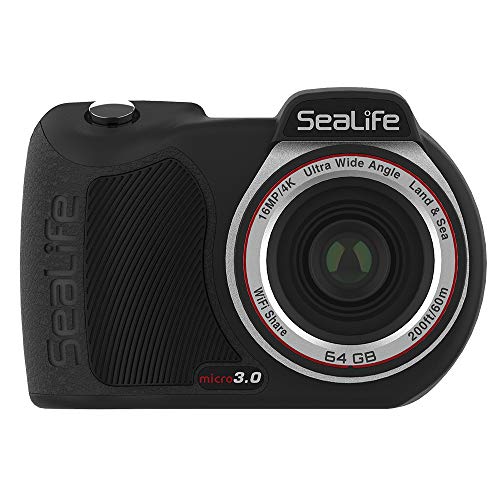
SeaLife Micro 3.0 — Best dedicated dive camera
Precision about roles matters most with this pick, so let it be said at the top: the SeaLife Micro 3.0 is not a general-purpose compact that happens to swim. It is a permanently sealed underwater camera — no doors to open, no battery to remove, no memory card to swap — designed by a company whose entire business is underwater imaging. Its verified listing describes a 64GB internal capacity, a 16MP sensor and 4K underwater video, with wireless transfer for moving files off a body that never opens. Everything about it trades terrestrial convenience for aquatic certainty.
The sealed design eliminates the category’s number-one killer: the compromised door seal. Every other camera here depends on a user closing a hatch perfectly over an O-ring free of sand and hair; the Micro 3.0 has no hatch, so the failure mode simply does not exist. For divers and dedicated snorkellers, that certainty compounds across hundreds of immersions, and the camera’s underwater colour handling and accessory ecosystem — SeaLife’s lights and trays are a whole world — serve people who photograph below the surface as a primary practice rather than a holiday novelty. Its piano-key controls are designed for gloved hands and housings-free operation at recreational depths far beyond the compacts’ ratings envelope in spirit, if judged as a diving tool.
The specialisation cuts the other way on land, and buyers must accept the terms. A sealed battery means a depleted camera charges as a whole unit and cannot be revived with a swap; internal storage means offloading happens wirelessly or by cable rather than by card; and the fixed-lens, underwater-first tuning makes it an eccentric choice for birthdays and street scenes. None of that is a flaw — a scalpel is not a flawed knife — but a family buying it as their only camera has misread the label this section is trying to make unmissable. Buy it for the water, where it is arguably the most serious device in this guide, and let a phone handle the restaurant.
- Design: permanently sealed body with no user-opened doors
- Storage: 64GB internal capacity per the verified listing
- Sensor and video: 16MP stills and 4K underwater video per the listing
- Transfer: wireless offloading, since the body never opens
- Ecosystem: built for underwater lights and tray accessories
Strengths
- No door seals to fail, removing the top cause of flooded cameras.
- Underwater-first tuning and accessories serve committed divers properly.
- Glove-sized controls work where touchscreen compacts struggle.
Trade-offs
- Sealed battery and storage cannot be swapped mid-trip.
- Land photography is an afterthought in its design priorities.
- The price buys specialisation a casual snorkeller may never use.
Best for: divers and serious snorkellers whose camera lives underwater more than on land. Not suited for: a family’s only camera, or the swap-a-battery, swap-a-card style of shooting.
Nikon COOLPIX W300 — Prose-only: discontinued
The W300 earns its place in this guide as a ghost at the table. When it sold new, it was the depth champion of the consumer class, rated far deeper than the fourteen-to-fifteen-metre norm, with 4K video and Nikon’s handling polish, and it remains the camera many shoppers arrive here hoping to buy. It is included so that those shoppers hear the essential fact from us rather than from a disappointing parcel: Nikon discontinued it, the new-stock pipeline has run dry, and what remains in listings is ageing inventory whose waterproof seals have spent years on shelves.
Seal age is not a technicality. The gaskets that keep a waterproof camera alive are perishable, and a camera that has sat boxed through several summers may carry a depth rating its rubber no longer honours. A used W300 from an owner who maintained it, or old stock from a retailer who will stand behind it, can still be a fine tool — but that judgement requires inspecting a specific unit and its seller, which a link in a guide cannot do. Hence prose, praise and a warning, in that order.
- Status: discontinued, remaining stock is ageing inventory
- Historical role: former depth leader of the consumer rugged class
- Video in its day: 4K recording with Nikon’s compact handling
- Risk: shelf-aged seals may not honour the original depth rating
- Buying route: only with inspection and a seller who stands behind it
Strengths
- A genuinely excellent design that defined this class’s ambitions.
- Deep-water rating beyond the current mainstream, when seals are sound.
- Nikon ergonomics that many owners still prefer to today’s options.
Trade-offs
- No living warranty story behind most remaining listings.
- Perished seals turn a depth rating into a historical document.
- Support and accessories thin out further every year.
Best for: Nikon loyalists buying a specific, inspected unit from a seller they trust. Not suited for: anyone ordering blind for a trip that starts next week.
How Do the Six Stack Up on Paper?
| Camera | Linked | Water depth | Video | Signature strength |
|---|---|---|---|---|
| OM SYSTEM Tough TG-7 | Yes | 15 m class | 4K | Bright lens, extreme macro |
| PENTAX WG-90 | Yes | 14 m class | Full HD class | Six-LED ring light, underwater mode |
| Ricoh WG-80 | Yes | 14 m class | Full HD | Jobsite toughness, bundled kit |
| KODAK PIXPRO WPZ2 | Yes | 15 m | 1080p | Value, Wi-Fi sharing |
| SeaLife Micro 3.0 | Yes | Dive-first sealed design | 4K | No seals to fail, underwater ecosystem |
| Nikon COOLPIX W300 | No — discontinued | Deepest in its day | 4K in its day | Historical benchmark, seal-age risk |
Two lessons hide in those rows. The first is that depth ratings have converged: the mainstream now lives at fourteen to fifteen metres because that envelope covers recreational reality, and the interesting competition has moved to lenses, lights and macro. The second is that the SeaLife refuses the table’s logic entirely — its depth story is about a design philosophy rather than a number, which is why comparing it by the metre column alone misunderstands what a sealed dive camera is for.
Video tells a similar story of convergence with one outlier of intent. The TG-7 and the Micro 3.0 offer 4K for keepers; the WG pair and the Kodak serve the Full HD reality of holiday clips destined for phones and family screens. Buyers planning serious underwater video should also budget attention for lighting, because below a few metres, colour and contrast are limited by the water itself far more than by any sensor in this guide.
What Should You Know About Water, Light and Seals Before the First Swim?
Water edits light aggressively. Red wavelengths vanish within the first few metres, which is why uncorrected underwater photographs lean blue-green, and why the better cameras here carry underwater white-balance modes that put the warmth back. Shoot closer than you think — water between lens and subject is fog you cannot remove later — and prefer the sunlit shallows where this class of camera produces its postcard frames. A waterproof compact at two metres on a bright reef will embarrass a flagship phone at ten metres in murk, because position beats specification underwater every single time.
Seals are a maintenance relationship, not a feature. Before every swim, run a fingertip around the battery and card door gaskets of the openable cameras, evicting sand grains, hairs and lint, and close the door with deliberate pressure. After salt water, soak or rinse the closed camera in fresh water, work the buttons gently under the rinse to flush grit from their collars, and let it dry before opening anything. The SeaLife’s sealed body skips the gasket ritual but still wants its rinse and its lens port cleaned. Ten calm minutes of this after each beach day is the difference between a five-year camera and a one-summer anecdote.
Are depth ratings measured the way you will use the camera?
Ratings are earned in controlled static conditions, while real use adds movement, impact and pressure changes — jumping into a pool spikes pressure on seals beyond the static equivalent of the depth, and surfing subjects a camera to repeated slaps of aerated water. This is why experienced owners treat the printed rating as a ceiling with margin built in, not a target: a fifteen-metre camera used at three metres has margin for the cannonball, the dropped retrieval and the ageing gasket. It is also why a freshly purchased camera deserves a shallow, supervised first immersion — a sink or a pool edge — before it is trusted over a reef.
How do these cameras cope with cold and snow?
The adventure trio — TG-7, WG-90 and WG-80 — carry explicit freezeproof credentials in their listings or pool summaries, and the class generally tolerates skiing better than phones do, since there is no giant glass touchscreen to fog, crack or drain. Battery output still sags in deep cold, so keep the camera in an inside pocket between runs and carry it warm to the lift. Condensation is the returning-home hazard: a cold camera brought into a warm lodge will fog internally if opened too soon, so let it acclimatise sealed in its bag before touching doors or cards.
How do battery life and charging behave on the road?
Rugged compacts sip power compared with phones, but water days are long and video is thirsty, so plan the energy the way you plan the film in an instant camera. A full day of snorkelling with regular 4K clips on the TG-7 or the Micro 3.0 deserves a charged spare or a midday top-up, while snapshot use of the WG pair or the WPZ2 comfortably spans a beach day on one charge. The SeaLife’s sealed design means charging happens through its external contacts or cable arrangement with the body whole — simple, but impossible to shortcut with a borrowed battery, which is one more reason its owners travel with a power bank as standard kit. Cold weather rewrites all of these numbers downward, and the inside-pocket rule from the snow section applies to spare cells as much as to the camera itself.
Charging discipline has a waterproofing dimension that catches travellers out. A camera must be dry — genuinely dry, including inside the door recesses — before it is opened for charging or card access, and humid bathrooms are the worst place to perform that ritual. Establish a dry station away from the pool bag: towel, shade, ten patient minutes. Owners who treat the dry station as part of the swim, rather than as an interruption to the holiday, are the ones whose cameras survive to a second and third trip.
How Do You Shoot Underwater Photographs That Are Worth Keeping?
Get close, then get closer, then check you are not about to kneel on something alive. Underwater sharpness and colour are rationed by distance, so the working range of this entire camera class is arm’s length to about two metres. Compose with the sun behind you where possible, since front-lit subjects keep their colours while backlit ones become silhouettes against the glitter. Shoot slightly upward at fish and swimmers to include the bright surface in the frame, which gives underwater images their characteristic sense of another world — and shoot bursts, because subjects with fins do not take direction.
On the surface intervals, manage the lens port like a pair of glasses. A droplet on the port becomes a soft moon in every frame, so lick-or-wipe discipline — a drop of water spread evenly, or a dry microfibre kept in a sealed pocket — separates keepers from rejects more reliably than any setting. Set the camera’s underwater mode before entering rather than fumbling menus with wet hands, lock in the macro mode for pool and tide-pool sessions, and review the first frames of each session at full size on the camera screen to catch port droplets and seal warnings early, while the session can still be saved.
Above all, respect the environment that makes the photographs possible. No frame justifies standing on coral, chasing a turtle or feeding wildlife for a pose, and the ruggedness of these cameras is a promise to survive accidents, not a licence to treat reefs as furniture. The best underwater photographers move slowly, touch nothing and leave subjects calmer than they found them — and their portfolios, incidentally, are always the strongest.
Which Ownership Mistakes Flood Good Cameras?
Opening a door with wet or sandy hands is the flood that ends most rugged compacts, and it is always impatience wearing a disguise. The camera surfaces from a dive, the owner wants the card or the battery immediately, and a single grain under the gasket converts the next swim into a funeral. The ritual that prevents it costs nothing: dry the camera fully, in shade, with doors closed, and only then open anything — and never open a camera on the beach itself if it can possibly wait for the hotel.
Trusting a rating instead of a margin is the second killer. Buyers read fifteen metres, plan a fourteen-metre dive on a camera with three summers of gasket wear, and discover the difference between laboratory conditions and their own maintenance history. Keep dives honest and shallow relative to the rating, retire or service cameras whose doors feel loose, and treat any camera that has taken a hard drop onto concrete as a suspect swimmer until it has passed a shallow test. Rugged cameras forgive abuse; they do not forget it.
The third mistake is buying the wrong temperament for the trip. A sealed dive specialist as the family’s only holiday camera frustrates everyone at the birthday dinner; a value snapshot body as the sole recorder of a Galápagos cruise underserves a journey that will not repeat. This guide’s six entries are roles — flagship, macro tool, workhorse, value companion, dive instrument, retired champion — and matching role to itinerary is the decision that determines whether the camera comes home loved or listed for sale.
Why Should a New Rugged Camera Be Tested Before the Trip That Matters?
Every camera in this guide should earn its owner’s trust in shallow, forgiving water before it is asked to perform over a reef or under a waterfall. The test is simple and slightly ceremonial: inspect the seals, close the doors, take the camera into a pool or even a filled sink area where retrieval is trivial, shoot a dozen frames including a burst and a short video, then dry it completely and inspect the compartments for any trace of moisture. A camera that passes has demonstrated its seals, its controls and its owner’s loading routine in one rehearsal. A camera that shows condensation or a damp gasket has delivered the most valuable warning in photography, at the cheapest possible price.
The rehearsal has a photographic half as well. Use it to learn where the underwater mode lives in the menu, how the screen reads through a mask’s worth of squinting, whether your gloves can work the zoom, and how the lens port behaves with droplets. Families should hand the camera to the children during the rehearsal too, because the grip and button layout that suit an adult may defeat small hands, and discovering that at home leads to a wrist strap and a briefing, while discovering it on a boat leads to a story nobody wanted. Photographers planning macro work should rehearse the ring light or microscope modes on coins and shells in a washing-up bowl; the technique is identical in a tide pool and far easier to debug at a kitchen table.
Finally, rehearse the evening routine, not just the swim. Rinse the camera, dry it, open it, move the day’s photographs to a phone or laptop, and confirm the files are what you hoped before the card is cleared. Trips fail photographically in the evenings as often as in the water — a corrupted transfer discovered at home, a week of files on a single card lost on the last day. Owners who build the nightly backup habit during the rehearsal carry it through the trip without thinking, and their albums survive accidents that have nothing to do with waterproofing at all, which is why the rehearsal, humble as it sounds, separates the owners who come home with a camera full of photographs from the owners who come home with a story about a camera.
How Does Each Camera Suit a Different Kind of Trip?
Abstract rankings become clearer when they are forced through real itineraries. Take the family beach fortnight first: two adults, children of assorted ages, a pool, a waterpark day and one boat trip. The Kodak WPZ2 is the natural citizen of that fortnight, cheap enough to live in the beach bag, simple enough for every family member, and connected enough to keep grandparents supplied with photographs each evening. The TG-7 would take better reef photographs on the boat day, but it would also spend the fortnight being guarded, and guarded cameras take fewer photographs. Families who snorkel seriously as a unit — older children, a reef on the doorstep — flip the answer and should buy the flagship once rather than the value body twice.
The dive-centred trip inverts everything again. A liveaboard week or a resort stay built around daily diving wants the SeaLife Micro 3.0 as the primary instrument, with its sealed certainty and its light-and-tray ecosystem, and treats a rugged compact as the surface-interval companion for the boat and the beach bar. Attempting the same week on a door-sealed compact is not impossible — generations of divers did exactly that — but every dive begins with a gasket inspection and ends with a rinse ritual, and the cumulative anxiety is a real cost that the sealed design simply deletes. Divers should also note the social geometry: a dedicated underwater rig signals seriousness to dive buddies and guides, who will point out the good subjects to the photographer they believe can capture them.
The winter trip — skiing, snowboarding, a northern-lights excursion — belongs to the freezeproof trio, and among them the choice is about hands. Gloved operation favours the WG bodies’ chunky controls; photographic ambition favours the TG-7’s lens and macro modes for frost and ice detail; budget realism may favour whichever of the three is bundled best at purchase time. What winter punishes is the unprepared battery, so the trip’s real accessory is a second cell carried warm. The Kodak, lacking the same cold credentials, should stay in milder itineraries where its value can shine without a blizzard auditing its claims.
The worksite rotation deserves its own paragraph because it is the use case nobody photographs for brochures. Surveyors, builders, adjusters and inspectors need a camera that documents conditions in rain, dust and cold, that a rotating cast of employees can operate without training, and whose loss is an expense line rather than an incident. That is the WG-80’s home ground, with the WG-90 beside it when close-up evidence — cracks, corrosion, serial plates under the ring light — is the deliverable. Office-bound reviewers consistently underestimate how large this buyer group is; the WG line’s longevity in the catalogue is their footprint.
Which accessories genuinely earn their space in the bag?
The float strap has already been praised and deserves its repetition here: it is the highest-value object in this entire category relative to its cost. After it comes a hard or padded pouch, because rugged ratings cover drops, not a year of rattling against keys and tools in a bag’s bottom. A spare battery matters for the cold-weather and heavy-video users, a fast, good-quality memory card matters for the 4K bodies, and a small dry-bag for the camera’s land transport keeps sand out of the equation during the journeys between swims. Underwater lights transform results for the SeaLife ecosystem and for TG-7 divers working below a few metres, but they are a second purchase to make after the first trip reveals whether the interest is real. Filters, novelty mounts and elaborate cases mostly serve the retailer’s margin rather than the photographer’s album.
Should you insure or simply accept the risk?
Rugged compacts sit in an odd insurance niche: they are bought to be risked, yet valuable enough that loss stings. The honest calculus runs through replacement cost and trip importance. A WPZ2 on a family holiday is self-insured by its price — that is its charm. A TG-7 or a Micro 3.0 travelling to a remote reef justifies either a rider on household insurance or at least a photographed record of serial numbers and a backup plan for the photographs themselves, which are the truly irreplaceable cargo. Whatever the paperwork, the cheapest insurance in this category remains behavioural: the float strap worn, the wrist loop used, the camera never set down on a boat’s edge for just a second.
Final Recommendation
Most buyers should take the OM System Tough TG-7: it is the most capable, most protective and most rewarding rugged compact in production, and its lens and macro system will still be teaching its owner new tricks in year three. The Pentax WG-90 is the close-up artist’s alternative and the Ricoh WG-80 the working tool’s, while the Kodak Pixpro WPZ2 is the easiest recommendation in the guide for families who want waterproof photographs without a flagship’s commitment. The SeaLife Micro 3.0 stands apart on purpose, the right answer for divers and the wrong one for generalists, and the Nikon W300 stands as a reminder that even champions retire. Choose by the water you actually swim in, maintain the seals like you mean it, and the camera you buy from this page should still be taking photographs in places your phone would not dare to go, long after that phone has been replaced twice.
If a single sentence could carry this guide’s whole argument, it would be that a waterproof compact is bought for the photographs that bravery makes possible: the wave taken at face height, the child’s first duck-dive, the reef at dawn before the boats arrive, the summit in weather that empties the viewpoint of everyone sensible. None of the six entries here is the best camera in any absolute sense, and each is, in its assigned water, the camera most likely to be present when the moment happens. Presence is the specification that never appears on a box. Buy for presence, rehearse before the trip, rinse after every swim, and this unfashionable little category will repay you in the only currency photography ultimately deals in — pictures that exist.
Frequently Asked Questions
Can a waterproof compact replace a phone on holiday?
For photography in and around water, yes, and it should — that substitution is the category’s purpose. For communication, navigation and evening photographs in restaurants, the phone remains the better tool, and most owners carry both, letting each do what it is sealed or computed to do. The compact’s gift is freedom: the phone stays dry in the room safe while the camera goes down the waterslide.
How deep can a snorkeller actually go with a 14 or 15 metre camera?
Recreational snorkelling happens at the surface and in brief duck-dives of a few metres, far inside these ratings. The margin is the point: it absorbs entry jumps, wave slap and seal ageing. Freedivers and scuba divers descend beyond this class’s comfort and should look to dedicated dive equipment such as the SeaLife line or housings, rather than stretching a holiday compact past its design.
Do I need a housing for any of these cameras?
Not for their rated depths — the bodies are the housing. Housings enter the conversation for deeper scuba use, for mounting serious lights and filters, or for protecting an older camera whose seals you no longer fully trust. For the pool, reef shallows, surf and snow that define this category’s real life, the naked camera plus a wrist float strap is the complete kit, and every housing conversation should start by asking what specific depth, light or lens requirement the naked body genuinely cannot meet on the trip actually being planned, rather than on the expedition of the imagination.
What is a float strap and why does everyone recommend one?
It is a bright, buoyant wrist strap that keeps a dropped camera at the surface instead of on the seabed. Most rugged compacts are denser than water and sink with real determination, usually in the exact moment a wave rearranges a swimmer’s priorities. The strap costs very little, weighs nothing and converts the commonest underwater camera loss into a non-event, which is why experienced owners treat it as part of the camera rather than an accessory. Choose a strap in a colour visible against blue water, check its buoyancy with your specific camera in a pool before trusting it in the sea, and replace it when its foam compresses or its stitching frays, because a float strap is itself a consumable with a service life. Boat crews, who retrieve more dropped holiday cameras than anyone, will tell you the pattern never varies: the cameras that come back up are wearing orange, and the ones that do not are wearing nothing at all.
How long do waterproof seals last?
With rinsing, grit discipline and shaded storage, the gaskets on the openable cameras here serve for years; with beach-bag neglect, a single season can compromise them. Warning signs are doors that close too easily, visible gasket flattening or debris that returns immediately after cleaning. Manufacturers of this class have historically offered seal servicing, and a camera destined for an important trip deserves that attention if any doubt exists. Owners can extend seal life meaningfully on their own: store the camera with doors closed but unlatched pressure relieved where the design allows, keep it out of gloveboxes and sun-baked bags, and never use solvents or lubricants on a gasket unless the maker specifies them, because the wrong grease swells the very rubber it was meant to protect. Treated as a perishable component with a service life — like a tyre rather than a chassis — the seal stops being a source of mystery failures and becomes simple scheduled care, which is all that separates the cameras that flood from the cameras that merely age.
Is a rugged compact better than a waterproof phone case?
For photography, comfortably. A case puts a layer of plastic or glass in front of a phone’s lens, traps reflections, makes touchscreens unreliable when wet and leaves the phone one seal failure away from a very expensive afternoon. A rugged compact has a lens designed for the water, physical controls that work with wet hands and a body whose loss would not also erase your boarding passes, banking app and holiday communication. Cases have their place for a quick pool snapshot; a camera is the answer for a trip built around the water.
Can these cameras be used by children safely?
They are among the few cameras that should be given to children deliberately. The shock ratings absorb the drops, the sealed bodies absorb the pool, and the simpler models — the WPZ2 above all — ask nothing of a young photographer beyond pointing and pressing. Add the float strap, brief them on not opening any doors, and rinse the camera yourself in the evening. The photographs children bring back from inside the pool, at their own eye level, are frequently the ones families treasure most from the whole trip.
Related Guides
Travellers building a full camera kit may also enjoy our survey of the best instant digital cameras for prints that develop on the spot, and our honest account of the best wide instant cameras, where a shrinking format is given the straight treatment it deserves. See also wide instant cameras.


