Our Top Picks



What's inside
- How a watch ECG works
- What a single lead watch ECG can and cannot show
- Clearance, age limits, and regional availability
- The major implementations compared
- Heart rate accuracy is a separate question from ECG
- Skin contact, fit, and moisture as measurement variables
- Battery life and sensor trade offs
- Who benefits, and the honest limits
- Exporting tracings and talking to a clinician
- Choosing between the ECG implementations
- Setup and first reading checklist
- Common misunderstandings
- Questions to answer before buying
- How the waveform itself should be read by a lay wearer
- Watch ECG compared with patch monitors and clinical recorders
- Travelling, changing phones, and keeping the feature working
- Caring for electrodes and the watch back
- Check prices on Amazon
- Special situations: older wearers, carers, and shared information
As an Amazon Associate I earn from qualifying purchases. This post may contain affiliate links at no extra cost to you.
A smartwatch with an ECG feature, sometimes labelled EKG in older terminology, records the electrical activity of the heart from the wrist using dry electrodes built into the watch case, bezel, crown, or button. The wearer completes the circuit by touching that electrode with a fingertip from the opposite hand, and the watch app records a tracing, usually for thirty seconds, then classifies the rhythm it can recognise or reports that the reading is inconclusive. That is the whole mechanism, and understanding it clearly is the best protection against both dismissing the feature as a gimmick and trusting it as a diagnosis.
This guide is based on manufacturer documentation and published specifications, including the support pages, user manuals, and regulatory summaries published by Apple, Samsung, Fitbit, and Withings for their ECG capable models. Those documents describe electrode placement, recording length, classification categories, heart rate ranges for classification, age restrictions, and the conditions under which a reading cannot be taken. Where a capability depends on a phone application, a country, or a software version, this guide says so, because an ECG feature that exists in hardware but is not enabled in the wearer region is not an available feature in any practical sense.
The watches covered here approach the same measurement from different industrial designs. Apple Watch places electrodes in the Digital Crown and in the back crystal. Samsung Galaxy Watch models use a button or bezel related electrode arrangement depending on generation, paired with the Samsung Health Monitor application. Fitbit has offered ECG in the Sense line and in the Charge tracker line, using metal surfaces on the device that the wearer touches with both hands. Withings ScanWatch takes a hybrid approach, combining a conventional analogue watch appearance with electrodes in its bezel and case, long battery life, and a health application that stores the tracings. The differences between them are not cosmetic; they affect how a reading is taken, how results are explained, and how a tracing reaches a clinician.
How a watch ECG works
The heart beats because electrical signals spread through its muscle in a coordinated pattern, and electrodes on the skin can detect the small voltage changes those signals produce. A clinical electrocardiogram uses multiple electrodes placed across the chest and limbs to view that activity from twelve angles, called leads. A smartwatch has one practical viewpoint, between the wrist wearing the watch and the fingertip touching its electrode, which corresponds roughly to Lead I in clinical terminology. Manufacturers describe watch recordings as single lead ECGs, and that single word, single, carries most of the limitations discussed later in this guide.
The electrodes are dry, meaning they press against skin without the conductive gel used in clinical settings. On an Apple Watch, documentation describes the electrode in the Digital Crown and the electrodes in the back of the watch, so resting a fingertip on the crown closes the circuit through the body. On a Galaxy Watch, the wearer touches the designated button with a fingertip while the back of the watch sits against the wrist. On Fitbit ECG models, the wearer holds metal corners or surfaces with fingers from both hands. On the Withings ScanWatch, the wearer grips the bezel or places fingers as the application instructs while electrodes in the case back contact the wrist. In every case the second contact point is essential; wearing the watch alone, without the fingertip, does not produce an ECG.
A typical recording lasts thirty seconds. The application counts down, instructs the wearer to sit still, rest the arms, and keep the watch snug and the fingertip lightly in contact. Movement, talking, a loose strap, dry skin, or a finger pressing too hard can introduce noise that obscures the waveform. At the end of the recording the application analyses the trace and presents a result, which may be a classification such as sinus rhythm or atrial fibrillation, a statement that the heart rate is too high or too low for classification, or an inconclusive result. The tracing itself is stored in the paired health application, where it can usually be viewed and exported.
The watch does not record an ECG continuously. Heart rate monitoring runs in the background using optical sensors, but an ECG is a deliberate spot check that the wearer starts and performs. That distinction matters for expectations: a watch can be worn all day and night and still have no ECG tracing for the moment a symptom occurred, unless the wearer opened the application and took a reading at that moment. Some watches prompt the wearer after detecting an irregular rhythm notification from the optical and algorithmic monitoring, which is the intended workflow in manufacturer documentation, but the ECG itself remains an on demand measurement.
What a single lead watch ECG can and cannot show
The classification offered by cleared watch ECG applications is narrow by design. The central distinction in the documentation is between sinus rhythm, meaning the tracing shows the regular pattern the algorithm expects, and atrial fibrillation, an irregular rhythm in which the upper chambers of the heart quiver instead of contracting in an organised way. Atrial fibrillation matters because it is common, it can occur without symptoms, and it is associated with increased stroke risk, which is why a spot check that can flag a possible episode has genuine value when its result is passed to a clinician.
A watch ECG cannot show most other cardiac conditions. A single lead tracing from the wrist cannot reliably identify a heart attack, cannot map where in the heart a problem originates, cannot measure the intervals and segments across the chest that clinicians use to diagnose many conduction disorders, and cannot exclude atrial fibrillation that was not happening during the thirty seconds recorded. Manufacturer documentation states these limits in plain terms, including warnings that the application is not intended to detect heart attack or stroke and that a reassuring result does not rule out disease. Those warnings are not legal decoration; they describe the physical limits of one viewpoint and one brief sample.
Inconclusive results are a normal part of the system, not a failure of the wearer. Watch ECG applications specify a heart rate range within which classification is offered, commonly with a lower boundary around fifty beats per minute and an upper boundary that varies by manufacturer and generation, often around one hundred and twenty beats per minute. Above or below that range the application may record the tracing but decline to classify it, because the algorithms were validated within the stated range. A fast heart rate after climbing stairs or during illness will therefore often produce an inconclusive result, which is the application behaving as documented rather than malfunctioning.
Other rhythms and conditions also produce inconclusive readings. Frequent extra beats, a pacemaker, certain known arrhythmias, and poor signal quality can all prevent classification. Documentation for the major applications advises users who already know they have a condition other than atrial fibrillation that the application is not intended for them, or that its classifications do not apply to their situation. Anyone with an implanted device or a diagnosed arrhythmia should follow their own clinician guidance about whether a watch ECG adds anything, because for them the answer may honestly be that it does not.
Clearance, age limits, and regional availability
Watch ECG applications are regulated software. In the United States, the ECG applications from the major manufacturers have received clearance from the Food and Drug Administration for specific uses, specific classifications, and specific populations, and the cleared wording defines what the application may claim. Clearance is not the same as approval of the watch as a medical device for diagnosing heart disease, and the cleared indications consistently describe an aid to distinguishing atrial fibrillation from sinus rhythm in adults, not a general cardiac diagnosis tool. Readers should look for the exact cleared indication for the model and application version they are considering, because indications have expanded and changed across generations.
Age restrictions follow from the validation studies. The major ECG applications specify that they are not intended for people under twenty two years of age, because the algorithms were not validated in younger populations and atrial fibrillation is rare in that group. A watch may physically record a tracing for a younger wearer in some regions or versions, but the classification carries no validated meaning there. Parents considering a watch for a teenager with palpitations should understand that the ECG application is not the tool its marketing might suggest for that situation, and that a clinician can arrange appropriate monitoring directly.
Regional availability is the other practical gate. Because the ECG application is regulated as medical software in many jurisdictions, manufacturers enable it country by country as local authorisations are obtained. A watch bought in one country may show no ECG application until the paired phone region, account region, and software versions align with an authorised market. Samsung ECG additionally depends on a Galaxy phone with the Samsung Health Monitor application in many configurations, while Apple ECG depends on the paired iPhone and its region settings. Checking the manufacturer availability list for the exact country of use, before purchase, prevents the common disappointment of owning capable hardware with the headline feature switched off.
Software versions matter for the same reason. ECG features have arrived on some models through updates, and classification improvements have been delivered as application updates that change the heart rate range or the handling of inconclusive results. Keeping the watch, phone, and health applications updated is therefore part of owning the feature, and manufacturer release notes are the reliable source for what an update changes. Conversely, a reader comparing two watches should compare them at their current documented state, not at the state promised in a launch announcement.
The major implementations compared
Apple Watch
Apple documentation for the ECG application covers Series 4 and later models with the electrical heart sensor, excluding certain lower cost models that lack it, and describes taking a recording by opening the ECG application, resting the arms, and holding a fingertip on the Digital Crown for thirty seconds. The electrodes are the crown and the back crystal. Results appear on the watch and are stored in the Health application on iPhone, where the waveform can be viewed and exported as a PDF for a clinician. Apple classifies results into categories that include sinus rhythm, atrial fibrillation, inconclusive, and high or low heart rate, with the documented classification range and version specific additions described in its support material.
The strengths of the Apple implementation are integration and export. The tracing, symptoms the wearer chooses to log, heart rate data, and irregular rhythm notifications live in one health record, and the PDF export is straightforward. The constraints are the iPhone requirement, the regional availability of the application, and the fact that optical heart rate and ECG remain separate systems with separate accuracy questions. Battery life on Apple Watch models is measured in hours to a small number of days depending on model and use, so a wearer who wants overnight data as well as daytime ECG spot checks must build charging into a routine, typically while washing or dressing.
Samsung Galaxy Watch
Samsung documentation describes the ECG function on Galaxy Watch models equipped with its bioelectrical impedance and electrical heart sensors, taken through the Samsung Health Monitor application by resting a fingertip lightly on the designated button for thirty seconds while sitting still. The result categories mirror the industry pattern of sinus rhythm, atrial fibrillation, and inconclusive, with heart rate boundaries stated in the application. Recordings are stored in Samsung Health Monitor, and reports can be shared from the phone as documents for clinical review.
The defining constraint of the Samsung implementation is its phone pairing. In many markets the ECG function requires a Samsung Galaxy phone, because Samsung Health Monitor is distributed for Galaxy devices, which means the watch ECG is not available in the same form to users of other Android phones even though the watch itself pairs more broadly for other features. Readers for whom ECG is the main reason to buy should treat the phone requirement as part of the product specification, confirm the exact watch generation carries the sensor, and confirm their country appears on Samsung availability list before relying on the feature.
Fitbit Sense and Charge lines
Fitbit introduced ECG in the Sense line and later brought an ECG application to the Charge tracker line, and its documentation describes holding the metal surfaces or corners of the device with fingers and thumb for thirty seconds while remaining still. The result is presented as signs of atrial fibrillation or a normal sinus rhythm, or as inconclusive, and readings are stored in the Fitbit application where they can be reviewed in the health assessments area and shared as a report. The form factor is the interesting difference: a Charge device is a narrow tracker rather than a full smartwatch, so ECG is available to wearers who do not want a large watch face.
Fitbit ownership of the wider platform by Google means account requirements and application details have changed over time, and some features sit behind subscription tiers while the ECG application itself is described separately in Fitbit help material. Readers should verify, for the specific Sense or Charge generation, whether the ECG application is available in their country, what phone operating systems it supports, and how the report export works in the current application version. Battery life on these devices spans several days, which suits wearers who want sleep and activity data alongside occasional ECG readings without daily charging.
Withings ScanWatch
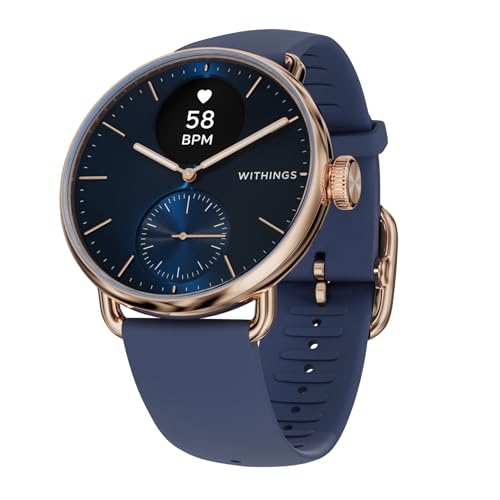
Withings ScanWatch is a hybrid watch with analogue hands, a small display, and electrodes integrated so that the wearer can record an ECG by placing fingers on the bezel as the application instructs, with the case back against the wrist. Withings documentation emphasises a thirty second recording, classification focused on atrial fibrillation detection, and storage in its health application with the ability to share a PDF of the tracing. The ScanWatch line also offers blood oxygen measurement and sleep tracking in a case that looks like a conventional watch, which is its main appeal.
Battery life is where the ScanWatch diverges most sharply from the other implementations, with Withings publishing figures measured in weeks rather than days for typical use. That longevity comes from the small display and the absence of a full smartwatch application platform, so notifications, replies, and third party applications are limited compared with Apple or Samsung watches. For a wearer whose priority is health spot checks, including ECG, in a watch that rarely needs charging and can be worn continuously, that trade is rational. For a wearer who wants a phone on the wrist, it is not.
Shoppers who are still deciding whether health tracking or general smartwatch features matter more to them will find broad comparisons such as best activity smartwatches helpful for the activity side of the question, because an ECG sensor does not make a watch good at workout tracking. Step counts, GPS accuracy, sport modes, and coaching features vary independently of the ECG hardware. A watch should be chosen for the combination a wearer will actually use weekly, not for a single sensor that may be used monthly.
Heart rate accuracy is a separate question from ECG
Smartwatches measure heart rate optically for most of the day. Light from the back of the watch enters the skin, and a photodetector measures changes in reflected light as blood volume pulses with each beat, a technique called photoplethysmography. That optical system produces the continuous heart rate graph, resting heart rate trends, workout intensity data, and the irregular rhythm notifications that may prompt an ECG. Its accuracy depends on skin contact, fit, movement, tattoos, skin tone, temperature, and the activity being performed, and it is generally strongest at rest and during steady exercise and weakest during rapid arm movement or interval efforts.
An ECG measures something different. It records electrical activity directly, so its heart rate is derived from the actual electrical beats during the recording, and its waveform shows the shape of each beat from the single lead viewpoint. Judging a watch by its optical heart rate performance in a workout review therefore says little about its ECG quality, and judging it by a clean ECG at rest says little about its heart rate accuracy during rowing or weight training. Manufacturer documentation treats the two systems separately, with separate sensors, separate limitations, and separate regulatory status, and buyers should do the same.
Irregular rhythm notifications sit between the two systems. Apple, Samsung, Fitbit, and Withings each describe background monitoring that analyses pulse data collected optically, sometimes over extended periods, and notifies the wearer of patterns suggestive of atrial fibrillation. A notification is not a diagnosis and is not an ECG; it is a prompt to take an ECG if the watch offers one, or to seek clinical assessment. Documentation also notes that notifications are disabled or unavailable for users who have already reported a diagnosis of atrial fibrillation in some implementations, because the feature is designed to surface unknown possible episodes rather than to monitor a known condition.
Skin contact, fit, and moisture as measurement variables
Every variable that affects an optical heart rate reading affects an ECG reading differently, and the ECG list is dominated by contact quality. The watch back must sit flat and snug against the wrist, not tight enough to be uncomfortable and not loose enough to slide. The fingertip on the crown, button, or bezel should rest lightly and consistently; pressing harder does not improve the signal and can add muscle noise. Sitting with the arms supported, as the applications instruct, removes the tremor and movement that are the most common cause of a noisy or inconclusive tracing.
Moisture cuts both ways. Slightly moist skin can improve electrical contact for dry electrodes, which is why some manufacturer guidance suggests ensuring hands are not excessively dry, while a wet wrist after swimming or a shower can create erratic contact and is a documented reason to wait and dry the skin and the watch. Lotions, sunscreen, and dirt on the electrodes or the case back interfere with both optical and electrical sensors, so cleaning the watch as the manufacturer directs, with a soft cloth and without harsh chemicals, is part of measurement hygiene rather than cosmetics.
Anatomy and environment add further variation. Very hairy wrists, tattoos under the sensor, cold hands that reduce peripheral circulation for the optical system, and electrical interference from some environments can all degrade readings. Cold is particularly relevant to spot checks taken outdoors in winter, where a wearer investigating palpitations may get an inconclusive ECG and a poor optical reading at the same time. Moving indoors, warming the hands, drying the skin, and retaking the reading while seated removes most of these variables, and a tracing taken under those conditions is far more useful to a clinician than one taken while walking in the cold.
Consistency of technique matters when readings are compared over time. Taking ECG spot checks in the same position, at a similar time relative to symptoms, with the same watch fit, produces a series a clinician can interpret. A folder of tracings taken in random conditions, some noisy and some clean, with no symptom notes, is much harder to use. The applications allow symptom logging alongside recordings in several implementations, and using that field for palpitations, dizziness, breathlessness, chest discomfort, or the absence of symptoms turns a bare waveform into clinical information.
Battery life and sensor trade offs
An ECG recording itself uses little power; thirty seconds of measurement is trivial beside a bright always on display, cellular radios, GPS workouts, and music streaming. The real trade off is between the watch platforms that offer ECG. Full smartwatches from Apple and Samsung pair the feature with large displays, application stores, and short charging cycles, so the wearer must plan charging around sleep tracking and daily wear. Fitbit devices stretch that cycle to several days with smaller displays and fewer general purpose applications. The Withings hybrid stretches it to weeks by giving up the large display almost entirely.
Continuous wear is what makes spot checks and background notifications valuable, because palpitations do not schedule themselves around a charging cable. A watch that spends every night on a charger cannot record sleep data and cannot be on the wrist for a symptom that occurs overnight, although an ECG still requires the wearer to wake and take it deliberately. Households choosing between implementations should therefore count realistic worn hours per day, not headline battery figures, and should prefer the watch they will actually keep on their wrist. Published battery estimates from manufacturers assume specific usage mixes, and enabling always on display, cellular, and frequent GPS can reduce them substantially.
Sensor packages interact in other ways. Adding blood oxygen estimation, skin temperature sensing, electrodermal activity sensing on some Fitbit models, and fall or crash detection increases the health picture a watch can build, but each sensor has its own limitations and none of them upgrades the ECG from single lead to multilead. Marketing that bundles sensors into a general impression of medical capability should be resisted. The ECG remains a thirty second single lead recording with a narrow classification, however many other sensors share the case, and its documentation should be read on its own terms.
Budget shoppers comparing platforms will inevitably look at value focused categories such as best affordable android smartwatches while researching, and that research is worthwhile for displays, battery, and general features, with one warning attached. Many affordable Android compatible watches advertise heart rate and even ECG style graphics without a cleared ECG application, validated classification, or the electrode design described in this guide. A heart rate graph is not an ECG, and an unvalidated tracing that labels rhythms without regulatory clearance is worse than no label at all, because it invites confidence it has not earned.
Who benefits, and the honest limits
The clearest beneficiaries are adults with intermittent symptoms that are hard to capture. Palpitations that occur for a few minutes at unpredictable times often vanish before a clinical appointment, and even a twenty four hour clinical monitor can miss episodes that happen weekly. A watch that is already on the wrist lets the wearer record a tracing during the symptom, and a series of such tracings, exported and given to a clinician, can shorten the path to a proper diagnosis considerably. Manufacturer case material and clinical guidance both describe this spot check role, and it is the use case where the technology earns its place.
A second group is adults whose clinician has asked for spot checks. After a diagnosis, during medication changes, or while investigating whether symptoms correspond to rhythm changes, a clinician may welcome watch tracings as supplementary information between appointments. The key word is supplementary. The clinician remains responsible for diagnosis and treatment, may arrange a clinical ECG, a longer patch monitor, blood tests, or imaging, and will treat the watch data as one input. Wearers should ask their clinician directly whether watch ECG recordings are wanted, in what format, and how often, rather than assuming more data is always better.
The limits deserve equal emphasis. A watch ECG is not a diagnostic device for the wearer to self manage a heart condition. It cannot detect a heart attack, and anyone with chest pain, severe breathlessness, fainting, or a racing heart that will not settle should seek emergency care rather than taking repeated watch readings. It cannot provide false reassurance responsibly: a sinus rhythm result during thirty calm seconds does not exclude atrial fibrillation at other times, structural heart disease, or any condition outside its single lead view. Documentation from every major manufacturer states that people who feel unwell should seek medical attention regardless of what the application reports.
False positives carry costs too. An atrial fibrillation classification in a low risk wearer can be wrong, particularly with a noisy tracing, and the anxiety and cascade of appointments that follow are real burdens. This is one reason the applications are not intended for younger users and why clinicians interpret a watch classification in the context of the person, their risk factors, and a confirmatory clinical tracing. The healthiest mental model is that the watch raises or lowers a question; it never settles one. Wearers who understand that tend to use the feature calmly and occasionally, which is exactly the pattern its designers describe.
Privacy and data handling form a quieter limit. ECG tracings, heart rate histories, and symptom notes are health data, stored in manufacturer accounts and phone health records, and shared according to the permissions the wearer grants to applications. Before enabling integrations that send health data to third party services, a wearer should read what is shared and with whom, and should treat an exported PDF like any other medical document when sending it. None of this is a reason to avoid the feature, but it is part of owning a device that records the heart.
Exporting tracings and talking to a clinician
Data export is where the implementations differ in ways that matter clinically. Apple stores ECG waveforms in the Health application and offers a PDF export designed for sharing with a doctor, showing the tracing, the classification, the date and time, and the heart rate. Samsung Health Monitor produces a report from the phone that can be shared in document form. Fitbit provides a wellness report route through its application for assessments including ECG results. Withings offers PDF sharing of ECG recordings from its application. In each case the exported document, not a screenshot of the watch face, is the artefact a clinician can file and compare.
A useful export package contains more than the PDF. The dates and times of symptoms, what the wearer was doing, any medication taken, caffeine or alcohol intake, and whether the episode resolved on its own all help a clinician interpret a tracing. Several applications allow symptom entry at the time of recording, which is the easiest moment to capture that context accurately. Wearers who record a tracing during palpitations and add two lines of context produce something genuinely useful; wearers who accumulate dozens of unlabelled normal readings taken from curiosity produce a haystack.
Frequency of checking is worth discussing openly. Taking an ECG occasionally during symptoms, or as a clinician directs, is the documented purpose. Taking one many times a day in search of reassurance tends to increase anxiety and inconclusive results, and some clinicians advise patients explicitly on this point. If checking becomes compulsive, that is information to share with the clinician as well, because the goal is a wearer who feels more informed and less worried, not the reverse. The watch is a tool with a narrow job, and using it within that job keeps it helpful.
Readers choosing a watch mainly as an everyday timepiece for men, with health features as a secondary benefit, may be cross referencing best mens smartwatches for case sizes and strap options alongside this guide, which is a reasonable way to shop as long as the ECG specifics are settled here. Case size affects electrode contact and comfort during sleep, and strap material affects fit consistency, so the style decision and the health decision are not entirely separate. A watch that is slightly less elegant but worn comfortably every day will produce better health data than a beautiful watch left in a drawer.
Choosing between the ECG implementations
iPhone owners who want the tightest integration between watch, phone health records, and PDF export will find the Apple implementation the natural fit, provided their country supports the application and they accept daily or near daily charging. Android owners should begin with the phone in their pocket: Galaxy phone owners can consider the Samsung implementation on its merits, while owners of other Android phones should check whether a given Galaxy Watch ECG configuration will work for them at all, and may be better served by Fitbit or Withings, whose applications run across both major phone platforms.
Wearers who dislike the appearance and charging rhythm of a full smartwatch have two honest alternatives. A Fitbit Charge line device provides the ECG application in a slim tracker with multi day battery life and a strong activity and sleep platform, at the cost of a small screen and limited smartwatch features. A Withings ScanWatch provides ECG in a conventional looking hybrid with battery life measured in weeks, at the cost of most smartwatch behaviour. Neither compromise is a defect; they are different answers to the question of what a wrist device is for, and both keep the ECG itself at the same single lead, thirty second standard.
Anyone whose main interest is a single watch that does a bit of everything, from notifications to workouts to occasional health checks, will be comparing the same shortlist that appears under best all around smartwatches in general buying research, and the ECG lens adds three specific filters to that comparison. First, is the ECG application cleared and enabled in the buyer country for that exact model. Second, does the electrode design suit the buyer hands and habits, whether that is a crown, a button, device corners, or a bezel. Third, can the buyer export a proper PDF tracing from the phone application without a subscription or workaround they find unacceptable.
Setup and first reading checklist
Setup begins with the phone. Install or update the manufacturer health application, pair the watch, and follow the ECG onboarding, which in the major implementations includes confirming age eligibility, reading the limitations, and in some cases answering questions about prior diagnosis. That onboarding is not bureaucratic filler; it is where the application establishes whether its classifications are intended for this wearer at all. Skipping the reading and tapping through produces owners who expect the watch to detect conditions it explicitly does not claim to detect.
The first reading should be taken calmly, seated, with the watch snug on the wrist it is normally worn on, the arms resting on a table or lap, and the fingertip resting lightly on the electrode for the full countdown. The result, whatever it is, establishes a baseline and proves the technique works for that wearer hands and skin. If the first attempt is inconclusive, the documented remedies are mundane: dry or warm the hands as appropriate, tighten the strap by one notch, sit still, and try again. Repeated inconclusive results in good conditions are worth raising with the manufacturer support channels, because electrode faults, while uncommon, do occur.
After the first successful reading, open the phone application and find the tracing. Confirm where it is stored, practise producing the export, and check what information the export contains. Doing this before a symptomatic episode means that, on the day a tracing actually matters, the wearer already knows how to capture and send it. It also reveals any regional or account problem with the feature while the watch can still be returned or exchanged, rather than months later when the feature is first needed.
Common misunderstandings
The most persistent misunderstanding is that a watch ECG replaces a clinical ECG. It does not, and no manufacturer claims it does. A clinical twelve lead recording views the heart from twelve angles with gel electrodes placed by a trained person, interpreted in the context of an examination and history. A watch recording is one angle, dry electrodes, thirty seconds, and an algorithm with a narrow classification task. The watch is valuable precisely because it is present at moments the clinic cannot be, not because it equals the clinic.
A second misunderstanding treats a normal result as a certificate of health. Sinus rhythm for thirty seconds means the rhythm in that window looked regular to the algorithm. It says nothing about blood pressure, cholesterol, valve disease, heart muscle health, or rhythms at other times. Wearers with risk factors still need the screening and follow up their clinician recommends, and a watch should never be the reason an appointment is cancelled or a symptom is dismissed.
A third misunderstanding concerns detection claims for other features. Fall detection, crash detection, blood oxygen estimates, sleep staging, and readiness scores are separate systems with separate evidence bases, and their presence in the same watch neither strengthens nor weakens the ECG. Evaluating each feature against its own documentation, rather than against a general feeling that the watch is medically advanced, is the discipline this guide has applied to the ECG throughout, and it serves buyers well across the whole category.
Questions to answer before buying
Is the ECG application available in your country, on this exact model, with your phone? Are you in the adult population the application is intended for, and free of a prior diagnosis that the documentation says makes it unsuitable? Which electrode design will you find easiest to use calmly during symptoms? How will you export a tracing, and has your clinician said they want them? How many hours a day will you realistically wear the watch, given its charging needs, and does that coverage include the times your symptoms usually occur?
Those questions expose the real differences between the watches in this guide far better than a specification table alone. Two watches can list the same ECG feature and differ completely in usefulness to a particular wearer because of region, phone, battery rhythm, or export friction. Conversely, a wearer who answers the questions clearly may find that a tracker or hybrid serves their health goals better than the flagship smartwatch, at lower cost and with less charging, which is a perfectly good outcome.
Finally, consider what happens if the feature finds something. A wearer should know, before the first atrial fibrillation classification appears on their wrist at midnight, what they will do with it: note the symptoms, save and export the tracing, and contact their clinician or local medical advice service within a sensible timeframe, or seek urgent care if symptoms demand it. Having that plan in advance turns a potentially frightening notification into a managed piece of information, which is the most that any consumer health technology should promise.
How the waveform itself should be read by a lay wearer
A watch ECG tracing is a line that rises and falls with each heartbeat, and even a wearer with no medical training benefits from knowing its basic anatomy as manufacturers present it in their educational material. Each beat normally shows a small rounded wave, then a sharp tall spike, then a broader rounded wave. The small wave reflects the upper chambers activating, the spike reflects the main pumping chambers activating, and the final wave reflects those chambers recovering. The regularity of the spacing between spikes is what the eye notices first, and it is also what the classification algorithm examines most closely when it distinguishes a regular sinus pattern from the irregularly irregular pattern associated with atrial fibrillation.
That basic anatomy also explains why noise is so damaging. A sharp spike produced by a wrist movement can imitate an extra beat, and a wandering baseline caused by poor contact can hide the small wave entirely. When an application labels a tracing inconclusive, it is often because these features could not be identified reliably enough for the validated algorithm to run. Wearers should resist the temptation to interpret a noisy tracing themselves by counting spikes on a phone screen. The exported PDF viewed by a clinician, who can judge signal quality and context together, is the correct route for any tracing that looks unusual.
Heart rate reported with the ECG is an average over the recording, which is why it can differ from the instantaneous optical reading shown a minute earlier. During a thirty second recording in which the rate slows as the wearer sits down and relaxes, the average sits between the starting and ending values. That is normal arithmetic, not a sensor disagreement. Clinicians reading the export expect an average, and the tracing itself shows the beat to beat variation behind it, including whether the rate changed smoothly or abruptly during the recording.
Watch ECG compared with patch monitors and clinical recorders
A clinician who needs more than spot checks has several established tools, and understanding them clarifies what a watch is for. A patch monitor is a small recorder stuck to the chest and worn continuously for days or up to two weeks, capturing every beat including during sleep and exercise, without any action by the wearer. An event recorder is carried or worn and activated during symptoms, or records automatically when it detects an abnormal rhythm. An implantable loop recorder sits under the skin for selected patients with rare but serious episodes such as unexplained fainting, monitoring for months or years.
Against those tools the watch has one advantage and several disadvantages. Its advantage is presence over an unlimited period: it is already bought, already worn, and available during an episode that happens months after a two week patch has been returned. Its disadvantages are that it records only when activated, only for thirty seconds, only from one lead, and only when contact conditions allow. A negative or inconclusive watch history therefore carries far less weight than a negative patch recording, and a clinician investigating serious symptoms will not accept watch data as a substitute for continuous monitoring when continuous monitoring is indicated.
The two approaches combine well in practice. A watch tracing that captures a clear episode can justify fitting a patch to measure how often the rhythm occurs and how long episodes last, which are the questions that guide treatment. A patch finding can also explain symptoms that a wearer never managed to record on the watch. Framing the watch as the first rung of a ladder, rather than as a rival to clinical equipment, matches both manufacturer documentation and the way cardiology services actually work through a diagnostic problem.
Travelling, changing phones, and keeping the feature working
Travel exposes the regional logic of ECG applications. A watch whose ECG was enabled in its home market generally continues to function while travelling, because enablement is tied to the device, account, and phone configuration established at setup, but manufacturer policies differ and have changed over time. A wearer who buys a watch abroad, changes phone region, or replaces a phone while travelling can find the application missing until the configuration again matches an authorised market. Anyone who relies on the feature should set it up and verify it at home, well before a trip, and should not perform first time setup in a country where the application is not offered.
Changing phones is the other moment the feature quietly disappears. The ECG application, its onboarding, and the stored tracings live partly on the phone, so a phone upgrade requires re-pairing, restoring or re-enabling the health applications, and confirming that historical tracings have transferred. Cloud backups from Apple, Samsung, Fitbit, and Withings each handle health data according to their own settings, and a wearer who values a long tracing history should verify that history after any phone change rather than discovering a gap when a clinician asks for an older recording.
Caring for electrodes and the watch back
Electrodes and optical sensors share the same physical surfaces, so care instructions overlap. Manufacturers direct owners to clean the back of the watch and any metal contact surfaces with a soft, lint free cloth, slightly dampened with water if needed, and to dry the device before charging or wearing it again. Solvents, abrasive materials, and ultrasonic cleaners are excluded in the manuals. Sweat after exercise, sunscreen in summer, and soap residue from washing hands under a watch all accumulate exactly where the sensors sit, and a weekly cleaning rhythm keeps both heart rate and ECG contact consistent.
Straps influence measurement more than their fashion role suggests. A strap that has stretched, a metal bracelet that cannot be adjusted finely, or a loose hook and loop band all allow the watch to move during a recording. Many owners who take health features seriously keep a sport strap for exercise, sleep, and ECG spot checks, because it adjusts in small increments and holds the case flat, and change to a formal strap for occasions when no measurement matters. That simple habit removes a large share of inconclusive results without any change of watch.
Water resistance ratings are often misunderstood in this context. A watch rated for swimming can survive immersion, but manufacturers still advise drying it before taking an ECG, and the rating itself declines with age, impacts, and exposure to heat or chemicals. A cracked case back or a damaged crown seal compromises both water resistance and sensor contact. After any drop onto a hard surface that chips the back crystal, a wearer should treat subsequent readings with suspicion until the device has been inspected, because the electrode surface itself may be the damaged part.
Check prices on Amazon
Live listings for the shortlist in this guide are pulled from Amazon below, so prices and availability are always current at the moment you look.


Special situations: older wearers, carers, and shared information
Older adults are the group with the highest prevalence of atrial fibrillation, and also the group most likely to struggle with small touch targets, onboarding flows, and export procedures. For an older wearer, the best ECG watch may be the one a family member can help set up, with the largest crown or button target, the clearest result wording, and an export route the wearer has practised. Some platforms allow health data sharing with a family member or directly within a health record system, and setting that sharing up in advance, with the wearer consent, means a concerning tracing can reach both clinician and family without the wearer wrestling with file attachments.
Carers should understand the boundaries of that sharing. Receiving a notification or a tracing does not make a family member responsible for interpreting it, and the agreed response to a worrying result should be the same clinical route the wearer would use alone. Agreeing that plan in advance, including who is contacted and in what order, prevents a well meant sharing feature from producing panic at a distance. It also respects the wearer autonomy: health sharing can usually be limited or revoked, and the wearer choices about their own data govern.
Tremor, arthritis, and reduced sensation in the fingers all affect the fingertip contact an ECG requires. A wearer who cannot hold a light, steady contact for thirty seconds may produce repeated inconclusive results through no fault of technique, and for them a clinician arranged monitor is likely to be more productive than persistence with a watch. Trying the feature in a shop or with a borrowed device, where possible, is a sensible test for anyone with a condition affecting the hands, because electrode designs differ enough that a wide bezel may be manageable where a small crown is not.
When you use a retailer link from this page and complete a qualifying purchase, this site may receive a commission that supports its documentation based guides, and the price you pay is not increased by that arrangement.
Choose the watch whose ECG you can actually enable, wear every day, and record calmly during the moments that matter, because a single well taken tracing placed in a clinician hands is worth more than a specification sheet full of sensors on a watch that was charging in another room.


