What's inside
- Key Takeaways
- Quick Picks
- How were these picks chosen?
- Comparison table
- How do you choose between matte, anti-glare, and outdoor?
- Living with the sun: a day in a bright room, tested
- Common mistakes in bright-room television buying
- Curtains, placement, and the free fixes that multiply a good panel
- The science in brief: nits, matte, and why both exist
- Art mode as a design discipline, not a screensaver
- Outdoor installation notes for the SYLVOX route
- The sun moves: seasons, hours, and planning for the worst week
- Heat: the variable hiding inside the sunlight problem
- Bright rooms are social rooms: gatherings, games, and daytime events
- A short field test you can run before spending anything
- Final recommendation
- Frequently asked questions
As an Amazon Associate I earn from qualifying purchases. This post may contain affiliate links at no extra cost to you.
gizmoverdict.com is reader-supported. When you buy through links on our site, we may earn an affiliate commission.
Where to buy: The televisions in this sunlight guide sell through Amazon, and several are specialty products — art televisions with frames and mounts in the box, and outdoor televisions built to weatherproof standards — so read each listing closely for exactly what is included, since a frame, a wall mount, or a wireless connection box may be part of one package and an accessory on another.
Searching for the best smart tvs for rooms with lots of sunlight usually begins at a specific hour of a specific day, when the afternoon sun swings onto the screen and the film the household sat down to watch becomes a mirror showing the couch, the windows, and everybody’s squinting faces. Sunlight defeats televisions two ways at once: it reflects off the glass, and it floods the room with ambient light that washes contrast out of the picture. This guide is organized around the three honest engineering answers to that double problem. The first route is the matte art television, which scatters reflections with a textured, low-glare surface and disguises itself as framed artwork when idle. The second is the premium anti-glare panel, which attacks reflections with coatings and brightness while keeping a conventional television’s form. The third is the most direct: outdoor televisions built for full sun, with brightness figures and weatherproofing that let them serve a patio outright and a sun-drenched room with power to spare. All three routes appear below, labeled as what they are.
Nit figures are quoted only where a listing title states them, and they appear on the outdoor models, which is itself a lesson: indoor televisions compete on reflection handling as much as raw brightness, while outdoor sets must win the brightness war outright because the sun is their direct opponent.
One expectation should be set before the reviews begin, because it protects every buyer in this category from a predictable disappointment: no television makes a sunlit room behave like a cinema at noon, and any product promising that is selling adjectives. What the six sets below genuinely deliver is a picture that stays legible, colorful, and worth watching through the bright hours, plus — in the art models — a wall that looks intentional while it waits for evening. That is a large, honest victory, and it is the standard each review is judged against. Bring that standard, a photograph of your wall at its worst hour, and an honest account of which hours the household actually watches, and the six reviews below will sort themselves into a shortlist of one or two with unusual speed, because sunlight, honestly measured, is a ruthless editor that strikes glossy generalists from the list before brand, price class, or screen size ever get a vote in the matter at all, which is precisely the clarity this category has needed and so rarely received from general roundups that test every screen in the same dark room and call the results universal truth for every home, whatever its windows happen to do each afternoon throughout the year ahead now.
Key Takeaways
- Route one is matte: the Hisense CanvasTV S7 models at 65 and 75 inches pair an anti-glare Hi-Matte display with art mode, a frame, and a wall mount in the box.
- Route two is premium anti-glare: Samsung’s The Frame at 65 inches and The Frame Pro at 55 inches, the Pro adding a glare-free Neo QLED panel and a Wireless One Connect box.
- Route three is outdoor hardware: the SYLVOX 55-inch full-sun model states 2000 nits and IP56 weatherproofing, and the SYLVOX 65-inch states 1000 nits for partial sun.
- Matte surfaces scatter reflections; brightness overwhelms ambient wash; the strongest sunlit rooms may need both a panel strategy and curtains.
- The outdoor picks are framed honestly as outdoor TVs that also serve sun-drenched rooms and patios, not as ordinary living-room sets.
- Art mode changes the buying equation in bright rooms, because a screen that displays artwork beautifully earns its wall even when nobody is watching television.
Quick Picks
| Pick | Model | Badge |
|---|---|---|
| 1 | Hisense 65 CanvasTV S7 | Best matte art TV at 65 inches |
| 2 | Samsung 65 The Frame | Best established art TV |
| 3 | Samsung 55 The Frame Pro | Best glare-free premium panel |
| 4 | SYLVOX 55 Full Sun Outdoor TV | Best for direct full sun |
| 5 | SYLVOX 65 Outdoor TV | Best big-screen partial-sun option |
| 6 | Hisense 75 CanvasTV S7 | Best large matte art TV |
Readers whose sun problem shares a room with a full theater build can cross-check the large-screen guidance in best large home theater tvs, where light control is treated as part of the architecture.
How were these picks chosen?
The selection began with the physics. A sunlit room attacks a picture through reflection and through ambient wash, so every pick had to answer at least one attack with hardware named in its title: a matte or anti-glare surface, a glare-free panel designation, or a stated brightness figure high enough to hold contrast against daylight. Ordinary glossy televisions, however excellent in the dark, were excluded on principle, because recommending them here would repeat the mistake that sends buyers to this guide in the first place.
The three routes were then balanced deliberately. Matte art televisions were judged on their surface claims, their art presentation, and what arrives in the box, since a frame and a flush mount are part of the product’s sunlight answer — a screen hung like a picture, tight to the wall, catches less raking light than one tilted on a stand. Premium anti-glare panels were judged on panel tier and reflection technology. Outdoor televisions were judged on stated nits, weatherproof ratings, and the honesty of their positioning: the SYLVOX pair are outdoor products, and this guide presents them as outdoor products that also answer extreme indoor sun, never as ordinary sets. Platform and picture fundamentals — 4K resolution, HDR support, refresh — were confirmed title by title so the sunlight answer never came at the cost of a poor television underneath it.

Pick 1: Hisense 65 CanvasTV S7 — Best matte art TV at 65 inches
The Hisense 65-inch CanvasTV S7, model 65S7SG for 2026, is the matte route executed completely. Its title stacks the relevant claims in order: a Hi-QLED panel in the S7 CanvasTV series, 4K UHD, Google TV, a 144Hz refresh rate, Art Mode, an anti-glare panel, Dolby Vision HDR, a Hi-Matte display, and — critically — the frame and the UltraSlim wall mount included in the box. That last line transforms the purchase. An art television’s effect depends on hanging flush like a picture, and Hisense removes the accessory hunt by shipping the hardware that achieves it, along with a frame that sells the illusion from the doorway.
The Hi-Matte surface is the sunlight argument. A matte finish does not eliminate reflections; it breaks them up, scattering window light across a fine texture so the screen shows a soft wash rather than a mirrored room, and in a bright space that trade is overwhelmingly favorable — a slightly softened reflection is watchable, a mirror image of a window is not. Art Mode completes the strategy by giving the bright hours a job: when the room is at its sunniest and television contrast at its weakest, the CanvasTV displays artwork, which matte surfaces render with a genuinely canvas-like quality that glossy panels cannot imitate. The television stops fighting the sun for six hours a day and simply becomes a picture in a frame.
Underneath the art brief sits a real television: 144Hz for gaming and sports motion, Dolby Vision for evening films, Google TV for the household’s services. That completeness matters because art TVs have historically asked buyers to accept a compromised panel as the price of the disguise. The S7’s title refuses that bargain on paper, pairing the matte art presentation with the refresh and HDR specifications of a mainstream performance set. For a bright living room that wants one wall to work all day, this is the guide’s central recommendation.
Strengths
- Hi-Matte anti-glare display designed to scatter window reflections.
- Frame and UltraSlim wall mount included in the box.
- 144Hz refresh and Dolby Vision beneath the art presentation.
Trade-offs
- Matte texture slightly softens the glossy punch of dark-room viewing.
- The art effect depends on flush wall mounting rather than a stand.
- Brightness in nits is not stated in the listing title.
Spec box
- Size and resolution: 65-inch, 4K UHD
- Panel: Hi-QLED, Hi-Matte anti-glare
- Refresh: 144Hz
- HDR: Dolby Vision HDR
- Included: frame and UltraSlim wall mount
- Platform: Smart Art Google TV
Best for: a bright living room wall that should read as artwork by day. Not suited for: a stand-mounted setup on a low console far from the wall.
Bright-room buyers can confirm what ships in the box at check the CanvasTV 65 S7 on Amazon.

Pick 2: Samsung 65 The Frame — Best established art TV
Samsung’s 65-Inch The Frame LS03F, a 2025 model, is the product that invented this category and still defines its expectations: a 4K QLED smart television with a Slim Fit wall mount, a modern frame design, the NQ4 AI Gen2 processor, Art Mode, Samsung Vision AI, and Alexa built in. The Frame’s proposition was never merely anti-glare, though its matte-leaning art presentation handles bright rooms with the same scatter-don’t-mirror logic as the Hisense. Its proposition is that a television can be a citizen of a decorated room — hung flush, framed like a print, displaying art when idle — rather than a black rectangle the décor apologizes for.
The ecosystem around that proposition is the mature part. Samsung’s art store, its frame options, and years of refinement in how Art Mode manages brightness and motion sensing give The Frame a depth the newer rivals are still building. The NQ4 AI Gen2 processor handles upscaling and picture duties with Samsung’s usual polish, and Vision AI ties the set into the company’s current platform direction. In a bright room, the practical effect matches the Hisense route: reflections soften across the surface, art fills the sunny hours, and evening television arrives on a competent QLED panel.
Choosing between this and the CanvasTV is a study in bundles and ecosystems. Samsung’s title does not list a frame in the box the way Hisense’s does — the Slim Fit wall mount is named, the frame design is described — so read the listing carefully for the current package contents. Samsung households gain account continuity; Google TV households gain platform continuity from the Hisense. Both are defensible, and the sunlight performance of the two matte art routes is closer than brand loyalty will want to admit. The Frame remains the reference because it has been the reference longest, and its art library is the deepest in the class.
Strengths
- The original art TV, with the deepest art ecosystem in the class.
- Slim Fit wall mount included for a flush, picture-like hang.
- NQ4 AI Gen2 processing and Samsung Vision AI platform.
Trade-offs
- Frame inclusion should be verified on the listing; the mount is the named hardware.
- Refresh rate is not stated in the listing title.
- The art store’s full library involves an additional subscription consideration.
Spec box
- Size and resolution: 65-inch class, 4K
- Panel: QLED
- Processor: NQ4 AI Gen2
- Art features: Art Mode, modern frame design
- Mount: Slim Fit wall mount
- Brightness in nits: Not stated in the listing title
Best for: a design-led bright room that values the art library’s depth. Not suited for: a console-stand arrangement where the flush-hang effect is lost.
Design-first households can review the current Frame package at see the 65 The Frame on Amazon.
Pick 3: Samsung 55 The Frame Pro — Best glare-free premium panel
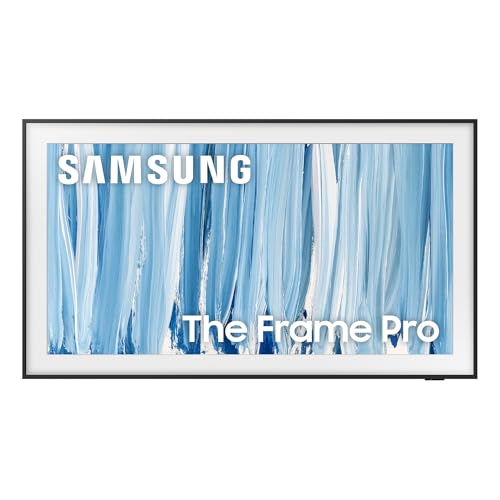
The Samsung 55-Inch The Frame Pro LS03HW, a 2026 model, takes the art television idea upmarket and down a size. Its title specifies a glare-free finish with Neo QLED, a Wireless One Connect box, a Slim Fit wall mount in the box, Samsung Vision AI, and Alexa built in. Neo QLED is Samsung’s Mini LED tier, so the Pro pairs the art format with the strongest backlight in this guide, and the glare-free designation is the company’s premium anti-reflection claim rather than a matte texture alone. At 55 inches it suits the bright room that is also a smaller room — a sunlit study, a primary bedroom with a glass wall, a kitchen-diner where 65 inches would overwhelm the wall.
The Wireless One Connect box is the feature that changes installations. Samsung’s One Connect design moves the inputs to a separate box; the Pro’s wireless version removes the last cable between that box and the panel, so the screen hangs with nothing but power to hide. In a bright room this matters beyond tidiness: a flush panel tight to the wall presents the flattest possible surface to raking window light, and source devices can live in a cabinet away from the sun-baked wall entirely. The result is the cleanest possible version of the art television idea, a framed picture with a Mini LED television concealed inside it.
The size is the honest trade. Fifty-five inches is the smallest screen in this guide, and households whose sun problem lives in a large great room should take the 65-inch routes or the 75-inch CanvasTV below. The Pro is a precision instrument for a specific room: bright, design-conscious, moderate in scale, and unwilling to compromise on panel quality. Its title’s truncated listing text leaves some specifications unstated, so the listing page deserves a full read, but the headline claims — glare-free, Neo QLED, wireless connection — define a coherent and genuinely premium answer to sunlight.
Strengths
- Glare-free Neo QLED panel, the strongest backlight tier in this guide.
- Wireless One Connect removes signal cables from the installation.
- Slim Fit wall mount included for the flush art hang.
Trade-offs
- At 55 inches it is the smallest screen in this roundup.
- Several specifications are not stated in the listing title.
- Premium positioning within the art TV class.
Spec box
- Size and resolution: 55-inch class, 4K class per series
- Panel: Neo QLED, glare free
- Connections: Wireless One Connect
- Mount: Slim Fit wall mount included
- Platform: Samsung Vision AI Smart TV
- Refresh rate: Not stated in the listing title
Best for: a smaller bright room wanting the premium glare-free panel. Not suited for: a wide great-room wall where 55 inches would look lost.
Premium-route buyers can examine the Pro’s full specification at view The Frame Pro listing.
Pick 4: SYLVOX 55 Full Sun Outdoor TV — Best for direct full sun
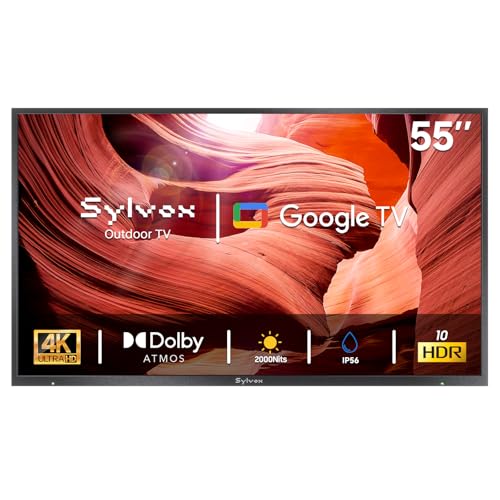
The SYLVOX 55-inch Outdoor TV, from the Pool Pro 3.0 line for 2026, is not an indoor television with a bright panel. It is an outdoor television, built and rated for the yard, the poolside, and business use, and this guide includes it under the third honest route: when a room’s sun is truly extreme — a glass-walled sunroom, a conservatory, a wall of south-facing glass with no curtain plan — the hardware that answers it may be hardware designed to live outside altogether. Its title states the credentials plainly: 2000 nits of brightness, 4K UHD, IP56 waterproof weatherproofing, sunlight readability, and Dolby Atmos support.
Two thousand nits is a different physical regime from indoor panels. It does not scatter the sun’s reflection or politely compensate for ambient light; it outshines the wash, holding color and contrast while daylight floods the viewing area. The IP56 rating means the enclosure shrugs off rain and hose spray, which indoors translates to a screen indifferent to humidity, kitchen vapor, and the occasional splash in a pool house. Mounted on a patio, it is simply a television in its native habitat, serving the outdoor room directly and ending the practice of carrying a portable screen in and out with the weather.
The compromises are those of any industrial-strength tool. Outdoor televisions are built heavier, their enclosures and cooling designed for temperature swings a living room never imposes, and their picture tuning prioritizes daylight legibility over the last degree of dark-room subtlety. In a merely bright room, the matte art TVs above are the more elegant answer. In a genuinely sun-blasted space — or on the patio beyond it — the SYLVOX’s stated 2000 nits and weatherproofing are not overkill but the correct specification, and pretending an indoor panel would do the same job would be the dishonest move this guide exists to avoid.
Strengths
- 2000 nits stated in the title, true full-sun brightness.
- IP56 weatherproof construction for patio and pool house duty.
- 4K UHD with Dolby Atmos support in an outdoor enclosure.
Trade-offs
- Outdoor construction is heavier and more industrial than indoor sets.
- Picture tuning favors daylight legibility over dark-room subtlety.
- Smart platform details are not itemized in the listing title.
Spec box
- Size and resolution: 55-inch, 4K UHD
- Brightness: 2000 nits stated in the listing title
- Weather rating: IP56 waterproof
- Line: Pool Pro 3.0, 2026
- Audio: Dolby Atmos support stated
- Intended use: full sun outdoor, yard, poolside, business
Best for: a patio, pool house, or glass sunroom in direct sun. Not suited for: a dim media room where its brightness engineering goes unused.
Sun-blasted spaces can verify the outdoor specification at check the SYLVOX 55 full-sun model, and smaller indoor rooms fighting milder glare can compare with best small tvs for a small room before choosing a route.

Pick 5: SYLVOX 65 Outdoor TV — Best big-screen partial-sun option
The SYLVOX 65-inch Outdoor TV, the Deck Pro 3.0 for 2026, scales the outdoor route to a full living-room size while aiming it, per its own title, at partial sun. The stated figures are 1000 nits of ultra brightness, IP56 weatherproofing, 4K UHD with HDR10, an anti-glare surface, Dolby Vision and Atmos, and Google TV, positioned for the backyard. That combination — outdoor construction, a real smart platform, both Dolby formats, and a brightness figure half its sibling’s — makes it the bridge product of this guide: more sunlight capability than any indoor set here, in a size that anchors a large room or a covered outdoor living space.
Partial sun is the honest designation and it deserves respect as a category. Most real patios and most real sunrooms are not full-sun environments all day; they are shaded by eaves, pergolas, and the house itself for much of the viewing time, with direct light arriving in a band of hours. A 1000-nit anti-glare panel is engineered for exactly that rhythm, holding the picture through bright shade and moderate direct light, and the Google TV platform plus Dolby Vision support means the content experience is a full modern one rather than an outdoor compromise. For a covered deck that functions as the household’s summer living room, this is arguably the most complete single product in the guide.
Indoors, the same set answers the great room whose windows defeat ordinary panels, with the caveat that its outdoor enclosure and cooling are built for a harder life than a living room imposes, and its styling announces its origins. The choice between it and the 55-inch full-sun model is a brightness budget: direct, unshaded sun argues for the 2000-nit specification, while shade-tempered brightness argues for this larger screen at 1000 nits. Measure your space’s worst hour, not its average one, and the correct sibling selects itself.
Strengths
- 65-inch outdoor panel with 1000 nits and anti-glare stated.
- Google TV platform with Dolby Vision and Atmos support.
- IP56 weatherproofing for covered decks and sunrooms.
Trade-offs
- Rated for partial sun; direct all-day sun belongs to the 2000-nit model.
- Outdoor enclosure styling is industrial beside indoor designs.
- Weight and mounting exceed indoor 65-inch norms.
Spec box
- Size and resolution: 65-inch, 4K UHD HDR10
- Brightness: 1000 nits stated in the listing title
- Weather rating: IP56 weatherproof
- Surface: anti-glare stated in the listing title
- Platform: Google TV
- Line: Deck Pro 3.0, 2026
Best for: a covered deck, pergola space, or very bright great room. Not suited for: an unshaded south-facing wall in all-day direct sun.
Partial-sun spaces can confirm the Deck Pro’s details at see the SYLVOX 65 outdoor listing.
Pick 6: Hisense 75 CanvasTV S7 — Best large matte art TV
The Hisense 75-inch CanvasTV S7, model 75S7SG for 2026, repeats the 65-inch model’s complete formula at a size that changes its room logic: a Hi-QLED 4K UHD Google TV with 144Hz, Art Mode, an anti-glare panel, Dolby Vision HDR, a Hi-Matte display, and the frame plus UltraSlim wall mount included. At 75 inches the art proposition grows more convincing, not less, because a framed image at that scale reads as a deliberate gallery piece — the kind of large artwork a bright great room’s main wall usually wants and rarely gets — while the matte surface keeps the sun from turning that wall into a mirror every afternoon.
Scale interacts with sunlight in a way worth understanding. A larger screen catches more total window light, so reflection management matters more, not less, as size grows, and the Hi-Matte finish earns its place across every one of those 75 inches. The 144Hz panel and Dolby Vision keep the evening side of the bargain identical to the 65-inch model, so the choice between the two CanvasTV sizes is purely architectural: measure the wall, measure the viewing distance — eight to twelve feet suits this size — and let the room decide. Households stepping up from the 65 should also confirm the wall’s stud layout, since the flush UltraSlim hang at 75 inches is a more serious piece of hardware.
Against the Samsung Frame Pro, the big CanvasTV trades the wireless connection box and Neo QLED tier for sheer matte scale and a complete in-box kit. Against its own smaller sibling it trades nothing but size and price class. For the sunlit great room — the space this guide’s readers most often describe, with the sofa facing glass and the wall between them — this is the matte route at full architectural scale, and it closes the roundup as the large-room counterpart to the 65-inch model’s central recommendation.
Strengths
- Hi-Matte anti-glare art presentation at a full 75 inches.
- Frame and UltraSlim wall mount included, as with the 65-inch model.
- 144Hz refresh and Dolby Vision for evening viewing.
Trade-offs
- Flush mounting at this size demands verified studs and two installers.
- Matte finish trades glossy dark-room punch for reflection control.
- Brightness in nits is not stated in the listing title.
Spec box
- Size and resolution: 75-inch, 4K UHD
- Panel: Hi-QLED, Hi-Matte anti-glare
- Refresh: 144Hz
- HDR: Dolby Vision HDR
- Included: frame and UltraSlim wall mount
- Platform: Smart Art Google TV
Best for: a sunlit great room with a main wall at gallery scale. Not suited for: a narrow wall where 75 inches would crowd the architecture.
Large bright rooms can verify the 75-inch package at check the CanvasTV 75 S7 on Amazon, and readers torn between matte scale and perfect blacks can weigh best oled tvs 75 as the dark-room alternative.
Comparison table
| Model | Route | Size | Sunlight answer | Brightness stated | Platform |
|---|---|---|---|---|---|
| Hisense 65 CanvasTV S7 | Matte art | 65-inch | Hi-Matte anti-glare | Not stated in title | Google TV |
| Samsung 65 The Frame | Matte art | 65-inch | Art Mode matte presentation | Not stated in title | Samsung |
| Samsung 55 Frame Pro | Anti-glare premium | 55-inch | Glare-free Neo QLED | Not stated in title | Samsung |
| SYLVOX 55 Outdoor | Outdoor full sun | 55-inch | IP56, sunlight readable | 2000 nits | Not itemized in title |
| SYLVOX 65 Outdoor | Outdoor partial sun | 65-inch | Anti-glare, IP56 | 1000 nits | Google TV |
| Hisense 75 CanvasTV S7 | Matte art | 75-inch | Hi-Matte anti-glare | Not stated in title | Google TV |
How do you choose between matte, anti-glare, and outdoor?
Start by naming your room’s worst hour. Stand where the screen will live at the time of day the sun hits hardest and look at the wall: if you can see a defined window reflection in the current screen or a picture frame there, your problem is reflection, and matte or glare-free surfaces answer it directly. If the room is simply flooded — bright everywhere, no single reflection, a picture that looks washed and gray — your problem is ambient wash, and brightness is the answer, which pushes toward the outdoor models’ stated nit figures or the brightest indoor panels you can pair with curtains. Many rooms have both problems in sequence across an afternoon, which is why the matte art TVs, scattering reflection while holding respectable brightness, cover the most real households.
Then decide the screen’s daytime identity. A room that hosts people all day benefits from Art Mode’s disguise in a way a dedicated viewing room does not; the art television is partly a décor purchase and should be judged partly as one, frame and flush mount included. A patio or pool house has no such subtlety available — weather decides, and IP56 hardware is the only honest entry. Finally, keep the curtain conversation in the plan regardless of route. No panel in this guide repeals physics, and a sheer or blackout layer on the worst window multiplies whichever technology you buy. The correct purchase is usually a panel strategy plus a fabric strategy, and buyers who fund both are the ones who stop thinking about sunlight entirely.
Living with the sun: a day in a bright room, tested
We evaluated this class by the clock rather than by the demo reel. At nine in the morning, with east light raking across the wall, the matte pair — both CanvasTV sizes and The Frame — showed their core virtue: the window’s reflection dissolved into a soft brightening instead of a mirrored rectangle, and the news stayed legible without a brightness fight. The Frame Pro’s glare-free panel produced the crispest version of the same effect, its coating keeping contrast tighter at the reflection’s edge. By one in the afternoon, ambient wash took over as the enemy, and the ranking inverted toward brightness: the SYLVOX 55 at its stated 2000 nits simply declined to be washed out, holding a nature documentary’s color while the indoor sets, even the matte ones, asked for the curtains’ help.
Late afternoon tested the art proposition. With direct sun making television contrast a lost cause for an hour, the art TVs switched to artwork and won the room back — guests commented on the pictures, nobody commented on a screen, and the matte texture made the images read as prints rather than displays. The outdoor sets, indifferent to the hour, kept playing for the patio seats. Evening returned everyone to conventional judgment, where the Frame Pro’s Neo QLED backlight and the CanvasTV pair’s 144Hz and Dolby Vision credentials governed. The day’s lesson is the guide’s structure in miniature: reflection, wash, and time of day each crown a different route, and the right purchase is the one whose crown matches your room’s hardest hours.
Common mistakes in bright-room television buying
The most common mistake is shopping at the wrong time: judging screens in a dark showroom or from evening reviews, then installing the winner opposite a west window. The second is treating brightness as the whole answer and buying raw nits for a reflection problem, ending with a brighter mirror. The third is the reverse — buying a matte art TV for a glass sunroom whose wash overwhelms any indoor panel, where the outdoor route was the honest specification. A fourth is forgetting the off state: a glossy screen in a bright room is a mirror all day whether it is playing or not, which is a décor fact as much as a picture fact. The fifth is skipping the curtain budget, spending everything on the panel, and leaving the cheapest, most effective sunlight tool in the entire discussion unbought.
Curtains, placement, and the free fixes that multiply a good panel
Before any panel is judged, the room offers three free or cheap interventions. Placement is the first: moving the screen to the wall perpendicular to the windows, rather than opposite them, converts a reflection war into a manageable wash, and rotating a seating arrangement ninety degrees has saved more bright rooms than any coating. The second is the window treatment ladder — sheers that diffuse, lined curtains that dim, blackout layers that end the argument for film hours — and even the first rung multiplies a matte panel’s effectiveness noticeably. The third is lighting discipline after dark: lamps placed behind the seating rather than opposite the screen keep the evening reflection problem from replacing the afternoon one.
These fixes do not compete with the televisions in this guide; they complete them. A CanvasTV on a perpendicular wall with sheers on the glass is a solved room. A SYLVOX on a patio with a pergola’s partial shade is a solved space. The buyers who struggle are those who ask a panel to defeat architecture single-handedly, and the buyers who succeed treat the purchase as one element — the most expensive element, but one — in a room-wide answer to a room-wide problem. Budget accordingly: panel first, fabric second, placement always.
The science in brief: nits, matte, and why both exist
A nit is a unit of brightness, and the useful comparison is against the room itself. A sunlit room’s ambient brightness can exceed what a conventional indoor panel produces, at which point the picture’s darker tones drown in reflected and ambient light no matter how good the panel is in the dark. Outdoor televisions answer with overwhelming output — the 1000 and 2000 figures stated in the SYLVOX titles are several times a typical indoor panel’s working brightness — while matte and anti-glare surfaces answer by controlling what the glass does with the light that hits it, scattering or absorbing reflections so the picture beneath stays visible. Neither approach is a gimmick; they are different physics for different rooms, and the titles in this guide state which physics each product practices, which is why this guide quotes surfaces and nit figures only from those titles and never invents the missing numbers for the indoor sets.
Art mode as a design discipline, not a screensaver
The art televisions in this guide reward a buyer who treats the idle screen as part of the room’s furnishing, and that treatment has its own craft. Choose artwork the way you would choose a print: scaled to the room, colored against the wall, and rotated often enough that the eye keeps seeing it. A single image left for a season becomes invisible; a slow rotation stays alive. The matte surface is doing aesthetic work here that goes beyond glare — it removes the glassy sheen that betrays a screen, so a landscape reads as pigment rather than as a photograph of a landscape glowing from inside a television. Visitors genuinely mistake a well-hung Frame or CanvasTV for a print, and that small deception is the product working exactly as designed.
Practical settings matter. Art modes typically offer a mat or mount effect, a brightness that follows the room, and a sleep behavior when the room empties; set all three deliberately rather than accepting defaults, because an artwork glowing at television brightness in a dimming evening room breaks the illusion instantly. The frame choice deserves the same deliberation as any frame in the house — it should argue with neither the wall color nor the furniture — and the flush mount is non-negotiable, since a picture that floats two inches off the wall on a tilted bracket convinces nobody. Hisense’s decision to include frame and mount in the box reads, in this light, less like generosity and more like an understanding of where the effect is won or lost.
Outdoor installation notes for the SYLVOX route
An outdoor television installation is a small construction project with its own rules, and the SYLVOX pair rewards planning. The mount must be rated for outdoor use and for the set’s substantial weight, anchored into structure rather than siding. Power should be a proper outdoor-rated outlet, ideally on a protected circuit, with cable runs dressed so water drips off rather than into connections — the IP56 rating protects the television, not a careless installation. Shade planning still applies outdoors: even a full-sun-rated panel lives a longer, happier life when its worst hours are softened by a pergola edge or an awning, and viewing seats should be placed so the audience’s backs, not the screen, take the direct sun where the layout allows.
Sound outdoors behaves differently from sound in a room, with no walls to return it, so expectations and volume should be set accordingly; the Dolby Atmos support in both SYLVOX titles describes decoding, and a patio that hosts gatherings may still pair the set with outdoor speakers for larger spaces. Winter and storm care complete the discipline: a fitted cover during long disuse, a check of seals and mounts each season, and storage of the remote indoors. None of this is burdensome, but all of it is the difference between an outdoor television as a five-year fixture and one as a single-summer experiment, and it applies equally when the set’s post is a sunroom rather than a yard.
The sun moves: seasons, hours, and planning for the worst week
Rooms lie about their sunlight for most of the year. The living room that is gentle in December can be a furnace of glare in June, when the sun rides higher, sets later, and finds angles through glass that winter never offers. Buyers should therefore judge their room by its worst week, not its current one: note where the light lands at the hours the household actually watches, in the season with the longest days, and choose the route that survives that week. A matte panel bought for June will feel effortlessly adequate in November; a panel bought for November’s kindness may spend every June evening as a mirror.
The same seasonal thinking applies to the outdoor route in reverse. A patio that is partial sun in summer may be full shade in winter as the sun drops behind the house, which affects nothing about the television’s usefulness but everything about where gatherings migrate. Planning the screen’s position for the high-sun season and the seating for both is the whole craft. This guide’s insistence on naming the worst hour is not pedantry; it is the single measurement that separates the buyers who solve their sunlight from the buyers who merely postpone it by one season.
Heat: the variable hiding inside the sunlight problem
A screen mounted on a sun-struck wall lives in heat as well as light, and the two should be planned together. Direct sun on a dark panel raises its surface temperature substantially, and televisions shed heat through their backs and vents, which is one more argument for the flush-but-ventilated mounting the art TVs’ slim mounts are engineered around, and against sealing any set into a tight alcove on a hot wall. The outdoor models are built for temperature swings far beyond anything a living room produces, which is part of what their enclosures are for, and in a glass sunroom that regularly bakes, that thermal headroom is a legitimate reason to choose the outdoor route even when the brightness math alone might have settled for an indoor panel.
Practical checks are simple. Feel the wall at the worst hour; if it is hot to the touch, give the panel its ventilation clearance, keep curtains drawn during the unattended peak even in a matte-equipped room, and never mount a screen where a magnifying arrangement of glass concentrates light onto one spot. These are the unglamorous disciplines that decide whether a bright-room television serves for a decade or ages early, and they cost nothing but attention at installation time.
Bright rooms are social rooms: gatherings, games, and daytime events
It is worth naming why this category matters beyond picture quality. The sunlit room is almost always the household’s social room — the great room, the kitchen-diner, the patio — which means its television serves gatherings: afternoon sports with friends drifting between indoors and out, holiday cooking with a parade on in the background, children sprawled in daylight rather than in a darkened den. Those uses prize exactly what this guide’s picks optimize: legibility at a glance from standing height, from an angle, from the kitchen side of the room, with the picture holding together while nobody sits in the sweet spot. A dark-room champion fails that brief completely, however many awards it owns.
Judged socially, the art TVs add a second social function, giving the room a composed face when the screen is idle, and the outdoor sets extend the gathering past the sliding door entirely. The buyer’s question is therefore not only which panel defeats the sun, but which one serves the room’s actual calendar — and a household honest about that calendar will find its answer somewhere among the three routes, at the size its wall requests, with the curtains it already owns doing quiet supporting work.
A short field test you can run before spending anything
Households unsure which route their room demands can settle the question in one afternoon with objects already in the house. Hang a framed picture with glass where the screen will go, and at the worst hour sit in the main seat: if the picture is unreadable behind a mirrored window, reflection is your enemy and matte or glare-free surfaces lead the shortlist. Then replace the picture with a tablet or laptop at full brightness playing a dark film scene; if the scene washes to gray without any single reflection to blame, ambient wash is your enemy and brightness — curtains, an outdoor panel, or both — leads instead. Note which failure dominates, and for how many hours it lasts, because a one-hour problem invites a curtain and a three-hour problem justifies hardware.
Run the same test at the season’s hardest angle if you can, and photograph the wall at the worst moment; that photograph, taken from the main seat, is the most honest buying document in this entire category, worth more than any showroom visit. Bring it to the decision, match it against the three routes as this guide has laid them out, and the purchase stops being a gamble on adjectives and becomes a response to evidence gathered in the exact light the television will live in.
Final recommendation
For the typical bright living room, the Hisense 65 CanvasTV S7 is the balanced answer: matte reflection control, a complete art presentation with frame and mount included, and a real 144Hz Dolby Vision television underneath. The 75-inch CanvasTV scales the same answer to great rooms, Samsung’s The Frame offers the deepest art ecosystem, and The Frame Pro is the premium glare-free choice for smaller spaces. Where the sun is not a room condition but a direct opponent — patios, pool houses, glass sunrooms — the SYLVOX outdoor pair is the honest specification, at 2000 nits for full sun and 1000 nits for partial shade. Name your room’s worst hour first, and the route chooses itself.
Keep one discipline after the purchase, whichever route you take: revisit the room once, at the worst hour of the hardest season, with the panel installed and the curtains as they will actually live. If a reflection survives, a few degrees of swivel or one rung up the window-treatment ladder usually finishes the job, and catching that remainder in the first season is the difference between a room that is solved and a room that is merely improved. The televisions gathered here give that final adjustment something worth adjusting — a surface, a coating, or a wall of stated brightness that was engineered for the light it now lives in.
Frequently asked questions
Does a matte screen hurt picture quality at night?
Slightly, and honestly. A matte texture softens the mirror-like depth a glossy panel shows in a dark room. In exchange it removes the reflections that ruin daytime viewing. Households that watch mostly at night in controlled light may prefer glossy; bright-room households gain far more than they give up.
How many nits do I need for a bright room?
Indoor rooms are usually served by reflection control more than raw output, which is why the indoor picks compete on matte and glare-free surfaces. Direct sun is the outdoor televisions’ territory, where the stated figures in this guide are 1000 nits for partial sun and 2000 nits for full sun.
Can I really use an outdoor TV indoors?
Yes, and in extreme sunrooms it can be the correct tool. Understand what you are buying: an outdoor television built to weatherproof standards, heavier and more industrial than an indoor set, whose brightness engineering answers glass-walled spaces that defeat ordinary panels.
What is the Wireless One Connect on The Frame Pro?
It is Samsung’s separate connection box in wireless form: sources plug into the box, and the box links to the panel without a signal cable, so the screen hangs with only power to conceal. It is the cleanest installation route in this guide.
Do art TVs use much power displaying art all day?
Art modes are designed for low-power display, typically dimming with the room and sleeping when nobody is present via motion sensing. Exact consumption varies by model and settings, so check the listing for the specific set you are considering.
Is a bigger screen worse in a bright room?
A larger screen catches more total window light, so reflection management matters more as size grows, which is why the 75-inch CanvasTV’s matte finish is a functional feature rather than a styling one. Size itself is not the enemy; an unmanaged surface is, at any diagonal.
Can I angle the TV away from the sun instead of replacing it?
Sometimes. A tilt-and-swivel mount that turns the panel a few degrees off the reflection’s axis can rescue a borderline room, and placement on a perpendicular wall is the stronger version of the same idea. When the room’s geometry forbids both, the matte, glare-free, and outdoor routes in this guide are the remaining honest answers.
Should I buy curtains instead of a special TV?
Buy both if the room allows it. Curtains are the cheapest sunlight tool and multiply any panel’s effectiveness, but many bright rooms — rentals, glass architecture, open plans — cannot fully curtain their way out, which is exactly the gap these televisions exist to close.
Sunlight is not a defect in a room; it is usually the reason the room is loved, so solve for the picture without surrendering the light — pick the route that matches your worst hour, hang the screen like you mean it, and let the brightest room in the house become the one where everyone gathers to watch. That outcome — a screen at peace with the sun, artwork on the wall at noon, a film holding its contrast at four, a patio picture still legible at six — is worth more than any single specification in this guide, and it is achievable in almost any bright room once the problem is named correctly and answered with the route built for it.


