Our Top Picks


What's inside
- What tough means for a smartwatch, and what it does not
- MIL-STD-810H explained without the marketing gloss
- Water ratings: 5ATM, 10ATM and the gaps between labels
- Glass: sapphire, hardened mineral glass and coated options
- Case materials: polymer, titanium, aluminium and steel
- Displays: AMOLED brightness against memory-in-pixel endurance
- Battery life and why published figures need careful reading
- Dual-band GPS and what it fixes outdoors
- ABC sensors: altimeter, barometer and compass in practice
- Operating temperature, shock and the edges of the envelope
- Case diameter, thickness and honest wrist fit
- Straps: the part that fails first and matters daily
- How the main brands build and describe toughness
- Smart features under rough conditions
- Durability over years: service, updates and wear
- Matching a model family to a job
- A buyer checklist drawn from published documents
- Check prices on Amazon
- Final judgement on the tough smartwatch field
As an Amazon Associate I earn from qualifying purchases. This post may contain affiliate links at no extra cost to you.
A tough smartwatch has to survive two kinds of trouble at once. It must take knocks, grit, rain, heat, cold and vibration without cracking or flooding, and it must keep doing the ordinary smartwatch jobs of tracking position, recording heart rate, showing maps and staying alive for days between charges. Plenty of watches look rugged. Far fewer publish the test methods, water ratings and material choices that let a buyer judge whether the styling is backed by engineering. This guide separates those layers, using the Amazfit T-Rex line, the Garmin Instinct and fenix lines, Casio G-Shock smart models and the Samsung Galaxy Watch Ultra class as the main reference points, because those families publish the most detailed toughness information in the category.
Disclosure in plain terms: this comparison rests on published manufacturer documents, specification sheets and standard definitions rather than direct use of the products named here. The site may earn a commission when readers buy through links on the page, and that commission does not add to what a reader pays at the retailer.
The first mistake to avoid is treating toughness as a single score. A watch can carry a strong water rating and still have a glass face that chips on granite. Another can survive repeated drops onto concrete yet offer only basic splash protection for its speaker ports. A third can shrug off desert heat but lose most of its battery advantage once its bright display and dual-band satellite tracking run together. Reading a tough watch well means breaking the claim into parts: impact, water, dust, temperature, corrosion, screen hardness, case construction, strap survival and the electronic features that must keep working after the body has taken punishment.
What tough means for a smartwatch, and what it does not
An ordinary tool watch only has to keep time after abuse. A smartwatch carries far more that can fail. Behind the case sit an optical heart rate array pressed against the skin, a battery that dislikes heat and puncture, microphones and speakers with openings, barometric ports that must breathe air yet exclude water, charging contacts exposed to sweat and salt, and a display stack bonded to glass that can delaminate after a hard edge strike. Buttons must still travel after mud dries around them. The touchscreen must still respond with gloves, rain or sunscreen on the surface. Toughness for this category therefore covers the whole system, not just the outer shell.
That system view also explains why headline claims can mislead. A case molded from fiber-reinforced polymer may flex slightly on impact and protect the module inside, while a metal case may resist scratching yet pass more shock straight through. A raised bezel may guard the glass during flat drops but do little when the watch strikes a rock corner at an angle. A strap made from fluoroelastomer may tolerate sweat and salt water well, while a nylon strap may feel better on a long hike yet hold moisture against the wrist. Each choice trades one kind of protection against another, and the right balance depends on where the watch will actually be worn.
Readers who want a broader view of the category before narrowing to rugged models can start with best all around smartwatches and then return here for the durability detail, because the priorities shift quickly once impact and water exposure move to the top of the list.
MIL-STD-810H explained without the marketing gloss
MIL-STD-810H is a United States Department of Defense document that sets out laboratory test methods for how equipment responds to environmental stress. It is not a single pass or fail certificate handed out by one central body. The standard contains a long menu of methods, each aimed at a different stress: low pressure, high temperature, low temperature, temperature shock, contamination by fluids, solar radiation, rain, humidity, fungus, salt fog, sand and dust, explosive atmosphere, immersion, acceleration, vibration, acoustic noise, shock, and several others. A brand that cites the standard should say which methods were used, under which procedure within each method, and to what severity. Without that detail, the citation tells a reader very little.
Manufacturers generally arrange their own testing, sometimes in their own laboratories and sometimes through outside facilities, and then report that a device passed selected methods. That is a legitimate way to use the standard, but it is not the same as a military procurement approval, and it does not mean every unit sold was put through every test. Laboratory samples are tested, production continues afterward, and the buyer relies on the maker to hold the design and materials steady. A careful reader therefore treats a MIL-STD-810H claim as a starting point for questions rather than as a final verdict.
The methods that matter most on a wrist
For a watch, a handful of methods carry the most practical weight. The shock method looks at sudden mechanical impact, the kind of event that happens when a wrist hits a door frame, a ladder rung or a rock face. The vibration method covers sustained shaking, relevant for mountain biking, off-road driving, power tools and helicopter or boat travel. Rain and immersion methods address water driven at the case and water surrounding it. Sand and dust methods examine whether fine particles reach seals and moving parts. Temperature methods cover storage and operation in heat and cold, plus the shock of moving quickly between the two, such as stepping from an air-conditioned vehicle into desert air or from a heated cabin into winter wind.
Salt fog deserves special attention for anyone near the sea. Salt accelerates corrosion on exposed metal, charging pins and spring bars, and it can creep into seams as water evaporates and leaves crystals behind. Solar radiation testing matters for dashboard heat and high-altitude sun, where ultraviolet light ages polymers and adhesives. Humidity testing matters in tropical climates, where warm moist air finds every weak seal over time. A brand that lists many methods has usually thought about varied environments. A brand that lists only a few may still have built a strong watch, but the published record covers less ground.
What the standard does not prove
Passing a laboratory shock procedure does not guarantee survival after a fall onto a sharp stone from a particular height, because the laboratory setup controls surface, orientation and energy in ways real accidents never do. Passing a rain procedure does not make a watch a dive instrument. Passing a dust procedure does not mean buttons will stay clean after a week of cement work. The standard also says nothing about how readable a screen is in sunlight, how accurate a heart rate sensor is on a cold wrist, or how long a battery lasts with satellite tracking active. Those qualities sit outside the document entirely, and any guide that folds them into a military claim is blurring separate questions.
Another limit is severity choice. Within a method, procedures and levels can differ, and two brands can both cite the same standard while testing to different durations or intensities. Published summaries rarely give the full laboratory report, so direct brand-to-brand ranking from the citation alone is unreliable. The honest use of MIL-STD-810H in a buying decision is comparative in a modest way: a watch with a detailed method list and clear operating limits gives a buyer more to work with than a watch that offers only a bold badge and no supporting detail.
Water ratings: 5ATM, 10ATM and the gaps between labels
ATM figures describe pressure resistance expressed as multiples of standard atmospheric pressure at sea level. A 5ATM rating corresponds to a static pressure equivalent of about 50 metres of water, and a 10ATM rating to about 100 metres. Those metre figures are laboratory pressure equivalents, not promises that the watch belongs at that depth on a wrist. Movement through water raises pressure at the case, hot showers add heat and soap, and ageing seals lose the margin they had when new. Brands and standards bodies have long warned against reading the metre number as a diving depth, yet the misunderstanding survives because the number looks so concrete.
In practical published guidance, 5ATM watches are generally presented as suitable for showering, swimming in a pool or shallow open water, and ordinary rain and splashing, subject to each maker guidance on hot water, saunas and high-speed water sports. A 10ATM watch is generally presented as better suited to snorkelling, vigorous surface swimming and water sports with greater impact, and it gives more margin for repeated immersion. Neither figure by itself certifies a watch for scuba diving. Dive use belongs to a separate regime, most clearly the ISO 6425 standard for dive watches, which adds requirements covering visibility, magnetic resistance, shock, salt water and operation of controls under water, among other points.
Why two watches with the same rating can behave differently
Seals are systems. A watch may protect its case with gaskets around the back, the crown or buttons, the display bond and the sensor window, and the weakest of those paths sets the real limit. Speaker and microphone membranes must let sound pass while holding water out, and barometric sensors need an air path that complicates sealing further. Button presses under water can work against a seal, which is why many makers advise against operating buttons while submerged unless the model is explicitly built and rated for that use. Charging contacts on the case back must resist corrosion so that the watch can be refilled after years of sweat and pool water.
Age matters as much as design. Gaskets compress, dry out and pick up grit. A knock that leaves no visible mark can still shift a case back slightly. Sunscreen, insect repellent and solvents can attack some seal materials. For that reason, published water ratings describe a new watch in tested condition, and long-term owners who swim daily should treat periodic seal checks and careful rinsing as part of ownership rather than as optional fuss. Rinsing in fresh water after sea or pool use, drying the strap and contacts, and keeping the charging area clean are small habits that protect the rating the buyer paid for.
Fresh water, salt water and hot water are different problems
Chlorine in pools, salt in the sea and heat in a bath stress a watch in different ways. Salt dries into crystals that can work into seams and scratch surfaces during cleaning. Chlorine and cleaning chemicals can age polymers over repeated exposure. Hot water combines heat expansion with soap that lowers surface tension, letting liquid reach places cold water might not. Steam in a sauna is finer still. When a maker publishes separate guidance for these settings, that guidance outranks any general rule of thumb, and a buyer who plans daily hot tub or sauna use should check the exact wording for the exact model rather than relying on the ATM figure alone.
Glass: sapphire, hardened mineral glass and coated options
The face is the part most likely to meet rock, metal and concrete first, so glass choice shapes real-world survival more than many case claims do. Sapphire crystal, grown synthetically rather than mined, sits near the top of common hardness scales and resists scratching from sand, keys, tools and stone far better than ordinary glass. That hardness comes with trade-offs. Sapphire costs more, can reflect more light depending on coatings, and hardness is not the same as toughness: a very hard material can still chip or crack under a sharp concentrated blow, sometimes more readily than a softer glass that gives slightly under impact.
Hardened or chemically strengthened glass, sold under various trade names, takes the opposite balance. It tends to handle impact well for its cost, keeps reflections and price under control, and appears on many mid-priced rugged models. Its weakness is surface wear over time. Grit dragged across the face, repeated contact with sleeve fasteners, gym equipment and work surfaces can leave fine marks that sapphire would likely shrug off. A raised bezel reduces that contact, and a screen protector can sacrifice itself first, but neither changes the underlying material.
Coatings, layers and the display stack beneath
Modern smartwatch faces are stacks, not single panes. Beneath the outer glass sit touch layers, the display itself, adhesives and sometimes an additional protective film or anti-reflective coating. Oleophobic coatings that resist fingerprints wear away with friction and cleaning, which is normal and not a sign of failure. Anti-reflective treatments help in bright sun but can show wear at edges after long use. When comparing models, look for published information on the glass type, whether the bezel stands proud of the glass, and whether the maker sells a replacement path if the face is damaged. A tough watch that cannot be repaired after one bad fall is less tough in ownership terms than its laboratory record suggests.
Edge geometry matters too. Flat glass set below a metal or polymer bezel gains protection from glancing blows. Domed glass looks refined and can shed some side contact, yet its highest point meets flat surfaces first. Recessed crowns and button guards follow the same logic: shaping the case so that vulnerable parts are not the first point of contact. Casio built its reputation partly on this kind of geometry, with deep bezels and protruding guards that take abuse before the module does, and other brands now use similar thinking in polymer and metal.
Case materials: polymer, titanium, aluminium and steel
Fiber-reinforced polymer is the workhorse of the rugged category. It is light, it does not corrode, it can be molded with button guards, bezel ribs and lugs in one piece, and it absorbs some impact by flexing. Its limits are surface wear, long-term ultraviolet ageing on lower-grade mixes, and a feel some buyers find less premium. Garmin uses polymer extensively across Instinct models and in parts of fenix cases, Amazfit uses it across much of the T-Rex range, and Casio pairs resin cases with its long-standing shock-absorbing structures. For long days on the trail, low weight is itself a durability feature, because a lighter watch swings less, catches less often on straps and sleeves, and fatigues the wrist less.
Titanium brings a different profile. It resists corrosion very well, including in salt water, it is strong for its weight, and it suits buyers who want metal without the heft of steel. It can still scratch, though many marks are shallow surface changes in the oxide layer, and it costs more to machine. Titanium appears on higher fenix variants and on Samsung Ultra models, often paired with sapphire glass to build a flagship rugged specification. Stainless steel is heavier, familiar from traditional watches, and tough in a dent-and-wear sense, but its weight counts against it during running and sleep tracking. Aluminium is light and inexpensive yet dents more readily and offers less corrosion margin in harsh settings.
Internal protection matters as much as the shell
Two watches in similar shells can protect their electronics very differently. Internal layouts may suspend the module, isolate the battery, route shock away from solder joints, or use gaskets that double as cushions. Casio describes guard structures and hollow case concepts in its G-Shock literature, where the module is supported at points rather than clamped rigidly everywhere. The principle generalises: controlled movement inside a case can prevent damage better than total rigidity. Buyers cannot see this engineering, so published drop and shock information, warranty terms and the maker record over several generations carry more weight than a photograph of a chunky case.
Displays: AMOLED brightness against memory-in-pixel endurance
Display choice is where toughness, readability and battery life collide. AMOLED panels produce deep blacks, strong colour and high brightness, and they make maps, photos and message content look sharp. Garmin fenix AMOLED variants, Samsung Ultra models and recent Amazfit T-Rex flagship models use this route. The costs are power draw and behaviour in always-on use. An AMOLED screen that stays lit consumes far more energy than a reflective panel, bright sunlight can push brightness upward and draw still more, and static elements shown for long periods raise the question of panel ageing over years, though makers use pixel shifting and brightness limits to manage that risk.
Memory-in-pixel, often shortened to MIP, works differently. Each pixel holds its state with very little power, and the panel reflects ambient light, so it becomes easier to read as sunlight strengthens. Colours are muted, resolution is lower, and backlighting is needed at night, but endurance is excellent. Garmin built much of the Instinct and fenix reputation on MIP models that run for weeks in smartwatch mode under published test conditions. For a buyer whose main fear is a dead watch on day nine of a trek, MIP remains a rational choice even though store photographs make it look dated beside AMOLED.
Choosing a display for the places you actually go
Think about light first. Desert, snowfields, open water and high mountains reward reflective panels and high-brightness AMOLED alike, though for different reasons. Forest shade, night shifts and indoor training favour AMOLED clarity and colour-coded maps. Think about gloves and wet hands next: a dim but glanceable MIP face with strong button control can beat a brilliant touchscreen that needs bare fingers. Think about maps last. Colour AMOLED shows contour detail, route colours and labels more clearly, which can prevent navigation errors. The display decision is therefore not a fashion choice; it changes navigation quality, charge planning and how often the watch must come off the wrist.
Readers comparing outdoor training features alongside screen types may find best activity smartwatches useful, since activity tracking demands overlap with rugged use but do not map onto it perfectly.
Battery life and why published figures need careful reading
Battery claims in this category span an enormous range, from roughly a day or two on a full-featured AMOLED watch with cellular service to several weeks on a MIP watch used mainly for time, sensors and periodic satellite fixes. Both ends can be honest under their stated conditions. The problem is that conditions differ so widely that headline numbers cannot be compared directly. Always-on display settings, satellite mode, music playback, pulse oximetry frequency, screen brightness, temperature and notification volume all change the result, sometimes by multiples rather than by small margins.
Read the mode table, not the banner. Makers publish separate figures for smartwatch mode, battery saver mode, GPS-only tracking, multi-band tracking, expedition modes with infrequent fixes, and maximum settings. A watch that claims weeks of life may reach that figure with satellite tracking off and the display mostly asleep. A watch that claims only days may deliver far more once its always-on face and cellular radio are disabled. Cold weather shortens usable capacity while the watch is on a winter wrist over a jacket cuff, and heat during charging ages cells faster over the life of the product.
Solar charging and power management
Solar-assisted models, notably in the Garmin Instinct and fenix ranges, add a photovoltaic layer that can extend time between charges under strong light. Published solar figures depend on defined light intensity and hours of exposure, so a cloudy week in northern winter will not reproduce them. Solar input is best understood as a brake on battery decline rather than as a replacement for the charger, except in low-power use where it can hold charge for very long periods. Power manager features that let the user disable sensors, change satellite settings and control the display by activity are equally valuable, because they let one watch behave like an endurance instrument on a trek and like a connected smartwatch in town.
Charging hardware is part of toughness too. Proprietary puck and cable systems are common, contacts must stay clean, and a lost cable on a long trip can end the watch usefulness regardless of case strength. Some models now charge through widely available standards or accept phone reverse charging in the Samsung ecosystem, which adds resilience of a practical kind. Before buying, check cable availability, charging speed from low battery, and whether the watch can record an activity while charging from a power bank, a feature that matters for ultra-distance events and multi-week travel.
Dual-band GPS and what it fixes outdoors
Satellite positioning on a wrist faces hard physics. Signals arrive weakly, bounce off cliffs, towers and wet tree canopy, and must be received by a small antenna wrapped around a moving arm. Single-frequency receivers use one band from each satellite system. Dual-band, also called multi-frequency, receivers use two bands, which helps the watch identify and reject reflected signals that would otherwise drag a recorded track away from the true path. In cities with tall buildings, in gorges, under dense forest and along rock faces, the improvement can be visible as a cleaner track and a more stable pace.
The benefit is real but bounded. Dual-band reception draws more power, sometimes cutting activity recording time sharply compared with single-band or GPS-only modes. It cannot create a signal where the sky is fully blocked in tunnels, caves or deep indoor spaces. It also interacts with antenna design and software filtering, so two watches with the same chipset class can still produce different tracks. Makers publish recording-time figures for each satellite setting, and those tables deserve as much attention as the accuracy claim itself. A sensible default for many users is a balanced mode that uses multiple satellite systems on one band, switching to dual-band for races, dense cities or technical terrain where track fidelity matters most.
Satellite systems, maps and navigation depth
Beyond the headline bands sit the constellations themselves: GPS, GLONASS, Galileo, BeiDou and QZSS in various combinations. More systems give the receiver more satellites to choose from, which helps at high latitudes, in deep valleys and during hours when one constellation geometry is poor. Navigation depth then separates outdoor instruments from connected smartwatches. Downloadable topographic maps, routable trails, turn guidance, back-to-start functions, waypoint storage and storm alerts built on barometric trends belong mainly to the Garmin fenix class and selected rivals. Samsung and Amazfit models offer route features and offline map support on certain models, but the depth of mapping, the update path and the phone dependence vary, so a buyer planning phone-free navigation should compare feature lists model by model rather than by brand reputation.
ABC sensors: altimeter, barometer and compass in practice
The letters ABC stand for altimeter, barometer and compass, a trio long associated with outdoor watches. The barometric altimeter estimates elevation from air pressure, which gives detailed ascent and descent data and responds quickly on climbs. Its weakness is weather: a passing front changes pressure without any change in height, so elevation can drift during a stormy day. Watches handle this with satellite calibration, automatic calibration during activities, and settings that tell the sensor whether pressure changes should be read as weather or as movement. Understanding those settings turns a confusing sensor into a useful one.
Temperature sensing and its limits on the wrist
Many rugged watches include a temperature sensor, but wrist temperature is not air temperature. Body heat, sunlight on the case, wind and sleeve coverage all pull the reading away from the surrounding air. Some models solve this by pairing with an external sensor for accurate ambient data, or by giving credible readings only when the watch is off the wrist and shaded. Published operating temperature ranges are a separate matter from sensor readings: they state the conditions under which the device is designed to function, covering battery behaviour, display response and material performance. A watch rated to operate well below freezing can still show a sluggish display in deep cold, because liquid crystal and OLED response and battery voltage all change at low temperature.
Operating temperature, shock and the edges of the envelope
Published operating ranges for rugged models commonly span from about minus 20 or minus 30 degrees Celsius up to about 55 or 60 degrees, with storage ranges wider than operating ranges. Exact figures differ by model and should be read from the current specification sheet, because a battery that survives storage in a hot vehicle may not be rated to charge in that heat, and charging limits are usually narrower than operating limits. Heat plus charging is a recurring theme in battery longevity guidance: charging a hot watch, or leaving it on a dashboard in summer sun, ages the cell faster than normal use.
Cold brings its own pattern. Capacity falls temporarily, screens can ghost or slow, straps stiffen, and condensation can form when a cold watch enters warm humid air. Wearing the watch under a cuff keeps it warmer and steadier, though satellite reception and heart rate sensing may suffer depending on placement. For winter sport, button operation becomes more important than touchscreen finesse, and models with large physical controls hold a clear advantage. For desert and industrial heat, light-coloured straps, ventilation and the discipline of shading the watch during rest stops all extend comfort and function.
Drop claims and shock language
Shock resistance language varies widely. Casio publishes a long-standing drop-oriented design philosophy for G-Shock, built around protecting the module from direct impact. Other makers cite the shock method within MIL-STD-810H or describe internal protection without a consumer drop height. A stated drop height, where given, should be read with its surface and condition details, because a fall onto soil, timber and concrete are different events. No mainstream smartwatch should be treated as unbreakable: displays remain glass, seals remain seals, and a single unlucky edge strike can end a watch that survived a hundred ordinary knocks. Warranty wording, accidental damage cover availability and repair pricing therefore belong in a toughness comparison alongside laboratory claims.
Case diameter, thickness and honest wrist fit
Rugged watches run large, and size decides whether toughness gets worn or left in a drawer. Case diameters in this category commonly range from about 42 millimetres for compact Instinct and fenix variants up to 49 or 51 millimetres for the largest T-Rex, fenix and Ultra-class models. Thickness often sits between roughly 13 and 16 millimetres. Those numbers interact with wrist circumference, lug-to-lug length, strap curvature and weight. A 47 millimetre case with short lugs and a flexible strap can sit comfortably on a medium wrist, while a smaller diameter case with long flat lugs can overhang and catch on everything.
Fit is also a sensor issue. Optical heart rate readings depend on a snug, stable fit that does not bounce during running or let light leak during intervals. A heavy watch on a loose strap slides toward the hand during descents and presses on wrist bones during push-ups, plank work and cycling. For sleep tracking, bulk matters even more, because a thick case changes sleeping position for some people and reduces the data continuity that recovery features depend on. Buyers between sizes should favour the smaller case when sensor quality and daily wear matter, and the larger case when map reading, glove use and maximum battery are the dominant needs.
How a reader can check fit before buying
Published dimensions allow a simple paper check. Cut a strip to the lug-to-lug length of a candidate model, lay it across the wrist where a watch sits, and note whether the ends stay within the flat top of the wrist or project beyond it. Compare case thickness with cuffs, jacket closures and climbing or work gloves the watch must fit under or over. Check weight against a watch already owned, adding a margin for metal bracelets or thick straps. Retailer return policies matter here, and trying a size at the retailer counter with a sleeve and glove, where possible, settles questions that photographs cannot.
Adventure travel adds another fit angle, since wrists swell with heat, altitude and long flights, and shrink in cold water. A strap with fine adjustment range, or a hook-and-loop nylon option for activity use, prevents the slow loosening that ruins heart rate data late in a long day. That is one reason many outdoor models ship with multiple strap holes at close spacing or offer secondary straps in the box or as accessories. For extended trips where the watch rarely leaves the wrist, readers may also want to compare best adventure fit smartwatches for fit-focused guidance alongside the durability points covered here.
Straps: the part that fails first and matters daily
Straps absorb sweat, salt, sunscreen and friction, and they are usually the first component to wear out. Silicone and fluoroelastomer straps dominate the category for good reasons: they rinse clean, tolerate water, stay flexible across a wide temperature span and resist cracking better than many older rubber mixes. Their downsides are heat and moisture trapped against skin during long efforts, which can irritate, and a tendency to attract dust on some finishes. Ventilation channels, perforations and wearing the strap slightly looser outside activity sessions all help.
Nylon straps breathe better, conform to odd wrist shapes, dry more slowly but feel softer during sleep, and suit ultra-distance events where swelling is expected. They can fray, hold odours and need washing more often. Metal bracelets look strong yet add weight, can pinch, and are rarely ideal for sport. Leather has no place on a genuinely wet-use rugged watch. Quick-release systems and standard lug widths improve long-term ownership, because a torn strap should be a minor errand rather than a service event. Spare spring bars, a strap tool and a backup strap in the travel kit cost little and have saved many trips.
How the main brands build and describe toughness
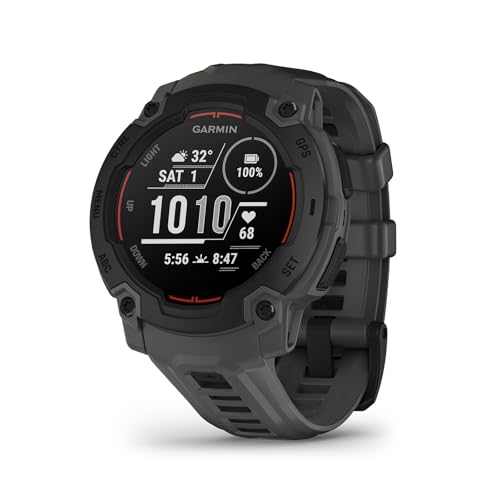
Garmin splits its rugged offering into two personalities. Instinct models lean toward polymer cases, monochrome or limited-colour MIP displays on many variants, solar options, long battery tables and a shape that echoes classic outdoor instruments. Fenix models add mapping depth, more case sizes, metal and titanium variants, sapphire options and AMOLED choices at the top of the range. Garmin publishes unusually detailed battery and satellite mode tables, lists water ratings of 10ATM for these lines, and describes MIL-STD-810H testing for thermal, shock and water resistance in its product literature. The strength of the Garmin record is granularity: a buyer can usually find the exact mode, size and material combination being considered.
Amazfit positions the T-Rex family as rugged value with large AMOLED displays on recent flagship models, dual-band positioning, 10ATM ratings on key models, and published lists of MIL-STD-810H methods passed that are longer than many rivals disclose. Case construction leans on reinforced polymers with metal bezels or accents depending on model. Battery claims are strong for AMOLED hardware, aided by large cells and aggressive power management, though as always the satellite and always-on settings decide the lived result. The T-Rex line suits buyers who want a big bright screen and outdoor features without moving to the highest price tier of the category, keeping in mind that no prices are compared here and specifications change between generations.
Casio brings the deepest shock-protection heritage. G-Shock smart models combine resin guard structures with Wear OS or Casio own software depending on generation, heart rate sensing, satellite positioning on selected models, and water resistance published at 20 bar for many G-Shock lines, a figure above the 10ATM level common elsewhere. The trade-offs tend to be size, weight, battery endurance on the smartest models and a design language that divides opinion. For buyers whose work involves repeated impact – construction, warehousing, mechanical trades, military and emergency roles – the Casio approach of building the case around shock first remains distinctive.
Samsung Galaxy Watch Ultra class models take the connected route: titanium case, sapphire glass, 10ATM rating plus an IP68 dust and water entry in published specifications, dual-frequency positioning, and the full Wear OS application ecosystem with strong phone integration for Android owners. Battery life sits at the shorter end of this comparison group, measured in days rather than weeks, and the toughness story emphasises materials, water resistance and temperature tolerance alongside features such as a quick button and siren on Ultra models. For a buyer who wants one watch for office, training and rough weekends, and who charges frequently without complaint, that balance can be the right one.
Reading brand test regimes side by side
The four families publish toughness in different dialects. One lists military methods in detail. Another leads with a bar figure inherited from traditional watchmaking. Another pairs an ATM figure with an IP code that covers dust entry and immersion under a separate test system. Another foregrounds materials – titanium, sapphire – and treats those as the headline. None of these dialects is automatically superior. The buyer job is translation: convert every claim into impact, water, dust, temperature and material terms, then compare like with like. Where a brand publishes less, the gap itself is information, and it should weigh against a rival that documents more for a similar role.
Smart features under rough conditions
Toughness would be wasted if the smart layer failed outdoors. Touchscreens struggle with heavy rain, thick gloves and wet fingers, so physical buttons that can start, pause, lap and scroll without looking are a genuine safety feature on climbs, rides and water. Voice assistants and gesture controls help in some settings and fail in wind or noise. Speaker volume matters for alerts on a bike or boat. Haptic strength matters when the wrist is inside a jacket. These details rarely headline a launch, yet they decide whether a rugged watch stays usable when conditions turn poor.
Health and training sensors also face the environment. Optical heart rate performs best with a clean sensor window, a snug strap and warm skin; cold, tattoos, very loose fit and high-motion sports such as racket games or weightlifting can all degrade readings, on every brand. Chest strap pairing remains the reference route for interval accuracy, and all major rugged lines support external sensors to varying degrees. Pulse oximetry draws notable power and is best scheduled or used on demand rather than left running continuously without a reason. Sleep, recovery and readiness scores depend on consistent wear, which loops back to size and strap comfort: the toughest watch loses data value on the nights it stays on a dresser.
Safety and communication features
Incident detection, fall alerts, emergency contact messaging, live tracking links and audible sirens appear across parts of this category, with availability tied to phone connection, cellular variants and regional rules. A watch with LTE can raise an alert away from a phone on supported networks, while a Bluetooth-only model depends on the phone being present and connected. Buyers in remote areas should not confuse these features with a satellite messenger or personal locator beacon, which use different networks and subscription systems built for wilderness emergencies. A rugged smartwatch complements proper emergency equipment; it does not replace it.
Durability over years: service, updates and wear
A tough watch should age slowly in every sense. Software update policy affects security, satellite performance improvements, sensor algorithms and map support. Battery health declines with cycles and heat, and few rugged watches offer user-replaceable cells, so realistic service life is often set by the battery rather than by the case. Ask whether the maker offers battery service, screen repair and strap availability for older generations. Ask how long accessories such as charging cables remain on sale. A model that stays supported for years is a better outdoor investment than a marginally stronger model abandoned quickly.
Care routines that protect the rating
Rinse the watch in fresh water after sea, pool or heavy sweat sessions, then dry it with a soft cloth, paying attention to charging contacts and the area under the strap. Keep buttons moving freely by rinsing away grit rather than pressing dried mud deeper into seals. Avoid exposing the watch to solvents, strong detergents and insect repellent sprays directly on the case. Do not charge a watch that is wet unless the maker explicitly allows it, and let a cold watch warm gradually before charging after winter use. Store it partly charged if it will sit unused for months, and check seals and strap condition before any trip where failure would matter.
Matching a model family to a job
For multi-day hiking and mountaineering, the strongest pattern is a MIP or efficient AMOLED display, 10ATM water resistance, detailed battery tables, dual-band positioning that can be switched off when terrain is open, barometric elevation with satellite calibration, and buttons that work in gloves. Instinct and fenix models were shaped by this brief, and T-Rex models answer it with larger screens and strong value in specification terms. Weight and case size should stay within what the wrist can carry for ten hours without distraction.
For ocean use – sailing, paddling, surfing, coastal fishing and beach work – corrosion behaviour and rinse discipline matter as much as the water figure. Titanium or polymer cases, sapphire or well-guarded glass, straps that tolerate salt and dry without odour, and tide or wind features where offered, all count. After every salt session the watch needs fresh water rinsing, and metal spring bars deserve inspection because they are small, loaded and exposed. A 10ATM rating is the sensible floor for regular surface water sport, with brand activity guidance checked for high-speed falls from boards or personal watercraft, where impact pressure can exceed gentle swimming by a wide margin.
For building sites, workshops, warehouses and mechanical work, shock structure and bezel protection lead. G-Shock smart models speak directly to this life, and polymer Instinct models suit it well too. A screen protector is cheap insurance against tool contact, straps should be washable, and the buyer should think honestly about chemicals, welding sparks, solvents and vibration from tools, none of which a general rugged label fully covers. Where employers set rules for jewellery and loose items, a watch may need to come off regardless of toughness, and snag risk should be part of the decision.
For runners and triathletes who also want durability, weight, strap stability and satellite recording quality dominate. A mid-size fenix, a lighter Instinct variant or a T-Rex model with a well-fitted strap can all serve, while the largest cases can bruise wrist bones during high-cadence arm swing for some runners. For daily wear with occasional rough use, the Samsung Ultra class offers the smoothest general smartwatch life, provided its owner accepts frequent charging as the price of that polish. Budget limits are real for many buyers, and readers weighing cost against features can look at best affordable android smartwatches before deciding how far up a rugged range to climb.
Winter, desert and jungle specifics
Winter sport rewards low-temperature operation, glove-friendly controls, a strap long enough for jacket cuffs when heart rate is not needed, and battery expectations set for cold derating. Desert use rewards dust sealing, solar tolerance without dashboard baking, light strap colours and displays that stay readable at noon. Jungle and monsoon use reward humidity resistance, straps that resist odour and rot, frequent rinsing, and drying time off the wrist so skin can recover. No single model leads every climate, which is why published operating ranges and method lists – rain, dust, humidity, salt fog, solar – should be matched to the climate a buyer actually faces rather than to a generic idea of adventure.
A buyer checklist drawn from published documents
Start with the specification sheet for the exact model and size, not the range overview. Note the water figure and the maker activity guidance beside it. Note the glass material, case material, case diameter, thickness, lug-to-lug length if given, and weight with the supplied strap. Record the operating temperature range and any separate charging range. Then read the battery table mode by mode, writing down the satellite settings that match your sport, because those hours – not the smartwatch headline – decide whether the watch finishes your longest day.
Next, examine the toughness evidence. Which MIL-STD-810H methods are named, and does the maker describe them as passed, tested or designed to the standard? Is an IP code given, and what does each digit cover? Is there a dive standard claim, or only an ATM figure that should not be read as one? Does the warranty cover water damage, and under what conditions? Makers differ on water damage exclusions, and that wording can matter more than a dramatic launch photograph of a watch under a waterfall.
Then check the working details: button layout and glove use, touchscreen lock for water, satellite modes and their recording hours, map storage, external sensor support, phone compatibility, payment support in your country, strap lug width and connector type, charging cable type and spare availability. Finish with ownership questions: update history for the range, repair options, strap and cable availability for prior generations, and return terms that allow a genuine fit check at home. A watch that passes every laboratory point yet fails the fit check will not be worn, and an unworn watch protects nothing.
Common misunderstandings to leave behind
Leave behind the idea that a metre figure beside a water rating is a permitted diving depth. Leave behind the belief that a military standard citation is a government guarantee of the finished product. Leave behind the assumption that sapphire cannot break, that titanium cannot scratch, or that a polymer case is a lesser choice by default. Leave behind headline battery numbers compared across brands without matching modes. Each of these errors pushes buyers toward the wrong model with great confidence, and each is avoidable by reading the documents the makers themselves publish.
Check prices on Amazon
Live listings for the shortlist in this guide are pulled from Amazon below, so prices and availability are always current at the moment you look.


Final judgement on the tough smartwatch field
The strongest rugged smartwatches share a pattern that has little to do with aggressive styling. They publish their water figures with activity guidance, name their glass and case materials plainly, give battery tables by mode, describe environmental testing in method-level detail, and keep physical controls at the centre of the design. Garmin Instinct and fenix models remain the reference for outdoor depth and endurance options. Amazfit T-Rex models press hard on screen size, satellite features and specification value. Casio G-Shock smart models carry the clearest shock-first design story. Samsung Galaxy Watch Ultra class models deliver the most complete connected smartwatch experience inside a titanium and sapphire shell for owners content with short charging intervals.
Choose by failure mode, not by badge. Ask what is most likely to end your watch service life: a cracked face on rock, a flooded seal after years of pool use, a dead battery on a long route, a strap torn at work, a screen unreadable at noon, or a case so large it lives in a drawer. The model whose published strengths answer that specific risk, in the size your wrist can carry and with the phone support your life requires, is the right tough watch for you. Documentation will not make a watch unbreakable, but it will tell you, more honestly than any slogan, where the strength ends and your own care must begin.
When the next storm front rolls over the ridge and the trail turns to running water, the watch still glowing on a soaked wrist will be the one that was chosen by evidence rather than by armour-plated looks alone.
Related guides
- Best 1080p IP Cameras: PoE Domes, Turrets, Bullets and a PTZ That Earn Their Cable
- Best 43 1080p TVs: Why 43 Inches Went 4K — and Where True Full HD Survives
- Best Doorbell Cameras No Subscription: Local Storage Picks, and the Ring/Blink Truth
- Best AC Powered Wireless Security Cameras: Wi-Fi Data, Mains Power, Zero Sleep


