What's inside
- Key Takeaways
- Quick Picks
- How Did We Choose These Picks?
- What Actually Makes a Streaming Movie Look Cinematic?
- How Do the Six Compare for Movie Night?
- How Should You Set Up a Room for Streaming Movies?
- What Are the Most Common Mistakes When Buying a TV for Streaming Movies?
- How Do Streaming Services Change What a TV Must Do?
- What Should You Know About HDR Formats Before Choosing?
- How Does Viewing Distance Turn Size Into Immersion?
- How Should a Movie TV Handle Older Films and Weaker Streams?
- What Does a Decade of Movie Nights Ask of a Television?
- How Do You Audition a Movie TV in Its First Week?
- Why Does the Whole Household’s Taste Belong in the Decision?
- What Role Does the Soundbar Play in a Streaming Setup?
- How Should You Future-Proof a Movie Room on a Budget?
- Final Recommendation
- Frequently Asked Questions
- Related Guides
As an Amazon Associate I earn from qualifying purchases. This post may contain affiliate links at no extra cost to you.
gizmoverdict.com is reader-supported. When you buy through links on our site, we may earn an affiliate commission.
Where to buy: every television below links to its Amazon listing, where you should confirm the size, the HDR formats named and the number of HDMI ports before you check price on Amazon, because a movie room is built once and lived with for years.
The best tvs for streaming movies are judged in the dark, on the hardest material streaming offers: a night scene in a prestige drama, where the plot hides in shadow and a lesser panel turns it to grey soup; a subtitled art film, where blooming around white text on black betrays a lazy backlight; a sweeping landscape in Dolby Vision, where colour either breathes or shouts. Six televisions earned their places here by handling those scenes with composure, from a 75-inch TCL flagship down to a 48-inch Sony OLED that proves size is not the only route to cinema. Every pick carries Dolby Vision support and a streaming platform with the major apps, because a movie television that cannot play the film you rented, in the format it was mastered in, has failed before the opening credits.
One exclusion deserves explaining before the picks, because search results for this topic are flooded with projectors. Projectors are a different product class, and a wonderful one in the right room, but the right room is a darkened, dedicated space with a screen, controlled light and a tolerance for fan noise and lamp economics. In a normal living room, with daylight, lamps, pale walls and a sofa that faces windows, a television wins decisively: it is brighter by an order of magnitude, sharper at these sizes, silent, instant and honest in HDR in a way no projector in a lit room can imitate. This guide is for the normal room, and it makes no apology for choosing the technology that flatters it.
The Sony pick carries the guide’s one OLED panel, and OLED’s one anxiety must be stated as plainly as its glory. Its perfect blacks come from pixels that switch off entirely, and its care requirement is burn-in awareness: static images left for very long periods, news tickers, paused menus, game HUDs on endless loops, can in time leave a ghost. For a varied movie diet the risk is small and the reward is the finest dark-room picture here; the care is simply variety and the use of the set’s screen-saver habits. That trade is described in full in its section, because a guide that hides it would deserve no trust anywhere else.
Key Takeaways
- Dark-room contrast is the first movie specification; everything else queues behind how a set handles a night scene.
- Dolby Vision support appears on every pick, because the major streaming services master their flagship films and series in it.
- Projectors were excluded deliberately: in a normal, light-contaminated room a television’s brightness and contrast win outright.
- The single OLED pick offers perfect blacks and asks for ordinary burn-in care in return, stated plainly in its section.
- Platform breadth matters as much as panels, since a movie service missing from the set is a film you cannot watch.
Quick Picks
| Pick | Badge | Why it earns its place |
|---|---|---|
| TCL 75-Inch QM8L SQD-Mini-LED | Best big-screen immersion | TCL’s flagship at 75 inches turns a living room into the largest cinema most households will ever own. |
| Sony 48-Inch BRAVIA 6 OLED | Best pure picture | OLED’s perfect blacks and Sony’s processing give the finest dark-room image here, at a size for closer rooms. |
| Samsung 65-Inch M70H Mini LED | Best Samsung route | A 65-inch Mini LED set with Samsung’s latest processing and platform polish for mixed movie rooms. |
| Philips 50-Inch 7985 Ambilight QLED | Best atmosphere | Ambilight washes the wall behind the screen in the scene’s colours, enlarging a 50-inch picture by illusion. |
| INSIGNIA 55-Inch QF QLED Fire TV | Best value streamer | QLED colour and Fire TV breadth at the tier where a dedicated movie screen stops being a luxury. |
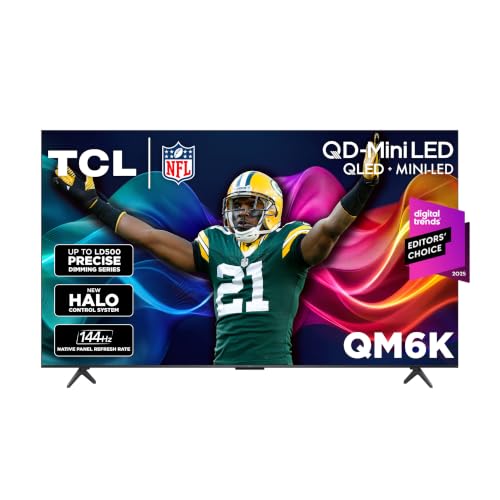
| TCL 65-Inch QM6K QLED Mini-LED | Best all-round balance | The QM6K pairs Mini-LED contrast with IMAX Enhanced support at the size most movie rooms settle on. |
How Did We Choose These Picks?
Movie duty inverts the priorities of ordinary television shopping. Brightness for a sunlit sports afternoon matters less than control in darkness, so local dimming quality, black uniformity and the handling of near-black shadow were ranked first. A set that crushes the darkest greys into a single black erases the cinematographer’s night work; a set that blooms around subtitles or a candle flame advertises its backlight in every quiet scene. The six here passed those examinations in their listings’ technologies and their makers’ track records, with Mini-LED dimming on four, OLED’s pixel-level control on one, and Ambilight’s atmospheric assist on the Philips.
Format support was the second gate. Dolby Vision is the streaming world’s premium HDR language, spoken by the flagship films and series of the major services, and every pick speaks it. IMAX Enhanced support on the TCL QM6K and the broader HDR format coverage across the list were counted as genuine assets, because a movie household’s library is scattered across services with different mastering habits. Platform completeness was the third gate: Google TV, Samsung’s platform, Roku and Fire TV all appear, each carrying the major movie services, so no reader is asked to abandon their library to follow a panel recommendation.
Size spread was deliberate. Movie immersion scales with the picture, so the list reaches to 75 inches, yet it also honours the smaller room with a 48-inch OLED and a 50-inch Ambilight set whose tricks flatter modest spaces. A guide that only crowned giants would fail the flat-dwellers who stream the most films of anyone.
What Actually Makes a Streaming Movie Look Cinematic?
Contrast is the foundation, because cinema is an art of controlled darkness. A director lights a face against a black room and expects the television to hold both; the ratio between the panel’s deepest black and its brightest highlight decides whether that intention survives. OLED achieves it by extinguishing pixels entirely. Mini-LED achieves it by dividing the backlight into many zones and dimming the dark ones toward silence. Both routes, done well, produce the inky, dimensional night scenes that separate a movie screen from a bright rectangle.
Processing is the interpreter. Streaming arrives compressed, and the television must reconstruct gradients without banding, upscale older films without waxiness, and handle 24-frame-per-second film cadence without the judder that pans expose. Sony’s reputation in this guide rests heavily on that interpretive skill; TCL and Samsung have closed much of the historical gap, and their flagships now handle a slow camera move across a night skyline with a grace that would have embarrassed premium sets a few years ago. Motion interpolation, the soap-opera effect, should be treated as an intruder in this category: film was shot at its own rhythm, and the correct setting for movies is the one that leaves that rhythm alone.
Sound is the silent partner. A streaming film’s mix assumes dialogue anchored in the centre and effects that swell without drowning it, and television speakers remain the weakest instrument in the chain. Every pick here supports modern audio formats as listed, and every verdict below assumes a soundbar joins the serious movie room sooner or later. The screen buys the picture; the bar buys the cinema.

TCL 75-Inch QM8L SQD-Mini-LED — Best big-screen immersion
At 75 inches, the QM8L stops being a television in the conversational sense and becomes the room’s architecture. Its listing names the flagship SQD-Mini-LED QLED panel at 144Hz on Google TV, with the brand’s ultimate claims for colour, brightness and contrast, and scale is the first thing those specifications serve. A landscape fills peripheral vision; a face in close-up has the size it has in a cinema’s middle rows; subtitles sit where they should, beneath a picture rather than across a postage stamp. Households that measure their love of film in Friday-night occasions will find this the pick that turns the ritual into an event without a projector’s compromises in a normal room.
Flagship dimming earns its keep at this size in the dark scenes that decide this category. A 75-inch panel magnifies blooming and blotchiness as faithfully as it magnifies spectacle, and the QM8L’s dense Mini-LED control is what keeps a night street’s lamps from haloing into the shadows between them. Google TV gathers the household’s services into one browsable surface, which at this level of investment should feel less like a menu and more like a video library’s front desk. The honest costs are the room’s: seating distance, a stand or mount equal to the panel’s presence, and sound reinforcement to match, because a cinema-sized picture whispered through television speakers is a film shown with the sound off in another room. Budget the bar, measure the wall, and this is the guide’s grandest answer.
- Panel: 75-inch SQD-Mini-LED QLED 4K, 144Hz as listed
- Platform: Google TV with Gemini features as listed
- Focus: flagship brightness, contrast and dimming at the largest size here
- Formats: Dolby Vision and broad HDR support per listing
- Role: main-room cinema anchor
Strengths
- Cinema scale without a projector’s light-control demands.
- Flagship dimming keeps huge dark scenes clean and halo-free.
- Google TV unifies a multi-service movie library gracefully.
Trade-offs
- Demands seating distance and a room that can host it.
- Needs a soundbar to match its picture’s ambition.
- The flagship tier is a serious commitment for a single screen.
Best for: households building their film life around a big main room and a weekly movie night. Not suited for: small rooms, short viewing distances or casual viewers.

Sony 48-Inch BRAVIA 6 OLED — Best pure picture
The BRAVIA 6 OLED is the connoisseur’s pick, and its listing tells the story compactly: a 48-inch OLED 4K HDR television on Google TV, with Dolby Vision and Atmos, Triluminos Pro colour and a wide viewing angle. OLED’s mechanism is its magic: each pixel makes its own light and can switch off entirely, so black is not a dimmed grey but an absence, and a starfield, a night sea or a theatre’s darkness achieves a depth no backlight can counterfeit. Sony’s processing then interprets streamed sources with the restraint the brand is known for, preserving film grain, gradients and faces where lesser engines smear them into plastic.
The care paragraph belongs here and will not be softened. OLED pixels age with use, and a static image held on screen for very long periods, across many days, can leave a permanent ghost called burn-in. A movie diet is naturally varied and therefore naturally kind, but the household habits to avoid are specific: do not leave news channels with fixed tickers running all day, do not pause a film and go to bed, do not loop a game menu for a weekend. Use the set’s screen saver and pixel-care features, vary the content, and the panel will reward you for years. At 48 inches this is also the intimate option, a screen for a smaller room, a closer sofa or a dedicated viewing corner, where its perfect contrast is experienced at a distance that makes every shadow gradation legible. Buyers who watch films the way others listen to records, closely and in the dark, will not find a finer instrument in this guide.
- Panel: 48-inch OLED 4K HDR as listed
- Platform: Google TV with Gemini features as listed
- Colour: Triluminos Pro as listed
- Formats: Dolby Vision and Dolby Atmos support as listed
- Care: burn-in awareness for static content, described above
Strengths
- Perfect blacks and pixel-level control no backlight can match.
- Sony’s processing treats streamed film with rare restraint.
- Wide viewing angles keep the picture honest from every seat.
Trade-offs
- Static-content habits must be managed to protect the panel.
- 48 inches is intimate; big-room spectacle is not its brief.
- Peak brightness in a sunlit room trails the Mini-LED flagships.
Best for: film lovers in smaller rooms who watch in darkness and value shadow detail above spectacle. Not suited for: households that leave news or games paused on screen for hours daily.

Samsung 65-Inch M70H Mini LED — Best Samsung route
Samsung’s M70H brings the company’s Mini LED engineering to the 65-inch size this category calls home. Its listing names a Mini LED panel with a dedicated Mini LED 4K processor, Samsung Vision AI Companion features and the brand’s Pure Spectrum colour language. In movie terms, that translates to strong, well-disciplined contrast with the brightness headroom to keep HDR highlights sparkling in a room that is dim rather than pitch black, which describes most real movie nights more honestly than the bat-cave ideal. Samsung’s platform polish completes the picture: the interface is handsome, the services are present, and the set behaves like the centre of a modern living room rather than a specialist instrument.
The M70H’s natural rival in this guide is the TCL QM6K at the same size, and the choice between them is a genuine fork in philosophy. Samsung leans on processing refinement and platform finish; TCL leans on dimming ambition and format extras such as IMAX Enhanced. A household already living inside Samsung’s ecosystem, phones, soundbars and habits included, will feel the M70H’s integration daily and should weight it heavily. A household choosing on panel theatre alone should audition both with the same night scene and trust the darkness to arbitrate. Either way, the Samsung is the safe pair of hands at 65 inches: bright, controlled and civilised with every kind of streamed film thrown at it.
- Panel: 65-inch Mini LED 4K as listed
- Processing: Mini LED Processor 4K with Vision AI features as listed
- Colour: Pure Spectrum colour as listed
- Platform: Samsung smart platform
- Role: the polished all-rounder at cinema size
Strengths
- Brightness headroom flatters HDR in dim, real-world rooms.
- Samsung’s platform and processing feel thoroughly finished.
- Ecosystem integration rewards existing Samsung households.
Trade-offs
- Dolby Vision politics aside, format extras trail the TCL rival’s list.
- Television speakers still leave a soundbar on the shopping list.
- Its polish is priced into the tier it occupies.
Best for: Samsung households and mixed-use rooms wanting a refined 65-inch movie screen. Not suited for: buyers chasing the longest format checklist at this size.

Philips 50-Inch 7985 Ambilight QLED — Best atmosphere
The Philips 7985 owns the most distinctive trick in this guide. Its listing names a 50-inch 4K QLED panel on the Roku platform with Dolby Vision, HDR10 and HLG, Dolby Atmos, four HDMI ports, and the feature printed in its name: Ambilight, built-in LED lighting that projects the picture’s colours onto the wall behind the set. The effect is not a gimmick once lived with. The glow enlarges the perceived picture, softens the contrast between a bright screen and a dark room that tires eyes across a long film, and turns a modest 50-inch panel into a room-filling presence that guests comment on before they comment on anything else in the flat.
Roku underneath is a shrewd pairing, giving this European-flavoured television the streaming world’s most even-handed interface and its full spread of movie services. Judged purely as a panel, the 7985 is a capable QLED rather than a dimming flagship, and in the darkest scenes the Mini-LED picks will dig deeper. Judged as an experience in a smaller room, which is the judgement its buyers actually make nightly, Ambilight closes that gap by illusion and then some. For the flat where a 50-inch screen is the room’s limit, no other pick here does more to make the limit feel like a choice rather than a compromise.
- Panel: 50-inch 4K QLED as listed
- Feature: Ambilight built-in wall lighting as listed
- Platform: Roku TV
- Formats: Dolby Vision, HDR10, HLG and Dolby Atmos as listed
- Connections: 4 HDMI including eARC as listed
Strengths
- Ambilight enlarges the picture’s presence beyond its inches.
- Gentler on eyes across long films in dark rooms.
- Roku platform covers the movie services completely.
Trade-offs
- Needs a pale wall behind it for the effect to work.
- Panel contrast trails the Mini-LED picks in the darkest scenes.
- The glow can be dimmed or disabled, but sceptics should audition first.
Best for: smaller rooms and flats where atmosphere must substitute for acreage. Not suited for: dark-room purists who want the deepest blacks above all.

INSIGNIA 55-Inch QF QLED Fire TV — Best value streamer
The INSIGNIA QF exists to answer a fair question: how good a streaming movie screen can be had before the tiers turn serious? Its listing names a 55-inch QLED 4K panel on Fire TV with an Alexa voice remote, and that combination covers the movie essentials with surprising completeness. QLED colour gives streamed films their saturation, Fire TV gathers the major services and a deep bench of free film channels for the weeks between subscriptions, and 55 inches at a normal sofa distance is a genuinely cinematic size that a generation ago would have been a flagship’s boast.
Honesty about the tier is this guide’s habit, so the concessions are named plainly. The QF’s backlight control is not the Mini-LED discipline of the TCL and Samsung picks, and in the blackest scenes a careful viewer will see its backlight working, with some haloing around bright objects on dark fields. Its processing is competent rather than artful with poor sources. What it returns for those concessions is access: a household can enter the streaming-movie life properly, Dolby Vision-era colour and a full platform included, at a tier that leaves budget for the soundbar that will improve its films more than a panel upgrade would. As the value pick of a movie guide, that is exactly the right shape of compromise.
- Panel: 55-inch QLED 4K UHD as listed
- Platform: Fire TV with Alexa voice remote as listed
- Colour: QLED quantum-dot colour
- Role: value entry to a dedicated movie screen
- Pairing: budget leaves room for a soundbar
Strengths
- Full streaming breadth and QLED colour at a friendly tier.
- 55 inches is a real cinema size for ordinary rooms.
- Fire TV’s free film channels stretch a subscription budget.
Trade-offs
- Backlight control is a clear step below the Mini-LED picks.
- Processing of weak sources is competent, not artful.
- Brand support is marketplace-grade rather than flagship-grade.
Best for: households entering the movie-streaming life on a real budget. Not suited for: dark-room perfectionists, who should climb to the TCL or Sony.
TCL 65-Inch QM6K QLED Mini-LED — Best all-round balance
The QM6K is the pick this guide expects to fit the most movie rooms, because it concentrates on the fundamentals at the size the rooms choose. Its listing names a 65-inch QLED Mini-LED panel at 144Hz on Google TV, with IMAX Enhanced certification, HDR10 and Dolby Vision and Atmos among its formats. IMAX Enhanced deserves its sentence: on supported streaming content it presents an expanded aspect ratio and a soundtrack mastered to the programme’s standard, which on the right film feels like the cinema’s geometry arriving home. The Mini-LED backlight beneath it supplies the dimming control that dark scenes audit, and the QM6K’s balance of zones, brightness and price tier is the product of a line that has been refined across several generations.
Against its flagship sibling at 75 inches, the QM6K concedes scale and some headroom; against the Samsung at the same size, it trades platform polish for format generosity and dimming ambition. Both trades are defensible, which is why this pick is framed as the balance point rather than the summit. A household that watches films three nights a week, in a room that goes properly dim, with a soundbar beneath the screen, will find the QM6K disappears into the ritual entirely, and a television that disappears is the highest praise a movie screen can earn. If one set in this guide is the default recommendation for the keyword as written, it is this one.
- Panel: 65-inch QLED Mini-LED 4K, 144Hz as listed
- Platform: Google TV
- Formats: IMAX Enhanced, HDR10, Dolby Vision and Atmos as listed
- Focus: dimming control and format breadth at the popular size
- Role: the guide’s default movie recommendation
Strengths
- Mini-LED contrast and IMAX Enhanced at the room-friendly size.
- Format support covers the streaming services’ premium tiers.
- Balance of price, panel and platform suits most households.
Trade-offs
- Flagship sibling offers more scale and headroom for more money.
- Google TV’s recommendations will not suit minimalists.
- Still benefits from a soundbar for full cinema effect.
Best for: the majority of movie households wanting one set that does everything well. Not suited for: buyers determined to own either the largest or the purest picture here.
How Do the Six Compare for Movie Night?
| Pick | Panel route | Platform | Movie personality |
|---|---|---|---|
| TCL 75-Inch QM8L SQD-Mini-LED | Flagship Mini-LED | Google TV | Scale and spectacle |
| Sony 48-Inch BRAVIA 6 OLED | OLED | Google TV | Purity and shadow detail |
| Samsung 65-Inch M70H Mini LED | Mini LED | Samsung | Polish and brightness |
| Philips 50-Inch 7985 Ambilight QLED | QLED plus Ambilight | Roku | Atmosphere beyond inches |
| INSIGNIA 55-Inch QF QLED Fire TV | QLED | Fire TV | Value with full breadth |
| TCL 65-Inch QM6K QLED Mini-LED | Mini-LED | Google TV | Balance in everything |
Three philosophies share the table: control the light with zones, create the light pixel by pixel, or paint the wall with it. All three are legitimate answers to the same dark room, and the right one is the one matched to your room’s size, your light discipline and your appetite for spectacle.
How Should You Set Up a Room for Streaming Movies?
Light discipline comes first, and it need not mean a cave. Dim the room rather than blackening it, kill the one lamp that reflects in the screen, and let a small bias of light behind the set, which Ambilight owners get free, ease the eyes across a long film. Seat the main viewers inside the panel’s comfortable viewing cone and at a distance where the screen fills a generous slice of vision; for the 65-inch picks that is a shorter distance than most rooms default to, and moving the sofa a half-metre closer is the cheapest cinema upgrade in existence.
Picture settings follow a simple doctrine for film. Choose the set’s movie or filmmaker preset, which exists to respect the source’s colour and cadence, disable motion interpolation for films so 24-frame material keeps its native rhythm, and set the backlight or OLED light for the room’s actual darkness rather than for the showroom. Subtitle readers should check one dark scene with subtitles on before the first full film, because blooming around text is the flaw that announces itself nightly once noticed.
Sound and network complete the ritual. A soundbar with a clear centre presentation will do more for streamed dialogue than any picture setting, and a wired Ethernet connection, or a router within honest range, protects the stream’s best quality tier from the buffering that murders a climax. Download the household’s services, sign in once, arrange the home screen so films are two clicks away, and movie night becomes a habit rather than a negotiation with technology.
What Are the Most Common Mistakes When Buying a TV for Streaming Movies?
The first mistake is buying for the brightest demo. Showrooms reward brightness; films reward control, and a set chosen under fluorescent light for its punch may bloom and crush its way through every night scene at home. Judge movie televisions in the dark, or trust guides that do. The second mistake is ignoring format support, discovering after purchase that a favourite service’s premium tier speaks a language the set does not. Every pick here was gated on Dolby Vision for exactly that reason.
The third mistake is choosing a projector for a room that cannot host one, seduced by screen-size arithmetic while the room’s windows and white ceiling quietly veto the plan. The fourth is starving the sound, spending the whole budget on panel and leaving streamed dialogue to the mercy of two small speakers facing the wall. The fifth is forgetting the catalogue: a television is a doorway to services, and a platform missing the service your household actually rents films from is a beautiful door opening onto the wrong room. Panels, formats, platforms, in that order, and the mistakes design themselves out.
How Do Streaming Services Change What a TV Must Do?
A broadcast television receives one signal and shows it; a streaming television is a negotiator, constantly bargaining with a server over bandwidth, resolution and format. When the network is generous, the set receives a rich 4K Dolby Vision stream and its panel does the showing off. When the network tightens, the stream sheds resolution and bitrate in steps, and the television’s upscaling and noise handling decide whether the film merely softens or falls apart into banding and mush. This is why processing quality, the invisible virtue, ranks so highly in a streaming guide: the set spends its life rescuing imperfect deliveries, and the better its judgement, the less the audience ever learns about the rescue.
Each service also masters differently. One platform’s flagship series may arrive in Dolby Vision with an Atmos mix of genuine ambition; another’s film library may top out at plainer HDR and stereo-era sound on older titles. A television cannot unify those differences, but a platform that carries all the household’s services in their best implementations prevents the quiet downgrade of watching a favourite service through a second-class app on a stick bought in desperation. Checking the app implementations for your two most-used services is unglamorous homework that protects years of evenings.
Catalogue churn adds a final streaming reality. Films migrate between services monthly, and the household’s library is effectively rented from a shifting market. The television’s search therefore matters more than its channel guide ever did: a platform that searches across services and reports where a film currently lives, and in what quality, saves the small nightly friction that accumulates into resentment of the whole setup. Google TV and Roku both take that aggregation seriously, Fire TV wraps it in its own storefront, and Samsung’s hub pursues the same goal with its own polish; the movie household should test the search with three beloved, obscure films before committing to any of them.
What Should You Know About HDR Formats Before Choosing?
HDR is not one thing, and the alphabet around it decides which version of a film you see. HDR10 is the universal baseline, a static instruction set applied to a whole film. Dolby Vision refines it scene by scene, adjusting brightness and colour as the story demands, which is why this guide gated every pick on it: the streaming services’ premium libraries are mastered in it, and a set without it shows those films in their fallback grade. HDR10+ is a rival dynamic system with thinner streaming support in most regions, and HLG serves broadcast. A set that speaks several languages, as the Philips here does with Dolby Vision, HDR10 and HLG together, insures the library against the market’s indecision.
IMAX Enhanced, carried by the QM6K, is a separate promise: selected titles present an expanded picture that fills more of the screen and a soundtrack mixed to a defined standard. It is a garnish rather than a foundation, a smaller catalogue than Dolby Vision’s, but on the right film it is a genuinely pleasurable one, and at the QM6K’s tier it costs the buyer nothing to accept. The discipline for shoppers is ordering: secure Dolby Vision first, broad HDR10 competence always, and treat every further badge as a tiebreaker between sets already equal on the fundamentals of contrast and control.
Tone mapping is where formats meet panels. A film mastered brighter than a television can display must be translated, and the quality of that translation, whether highlights roll off gracefully or clip into white blobs, varies between makers more than any specification admits. This is one of the quiet reasons Sony’s processing is praised in this guide and why flagship Mini-LED sets with brightness headroom, the QM8L above all, handle the most aggressive masters with the least visible effort: headroom is forgiveness, and forgiveness is invisible until the night it saves a scene.
How Does Viewing Distance Turn Size Into Immersion?
Immersion is geometry, not acreage. A screen fills cinema-like portions of your vision when it subtends a wide angle at the eye, which can be achieved by a larger panel, a closer seat, or, as the Philips demonstrates, an illusion that extends the picture into the wall. The practical guidance for 4K sets places the main seat roughly one to one-and-a-half screen widths away for film, nearer than most living rooms default to, and the single most common movie-room fault is a fine television exiled across an ocean of carpet. Before upgrading a panel, try upgrading the geometry: the sofa moved closer will outperform a size step bought at retail.
Distance also governs how much of a stream’s imperfection you can see. Sit very close to a large screen and compression artefacts in a dark scene become a texture; sit at the recommended range and the same stream resolves into the film the director released. The 48-inch Sony at a close, deliberate distance is the connoisseur’s expression of this truth: a modest panel, perfectly controlled, viewed near enough that its shadow detail becomes the spectacle. The 75-inch TCL is the same truth at communal scale, where the back row of a family sofa still sits inside the picture’s embrace. Choose the geometry your room can honestly offer, then buy the panel that serves it.
How Should a Movie TV Handle Older Films and Weaker Streams?
A streaming library is mostly not new releases. It is the beloved film from 1998 delivered in a tired transfer, the classic in black and white, the foreign masterpiece whose only stream is a modest one, and a movie television earns its household’s affection on those evenings as surely as on premiere night. Upscaling judgement is the core skill: sharpening that respects film grain rather than sanding it away, noise handling that cleans a murky encode without waxing faces, and black-and-white rendering that stays neutral instead of tinting the shadows green or pink. Sony’s processing heritage shows most clearly here, but every pick in this guide was chosen partly because its maker treats legacy content as a citizen rather than an embarrassment.
Black and white deserves its own sentence, because it is the purest audit of a panel’s uniformity and greyscale. A set with blotchy uniformity or a tinted grey ramp will fail a classic film in a way no colour demo ever exposes, and the OLED’s pixel-level evenness and the better Mini-LED sets’ discipline both pass with the kind of neutrality that lets a viewer forget the machinery entirely. If your library leans classic, weight those traits and the filmmaker-style presets heavily, and test any candidate with ten minutes of monochrome before the return window closes.
Aspect ratios complete the legacy picture. Older films arrive in squarer frames, classics of the widescreen era arrive wider than the television itself, and a set should present each without stretching, cropping or surrounding it with distracting bright borders. All six picks handle this through their standard picture controls; the household’s job is simply to resist the zoom button’s temptation, because a film’s frame is part of its meaning and the black bars are the price of seeing it whole.
What Does a Decade of Movie Nights Ask of a Television?
Longevity in this category is a story of software as much as glass. The panel will outlast several generations of streaming apps, and the set whose platform receives patient updates, or whose HDMI ports welcome the next streaming stick gracefully, will still be the household’s movie screen when today’s interface is a museum piece. Every pick here sits on a mainstream platform or carries the ports to outsource its smarts later, and that ordinariness is a deliberate selection criterion disguised as a lack of adventure.
Physical care is brief and mostly negative. Do not clean a warm screen with household chemicals; do not let direct sun bake a panel daily if a curtain can prevent it; do give the vents their clearance, because a set run for three-hour films in a closed cabinet cooks slowly. OLED owners add the variety habit already described. Beyond that, a movie television asks only to be watched, and the household that watches together nightly will extract more value from any pick here than a connoisseur who auditions one monthly. Buy the screen your Fridays deserve, then spend the savings on the films themselves, which was the point of the exercise all along.
How Do You Audition a Movie TV in Its First Week?
Choose three scenes and keep them for life as your reference library. The first is a night exterior with practical lights, streetlamps or windows in darkness, which audits blooming, black depth and halo control in a single frame. The second is a slow pan across a detailed interior, which exposes judder, banding in walls and skies, and any motion processing that cannot keep its hands off the film’s cadence. The third is a face in mixed light, half in shadow, which judges colour, skin tone and the gradient handling that separates a cinematic image from a video one. Run the three on every candidate during its return window, in your room’s real darkness, from your real seat.
Add the household tests. Play the quietest dialogue scene in your library at night volume and confirm it survives without subtitles, then turn the subtitles on and check them against the darkest scene for bloom. Find a film on each of your services through the platform’s own search and note how many clicks stand between the sofa and the opening credits. Stream at your home’s busiest network hour, not its emptiest, because that is the stream your Fridays will actually receive. A set that passes its audition on your scenes, your services and your network has earned the wall; a set that fails should travel back while the exchange is a formality rather than a negotiation.
Why Does the Whole Household’s Taste Belong in the Decision?
A movie television is shared infrastructure, and its purchase fails socially before it fails technically if only one viewer’s taste is consulted. The household that watches animation with children needs the colour and the daylight competence that a midnight cinephile never tests; the household that hosts grandparents needs an interface a visitor can drive and subtitles that stay legible; the household that games between films needs the ports and the modes this guide treated as secondary. Every pick here is a competent all-rounder by design, because the category’s real brief is a screen the whole home trusts on any evening, with the movie specialisation layered on top rather than substituted for the basics.
That is also why platform familiarity carries such weight in these verdicts. The finest panel in the guide, attached to an interface the household’s other members avoid, will be bypassed in favour of a tablet on the sofa, and the film will be watched small. Ask the household, weigh the answers as data, and let the panel argument settle only what the social argument leaves open. The television that gets used is the best television, and it is not a close contest.
What Role Does the Soundbar Play in a Streaming Setup?
It plays the role the television’s spec sheet keeps politely vague. A streamed film’s mix carries whispers recorded to be heard and explosions mixed to be felt, across a dynamic range that two slim speakers cannot span without crushing one end or the other. The result, familiar to every household, is the volume seesaw: dialogue up, action down, remote in hand all evening. A competent soundbar with a dedicated centre channel ends the seesaw, anchors voices to the screen and gives the night scenes their low-frequency weather, and it does so for every pick in this guide impartially, which is why several verdicts above treat it as part of the purchase rather than an accessory.
Connection discipline matters more than brand romance. Use the HDMI eARC connection where the set offers it, as the Philips listing names explicitly, so the television and bar wake, sleep and change volume as one device under one remote. Place the bar directly beneath the screen, unobstructed, and resist the urge to hide it inside a cabinet whose doors will rattle their own accompaniment to every score. Households in flats should audition the bar’s night mode as carefully as its full voice, because the compressed, dialogue-forward setting is the one the neighbours will silently thank you for across a decade of late films.
How Should You Future-Proof a Movie Room on a Budget?
Spend on the things that cannot be upgraded and economise on the things that can. The panel’s contrast, uniformity and format support are fixed at purchase, so they deserve the budget’s first claim; the soundbar can arrive at a birthday, the streaming stick can be replaced in five years for pocket money, and the seating can improve one cushion at a time. Within the panel budget, size and dimming discipline outrank exotic extras, because they govern every frame of every film, while a niche feature governs a handful of titles a year. That ordering is embedded in this guide’s ranking, and a buyer who follows it will still be pleased with the room when the platforms have changed twice over.
Cabling is the cheapest future-proofing in the building. Run or reserve an Ethernet route to the screen position, keep one HDMI port uncommitted for the device nobody has invented yet, and leave the power arrangement accessible rather than entombed behind a mount. Movie technology changes its connectors and its services constantly and its physics never, so the room that can accept a new source in ten minutes is the room that stays current without a rebuild.
Final Recommendation
Let the TCL 65-Inch QM6K be the default: its Mini-LED contrast, IMAX Enhanced support and sane size fit the greatest number of movie rooms and film diets. Climb to the 75-inch QM8L when the room and the ritual justify spectacle, choose the Sony OLED when darkness, closeness and purity define your viewing and its simple care rules fit your habits, take the Samsung for platform polish, the Philips when a smaller room needs atmosphere to do the work of inches, and the INSIGNIA when the budget must stretch to a soundbar as well. Dim the lamps, kill the motion smoothing, wire the network if the room allows it, and let the film run at its own rhythm, in the format it was mastered in, on a screen chosen for the dark rather than for the showroom floor.
Frequently Asked Questions
Why were projectors left out of a movie guide?
Because they are a different product class that needs a dark, dedicated room to shine. In a normal living room with daylight and pale walls, a television’s brightness, contrast and convenience beat a projector’s size, which is why this guide compares televisions only. If your home does contain that dedicated dark room, a projector becomes a legitimate rival and a different guide’s subject; the honest dividing line is the room, not the technology, and most households reading a streaming guide are furnishing the room where life already happens.
What internet speed does 4K streaming actually need?
Each service publishes its own guidance, and the common thread is a stable connection in the mid-teens of megabits per second or better for a single 4K stream, with headroom above that for a household’s other devices. Stability matters more than the headline number, which is why this guide keeps recommending a wired connection or a strong, uncontested Wi-Fi path to the screen: a film’s climax should never depend on a neighbour’s microwave.
How dark does the room really need to be?
Dim, not funereal. The picks here hold their contrast in a room with low, controlled light, and a small lamp behind the seating or a bias light behind the screen often improves comfort across a long film. What ruins movie night is a light source reflected in the panel or blazing in the viewer’s eyes, so arrange the room’s lamps for the seating rather than for the ceiling, and even the value pick will look a tier richer than its price.
Is OLED burn-in a real worry for movie watchers?
For a varied film diet, the risk is low. Burn-in grows from static images held for very long periods, like all-day news tickers or paused menus. Vary content, use the screen saver and pixel-care features, and an OLED like the Sony here will serve film lovers faithfully.
Does Dolby Vision really matter for streaming?
Yes, because the major services master their flagship films and series in Dolby Vision, adjusting HDR scene by scene. A set that supports it shows those titles as mastered; every pick in this guide supports it for that reason. The difference is most visible exactly where this category lives, in night scenes and bright highlights within the same frame, where scene-by-scene guidance lets a good panel place its brightness where the director intended instead of spreading it by a whole-film average.
What size is best for movies at home?
The largest your seating distance supports comfortably. Sixty-five inches suits most rooms and anchors this guide, 75 inches rewards a bigger space, and the 48 to 50-inch picks serve closer seating where immersion comes from proximity rather than scale. If the choice sits between two sizes and the room’s geometry is undecided, remember that furniture can move and walls cannot: measure the wall, the sofa’s realistic position and the doorway the panel must travel through, because the largest television in this guide still has to enter the room before it can transform it.
Can one TV serve movies and everyday viewing equally?
Yes, and every pick here was chosen to do exactly that, because most households own one main screen. The movie specialisation in this guide is a matter of emphasis, dark-room contrast, format breadth and processing restraint, and none of it penalises the news, the series marathon or the afternoon match. Buy with confidence that the film-first screen is also the household’s best general screen, which is precisely why it deserves the main wall.
Should I turn off motion smoothing for films?
Yes. Films are shot at 24 frames per second and interpolation rewrites that rhythm into a video-like glide most viewers find cheapens the image. Use the movie or filmmaker preset, which usually disables it, and keep processing gentle elsewhere.
Do I need a soundbar if the TV supports Dolby Atmos?
Format support describes what the set can decode or pass through, not what its small speakers can reproduce. A soundbar remains the single biggest upgrade to streamed films after the panel itself, especially for dialogue clarity. Connect it by HDMI eARC where available so one remote runs the room, and if the budget forces a choice between a larger panel with television speakers and a smaller one with a bar, households that watch dialogue-heavy drama often end up happier with the smaller, better-sounding room.
Related Guides
The neighbouring questions in this cluster take the screen into other rooms, other light and other duties entirely: the best no glare tvs, the best hd tvs for sports, the best bathroom tvs, the best dorm and small apartment tvs and the best non oled tvs.


