What's inside
- Key Takeaways
- Quick Picks
- How Did We Choose These 1080p Mini Projectors?
- Native 1080p Versus Supported 1080p: The Only Lecture That Matters
- Which 1080p Mini Projectors Earned a Detailed Look?
- How Do the Six Compare as Pocket Cinemas?
- How Do You Set Up a Mini Projector Night, Step by Step?
- What Screen Size Should You Actually Aim For?
- How Bright Is Bright Enough, Without a Single Invented Number?
- What About Throw Distance and Room Geometry?
- What Mistakes Do Mini Projector Buyers Make?
- What Accessories Actually Earn Their Place in the Bag?
- How Do You Care for a Mini Projector So It Lasts?
- Mini Projector or Portable Monitor: Which Travel Screen Wins?
- Final Recommendation
- Frequently Asked Questions
- Related Guides
As an Amazon Associate I earn from qualifying purchases. This post may contain affiliate links at no extra cost to you.
gizmoverdict.com is reader-supported. When you buy through links on our site, we may earn an affiliate commission.
Where to buy: Two picks below link to listings in our verified pool, and the remaining four are discussed without links rather than attached to unrelated products. With mini projectors, read every listing’s resolution line twice: the honest machines in this guide resolve a true 1920 by 1080 image, while much of the category merely accepts a 1080p signal and displays something far softer.
The best 1080p mini projectors promise a small miracle: a cinema that fits in a jacket pocket, a coat bag, or the corner of a carry-on, then opens onto a wall, a ceiling, or a sheet hung between two trees. The miracle is real, but it obeys physics with unusual strictness. A projector the size of a drinks can carries a small light source, a small battery, and small speakers, and every honest recommendation in this category is really a negotiation among those three smallnesses under the heading of portability.
Resolution is where the negotiation must start, because this corner of the projector market has a language problem. Listings shout 1080p when a device accepts a Full HD signal, even when its display chip resolves a fraction of that detail, and the resulting image is a soft suggestion of your film rather than the film itself. Every pick in this guide is here because its native resolution is genuinely 1080p, so the detail you feed it is the detail on the wall. That single filter removes most of the category’s noise and all of its cheapest disappointments.
Brightness is the second honesty test. Mini projectors are evening machines: they perform in darkened rooms, tents, gardens after sunset, and bedrooms with the curtains drawn, and they lose gracefully to daylight and bright living rooms. The picks below are judged within that truth, on how large an image they can hold convincingly after dark, how intelligently they correct their own geometry, and how painless they make the journey from bag to film. A mini projector bought with those expectations delights for years; one bought as a television replacement for a sunny lounge delights for one afternoon.
Key Takeaways
- Native 1080p is the only resolution claim that matters; supported 1080p describes the input, not the picture.
- Mini projectors are darkness machines, happiest after sunset or behind curtains, whatever the box implies.
- Battery life, brightness, and size form a triangle: every model sacrifices a different corner of it.
- Automatic focus and keystone correction separate the pocket cinemas you will use weekly from the ones you will lend away.
- Built-in smart platforms remove the laptop and streaming stick from the bag, which is half the point of going mini.
- Sound is the quiet weak point of the class; a small Bluetooth speaker transforms every pick here.
Quick Picks
| Pick | Badge | Why it earns a place |
|---|---|---|
| NEBULA Capsule 3 | Best Overall Pocket Cinema | Native 1080p, battery power, and smart streaming in a can-sized body that travels anywhere. |
| NEBULA Capsule 3 Laser | Best Brightness in Mini Class | A laser light source lifts image punch while keeping the Capsule’s pocketable shape. |
| XGIMI MoGo 2 Pro | Best Smart-Feature Alternative | Native 1080p with polished auto-setup and Android TV manners, discussed without a pool link. |
| NEBULA Mars 3 Air | Best for Garden Movie Nights | A larger mini built for outdoor evenings, with battery and sound sized for the lawn. |
| BenQ GV31 | Best Ceiling-Projection Design | A rotating lens made for bedroom ceilings and a brand that treats colour seriously. |
| Samsung The Freestyle | Best Ecosystem Mini | Samsung’s smart platform in a tilting spotlight body, for homes already speaking Samsung. |
How Did We Choose These 1080p Mini Projectors?
Native resolution was the gate, applied without exceptions or sentiment. A projector entered this guide only if its display genuinely resolves 1920 by 1080, verified against manufacturer specifications rather than marketplace headlines. That rule excluded an army of inexpensive minis whose images would betray the keyword, and it is the rule we would urge on any shopper reading beyond this guide: find the native resolution line, in the specifications, in writing, before any other feature charms you.
Within the honest class we scored the portable cinema experience end to end. Setup intelligence mattered enormously, because a projector that focuses itself and squares its own image gets used on impulse, while one demanding ten minutes of menu archaeology gets used on occasions. Battery behaviour mattered in the same practical currency: not the laboratory figure, but whether a full film survives away from a socket with brightness set for pleasure rather than for spec-sheet survival.
We weighted the smart platform as heavily as the optics, a judgement some purists will question and most owners will endorse. A mini projector’s natural habitat is away from the home cinema rack: hotel rooms, gardens, ceilings, friends’ walls. Built-in streaming with the major services licensed properly removes the dongle, the laptop, and the HDMI cable from that habitat, and the projector that carries its own brain simply gets carried more.
Finally, we kept the pool rule visible in the open. Two picks link to verified listings; four are included as prose guidance because they belong in an honest account of this category, and dressing them in borrowed links would corrupt the guide’s one job. Each prose pick is labelled in its section, and the comparison table repeats the distinction.
We also listened to how owners actually use these machines six months in, because launch enthusiasm is a poor predictor. The pattern is consistent: the projectors that survive are the ones that start fastest, live where life happens rather than in a cupboard, and forgive impromptu plans. Image quality decides the purchase; convenience decides the habit, and a projector that becomes a habit is the only kind worth its price, however small the machine or the bill.
Native 1080p Versus Supported 1080p: The Only Lecture That Matters
A projector contains a display device, a tiny panel or chip whose physical pixels form the image. Native resolution counts those pixels. When a listing advertises 1080p support, it describes the signals the electronics can accept and then downscale to whatever the panel actually holds, which in the budget mini class can be startlingly little. The film arrives in high definition and is displayed in something closer to a memory of it: text smears, faces soften, and the fine detail that justifies 1080p evaporates before the light leaves the lens.
The practical test while shopping is vocabulary discipline. Look for the words native, true, or real resolution in the manufacturer’s own specifications, and treat any listing that leads with supported, compatible, or max input as a confession. Price is a clue but not a proof, since honest 1080p minis have become affordable while dishonest marketing remains free. Every pick below passes the vocabulary test in its maker’s documentation, which is why a guide about mini projectors can afford to spend its remaining words on subtler questions.
Why does the distinction matter so much at mini sizes? Because these projectors are often used large relative to their power, on walls of eighty inches and beyond, where every missing pixel is stretched across the plaster. A native 1080p image at that size looks like cinema; a downscaled one looks like a rumour of cinema, and the difference is visible from the sofa, not merely from a test bench.
Text is the fastest lie detector available to a shopper. Open a menu, a subtitle-heavy scene, or a presentation slide, and a downscaled projector confesses within seconds: lettering fringes, small fonts dissolve, and the interface looks photographed through gauze. Films forgive softness that text never will, which is why demonstrations in shops always seem to be playing animation. When you test any mini, ask for the settings menu on screen and read it; the projector that renders its own menus crisply is telling the truth about its panel.
Which 1080p Mini Projectors Earned a Detailed Look?

NEBULA Capsule 3 — Best Overall Pocket Cinema
The Capsule 3 is the mini projector distilled to its essence: a cylinder the size of a drinks can that contains a native 1080p picture, a battery, speakers, and a full smart streaming platform. Anker’s Nebula line has pursued this soda-can cinema idea through several generations, and the third-generation Capsule is where the concept’s compromises settle into a genuinely satisfying balance. It is the projector this guide would hand to a friend travelling for a month with one bag and a list of films.
Image behaviour after dark is its home ground. In a properly dark room the Capsule 3 holds a picture in the range a mini can honestly serve, roughly the size of a large television and a little beyond, with colours that flatter films and focus that sets itself. Push it toward daylight or toward wall-filling sizes and it declines politely rather than disgracefully, which is all physics allows. Owners who respect that envelope describe the same small wonder on every trip: the hotel wall becoming a cinema between unpacking and dinner.
The smart platform carries official streaming applications, which matters more than it sounds, because pocket projectors live on hotel Wi-Fi and borrowed passwords where laptops and sticks multiply friction. Autofocus and auto-keystone handle the geometry of strange rooms, ceilings included, and the battery covers a film with the understanding that brightness settings are the throttle. Keep a USB-C power bank in the same bag and the Capsule’s one structural limit effectively retires.
Sound from a can is sound from a can: clear at conversational volumes, thin at cinematic ones. Pair a small Bluetooth speaker for films where the score matters, and the Capsule 3 becomes a two-piece cinema that still fits a coat’s worth of luggage. As an overall package of size, honesty, and convenience, it defines this category’s centre, and the rest of this guide is arranged around it.
Students have become its most eloquent advocates, because a Capsule turns a dormitory wall into the room’s social centre without a television’s cost, bulk, or licence to dominate the furniture. Film societies, football nights, and revision-week background concerts all flow from the same can, and when the term ends the cinema goes home in a coat pocket. Appliances that fit a life stage that precisely tend to be remembered fondly for decades, and the Capsule 3 is accumulating that kind of testimony quickly.
- Type: Portable DLP mini, native 1080p
- Power: Internal battery plus USB-C
- Platform: Built-in smart streaming
- Setup: Autofocus and auto keystone
- Sweet spot: Travel, bedrooms, dark rooms up to TV-plus sizes
Strengths
- Genuine pocket size without surrendering native 1080p.
- Self-setup makes impromptu cinema genuinely impromptu.
- Battery and streaming remove every cable from the ritual.
Trade-offs
- Brightness belongs to darkness, not to sunny lounges.
- Built-in sound needs a Bluetooth partner for big films.
- Image size ambitions must respect the mini envelope.
Best for: Travellers, students, and bedroom cinema devotees. Not suited for: Bright-room television replacement duty.
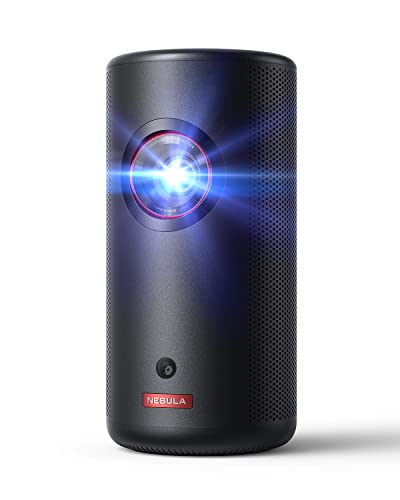
NEBULA Capsule 3 Laser — Best Brightness in Mini Class
The Capsule 3 Laser answers the standard Capsule’s one structural compromise by changing the light itself. A laser light source delivers more brightness and richer colour from the same pocketable architecture, and the difference registers exactly where minis usually fade: slightly larger images, rooms that are dim rather than dark, and scenes whose colours need confidence. It remains unmistakably a Capsule, same travel-first silhouette, same smart platform, with the picture turned up a meaningful notch.
Laser light brings secondary gifts that owners notice across months. Brightness holds steadier across the source’s life than lamp-based designs promise, colours keep their saturation at sizes where LED minis begin to wash, and the projector reaches full performance essentially at switch-on. For the user whose mini is a primary screen in a small flat, a bedroom, a studio, those qualities convert the device from a travel toy into household infrastructure.
The battery story deserves the same honesty applied throughout this guide. More brightness spends more power, so the Laser rewards owners who treat the socket or a power bank as part of long sessions and the battery as the freedom to choose any wall, not as an all-evening guarantee at maximum output. Managed that way, it offers the strongest picture-per-pound in this guide, and the premium over its sibling reads as a brightness purchase rather than a badge purchase.
Choose between the two Capsules by room, not by aspiration. Truly dark, truly portable use flatters the standard model and saves the difference; mixed lighting, bigger images, and daily-driver duty flatter the Laser every single evening. Either way, the pair demonstrates how far the pocket cinema has come: native 1080p, self-setup, streaming built in, and an image that no longer apologises for its projector’s size.
There is a rental-flat argument for the Laser that deserves airtime. Tenants who cannot mount a television or drill for a screen bracket can still command a large evening picture from a device that leaves no trace when the lease ends, and landlords have no opinion about a can on a bookshelf. In cities where the first flat is small, shared, and temporary, that traceless cinema is not a compromise purchase; it is the only cinema the contract allows, and the Laser is its strongest form in this guide.
- Type: Portable mini, native 1080p, laser light source
- Power: Internal battery plus USB-C
- Platform: Built-in smart streaming
- Setup: Autofocus and auto keystone
- Sweet spot: Small flats, bigger mini images, dim rooms
Strengths
- Laser brightness stretches image size and room tolerance.
- Colour confidence survives where LED minis fade.
- Same pocketable, cable-free Capsule ritual.
Trade-offs
- Premium pricing over the standard Capsule.
- Brightness and battery remain a negotiated settlement.
- Still a darkness-first device by physics, not by flaw.
Best for: Small-space dwellers wanting the strongest mini picture. Not suited for: Buyers expecting main-television brightness.
XGIMI MoGo 2 Pro — Best Smart-Feature Alternative
XGIMI has built its name on projectors that behave like well-mannered smart televisions, and the MoGo 2 Pro carries that philosophy into the native 1080p mini class. It is discussed here without a purchase link, because our verified pool holds no listing for it, but an honest map of this category includes it: XGIMI’s automatic setup technology, which handles focus, keystone, and obstacle avoidance with unusual grace, makes it the mini most likely to be projecting within a minute of entering a room.
The Android TV platform is the other half of its appeal, offering the familiar streaming environment with proper application support in a compact body that travels between bedroom, office, and garden. XGIMI’s colour tuning leans pleasant rather than clinical, suiting the films and series that dominate mini projector duty, and its speakers, tuned with more care than the class average, postpone the Bluetooth speaker purchase for casual viewing.
Against the Capsules, the MoGo’s argument is polish over ultimate portability. It is a mini to carry between rooms and on deliberate trips rather than a can to forget in a jacket, and buyers should choose by which of those lives they actually lead. Either way, its presence in this guide marks the standard the class now meets: native resolution, intelligent setup, licensed streaming, and an image that respects the content.
Presenters form an unglamorous but devoted MoGo constituency. A trainer or teacher who carries their own projector stops negotiating with venue equipment of unknown vintage, and the MoGo’s quick, self-squaring setup in a borrowed room is worth more in that life than any brightness increment. Slides are unkind to soft projectors, which is precisely where the native resolution gate in this guide stops being a cinema preference and becomes a professional requirement.
- Type: Portable mini, native 1080p
- Power: Mains-focused with portable design
- Platform: Android TV built in
- Setup: Advanced auto focus, keystone, obstacle avoidance
- Sweet spot: Room-to-room smart cinema
Strengths
- Auto-setup intelligence leads the class in convenience.
- Smart platform feels like a television, not a compromise.
- Sound quality postpones external speaker purchases.
Trade-offs
- No pool listing here, so shop its specifications carefully.
- Less pocketable than the Capsule family.
- Battery freedom is not its central design promise.
Best for: Smart-TV-minded buyers wanting a polished mini. Not suited for: Ultralight travellers counting every gram.
NEBULA Mars 3 Air — Best for Garden Movie Nights
The Mars 3 Air stretches the definition of mini toward the garden fence, and earns its place by being the projector this guide would carry outside. Also presented without a pool link, it is Nebula’s larger portable: native 1080p, a battery sized for a full outdoor feature, sound with enough body to reach a circle of chairs, and a handle-and-stand physicality designed for grass, patios, and campsite tables rather than for coat pockets.
Outdoor projection is a distinct discipline that exposes weak minis cruelly. Ambient light lingers after sunset, screens are improvised, and the audience sits further from the speakers than any living room arranges. The Mars 3 Air’s extra brightness headroom and audio muscle address that discipline directly, while its smart platform keeps the film library self-contained when the garden Wi-Fi reaches bravely from the house. A sheet or a simple outdoor screen, a darkening sky, and this machine constitute a complete neighbourhood cinema.
Its size is the honest cost: this is a carry-to-the-garden device, not a forget-it-in-the-bag device, and apartment dwellers without outdoor space will find the Capsules better matched to their lives. For households whose summers are measured in outdoor film nights, though, the Mars 3 Air is the natural flagship of the portable fleet, and its absence from our pool is a listing gap rather than a quality verdict.
Campsite etiquette is the Mars owner’s final exam, and the machine helps them pass it. A contained picture, sound aimed at your own circle, and a screening that ends at a neighbourly hour turn a projector from a nuisance into the site’s favourite invitation. Owners who master that diplomacy find the Mars 3 Air buying them friends as reliably as films, which may be the most portable-cinema outcome of all.
- Type: Portable outdoor-leaning mini, native 1080p
- Power: Internal battery sized for a feature
- Platform: Built-in smart streaming
- Setup: Autofocus and auto keystone
- Sweet spot: Gardens, patios, campsites
Strengths
- Brightness and sound sized for outdoor audiences.
- Battery supports a full film away from sockets.
- Physical design suits grass and patio duty.
Trade-offs
- Largest body among this guide’s portable picks.
- No pool listing here; verify specifications when shopping.
- Overpowered for a small bedroom wall.
Best for: Households with gardens and outdoor film traditions. Not suited for: Minimalist travellers or tiny indoor spaces.
BenQ GV31 — Best Ceiling-Projection Design
BenQ’s GV31 begins from a posture: lying in bed, watching the ceiling. Its lens rotates within its round body so the projector can sit on a nightstand and throw its native 1080p image upward without tripods, stacks of books, or chiropractic consequences, and that single design decision reorganises the bedroom-cinema experience completely. It appears here as prose guidance, without a pool link, because a guide to this category that omitted the ceiling specialist would be incomplete.
BenQ’s heritage is colour seriousness, and the GV31 carries more of that DNA than its playful shape suggests. Skin tones and film colour hold together with a confidence that reflects decades of home-cinema tuning, and the integrated streaming platform keeps the nightstand free of extra boxes. Its sound, delivered by a proper little speaker system with a woofer’s ambition, serves dialogue-driven viewing better than most of the class.
The trade is travel. The GV31 is a room resident that can visit other rooms, not a pocket traveller, and its brightness belongs to the same darkness-first physics as every pick here. Buyers whose mini projector fantasy is specifically the bedroom ceiling, the children’s room story projection, the rented flat where no television mount is allowed, will find this the most thoughtfully aimed machine in the guide.
Parents quietly rate the ceiling trick as a parenting instrument. A story, a star field, or a gentle film projected overhead settles a room in a way a glowing rectangle at eye level never has, and the GV31’s rotation makes that trick a nightly routine rather than a furniture rearrangement. Devices that serve both the children’s bedtime and the parents’ film hour earn their shelf in a way single-purpose gadgets rarely do.
- Type: Portable mini, native 1080p, rotating lens
- Power: Mains-focused, room-to-room portable
- Platform: Built-in streaming
- Setup: Auto focus and keystone with ceiling mode
- Sweet spot: Bedrooms and ceiling viewing
Strengths
- Ceiling projection solved by design rather than by furniture.
- Colour tuning carries BenQ’s cinema heritage.
- Sound serves dialogue without instant speaker shopping.
Trade-offs
- No pool listing here; check specifications at purchase.
- Portability means room-to-room, not pocket travel.
- Darkness-first brightness like the whole class.
Best for: Bedroom cinema and ceiling-projection households. Not suited for: Travellers or bright-room viewing.
Samsung The Freestyle — Best Ecosystem Mini
Samsung’s Freestyle is the mini projector as a spotlight: a cylindrical body on a tilting cradle that points its native 1080p image at walls, ceilings, and tables with a gesture, running the same smart television platform as Samsung’s full-size screens. It is included without a pool link as the ecosystem pick, the projector for households whose televisions, phones, and soundbars already speak Samsung and who value that fluency over raw specification contests.
The platform is the product. Setup mirrors a Samsung television’s, streaming services arrive properly licensed, and features like automatic levelling and keystone keep the spotlight gesture honest by squaring the picture after the pointing. For families, the Freestyle’s talent for projecting onto a table or a tent ceiling turns it into a games-and-stories device as readily as a film device, a versatility its design clearly intends.
Judged purely as a projector against the Capsule 3 Laser, specification shoppers may find the Samsung’s brightness and battery story less commanding, and this guide will not pretend otherwise. Its case rests on integration and industrial design: the household that lives inside Samsung’s world gains a mini that behaves exactly like its television, only portable, and that familiarity is a feature real families use nightly while laboratory advantages gather dust.
The Freestyle also moonlights as the party projector of this guide, because pointing a picture at a table for a game, at a wall for a slideshow, or at a marquee ceiling for ambiance is a gesture its body was born to make. Hosts who buy it for films frequently report the ambiance work becoming its main employment, which says something true about the category: once a cinema fits in a hand, people invent uses no product manager scheduled.
- Type: Portable spotlight mini, native 1080p
- Power: Mains or USB-C battery accessories
- Platform: Samsung smart TV platform
- Setup: Auto levelling, focus, and keystone
- Sweet spot: Samsung households, family versatility
Strengths
- Television-grade smart platform in a mini body.
- Point-and-project design suits walls, ceilings, tables.
- Integrates naturally with Samsung phones and audio.
Trade-offs
- No pool listing here; verify the generation when shopping.
- Specification-per-price trails the brightest rivals.
- Battery viewing depends on accessory power.
Best for: Samsung-ecosystem homes wanting familiar software. Not suited for: Pure specification-per-price shoppers.
How Do the Six Compare as Pocket Cinemas?
| Pick | Native 1080p | Battery | Linked here? | Signature use |
|---|---|---|---|---|
| NEBULA Capsule 3 | Yes | Yes | Yes | Travel cinema |
| NEBULA Capsule 3 Laser | Yes | Yes | Yes | Strongest mini picture |
| XGIMI MoGo 2 Pro | Yes | Limited | No | Smart room-to-room |
| NEBULA Mars 3 Air | Yes | Yes, feature-length | No | Garden nights |
| BenQ GV31 | Yes | No | No | Ceiling viewing |
| Samsung The Freestyle | Yes | Accessory | No | Ecosystem versatility |
How Do You Set Up a Mini Projector Night, Step by Step?
Darkness first, technology second. Choose the wall or screen, then remove the room’s competing light: curtains drawn, hallway door closed, the kitchen light forgiven but dimmed. A plain light wall serves surprisingly well; a simple matte screen serves better and costs less than any projector upgrade, making it the highest-value accessory in this entire category. Position the projector squarely where possible, because every degree of angle corrected digitally spends a little resolution and brightness on the correction.
Let the machine set itself up before helping it. Modern autofocus and keystone systems in these picks are genuinely competent, and the owner’s job is to provide a stable surface at roughly the right distance, then resist micro-adjusting what the automation already solved. Check focus with a menu screen’s text rather than a film frame, since lettering exposes softness the cinema image forgives, and confirm the image’s corners are square before the audience settles.
Sound and power complete the ritual. Connect the Bluetooth speaker before the film, not during its quiet opening scene, place it near the screen rather than near the projector so voices come from the picture, and decide the power plan in advance: battery for the garden, socket or power bank for the long epic. Five minutes of this choreography is the entire difference between a gadget demonstration and a cinema night, and it is why owners of these small machines develop such disproportionate affection for them.
Outdoor nights add two steps to the choreography. Wait for true dusk rather than fighting the twilight, because the first twenty minutes of darkness improve the picture more than any setting, and secure the screen against the evening breeze that turns a sheet into a sail at the film’s climax. A small weight on the screen’s stand and a speaker placed before the audience, not behind it, complete an outdoor setup that neighbours will remember as cinema rather than as noise.
What Screen Size Should You Actually Aim For?
Smaller than your ambition and larger than your television is the honest band. In a dark room, the linked Capsule models hold a satisfying image around the size of a big television and somewhat beyond, with the Laser stretching that envelope furthest. Every additional diagonal step spends brightness, so the picture that looks cinematic at one size looks apologetic two sizes up, and no setting reverses that arithmetic.
Judge by the seating, not by the wall. A picture viewed from two metres away does not need to cover the plaster to feel enormous, and a modest image with strong contrast will beat a giant washed one in every viewer’s memory of the evening. Buyers who internalise that will find these minis more capable than their specifications suggest, because they will use them inside the envelope where the magic actually lives.
Children, incidentally, are the least size-snobbish audience in the world and the most darkness-tolerant, which is why a modest mini image at a sleepover registers as a cinema palace to its audience. Adults calibrating a purchase by their most critical friend’s opinion should remember that most real audiences, family, neighbours, fellow travellers, are grading the evening, not the projector, and evenings are won by convenience and sound as much as by diagonal inches.
How Bright Is Bright Enough, Without a Single Invented Number?
Brightness claims in this category arrive in incompatible units and optimistic laboratory conditions, so this guide judges the question experientially instead. A mini projector is bright enough when, in the room you will actually use, at the size you actually want, dark scenes remain legible and faces keep their expressions. Every pick here clears that bar in darkness at television-plus sizes, and none of them clears it in a sunlit room at wall-filling sizes, and a shopper who tests any candidate against that sentence will not be disappointed by physics.
Three levers move the experience more than the specification does. Darkness is the first and cheapest: blackout curtains or an evening schedule multiply a mini’s effective brightness more than any model upgrade. Distance is the second: moving the projector closer shrinks and brightens the image dramatically, which is why a coffee-table placement often beats a bookshelf placement for the same machine. The surface is the third, as the setup section notes, because a proper screen returns light the wall was absorbing.
Beware, finally, of brightness modes with fine print. Many projectors quote their finest figure in a mode with altered colour or fan behaviour that nobody uses for films, while the cinema mode you will actually watch runs gentler. Judge a mini by its movie-mode reputation among owners, not by the largest number on its box, and the machine you receive will match the machine you imagined.
Fan noise belongs in this brightness conversation, because the two are mechanically married. A mini working hard in a warm room fans audibly, and in a quiet bedroom scene that whisper competes with dialogue. Placement helps, a metre or two between projector and pillow, as does choosing the gentler picture mode for late-night viewing. Owners who plan for the sound as part of the setup, rather than discovering it during a hushed film, report it as ambience within a week.
What About Throw Distance and Room Geometry?
Every projector paints its picture from a specific distance relationship: place it too close and the image shrinks, too far and it dims as it grows. Mini projectors are generally designed for the distances homes actually offer, a coffee table to a wall, a nightstand to a ceiling, but the wise buyer measures their intended throw before ordering and checks it against the model’s stated range for the size they want. A tape measure in the actual room settles questions that no review, including this one, can settle from outside it.
Keystone correction rescues imperfect geometry at a small cost in resolution and brightness, because the projector discards the pixels outside the corrected rectangle. Use it as the fine adjustment it is, a few degrees of grace, rather than as a licence to place the machine at a wild angle, and the image keeps its native honesty. The auto-setup systems in these picks handle that fine adjustment gracefully, which is exactly their job.
Ceilings deserve their own geometry note. The distance from nightstand to ceiling is short, the image lands overhead at an angle the viewer watches lying down, and brightness demands fall because the room is at its darkest. It is the most forgiving projection environment in the home, which is why the ceiling-capable picks here deliver an experience out of proportion to their size.
One geometry trap catches buyers of every class: the offset. Many projectors aim their image slightly upward from the lens’s level, which is helpful on a coffee table and confusing on a high shelf, where the picture may land partly on the ceiling. The auto-keystone in these picks compensates within reason, but a five-minute experiment in the actual room, before furniture is rearranged around an assumption, remains the cheapest certainty in home cinema.
What Mistakes Do Mini Projector Buyers Make?
The founding mistake is the resolution swindle, buying a supported-1080p device whose native picture belongs to an earlier decade. It is avoidable in one minute by finding the native specification, and this guide has repeated the warning because the category’s return counters are paved with exactly this disappointment.
Brightness optimism follows close behind. Buyers imagine a sunny lounge, a sports afternoon, a picture window behind the sofa, and a mini projector bravely competing. It will not, and the fault is the fantasy’s, not the device’s. Purchase a mini for evenings, bedrooms, travel, and gardens after dark, and it will be judged a marvel; purchase it as a daylight television and it will be judged a toy, by the same owner, of the same machine.
A third error is ignoring the sound until the first film. Dialogue intelligibility makes or breaks a film night more than another increment of picture size, and the small speakers of pocket projectors are physics-bound. Budget the little Bluetooth speaker from the start, as part of the projector’s true price, and the category’s one predictable disappointment never occurs.
Finally, buyers forget the surface. Projecting onto a coloured, textured, or glossy wall taxes the image before the projector has a chance, and many a mini has been blamed for a magnolia wall’s opinions. A portable screen, a white sheet properly tensioned, or at minimum the lightest smooth wall in the room will repay its trivial cost every single night.
A fifth oversight is neglecting the tripod thread or stand the machine expects. Several minis are designed to perch on a small tripod or a specific stand for their best angles, and owners who skip that accessory spend evenings balancing the projector on books of decreasing suitability. Check what your chosen model stands on, buy that modest thing in the same order, and the setup ritual this guide praises will actually be the ritual you experience.
What Accessories Actually Earn Their Place in the Bag?
The Bluetooth speaker has already been promoted to near-essential in this guide, and it leads the list honestly. Behind it comes the small tripod or stand your model expects, which converts any table, shelf, or patch of grass into a projection booth at the correct height. A compact USB-C power bank follows for the battery models, effectively deleting their one structural anxiety, and a short HDMI cable covers the laptop and console occasions that casting occasionally fumbles.
The portable screen is the accessory owners delay longest and praise loudest once bought. Even an entry-level pull-up or folding screen flatters every projector in this guide more than a model upgrade would, because it returns contrast and colour the wall was quietly taxing. Travellers can substitute a white blackout curtain liner, which packs flat, hangs anywhere, and has rescued more holiday film nights than any gadget in the bag.
What does not earn its place: elaborate carrying systems for a device designed to be carried casually, spare lamps for lamp-free machines, and cleaning kits beyond a lens cloth and common sense. The mini projector philosophy is subtraction, and the accessory bag should honour it, five useful objects deep at most, each one earning its grams on every trip. If a sixth object keeps auditioning, a spare charging cable usually wins the role, because the cable left in a hotel room is the one accessory failure every traveller eventually funds.
How Do You Care for a Mini Projector So It Lasts?
These are optical instruments wearing consumer clothing, and their care rules follow from that. Keep the lens clean with a soft cloth and never a sleeve, let the fan finish its cooling moment before bagging the machine after a session, and store it in its case or a drawer rather than as a dust-collecting ornament. LED and laser light sources in this class are rated for very long service compared with old lamp projectors, so the machine’s practical lifespan is usually decided by its battery and its software rather than by its light.
Battery care is the one active discipline. A lithium battery left empty in a drawer for a year ages badly, while one cycled regularly and stored partly charged stays healthy for the projector’s life. Owners who use their mini monthly will never think about this; owners who buy for a single trip should run the machine occasionally afterward, which has the side effect of producing more film nights, an acceptable burden.
Software updates deserve installation rather than postponement, because streaming platforms change their requirements and manufacturers patch their applications accordingly. A mini projector whose apps age out becomes a casting target rather than a self-contained cinema, still useful but diminished, and five minutes of updates per season prevents that quiet demotion entirely.
Lending deserves a policy, because these machines are eminently lendable and friendship is a finite resource. Owners who lend happily tend to lend the whole kit, projector, cable, speaker, and a one-line instruction card, and to accept that the machine may return with someone else’s streaming account still signed in. The projector that circulates among friends becomes a small institution, and more than one film society began as exactly that circulation.
Storage temperature is the last quiet rule. A car boot in summer and a freezing garage in winter both age batteries and optics faster than the machine’s working life ever will, so the mini that lives indoors, in the drawer by the sofa it serves, will outlast the one stored with the camping gear. Longevity in this category is mostly a matter of not exiling the device between its moments of glory, and of keeping its little case zipped against the dust that every home manufactures without pause, season after season, year after year. Treat the projector kindly in these small ways and it will still be turning walls into cinemas long after the streaming services have renamed themselves twice and the household has forgotten what the machine cost, which is the final stage of every good appliance’s life, and the surest sign the purchase was right all along, truly right.
Mini Projector or Portable Monitor: Which Travel Screen Wins?
Travellers increasingly choose between this category and a portable monitor, and the honest answer depends on the audience. For one viewer working or gaming at a desk, the monitor wins on brightness, sharpness per coin, and all-day usability. For any audience larger than one, and for any viewing that is an event rather than a task, the projector’s ability to turn a wall into a shared screen wins without a contest, because cinema is a social technology and a fourteen-inch panel is not.
Hybrid travellers carry the projector alone and borrow the room. Hotel walls, hostel common rooms, and relatives’ spare bedrooms all contain the screen a projector needs, which is why the Capsule class has become a genuine travel genre rather than a novelty. The monitor traveller carries their screen with them and is never disappointed by a wall’s colour; the projector traveller carries a cinema and accepts the wall as part of the adventure. Both are rational, and this guide’s readers have usually chosen their temperament before they reach this paragraph. Households with children tend to break toward the projector over time, because a screen that appears on a wall for a film and vanishes afterward teaches a gentler relationship with viewing than a permanent glowing rectangle, and parents are allowed to count that as a feature even if no specification sheet will.
Final Recommendation
Buy the NEBULA Capsule 3 if your cinema travels, and the Capsule 3 Laser if it mostly stays home in a small room where its extra punch will be spent nightly; between them they cover the honest centre of this category with native 1080p, real batteries, and streaming that needs no entourage. Garden households should hunt the Mars 3 Air, ceiling dreamers the BenQ GV31, and Samsung families will feel instantly at home with The Freestyle, while XGIMI’s MoGo 2 Pro remains the polished alternative for smart-platform devotees. Whichever name you choose, choose it for after-dark magic at sensible sizes, and a projector that fits in a coat will repay you with film nights in places no television will ever see.
One practical closing note on buying: because this category’s marketing is the noisiest in home electronics, purchase from a seller whose returns process you trust, and spend the first evening testing the projector in your darkest room at your intended size with your own content, menus included. The honest machines in this guide will pass that evening easily. A machine that fails it should travel back while the window is open, carrying its supported-resolution promises with it.
Frequently Asked Questions
Can a mini projector replace my television?
In a bedroom, a small flat, or a student room used mainly after dark, it genuinely can, and many owners live exactly that way. In a bright family lounge used all day, it cannot, because brightness physics does not negotiate. The honest question is when your household watches, and the answer picks the device more reliably than any specification. Households that split the difference often keep the television for the day and let the projector own the night, a treaty both devices seem content with.
How long do the batteries really last?
Long enough for a typical film at sensible brightness on the battery-equipped picks, with the understanding that maximum brightness and maximum runtime are opposite ends of the same dial. For epics, double features, and garden parties, treat a socket or a USB-C power bank as part of the kit and the question stops mattering. Eco or battery-saver modes stretch runtime noticeably for children’s films and background viewing, where a gentler picture costs the evening nothing.
Can a wall replace a screen for a mini projector?
A smooth, light-coloured wall is enough to begin, and many owners never go further. A simple matte screen improves contrast, colour, and edge definition noticeably for less than the price difference between projector models, which makes it the smartest first accessory. Avoid glossy paint and strong wall colours, which tax every projector in this guide equally. Renters should note the removable screen options and the curtain-liner trick from the accessories section, both of which deliver screen benefits without a single screw in a landlord’s wall.
Can I connect a phone or laptop instead of using built-in apps?
Yes. Every pick here accepts external sources by cable or wireless casting in some form, which rescues local files, laptops, and games consoles. The built-in platforms shine for travel simplicity, but nothing in this category locks you into them, and a console connected to a Capsule on a bedroom wall is a legitimate small-space gaming setup. Presenters and teachers rely on the same flexibility daily, since a laptop connection remains the universal language of borrowed rooms.
Can I use a mini projector in a hotel room?
It is one of the category’s founding pleasures. The projector connects to hotel Wi-Fi or casts from your phone, the wall above the desk becomes a screen, and the battery frees you from hunting sockets behind furniture. Respect the neighbours with the volume, log out of streaming accounts before checkout, and the hotel cinema remains the traveller’s best argument for carrying one of these machines at all.
What should I check in the first evening with a new mini?
Run the honesty checklist this guide has built: read the projector’s own menus for crispness, watch a dark scene and a bright one at your intended size, play dialogue through the built-in speaker and then through your Bluetooth backup, and run twenty minutes on battery to confirm the machine’s habits match its promises. An evening spent this way converts marketing into knowledge while the return window stands open, which is exactly when knowledge is cheapest. Add one social test if you can: show a scene to the person you will watch with most often, because cinema is shared or it is merely display, and their delight is a more predictive metric than any laboratory figure in this category.
Are mini projectors good for gaming?
For casual, social, and retro gaming, absolutely: a big forgiving picture suits split-screen and party titles beautifully. For competitive play where input response is the sport itself, a gaming monitor remains the correct tool, and this guide’s projector picks should be bought for cinema first and games as a joyful bonus. Families should note the sleepover factor: four children, one wall, and a kart racer is an evening no handheld console has ever produced.
Related Guides
Readers building a full small-room cinema may continue with best 1080p home theater projectors for the larger machines, while travellers comparing display options can weigh this category against best portable monitors for travel, and anyone furnishing a complete den can finish with best 4K laser projectors for dedicated rooms. See also 2k projectors.


