What's inside
- Where to buy
- Key Takeaways
- Quick Picks
- How Did We Choose These Small TVs Without Inventing Numbers?
- Where Do a Small TV’s Real Energy Numbers Live?
- Why Has 32 Inches Survived Every Fashion in Television?
- What Does a Smart Platform Cost You in Attention?
- How Does a Small TV Earn Its Keep, Room by Room?
- What Changes in an RV, a Rental or a Student Room?
- How Do You Run a Small TV Frugally Without Guessing?
- How Do You Set Up a Small TV in Ten Minutes?
- Which Small TV Fits Which Small Room?
- How Long Should a Small TV Serve, and What Retires One?
- What Mistakes Do Small-TV Buyers Make?
- Final Recommendation
- Frequently Asked Questions
- Related Guides
As an Amazon Associate I earn from qualifying purchases. This post may contain affiliate links at no extra cost to you.
gizmoverdict.com is reader-supported. When you buy through links on our site, we may earn an affiliate commission.
Where to buy
Amazon’s US store lists all six televisions in this guide under the verified listings quoted in the reviews, and the links here lead to those listings. Small televisions are sold under churning model names and retailer variants, so match the full listing title — series, size and platform — before you buy.
The best energy smart small tvs begin with an honesty obligation, and this guide will state it once, plainly, and then hold itself to it: not one of the six listing titles in this roundup states an energy certification or a wattage figure, so this article will claim neither for any pick. What can be said truthfully is structural. Every pick here is a 32-inch LED television — a small panel lit by the most efficient mainstream backlight technology, in the size class that has always sipped rather than gulped — and the authoritative numbers for any individual set live where they have always lived: on the yellow EnergyGuide label in the box and in the manufacturer’s documentation. This guide will point you to those, frame the choice on size, panel and platform, and resist the temptation to decorate a listing’s silence with invented efficiency claims.
Within that discipline, the category is a pleasure. The 32-inch smart TV is the household’s utility player — the kitchen screen that runs the news and the recipe video, the bedroom set that ends the day, the RV and dorm and spare-room answer — and the current crop divides neatly by platform and by panel ambition: Fire TV against Tizen against VIDAA against two Roku sets, an HD majority against one Full HD model, and a 2026 QLED-flavoured entrant arguing that small no longer means basic. Six screens, one size, and a choice that turns out to be about ecosystems and rooms rather than inches.
Key Takeaways
- No listing title here states an energy certification or wattage, so this guide claims neither — the EnergyGuide label in the box is the authoritative source, and every spec box below says exactly that.
- All six picks are 32-inch LED sets, the size-and-backlight combination that defines the modest end of television power draw as a class.
- Platform is the real fork in this guide: Fire TV, Tizen, VIDAA and Roku each organise the same streaming life differently, and your phone’s ecosystem should cast a vote.
- The Insignia F40 is the resolution outlier — the only 1080p Full HD panel here — while its F20 sibling anchors the value end of the Fire TV family.
- The Hisense QD4, a 2026 model, brings QLED-class colour and a game mode to a size that used to be an afterthought.
Quick Picks
| Pick | Badge | Why it earns its place |
|---|---|---|
| Insignia 32-inch F20 Fire TV | The Kitchen-and-Dorm Default | An HD Fire TV with an Alexa voice remote that covers the streaming essentials without ceremony. |
| Samsung 32-inch H5000F | The Polished All-Rounder | Samsung’s 2025 small screen with HDR, Knox Security and One UI Tizen for households in that orbit. |
| Hisense 32-inch QD4 | Most Ambitious Small Panel | A 2026 Hi-QLED set with HDR10, a game mode and AirPlay on the VIDAA platform. |
| Philips 32-inch Roku TV | Best Connected for Its Size | Three HDMI ports, two USB, and compatibility with Siri, Google Assistant and AirPlay on Roku’s calm interface. |
| Westinghouse 32-inch Roku TV | The Simple Second Screen | Dolby Audio, AirPlay and every major voice assistant on the platform nobody needs to be taught. |
| Insignia 32-inch F40 | Sharpest Picture Here | The group’s only 1080p Full HD direct-LED panel, for small rooms where viewers sit close. |
How Did We Choose These Small TVs Without Inventing Numbers?
By grading what the listings actually state, which in this category is plenty. Panel first: all six are LED, five are HD-class and one — the Insignia F40 — is Full HD, a distinction that matters at the close distances small TVs are watched from. Platform second, because a 32-inch set’s daily life is its interface: Fire TV’s Alexa-centred world, Samsung’s One UI Tizen with Knox security, Hisense’s VIDAA with its unexpectedly rich feature list, and Roku’s deliberately simple tiles in two different manufacturers’ cabinets. Features third — voice remotes, AirPlay and casting compatibility, port counts, game modes — each taken from the listing’s own words.
And on energy, the method was restraint, stated as method: we note the class facts that are true of every pick — LED backlighting, a 32-inch panel — and we direct readers to the EnergyGuide label and the manufacturer’s documentation for the per-model figures, because those documents exist precisely so that guides like this one do not have to guess. Any roundup that decorates a small TV with efficiency numbers its listing never stated is writing fiction in a lab coat. Readers comparing the Roku contingent here against the wider field will find the platform’s other sizes in best 32 inch tvs roku, and those weighing a smaller screen still should look at best 24 inch smart tvs before settling.
Where Do a Small TV’s Real Energy Numbers Live?
On the yellow label, and it is worth knowing how to read the system rather than any single figure. Appliances and televisions sold in the United States carry an EnergyGuide label that states an estimated yearly energy cost and consumption for that model, calculated under a standard test so that models can be compared like for like. That label — in the box, and reproduced in the manufacturer’s documentation and specification sheet — is the only per-model energy statement a buyer should ever act on, because it is measured, standardised and attached to the exact set you are buying rather than to its marketing.
What a buyer can reason about without the label is class behaviour, and this guide confines itself to it. LED backlighting displaced older, thirstier technologies across the whole television market; a 32-inch panel lights a fraction of the area of the big-room screens elsewhere in this batch of guides; and the usage pattern of small TVs — a kitchen’s morning hours, a bedroom’s evening wind-down — is measured in hours, not in the all-day marathons of a main set. Add the habits the how-to section covers — brightness matched to the room rather than maximised, sleep timers used, standby behaviour understood — and a small TV’s footprint stays what its class promises: modest. For anything more specific, the label is the law, and every spec box in this article repeats the direction to it verbatim.
There is a second document worth knowing: the manufacturer’s full specification sheet, which the EnergyGuide complements rather than duplicates. Where the label gives the standardised yearly estimate that makes models comparable, the spec sheet is where a maker publishes the detailed electrical and physical data of the exact set — the document an RV owner planning a power budget, or a landlord fitting out several rooms, should work from. Both documents exist for every pick in this guide; neither requires the buyer’s trust in a review’s paraphrase, which is precisely the standard this article has tried to model. Ask of any television claim the question this section began with — where does that number live? — and you will never be misled by this category again.

Insignia 32-inch F20 Fire TV — The Kitchen-and-Dorm Default
The F20 is the small television as solved problem. A 32-inch LED HD panel running Fire TV, with a voice remote with Alexa and access to free and live TV alongside the subscription services, it is the set that goes on the kitchen wall, the dorm dresser and the workshop bench and simply becomes part of the room’s routine. Fire TV’s proposition at this size is convenience density: the news at breakfast, a recipe video at counter height, the match murmuring in the background of a study session, all summoned by voice when hands are floury, busy or holding a textbook.
Its HD resolution deserves the honest sentence this guide gives every pick: at 32 inches and kitchen distances, HD is a reasonable engineering choice, and the eye that finds it wanting is usually sitting closer than kitchens arrange. The set’s real competition is not the Full HD sibling below but the household’s second phone — and against a phone, a 32-inch screen with a voice remote wins every shared moment. Insignia’s position as a retailer-house brand means support runs through that channel, a fact regular buyers of the brand already price in.
Choose the F20 when the brief is a dependable, voice-run screen for a room that already has a main television — or that never wanted one. It is the least ambitious pick here and quite possibly the most bought, because most small-TV purchases are exactly its brief: cover the essentials, integrate with the household’s Alexa habits, and disappear into the room’s life. Ambition lives elsewhere in this guide, at prices and complexities this set’s buyers are entitled to skip.
One constituency deserves a direct word: the household buying this set for an older relative. The F20’s combination — a familiar retail brand, a voice remote that replaces menu archaeology with asking, and free and live TV that behaves like the television they grew up with — is the gentlest on-ramp in this guide to the streaming era. Set it up on their network, sign in once, pin the favourites, and the F20 will ask almost nothing of them afterward. Technologies are often judged by their most demanding users; this one earns its place by how it treats its least demanding.
- Panel: 32-inch LED HD
- Platform: Fire TV with voice remote with Alexa
- Content: free and live TV alongside subscription services
- Not stated in the listing title — verify with the manufacturer documentation.
- Class: 32-inch second-room and small-room television
Strengths
- Fire TV plus an Alexa voice remote is the hands-busy room’s ideal interface.
- Free and live TV access softens the subscription-only feel of smart platforms.
- The set’s simplicity is its reliability — nothing here is waiting to confuse anyone.
Trade-offs
- HD resolution is the floor of this guide; close viewers should take the F40.
- Fire TV’s home screen promotes content in a way minimalists may resist.
- House-brand support channels are functional rather than white-glove.
Best for: kitchens, dorms, workshops and spare rooms that need a voice-run streaming screen. Not suited for: close-range viewers who will see and mind the HD ceiling.

Samsung 32-inch H5000F — The Polished All-Rounder
Samsung’s presence at 32 inches is a statement that the small end of the range gets the house polish too. The H5000F — a 2025 model — is an HD smart TV with HDR support, Object Tracking Sound Lite, Knox Security and One UI Tizen, which is to say the same interface family, the same security platform and the same sound thinking as the 75-inch Samsungs elsewhere in this batch of guides, scaled to a bedroom or kitchen. Households already living in Samsung’s orbit will find the smallest screen in the house speaks the same language as the largest, remotes and menus included, and that consistency is a real daily comfort.
HDR at this size and class should be understood proportionately: it will not redraw your expectations of contrast, but it gives streamed content a headroom that plain HD panels flatten, and Object Tracking Sound Lite likewise lifts the audio above the small-TV murmur by steering effects toward their sources. Knox Security is the listing point that sounds abstract until a television is a networked computer in a child’s bedroom or a rental property — a stated security platform on a small TV is a grown-up feature, and Samsung is right to print it.
The H5000F’s buyer is the household standardising on one ecosystem, or the buyer who simply trusts the badge’s support network behind a long-lived appliance. Its ceiling is the shared one of its HD class, and Samsung households wanting more panel at small sizes will be reading the Hisense below with interest. But as the polished, supported, consistent small Samsung, the H5000F is the pick that asks the fewest questions of its owner over the longest time — a virtue that compounds quietly in second rooms. Those building a Samsung-flavoured small-room setup may also browse best 32 android tvs to see what the rival platform offers at this exact size.
There is also a fleet argument for this set that multi-room households will recognise. A home with a Samsung in the living room and a Samsung in the bedroom has one remote language, one account shape and one set of habits to teach children, guests and grandparents; a home with three platforms has three of everything, and the friction is paid in small coins every day. The H5000F sells that coherence at the size where households most often improvise a mismatched purchase — which is why, specification for specification, it may be the most quietly rational pick in this entire guide.
- Panel: 32-inch HD with HDR
- Platform: One UI Tizen
- Audio: Object Tracking Sound Lite
- Security: Knox Security, per the listing
- Not stated in the listing title — verify with the manufacturer documentation.
- Model year: 2025
Strengths
- The full Samsung software and security furniture at the range’s smallest size.
- HDR and Object Tracking Sound Lite lift picture and audio above class basics.
- Brand support and ecosystem consistency suit long-life second rooms.
Trade-offs
- HD resolution, like most of this guide — the F40 holds the Full HD flag.
- Tizen is a second ecosystem for Google- or Alexa-standardised homes.
- Its polish premium buys refinement, not a bigger panel specification.
Best for: Samsung households and buyers who value support and consistency in a second room. Not suited for: resolution-first shoppers or rival-ecosystem loyalists.

Hisense 32-inch QD4 — Most Ambitious Small Panel
The QD4 reads like a dispatch from a future where small TVs stopped apologising. A 2026 model, it is a 32-inch Hi-QLED HD set on Hisense’s VIDAA platform with DTS Virtual:X audio, HDR10, a Game Mode, an AI Sports Mode, noise reduction, and works-with-Alexa plus Apple AirPlay and HomeKit compatibility. Any two of those features would be a headline at this size; together they describe a manufacturer treating the second room as a first-class citizen. The Hi-QLED panel is the foundation — quantum-dot colour in a class where colour is usually whatever the panel lottery provides — and for the kitchen or bedroom that doubles as a viewing room, that colour is visible every single day.
The gaming and sports modes deserve their moment, because they reveal the QD4’s intended owner: the household whose small TV is also a play screen. A Game Mode at 32 inches serves the bedroom console, the handheld dock and the spare-room setup; an AI Sports Mode serves the fan whose second screen carries the second match. VIDAA, Hisense’s own platform, has matured into a quick, complete streaming home, and the cross-platform courtesies — AirPlay and HomeKit from the Apple side, Alexa compatibility from the Amazon side — mean the QD4 refuses to pick a fight with any phone in the house.
Its honest limits are the class’s own: HD resolution beneath the QLED colour, and a platform that, however capable, is the one your guests will not already know. Neither dent the central fact that this is the most feature-complete small television in the guide, from the newest model year, arguing that the second room deserves ambition. Buyers who agree — who watch their small TV as much as their large one — will find the QD4 is the pick that was designed for them, and the rest of the guide is the control group that proves it.
A word for the sceptic who suspects the QD4’s feature list is a brochure in search of a user. Walk the list against a real second room’s week: the game mode on Thursday when the console migrates upstairs, the sports mode on Saturday, AirPlay when a phone holds the photos from the holiday, the QLED colour every evening in between. The features are not garnish; they are a diary. Hisense has simply noticed that the second room is where much of the household’s actual viewing now happens, and specified accordingly — the rest of the industry is invited to catch up.
- Panel: 32-inch Hi-QLED HD with HDR10
- Platform: VIDAA smart TV
- Audio: DTS Virtual:X
- Modes: Game Mode and AI Sports Mode, per the listing
- Not stated in the listing title — verify with the manufacturer documentation.
- Compatibility: works with Alexa; Apple AirPlay and HomeKit; model year 2026
Strengths
- QLED-class colour at 32 inches is a genuine class upgrade.
- Game and sports modes serve the second room’s double life.
- AirPlay, HomeKit and Alexa compatibility together refuse all ecosystem wars.
Trade-offs
- VIDAA is the platform guests and grandparents will not already know.
- HD resolution caps the panel ambition the QLED colour promises.
- Feature richness means settings worth exploring — minimalists may not bother.
Best for: second rooms that are really first rooms, and small-TV gamers and sports fans. Not suited for: buyers who want the simplest possible interface above all.

Philips 32-inch Roku TV — Best Connected for Its Size
The Philips Roku TV makes its case in the connectivity column, where small televisions usually economise: three HDMI ports and two USB ports, as its listing states, wrapped around a 720p HD LED panel with a bezel-less design, running Roku, and compatible with Siri, Google Assistant and AirPlay. Three HDMI at 32 inches is generosity with a purpose — the bedroom console, the streaming box the household prefers, and a spare for the laptop or the visiting machine can all live on the set at once, which is precisely the port scarcity that makes small TVs annoying in real homes. The voice-assistant breadth is the same philosophy applied to phones: whichever assistant your household speaks, this television claims to listen.
Roku itself needs no introduction and gets none here beyond the essential: it is the interface that asks the least of its user, tiles and a remote a child can drive, and in a kitchen or a guest room that is the highest praise available. The bezel-less design is a small aesthetic grace that matters at this size, where the screen often sits on a counter or a dresser as a piece of the room’s furniture rather than dominating a wall. Two built-in speakers and the 720p panel mark the honest class position — this is an HD set in the guide’s HD majority, tuned for the distances and content of second rooms.
Choose the Philips when the small TV is a hub — multiple sources, multiple phones, multiple assistants — and when the room’s viewers sit at kitchen or bedroom range rather than inspection distance. Its natural rival is the Westinghouse below, Roku’s other advocate here, and the split between them is ports and polish against simplicity and audio branding. For the household whose small screen must connect to everything it owns, the Philips has quietly assembled the strongest claim in this guide.
Its 720p resolution will draw the specification crowd’s eyebrow, so let the room answer them. On a kitchen wall eight feet from the cook, or a bedroom dresser viewed from a bed, 720p’s pixels are below the threshold the evening asks about — what the eye registers instead is the Roku interface’s clarity, the AirPlay handoff that worked first time, and the third HDMI device that did not require a decision about which cable to sacrifice. Specifications are means; the Philips has spent its budget on the means its rooms actually use, and there is a discipline in that which more expensive sets sometimes lack.
- Panel: 32-inch 720p HD LED, bezel-less design
- Platform: Roku TV
- Ports: 3 HDMI and 2 USB, per the listing
- Compatibility: works with Siri, Google Assistant and AirPlay
- Not stated in the listing title — verify with the manufacturer documentation.
- Audio: 2 built-in speakers
Strengths
- Three HDMI and two USB ports end small-TV cable swapping.
- Every major voice assistant is welcomed — the ecumenical small screen.
- Roku’s simplicity suits kitchens, guest rooms and grandparents equally.
Trade-offs
- 720p is the lowest resolution class in this guide — distance is its friend.
- Its virtues are connective rather than cinematic.
- Philips’ TV support runs through its licensed channels rather than a flagship network.
Best for: multi-source small rooms — bedrooms with consoles, kitchens with everything. Not suited for: close-range viewers or picture-quality-first buyers.
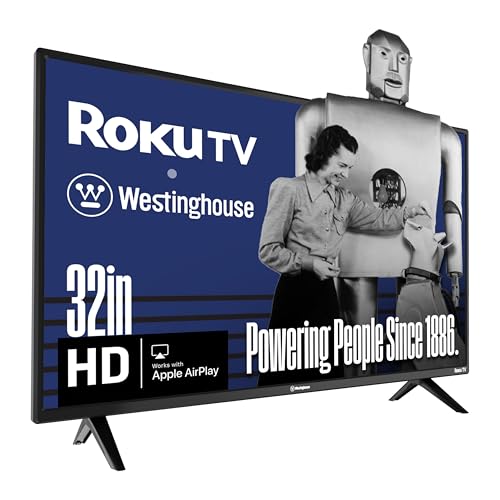
Westinghouse 32-inch Roku TV — The Simple Second Screen
Westinghouse’s Roku set is the guide’s argument that a second television should be a solved problem you stop thinking about. A 32-inch HD LED panel with Dolby Audio, Wi-Fi, a mobile app, and compatibility with Apple AirPlay, Alexa and Google Assistant, running the Roku platform — every element of that sentence is a familiar comfort, and their combination is the point. This is the television for the guest room that must explain itself to a visitor in zero sentences, the rental property, the parent’s kitchen, the room where the screen’s job is to be instantly, obviously usable by whoever walks in.
Dolby Audio is its one flourish, and a well-chosen one: small televisions fail their viewers through dialogue more often than through pixels, and an audio standard that keeps speech forward in the mix serves the news, the drama and the late-night film at bedroom volume. The mobile app matters in the same practical register — the phone as remote is the remote that is never lost in the bedding — and AirPlay covers the Apple household’s casting without a second thought. Roku’s platform handles the rest with its customary calm.
Against its Roku sibling above, the Westinghouse trades port-count generosity for this audio-and-simplicity emphasis; against the Fire TV and Tizen sets it trades ecosystem depth for neutrality. Those are fair trades, honestly labelled, and they make the Westinghouse the pick for buyers whose highest requirement is that nobody ever has to ask how the television works. In a guide full of ambition, there is real wisdom in the set that aspires to be furniture with a picture — and delivers exactly that, every day, without a single support call to a relative.
Landlords and hosts of short-stay properties should recognise their own brief in this set, because it is the television that survives contact with strangers. Roku’s interface resets the hospitality problem to near zero — a guest who has never seen the remote understands the screen in one glance — the mobile app rescues the evening when the remote vanishes into the sofa, and the assistant breadth means the property’s listing can promise compatibility with whatever phone the guest brings. A television that generates no messages to the host is, in that world, the highest-performing television of all, and the Westinghouse is built to generate none.
- Panel: 32-inch HD LED
- Platform: Roku TV with mobile app control
- Audio: Dolby Audio
- Compatibility: Apple AirPlay, Alexa and Google Assistant
- Not stated in the listing title — verify with the manufacturer documentation.
- Connectivity: Wi-Fi
Strengths
- Roku plus a phone app makes it the zero-instruction television.
- Dolby Audio puts dialogue first, where small TVs usually lose it.
- Assistant and AirPlay breadth keeps every household member connected.
Trade-offs
- HD class resolution, shared with most of this guide.
- Fewer ports than the Philips for multi-source rooms.
- Its neutrality means no ecosystem’s deepest features are exploited.
Best for: guest rooms, rentals and any space whose viewers should never need a tutorial. Not suited for: multi-console bedrooms or resolution-led buyers.

Insignia 32-inch F40 — Sharpest Picture Here
The F40 closes the guide with the specification that quietly rearranges it: 1080p Full HD, on a direct-LED panel, in a class where every other pick is HD. At 32 inches the difference is not a showroom miracle — it is a distance effect, and it is real exactly where small TVs are watched hardest: the desk-adjacent bedroom setup, the study, the kitchen counter stool, the gaming chair pulled close. At those ranges Full HD keeps text crisp, interfaces clean and faces detailed in a way the HD sets soften, and the direct-LED backlight gives the picture an evenness that serves films after dark. Fire TV with an Alexa voice remote runs the platform side, free and live TV included, mirroring its F20 sibling’s convenience with a sharper window onto it.
The F-sibling relationship is the honest frame for choosing: the F20 is the value default for rooms where the screen is ambient company; the F40 is for rooms where the screen is watched — properly watched, at close range, for whole films and full matches. That distinction, more than any badge, is what the step between them buys. Households with a small room that serves as a genuine second cinema, students whose desk is their media centre, and anyone whose small TV carries a console will feel the F40’s resolution as a daily fact rather than a specification.
Its trade-offs are the family’s: Fire TV’s promotional home screen, house-brand support channels, and the standing truth that 1080p at sofa distance across a large room would be wasted — but nobody buys a 32-inch set for that job. Within the small-TV brief, the F40 is the picture-quality pick, and it earns the guide’s closing position the way its sibling earned the opening one: by matching a clear specification to a clear kind of room, without pretending to be anything else. Readers still torn between sizes will find the neighbouring classes in best 24 inch led tvs worth a glance before deciding.
Students should hear their name called once more before this guide closes, because the F40 assembles their brief almost exactly: one screen for the streamed lecture, the console and the film, at the distance of a desk chair, in a room that cannot hold anything larger. The Full HD panel is the difference between reading the lecturer’s slides and guessing at them, and between a game that looks like the version reviewed and one softened by the screen. If a single small television must be a student’s whole media centre, this is the one whose specification was written by that requirement.
- Panel: 32-inch 1080p Full HD direct LED
- Platform: Fire TV with voice remote with Alexa
- Content: free and live TV alongside subscription services
- Not stated in the listing title — verify with the manufacturer documentation.
- Class: the guide’s only Full HD small TV
- Role: close-range second-room and desk-side viewing
Strengths
- Full HD is a real, daily advantage at small-TV viewing distances.
- Direct-LED backlighting gives an even, film-friendly picture.
- Fire TV and Alexa keep the convenience of its sibling intact.
Trade-offs
- Its resolution premium is wasted on ambient, across-the-room viewing.
- Fire TV’s home screen will still try to sell you things.
- House-brand support is the family arrangement, as with the F20.
Best for: close-range viewers — desks, studies, small second cinemas and console corners. Not suited for: ambient kitchen duty, where its sibling does the same job for less fuss.
Why Has 32 Inches Survived Every Fashion in Television?
Because it is the size at which a screen stops being a compromise and starts being furniture. Smaller sets — the 24-inch class and below — are appliances for surveillance of content: fine for a counter’s corner, cramped for a film. Larger sets annex rooms. Thirty-two inches is the largest screen that still fits the furniture households already own — the dresser, the kitchen counter’s end, the desk’s far edge, the RV’s cabinet — and the smallest that still gathers two viewers in comfort. That dual citizenship, big enough to share and small enough to place, is why every manufacturer in this guide fields a serious 32-inch model and why the size has outlived every prediction of its death by tablet.
It is also the size where the economics of the whole television industry become kind. Panels at 32 inches are a mature, high-volume product; the platforms cost nothing to include; and the competition among the six makers here keeps the class honest in a way flagship categories, with their theatre of scarcity, rarely are. The buyer of a 32-inch smart TV in this generation is purchasing a solved problem at its most solved — which is precisely why the remaining differences, platform and ports and the one Full HD panel, deserve the careful reading this guide has given them. When the fundamentals converge, taste is the specification.
What Does a Smart Platform Cost You in Attention?
Every platform in this guide pays for its conveniences in the same currency: a home screen that has opinions about what you should watch next. Fire TV is the most enthusiastic merchant, Tizen and VIDAA arrange their recommendations with varying discretion, and Roku remains the quietest shopkeeper of the four — one reason its two sets here are the guest-room recommendations. None of this is sinister, and all of it is manageable: ten minutes in the settings on day one, pruning home-screen rows and turning off the autoplay previews, converts any of these platforms from a billboard into a tool. The households that skip those ten minutes pay for the omission in small irritations for years.
The other attention cost is accounts. A smart small TV wants signing in — to the platform, to the services, to the voice assistant — and each sign-in is a small marriage between the room and an ecosystem. Bedrooms and kitchens forgive this; a set destined for a rental, a child’s supervised use or a relative’s house argues for the lightest account footprint available, which is again Roku’s quiet pitch and the Westinghouse’s in particular. Choose the platform the way you would choose a housemate: the one whose habits you can live with at breakfast, because at 32 inches, breakfast is exactly when you will meet it.
How Does a Small TV Earn Its Keep, Room by Room?
The kitchen is the small TV’s ancestral post, and its requirements are specific: a screen legible in the brightest room in the house, an interface operable with wet or floury hands — which is why voice remotes recur through this guide — and audio that keeps dialogue above the extractor fan. The F20 was practically described into existence by that brief. The bedroom asks the opposite virtues: gentleness. A dimmable picture for the last hour of the day, a sleep timer that is actually used, and a platform that resumes the series without a search expedition — the bedroom is where the Samsung’s polish and the Westinghouse’s calm earn their keep, at volumes that respect the sleeping.
The study and the desk corner are the F40’s parish, because that is where a television is watched at monitor distance and resolution stops being a specification and becomes eyesight. The guest room belongs to Roku’s two advocates, whose interfaces need no induction. The child’s room — supervised, bounded, and better for a platform the parents can govern — is its own conversation, and the QD4’s HomeKit compatibility hints at how the managed household now wires even its smallest screens into the family’s rules. A 32-inch television is never the house’s flagship; it is the house’s staff, and staff are chosen for the post, not the parade.
What Changes in an RV, a Rental or a Student Room?
Constraints, mostly — and constraints are clarifying. The RV runs its television inside a power budget shared with lights, pumps and a fridge, which makes the class virtues of these sets — small LED panels, modest habits — operationally real rather than rhetorically nice, and makes the EnergyGuide habit a planning tool rather than a virtue: read the label, know the draw class, plan the evenings. The rental forbids the drill and punishes the deposit, so the small TV lives on furniture, moves when the lease does, and rewards the platforms — Roku above all — that a landlord’s next tenant or a visiting parent can operate untouched by your instructions.
Student housing adds the audience of strangers and the timetable of essays: a small TV there is a games screen at midnight, a lecture-catch-up screen at nine, and a communal screen whenever the corridor gathers, which argues for the QD4’s modes or the Philips’ ports and against any set whose charms require solitude to appreciate. Across all three settings the same moral repeats, and it is the moral of this entire category: a small television’s value is measured in fit, not in flagship features, and the six picks here were chosen because each fits a recognisable life unusually well.
How Do You Run a Small TV Frugally Without Guessing?
With habits, not folklore — and with the label, not with invented figures. Start with brightness discipline: a small TV’s backlight is its hungriest component, and matching brightness to the room — rather than leaving the set at its showroom torch setting — is the single largest lever a viewer actually controls. A kitchen set needs daytime legibility; a bedroom set at midnight needs a fraction of it, and the picture will look better for the restraint as well as costing less to run. Use the sleep timer in bedrooms without exception, because the most wasteful television hour is the one played to a sleeping room, and every platform here offers the timer that ends it.
Then understand standby honestly. A smart television is never fully asleep — it keeps a network ear open for casting and voice commands, which is a small, real draw and also the price of the conveniences this guide praises. Households that care can switch the set at the wall for long absences, and should weigh that against the casting convenience they lose; households that do not care can at least make the choice knowingly. Finally, buy the label habit: when the set arrives, read its EnergyGuide figures, file them with the manual, and let measured fact — the manufacturer’s, under a standard test — be the household’s energy record for the set. That is the whole method: class reasoning for shopping, label figures for accounting, and brightness and timers for the daily savings that habits, unlike specifications, actually deliver.
A final habit costs nothing and pays in picture as well as power: clean the screen and keep the vents of the cabinet clear. A small television in a kitchen lives in airborne grease and dust, and a set that runs hot because its vents are furred will age its backlight faster and draw its picture dimmer for the same electricity. A soft cloth monthly is the entire maintenance contract of the small-TV class — one more way in which these sets ask little of the households they serve, provided the households return the courtesy.
How Do You Set Up a Small TV in Ten Minutes?
Small TVs reward a small ritual. First, placement before power: the screen at the eye height of its actual audience — counter height in the kitchen is standing eye height, not sofa height — and angled away from the window’s direct rake, because a 32-inch panel has no brightness reserves to waste on fighting the sun. Second, the network: join the household Wi-Fi and run the platform update before signing in to anything, so the accounts land on the finished software rather than the factory’s. Third, the picture: choose the room’s honest mode, set brightness for the room’s real light rather than the shop’s, and set the sleep timer if the room is a bedroom — three settings that will still be right in a year.
Fourth, the connections audit: plug in everything the room owns on day one — the console, the stick, the antenna if the room uses one — and confirm each input is named and reachable, because the second HDMI device always arrives on the evening you least want to be behind the television with a torch. Fifth, the label: read the EnergyGuide figures while the box is still open, and put the manual where manuals live. Ten minutes, five habits, and the small TV is installed in the only sense that matters — it fits the room’s life and asks nothing further of anyone.
Which Small TV Fits Which Small Room?
| Pick | Panel | Resolution | Platform | Defining trait | The room it fits |
|---|---|---|---|---|---|
| Insignia F20 | LED | HD | Fire TV | Alexa voice remote | Kitchen, dorm, workshop |
| Samsung H5000F | LED | HD with HDR | One UI Tizen | Knox Security | The Samsung household’s second room |
| Hisense QD4 | Hi-QLED | HD with HDR10 | VIDAA | Game and sports modes | The ambitious bedroom or den |
| Philips Roku | LED | 720p HD | Roku | 3 HDMI, 2 USB | The multi-source small room |
| Westinghouse Roku | LED | HD | Roku | Dolby Audio, mobile app | Guest room, rental, parents’ kitchen |
| Insignia F40 | Direct LED | 1080p Full HD | Fire TV | The guide’s only Full HD panel | Desk-side and close-range viewing |
Every row shares the two class facts this guide is built on — 32 inches, LED — and divides on platform, resolution and one defining trait. That is the honest shape of the small-TV market: the fundamentals have converged, and the choice is about the life around the screen. The energy column, you will notice, is absent from this table by design: no listing stated the figures, so the table does not invent a ranking from silence. Check the EnergyGuide label of your shortlisted pair and you will have the only energy comparison worth printing.
How Long Should a Small TV Serve, and What Retires One?
Small televisions rarely die; they are demoted. The panel and backlight of a modern LED set have a service life measured in many years of second-room duty, and what usually ends a small TV’s first career is the world moving — a platform whose apps stop being updated, a streaming service that drops support, a household standardising on a new assistant. That is an argument, when choosing among these six, for weighting the platform’s longevity and the maker’s support habits alongside the panel: the screen will almost certainly outlast the software’s welcome, and the sets that age most gracefully are the ones whose ecosystems are tended longest.
The graceful retirement path is part of the category’s charm. A demoted smart TV becomes the kitchen’s broadcast-and-radio screen, the workshop’s set, the donated dorm starter — roles where its remaining virtues, a working panel and a simple tuner-era diet of inputs, are exactly what is asked. Buyers who think in these lifecycles buy differently: they choose the pick whose platform they will enjoy now and whose panel they will not mind inheriting in a lesser room later. Every set in this guide passes that test in its class, which is more than can be said for the anonymous small screens that crowd the bottom of the market.
What Mistakes Do Small-TV Buyers Make?
The first is believing efficiency claims that no label supports — including, especially, the ones in review headlines. If a figure does not come from the EnergyGuide label or the manufacturer’s documentation, it is decoration, and this category attracts decoration because the truthful numbers are unglamorously small in every direction. The second mistake is resolution snobbery in both directions: dismissing HD sets that would serve a kitchen perfectly, or buying the Full HD F40 for an ambient room where its sharpness will never once be noticed. Distance decides, and distance is measurable before money moves.
Then the platform sins: buying a second ecosystem for a household that will resent learning it, or a neutral platform for a household deep in one assistant’s world. And the placement sins — a small TV mounted where the room’s light rakes across it, a bedroom set without its sleep timer set, a kitchen screen at a height that serves nobody’s eye line. Small televisions are bought quickly because they are cheap, and regretted slowly for exactly the same reason. The six picks here reward the buyer who spends ten minutes on platform, distance and label before spending anything else.
One more mistake is specific to this guide’s keyword and worth naming outright: assuming that a small television’s efficiency story can be comparison-shopped from marketing copy at all. Two households can buy the same set and run it at utterly different costs — one in a bright kitchen at full backlight for six hours a day, one in a dim bedroom for ninety minutes a night — and both would be telling the truth about “their” television’s appetite. Usage is the variable; the label is the constant; and the buyer who holds those two apart will read every future efficiency claim, in this category and beyond it, with the calm scepticism it deserves.
Final Recommendation
Let the room and the phone in your pocket decide. Alexa households in kitchens and dorms take the F20; the same households at close range take the F40 and its Full HD clarity. Samsung households take the H5000F and its house polish. The second room that thinks it is a first room takes the QD4, the most ambitious small screen here. Multi-source rooms take the Philips and its generous ports; rooms that must explain themselves to guests take the Westinghouse and its blessed simplicity. And every buyer, whichever badge they choose, should do the one thing this guide has insisted on from its first paragraph: read the yellow label in the box, because the only energy figure worth knowing about your television is the one that was measured — and a small LED set, honestly specified and sensibly run, will reward that honesty by disappearing into the household’s life and its bills alike, asking almost nothing and giving a room its window on the world. That is the small television’s whole promise, kept quietly for decades in kitchens, bedrooms and dorm rooms everywhere: not the best picture in the house, but the right picture, in the right room, at a cost in every sense that never once makes the household think twice about switching it on.
Frequently Asked Questions
How much power does a 32-inch TV actually use?
The honest answer lives on the specific model’s EnergyGuide label and in its manufacturer documentation, because figures vary by model and no listing title in this guide states one. What is true as a class: 32-inch LED televisions sit at the modest end of the television market’s consumption, and your set’s label will give you its measured yearly estimate under the standard test.
Is 720p or HD enough at 32 inches?
At kitchen and bedroom distances, for most viewers and most content, yes — the HD sets here are engineered for exactly those rooms. At desk distance or for text-heavy use, the gap to the F40’s Full HD becomes visible and worth paying for. Measure your viewing distance before deciding; it is the whole question.
Which platform is best for a small TV?
The one your household already speaks. Alexa homes flow into Fire TV, Samsung homes into Tizen, Apple-heavy homes should note the AirPlay support on the Hisense, Philips and Westinghouse, and households that prize neutrality above features take Roku. A small TV’s interface is its daily experience; familiarity beats novelty at this size.
Can a 32-inch TV work for gaming?
Comfortably, as a second-room or bedroom screen — the Hisense QD4 even carries a stated Game Mode for the job, and a 32-inch panel at desk or bed distance is a well-proportioned gaming window. Players chasing high-refresh flagship performance belong with the dedicated gaming televisions elsewhere in our guides; players wanting the spare room to play properly are well served here.
Should I switch my small TV off at the wall?
For long absences, it is a reasonable habit; for daily life, weigh it against what standby buys you — instant casting, voice wake and a set that is ready when you are. The sleep timer is the better daily tool: it ends the genuinely wasteful hours, the ones played to an empty or sleeping room, without surrendering the conveniences.
Do small TVs need an antenna or cable box?
No — every set here streams over Wi-Fi through its own platform, which covers the great majority of households’ viewing. Most also carry tuners and inputs for households that use an antenna or an existing box, and the Philips’ three HDMI ports make it the natural pick if legacy sources are part of the room’s life. Check the listing of your chosen model for the exact input list before buying.
Related Guides
Shoppers weighing the no-frills end of the market should compare best affordable non smart tvs, and families furnishing a child’s room will find the safety-and-simplicity angle covered in best smart tvs for kids, where the same small sizes are judged by a stricter, more protective set of household rules.
Small screens sip where big ones gulp; the full-sun exception to that rule is examined in our guide to the best outdoor tvs for florida.
The small indoor screens in this guide have armoured outdoor cousins, and our guide to the best weatherproof tvs introduces them by rating and brightness tier.
At the opposite end of the size ladder, our guide to the best 75 samsung tvs shows what the same money buys when the screen fills a wall.


