What's inside
- Where to buy
- Key Takeaways
- Quick Picks
- How Did We Choose These Weatherproof TVs?
- What Does an IP Rating Actually Promise?
- What Is Happening Inside a Sealed Cabinet All Year?
- What Happens to Sound When a Television Moves Outside?
- How Do Shade, Partial Sun and Full Sun Change the Screen You Need?
- How Do You Install an Outdoor TV So It Survives?
- Which Size Belongs on Which Wall — 43, 55 or 65 Inches?
- Which Weatherproof Details Separate These Six Screens?
- How Long Should a Weatherproof TV Last, and What Shortens Its Life?
- What Mistakes Ruin Outdoor TVs?
- How Should You Care for an Outdoor TV Across the Seasons?
- Final Recommendation
- Frequently Asked Questions
- Related Guides
As an Amazon Associate I earn from qualifying purchases. This post may contain affiliate links at no extra cost to you.
gizmoverdict.com is reader-supported. When you buy through links on our site, we may earn an affiliate commission.
Where to buy
Every set in this guide is sold through Amazon’s US store under the listings we verified, and that is where the links in this article point. Outdoor televisions are a category where the listing matters as much as the model name, because the same brand sells indoor, covered-patio and full-exposure versions that look nearly identical in a thumbnail — so buy from the exact listing for the exact screen, and read the ingress rating on that page before you pay.
The best weatherproof tvs solve a problem that an ordinary television simply cannot be argued into solving. A living-room panel is built for a climate-controlled box: dry air, stable temperatures, no direct sun, no insects looking for a warm place to live. Move it outside and every one of those assumptions fails at once. Rain finds the vents. Humidity condenses inside the cabinet on cool mornings. Sunlight washes the picture out and bakes the panel. Dust and pollen coat the electronics. A weatherproof TV is engineered against all of that from the first sketch — a sealed cabinet, a rated barrier against water and dust, a screen bright enough to fight daylight, and components chosen to survive temperature swings that would age an indoor set in a single season.
That engineering is what this guide ranks. The six screens below were chosen because their listings state the two numbers that decide outdoor survival: an IP rating for the seal, and a brightness figure in nits for the fight against daylight. Everything else — the smart platform, the sound, the size — is secondary to those two, and the reviews are written in that order on purpose. If you remember nothing else, remember this: match the television to the exposure of the spot where it will actually hang, not the exposure you wish that spot had.
Key Takeaways
- The IP rating is the seal of the deal: IP56 and IP65 sets here shrug off driven rain and dust, while IP55 models belong under a roof line even though they are genuinely weatherproof.
- Brightness sorts the field faster than size does — 700-nit screens are shade instruments, and the 1,000-nit models are the ones that hold a picture when partial sun crosses the patio.
- The Titan S100 QLED carries the strongest seal in this group at IP65 and pairs it with a QLED panel, making it the covered-patio purist’s pick.
- SYLVOX brackets the whole category, from a 43-inch 700-nit porch set to a 65-inch 1,000-nit screen with Dolby Atmos for bigger yards.
- An indoor TV under a fabric cover is not a weatherproof TV — the mistakes section explains why that shortcut fails, slowly and then all at once.
Quick Picks
| Pick | Badge | Why it earns its place |
|---|---|---|
| SYLVOX 43-inch Outdoor TV | Best for Porches and Gazebos | An IP56 seal and 700-nit panel sized for covered spaces where a huge screen would overwhelm the seating. |
| SYLVOX 65-inch Outdoor TV | Best Big-Screen Outdoor Pick | 1,000 nits, Dolby Atmos support and an IP56 cabinet make it the large-format anchor for partial-sun yards. |
| Titan S100 QLED 43-inch | Strongest Seal | IP65 is the tightest rating in this guide, and the QLED panel brings colour volume a covered patio can actually use. |
| RIXZSIW 55-inch Outdoor TV | Best webOS Outdoors | A 1,000-nit IP55 screen running webOS 25 with voice control, aimed squarely at covered patios and poolside walls. |
| MWE 55-inch Outdoor TV | Mount Included | Ships with the wall mount in the box, removing the most-forgotten line item from an outdoor installation. |
| Westinghouse 55-inch Partial Sun Outdoor TV | Anti-Glare Value | A 700-nit anti-glare panel on the simple Xumo platform for households that want outdoor TV without a second ecosystem. |
How Did We Choose These Weatherproof TVs?
We started from the exposure map, not the brand list. Outdoor viewing spots fall into three honest classes — full shade under a permanent roof, partial sun where light crosses the screen for part of the day, and full sun — and a television that is brilliant in one class can be useless in the next. So the first filter was whether a listing states its brightness and its intended exposure plainly. Screens that hid behind vague words like “outdoor ready” without a nit figure or an IP code did not make the cut, however familiar the logo on the bezel.
The second filter was the seal. An IP code has two digits: the first grades dust protection, the second grades water. Every pick here carries at least IP55, which means dust-protected construction and resistance to water jets; the IP56 and IP65 models step that up further. We also weighed what surrounds the panel — the smart platform you will actually live with, whether the listing includes a mount, how the set handles sound in open air, and whether the size range lets you fit the screen to the space rather than the other way round. Readers comparing the harsher end of the exposure scale should also read our companion guide to best outdoor tvs for florida, which uses a completely separate set of screens chosen for full-sun yards and coastal air.
Finally, we were strict about what does not count. Search results for this category are crowded with fabric covers, sealed enclosures and lift cabinets. Those are accessories — sometimes useful ones — but a cover over an indoor television does not re-engineer the television, and none of them appear here as picks. Every product below is a purpose-built outdoor TV whose own listing states its weatherproofing.
What Does an IP Rating Actually Promise?
The IP code is the closest thing this category has to a contract, so it is worth reading properly. The first digit runs from 0 to 6 and describes solids: a 5 means dust cannot enter in quantities that harm operation, and a 6 means the cabinet is dust-tight outright. The second digit runs to 9 and describes water: 5 covers jets from a nozzle, 6 covers powerful jets and heavy seas-style spray. In patio terms, IP55 handles rain blown in under a roof edge and the spray from a garden hose used carelessly nearby. IP56 and IP65 buy margin — the difference between a set that survives a storm and a set you never think about during one.
What the code does not promise matters too. No rating here means submersible, and none of these televisions should ever be pressure-washed, hosed down on full blast for fun, or mounted where a sprinkler head strikes the screen daily. The rating also says nothing about sunlight: a perfectly sealed 700-nit television still loses its picture at noon in open sun, because legibility is a brightness problem, not a sealing problem. Treat the two numbers as separate questions — will weather get in, and can the picture fight the light — and grade every candidate on both. Our guide to best no glare tvs goes deeper on the reflection half of that fight for readers whose problem is a bright room rather than a bright yard.

SYLVOX 43-inch Outdoor TV — Best for Porches and Gazebos
Most outdoor viewing does not happen in the middle of a lawn. It happens on a porch with a ceiling fan turning overhead, in a gazebo at the end of the garden, or under the covered half of a patio where the grill smoke drifts past. The SYLVOX 43-inch is built precisely for that geography. Its listing states an IP56 seal — a step above the category’s floor — with 700 nits of brightness, a 4K UHD panel with HDR10, and Google TV running the show. The size is the quiet virtue here: 43 inches is large enough to read a score bug from a porch swing and small enough not to turn a gazebo into a drive-in.
The 700-nit figure tells you exactly where this set belongs. Under a roof, ambient light is real but indirect, and 700 nits is comfortably ahead of it — news, sport and evening films all hold their contrast. Swing the mount into open sun, though, and the same panel will wash toward grey by midday, which is not a defect but a boundary the listing itself respects by pitching this series at backyard, porch and gazebo duty. The temperature-resistant, anti-scratch build language in the listing points the same way: this is a screen meant to live outside permanently in a sheltered spot, not a fair-weather guest brought out for big games.
Google TV is a sensible pilot for a set like this. The interface aggregates streaming services into one rail, the voice remote handles the “put the match on” moments when your hands are full, and the platform’s app library covers the sports and film services a porch set actually gets asked for. Sound from a 43-inch cabinet in open air will never be cinematic, but for dialogue-led viewing — commentary, news, talk — it is fit for purpose, and the set pairs over Bluetooth when you want to hand audio to a nearby speaker instead.
- Panel: 43-inch 4K UHD with HDR10
- Brightness: 700 nits, pitched at shaded and covered spaces
- Sealing: IP56 waterproof rating
- Platform: Google TV with voice remote
- Build notes from the listing: temperature-resistant, anti-scratch screen treatment
Strengths
- IP56 sealing is a grade above the minimum this category should accept, and it is stated plainly in the listing.
- The 43-inch size suits real porches and gazebos instead of demanding a feature wall.
- Google TV keeps every major streaming service one voice command away.
Trade-offs
- At 700 nits it is a shade instrument; a sun-struck wall will defeat it at midday.
- Built-in audio is tuned for dialogue clarity rather than film-night weight.
- Google TV’s home screen promotes content rows some viewers would rather switch off.
Best for: covered porches, gazebos and screened rooms that need a permanent, honestly sealed screen. Not suited for: open decks and pool walls where direct sun hits the glass for hours.
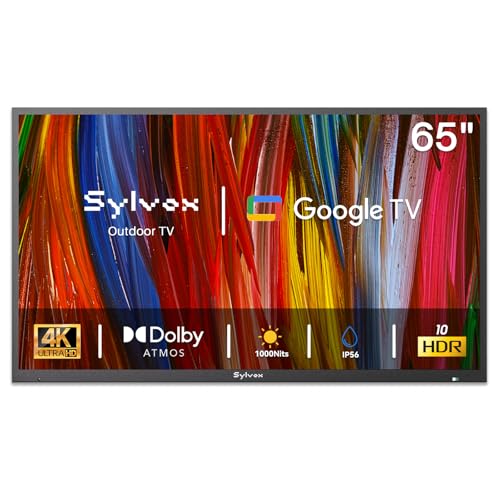
SYLVOX 65-inch Outdoor TV — Best Big-Screen Outdoor Pick
Scale changes the outdoor problem. A 65-inch screen is a sail in the wind, a mirror for half the sky, and the centrepiece of any yard it hangs in — so it has to be brighter and tougher than a porch set, not just bigger. This SYLVOX answers with 1,000 nits, an IP56 cabinet and support for Dolby Atmos, running the Deck Pro 3.0 line that the brand aims at partial sun and full shade. On a patio where sunlight crosses the seating in the late afternoon, that extra brightness over the 700-nit class is the difference between squinting at a washed-out match and simply watching it.
The picture specification is the full modern stack for this class: 4K UHD resolution, which at 65 inches keeps sport and nature footage crisp from typical patio distances, and a panel bright enough to preserve HDR contrast outdoors, where lesser screens flatten everything to a milky average. Dolby Atmos support matters outside for a practical reason — open air swallows sound, reflections vanish, and object-based mixes with a compatible soundbar keep dialogue anchored to the screen instead of smeared across the yard. Even without extra speakers, the provision is there when the installation grows.
Think carefully about the mount and the wall before this screen arrives. A 65-inch outdoor television is heavy, lives outside in weather, and should be fixed to structure, not siding — studs, masonry, or a properly rated post. The IP56 seal handles rain and dust with a grade of margin, but no seal excuses a bracket that flexes. Buyers planning a genuinely unshaded, all-day-sun position should step up to the 2,000-nit class covered in the Florida guide; this set’s honest territory is the big covered patio and the partially shaded yard, where it is close to ideal.
There is a social dimension to a screen this size that smaller sets do not have: it becomes the yard’s hearth. Big matches, film nights and photo slideshows from a family trip all gather people in a way a porch set does not, and the SYLVOX’s brightness headroom means those gatherings are not hostage to the sun’s timetable. Hosts should still choreograph a little — angle the seating so the worst reflection hour falls on nobody’s favourite chair, and keep the grill smoke path in mind, because a summer of barbecue haze will film any screen, sealed or not, and this one deserves the occasional wipe like the others. Treat it as furniture-grade infrastructure and it behaves like it.
- Panel: 65-inch 4K UHD
- Brightness: 1,000 nits, for partial sun and full shade
- Sealing: IP56 waterproof rating
- Audio: Dolby Atmos support
- Series: Deck Pro 3.0
Strengths
- The 1,000-nit panel holds contrast in partial sun where 700-nit sets surrender.
- Atmos support gives an outdoor cinema build a proper audio upgrade path.
- IP56 sealing matches the exposure a large patio screen will genuinely meet.
Trade-offs
- Its size and weight demand structural mounting — this is a two-person, plan-ahead install.
- Full-sun positions still belong to the 2,000-nit class above it.
- A screen this large dominates smaller patios visually even when switched off.
Best for: large covered patios and partially shaded yards that host groups for sport and film nights. Not suited for: small balconies, or walls in direct sun from morning to evening.

Titan S100 QLED 43-inch — Strongest Seal
If the seal is the contract, the Titan S100 holds the best penmanship in this guide. Its listing states IP65 — dust-tight at the first digit, not merely dust-protected — wrapped around a 43-inch QLED panel with HDR10+ and Samsung’s Tizen operating system. That combination is aimed at the covered patio, and it is worth pausing on why dust-tightness matters in a space that already has a roof. Patios are dusty places: pollen in spring, grit all summer, ash and leaf-litter in autumn. A dust-tight cabinet keeps that slow abrasion away from the panel and boards for the whole life of the set, not just its first season.
QLED is the other half of the argument. Quantum-dot panels deliver wide, saturated colour volume, and colour is the first casualty of ambient light — reds go rusty, greens go grey. On a covered patio in bright daytime, a QLED picture keeps its identity better than a plain LED at similar brightness, which makes the Titan a strong daytime-sports screen despite its compact size. HDR10+ adds per-scene tone mapping for streamed films in the evening, when a covered patio turns into the nicest room in the house.
Tizen will divide opinion neatly along household lines. If your indoor screens already run Samsung’s platform, the Titan feels like family: same remote logic, same app store, same quirks. If your home is built on another ecosystem, expect a short adjustment. Either way the platform is mature, quick and well supplied with streaming apps. The Titan’s honest boundary is exposure: the listing frames it for covered patios and outside use under shelter, and its brightness class belongs there. Within that territory, though, the IP65-plus-QLED formula is the most engineering-forward pitch in this article, and readers who like the formula at other sizes will find the same thinking across the screens in our roundup of best 65 inch 4k tvs for glare and viewing angle.
One more consideration belongs to the Titan specifically, because its formula invites a question: why pay for the strongest seal at the smallest size? The answer is that exposure is about what reaches the wall, not how big the screen is. A 43-inch set on a covered patio near a pool takes chlorine-laden splash, wind-driven grit and summer humidity at exactly the same rate as a 65-inch set on the same wall. Buyers who think of sealing as insurance will find the Titan’s premium rational; buyers whose patio is genuinely gentle may reasonably spend the difference on inches instead. Both readings are honest — the guide’s job is to make sure the choice is made with the exposure map in hand, not by accident.
- Panel: 43-inch 4K UHD QLED with HDR10+
- Sealing: IP65, dust-tight and water-jet resistant
- Platform: Tizen OS
- Positioning in the listing: covered patio outdoor TV
- Colour: quantum-dot panel for wide colour volume
Strengths
- IP65 is the strongest seal here — the first digit 6 means dust-tight, full stop.
- QLED colour volume fights the washed-out look that ambient light imposes.
- Tizen is fast, familiar to Samsung households and rich in streaming apps.
Trade-offs
- The covered-patio brief is real: this is not the pick for an exposed pool wall.
- Households invested in a rival smart platform face a second remote logic outdoors.
- At 43 inches it will feel small on a long patio with seating far from the wall.
Best for: covered patios where dust, pollen and blown rain are the daily enemies and colour quality matters. Not suited for: unsheltered positions or very large outdoor rooms.

RIXZSIW 55-inch Outdoor TV — Best webOS Outdoors
LG’s webOS rarely gets to live outside, which makes the RIXZSIW an interesting animal: a 55-inch, 1,000-nit, IP55-sealed screen running webOS 25 with voice control and Dolby Atmos support. The platform is the headline. webOS is the pointer-driven, card-based interface that a generation of indoor viewers learned to love, and having it on the patio means nobody in the household has to learn a second system to put a film on outside. The voice control earns its keep in exactly the situations outdoor viewing creates — hands wet from the pool, hands busy at the grill, remote somewhere under a cushion.
The panel specification suits the covered-patio and poolside brief the listing claims. 1,000 nits is partial-sun money: a poolside wall that catches morning light will still show a readable picture, and under a roof the brightness is generous headroom that keeps HDR material punchy. The IP55 seal is the honest floor for weatherproofing — dust-protected, resistant to water jets — which is entirely adequate under cover and acceptable for a poolside wall that takes spray rather than storms head-on. Mount it where the roof line or a wall breaks the worst of the weather and the rating will never be tested near its limit.
Atmos support again provides the growth path: start with the built-in speakers for commentary and casual viewing, add a compatible soundbar when film nights become a habit. The 55-inch size is the patio sweet spot for many homes — big enough for a group around a table, small enough to mount without engineering drama. Buyers should simply go in clear-eyed about the brand: RIXZSIW is not a household name, so lean on the listing’s stated specifications, check the seller’s support terms, and register the product on arrival. Judged on what its listing promises — brightness, seal, platform, audio — it promises the right things.
- Panel: 55-inch 4K UHD
- Brightness: 1,000 nits
- Sealing: IP55 waterproof rating
- Platform: webOS 25 with voice control
- Audio: Dolby Atmos support
Strengths
- webOS 25 outdoors is a genuine differentiator for LG households.
- 1,000 nits covers poolside mornings and bright covered patios confidently.
- Voice control proves its worth precisely when hands are wet or busy.
Trade-offs
- IP55 is the floor of the weatherproof class — position it with some shelter.
- A lesser-known brand means support runs through the seller, not a global network.
- Pointer-style webOS navigation can feel fussy with a basic remote in bright light.
Best for: covered patios and poolside walls in households that already speak webOS indoors. Not suited for: fully exposed mounting points that take direct storm weather.

MWE 55-inch Outdoor TV — Mount Included
Every outdoor TV installation has a forgotten line item, and it is usually the mount — discovered missing on the Saturday morning the installer (you) is standing on a ladder. The MWE removes that small disaster from the story by including the wall mount in the box, a detail its listing states plainly alongside a 1,000-nit 4K panel, Wi-Fi, Bluetooth and a voice remote. It sounds like a minor convenience until you have priced outdoor-rated mounts separately and waited a week for one to arrive while the television sat in its box in the garage.
The rest of the specification is squarely in the sensible middle of this category. 1,000 nits places it with the partial-sun class: the listing pitches it at partial sun and full shade, and that is where it should live. The smart platform covers the streaming staples, Bluetooth lets you push audio to an outdoor speaker for gatherings or pull it into headphones for a quiet late match, and the voice remote covers the everyday commands. In a category full of exotic claims, the MWE’s appeal is that its promises are ordinary, checkable and complete — panel, brightness, connectivity, remote, mount.
One caution belongs in any honest review of this set: the listing language we verified emphasises waterproof weatherproof construction without our being able to point you to a specific IP code in the title, so before purchase, confirm the exact IP rating on the product page and match it to your exposure using the guide section above. That is not a dismissal — several fine outdoor sets present their ratings in the body of the listing rather than the headline — but the discipline of this category is to buy the number, not the adjective. Do that check, and the MWE is the most installation-friendly route to a 55-inch outdoor screen in this guide.
There is also a budgeting honesty to the MWE’s pitch that deserves credit. Outdoor installations hide costs — the mount, the outdoor outlet, the longer cable runs, sometimes a mesh node for Wi-Fi — and a listing that absorbs one of those costs into the box price is easier to plan a whole project around. First-time outdoor buyers routinely underestimate the accessories by a wide margin; starting with the screen that includes its own mount is a small but real correction to that habit, and it leaves more of the project fund for the electrical work that should never be improvised.
- Panel: 55-inch 4K UHD
- Brightness: 1,000 nits, for partial sun and full shade
- In the box: wall mount included, per the listing
- Connectivity: Wi-Fi and Bluetooth, voice remote
- Positioning in the listing: waterproof weatherproof TV for outside use
Strengths
- The included mount deletes the most common installation delay in this category.
- 1,000 nits is the right brightness class for the patios most homes actually have.
- Bluetooth audio flexibility suits both parties and quiet late-night viewing.
Trade-offs
- Confirm the precise IP code on the product page before matching it to an exposed spot.
- The smart platform is serviceable rather than best-in-class.
- An included mount fits standard walls; unusual surfaces may still need different hardware.
Best for: buyers who want one box to contain the whole project, mount and all. Not suited for: anyone unwilling to verify the exact seal rating against their exposure first.

Westinghouse 55-inch Partial Sun Outdoor TV — Anti-Glare Value
Westinghouse brings a familiar name and an unfussy proposition: a 55-inch 4K UHD outdoor screen with an anti-glare display, 700 nits of brightness, an IP55 seal and the Xumo streaming platform. The anti-glare treatment is the feature to linger on. Reflections are the silent killer of patio viewing — a glossy screen under a bright sky acts as a mirror for the yard behind you — and a matte, anti-glare surface trades a whisper of absolute contrast for a picture you can actually watch at four in the afternoon. For porches and partially sunny walls, that trade is usually correct.
The 700-nit rating places it honestly in the shade-to-partial class, and the listing says so, calling it a partial sun set. Temperature resistance is also claimed, which matters for sets that overwinter outside in colder states: electronics and LCD panels both dislike deep cold, and a set designed to sit through it saves the annual ritual of unmounting and storing a television in the garage. Xumo, the platform, is deliberately simple — a joint streaming interface that emphasises free and live channels alongside the big subscription apps. Households tired of managing five ecosystems may find that simplicity is the feature.
Bluetooth and Wi-Fi cover the connectivity basics, and the 55-inch size suits the same middle patios as the RIXZSIW and MWE above. Choosing between those three is a platform and detail decision: webOS polish from the RIXZSIW, the included mount from the MWE, or anti-glare plus a heritage brand and a simpler interface here. What the Westinghouse asks in return is modest expectation management — it is a value-positioned set, so judge its picture against its class rather than against screens costing several times more, and it will satisfy. Readers furnishing a covered den-like space rather than a patio face an easier version of this same problem indoors, where the light fight is gentler and the screens get cheaper.
- Panel: 55-inch 4K UHD with anti-glare display
- Brightness: 700 nits, partial-sun class
- Sealing: IP55 waterproof rating
- Platform: Xumo streaming
- Build notes from the listing: temperature resistant
Strengths
- Anti-glare glass attacks the reflection problem that ruins bright-porch viewing.
- Xumo’s simplicity suits households that want channels and apps without fuss.
- Temperature resistance suits sets that stay mounted through winter.
Trade-offs
- 700 nits is shade-class brightness; open-sun walls overwhelm it.
- Xumo’s app catalogue is leaner than Google TV’s or webOS’s.
- Picture finesse is value-class — film purists will see the gap at night.
Best for: porches and partial-sun walls where reflections, not darkness, are the enemy. Not suited for: full-sun installations or viewers building a reference-grade outdoor cinema.
What Is Happening Inside a Sealed Cabinet All Year?
It is worth understanding what you are paying for, because a weatherproof television fights a quieter war than rain. The daily enemy is the breathing cycle: a cabinet warms in the sun and cools at night, and an ordinary vented television inhales a little of the outside world with every cycle — moist air, dust, pollen, the occasional insect that finds the warmth attractive. Inside an indoor set living outdoors, that inhaled moisture condenses on cold boards at dawn, corrodes contacts over months, and eventually writes the set’s ending as a flicker, a line on the panel, then silence. Sealing the cabinet and protecting the electronics is how the sets in this guide refuse that story, and it is why the IP code’s first digit — the dust and solids grade — matters even under a roof.
Heat is the second internal battle. A television in a black cabinet on a sunlit wall lives in an oven of its own making, and high-brightness panels generate real warmth of their own. Outdoor designs answer with metal cabinets that conduct heat to the outer surface, internal layouts that keep hot components away from the panel, and brightness systems that can sustain output instead of surging and fading. This is also why recessing an outdoor set into a sealed decorative box is such a reliable way to kill it: you have rebuilt the oven and removed the chimney. Give the cabinet air, keep direct sun off it where the design brief says shade, and the thermal engineering you paid for can do its work.
Cold writes the third chapter, mostly in the panel itself. Liquid crystals grow sluggish as temperatures fall, so a set switched on at dawn in January may smear motion until it warms — normal behaviour, not damage. What deep cold does punish is haste: condensation forms when a freezing set is brought into warm air or powered hard from cold-soaked, which is why the care section advises patience after extreme nights. None of this requires expertise from the owner. It requires only that the television be a genuine outdoor design, mounted with air around it, in the exposure class its listing claims. The engineering handles the rest, season after season, which is precisely the promise the indoor-under-a-cover shortcut cannot make.
What Happens to Sound When a Television Moves Outside?
Indoors, walls do half of your speakers’ work: reflections return energy to the seating, and dialogue stays intelligible at modest volume. Outdoors, sound simply leaves. It radiates into open air, competes with pool pumps, traffic, wind in the trees and the neighbour’s dog, and loses the low frequencies first. This is why outdoor viewing so often feels thin even on a good television, and why the audio provisions in these listings deserve more respect than buyers usually give them. Dolby Atmos support on the two SYLVOX sets and the RIXZSIW is not a badge for its own sake — it is the doorway to a soundbar that can throw dialogue forward and survive being asked to work in the open.
The practical ladder has three rungs. Start with the built-in speakers, which on every set here are adequate for commentary, news and casual viewing at conversational distance. Add a Bluetooth speaker placed near the seating — not near the screen — when gatherings spread out; the MWE and Westinghouse both carry Bluetooth, and proximity beats power for intelligibility. Then, for households that host film nights, commit to a wired or wireless soundbar mounted under the screen, ideally one itself rated or sheltered for outdoor life. What never works is simply turning an indoor-style system louder: volume without placement just exports your film to the whole street. Think of outdoor audio as a seating-area problem, and the picture’s job is only half the installation.
How Do Shade, Partial Sun and Full Sun Change the Screen You Need?
Walk your mounting spot through a full day before you spend anything. Full shade means the sun never strikes the screen directly — under a solid roof, on a north-facing wall, beneath deep eaves. There, 700 nits is plenty and even a glossy panel behaves. Partial sun means direct light crosses the screen for part of the day, typically morning or late afternoon; that is 1,000-nit territory, ideally with an anti-glare surface, because the picture must survive the worst hour, not the average one. Full sun — an unshaded pool wall, a south-facing deck — demands the 2,000-nit class and is a different budget conversation entirely.
Two traps hide in this exercise. The first is seasonal drift: a wall that is shaded in June may take direct sun in September as the sun’s angle drops, so think about the whole year the set will live outside, not the week you install it. The second is reflected light, which arrives even in “shade” — a pale patio floor, a white fence or a swimming pool can bounce enough glare onto a screen to halve its effective contrast. That is why the anti-glare sets in this guide punch above their nit figures, and why our look at best large tvs for bright room is useful background even for outdoor shoppers: the physics of fighting light does not change at the patio door.
A practical way to run this audit is with your phone. Stand at the mounting point at three times of day — morning, mid-afternoon and the golden hour when you will actually watch — and photograph the blank wall. If the frame is lit directly in any shot, that hour defines your class, whatever the other two show. Then check where the sun sits in the opposite season, using any sun-path app or simply your memory of last winter’s garden. Fifteen minutes of this honesty at the planning stage is what separates the installations that delight for a decade from the ones that get a resigned shrug every bright afternoon.
How Do You Install an Outdoor TV So It Survives?
Start with structure. An outdoor mount must anchor into studs, masonry or a rated post — never into siding or render alone — because wind loads on a large panel are real and the set lives out there in storms. Use stainless or coated outdoor hardware; ordinary indoor screws corrode, stain the wall and eventually let go. Height is the second decision: mount for seated eye level in the chairs that will actually be used, and tilt the screen slightly downward if it must sit higher, which also sheds both glare and rain.
Power and water need a plan that respects both. Outdoor outlets should be weather-rated, covered and on a protected circuit, with cables run so they cannot chafe, pool water or cross a walkway. Leave a drip loop in any cable that descends to the set, so rain runs off the loop instead of travelling into a port. For signal, Wi-Fi reaches most patios, but a set at the garden’s end may need a mesh node or a wired run — test streaming quality at the exact spot with your phone before the mount goes up, not after. Finally, ventilation cuts both ways: a sealed outdoor TV is designed to shed heat through its cabinet, so do not smother it in a decorative box or recess it into a sealed cavity; give the cabinet the air its designers assumed.
Before the first film night, run a commissioning pass. Update the platform’s software while the set is easy to reach, sign in to your services, and check the picture in both the brightest and darkest conditions the spot produces — a screen that looks perfect at dusk may need its brightness and motion settings revisited at noon, and the reverse is equally true. Photograph the rear connections before the set goes flat to the wall, because the day you need to know which port the soundbar uses is the day you will not want to unmount a television to find out. Ten minutes of this foresight saves every future adjustment from becoming a ladder job.
Which Size Belongs on Which Wall — 43, 55 or 65 Inches?
Outdoor seating is rarely arranged in a neat cinema row, so size by the farthest regular seat rather than the closest. On a porch where chairs cluster within two or three metres, a 43-inch screen reads clearly for sport and news, and its smaller cabinet is kinder to old porch posts and narrow walls — that is the natural home of the SYLVOX 43 and the Titan. The 55-inch class is the patio default for a reason: at three to five metres it fills the view for a group around a table without demanding a structural engineering review, and three of our six picks live there because most patios do.
Step to 65 inches when the yard itself is the room — seating spread across a deck, a pool beyond it, viewers drifting between the grill and the water. The SYLVOX 65 exists for that geography, and its 1,000-nit panel matters more at that size, because a bigger screen reflects a bigger piece of sky. One warning travels with size in the other direction: an oversized black rectangle dominates a small garden even when off, and it catches wind like a sail. Measure the wall, pace out the seating, and let the smaller honest screen win when the distances say so.
Which Weatherproof Details Separate These Six Screens?
| Pick | Size | Brightness | Seal | Platform | Defining trait |
|---|---|---|---|---|---|
| SYLVOX 43-inch Outdoor TV | 43″ | 700 nits | IP56 | Google TV | Porch-sized with an above-floor seal |
| SYLVOX 65-inch Outdoor TV | 65″ | 1,000 nits | IP56 | Google TV | Big-screen partial-sun anchor with Atmos support |
| Titan S100 QLED 43-inch | 43″ | Covered-patio class | IP65 | Tizen | Dust-tight seal plus QLED colour |
| RIXZSIW 55-inch Outdoor TV | 55″ | 1,000 nits | IP55 | webOS 25 | LG’s interface in a poolside-ready cabinet |
| MWE 55-inch Outdoor TV | 55″ | 1,000 nits | Verify code on listing page | Smart TV platform | Wall mount included in the box |
| Westinghouse 55-inch Partial Sun | 55″ | 700 nits | IP55 | Xumo | Anti-glare panel and temperature resistance |
Read the table by exposure first. If your spot is covered and dusty, the Titan’s IP65 and QLED colour make it the connoisseur’s 43-inch answer, while the SYLVOX 43 matches it on seal grade at the water digit and adds Google TV. The three 55-inch sets split on personality rather than power — webOS, an included mount, or anti-glare simplicity — and the 65-inch SYLVOX stands alone for buyers whose patio genuinely seats a crowd. Notice what the table does not contain: a full-sun recommendation. That absence is deliberate honesty, because none of these six listings claims the 2,000-nit class, and a guide that blurs that line sells televisions that disappoint at noon.
How Long Should a Weatherproof TV Last, and What Shortens Its Life?
A purpose-built outdoor television, mounted in its stated exposure class, should be planned like a fixture rather than a gadget: years of service measured against the patio’s life, not the phone upgrade cycle. The electronics are protected, the panel is the same fundamental technology as indoor sets, and the parts that age fastest indoors — backlights driven at maximum, boards breathing damp air — are exactly the parts the outdoor design addresses. What shortens the story is almost never the weather the set was rated for. It is the weather it was not: a shade-class screen baked in full sun until its panel and polariser tire, a cabinet recessed into a sealed box cooking its own boards, a mount that flexes until a seal is stressed at one corner season after season.
There is also a paperwork dimension to longevity. Register the set, keep the listing’s stated specifications, and photograph the installation once it is done. If a seal ever fails inside warranty, that small archive is the difference between an argument and a replacement. And when the set eventually does retire, notice what will have been true across its life: no hauling, no storage, no seasonal ritual — just a screen that was part of the house. That quiet reliability, spread over years of evenings, is the real product this category sells.
What Mistakes Ruin Outdoor TVs?
The classic mistake is the indoor TV under a cover, and it deserves a direct answer: a fabric cover keeps bulk rain off a cabinet that was never sealed, while humidity, condensation, insects and heat continue their work unopposed. The set may survive a season. It will not survive three, and its warranty never covered the experiment. The second mistake is buying brightness for the average hour instead of the worst one — a screen that is lovely at dusk and invisible at four o’clock is a screen that fails at sport time, which is when patios fill.
Mounting errors come next: brackets fixed to siding, indoor hardware corroding outdoors, screens hung at standing height above seated viewers, and cabinets recessed into sealed boxes that trap heat. Then come the quiet ones — no drip loop on the cable, a sprinkler head aimed at the screen, a pressure washer used on the patio with the TV “probably fine” in the blast zone. And the paperwork mistake: never registering the product or keeping the listing’s stated specifications, which are your evidence if a weatherproofing claim is ever disputed. Every one of these is avoidable in an afternoon of planning, which is more than can be said for replacing a dead television.
How Should You Care for an Outdoor TV Across the Seasons?
Spring asks for an inspection: check the mount’s bolts for winter movement, confirm the drip loops still hang below the ports, and clear the pollen film from the screen with a dry microfibre before it bakes into a haze. Summer is about heat and habits — a sealed cabinet sheds warmth through its surfaces, so keep planters, cushions and grill covers from leaning against it, and resist the urge to drape anything over a running set during a shower; a weatherproof television would rather be rained on than smothered. If a storm is severe enough to send you indoors worrying about the furniture, the television will be fine; that is the point of it.
Autumn brings leaves and condensation. Clear leaf litter from behind the cabinet where it traps moisture against the wall, and on still, dewy mornings accept that a cold screen may fog briefly on its outer surface — that is physics on the glass, not water inside the seal, and it clears as the panel warms. Winter divides households by climate. In mild regions, leave the set mounted and use it; televisions that are run regularly age better than televisions stored damp. In genuinely cold regions, check the listing’s temperature language, consider a breathable cover for the dormant months, and never power up a set that has just come in from deep cold until it has acclimatised — a precaution borrowed from camera care that electronics generally appreciate. An hour of attention per season is the entire maintenance contract, and it is a kind one compared with hauling an indoor set in and out of the rain.
Final Recommendation
For most covered patios, start with the exposure and let it choose for you: deep shade and dust point to the Titan S100 QLED and its IP65 seal; a porch or gazebo points to the SYLVOX 43; a big partial-sun patio points to the SYLVOX 65; webOS households take the RIXZSIW; anyone who wants the mount in the box takes the MWE; and reflection-plagued porches take the anti-glare Westinghouse. Buy the seal and the brightness your worst weather and your brightest hour demand, and the screen will still be out there, working, when the neighbours are carrying their second indoor television to the kerb. A weatherproof TV is not really a purchase of a screen at all — it is the purchase of every ordinary evening you will never have to think about the weather again.
Frequently Asked Questions
Can a weatherproof TV stay outside all winter?
Sets in this class are designed to live outdoors year-round, and several listings here claim temperature resistance explicitly. In severe cold, LCD response slows and any screen appreciates a cover during long disuse, but the annual unmount-and-store ritual belongs to indoor televisions, not to these. Check the listing’s stated operating range for your climate and you can leave the ladder in the garage.
Is IP55 enough, or should I insist on IP65?
It depends on exposure, which is the theme of this whole guide. Under a solid roof, IP55’s dust protection and water-jet resistance cover everything the spot will deliver. The more open the position — blown rain, sprinkler drift, coastal dust — the more the IP56 and IP65 margin earns its keep. Buy the rating for the weather that reaches the wall, not the weather on the forecast.
Why do outdoor TVs cost so much more than indoor ones?
Because almost nothing is shared with the indoor product: a sealed metal cabinet instead of vented plastic, conformal protection for the electronics, a panel two to four times brighter, thermal design for a box that bakes in sun and chills at night, and low production volumes. You are paying for the engineering that lets a television ignore weather, and compared with replacing indoor sets every couple of seasons, the arithmetic often favours the real thing.
Do I need a special mount and cables outdoors?
The mount should be outdoor-rated with corrosion-resistant hardware, anchored to structure — one pick in this guide, the MWE, includes its mount, which removes the guesswork. Cables should be rated for outdoor runs, given a drip loop before the set, and kept out of standing water. None of this is exotic; it is simply the difference between an installation and an accident in progress.
Can I hose down an outdoor TV to clean it?
No. IP ratings cover rain and water jets at defined pressures, not a deliberate hosing at close range, and detergents attack screen coatings. Clean with a soft, slightly damp cloth, let the set dry, and keep pressure washers pointed at the patio stones well away from the screen. The seal is armour against weather, not an invitation.
Will a weatherproof TV work with my existing streaming accounts?
Yes — each platform here (Google TV, Tizen, webOS, Xumo) carries the major subscription services, and you sign in with the same accounts you use indoors. The one planning note is Wi-Fi reach: streaming a 4K film to the far end of a garden asks more of your network than scrolling a phone there does, so test the signal at the mounting spot first and budget for a mesh node if it wavers.
Related Guides
Shoppers whose yards take the full force of the sun should continue to best outdoor tvs for florida for the 2,000-nit class, and anyone still weighing an indoor alternative for a bright space will find the physics explained in best large tvs for bright room, where the same brightness discipline applies behind glass, season after season, in every climate.
Shops that sell under a canopy outdoors end up asking television questions too, and our guide to the best tablets for point of sale with paypal answers the till half of that day.
Fixed outdoor panels and screens that travel are the two ends of flexible viewing, and our guide to the best portable tvs for gaming covers the moving end.
Outdoor panels sip power compared with the indoor giants they replace, and our guide to the best energy smart small tvs follows that thought to its small-screen conclusion.
The indoor flagship end of the television shelf is a different sport entirely, and our guide to the best 65 gaming tvs referees it by refresh rate and HDMI count.
Related guides
- Best 1080p IP Cameras: PoE Domes, Turrets, Bullets and a PTZ That Earn Their Cable
- Best 43 1080p TVs: Why 43 Inches Went 4K — and Where True Full HD Survives
- Best Doorbell Cameras No Subscription: Local Storage Picks, and the Ring/Blink Truth
- Best AC Powered Wireless Security Cameras: Wi-Fi Data, Mains Power, Zero Sleep


