What's inside
- Key Takeaways
- Quick Picks
- How Did We Judge Cameras This Simple?
- Why Are People Returning to Film Point-and-Shoots at All?
- How Do the Six Stack Up Against Each Other?
- What Should a First-Time Film Buyer Know About Running Costs?
- Which Mistakes Ruin Beginners’ First Rolls?
- How Do You Load, Shoot, and Finish a Roll Well?
- Why Does Half-Frame Keep Winning Converts?
- Which Film Stock Should You Feed These Cameras?
- What Happens After the Lab — Scanning, Sharing, and Printing?
- How Do These Cameras Behave at Parties, Weddings, and on Trips?
- How Do You Buy a Vintage Film Compact Without Getting Burned?
- What Accessories and Care Do Reusable Film Cameras Actually Need?
- What Should Your First Three Rolls Teach You?
- Is Reusable Film Actually Kinder to the Planet Than Disposables?
- Which of These Makes the Right Gift, and for Whom?
- A Note on Patience, Expectation, and the Envelope Moment
- What Separates a Toy From a Tool in This Category?
- Final Recommendation
- Frequently Asked Questions
- Related Guides
As an Amazon Associate I earn from qualifying purchases. This post may contain affiliate links at no extra cost to you.
gizmoverdict.com is reader-supported. When you buy through links on our site, we may earn an affiliate commission.
Where to buy: the five modern reusable cameras below carry Amazon links, while the vintage Canon discussed at the end is prose-only because it survives purely on the secondhand market. Anyone shopping for the best affordable point and shoot film cameras today faces a market split cleanly in two. On one side stand brand-new reusable cameras, mostly simple plastic bodies with fixed-focus lenses, sold with warranties and honest expectations. On the other side lurk the celebrated autofocus compacts of the nineteen-eighties and nineties, optically superior and mechanically mortal, each one a small gamble dressed as nostalgia.
This guide keeps those two worlds separate on purpose. A new Kodak that costs little and works predictably serves a beginner better than a dying classic whose light seals have turned to dust, however legendary the classic’s lens once was. Yet a healthy vintage Canon, bought from a seller who actually ran film through it, can produce negatives no plastic newcomer will ever match. Understanding which risk profile suits you matters more than any ranking, so each entry below states plainly whether you are buying certainty or character.
Film itself deserves a budget conversation before cameras enter it. Every frame costs money twice — once for the roll, once for developing and scanning — and half-frame models stretch a roll to seventy-two exposures, halving that ongoing expense. Beginners routinely undercount this arithmetic and then shoot timidly, which defeats the entire pleasure of an unfussy camera. Choose the body whose running costs let you photograph freely, because a film camera rationed by anxiety is just expensive jewelry.
Key Takeaways
- Half-frame designs from Pentax and Kodak double your frames per roll, quietly transforming the economics of casual film shooting.
- Every linked pick here is a new reusable camera; the vintage Canon is prose-only and demands used-market caution.
- Fixed-focus plastic lenses forgive beginners and punish perfectionists in roughly equal measure.
- Flash strength, battery type, and whether film is even included separate these near-identical-looking boxes more than brand names do.
- Developing costs will exceed the camera’s price within a handful of rolls, so plan the whole habit, not just the purchase.
Quick Picks
| Pick | Badge | Why it earns a slot |
|---|---|---|
| Pentax 17 | The serious newcomer | A genuinely engineered half-frame camera with a real lens, zone focusing, and exposure control for growers. |
| Kodak Ektar H35 | Half-frame bargain | Seventy-two frames per roll from a featherweight body that asks nothing of its owner but film and light. |
| Kodak EC35 | Slide-cover simpleton | A protective sliding cover and built-in flash make it the toss-in-a-bag option for careless fun. |
| Kodak Snapic A1 | Two-zone step up | Its switchable focus zones rescue closer subjects that fixed-focus rivals blur without apology. |
| Ilford Sprite 35-II | Full-frame traditionalist | A standard thirty-six frame layout from a film manufacturer, with a lens shade of character and simplicity. |
| Canon Sure Shot / AF35M (used) | Vintage temptation, prose-only | Autofocus and a proper lens await buyers willing to accept forty-year-old electronics and no warranty. |
How Did We Judge Cameras This Simple?
Specification sheets for this category fit on an index card, so judging leaned on shooting logic instead. How forgiving is the lens at conversational distances? Does the flash recycle fast enough for a party, or does the camera go silent while the moment escapes? Can a complete novice load film without a video tutorial and tears? Those questions, answered honestly, separate a delightful toy from a frustrating one more reliably than any optical bench test.
Reliability evidence weighed heavily because these bodies are largely plastic mechanisms expected to survive handbags and glove compartments. New cameras earned credit for warranties and return routes. The vintage entry earned its place through reputation alone and carries warnings proportional to its age. We also considered the surrounding ecosystem: standard thirty-five millimeter film remains available everywhere from specialist shops to online giants, and any lab on Earth can process it, which cannot be said for orphaned formats.
Finally, we priced the habit rather than the hardware. A camera saving its owner money on every roll through half-frame economy may be the genuinely cheaper instrument after a summer of shooting, even when its shelf price doubles a rival’s. Conversely, the cheapest body becomes expensive if its blurry lens wastes paid-for frames. Film photography punishes false economy with unusual precision, because every disappointment arrives itemized on a lab invoice weeks later.
Why Are People Returning to Film Point-and-Shoots at All?
Partly it is the look: grain, halation around lights, and colors that flatter skin without an editing session. Partly it is the discipline of thirty-six decisions instead of three thousand, which makes photographers walk closer, wait longer, and compose like they mean it. And partly it is social — a small film camera at a gathering invites curiosity rather than the fatigue a phone camera now triggers. People pose differently when the photograph is scarce, and many shooters find that difference worth every inconvenience of developing.
There is also honest rebellion against the computational sameness of phone images. A plastic lens flares, vignettes, and softens corners in ways no filter convincingly reproduces, because the flaws respond to real light in real time. Beginners should hear the counterargument too: film’s delays frustrate anyone who needs to check results instantly, and its costs compound relentlessly. This category thrives when expectations stay playful. Treat these cameras as instruments of serendipity and they delight; demand wedding-photographer reliability and they will eventually break your heart at an important moment.

Pentax 17 — The serious newcomer
The Pentax 17 is what happens when an actual camera company, rather than a licensing label, designs a modern film compact. Its half-frame format records two vertical images on each standard frame, yielding up to seventy-two photographs per roll, and the lens — a proper coated optic derived from Pentax’s compact heritage — renders detail that embarrasses every plastic rival in this guide. Holding it, you feel knobs, detents, and intent. This is a camera meant to be learned, kept, and handed down, in an era when most film newcomers are effectively disposable with extra steps.
Zone focusing replaces autofocus: you select a distance band, from close-up through landscape, using pictograms on the lens barrel. The system sounds primitive until you realize how fast it becomes, and how honestly it teaches the relationship between distance, aperture, and depth of field. Program exposure handles metering with a competence that frees beginners while the exposure compensation dial gives growing photographers a genuine creative lever. Flash, when wanted, fires with restraint rather than the nuclear blast cheaper bodies deliver.
Half-frame vertical orientation suits the way people now share photographs, and scanning labs handle the format routinely, though you should confirm your chosen lab delivers individual half-frames rather than paired scans. The format’s economy is profound for students: a single roll documents an entire term’s worth of weekends. Against that, the Pentax costs several times its plastic rivals, its images carry slightly more grain per frame because each negative is smaller, and its very seriousness may intimidate someone who only wanted a party toy. Both readings are correct, which is why it tops this list for growers and ranks as glorious overkill for dabblers.
- Format: half-frame thirty-five millimeter, up to seventy-two exposures per roll
- Lens: 25mm f/3.5 fixed lens with zone-focus distance settings
- Exposure: program automatic with compensation control, built-in flash
- Character: engineered metal-and-quality construction, the keeper of this category
Strengths
- Real optics produce negatives with detail and contrast plastic lenses cannot approach.
- Seventy-two frames per roll slashes the per-photograph cost of learning film.
- Manual touches — compensation, focus zones — reward skill as yours develops.
Trade-offs
- Price sits far above the toy-grade rivals, demanding genuine commitment to film.
- Half-frame negatives show more grain when enlarged aggressively.
- Some labs need guidance on scanning individual half-frames rather than pairs.
Best for: committed beginners and returning film shooters wanting one modern camera to grow into. Not suited for: anyone seeking a nearly-free party accessory they can lose without regret.
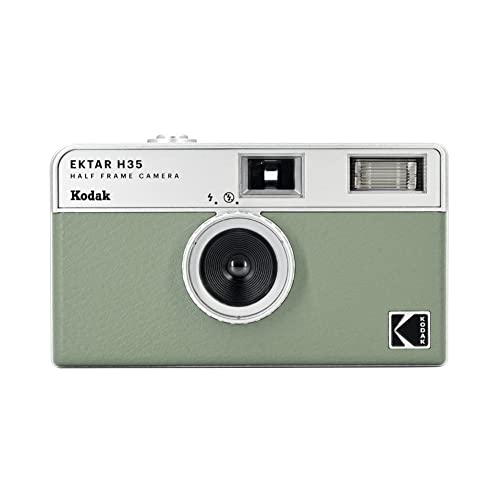
Kodak Ektar H35 — Half-frame bargain
If the Pentax is a music lesson, the Ektar H35 is a kazoo — and kazoos have their own joyful legitimacy. This featherweight half-frame box asks almost nothing: load film, slide the flash on when indoors, press the button, wind. Focus is fixed, exposure is automatic in the loosest sense, and the lens softens everything into a warm, forgiving haze that flatters friends and forgives beginners simultaneously. Seventy-two frames per roll means a single cartridge of film can cover a festival weekend and the birthday after it.
The Sage finish of this listing photographs beautifully itself, which matters more than purists admit, because a camera people enjoy carrying gets used. Build is unapologetically plastic, light enough to vanish in a jacket pocket, and the single AAA battery keeps the flash alive through many rolls. That flash is the camera’s second personality: indoors it rescues everything within a few meters, producing the direct-flash party aesthetic currently fashionable precisely because it looks nothing like a phone’s computational night mode.
Limitations arrive honestly. Focus-free means genuinely near subjects — an arm’s-length selfie, a plate of food — will soften, and landscapes lose bite at the edges. The shutter offers one speed, so bright snow and deep shade both stretch its competence. Film and battery are not included, a footnote that has ambushed many eager buyers at checkout. Yet for its purpose — carefree documentation with film’s texture at the lowest sustainable running cost — the H35’s compromises align almost perfectly with its audience’s desires.
- Format: half-frame thirty-five millimeter reusable camera, seventy-two frames possible
- Lens: focus-free fixed optic, built-in flash for indoor work
- Power: single AAA battery, not included; film also not included
- Finish on this listing: Sage green
Strengths
- Roll-stretching economy makes experimentation feel free rather than rationed.
- Featherweight body disappears into pockets, so it actually attends your life.
- Operation is genuinely learnable in under a minute by a total novice.
Trade-offs
- Close subjects blur because nothing about the focus can be adjusted.
- Single shutter speed struggles at brightness extremes, washing or muddying frames.
- Plastic construction will not survive the decades a vintage metal body has.
Best for: students, festival-goers, and the film-curious wanting maximum frames per roll. Not suited for: detail hunters or anyone photographing subjects closer than a conversation.

Kodak EC35 — Slide-cover simpleton
The EC35’s defining gesture is a cover that slides shut over its lens, and that small mechanical kindness solves the reusable-camera category’s quiet scandal: lenses smeared and scratched by months of naked pocket travel. Closed, the camera is a smooth pebble. Open, it is ready, with the sliding action doubling as a ritual that tells your brain a photograph is about to happen. For people who treat cameras as accessories to a life rather than instruments of a hobby, that protection-to-readiness loop is the whole product.
Photographically it occupies the honest middle of the plastic pack. Full-frame thirty-six exposures per roll, a focus-free lens tuned for the middle distances where friends and street scenes live, and a built-in flash with enough reach for living rooms and restaurant booths. An AA battery powers the flash, a size found in every convenience store on Earth, which travelers will appreciate at midnight in an unfamiliar town. Results carry the expected softness at frame edges and a cheerful contrast that suits color film’s forgiving nature.
Beginners feature in Kodak’s own description of this camera, and the label fits: there is almost nothing to set incorrectly. The counterargument is growth — there is also almost nothing to set at all, so the EC35 teaches film’s patience without teaching photography’s variables. Owners who catch the film bug seriously will upgrade within a year and keep this as a loaner for friends. That is a respectable destiny for an inexpensive camera, arguably a better one than pretending to be a precision instrument it plainly is not.
- Format: full-frame thirty-five millimeter reusable, standard roll lengths
- Protection: sliding cover shields the lens between outings
- Power: AA battery for the built-in flash; film and battery sold separately
- Character: beginner-first design with focus-free simplicity
Strengths
- Lens cover prevents the pocket scratches that quietly ruin rival cameras’ images.
- Common AA power means replacements exist in every airport and corner shop.
- Full-frame negatives enlarge more gracefully than half-frame alternatives here.
Trade-offs
- No focus adjustment of any kind limits close and distant sharpness alike.
- Thirty-six frames per roll doubles running costs versus half-frame stablemates.
- Serious learners will outgrow its absence of controls within a season.
Best for: carefree travelers and gift-givers wanting protected, uncomplicated film fun. Not suited for: budding photographers eager to learn exposure and focusing craft.

Kodak Snapic A1 — Two-zone step up
Somebody at Kodak’s licensing partner apparently photographed a birthday cake from half a meter away, received a blurry negative, and demanded a remedy. The Snapic A1’s remedy is a two-zone focus switch: one setting for near subjects, one for everything beyond. That single concession to reality elevates it above its fixed-focus siblings for anyone whose photography lives at conversational range — café tables, market stalls, friends across a picnic blanket — exactly the distances where focus-free lenses are weakest.
The rest of the formula stays deliberately light. A compact ivory-white body, a flash for interiors, AAA power, and full-frame economy. Zone switching does introduce a new failure mode: forgetting which zone is selected, then photographing a landscape through the close-up setting. The pictograms are clear, and the habit forms within a roll, but the first cartridge may contain a few soft horizons as tuition. Consider that a cheap education compared with cameras that never let you focus at all.
Image character follows the family recipe — pleasant contrast, soft corners, grain-forward charm — with noticeably better hit rates on near portraits than the EC35 or H35 manage. For social photographers, that improvement lands precisely where their albums live. The Snapic will not satisfy landscape perfectionists, and its plastic shell shares the category’s fragility, yet as the thinking person’s budget reusable it makes a persuasive case that one thoughtful feature beats a dozen decorative ones.
- Format: full-frame thirty-five millimeter reusable camera
- Focus: two selectable zones covering close subjects and general scenes
- Power: AAA battery, not included; film likewise sold separately
- Finish on this listing: Ivory White
Strengths
- Near-zone focusing rescues table-distance portraits its siblings soften.
- Compact shell and simple layout keep the learning curve nearly flat.
- Full-frame negatives suit modest printing better than half-frame rivals.
Trade-offs
- Wrong-zone mistakes will claim a few frames while the habit forms.
- Two zones remain crude beside genuine autofocus or the Pentax’s fuller range.
- Build quality is light-duty plastic, intolerant of drops and crushing.
Best for: social shooters whose subjects usually stand within a few paces. Not suited for: forgetful users who would rather never think about focus settings at all.
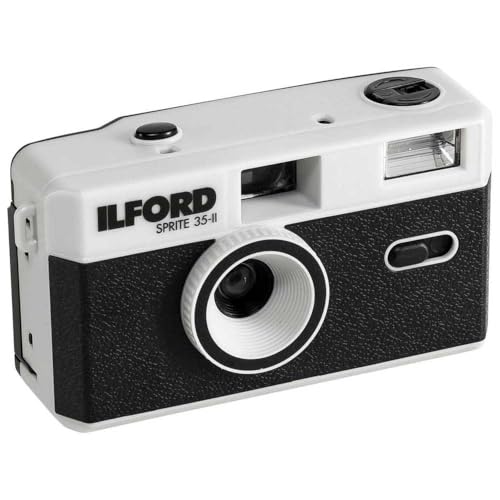
Ilford Sprite 35-II — Full-frame traditionalist
Ilford makes film — some of the most beloved black-and-white stock in history — and the Sprite 35-II exists to give that film an inexpensive, dependable vehicle. Its specification reads like nineteen-seventy in the best way: a 31mm fixed-focus lens at a modest aperture, a single shutter speed around a hundred-and-twentieth of a second, a built-in flash, and a wrist strap. Nothing digital, nothing rechargeable, nothing to update. For shooters drawn to film precisely because it refuses modern complexity, this stubborn simplicity is the attraction.
The wide-ish lens favors scenes over subjects: street corners, interiors, groups arranged in depth. Portraits at close range will distort noses and soften focus, so step back and let context in, which happens to be how documentary photographers have always worked. Paired with Ilford’s own black-and-white emulsions, the Sprite produces grainy, contrast-rich frames with a timelessness color snapshots rarely achieve. The shutter’s single speed demands film-speed awareness — choose a versatile four-hundred-speed stock and the camera copes from overcast streets to flash-lit rooms.
Reloadability is the quiet headline. Unlike the disposable cameras it superficially resembles, the Sprite opens, accepts another roll, and continues for years, paying back its modest price against disposables within a few cycles. Its flash needs batteries and its lens will never win a sharpness contest, but as an ambassador for traditional film practice — especially monochrome — it carries a credibility the fashion-led rivals cannot borrow. Beginners who suspect they will love black-and-white should start here and spend the savings on film and developing.
- Format: full-frame thirty-five millimeter reusable and reloadable body
- Lens: 31mm f/9 fixed-focus optic, single shutter speed near 1/120
- Flash: built-in unit for indoor and fill use
- Character: traditional simplicity from a historic film manufacturer
Strengths
- Reloadable design undercuts disposable cameras’ cost within several rolls.
- Wide lens and honest limitations teach scene-first composition naturally.
- Pairs beautifully with black-and-white film for a classic documentary look.
Trade-offs
- Slow lens and single shutter speed narrow the lighting it handles gracefully.
- Close portraits distort and soften; this is a scene camera, not a face camera.
- Flash-dependent indoors, with the harsh look that direct flash always brings.
Best for: monochrome romantics and traditionalists wanting the classic thirty-six frame ritual. Not suited for: low-light specialists or close-portrait enthusiasts.
Canon Sure Shot / AF35M (used only) — Vintage temptation, prose-only
Now for the siren. Canon’s original AF35M, sold as the Sure Shot in some markets, brought reliable autofocus to ordinary buyers at the turn of the nineteen-eighties, and its lens remains genuinely good — sharp, contrasty, and paired with metering that shames every new plastic camera in this guide. A healthy example produces negatives of startling quality. The catch lives in that word healthy: these cameras are around four decades old, their electronics were never designed for immortality, and no verified new listing exists, which is why this entry carries no purchase link.
Used-market risks deserve blunt enumeration. Light seals degrade into sticky foam that leaks light across negatives. Autofocus motors fail without warning or repair economics. Battery compartments corrode from cells forgotten since the last century, and sellers describing a camera as untested usually mean broken in a dialect of optimism. A film-tested example from a reputable dealer, with seals replaced and a return policy, costs more than the auction bargains — and is the only version of this purchase this guide endorses without reservation.
Buy well, though, and the rewards are real. Point the Canon at a dim café table and it focuses, meters, and delivers a frame the Kodaks would render as impressionist soup. That capability tempts many film-curious shoppers into vintage-first purchases, and for the mechanically sympathetic it can work beautifully. Everyone else should hear the actuarial truth: a new plastic camera with a warranty will photograph next year’s birthday, while a forty-year-old electronic compact might photograph nothing ever again, starting tomorrow, without appeal. Choose with your eyes open and your expectations priced accordingly.
- Format: full-frame thirty-five millimeter autofocus compact, circa turn of the eighties
- Availability: secondhand only; no verified listing, hence prose-only treatment
- Camera character: sharp lens and real metering far beyond new budget rivals
- Risk profile: seals, motors, corrosion, and absent warranties define ownership
Strengths
- Genuine autofocus and metering deliver image quality newcomers cannot match.
- Historic build feels substantial and satisfying beside featherweight plastics.
- Film-tested dealer examples can serve reliably for years of casual shooting.
Trade-offs
- Age-related failures arrive suddenly and are rarely economical to repair.
- Untested auction purchases are gambling, however romantic the listing photos.
- No warranty, no returns culture, and no manufacturer support remain available.
Best for: tinker-minded shooters buying a film-tested example from a trustworthy dealer. Not suited for: anyone needing a guaranteed camera for an unrepeatable event.
How Do the Six Stack Up Against Each Other?
| Camera | Defining trait | Principal caution |
|---|---|---|
| Pentax 17 | Engineered half-frame quality with real controls | Costs multiples of the plastic alternatives |
| Kodak Ektar H35 | Seventy-two frames of featherweight freedom | Close subjects soften beyond rescue |
| Kodak EC35 | Sliding lens cover on a friendly full-frame body | No controls to grow into |
| Kodak Snapic A1 | Two focus zones for social distances | Wrong-zone frames while learning |
| Ilford Sprite 35-II | Traditional full-frame simplicity, monochrome soul | Slow lens limits dim venues |
| Canon Sure Shot (used) | Autofocus quality from film’s golden age | Four decades of mechanical mortality |
The table’s deeper lesson concerns where each camera spends its compromises. New budget bodies sacrifice optics to buy reliability and price. The Pentax sacrifices price to buy nearly everything else. The vintage Canon sacrifices reliability itself, the one currency beginners can least afford to spend, in exchange for optical excellence. Ranked by expected photographs successfully captured per dollar across a year, the half-frame economy machines look startlingly strong, because film and developing — not hardware — dominate the annual budget of anyone who shoots regularly.
What Should a First-Time Film Buyer Know About Running Costs?
Do the arithmetic before the romance hardens. A roll of color film, professional developing, and decent scans together cost enough that a summer of weekly shooting funds a respectable digital compact. Half-frame cameras halve the per-frame portion of that bill, which is why two of them anchor this guide. Black-and-white film developed at home cuts costs further and adds a darkroom hobby some shooters end up loving more than photography itself; the Sprite exists partly to feed that path.
Lab choice shapes results as much as camera choice. A careful lab’s scans reveal what your negatives actually hold, while a careless one adds dust, strange color casts, and crushed shadows you will wrongly blame on the camera. Mail-order labs with strong reputations serve most regions well. Always request your negatives back — they are the originals, the only version of your photographs that can be rescanned by future technology at future quality. A shoebox of negatives is an archive; a folder of low-resolution scans is a rumor of one.
Which Mistakes Ruin Beginners’ First Rolls?
Opening the camera back mid-roll to check whether film is inside ranks first in destructive curiosity; light fogs the exposed frames instantly. Second comes loading carelessly so the leader never catches, producing a perfectly wound, entirely blank roll and a lab bill for developing nothing. Load in subdued light, confirm the rewind knob turns as you advance, and the ritual becomes automatic by the third roll.
Flash discipline causes the next wave of disappointment. These small flashes reach a few meters, not across a concert hall, and firing them at distant stages only illuminates the heads in front of you. Conversely, forgetting flash indoors yields orange blur. Fingers over lenses, straps dangling across frames, and photographing through dirty car windows complete the beginner’s bingo card. Film’s mercy is that these lessons arrive permanently recorded, which is why one cheap roll shot deliberately as practice — near, far, flash, no flash — teaches more than a month of forum reading.
How Do You Load, Shoot, and Finish a Roll Well?
Load somewhere shaded, seat the cassette, pull the leader to the marked sprocket, close the back, and advance until the counter shows the first frame. Photograph something unimportant immediately; if the film is misloaded, better to learn it at home than at a wedding. While shooting, keep the sun roughly behind you for beginners’ color work, move closer than feels natural, and note that these wide lenses reward bold proximity. Wind gently after each frame rather than discovering a half-advanced negative later.
When the roll ends, rewind fully before opening anything, then store the canister somewhere cool while you choose a lab. Ask for scans sized generously enough to print from, and review the results with a notebook: which distances worked, where flash fell short, how the light behaved. That review habit converts each roll into tuition for the next, and it is the single practice separating photographers who improve on film from those who merely accumulate grainy evidence. Within three rolls, your keeper rate will climb visibly.
Why Does Half-Frame Keep Winning Converts?
Because it attacks film’s only structural problem — cost per frame — without surrendering film’s texture. Vertical native orientation matches how photographs are consumed now, the modest grain increase bothers almost nobody outside pixel-peeping forums, and seventy-two frames change psychology: you stop rationing and start experimenting, which is when film gets fun. Portrait pairs shot side by side even develop into diptychs, an accidental art form the format’s community celebrates. For social documentation in this decade, half-frame is not a compromise but arguably the native format.
Which Film Stock Should You Feed These Cameras?
Film choice steers results more than the differences among the plastic bodies themselves, so spend thought here. A four-hundred-speed color stock is the universal donor: fast enough for overcast days and flash-assisted evenings, grain fine enough for enlargements, and tolerant of the exposure guesses these simple cameras make. Beginners who standardize on one emulsion for their first five rolls learn its personality — how it renders reds at parties, how greens behave in parks — instead of blaming a rotating cast of films for their own developing technique.
Eight-hundred-speed stocks extend these cameras into genuinely dim territory, letting the Sprite and EC35 photograph pub interiors without flash’s flattening blast, at the cost of chunkier grain and pricier rolls. One-hundred-speed films run the other direction: glorious in bright sun with fine grain and saturated color, hopeless once clouds gather over a camera with a slow fixed lens. Half-frame shooters should remember their smaller negatives magnify grain, making super-fast stocks look gritty sooner; the Pentax’s better lens earns back some of that ground through sheer sharpness.
Black-and-white deserves a dedicated experiment regardless of your color habits. Monochrome forgives the weird mixed lighting of kitchens and bars, because there is no color cast to forgive, and it converts these toy lenses’ softness into atmosphere. A contrast-rich emulsion through the Sprite produces frames that look deliberately archival rather than accidentally cheap. If a local lab develops monochrome slowly or expensively, home developing with a changing bag and a tank is a weekend skill that permanently cuts your running costs, and many shooters discover the ritual is half the hobby’s pleasure.
What Happens After the Lab — Scanning, Sharing, and Printing?
Most beginners meet their film first as scans, and scan quality silently defines whether they fall in love. Ask what resolution the lab delivers and whether files arrive as flexible TIFFs or only compressed JPEGs; for half-frame especially, generous scans preserve the format’s viability. Review every frame before posting any, because film’s delayed feedback loop means your mistakes and miracles arrive in the same envelope, and the discipline of editing ruthlessly — choosing twelve frames from seventy-two — is where a personal style actually forms.
Printing remains film’s home turf. A modest enlargement from a full-frame negative holds together beautifully, and even half-frame prints satisfy at the sizes people actually frame. Choose one favorite frame per roll and print it physically; the habit builds an archive that no platform bankruptcy can delete and teaches you, roll by roll, what your camera and film combination truly resolve. Many shooters find a printed contact sheet — every frame, tiny, in sequence — the most honest teacher of all, exposing habits of distance and timing that individual hero shots conceal.
Archiving digitally still matters as backup. Name folders by date and camera, keep the lab’s original scans untouched in one directory, and edit copies rather than originals. Note the film stock on a simple text file beside the scans, because in five years you will not remember which emulsion produced that beloved look, and your future self will want to buy it again. These unglamorous habits are the difference between a passing film fling and a body of work.
How Do These Cameras Behave at Parties, Weddings, and on Trips?
At parties, direct flash from a small film camera has become a visual dialect of its own: bright faces, dark backgrounds, zero computational smoothing. The H35 and EC35 speak it fluently and cheaply, which is why they appear on so many reception tables. If you deploy one as a guest camera, tape a simple instruction card to its back — advance after each shot, flash on indoors — and accept that a third of the roll will be ceilings and thumbs. The keepers will be worth it, and the couple will treasure drunken film candids differently from the professional’s polished gallery.
Weddings as a primary photographer are where this category must not go. No backup body, no instant review, no autofocus reliability under pressure: the vintage Canon tempts fate, the toys invite disaster. As a second personal camera for your own memories of a friend’s day, though, any of them adds texture the official album lacks. Keep expectations in that lane and nobody’s once-in-a-lifetime documentation depends on a plastic shutter.
Travel favors the light and the cheap-to-lose. A camera whose theft or drowning would ruin a day rather than a year changes how freely you shoot in markets, boats, and festivals. Film also crosses borders with one caveat: airport scanners, especially newer CT machines, can fog unprocessed rolls, so carry film in hand luggage and request hand inspection where offered. Develop abroad only when time is long and labs are reputable; otherwise bring the exposed canisters home like eggs. The Pentax suits the deliberate travel photographer documenting a journey as a project, while the Kodaks serve the traveler who wants film’s flavor without film’s homework.
How Do You Buy a Vintage Film Compact Without Getting Burned?
Start by deciding that untested is a synonym for broken and pricing your offers accordingly. The trustworthy purchase describes a specific test: a roll actually shot, the negatives examined, seals inspected or replaced, the flash fired, the lens checked for fungus under a torch. Sellers who performed that work say so proudly and charge for it. Sellers who hide behind estate-sale poetry are asking you to fund their uncertainty, and the correct response is a price that assumes a paperweight, or a polite walk away.
When the camera arrives, your own ritual begins before film gets involved. Fit fresh batteries and listen: healthy motors sound purposeful, dying ones grind or hesitate. Shine a light through the lens from behind and look for the web-like traces of fungus or the haze of separated elements, both of which soften every frame permanently. Open the back and inspect the seal channels; crumbling black foam must be replaced before light leaks tattoo your negatives. Fire the shutter at a bright window and a dim corner to hear whether speeds vary as they should.
Then shoot a sacrificial roll quickly and develop it fast, while returns remain possible. Photograph a bookshelf for sharpness, a friend at conversational distance for focus accuracy, a bright sky for light leaks, and a dim room with flash for exposure sanity. If that test roll comes back clean, you own a small miracle of surviving engineering. If it does not, you have evidence for a return rather than a shelf ornament and a grievance. This protocol, followed without exception, is the entire difference between vintage delight and vintage regret.
What Accessories and Care Do Reusable Film Cameras Actually Need?
Very little, which is part of their charm, but a few small things protect the investment. A soft pouch prevents the pocket scratches that the EC35’s cover was invented to avoid. Spare batteries belong in the same bag as spare film, because a dead flash battery at a party converts your camera into a daylight-only device mid-evening. A microfiber cloth, used weekly on the lens with breath moisture and patience, prevents the gradual haze that owners misdiagnose as a bad lens or bad lab.
Storage between outings matters more than handling during them. Keep cameras out of hot cars and damp bathrooms; heat ages film and electronics, while humidity invites the fungus that etches lens glass permanently. Silica gel sachets in the drawer where the camera lives cost almost nothing and quietly prevent the most irreversible damage in this entire hobby. If a camera will sit unused for months, remove its batteries, because leaking cells corrode compartments in the dark, unwitnessed, and a corroded contact can end an otherwise healthy vintage body.
Resist the accessory spiral beyond that. Straps that cost more than the camera, artisanal leather half-cases for plastic bodies, and filter systems for fixed-focus lenses all mistake the genre. These cameras exist to be carried carelessly and used constantly. Spend the money on film, developing, and one printed enlargement of the best frame you have made so far — the wall, not the shelf, is where this hobby keeps its trophies.
What Should Your First Three Rolls Teach You?
Treat roll one as tuition and shoot it within a single week, mixing bright exteriors, shaded portraits, one indoor flash session, and a few deliberate close attempts so the developed envelope maps your camera’s comfort zones precisely. Resist judging film by this roll’s disasters; judge it by whether two or three frames delight you in a way your phone’s output does not. Roll two then applies the map: stay inside the distances and light that worked, and watch the keeper rate climb in a way that feels almost unfair.
By roll three, introduce one controlled experiment — a different film stock, a monochrome conversion of your habits, or a themed walk where every frame must contain a chosen color. Cameras this simple reward constraints because they have so few settings to vary; the photographer’s eye becomes the only adjustable component, and it improves startlingly fast under that pressure. Keep brief notes on the envelope each roll returns in. Within a season you will own not just photographs but a documented education, and the camera that taught you will have opinions in your hands that no review could have given you.
Is Reusable Film Actually Kinder to the Planet Than Disposables?
Mostly yes, with honest caveats. A reusable body shot for years replaces dozens of single-use plastic shells landfilled after one roll, and that arithmetic is not close. Film itself still carries chemical and packaging footprints, and developing uses chemistry that responsible labs handle and dispose of properly, which is another argument for reputable labs over cut-price mysteries. The greenest camera, as always, is the one already owned and actually used, so the sustainable choice is buying one reusable body you will keep rather than sampling every model in this guide. If the hobby fades, pass the camera to a friend instead of drawer-exiling it; these little machines can start several people’s film journeys in sequence, and frequently do.
Which of These Makes the Right Gift, and for Whom?
Film cameras have become a staple gift for teenagers and students precisely because they invert the phone’s logic, and matching model to recipient prevents the gift from becoming drawer clutter. For the aesthetically driven niece who will photograph friends constantly, the Ektar H35 in a pretty finish plus two rolls of color film and a prepaid developing voucher forms a complete, thoughtful package — never give a film camera naked, because the first roll and its lab bill are where enthusiasm either ignites or stalls. For the methodical nephew who reads manuals for fun, the Pentax 17 respects his temperament and will still be serving him at graduation.
Adult recipients split differently. A parent who shot film in their youth often prefers the Sprite’s traditional ritual or, if you can source a tested one, the vintage Canon that resembles what they once owned — though the warranty-free gamble should be yours to absorb, not theirs, so buy from a dealer and test it yourself first. For a partner, the Snapic’s near-focus competence suits the way couples actually photograph each other across café tables. In every case, include film. A camera without its consumable is a sculpture, and the giver who includes the first rolls also buys the first envelope of results, which is where the gift truly lands.
One caution applies to all gifting here: do not give film to someone facing an unrepeatable event as their only camera. A honeymoon deserves a reliable digital companion alongside the film experiment. Positioned as a second, playful instrument, any of these bodies adds joy without risk, and the photographs they produce — flawed, warm, unrepeatable — often become the trip’s most-loved artifacts precisely because nobody could review and retake them into blandness.
A Note on Patience, Expectation, and the Envelope Moment
Every film photographer remembers the first envelope. Days after finishing a roll, the scans land in your inbox or the prints slide across a counter, and photographs you had half-forgotten taking return with the force of small time travel. That delay, so foreign to phone habits, is not a defect to tolerate but the category’s central pleasure, and it explains why cameras this technically modest inspire such loyalty. You cannot chimp, cannot delete, cannot filter in the moment; you can only have been there, attentive, when the shutter fired.
Manage your expectations to protect that pleasure. Some frames will fail. Light will leak occasionally, a focus zone will be wrong, a blink will coincide cruelly. Across a roll, though, the successes carry a density of memory that a hundred reviewed-and-retaken phone frames rarely match, because scarcity forced intention. Buyers who accept that bargain upfront almost always stay in the hobby. Buyers promised perfection by nostalgia marketing almost always leave after two rolls, blaming cameras that were only ever honest about what they were.
What Separates a Toy From a Tool in This Category?
Honesty of intent. A toy promises nothing beyond fun and delivers it reliably; a tool promises capability and must be judged when it fails to deliver. The Kodaks and the Sprite are excellent toys that occasionally produce art, while the Pentax is a tool that tolerates play. Confusing those contracts causes most dissatisfaction in this market — buyers demanding tool results from toy budgets, or tool-serious shooters sneering at toys that were never pretending. Read each entry above against its own contract and the ranking rearranges itself around your temperament, which is exactly how a purchase this personal should be made.
Final Recommendation
Beginners unsure of their commitment should start with the Ektar H35, whose economy forgives experimentation, or the Snapic A1 if most subjects will be friends at arm’s length plus a step. Traditionalists and monochrome dreamers belong with the Sprite. The EC35 suits anyone whose camera will live unprotected in bags and pockets. Graduates certain that film is a lasting love should skip the toys entirely and buy the Pentax 17, the only camera here engineered to be a life’s companion. The vintage Canon waits for gamblers with good dealers. Whichever body lands in your hands, load it this week and finish the roll quickly — film rewards momentum, and your first developed envelope, however flawed, will teach you more than another month of comparison shopping ever could.
Frequently Asked Questions
Is film for these cameras still easy to buy?
Yes. Standard thirty-five millimeter color and black-and-white stocks remain in regular production from several manufacturers and are sold by photo shops and online retailers widely. Specialty emulsions come and go, but a versatile four-hundred-speed color or monochrome roll — the sensible default for every camera here — is reliably available. Expired film sold at a discount is a creative gamble rather than a saving for beginners, since its color shifts and sensitivity loss will muddy the lessons your first rolls are supposed to teach.
Do these cameras work in winter and at the beach?
Within reason. Cold drains batteries and stiffens film, so keep the camera inside a coat between shots in serious winter, while sand and salt spray threaten any mechanism, making the cheapest body in your bag the wisest beach companion. None of these cameras is weather-sealed, so a plastic bag during downpours is not paranoia but standard film-shooter practice.
What does half-frame actually mean for my photos?
Each exposure uses half the usual negative area, recording a vertical image and doubling a roll’s capacity to as many as seventy-two frames. Prints at modest sizes look perfectly good, with somewhat more visible grain in large enlargements. Labs handle the format routinely, though mentioning it when you drop film off avoids paired-scan confusion.
Can these cameras really not focus at all?
Most rely on depth of field: a small aperture keeps everything beyond a meter or two acceptably sharp. That is why group photos and street scenes succeed while close portraits soften. The Snapic’s two zones and the Pentax’s fuller zone range exist precisely to push that near boundary closer, and genuine autofocus belongs to the vintage Canon alone here.
Should I buy the vintage Canon instead of a new Kodak?
Only if you can buy a film-tested example with replaced seals from a seller accepting returns, and only if a sudden failure would amuse rather than devastate you. For a first film camera meant to simply work at birthdays and trips, the new cameras’ warranties and predictability are worth more than the Canon’s superior lens.
How long does developing usually take?
Local labs with in-house processing often return scans within a few days, while mail-order services add shipping time in both directions and may take a week or more during busy seasons. Black-and-white frequently runs slower than color at general labs. Build that delay into event plans: film shot at a Saturday party will not illustrate Sunday’s social post, and accepting that rhythm is part of the format’s charm rather than a service failure.
Can I take these cameras through airport security?
Yes, with care. Carry unprocessed film in hand luggage, since checked-baggage scanners are stronger, and politely request a hand inspection where the airport offers one, particularly for high-speed stocks and where newer CT scanners are installed. The cameras themselves pass through security like any small electronic-free device; the film inside them deserves the same hand-check request, so finish or remove a roll before flying if the images matter deeply.
How should I store film and finished negatives?
Keep unshot film cool and dry, refrigerated if you hoard it, and let it warm before loading to avoid condensation. Store processed negatives in archival sleeves away from heat and light, and scan them at good resolution as a second copy. Treated that way, negatives outlive every digital storage format yet invented.
Related Guides
One closing practicality: whatever body you choose, buy two rolls of the same film with it, shoot the first within days while your enthusiasm is warm, and send it to a lab whose sample scans you have actually examined. Momentum matters more in film than in any other branch of photography, because the feedback that sustains the habit only arrives after a roll is finished, developed, and returned to you. Shoppers weighing film against instant gratification should read our comparison of instant cameras for parties, anyone seduced by the vintage route can continue with the guide to buying used film gear safely, and digital holdouts may prefer our favorite compact cameras that mimic film color for a different route to a similar look.


