What's inside
- Where to buy
- Key Takeaways
- Quick Picks
- How We Chose These Picks
- What Should You Check Before Mounting a TV on a Boat?
- Which of These Six Belongs in Which Part of the Boat?
- How Do You Keep a Boat TV Alive Season After Season?
- What Mistakes Do Boat Owners Make When Choosing a TV?
- How Much Power Will a Boat TV Actually Use?
- What About Sound, Light and Life Below Deck?
- Which Connectivity Still Works When the Marina Network Does Not?
- How Do You Read a Boat TV Listing Without Being Fooled?
- What Does a Proper Boat TV Installation Day Look Like?
- Which Boats Suit Which Approach Entirely?
- What Should You Budget Beyond the Television Itself?
- How Do the Small Screens Handle Real Cabin Content?
- What Changes on a 24-Volt or Metal Boat?
- A Last Word on Antennas and Broadcast TV Aboard
- Final Recommendation
- Frequently Asked Questions
- Related Guides
As an Amazon Associate I earn from qualifying purchases. This post may contain affiliate links at no extra cost to you.
gizmoverdict.com is reader-supported. When you buy through links on our site, we may earn an affiliate commission.
Where to buy
Every television in this guide is sold through Amazon in the United States, and the product pages there are the place to confirm the exact power leads, mounting hardware and warranty terms bundled with each set before you commit. Boat gear has a habit of arriving with the wrong cable for your panel, so check the listing against your boat’s electrical layout first.
Shopping for the best tvs for boats is a different exercise from shopping for a living room. A cabin is not a lounge: the screen lives a few feet from the viewer’s eyes, the boat’s batteries sag and surge as engines start and chargers cycle, condensation finds its way into lockers that felt dry in July, and everything aboard earns its place by surviving vibration that would rattle a domestic set’s stand loose in a single choppy crossing. A television that ignores those realities is not a bargain at any price; it is ballast with a remote control.
That is why this guide is built around three questions that landlubber roundups never ask. First, can the set run happily on the boat’s own DC supply, ideally across a wide voltage window so a flattening battery bank does not take the picture down with it? Second, how does it cope with damp air, spray near a companionway, and the fine salt film that coats everything within a season? Third, does it actually fit — in a 24-inch world of bulkhead corners, hanging lockers and galley shelves, screen size is a negotiation with the joinery, not a bragging right. The six sets below answer those questions in six different ways, from a waterproof mirror television for the heads compartment to a 43-inch weatherproof panel for a flybridge.
One honesty note before the picks. None of the manufacturers here claims a formal marine certification in the listings we checked, and we are not going to invent one. What the titles do state — wide-voltage DC inputs, an IP66 waterproof rating on one model, a weatherproof outdoor build on another — is what we judge them on. A set described as suitable for RVs, trucks and boats is being sold for mobile DC life, which is a meaningful claim, but it is not the same thing as a salt-spray test certificate, and your installation still needs sensible fusing, ventilation and mounting wherever the set lives.
Key Takeaways
- The SYLVOX 24-inch RV television takes the top spot because its 9–32V wide-voltage Google TV design was plainly drawn up for vehicles and hulls first, living rooms second.
- For a heads compartment or a steamy galley, the SYLVOX waterproof mirror set is the only pick here carrying an IP66 rating and an anti-fog screen in its listing.
- The Furrion Aurora 43-inch is the step-up for exposed cockpit and flybridge mounting, with a weatherproof build and a 750-nit panel the small cabin sets cannot match.
- Offline entertainment matters offshore: the SYLVOX 24-inch with a built-in DVD player keeps films running when there is no signal, no marina Wi-Fi and no patience left.
- Harbour-side streamers on a tight budget should look at the Westinghouse 24-inch Roku set, while the Supersonic SC-2420VTV adds a DC car cord in the box for simple AC/DC swapping.
- Power discipline decides everything aboard: a 24-inch DC-native set sipping from the house bank will outlast a big AC panel fed through an inverter on almost any cruising boat.
Quick Picks
| Pick | Badge | Why it is here |
|---|---|---|
| SYLVOX 24″ RV TV (12/24V) | Best Overall | A wide-voltage Google smart TV that treats a boat’s DC system as home turf rather than an afterthought. |
| SYLVOX 24″ Waterproof TV | Best Waterproof | An IP66 mirror television with anti-fog coating, made for the dampest corners of any vessel. |
| Furrion Aurora 43″ Partial Sun | Best Outdoor Step-Up | A weatherproof 4K panel with serious brightness for cockpits and flybridges that smaller sets cannot serve. |
| SYLVOX 24″ TV with DVD | Best with DVD | Disc playback, an ATSC tuner and wide-voltage power for anchorages where streaming simply gives up. |
| Westinghouse 24″ Roku TV | Best Smart Value | Roku streaming, AirPlay and voice-assistant support in a compact set priced for modest cabins. |
| Supersonic SC-2420VTV 24″ | Best AC/DC Smart | A VIDAA smart TV shipping with its DC car cord included, so moving between shore power and battery is painless. |
How We Chose These Picks
We started from the electrical system outward, because that is where boat installations fail. Any set that could not run from DC power, or at least tolerate the voltage swings of a working boat, had to justify itself some other way — the Furrion earns its place as an outdoor panel rather than a DC native, and it is framed that way in its review. Sets with a stated 9–32V input window scored highest, since that range shrugs off both a battery bank sagging under load and the higher voltage of a charging alternator.
Next came the environment. A television below deck lives with cooking steam, shower humidity and the occasional drip through a hatch that was not dogged down quite hard enough. We favoured sealed or waterproof designs for wet zones, ordinary sets only for genuinely dry cabins, and we were careful never to blur that line in the reviews. Screen size was judged against real cabins: 24 inches suits most saloons and staterooms under about forty feet, while the 43-inch Furrion only makes sense where the boat itself provides an outdoor viewing space big enough to deserve it.
Finally, we weighed how each set entertains when the outside world drops away. Offshore, a tuner and a disc drive can matter more than a smart platform; in a marina with decent Wi-Fi, the smart platform is the whole point. The six picks deliberately span that spectrum so the right answer depends on how you actually cruise, not on which specification shouts loudest.
What Should You Check Before Mounting a TV on a Boat?
Measure the bulkhead, then measure it again with the mount’s swing in mind. A tilting bracket on a boat is a liability in a seaway unless it locks; fixed or locking mounts are the sensible default, and the television should be secured so a wake crossing cannot turn it into a pendulum. Leave ventilation space behind the panel — electronics sealed into an airless locker cook themselves slowly, and heat is as real an enemy aboard as water.
Plan the power run before the screen goes up. A DC set wants its own fused circuit from the distribution panel, sized for the cable length, not a borrowed feed from the cabin lights. If you are running an AC set through an inverter, count the inverter’s own losses in your battery budget and remember that the set will draw whenever the inverter is live, even on standby in some installations. A simple switch you can reach beats a buried setting you cannot.
Think about glare and viewing angles from the actual seats. Saloon settees sit low and close; a screen mounted for standing eye level in the galley will look washed out from the settee. Sit where you will watch, hold a piece of card the size of the screen where it would hang, and check the reflections from ports and hatches at the time of day you actually watch. Ten minutes with cardboard saves a season of squinting.

SYLVOX 24″ RV TV (12/24V) — Best Overall
This is the set we would bolt into most cabins first, because its listing reads like it was written by someone who has actually lived on DC power. The headline figure is the 9–32V wide-voltage input: that window covers a 12V bank running low, a 24V system, and the voltage lift that arrives when the engine or a charger is pushing current back in. On a boat, that tolerance is not a footnote — it is the difference between a television that rides through an engine start and one that reboots every time the starter motor turns.
The smart side is Google TV with a built-in app store, Wi-Fi and Bluetooth, so in a marina you stream the way you would at home, and Bluetooth lets a single viewer use headphones while the rest of the cabin sleeps — a genuinely civilised feature in a space where the bed is four feet from the screen. The panel is 1080p Full HD, which at 24 inches and typical cabin viewing distances looks properly sharp; nobody sits eight feet from a bulkhead set in a saloon. HDMI and USB ports cover a laptop, a games console or a drive full of downloaded films for the passages where the marina network is a rumour.
- Screen: 24-inch, 1080p Full HD
- Power: 12/24V DC, 9–32V wide-voltage tolerance
- Platform: Google Smart TV with built-in app store
- Connections: Wi-Fi, Bluetooth, HDMI, USB
- Positioning per listing: RVs, campers, trucks and home use
Strengths
- The 9–32V input window swallows battery sag and charging surges that upset fussier electronics.
- Google TV plus Bluetooth headphone support suits close-quarters evening viewing unusually well.
- Full HD at this size keeps text, charts apps and films crisp from settee distance.
Trade-offs
- It carries no waterproof rating in its listing, so it belongs in a dry cabin, not a steamy heads.
- Smart features lean on marina Wi-Fi or a phone hotspot; offshore it is only as good as your downloads.
- The 24-inch screen will feel small in the saloon of a genuinely large yacht.
Best for: cruising couples fitting out a saloon or master cabin who want one set that streams in harbour and behaves on the house bank. Not suited for: exposed cockpit mounting, where spray and direct weather demand a purpose-built outdoor panel instead.
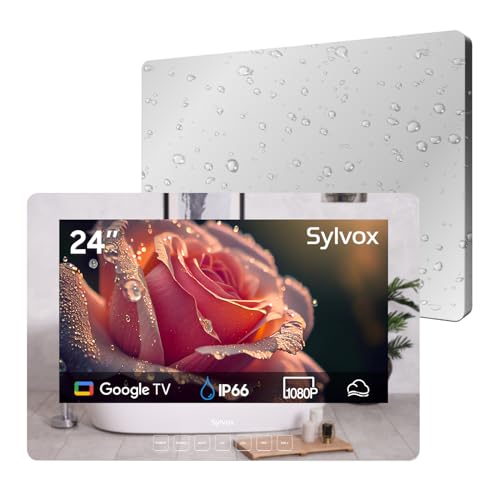
SYLVOX 24″ Waterproof TV — Best Waterproof
Some corners of a boat are simply wet, and pretending otherwise ruins televisions. This SYLVOX is built for those corners: the listing states an IP66 waterproof rating, an anti-fog screen and a magic-mirror design that sits on the wall of a bathroom like a mirror until the picture wakes it. On a boat, that translates to the heads compartment, a shower-adjacent cabin, or a galley bulkhead that takes steam and splashes every single day.
The specification around the waterproofing is respectable rather than token. It is a 1080p smart set with a built-in app store and voice assistant, and the listing calls out bass-boosted sound, which matters in a tiled heads where small speakers usually turn thin and splashy. The mirror format also solves a space problem: in the smallest room aboard, a screen that doubles as the mirror earns its bulkhead in a way a second, separate object never could. We would still mount it thoughtfully — IP66 shrugs off jets of water, but no rating excuses pointing a deck-wash hose at the seals for fun.
- Screen: 24-inch, 1080p
- Protection: IP66 waterproof rating, anti-fog screen
- Design: magic-mirror, on-wall model
- Platform: smart TV with built-in app store and voice assistant
- Audio note: bass boost called out in the listing
Strengths
- The IP66 rating is the strongest water protection claimed by any pick in this guide.
- Anti-fog treatment keeps the picture usable after a shower, not twenty minutes later.
- The mirror format genuinely saves space in a heads compartment.
Trade-offs
- Its listing frames it around bathroom installation, so the power arrangement needs checking against your boat’s wiring plan.
- A mirror-finish screen can reflect cabin lights more than a matte panel in bright spaces.
- It is a specialist set; as a main saloon television the generalist SYLVOX above is the better buy.
Best for: owners who want television in a heads or shower cabin and refuse to gamble on an ordinary set surviving the steam. Not suited for: a main saloon where a mirror finish and bathroom-first design solve problems the room does not have.

Furrion Aurora 43″ Partial Sun — Best Outdoor Step-Up
The Furrion plays a different sport from the other five. It is a 43-inch 4K outdoor television, weatherproof by design, with a 750-nit LED screen, an impact-resistant XtremeShield front and external antennas intended to stretch Wi-Fi range. On the right boat — a trawler with a covered flybridge, a catamaran with a proper cockpit lounge, a houseboat that lives at anchor in company — it turns an outdoor space into the best seat aboard for a match, a film night or the evening news with a view behind it.
Context matters, so let us be plain about the framing. This is an outdoor television from a brand rooted in RV and marine-adjacent leisure vehicles, and its listing sells weatherproofing rather than DC flexibility; plan on a proper AC supply, shore power or a sensibly sized inverter, and a mount built for a panel of this size and weight. The partial-sun designation is also a real limit: it is made for shaded or partly shaded outdoor spots, not for staring into a midday anchorage glare. Given the right shaded corner, though, 750 nits and 4K at 43 inches is a combination no 24-inch cabin set can imitate.
- Screen: 43-inch, 4K LED, 750-nit brightness
- Build: weatherproof outdoor television, impact-resistant screen
- Connectivity: external Wi-Fi-boosting antennas per the listing
- Rating note: designed for partial-sun outdoor placement
- Power planning: treat as an AC installation
Strengths
- Weatherproof construction answers the spray and damp questions the cabin sets cannot.
- Brightness and size make outdoor group viewing a real event rather than a huddle.
- The impact-resistant screen suits a space where gear, elbows and boat hooks move around.
Trade-offs
- It is far too large and power-hungry for the saloon of a typical cruising yacht.
- Partial-sun design still loses to truly direct, unshaded sunlight.
- Installation is a project — mount, power and weather sealing all need doing properly.
Best for: larger boats with a shaded flybridge or cockpit lounge that hosts group viewing. Not suited for: small sailing yachts, where its size, weight and AC appetite fight the boat at every turn.

SYLVOX 24″ TV with DVD — Best with DVD
There is a particular silence that falls over an anchorage when the streaming spinner gives up. This SYLVOX is the insurance policy against it: a 24-inch 1080p set with a DVD player built in, an integrated ATSC tuner for over-the-air broadcasts near shore, FM radio, and the same 9–32V wide-voltage, DC/AC power flexibility that makes its sibling our top pick. A shelf of discs aboard is unfashionable and completely reliable, and on the third rainy night at anchor, reliable wins.
It is deliberately non-smart, and we count that as a feature in this context rather than a gap. There is nothing to update, no account to sign into, no interface arguing with a weak hotspot; you put a disc in or tune a channel and watch. HDMI, USB and AV inputs still leave the door open to a streaming stick in marinas that have the bandwidth for one. For boats that cruise beyond reliable data — which is most cruising boats, most of the time — this is arguably the most honest television in the guide.
- Screen: 24-inch, 1080p flat screen
- Playback: built-in DVD player, FM radio
- Tuner: integrated ATSC for over-the-air broadcasts
- Power: 9–32V wide voltage, DC/AC
- Connections: HDMI, USB, AV
Strengths
- Discs and broadcast TV keep working with no network at all.
- Wide-voltage DC running matches the electrical reality of a cruising boat.
- The non-smart interface is instant, simple and guest-proof.
Trade-offs
- Streaming requires adding your own stick or box through HDMI.
- DVD is standard definition’s home format; film fans chasing 4K should look elsewhere.
- The disc mechanism is one more moving part to keep dry and clean.
Best for: long-distance cruisers and liveaboards who spend real time beyond marina Wi-Fi. Not suited for: harbour-based boats whose viewing is entirely app-based and who would never feed it a disc.

Westinghouse 24″ Roku TV — Best Smart Value
Not every boat television needs to survive a circumnavigation. For a weekend boat, a small cruiser that lives in a marina, or a second set in a guest cabin, the Westinghouse Roku set covers the essentials with the friendliest streaming platform in the business. Roku’s interface is the one non-technical guests already understand, and the listing adds Apple AirPlay plus compatibility with Alexa and Google Assistant, so phones can throw content to the screen without a tutorial.
The panel is HD rather than Full HD, and at 24 inches viewed from a settee that difference is smaller than the spec sheet suggests — streaming services themselves often serve modest bitrates to small screens. Dolby Audio is on board, Wi-Fi is built in, and the mobile app gives you a second remote when the first one slides into the bilge-adjacent void behind the cushions, as remotes aboard boats reliably do. One planning note: unlike the SYLVOX sets, this is a conventional AC television in its listing, so a boat without an inverter should treat it as a shore-power set or budget for the conversion losses.
- Screen: 24-inch, HD flat screen
- Platform: Roku TV with mobile app control
- Casting: Apple AirPlay; works with Alexa and Google Assistant
- Audio: Dolby Audio
- Power planning: standard AC set — check inverter or shore-power arrangements
Strengths
- Roku is the easiest platform for guests and family to drive unaided.
- AirPlay support makes phones aboard into instant content sources.
- Value pricing leaves budget for the mount, cables and installation that boats always demand.
Trade-offs
- HD resolution trails the Full HD SYLVOX sets on paper.
- No wide-voltage DC claim in the listing, so off-grid power needs extra hardware.
- No waterproofing or outdoor claims — a dry cabin set, full stop.
Best for: marina-based boats and second-cabin installs where streaming is the whole job. Not suited for: off-grid anchorages, where its AC power needs and network dependence both bite at once.

Supersonic SC-2420VTV 24″ — Best AC/DC Smart
The Supersonic splits the difference between the two camps in this guide. It is a 24-inch smart television — VIDAA platform, Wi-Fi, built-in speakers — that runs on AC or DC, and its listing specifically names boats among its intended homes and includes the DC car cord in the box. That included cord is a small thing that signals a big one: the manufacturer expects this set to move between shore power and battery without the owner hunting down a compatible lead.
Picture resolution is 1080p, connectivity is generous with USB and three HDMI ports including ARC — ARC is quietly useful aboard, because it lets a compact soundbar or the boat’s audio system carry the sound through the TV remote’s volume buttons instead of a second controller. For a saloon that doubles as the entertainment centre, three HDMI sockets also end the cable-swapping ritual when a console, a laptop and a streaming stick all come aboard for the weekend. It lacks the SYLVOX’s stated 9–32V window in its listing, so we frame its DC tolerance more cautiously, but as a flexible, fully featured cabin set it earns its place.
- Screen: 24-inch, 1080p LED
- Power: AC/DC, DC car cord included in the box
- Platform: smart TV powered by VIDAA, Wi-Fi built in
- Connections: USB, 3x HDMI with ARC
- Intended homes per listing: kitchen, RV, boat, truck, dorm and more
Strengths
- The bundled DC cord makes battery running a day-one feature, not an accessory hunt.
- Three HDMI ports with ARC is the richest socket count among the small sets here.
- Full HD resolution matches the best cabin picks in this guide.
Trade-offs
- The listing does not state a wide-voltage range, so charging surges deserve a regulated supply.
- VIDAA’s app catalogue is smaller than Google TV’s or Roku’s.
- No water-resistance claims — keep it in the dry part of the boat.
Best for: owners who split time between marina shore power and battery nights and want one set that handles both gracefully. Not suited for: wet zones or exposed mounting, where only the waterproof and outdoor picks belong.
Which of These Six Belongs in Which Part of the Boat?
Match the set to the space and most of the decision makes itself. The saloon of a typical cruiser wants the SYLVOX wide-voltage Google TV: dry, close viewing, DC-native, smart when the marina allows. A heads or shower cabin wants the waterproof SYLVOX and nothing else on this list. The flybridge or cockpit lounge of a larger boat is Furrion territory. A boat that cruises far and streams rarely should take the DVD SYLVOX; a marina weekender should take the Westinghouse; and the Supersonic suits the boat that cannot decide in advance whether tonight is a shore-power night or a battery night, because it refuses to make that the television’s problem.
| Pick | Screen | Power story | Entertainment route |
|---|---|---|---|
| SYLVOX 24″ RV TV | 24″ 1080p | 12/24V DC, 9–32V window | Google TV streaming |
| SYLVOX 24″ Waterproof | 24″ 1080p | Check listing for install | Smart apps, mirror design |
| Furrion Aurora 43″ | 43″ 4K, 750 nit | AC outdoor installation | Smart outdoor viewing |
| SYLVOX 24″ with DVD | 24″ 1080p | 9–32V DC/AC | DVD, ATSC tuner, FM radio |
| Westinghouse 24″ Roku | 24″ HD | Standard AC | Roku streaming, AirPlay |
| Supersonic SC-2420VTV | 24″ 1080p | AC/DC, cord included | VIDAA smart platform |
How Do You Keep a Boat TV Alive Season After Season?
Rinse the environment, not the television. Salt film is hygroscopic — it pulls moisture from the air and holds it against connectors and vents — so a soft, barely damp cloth over the casing and a dry brush around the ports at lay-up time does more for longevity than any spray. Check the mount’s fasteners each season; vibration works on screws the way it works on rigging, patiently. If the boat winters ashore in a cold climate, remember that LCD panels dislike deep freezing storage less than they dislike being powered up while still frozen — let the cabin warm before the screen does.
Electrically, the kindest thing you can do is stable power. A DC set on its own fused circuit, a surge-aware approach to shore power, and an inverter that produces clean output all pay for themselves in screens that simply keep working. And when you leave the boat, leave the set truly off or isolated; a standby draw that is nothing in a house is a slow leak in a battery bank you will not visit for three weeks.
What Mistakes Do Boat Owners Make When Choosing a TV?
The classic error is buying a domestic television because the price looked friendly, then discovering the inverter it needs costs more than the saving and hums through every quiet scene. The second is mounting a big screen where a small one belongs: a 43-inch panel in a 30-foot saloon does not feel cinematic, it feels like weather. The third is ignoring the power window — a set that reboots when the engine starts will be cursed nightly, and the curse will be deserved, because the specification that prevented it was printed in listings like the SYLVOX’s all along.
Owners also underestimate sound. Small cabins are kind to small speakers at anchor and cruel under way or beside a marina’s Saturday-night soundtrack. A set with Bluetooth for headphones, or ARC for a compact soundbar, solves evenings that a louder television never will. Finally, people forget the remote’s life aboard: choose a set whose platform also works from a phone app where possible, because the handset will go missing in the one locker you cannot reach at sea.
How Much Power Will a Boat TV Actually Use?
Battery maths is where television choices stop being about pictures and start being about arithmetic. A small DC-native set in the 24-inch class typically draws a modest load — the sort of draw you can run for an evening film without rearranging the boat’s whole energy budget. Feed a larger AC panel through an inverter and the picture changes twice over: the panel itself draws more, and the inverter takes its conversion toll on everything that passes through it, then often keeps sipping at standby for as long as it stays switched on. Over a four-hour film night the difference between the two approaches can be the difference between a house bank that shrugs and one that wakes up noticeably emptier.
The honest way to plan is in amp-hours, not adjectives. Take the set’s draw, multiply by the hours you genuinely watch — most cruising crews overestimate weekday viewing and underestimate a rainy Sunday — and put that number beside your fridge, your lights and your instruments in the daily budget. If the television line is the one that breaks the budget, the answer is rarely a bigger battery bank; it is a smaller, DC-native screen watched at cabin distance, which is precisely the shape of this guide’s top picks. Solar and charging habits matter too: a boat that spends its days topping up from a decent array can afford screen time that a boat relying on a weekly engine run cannot.
Standby deserves its own sentence because it is the silent line item. A set left in standby on an always-on inverter circuit draws a little all day and all night, and little multiplied by weeks at a mooring becomes a flat battery and a spoiled fridge. Wire the television so that off means off — a switch on its circuit, a breaker you habitually use — and the problem disappears. The SYLVOX and Supersonic DC sets make this easy because they live on the DC panel where a breaker is already part of the boat’s routine.
What About Sound, Light and Life Below Deck?
A boat cabin is an acoustic oddity: soft furnishings everywhere, hard curved surfaces behind them, and a soundtrack of water, rigging and weather competing with the dialogue. Small television speakers firing at a bulkhead can sound thinner aboard than the same set did in a showroom. This is why the details in these listings matter more than they appear to — the waterproof SYLVOX’s bass boost for a tiled heads, Bluetooth headphone support on the Google TV set for a sleeping cabin, and HDMI ARC on the Supersonic for handing sound to a compact soundbar or the boat’s stereo. Choosing the audio route is part of choosing the television, not an accessory decision to make later.
Light behaves oddly below deck too. A saloon at anchor in the evening is a dark room, and a screen that cannot dim gracefully will blast the cabin and ruin everyone’s night vision the moment someone steps on deck. Most modern sets handle this with brightness controls and picture modes; the habit to build is a dim evening preset, saved once and used nightly. In daylight the problem inverts: sun through ports and hatches washes out a dim panel, which is why positioning — the cardboard test from earlier — matters more aboard than panel specifications do, and why the Furrion’s 750-nit outdoor panel exists for the one space where positioning cannot save you.
Then there is the social geometry of a small screen. A 24-inch set watched by two people on a settee is an intimate, comfortable thing; the same set asked to serve six people around a cockpit table is a squint. Crews who entertain aboard should be honest about which evenings they are buying for. The nightly film for two is the common case and the small sets serve it beautifully. The big match with the whole pontoon invited is the rare case, and it is the Furrion’s reason to exist — or a good excuse to watch it at the marina clubhouse instead.
Which Connectivity Still Works When the Marina Network Does Not?
Marina Wi-Fi has a personality: strong at the office, heroic at the fuel dock, and mysteriously absent at your berth, which is always the farthest one. Every smart platform in this guide — Google TV, Roku, VIDAA — performs beautifully on a good connection and identically poorly on a bad one, so the differentiators are the fallbacks. USB playback of downloaded files, HDMI from a laptop that already holds the films, an ATSC tuner pulling broadcast signals near shore, and the DVD model’s spinning discs are the layers that keep an evening alive when the network gives up.
Phone hotspots deserve a mention because they rescue many harbour evenings: a phone with a decent data allowance, placed high in the cabin where signal lives, can feed any of these smart sets. Just remember the data arithmetic — an evening of high-definition streaming consumes gigabytes, and a month of evenings consumes the allowance of most plans. Downloading over marina Wi-Fi during the day, at the services’ lower resolutions, and streaming live only when it matters is the rhythm experienced cruising crews settle into, and every set here supports that rhythm in its own way.
Casting is the last layer. AirPlay on the Westinghouse and the casting built into Google TV on the SYLVOX sets let a phone hand over a downloaded film, the day’s photographs, or a video call with family ashore on the big — well, bigger — screen. On a boat, where the phone is already the camera, the chart backup and the library, that handoff is worth more than one more streaming app, and it costs no data at all.
How Do You Read a Boat TV Listing Without Being Fooled?
Listings for mobile televisions borrow vocabulary from three worlds at once — domestic TVs, RV gear and marine equipment — and the words do not always mean what a boat owner hopes. “Suitable for boats” in a title means the maker expects the set to be used in one, usually because of its DC power or compact size; it does not promise a salt-spray rating. “Waterproof” should always come with an IP number, as the SYLVOX mirror set’s IP66 does; an IP rating is a defined test, while the bare word is a mood. “Weatherproof” on the Furrion means an outdoor television built to live outside under a cover of sky and occasional rain — a stronger claim than splash resistance, and still not an invitation to pressure-wash it.
Voltage claims deserve the same care. “12V TV” can mean a set with a 12V input, a set bundled with a 12V adapter, or occasionally a set whose adapter merely resembles one. The figure that matters is the input range printed in the specification: 9–32V, as both SYLVOX cabin sets state, tells you the set was designed for vehicle electrics with all their moods. A set that simply says 12V with no range may still work aboard, but it is asking your wiring to be better behaved than boat wiring usually is, and a regulated supply becomes a wise companion purchase.
Resolution, finally, should be read against distance rather than against other televisions. At 24 inches and four feet, the gap between HD and Full HD is visible mainly on text and fine detail; the gap between Full HD and 4K is effectively invisible, which is why no 24-inch pick here chases it. At 43 inches across a cockpit, 4K earns its keep. Buyers who internalise that one relationship — pixels against feet — will never overpay for a cabin set or underbuy for an outdoor one.
What Does a Proper Boat TV Installation Day Look Like?
Start dry, on paper: a sketch of the bulkhead, the mount’s footprint, the cable route to the distribution panel and the nearest ventilation. Then dry-fit everything with the television still in its box nearby — hold the mount, mark the holes, check what is behind the panel you are about to drill, because boats hide wiring, plumbing and occasionally fuel lines in places that surprise even experienced owners. Pilot holes, sealant where the maker of your boat would want it, and fasteners into structure rather than lining: that order of operations is the whole craft.
Run power as its own circuit with its own fuse, sized for the run, with slack loops at both ends and chafe protection where the cable passes through bulkheads. Label it at the panel. Future you, tracing a fault at midnight in February, will be grateful for the label in a way present you cannot fully imagine. Connect, test on battery alone, test again with the engine running and the charger on, because the wide-voltage sets should ride through all of it and this is the moment to prove yours does.
Finish with the unglamorous details that decide whether the installation feels professional in six months: cables tied so they cannot swing, the remote given a home it returns to, a spare fuse taped inside the locker, and the set’s evening picture preset saved before the first film night rather than during it. Then take the boat out, cross a wake on purpose, and look at the mount. Installations, like anchors, should be tested while the stakes are low.
Which Boats Suit Which Approach Entirely?
A trailer sailer or small weekend cruiser lives on simplicity: one DC set, one fused circuit, a library of downloads and discs. The SYLVOX DVD model or the wide-voltage Google TV covers that boat completely, and anything larger is weight, draw and complication the boat never asked for. A family cruiser in the thirty-something-foot range adds a second viewing zone — children in the aft cabin, adults in the saloon — and there the Westinghouse earns its keep as the inexpensive second screen while the main set carries the smart features. A liveaboard, meanwhile, should think like a household: the boat is home, the television works every day, and reliability plus easy replacement matter more than any single specification, which argues for the mainstream platforms and the sets a courier can deliver to any marina office.
Motorboats and trawlers with generous alternators and inverters live by different rules again. Power is plentiful under way and merely adequate at anchor, so an AC set like the Westinghouse or even the Furrion becomes reasonable in a way it never is on a small sailing yacht counting amp-hours. Catamarans deserve a special note: their saloons are wide, bright and close to the cockpit, so glare management and viewing angles dominate, and a set that looks perfect in a monohull’s cosy cabin can wash out completely in a cat’s panoramic light. Charter and guest boats close the list: there, the interface is the product, because nobody reads a manual on holiday, and Roku’s familiarity or Google TV’s voice search will save the skipper a dozen demonstrations a week.
What Should You Budget Beyond the Television Itself?
The screen is rarely the whole bill. A locking mount fit for a seaway, cable, fuse holders, a regulated supply for fussier sets, perhaps a compact soundbar or a pair of Bluetooth headphones, and — for AC sets — the inverter conversation all belong in the honest total. None of this is extravagant, but it routinely adds a meaningful fraction to the price of a small set, which is why the value picks in this guide matter: the money saved on the Westinghouse against a premium panel is very often the money that buys the installation done properly.
There is also a replacement horizon to price in. Marine electronics live harder lives than domestic ones, and a television aboard should be bought with the calm assumption that it serves seasons rather than decades. That assumption argues against pouring the whole budget into one exotic panel for a space a modest set serves perfectly, and for keeping the installation — mount pattern, circuit, cable runs — standard enough that the next set bolts onto the same bones in an afternoon. Buy the installation once, properly; let the screens come and go.
How Do the Small Screens Handle Real Cabin Content?
Films are the easy case: at cabin distance, every Full HD set here renders a downloaded movie with more detail than the seating can interrogate, and even the HD Westinghouse acquits itself honourably on streamed drama. Sport is the sterner test, because a ball crossing a bright pitch exposes both motion handling and the screen’s ability to hold detail in fast pans. None of these compact sets is a sports-bar panel, and we will not pretend otherwise; what they do offer is a perfectly watchable match for two or three people, which is the actual use case aboard. Crews for whom the big game is a religious observance should either gather where the Furrion hangs or accept the marina bar’s hospitality.
Text is the quiet test nobody expects. Weather apps, tide tables on a mirrored laptop screen, song lyrics, subtitles on a foreign film — small text at small sizes separates Full HD from HD more honestly than any film does. If your evenings involve a laptop over HDMI as often as a streaming app, the 1080p sets pull ahead in a way you will feel nightly. Subtitles deserve a practical tip too: raise the caption size in the platform settings once, because default captions are sized for living rooms, and on a 24-inch screen at six feet they shrink into a rumour.
Gaming aboard is a niche but a real one, especially for families weatherbound with children. A compact console or a laptop over HDMI turns any of these sets into the games screen; input lag on televisions of this class is rarely the specification that ruins a family game, and the SYLVOX and Supersonic sets’ multiple HDMI ports keep the console permanently connected instead of competing with the streaming stick. The honest ceiling is competitive play, which wants a gaming monitor — but that is a different guide and a different boat.
News and daytime viewing close the survey. A bright saloon at noon is unkind to every set here except the outdoor Furrion, and the practical answers are positioning and curtains rather than specifications. Evening, though, is when boat televisions earn their keep, and evening is kind: low ambient light, short distances, small crews. Judge these sets by the evening test and they all pass; judge them by a sun-blasted noon and only the weatherproof panel survives — which is, in the end, exactly what its price and size are for.
What Changes on a 24-Volt or Metal Boat?
Twenty-four-volt boats can skip the step-down worries entirely with the wide-voltage SYLVOX sets, whose 9–32V window swallows a 24V bank’s full working range including its charging peak; that single specification is why those listings lead this guide. Twelve-volt boats with unusually long cable runs should mind voltage drop: a thin cable over a long run can deliver noticeably less than panel voltage at the set, and a wide input window forgives that too, within reason. When in doubt, thicker cable is cheaper than regret.
Steel and aluminium hulls add two footnotes. First, mounting into metal structure is mechanically excellent but demands isolation thought where dissimilar metals meet, the same galvanic discipline the rest of the boat already lives by. Second, Wi-Fi behaves differently inside a metal hull — signal that romps through a fibreglass boat can fade in a steel one, which strengthens the case for the Furrion’s external antennas outdoors and for placing a hotspot high and central when streaming below deck on a metal boat. Wooden boats, finally, ask only for the oldest courtesy: do not drill until you know what the timber is doing, and seal every penetration as if the sea were patient, because it is.
A Last Word on Antennas and Broadcast TV Aboard
It is easy to forget, in the streaming era, that several of these sets can pull television out of the air for free. The SYLVOX DVD model carries an integrated ATSC tuner, and any set with a tuner and a modest masthead or cabin-top antenna can receive broadcast channels in coastal waters near towns and cities — news, weather and sport with no data plan involved. Reception fades with distance offshore and behind headlands, which is precisely when the discs and downloads take over. Treat broadcast as the pleasant first layer of a layered entertainment plan, not the whole plan, and a boat television stops being a source of disappointment and becomes what it should be: the easiest hour of the day.
Final Recommendation
For most boats, buy the SYLVOX 24-inch wide-voltage Google TV and build the installation around it: fused DC circuit, locking mount, ventilation behind the panel. It is the only pick that treats the boat’s electrical system, the cabin’s distances and the marina’s Wi-Fi as one joined-up problem. Add the waterproof SYLVOX if a heads television is on the list, step up to the Furrion only when the boat genuinely has an outdoor room to serve, and choose the DVD model the moment your cruising ground stretches beyond dependable data. When the chartplotter sleeps and the anchorage settles, the right screen aboard is simply the one still glowing.
Frequently Asked Questions
Can I run a normal household TV on a boat?
You can, through shore power or an inverter, and many marina-based boats do exactly that. The costs are conversion losses on your battery bank, standby draw while the inverter idles, and no tolerance for the voltage swings a DC-native set with a wide input window shrugs off. For occasional harbour use it is workable; for cruising, a DC set is the calmer choice.
Why does a 9–32V input range matter so much?
Because a boat’s nominal 12V system is rarely at 12 volts. It sags under load, drops hard during engine cranking and rises while charging. A television rated across 9–32V keeps working through all of that and also suits 24V boats, which is why the SYLVOX listings lead with the figure.
Is 24 inches big enough for a saloon?
On most boats under roughly forty feet, yes. Cabin viewing distances are short — often four to six feet — where a 24-inch Full HD screen fills the view comfortably. Larger screens earn their place in big catamaran saloons and outdoor spaces, not squeezed onto a bulkhead a settee-length away.
Does the waterproof TV belong anywhere besides a bathroom?
Its IP66 rating and anti-fog screen suit any damp zone: a galley that steams, a cabin under a hatch that occasionally drips, a pilothouse that takes spray when a window is open. Just keep the installation sensible — the rating covers the set, not careless cable entries.
What if there is no Wi-Fi where we anchor?
That is the normal case, not the exception. Download before you leave the marina, carry films on a USB drive for the sets with USB playback, keep a small disc library for the DVD model, and use the ATSC tuner near populated coasts. Planning entertainment like provisions is simply part of cruising.
How should a TV be mounted to survive a seaway?
Use a fixed or positively locking mount through-bolted or screwed into solid structure, never just into thin lining panels, and add a strap or secondary restraint for passages. The set should not be able to swing, and neither should its cables — chafe on a power lead is an electrical fault waiting for a rough night.
Related Guides
Outfitting the rest of the cabin? Our roundup of compact televisions for RVs and small spaces covers the land-based cousins of these sets, the guide to 12-volt appliances for off-grid living helps balance the battery budget this screen will draw from, and our picks for outdoor televisions for patios and decks extend the Furrion conversation to the backyard.



[…] the rest of the small rooms? Our guide to televisions for bedrooms of every size widens the canvas question, the roundup of streaming platforms compared — Roku, Fire TV and Tizen […]