What's inside
- Key Takeaways
- Quick Picks
- How Did We Sort Short Throw From Ultra-Short Throw?
- Why Does the Screen Matter More for Short Throw Than for Any Other Projector?
- How Does an Ultra-Short-Throw Setup Compare With a Very Large Television?
- What Happens When Short Throw Meets Gaming and Simulation?
- How Should Sound Be Planned Around a Projector That Sits Like a Soundbar?
- Why Do Classrooms and Small Venues Still Choose Conventional Short Throw?
- How Much Room Light Can Each Geometry Honestly Handle?
- How Do You Align an Ultra-Short-Throw Projector Without Losing an Evening?
- What Mistakes Send Short Throw Buyers Back to the Returns Desk?
- What Does Living With Short Throw Teach You in the First Year?
- What Should Renters and Rearrangers Do Differently?
- How Do You Future-Proof a Fixed Installation?
- Comparison Table
- Final Recommendation
- Frequently Asked Questions
- Related Guides
As an Amazon Associate I earn from qualifying purchases. This post may contain affiliate links at no extra cost to you.
gizmoverdict.com is reader-supported. When you buy through links on our site, we may earn an affiliate commission.
Where to buy: Three models below carry links verified in this site’s pool. The other three are prose-only classes and well-known designs that no verified listing in the pool could honestly anchor, so they are discussed without links rather than dressed up with invented ones. One linked pick is a 1080p machine and is labelled as such every time it appears.
The best 4K short throw projectors exist to abolish a piece of furniture: the projector table in the middle of the room, with its cable tail, its wobble, and its talent for placing a hot, humming box exactly where somebody wanted to put their coffee. A short-throw lens throws a large picture from a short distance, and an ultra-short-throw lens takes the idea to its limit, producing a wall-filling image from a unit resting on a sideboard inches from the screen. The geometry sounds like a parlour trick until you live with it, at which point the conventional arrangement starts to look like the strange one.
Vocabulary matters here, because the market blurs it on purpose. A conventional short-throw projector typically sits a metre or two from the screen and suits classrooms, small cinemas and simulator rigs. An ultra-short-throw model, UST for short, sits within tens of centimetres of the wall and reflects its image upward at a steep angle through a mirror or a complex lens stack. Both families appear in this guide, and they are not interchangeable: they differ in screen requirements, in how they handle ambient light, in alignment sensitivity and in what they cost. The picks are labelled by family so a reader can shop within the geometry their room actually allows.
Resolution honesty matters just as much. Two linked picks deliver 4K-class pictures by different routes, and the guide names the route each time, because pixel-shifting and native resolution are both legitimate and not identical. The third linked pick, Epson’s LS300, is a 1080p machine included deliberately as the labelled value context: it shows what the UST experience costs when the 4K requirement is dropped, and for many living rooms that trade is the smart one. Around them sit three prose-only designs that complete the map of the category, from a flagship triple-laser class to a conventional short-throw gaming classic.
Key Takeaways
- Short throw and ultra-short throw are different geometries with different screen demands, not synonyms.
- UST models live on furniture against the wall, ending shadows, cable runs and mid-room tables.
- A flat, fixed screen is close to mandatory for UST; ripples bend the picture visibly.
- The LS300 in this list is 1080p, labelled plainly, and earns its place as the value context pick.
- Ambient-light-rejecting screens designed for UST angles transform daytime viewing.
- Alignment is a one-time patience exercise that pays back every single day afterwards.
Quick Picks
| Pick | Badge | Why it earns its place |
|---|---|---|
| Epson EpiqVision Ultra LS800 | Brightest UST linked pick | A listing-stated 4,000 lumens, 4K PRO-UHD picture and serious built-in Yamaha audio. |
| BenQ V7050i | Colour-disciplined UST | A 4K laser design with HDR-PRO processing and a three-year warranty in its listing. |
| Epson EpiqVision UST LS300 | 1080p value pick, labelled | The ultra-short-throw experience at a Full HD resolution and a friendlier commitment. |
| Flagship Triple-Laser UST Class | Prose-only premium class | The category’s ceiling: very wide colour, high brightness, integrator-grade pricing. |
| Hisense PX-Series UST Class | Prose-only living-room class | Living-room-first UST designs that bundle screens and sound with the projector. |
| Conventional Short-Throw Gaming Class | Prose-only classic geometry | A metre or two of throw, low-lag gaming manners and a much lower entry price. |
How Did We Sort Short Throw From Ultra-Short Throw?
The sorting rule used throughout is throw ratio, the relationship between distance and image width, even where a listing does not print the number. Conventional short-throw models need roughly a metre of distance for a two-metre-wide picture. Ultra-short-throw models need a small fraction of that, which is why they can sit on furniture. The distinction is not marketing garnish: it decides whether the projector lives on a ceiling, a shelf or a sideboard, whether people can walk between projector and screen, and whether the screen must be tensioned flat like a drum skin.
Each candidate was then judged on the evidence of its geometry. UST models were asked about their screen demands, their tolerance for room light and the quality of their built-in sound, since a UST unit usually replaces a television and inherits a television’s duties. Conventional short-throw models were asked about gaming latency in qualitative terms, lens flexibility and value, since their natural homes are dens, classrooms and simulator corners. Every model was also asked the alignment question: how much patience does the first setup consume, and how stable is the result once furniture gets bumped by ordinary life?
Brightness figures are quoted in each listing’s own unit and never converted, because ISO, ANSI and unqualified lumens measure different things and a converted number would be a fabricated one. What can be said safely is comparative and physical: a brighter UST behind a proper ambient-light-rejecting screen holds a watchable picture in a lit room, while any projector in a sunbeam loses. The guide keeps returning to that pairing, projector plus screen, because in this category the screen is not an accessory. It is half the product.
Why Does the Screen Matter More for Short Throw Than for Any Other Projector?
Geometry is unforgiving at steep angles. An ultra-short-throw beam strikes the screen from below at a shallow, grazing angle, which means any ripple, sag or texture in the surface is lit dramatically and bends straight lines into waves. A pull-down screen that served a conventional projector acceptably can make a UST picture look like it was projected onto water. Fixed-frame screens, tensioned flat, are the standard answer, and lenticular ambient-light-rejecting designs go further: their microscopic structure accepts light arriving from the UST’s low angle while rejecting the ceiling light arriving from above.
That rejection is the daytime miracle of the modern UST living room. A television-sized image at a hundred inches or more, watchable with curtains open, was a fantasy before these screens matured. The pairing has rules, though. The screen must be sized and positioned for the specific model, because UST throw distances are fixed by the lens: move the unit a centimetre and the image grows or shifts. Furniture depth matters too, since larger images need the unit to sit slightly further from the wall. Measure the sideboard before falling for the biggest screen in the range.
Conventional short-throw models are less demanding but not indifferent. Their angle is gentler, so modest screens behave, yet the short distance means the projector often sits low and close to viewers, where fan noise and heat join the experience. In classrooms and gaming dens that trade is happily made. The through-line of this whole category is that placement is a design decision, not an afterthought, and the rooms that plan it are the rooms where short throw feels like magic instead of compromise.
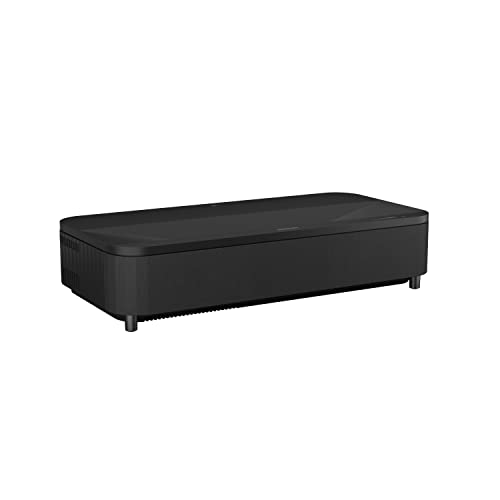
Epson EpiqVision Ultra LS800 — Brightest UST linked pick
The LS800 is the linked pick that most completely realises the television-replacement promise. Its 3LCD engine is listed at 4,000 lumens, bright by UST standards, and its 4K PRO-UHD picture is produced by pixel-shifting, a route this guide names openly because buyers deserve to know the mechanism behind the badge. On a proper UST screen the result is a large, composed, colour-confident image that holds together in a lit room far better than the category could manage a generation ago.
Daily life is where it separates itself. There is no warm-up ritual, no ceiling mount, no shadow when a child crosses the room during a match. The unit sits where a soundbar might sit, and its built-in Yamaha 2.1-channel audio, named in the listing, is strong enough that many owners will never add speakers at all. Android TV is built in, so the streaming layer arrives without an extra box or another remote in the drawer.
The conditions are real. The listing attached to this unit is a renewed one, presented neutrally here: check its warranty and returns terms on the listing page before ordering, as you would with any renewed flagship. The projector also demands its flat fixed screen and a sideboard deep enough for the image size you intend, and its throw is fixed, so the furniture plan is the installation plan.
For a living room that wants a hundred inches without a cinema room’s ceremony, this is the most complete linked answer in the guide. It costs like a flagship television because it replaces one, and judged on that basis rather than against portable projectors, its value story is coherent.
- Resolution: 4K PRO-UHD pixel-shifting, per listing
- Design: Ultra short throw, 3LCD laser
- Brightness: 4,000 lumens, listing-stated
- Audio: 2.1-channel Yamaha built-in, per listing
- Listing note: Renewed unit; verify warranty terms on the listing
Strengths
- Brightness leads the linked UST field for lit rooms
- Built-in audio is genuinely television-grade
- Pixel-shifted 4K looks composed at living-room distances
Trade-offs
- Demands a flat fixed UST screen to shine
- Sideboard depth limits maximum image size
- Renewed listing requires a careful warranty check
Best for: a main living room replacing a large television with a far larger picture
Not suited for: a renter who cannot fix a screen to the wall or commit furniture to one spot

BenQ V7050i — Colour-disciplined UST
BenQ approaches ultra-short throw from the picture-quality side of the street. The V7050i is a 4K laser design whose listing states 2500 ANSI lumens, a conservative figure in a conservative unit, signalling a machine intended for rooms that can control their light rather than fight the sun. Behind a UST ambient-light-rejecting screen in a curtained room, its HDR-PRO processing and wide-colour ambitions produce the most cinema-leaning picture among the linked picks, with tone mapping that treats film material respectfully.
Its ownership story is unusually grown-up. The listing names a three-year warranty, and BenQ’s projector heritage shows in the details: two HDMI inputs, an SPDIF connection with ARC for a soundbar, Android TV for the streaming layer and wireless casting for the phone in a guest’s pocket. The unit is designed to sit on low furniture and disappear, which in a living room is a feature money cannot easily buy after the fact.
The discipline cuts both ways. A bright, open-plan room with floor-to-ceiling glass will expose its brightness ceiling in a way the LS800’s extra output forgives, so this is a pick for rooms with curtains rather than rooms with views. Its built-in sound is serviceable rather than a headline, and most owners will pair it with the soundbar its ARC connection anticipates.
Choose it when the room is a evening-first space, the screen budget is real, and the films matter as much as the football. In that room it is not the second choice in this guide; it is the connoisseur’s first.
- Resolution: 4K, per listing
- Design: Ultra short throw laser
- Brightness: 2500 ANSI lumens, listing-stated
- Connections: HDMI x2, SPDIF with ARC, per listing
- Warranty: Three years, per listing
Strengths
- Colour and tone handling flatter film material
- Three-year warranty suits a long ownership horizon
- ARC connection plans properly for a soundbar
Trade-offs
- Brightness assumes a light-controlled room
- Built-in audio is not its headline act
- Fixed throw commits the furniture layout
Best for: an evening-first living room with curtains, a fixed screen and a film habit
Not suited for: a sunlit open-plan space that needs maximum brightness headroom

Epson EpiqVision UST LS300 — 1080p value pick, labelled
The LS300 carries the most important label in this guide: 1080p. It is not a 4K projector, and it is here because the honest shopping question is often whether the ultra-short-throw experience itself, rather than the resolution, is what a household actually wants. Its listing states 3,600 lumens of colour and white brightness from a 3LCD laser design, which is a healthy output for living-room duty, and its Yamaha speakers and Android TV complete the television-replacement shape at a gentler level of commitment.
At ordinary viewing distances on a hundred-inch screen, a great deal of real content forgives its resolution entirely. Broadcast sport, streaming drama shot soft, family photographs and console games all present happily, and the pixel structure only announces itself when a viewer sits close or when fine text fills the screen. A household upgrading from a modest television will experience the size first, the brightness second and the resolution a distant third, if at all.
The savings are not imaginary either, and they can be redirected into the screen, which this category keeps insisting is half the product. An LS300 in front of a proper UST ambient-light-rejecting panel will produce a more convincing daytime picture than a 4K unit projected onto a bare wall, and it will do so while leaving budget for the soundbar and the furniture the setup deserves.
Buy it with eyes open: the upgrade path from here is a replacement, not an adjustment, so a buyer already dreaming in 4K should stretch once rather than buy twice. For everyone else, this is the sensible doorway into ultra-short throw, and there is no shame in a doorway chosen deliberately.
- Resolution: 1080p Full HD, labelled
- Design: Ultra short throw, 3LCD laser
- Brightness: 3,600 lumens colour and white, listing-stated
- Audio: Yamaha speakers, per listing
- Platform: Android TV with Bluetooth, per listing
Strengths
- Full UST experience without the 4K premium
- Healthy brightness for living-room duty
- Savings can fund the screen the category demands
Trade-offs
- Resolution ceiling is real at close distances
- No path to 4K short of replacement
- Fine text and data are not its material
Best for: a household that wants the UST lifestyle for sport, streaming and games
Not suited for: a cinephile building a dedicated room around native-class 4K detail
Flagship Triple-Laser UST Class — Prose-only premium class
At the top of the ultra-short-throw market sits a class of triple-laser flagships that this guide discusses without a link, because no verified listing in the pool anchors a specific model and inventing one would break the rule that keeps this page trustworthy. The class is defined by separate red, green and blue laser light sources mixing directly, which produces a colour gamut wide enough to exceed the standards most content is mastered to, paired with high brightness and premium optics in furniture-grade cabinets.
What the money buys, beyond colour, is headroom in every direction: brightness that keeps a very large screen convincing in imperfect light, contrast arrangements that darken the room-side of the picture, and processing that handles tone mapping with a light touch. These machines are sold as the centrepiece of a designed living space, often through dealers who also supply the matched screen and the cabinet built to hide the unit entirely.
The class also concentrates the category’s risks. Prices reach deep into flagship-television territory and beyond, the matched screen is effectively compulsory, and the performance gap over the linked picks narrows in rooms that cannot control light or seating distance. A buyer here is purchasing the last increment of a mature technology, which is a legitimate desire and an expensive one.
Read the linked picks first and price the whole system, screen included, before ascending to this class. If the total still feels proportionate to the room it will serve for a decade, the flagships deliver a genuinely remarkable picture. If it does not, nothing in this guide will leave you feeling short-changed.
- Resolution: 4K across the class
- Light source: RGB triple laser, class-defining
- Brightness: High, varies by model
- Sales channel: Often dealer and integrator led
- Availability: Prose-only; no verified pool listing
Strengths
- Widest colour the category can produce
- Brightness headroom for very large screens
- Cabinet designs hide the machine completely
Trade-offs
- System cost includes a near-mandatory premium screen
- Gains narrow in uncontrolled rooms
- Dealer pricing is rarely transparent
Best for: a designed media living room with a decade-long horizon
Not suited for: a first UST purchase still testing whether the format fits the household
Hisense PX-Series UST Class — Prose-only living-room class
Hisense built its name in ultra-short throw by selling the living-room outcome rather than the projector component, and its PX-series class is included here in prose because that bundling philosophy shapes how many households actually enter the category. The pattern across the class is a bright laser UST unit, frequently offered with a matched ambient-light-rejecting screen in the same purchase, smart television software built in, and sound ambitions that aim to keep the sideboard uncluttered.
The appeal is logistical as much as optical. A bundle removes the two decisions newcomers get wrong: which screen technology the throw angle needs, and how far the unit must sit from the wall for the advertised image size. When the maker answers both in the box, the first evening ends with a picture on the wall instead of a forum thread. For households replacing a television, that completeness is the product.
The cautions mirror the strengths. Bundled screens fix the image size at purchase, so a later room change can strand the setup. Model names and specifications shift quickly within the class, which is precisely why this guide declines to attach a link it could not verify in the pool: any specific purchase deserves a fresh check of the exact unit, its brightness unit and its screen pairing on the day of buying.
Consider the class when the goal is a television-style purchase with a projector-sized result, and when the room’s layout is settled enough to commit to a screen size. It competes most directly with the LS300’s value logic and the LS800’s brightness, and it deserves a place on that shortlist even without a link here.
- Resolution: 4K across recent models in the class
- Concept: Projector and matched screen as one purchase
- Platform: Smart TV software built in
- Brightness: Varies by model; check the exact unit
- Availability: Prose-only; verify the specific model before buying
Strengths
- Bundled screen removes the hardest newcomer decision
- Television-style purchase suits television-style rooms
- Class pricing is aggressively competitive
Trade-offs
- Bundled screen size is fixed at purchase
- Specifications shift quickly between model years
- Exact-unit verification is essential before ordering
Best for: a household that wants one purchase to complete the whole setup
Not suited for: a tinkerer who prefers choosing projector and screen independently
Conventional Short-Throw Gaming Class — Prose-only classic geometry
Not every short-throw room is a living room, and the conventional short-throw class survives because it serves the rooms UST cannot: the gaming den, the classroom, the golf-simulator corner and the rental where nothing may be fixed to a wall. These projectors sit a metre or two from the screen, throw a large image over the players’ heads from a low table or ceiling mount, and keep the playing space completely clear of both equipment and shadows, which is why golfers and sim racers adopted them early.
The gaming members of the class built their reputations on responsiveness, with low-latency modes that this guide describes qualitatively because no verified pool listing supplies figures it may quote. What can be said is structural: a short throw keeps the projector near the console and the screen, cable runs stay short and simple, and the image is big enough that a racing cockpit or a putting mat feels enclosed by it. Many designs are lamp or LED based at prices far below the UST field.
Resolution in this class is commonly 1080p, with 4K models ascending in price toward UST territory, so the same honesty rule applies: check what the badge means on the specific unit. Brightness is usually quoted for darkened dens rather than lit living rooms, and the fans work accordingly. None of that diminishes the class; it defines its parish.
Choose this geometry when the projector must move, the wall cannot host a fixed screen, or the budget belongs partly to the simulator, the console or the classroom it serves. Ultra-short throw is the future of the living room, but the conventional short throw remains the present tense of everywhere else.
- Resolution: Commonly 1080p; 4K models exist at higher prices
- Throw: Roughly a metre or two for a large image
- Light source: Lamp and LED designs are common
- Strength: Low-lag gaming modes across the class
- Availability: Prose-only; no verified pool listing
Strengths
- Keeps play space clear of equipment and shadows
- Entry prices sit far below the UST field
- Portable between rooms, rentals and classrooms
Trade-offs
- Usually needs a darkened room to convince
- Fans sit closer to the audience
- 4K versions erode the price advantage
Best for: gamers, simulator builders and teachers who need size without installation
Not suited for: a living room seeking a permanent television replacement
How Does an Ultra-Short-Throw Setup Compare With a Very Large Television?
The comparison is now the category’s central contest, because screen sizes that once belonged exclusively to projection have become available, at a price, as televisions. A very large television wins on simplicity: one box, no alignment, brightness that shrugs off noon, and a picture that looks identical from every chair. It loses on logistics and scale. Getting a hundred-inch television into a flat, up stairs and onto a wall is a professional operation, and the price climbs steeply with every inch, while a UST projector and a fixed screen arrive in manageable boxes and reach sizes televisions still cannot touch.
The viewing experience differs in character as well as size. A projector’s image is reflected light, gentler on the eye across a long film, and the screen itself can be a calm, matte presence in the room when the system sleeps, where a giant television is a black mirror dominating the wall all day. Sound follows the furniture in a UST setup, firing from the sideboard at seated ear height, while a television’s speakers fire from a panel that grows thinner and less acoustic every model year. Neither advantage is decisive alone; together they explain why designed living rooms keep choosing projection even where a television would fit.
The honest ledger must also record projection’s costs. The screen is fixed, so the room commits. Daylight performance, even with an ambient-light-rejecting panel, trails a good television in a bright room. And the projector, screen and furniture form a small system with three chances to be misaligned, where a television has one. Households that value the last increment of convenience should buy the television. Households that value scale, softness of image and a wall that rests when the film ends should stay with this guide.
What Happens When Short Throw Meets Gaming and Simulation?
Simulation is short throw’s second homeland. A golf simulator needs a large image, an impact screen and a hitting zone that no projector beam may cross, which is precisely the geometry a short-throw lens provides from above or beside the player. Racing and flight rigs use the same trick to wrap a big picture around a cockpit without placing a hot projector inside it. In both cases the projector’s job is immersion at close range, and the buying criteria shuffle accordingly: uniformity and geometry matter more than cinema colour, and the ability to hold a square, stable image on a screen that takes physical punishment matters most of all.
Console and PC gaming in the living room asks a different question of the UST picks: how the television replacement behaves when the film ends and the controller comes out. The structural advantages remain, size and shadow-free play among them, and a player seated at a normal distance will find modern UST models perfectly companionable for the story-driven and sporting titles that dominate living-room play. Competitive players chasing the last increments of responsiveness have historically chosen dedicated gaming projectors or monitors, and the conventional short-throw class in this guide exists partly for them.
Room-sharing is the practical detail nobody mentions. A UST living-room system serves the whole household’s mix, films, sport, games and photographs, from one piece of furniture, which is why its compromises are tuned for breadth. A conventional short-throw rig in a den serves one passion deeply. Neither is the correct answer in the abstract; each is correct in its room, and the mistake is buying one geometry to do the other geometry’s job.
How Should Sound Be Planned Around a Projector That Sits Like a Soundbar?
Ultra-short throw quietly rearranged home audio geography. The projector occupies the exact spot a centre channel or soundbar wants, fires its own speakers from that spot, and throws its beam upward through the space where a tall soundbar would like to stand. Planning therefore starts with a tape measure: the clearance above the lens is sacred, and any audio hardware sharing the sideboard must be low, offset or relocated. The LS800’s built-in Yamaha system exists partly to dissolve this problem, delivering sound that makes an external bar optional rather than inevitable.
Where external audio is wanted, the ARC connection on models like the V7050i is the clean path: one cable returns sound from the projector’s streaming platform to a soundbar placed with care, or to an AV receiver in a cabinet. Wireless subwoofers and rear speakers suit UST rooms well because the front of the room is already furniture-committed, and a system that keeps cables out of the beam zone keeps the alignment sacred. The goal is a front soundstage that matches the image’s width without ever entering its light.
Conventional short-throw rooms have the opposite freedom and the opposite chore: the projector sits away from the screen, so sound must be deliberately placed at the screen rather than allowed to follow the projector, or dialogue will detach from faces in a way viewers feel before they can name it. A soundbar under the screen or speakers flanking it restore the illusion. In both geometries, the rule is the same sentence written two ways: sound belongs where the picture is, and the projector’s convenience must never be allowed to move it.
Why Do Classrooms and Small Venues Still Choose Conventional Short Throw?
Walk into a classroom with a short-throw projector and the design logic announces itself: the teacher stands at the board, inside what would be the beam of a conventional projector, and casts no shadow on the work. The projector hangs on a short arm above the board, close enough that the image is large, bright for its cost and safe from the traffic of the room. Interactive boards grew up around exactly this geometry, and a generation of teaching habits, reaching, pointing, annotating at the surface, assumes the shadow-free picture it provides.
Small venues repeat the pattern for their own reasons. A café showing sport, a community hall running a quiz night, a training room in a rented office: all need size without installation drama, tolerance for being moved, and prices that survive a committee. Conventional short-throw models, often lamp or LED designs with interchangeable nothing and fixable everything, fit that procurement reality. Their fans are louder and their pictures less refined than the living-room UST field, and in a room full of conversation neither fact registers.
The lesson for home buyers is not to imitate the classroom but to respect the match between geometry and life. If your projector will move, teach, travel or serve a room that rearranges itself monthly, the conventional class’s virtues are the relevant ones. If it will live in one place and serve one wall for years, the UST format’s stillness wins. Short throw is a family, and families are allowed to contain different answers.
How Much Room Light Can Each Geometry Honestly Handle?
Light tolerance is where short throw marketing grows most creative, so this guide will be plain. No projector in this article defeats direct sunlight on the screen. Every projector in this article benefits from an ambient-light-rejecting screen, and the UST models benefit most, because their matched lenticular screens are engineered for exactly their beam angle and for rejecting the ceiling light that constitutes most living-room glare. A bright UST on its proper screen is a genuinely daytime-capable system for sport, news and family viewing, with film-after-dark remaining its finest hour.
Conventional short-throw models in dens and classrooms work to a different bargain: the rooms are smaller, the images are smaller, and the light is usually fluorescent and diffuse rather than directional sun. Their quoted brightness serves that bargain adequately. Problems arise when a buyer carries a den projector into a bright living room, or a living-room UST into a glass pavilion, and blames the badge for the room’s physics. The categories are honest; the rooms must be too.
Practical light management is unglamorous and decisive: blinds on the offending window, the screen wall kept free of downlights aimed at it, and seating arranged so nobody watches through a reflection. Do those three things and the linked picks will perform at the top of their class. Skip them and the flagship class will underperform a mid-range model in a disciplined room, which is the most expensive way to learn the cheapest lesson in projection.
How Do You Align an Ultra-Short-Throw Projector Without Losing an Evening?
Alignment is the UST rite of passage, and it rewards method over force. Begin with the screen fixed and level, because the projector will be aligned to it and not the other way round. Place the unit on its furniture at the maker’s specified distance for your screen size, centred on the screen’s midpoint, and power it up before pushing it flush anywhere. Work in small movements: distance sets size, height sets vertical position, and rotation, the one beginners forget, sets whether the top corners agree with each other.
Use the projector’s test pattern or a grid from a streaming app, and resist digital keystone correction until the physical position is nearly right, because keystone spends resolution and softens text to buy forgiveness you may not need. When the geometry is square, mark the unit’s feet positions on the furniture with removable tape. That humble trick converts every future dusting accident from a realignment session into a ten-second restoration, and in a family room the unit will be nudged, by cleaners, children and life, more often than any manual admits.
Finish with focus, which on many UST models is electronic and subtle, checked at the corners rather than the centre, and with the picture mode you will actually use rather than the vivid mode the unit ships in. Then leave it alone for a week. New owners chase perfection nightly and enjoy nothing; the correct standard is a grid that looks square from the sofa and text that reads cleanly, after which the projector should disappear from attention entirely, which was the point of buying it.
What Mistakes Send Short Throw Buyers Back to the Returns Desk?
The leading mistake is the screen, again: pairing a UST projector with a wavy pull-down or a textured wall and concluding the projector is defective. The ripples were always there; the steep angle simply lights them like a landscape. Buy the fixed screen first if the budget forces a sequence, because a good screen outlives two projectors.
Second comes furniture arithmetic. The image size is set by the unit’s distance from the wall, and larger images need deeper furniture, yet buyers routinely fall for the largest screen while owning a sideboard that physically cannot place the projector far enough back. Measure the furniture, consult the model’s throw table, and let arithmetic choose the screen size. A slightly smaller image that fits is infinitely better than a larger one projected at a desperate angle.
Third, households underestimate sound placement. A UST unit’s speakers fire from the sideboard, which is fine, but a soundbar added later needs somewhere to live that does not block the upward beam. Plan the audio furniture with the projector furniture, because the inch of clearance above the lens is the most contested real estate in the modern living room.
Finally, buyers skip the light test. They audition in a darkened showroom, install in a bright room, and blame the badge. Audition material at home, in home light, on the worst afternoon the room offers, and let that evidence rank the shortlist. Short throw rewards honest rooms and punishes hopeful ones, and the difference is visible from the sofa.
What Does Living With Short Throw Teach You in the First Year?
The first lesson is that the screen disappears as a topic. Once the fixed panel is up and the unit is aligned, owners stop discussing the equipment entirely, which is the highest compliment domestic technology can earn. Guests assume the wall is a television until the size registers, children treat the sideboard as furniture rather than as a shrine, and the room returns to being a room. The technology’s invisibility is not a side effect of the UST format; it is the format’s entire argument, and it compounds quietly every day.
The second lesson concerns light discipline. Households learn their room’s hours: the morning angle that challenges the screen, the lamp whose reflection lives in the corner, the blind that earns its keep in June. A small light routine forms around the system, no more burdensome than the one around a piano or a plant, and the ambient-light-rejecting screen handles the rest. Owners of conventional-throw cinema projectors learn a stricter version of the same lesson, in darker rooms, and both groups report the same surprise: they adapted in a fortnight and stopped noticing.
The third lesson is about size itself. A household that steps from a modest television to a hundred inches expects the change to be about films, and discovers it is about everything: sport becomes architectural, photographs become gatherings, a video call with grandparents becomes a presence in the room. That is why so few UST owners return to smaller pictures, and why this guide keeps advising buyers to choose the screen size by the furniture’s honest arithmetic rather than by caution. Caution, in this category, is the one specification that never gets used.
What Should Renters and Rearrangers Do Differently?
Renting changes the moral of every installation story. A fixed screen wants fixings, a ceiling mount wants holes, and a landlord’s permission is a specification no review can supply. Renters in this category gravitate to two honest solutions. The first is the conventional short-throw model on a shelf or stand, aimed at a portable screen or a smooth wall, accepting a small quality tax in exchange for a deposit returned in full. The second is a UST unit paired with a floor-rising or framed screen that leans on furniture rather than on screws, a combination the market now serves surprisingly well.
Rearrangers, households whose rooms change with seasons and children, should weight portability inside the UST decision too. A unit that can move from the living room to a bedroom wall for a month, then return to its taped marks on the sideboard, earns a flexibility the specification sheet never lists. The LS300’s friendlier price makes it the natural candidate for that life, since the financial exposure of experimenting is lower and its picture forgives informal setups. The flagship classes, by contrast, are commitments, and should be bought the way commitments should be: after the room has stopped changing.
Either way, the discipline is identical: keep the original packaging until the setup has survived a month, photograph the aligned positions, and store the throw-distance figures for your screen size somewhere the next mover will find them. Short throw’s only real fragility is geometry, and geometry, once recorded, is never lost.
How Do You Future-Proof a Fixed Installation?
A fixed UST installation will likely outlive the streaming platform inside the projector, the console beside it and possibly the sofa in front of it, so future-proofing means separating the permanent from the replaceable. The screen and the furniture geometry are permanent; treat their purchase as architecture and buy the best your arithmetic allows. The projector is semi-permanent; its laser engine will serve for years, but its smart platform will age, and the graceful answer is an external streaming stick or box on an HDMI input, replaced cheaply whenever the software world moves on. The cables are consumables in disguise; run one spare HDMI alongside the working one while the furniture is apart, and a future standard will thank you.
Power and ventilation deserve the same foresight. The unit needs a socket that does not require moving the sideboard to reach, air space around its vents that soft furnishings must not colonise, and a surge-protected supply, because a laser projector is a computer with a very bright opinion about electricity. Note the model’s exact throw figures in the room’s records, so that a replacement unit years later can be chosen against the installed screen rather than against a memory. Do these small things and the installation becomes what it promised to be on the first evening: a wall that simply shows pictures, indefinitely, while everything around it changes.
One more household reality settles many short throw decisions: who else uses the room, and at what hours. A UST system in a family living room will show cartoons at seven in the morning, a grandparent’s video call at noon and a film at ten at night, and its instant-on laser, simple remote and television-style platform are what make that rotation painless. A dedicated cinema, by contrast, can tolerate a projector that warms up, cools down and demands a ritual, because the ritual is part of the occasion. Match the machine’s temperament to the room’s population and the purchase will feel right long after the specifications are forgotten. That temperament test, more than any single figure in the comparison table, is the one owners wish they had applied first.
Budget sequencing deserves a final word, because this category punishes buying in the wrong order. Screen first, or at least screen decided, then the projector chosen to serve that screen’s size and gain, then the audio that fits the remaining furniture, then the small change: cables, a spare remote, blackout for the one offending window. Buyers who reverse the sequence end up with a projector waiting on a wall it cannot flatter and a screen chosen in a hurry to end the waiting. The order costs nothing, and in a category defined by geometry, order is nearly everything.
And when the first film ends and the credits roll over a wall that was blank that morning, resist the urge to keep adjusting. Pour something, sit back, and let the room have its picture. Alignment tweaks made in the first week should serve the next five years, not the next five minutes, and a setup left in peace settles into the household exactly the way a good television once did, except larger, softer and considerably more smug about it.
Visitors, incidentally, are the format’s best salespeople and its sternest critics. They notice the missing television first, the size second and the absence of a projector table third, and they ask the question every owner loves: where is it? Pointing at a slim unit resting quietly on the sideboard, inches from the wall it fills, remains the most satisfying party trick in home cinema. It is also the moment the category’s whole argument lands, that the best technology in a living room is the technology the room barely has to host.
Keep the receipts, the throw table and the screen’s paperwork together in one folder, physical or digital, from that first evening onward. A fixed installation accrues small facts, distances, settings, dates, that are trivial to record and miserable to reconstruct, and the household that records them owns its system outright.
That folder is also where the next upgrade begins, years from now, when a brighter engine or a wider colour standard tempts the household: the screen’s limits, the furniture’s depth and the room’s light are already written down, waiting to judge the newcomer.
Comparison Table
| Pick | Geometry | Resolution honesty | Sound story | Best room |
|---|---|---|---|---|
| Epson LS800 | Ultra short throw | 4K PRO-UHD pixel-shift | Yamaha 2.1 built in | Main living room |
| BenQ V7050i | Ultra short throw | 4K | ARC ready for a bar | Curtained film room |
| Epson LS300 | Ultra short throw | 1080p, labelled | Yamaha speakers | Value living room |
| Triple-laser class | Ultra short throw | 4K | Varies by model | Designed media room |
| Hisense PX class | Ultra short throw | 4K | Bundled ambitions | Television-style buyer |
| Conventional class | Short throw | Often 1080p | Place at the screen | Den, class, simulator |
Final Recommendation
For most living rooms, the LS800 is the linked pick to build around: bright, composed, shadow-free and honest about its pixel-shifted route to 4K, with sound that completes the television replacement. Film-first rooms with curtains should take the V7050i and its colour discipline, while households testing the format should enter through the plainly labelled 1080p LS300 and spend the saving on the screen. Whichever geometry you choose, measure the furniture before the screen and the room before the badge, because a short throw projector is really a piece of room planning that happens to emit light — and when the planning is right, the wall simply becomes a window that was not there yesterday.
Frequently Asked Questions
What is the difference between short throw and ultra-short throw?
Distance, and everything that follows from it. A conventional short-throw projector sits roughly a metre or two from the screen. An ultra-short-throw model sits within tens of centimetres of the wall, usually on furniture, and throws upward at a steep angle. The UST arrangement removes shadows and ceiling runs but demands a very flat, usually fixed screen.
Can I use an ultra-short-throw projector on a plain wall?
You can, and many people start there, but the wall becomes the limit: texture, tint and any unevenness are lit dramatically by the steep beam, and daytime contrast suffers without an ambient-light-rejecting surface. A fixed UST screen is the single largest picture upgrade available to any model in this guide.
Is pixel-shifted 4K the same as native 4K?
Not mechanically, and this guide labels which route each pick takes. Pixel-shifting renders a 4K-class image by rapidly offsetting a lower-resolution panel, and at living-room distances on film and sport the result is highly convincing. Native resolution holds an edge with fine text and test patterns viewed closely. Buy with the distinction known, not hidden.
Do short throw projectors work for gaming?
The conventional short-throw class built its name on gaming, with low-latency modes and a layout that keeps players out of the beam. UST living-room models vary more, and serious players should check the specific model’s gaming mode. For a simulator or a den, the conventional geometry remains the specialist’s choice.
How large an image can I get, and what decides it?
The lens decides. Each UST model supports a defined size range set by its fixed throw, and the unit’s distance from the wall sets the size within that range, which in turn sets how deep your furniture must be. Consult the model’s throw table before choosing a screen, and buy the screen to fit the furniture you actually own.
Will an ultra-short-throw projector replace my television entirely?
For a growing number of households, yes: instant-on laser light, built-in streaming and, on the LS800, television-grade sound cover the daily duties, at sizes no comparably priced television reaches. The honest caveats are daytime brightness in uncontrolled rooms and the fixed screen commitment, both covered in the sections above.
Related Guides
Continue with best 4K projectors for office if the same shadow-free logic is needed at work, best 4K laser projectors for the light-source story in depth, and best 1080p home theater projectors for conventional-throw alternatives at gentler prices.


