Our Top Picks




What's inside
- The three formats in this guide: rigid pads, mesh pads, and roll-up pads
- How to read pad counts, kits, and sound libraries
- AKLOT Portable Electric Drum Set: a mesh snare at the centre
- Pyle Electronic Tabletop Digital Drum Set: the largest stated library
- KONIX Electronic Tabletop Drum Set: velocity pads with a visual guide
- HXW PD405 Tabletop Electric Drum Set: built-in speaker simplicity
- Donner Beat Go: lessons, demo songs, and a backpack
- LEKATO CPD-1000: quiet mesh pads for regular practice
- STRICH SED-PT200: seven mesh pads with dual speakers
- Donner Electronic Drum Set DED-20: the roll-up option
- Headphones, speakers, and playing quietly at home
- USB-MIDI, inputs, and connecting to a computer
- Check prices on Amazon
- Pedals, lessons, and building real coordination
As an Amazon Associate I earn from qualifying purchases. This post may contain affiliate links at no extra cost to you.
A table top drum set promises the core experience of drumming without the core problem of drumming: space and volume. An acoustic kit needs a room, tolerant neighbours, and a floor that can absorb constant vibration. A tabletop electronic kit needs a desk, a kitchen table, or a cleared corner of a work surface, plus a pair of headphones when the household needs quiet. For a beginner who wants to learn timing, coordination, and basic patterns at home, that difference decides whether practice happens daily or almost never.
This guide covers eight portable electronic drum kits that all live on a table rather than on stands across a floor. They are the AKLOT Portable Electric Drum Set, the Pyle Electronic Tabletop Digital Drum Set, the KONIX Electronic Tabletop Drum Set, the HXW PD405 Tabletop Electric Drum Set, the Donner Beat Go, the LEKATO CPD-1000, the STRICH SED-PT200, and the Donner Electronic Drum Set DED-20 roll-up pad. Every one of them is presented by its maker for beginners, home practice, or portable use, but they are not the same kind of instrument, and treating them as interchangeable is the most common buying mistake in this category.
The information in this guide comes from the published product titles for these eight kits and from general knowledge about how tabletop electronic drums work. Where a title states a number, such as a pad count, a sound count, or a speaker figure, this guide reports that number for that product only. Where a title does not state a detail, this guide does not invent one. General sections explain concepts that apply across the category, such as velocity sensitivity, USB-MIDI, and pedal technique, so that the stated figures for each kit are easier to interpret before you choose.
The three formats in this guide: rigid pads, mesh pads, and roll-up pads
The first distinction to understand is the playing surface, because it shapes noise, feel, durability, and storage more than any sound library does. Rigid tabletop units house their pads in a solid desktop console. The Pyle, the KONIX, and the HXW PD405 follow this pattern: a single unit sits flat on the table, the pads are part of that unit, and pedals connect for kick and hi-hat control. These consoles are simple to set up, simple to move from room to room, and simple to store on a shelf, because there is nothing to assemble beyond plugging in pedals and power.
Mesh pad kits take a different approach to the striking surface. Mesh heads are associated with quieter stick impact and a surface that gives a little under the stick, closer in spirit to a practice pad than to a hard plastic shell. In this guide, the LEKATO CPD-1000 is described with quiet mesh pads, the STRICH SED-PT200 is described with seven mesh pads, and the AKLOT pairs an 8-inch dual-zone mesh snare with 4.5-inch cymbals. If other people are in the next room while you practise, the surface material matters, because much of the noise a tabletop kit makes in a home is stick noise travelling through the table, not the sound coming out of the speaker.
The third format is the roll-up pad, represented here by the Donner DED-20. A roll-up kit prints or moulds its seven pads onto a flexible mat that can be rolled for storage and unrolled onto any flat surface for play. No format travels more easily or stores in a smaller space. The trade-off is feel: a flat flexible mat cannot reproduce the raised, separated playing zones of a rigid console or the response of a mesh head. For a child receiving a first instrument, for travel practice, or for a household where storage space is the deciding factor, that trade-off can be entirely reasonable. For an adult planning structured daily practice over a long period, it deserves more thought.
None of these formats is automatically the best table top drum set for every player. The right question is which set of compromises matches your room, your household, and your reason for playing. A rigid console suits a player who wants a stable, always-ready practice station on one desk. A mesh kit suits a player who practises often, plays later in the evening, and cares about stick noise. A roll-up pad suits a player whose kit must disappear into a drawer between sessions. The product sections below keep returning to those three use cases, because they explain most of the real differences between these eight kits.
How to read pad counts, kits, and sound libraries
Product titles in this category lead with numbers, and the numbers are easy to misread. A pad count tells you how many separate striking zones the layout offers. Seven pads is a common layout because it can mirror the broad shape of a drum kit: snare, toms, hi-hat, crash, and ride positions in miniature. Eight touch sensitive pads, as stated for the Pyle, give one more zone to assign or play. What a pad count does not tell you is how large each pad is, how far apart the zones sit, or how the layout feels under full-size sticks, so treat the count as a map of the layout rather than a score for quality.
Sound counts work the same way. The Pyle title states 575 sounds, the AKLOT states 360 sounds, the LEKATO states 220-plus sounds, the Donner Beat Go states 180 sounds, and the HXW PD405 states 163 percussion sounds. A larger library offers more variety across genres and more novelty for a beginner exploring what different kits and percussion voices sound like. It does not follow that a larger library is automatically more useful for learning. A beginner spends most early practice time on a small number of core voices: a snare, a kick, a hi-hat, and a few toms and cymbals. Library size matters most once basic coordination is in place and the player starts playing along with different styles of music.
Kits, meaning preset combinations of voices arranged as a virtual drum set, sit between those two ideas. The AKLOT title states 30 kits and the Donner Beat Go states 15 kits. Switching kits changes the whole character of the instrument at once, from a dry practice sound to a bigger stage-style sound, without changing any hardware. Demo songs and lessons are different again: the Donner Beat Go states 30 demo songs and training lessons, and the Donner DED-20 states 40 drum lessons. Those are learning features rather than sounds, and they matter most for a player who will practise without a teacher and needs structure built into the instrument itself.
Velocity sensitivity is the specification that most affects whether a tabletop kit can teach real dynamics. A velocity-sensitive pad responds to how hard it is struck, so a soft tap sounds soft and a firm strike sounds firm. The KONIX title states seven velocity sensitivity drum pads, and the HXW PD405 is described as a tabletop set with a velocity-sensitive drum pad. The AKLOT adds a related idea with its dual-zone mesh snare, meaning the snare surface distinguishes more than one playing area. Dynamics are not a luxury feature. Accents, ghost notes, and controlled quiet playing are core drumming skills, and a pad that cannot hear the difference between a tap and a hit cannot help a beginner learn them.
best pci sound cards for music production
AKLOT Portable Electric Drum Set: a mesh snare at the centre
The AKLOT Portable Electric Drum Set, ASIN B0GWQRZ9DP, is the kit in this group built most clearly around a single featured playing surface: an 8-inch dual-zone mesh snare. Snare placement is a thoughtful place to spend design effort, because the snare is the drum a beginner strikes most often and the drum where dynamic control develops first. A dual-zone surface distinguishes the centre of the head from another playing area, which gives a learner an early, physical understanding that where a drum is struck changes what it says. The mesh construction also supports the quieter home practice that most tabletop buyers are looking for.
Around that snare, the AKLOT title lists 4.5-inch cymbals and full-size pedals. Full-size pedals are worth pausing on. Many compact kits shrink the pedals along with everything else, and small pedals can feel vague underfoot, especially for an adult. Pedals closer to full size give the feet a clearer target and a more transferable feel if the player later moves to a larger electronic kit or an acoustic kit. Foot technique is half of drumming coordination, and a beginner who learns with pedals that respond like pedals builds habits that carry forward instead of habits that must be unlearned.
The stated sound content is 30 kits and 360 sounds, with USB-MIDI listed for connection to a computer. That combination suits a beginner who wants variety on the instrument itself and a path into recording or software instruments later. USB-MIDI means the kit can send playing data to music software, so the pads can trigger sounds in a program on the computer rather than only the sounds stored in the unit. The title also lists headphones, a drum guide, and a 2-year warranty in grey. A bundled guide matters for a self-taught player, because the first weeks of practice go better with a sequence to follow than with random exploration alone. Among the eight kits here, the AKLOT reads as the choice for a beginner who wants the playing surface itself, especially the snare, to be the priority.
Pyle Electronic Tabletop Digital Drum Set: the largest stated library
The Pyle Electronic Tabletop Digital Drum Set, ASIN B0045XUU08, is a compact portable drum pad kit built around eight touch sensitive pads and pedals. Its layout is spelled out more precisely than most in its title: 4 drums of 5 inches and 4 cymbals of 3.5 inches. That split tells a buyer exactly how the eight zones divide between drum voices and cymbal voices, and the stated pad sizes give a realistic sense of the playing area on the desk. For a buyer comparing desktop footprints, concrete dimensions like these are more useful than a pad count alone.
The headline figure for the Pyle is 575 sounds, the largest library stated among the eight kits in this guide. A library of that size is best understood as breadth for exploration: more percussion voices, more kit flavours, and more material for a player who enjoys browsing sounds and playing along with varied music. The connection list is also the broadest stated here, with USB and headphone outputs plus MIDI and AUX inputs. An AUX input is a practical practice feature, because it lets a player feed songs or lesson audio from a phone or player into the same listening path as the drums, so backing music and drumming arrive together in the headphones.
Touch sensitivity on the Pyle pads points toward responsive playing where strike strength registers on the surface, which supports the dynamic practice discussed earlier. The overall picture is a rigid desktop console for a player who values variety and connectivity in a single self-contained unit: many sounds, a clearly described eight-pad layout, pedals included in the concept, and inputs that make playing along with external audio straightforward. A player whose priority is the quietest possible surface, rather than the broadest library, would more likely look toward the mesh kits in this guide, and a player who needs the smallest possible storage footprint would look at the roll-up Donner. The Pyle instead suits the desk-based explorer who wants one unit that does a bit of everything.
best affordable tablets for musicians
KONIX Electronic Tabletop Drum Set: velocity pads with a visual guide
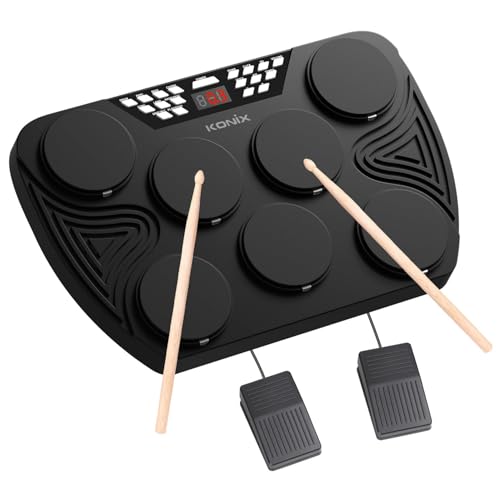
The KONIX Electronic Tabletop Drum Set, ASIN B09NBLR5MQ, is a portable electric drum kit with seven velocity sensitivity drum pads. Seven pads in a tabletop layout typically map onto the essential voices a beginner needs, and velocity sensitivity across the pad set means the whole layout can respond to playing dynamics rather than only one featured drum. For a learner, that consistency is valuable: a quiet stroke on a tom and a quiet stroke on the snare both register as quiet, so dynamic habits form evenly across the kit instead of only in one place.
The distinctive feature in the KONIX title is the LED drum light. Light guidance on a drum pad serves the same purpose as light guidance on a learning keyboard: it shows the player which pad to strike and when, turning early practice into a follow-along activity instead of a memory exercise. For a complete beginner, for a younger player, or for an adult returning to music after a long break, that kind of visual scaffolding lowers the barrier to the first successful patterns. It also makes the KONIX a natural fit for the gift and first-instrument role its title describes, aimed at adults and beginners.
USB-MIDI with Mac and PC support completes the KONIX picture. Stating both computer platforms matters, because a buyer should not have to guess whether a kit will talk to the machine already in the house. With USB-MIDI, the pads can drive software instruments and recording programs, which extends the kit beyond its internal sounds and gives a growing player room to develop. Taken together, the KONIX suits a beginner who learns best by following visual cues, wants dynamics across all seven pads from the start, and wants a clear, stated path to both major computer platforms without extra hardware in between.
HXW PD405 Tabletop Electric Drum Set: built-in speaker simplicity
The HXW PD405 Tabletop Electric Drum Set, ASIN B09N92MVFW, keeps its proposition simple: a velocity-sensitive drum pad layout, 163 percussion sounds, a built-in speaker, two pedals, and drum sticks in the box. That combination describes a kit that can be played within minutes of being placed on a table, with no separate amplifier, no computer, and no accessory hunt before the first session. For a gift purchase, that completeness matters. The recipient can open the box, set the unit down, pick up the included sticks, and play.
A built-in speaker changes how a tabletop kit fits into a home. With a speaker, the kit works as a shared instrument: a parent can hear a child’s progress, two players can listen together, and practice does not require headphones to be found and plugged in first. The trade-off is volume control over the room. A speaker plays to the whole space, so late-evening practice in a shared home still points toward headphone use on any kit that offers it, while daytime practice and family use are where a speaker earns its place. The PD405 title frames the set as a gift instrument for beginners, including for occasions such as Christmas and birthdays, and the included speaker, pedals, and sticks all support that ready-to-play framing.
The 163 percussion sounds give a beginner enough variety to explore different voices without the browsing overload a very large library can create. Velocity sensitivity on the pad supports the dynamic learning that separates drumming from simply triggering sounds in time. In this line-up, the PD405 is the straightforward, self-contained option: fewer stated extras, a clear beginner purpose, and everything needed for a first session included. A buyer who wants lessons built into the instrument would compare it with the two Donner models, and a buyer who wants mesh surfaces would compare it with the LEKATO and STRICH, but a buyer who wants the simplest possible start has a clear candidate here.
Donner Beat Go: lessons, demo songs, and a backpack
The Donner Beat Go Electric Drum Set, ASIN B0H8CYBW3B, is a portable electronic drum kit for beginners described as a compact table drum with training lessons. Its stated content is 180 sounds, 30 demo songs, and 15 kits, with USB-MIDI and two pedals. The balance of those numbers tells a story: this is a kit organised around guided learning rather than around the largest possible sound library. Thirty demo songs give a beginner material to play along with, and training lessons give that play-along time a structure, so practice sessions have a beginning, a target, and a sense of progress.
Play-along material matters more for beginners than experienced players sometimes admit. Drumming is a timekeeping skill, and timekeeping develops by playing with something steady outside your own head. Demo songs provide that steady reference inside the instrument itself, without needing a phone, a separate app, or a streaming account. A learner can sit down, choose a song, and work on staying with it. Combined with lessons, that makes the Beat Go a reasonable choice for a self-directed beginner who does not have a teacher setting weekly tasks and who benefits from the instrument suggesting what to do next.
The portability details in the title are a drumstick and a backpack. A backpack sounds like a minor accessory until a kit needs to move between a bedroom, a living room, a classroom, or another home on a regular basis. A dedicated carry solution keeps the unit, the pedals, and the sticks together, which protects the kit and removes the friction that quietly kills practice routines. If the Beat Go will live permanently on one desk, the backpack is a bonus. If it will travel between two households or to lessons outside the home, it becomes part of the reason to choose this model. Among the eight kits here, the Beat Go is the guided-practice option: lessons and songs first, with a sensible sound count and computer connection behind them.
LEKATO CPD-1000: quiet mesh pads for regular practice
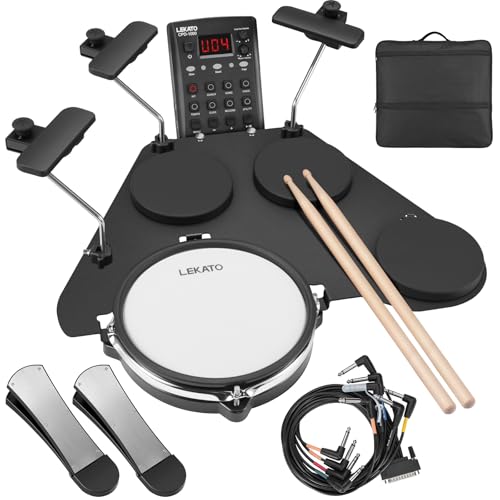
The LEKATO CPD-1000 Electronic Drum Set, ASIN B0FDK3KJ5M, is described with quiet mesh pads, and that single phrase defines its place in this guide. Mesh surfaces reduce the sharp stick noise that hard pads produce, and in a flat, an apartment, or a house where practice happens near other people, surface noise is often the real limit on when and how long a drummer can play. A kit that can be played in the evening without negotiating with the whole household will simply get played more, and frequency of practice beats almost every other variable for a beginner.
The stated library is 220-plus sounds with USB MIDI, which places the CPD-1000 in the middle of this group on variety while keeping the computer connection that extends a kit’s working life. The hardware notes in the title are two robust footswitch pedals, sticks, and a travel bag. The word robust in front of footswitch is a small but meaningful signal, because pedals and footswitches absorb repeated force all session long and are the parts of a compact kit most likely to be treated roughly by an enthusiastic beginner. Sticks and a travel bag in the box repeat the ready-to-play pattern: the kit arrives as a complete practice system rather than a unit waiting on accessories.
The CPD-1000 suits a particular buyer clearly: the regular home practitioner. Someone who expects to play most days, who shares walls or rooms with other people, and who wants a surface that stays quiet and feels forgiving under the sticks will find the mesh-first design pointed directly at them. A buyer who mainly wants light-up guidance would look at the KONIX, and a buyer who wants the absolute smallest storage footprint would look at the roll-up Donner, but for sustained, considerate home practice, the LEKATO’s combination of quiet mesh pads, a mid-sized library, USB MIDI, and included carrying gear is coherent and well aimed.
STRICH SED-PT200: seven mesh pads with dual speakers
The STRICH SED-PT200 Portable Tabletop Electric Drum Set, ASIN B0GY8KP5NL, combines seven mesh pads with dual 15W speakers, USB MIDI, two pedals, drumsticks, and a carry bag, and it is framed for adults and beginners. It is the only kit in this guide whose title states a speaker power figure, and the only one that pairs a full mesh pad layout with built-in speakers of that stated size. That pairing is interesting because it serves two different practice modes at once: mesh pads keep the physical act of playing quieter, while the speakers let the resulting music fill a room when playing aloud is welcome.
Seven mesh pads give the STRICH the joint-highest mesh pad count in this group, matching the layout breadth of the seven-pad rigid and roll-up designs while keeping the quieter, softer surface across the whole kit rather than on one featured drum. For an adult beginner with full-size hands and a normal practice desk, a complete mesh layout can feel more uniform: every voice is struck on the same kind of surface, so technique transfers evenly from snare to toms to cymbals. USB MIDI adds the computer path for recording and software sounds, and the two pedals cover the kick and hi-hat roles that turn pad patterns into recognisable drumming.
The included drumsticks and carry bag complete a package that reads as ready for an adult who wants one purchase to cover home practice, occasional playing for family or friends through the speakers, and transport without a separate case hunt. In this line-up, the STRICH is the room-filling mesh option. The LEKATO leans further toward quiet portability, the AKLOT concentrates its mesh investment in the snare with full-size pedals, and the STRICH spreads mesh across all seven pads and adds the strongest stated speaker setup. Buyers choosing between the three mesh kits are really choosing where they want the emphasis: snare feel, travel convenience, or full-layout mesh with louder built-in playback.
Donner Electronic Drum Set DED-20: the roll-up option
The Donner Electronic Drum Set DED-20, ASIN B0B8S6MDD4, is a seven-pad electric drum pad that rolls up, described as a quiet drum pad with a built-in speaker and 40 drum lessons included. It is positioned in its title as a kids’ holiday, Christmas, and birthday gift instrument, and that positioning is honest about what a roll-up format does best. It introduces drumming in the least intimidating, least space-consuming way possible. Unroll it on a table, play, roll it away again. No shelf space, no permanent desk claim, no setup ritual standing between a child and a first rhythm.
The 40 included drum lessons are the highest lesson count stated in this guide, higher than the training lessons of the Beat Go from the same brand. For a young beginner, structured lessons inside the instrument can matter more than pad feel, because the challenge at that stage is engagement and basic coordination rather than refined dynamics. A built-in speaker supports the same shared, family style of play as the HXW speaker: the sound is simply there in the room, with no headphones or extra equipment mediating between the child and the music.
The limits of the format should be stated plainly. A flat roll-up mat cannot offer raised pads, mesh response, or the pedal-centred layout of the console kits, and the title does not claim those things. An older beginner with serious long-term ambitions will likely outgrow a roll-up pad faster than a rigid or mesh kit. But judged on its own terms, as a first instrument, a travel pad, or a gift that fits in a drawer, the DED-20 occupies a niche none of the other seven kits can match. It is also the easiest kit here to lend, to pack for a holiday, or to bring out for a family music session and put away again in under a minute.
Headphones, speakers, and playing quietly at home
Every tabletop kit is quieter than an acoustic kit, but quieter is a spectrum, and the listening setup decides where on that spectrum a session lands. Headphone playing is the quietest mode: the musical sound stays with the player, and the room hears only stick impact and pedal movement. The AKLOT title lists headphones among its contents, and the Pyle lists headphone outputs, and headphone use is the default assumption for evening practice in a shared home on any kit that supports it. Headphones also help a beginner hear detail, such as whether two strokes meant to be even actually sound even.
Built-in speakers serve the opposite social purpose. The HXW PD405 and the Donner DED-20 are described with built-in speakers, and the STRICH SED-PT200 states dual 15W speakers. Speakers make a kit a shared instrument for lessons with a parent, practice that a teacher in the room needs to hear, or casual playing where shutting the sound away in headphones would miss the point. The practical household pattern for many beginners is both: speakers in the daytime, headphones in the evening. Buyers should therefore notice which kits state a speaker and which state headphone provision, and match that to the hours they realistically expect to practise.
The third noise factor is the table itself. A tabletop kit transmits stick energy into whatever it sits on, and a hollow or lightweight table can amplify that into a thump that carries to the room below. Placing a mat or a folded towel under a rigid console, choosing mesh pads where possible, and avoiding very resonant furniture all reduce that transfer. None of that requires buying anything exotic. It simply means the surface under the kit is part of the instrument’s sound in a home, and a minute spent on placement saves ongoing friction with the people who share the building.
best affordable music production laptops
USB-MIDI, inputs, and connecting to a computer
USB-MIDI appears across most of this line-up: the AKLOT, the KONIX with stated Mac and PC support, the Donner Beat Go, the LEKATO, and the STRICH all list it, and the Pyle lists USB alongside MIDI and AUX inputs. MIDI is the language instruments use to describe playing as data: which pad was struck, when, and how hard. Sent over USB to a computer, that data can trigger software drum sounds, be recorded and edited in music production software, or drive practice applications. For a beginner, the immediate benefit is variety beyond the internal library. The longer-term benefit is that the tabletop kit becomes an input device for a growing home music setup rather than a closed box.
Inputs matter in the other direction. An AUX input, stated for the Pyle, lets external audio join the kit’s own sound so a player can drum along with songs from a phone or media player through one set of headphones or one speaker path. Playing along with real music is where timing, listening, and enjoyment meet, and a simple input makes that a daily habit instead of a wiring project. Buyers who already know they will mostly play along with their own music collection should weigh stated inputs accordingly, while buyers focused on lessons inside the instrument will care more about the demo songs and lesson counts discussed earlier.
None of this connectivity is required to benefit from a tabletop kit. All eight kits here are presented as playable instruments in their own right, and a beginner’s first months are mostly about hands, feet, and time. Connectivity is best understood as headroom. It costs little to choose a kit that has it, and it keeps options open for recording a practice milestone, trying software instruments, or connecting the kit to the wider music technology that many players eventually explore.
Check prices on Amazon
Live listings for the shortlist in this guide are pulled from Amazon below, so prices and availability are always current at the moment you look.


Pedals, lessons, and building real coordination
Pedals are what separate a drum kit from a set of pads. Two pedals, stated for the HXW PD405 and the Donner Beat Go, two robust footswitch pedals on the LEKATO, two pedals on the STRICH, and full-size pedals on the AKLOT all serve the same musical roles: one foot typically works the kick voice and the other works the hi-hat. Learning to keep a foot pattern steady while the hands play something different is the central coordination challenge of drumming, and it cannot be learned on pads alone. A beginner comparing kits should treat pedal provision as a core feature, not an accessory detail.
Structured learning content is the other coordination shortcut. The Donner DED-20 states 40 drum lessons, the Donner Beat Go states training lessons and 30 demo songs, and the AKLOT includes a drum guide. Lessons and guides sequence the early skills: holding sticks, striking evenly, simple patterns, then combinations of hands and feet. Following a sequence prevents the common beginner trap of practising only what already feels easy. A player with a teacher may not need built-in lessons at all. A player learning alone at the kitchen table will feel their absence quickly, and for that player the Donner models and the guided AKLOT deserve extra weight in the decision.
Putting the whole comparison together, the choice resolves into a few clear profiles. Choose the AKLOT for the dual-zone mesh snare and full-size pedals. Choose the Pyle for the largest stated sound library and the broadest stated inputs in a rigid console. Choose the KONIX for velocity-sensitive pads with LED guidance and stated Mac and PC support. Choose the HXW PD405 for simple, speaker-equipped, ready-from-the-box play. Choose the Donner Beat Go for lessons and demo songs with a backpack for regular travel. Choose the LEKATO CPD-1000 for quiet mesh pads built around regular home practice. Choose the STRICH SED-PT200 for a full seven-pad mesh layout with dual speakers. Choose the Donner DED-20 for the roll-up format, the highest stated lesson count, and storage that fits in a drawer. Each of those is a defensible answer to the question of the best table top drum set, because each starts from a different honest priority.
Whichever kit you choose, set it up the same way: a stable table at a comfortable height, sticks held loosely, pedals placed where your feet fall naturally, and a short daily session rather than a rare long one. Tabletop kits reward consistency. Ten focused minutes a day on any of these eight instruments will build more timing, coordination, and confidence than an occasional hour, and the portability that defines this whole category exists to make those ten minutes easy to find. That, in the end, is what a table top drum set is for: a real instrument, on an ordinary table, ready whenever practice fits into an ordinary day.
One last practical note on expectations. A tabletop kit is a complete instrument for learning rhythm, coordination, reading simple patterns, and playing along with music at home, and for many beginners it remains satisfying for a long time. It is not a miniature copy of a stage kit, and it should not be judged as one. Judged as what it is, a practice instrument that fits on a table, stores in a cupboard or a bag, and stays quiet enough for a shared home, the format succeeds on its own terms.
Affiliate disclosure: This article is published on an affiliate website, and the Amazon product links connected with it are affiliate links. If you buy through one of those links, this site may earn a commission at no additional cost to you. The information in this guide is based on the published product titles and manufacturer descriptions for the eight kits covered, together with general background about tabletop electronic drums, and it is presented as a summary of those published specifications rather than as a record of personal use. Product details, included contents, and availability can change, so please confirm the current listing and the instructions supplied with the kit you choose before you buy.


