Our Top Picks



What's inside
- Where PDP sits in the drum market, and why that position matters
- Reading the lineup: which series is built for which player
- Shell wood: what maple, birch, and poplar actually change
- The DW design marks worth knowing: True-Pitch, STM, and MAG
- Configurations and sizes: fusion, rock, and what the numbers mean
- The shell pack trap: the most expensive misunderstanding in drum buying
- Auditing the hardware in the box: stands, pedal, and throne
- The cymbals in the box: brass, B8, and the disappointment to plan for
- Compact kits and the New Yorker: solving the space problem honestly
- Snare drums and the Concept Select idea
- First setup and tuning: a working method for your own kit
- The upgrade path that spends money in the right order
- PDP against the DW Design Series: knowing what the step up buys
- Check prices on Amazon
- Choosing by player: a plain summary for each kind of buyer
As an Amazon Associate I earn from qualifying purchases. This post may contain affiliate links at no extra cost to you.
Where PDP sits in the drum market, and why that position matters
PDP stands for Pacific Drums and Percussion, and the brand has occupied a very specific corner of the drum market since the late 1990s: it is the more affordable line built under the DW Drums umbrella. DW itself is known for high end custom kits made in California, with long waiting lists and prices that put them out of reach for most students, hobby players, and working drummers who gig in small rooms. PDP exists so that the design language, hardware ideas, and shell concepts from that world can reach a player whose budget stops well short of a custom order. That single fact explains almost everything about how the range is built, where corners get trimmed, and where the money is genuinely well spent.
A PDP kit is not a DW kit with a different badge, and treating it that way leads to disappointment. Shells are made overseas rather than in the DW workshop, finish choices are narrower, and the hardware packed into the entry level boxes is lighter than what a touring player would choose. What does carry over is the thinking: graduated shell sizes that make musical sense together, bearing edges cut for a wide tuning range, lug and mount designs borrowed from the parent line, and a product ladder where each step up buys a real change in wood, hardware, or shell construction rather than a new color alone. A buyer who reads the range on those terms tends to choose well. A buyer who shops on finish photos alone often ends up with the wrong bass drum size for the room the kit will live in.
The other thing to understand early is that PDP sells two very different kinds of product under one name. At one end sit shell packs, which are drums only: bass drum, toms, floor tom, and in many cases a snare, with no stands, no pedal, and no cymbals in the box. At the other end sit complete kits aimed at a first time buyer, where the box holds drums, stands, a bass drum pedal, a throne, and a set of cymbals, so the kit can be played the same evening it arrives. Both are legitimate ways to buy. They are not interchangeable, and the price gap between them is not a discount or a markup; it is the cost of the metal and brass that one box contains and the other does not. Much of this guide returns to that split, because it is the most common source of regret in this price band.
Reading the lineup: which series is built for which player
The PDP range is easiest to read as three tiers. The top tier is the Concept family, split into Concept Maple and Concept Birch, plus the Concept Select snare drums that sit alongside them. The middle tier holds MainStage, a complete kit aimed at a player who wants everything in one purchase at a moderate cost. The entry tier holds Encore, Spectrum, and Center Stage, all complete kits with different emphases, and off to one side sits the New Yorker, a compact configuration that solves a space problem rather than a budget problem. Reading the range this way is more useful than reading it by price order, because two kits at a similar cost can be built for entirely different players.
Concept Maple is the flagship of the line and the kit most often compared with mid range offerings from other makers. The shells are maple, built in configurations that include a five piece setup with a 22 inch bass drum and a four piece setup with a 20 inch bass drum, among other options that vary by year and finish run. Concept kits are sold as shell packs, which signals the intended buyer: someone who already owns stands and cymbals, or who wants to choose those parts separately. The hardware fitted to the shells themselves is where the DW influence shows most clearly, with True-Pitch tension rods, STM suspension tom mounts, and a MAG throw-off on the matching snare. Those details get their own discussion later, because they affect tuning stability and day to day use more than they affect a specification sheet.
Concept Birch follows the same formula with birch shells instead of maple. The choice between the two is a tone choice, not a quality step, and it is one of the few places in the affordable market where a buyer gets a genuine wood option at a similar level of shell hardware. Birch kits tend to be offered in slightly brighter finishes and in configurations aimed at players who record or play amplified music where the drums need to cut through a dense mix. A player choosing between Concept Maple and Concept Birch should decide on sound first and finish second, because the shells, mounts, and snare hardware are closely matched.
MainStage sits below Concept and is sold as a complete kit with hardware and cymbals included. The shells are poplar, the configurations are conventional, and the appeal is simplicity: one box, one purchase, a full kit with stands, pedal, throne, and a cymbal set. For a player who owns nothing and wants to start on a full size kit without building a parts list, MainStage is the natural PDP starting point. Encore, Spectrum, and Center Stage serve a similar all-in-one purpose at lower cost, with lighter hardware, simpler finishes, and in the case of Center Stage a long history as a first kit for younger players. The differences among those three are mostly in finish range, included cymbal count, and small hardware details, so a buyer should compare the included parts list line by line rather than assume one is a clear step above the others.
The New Yorker deserves separate treatment because it is not really a budget kit at all. It is a compact shell pack with small shell sizes, designed for tight stages, small apartments, busking, and low volume acoustic settings. Its shells are poplar in most runs, the bass drum is small enough to carry in one hand with the hardware in a bag over the other shoulder, and the whole kit can be set up in a corner that would never fit a 22 inch bass drum kit. Players sometimes dismiss compact kits as novelties. That is a mistake. For a drummer whose playing life happens in coffee shops, small function rooms, and rehearsal spaces reached by public transport, a kit that actually gets taken out and played beats a larger kit that stays at home.
Shell wood: what maple, birch, and poplar actually change
Shell material is the part of a drum buying decision that gets talked about in the vaguest terms, so it helps to ground the discussion in what the wood does physically. A drum shell is a cylinder that vibrates when the head is struck. A softer, less dense wood tends to emphasize lower frequencies and produce a warmer, rounder note with a slightly softer attack. A harder, denser wood tends to emphasize higher frequencies, giving a brighter note with a sharper attack and a shorter, cleaner decay. Neither is better in the abstract. The right choice depends on the music, the room, and whether the kit will be played acoustically or through microphones and a PA system most of the time.
Maple is the wood most players picture when they think of a professional kit, and Concept Maple uses it for good reason. Maple shells produce a balanced tone with strong low end warmth, a smooth midrange, and enough high end presence to stay clear in a mix without sounding harsh. In practical terms, a maple kit is forgiving: it sounds good at low volume in a rehearsal room, it records without a fight, and it covers rock, pop, worship, country, and most general playing without the player wishing for a different kit on the next song. If a buyer has no strong genre commitment and wants one kit to cover years of varied playing, maple is the safe and sensible default, which is exactly why it anchors the top of the PDP range.
Birch behaves differently. Birch shells are a little denser and harder, and the result is a brighter, more focused sound with a punchier attack and a slightly reduced low end bloom. Drummers who play funk, fusion, metal, and modern recorded styles often prefer birch because the drums speak quickly and stay distinct when the music gets busy. In a live setting with close microphones, birch toms tend to need less equalization work to sit in a mix, because the attack is already forward. The trade is that birch can sound a touch lean in a purely acoustic setting at low volume, where maple gives more body for free. Neither kit is a compromise; they are two answers to two different questions.
Poplar is the wood used in MainStage, Encore, Spectrum, Center Stage, and most New Yorker runs, and it deserves a fair hearing rather than a dismissive one. Poplar is softer and lighter than maple or birch, and it produces a warm, mellow tone with a shorter sustain. On an entry level kit that is a workable combination, because shorter sustain hides minor tuning unevenness and the warm character flatters a small room. Poplar shells are also lighter to carry and less costly to build, which is part of how a complete kit with hardware and cymbals reaches its price. The honest limits are projection and tuning range: a poplar kit will not push sound to the back of a large hall the way a maple kit will, and the shells respond over a narrower band of tunings before the tone chokes or goes slack. For a first kit played at home and in small rooms, those limits rarely matter in the first two years of playing.
Ply count, shell thickness, and why more is not simply better
Shells are built from plies, thin layers of wood glued and pressed into a cylinder. PDP publishes ply counts for its lines, and Concept shells are commonly described as seven ply for toms and bass drum with a ten ply construction on the matching snare in many runs, while entry level poplar shells use thinner constructions with fewer plies. The exact count matters less than what it produces. A thicker shell is stiffer, projects more, and leans brighter. A thinner shell flexes more, gives more low end warmth at low volume, and can feel more responsive under a light touch. Players who mostly play quietly at home often prefer the feel of a thinner shell even when they could afford a thicker one, while players who hit hard in loud bands need the projection and durability of a stiffer shell.
Reinforcement rings, bearing edges, and shell interior finish all interact with ply count. The bearing edge is the rim of the shell where the head makes contact, and its profile shapes both tone and tuning ease. A sharper 45 degree style edge gives a brighter, more open sound and a wide tuning range. A rounder edge gives a warmer, more focused sound with more head to shell contact and a slightly narrower sweet spot. PDP cuts its Concept edges for versatility, which suits a kit that will be retuned for different rooms and styles. On entry kits the edges are simpler, and one useful check for a buyer reading owner reports is whether edges are described as even all the way around, because an uneven edge makes one lug area impossible to tune cleanly no matter how carefully the player works.
The DW design marks worth knowing: True-Pitch, STM, and MAG
Three named features appear again and again in PDP literature, and each one does a concrete job. True-Pitch tension rods use a finer thread pitch than standard rods. A finer thread means each turn of the drum key moves the rod a smaller distance, so the player can make smaller, more precise adjustments to head tension. In practice that translates to easier fine tuning, especially on a snare where a quarter turn can be the difference between a crisp backbeat and a choked one, and to tension that holds more reliably because the finer thread resists working loose under vibration. It is a small feature with an outsized effect on how often a kit feels in tune.
STM stands for suspension tom mount. Instead of bolting a mount directly through the shell or clamping the tom by its hoops in a way that chokes vibration, the STM system holds the tom at points designed to let the shell resonate more freely. The audible result is a tom with a fuller note and a longer, more natural decay, and the practical result is a tom that can be positioned over the bass drum without a stand. On entry kits, toms usually mount on a simpler post through the bass drum or on basic arms, which works fine but gives a slightly shorter note. A buyer comparing a Concept kit with an entry kit should count this among the real differences, alongside the wood, rather than treating mounts as decoration.
The MAG throw-off is the snare strainer design fitted to Concept snares. A throw-off is the lever that engages or releases the snare wires against the bottom head. The MAG design uses a magnet assisted mechanism that gives a firm, positive action: the lever clicks into place and stays there, and the wires can be dropped fully for a tom like sound or engaged for a normal snare voice without the setting drifting mid song. Snare strainers on very cheap kits are a common failure point, with levers that slip and tension knobs that lose their grip. A solid strainer is not glamorous, but a snare that stays a snare for a whole set is worth more than a striking finish, and this is one of the places where the Concept line earns its step up in cost.
Configurations and sizes: fusion, rock, and what the numbers mean
Drum sizes are written as diameter by depth, in inches, and the set of sizes in a kit is called its configuration. Two configurations dominate the PDP range. A fusion configuration typically pairs a 20 inch bass drum with 10 and 12 inch rack toms and a 14 inch floor tom, plus a 14 by 5.5 inch snare. A rock configuration typically pairs a 22 inch bass drum with 12 and 13 inch or 10 and 12 inch rack toms and a 16 inch floor tom, again with a 14 inch snare. The names are marketing shorthand rather than rules, but the size differences behind them are real and audible, and they decide how a kit fits a room, a car, and a style of music.
The bass drum drives most of the decision. An 18 inch bass drum, found on compact kits like the New Yorker, gives a tight, punchy, controlled sound that works beautifully for jazz, acoustic, and low volume playing, and it can be tuned up into a singing bop tone or kept low and short for a modern dry feel. A 20 inch bass drum is the all rounder: deep enough for rock and pop, controlled enough for smaller rooms, and small enough to keep tom heights comfortable for shorter players. A 22 inch bass drum gives the biggest low end weight and the classic rock feel, but it raises the rack toms higher, takes more floor space, and can overwhelm a small rehearsal room unless the player damps it with care. Depth matters too: a 22 by 18 inch drum has more air to move and a boomier character than a 22 by 14 inch drum, which answers faster and feels more vintage.
Rack tom sizes shape both sound and ergonomics. A 10 inch tom tunes high and speaks quickly, suiting fusion, funk, and any style where the toms need melodic clarity. A 12 inch tom is the workhorse middle voice. A 13 inch tom adds body but can be harder to position low over a 22 inch bass drum, which is why many modern configurations skip it in favor of 10 and 12. Floor toms at 14 inches feel nimble and tune well for general playing, while a 16 inch floor tom gives the deep end weight that rock and worship players lean on for big fills. Depth plays a role here as well: shallower toms respond faster and tune more easily across a wide range, while deeper toms add volume and low end at the cost of a slightly slower feel.
The snare that ships with most PDP kits is a 14 by 5.5 inch drum, and that is no accident. That size is the most versatile snare format in common use: deep enough for a solid backbeat, shallow enough for a crisp response, and supported by the widest choice of replacement heads and wires of any size. A 5.5 inch depth suits most players as a starting point. Players drawn to a fatter, slower backbeat can look later at a 6.5 inch depth, and players who want a tight, high voice for funk can look at shallower drums, but neither needs to be bought on day one. The included snare should be judged on its strainer, its shell evenness, and how wide a tuning range it holds, because those qualities decide whether it stays in use for years or gets replaced within months.
Matching the kit to genre and to the room it will live in
Genre guidance is most useful when it is tied to sizes rather than to series names. For jazz and acoustic playing, smaller sizes win: an 18 or 20 inch bass drum, 10 and 12 inch toms or even a single 12, a 14 inch floor tom, tuned higher with minimal damping so the drums sing and blend at low volume. For rock and metal, a 22 inch bass drum and a 16 inch floor tom give the physical low end those styles expect, tuned lower with more damping for a short, heavy note. For funk and fusion, a 20 inch bass drum with 10, 12, and 14 inch toms tuned in clear intervals gives the melodic, articulate voice the music needs. For worship and general pop, the 20 or 22 inch fusion and rock configurations both work, and the deciding factor is usually room size rather than style.
Room size is the factor buyers underrate most. A kit played in a small bedroom or a basement corner does not need, and often does not benefit from, the largest sizes. Big drums in a small reflective room produce a loud, blurred sound that annoys the household and teaches the player to hit softly all the time, which builds poor habits. A 20 inch fusion kit, or a compact kit, played at a natural dynamic in the same room sounds better, records better, and is simply more pleasant to practice on. Measure the footprint before ordering: a five piece kit with cymbals needs roughly a five by six foot area as a minimum, and the player needs space behind the throne to sit and move. If that area does not exist, the answer is a smaller configuration, not a larger kit squeezed against a wall with the floor tom left in its box.
When the drums share a stage with amplification
Many PDP buyers play in settings where acoustic drums sit alongside amplified instruments, or where a drummer doubles on an electronic kit for rehearsal and needs a powered speaker to hear it. In those small stage and rehearsal contexts, the speaker that carries an electronic kit, a keyboard, or a vocal microphone shapes how the whole band balances against the acoustic drums. A compact powered speaker that suits a rehearsal corner will not necessarily cover a hall, and a large speaker bought for a hall is wasted in a bedroom. Readers working through that side of a small stage setup will find the dedicated speaker guides useful alongside this one.
Ten and twelve inch powered speakers are the sizes most often paired with electronic drums in rehearsal rooms, because they reproduce the low thump of a sampled bass drum without the bulk of a fifteen inch cabinet. The choice between them comes down to how much low end the room can handle and how far the sound has to travel.
For a drummer who triggers samples or runs an electronic kit at a small gig, the speaker is effectively the drum amplifier, and its input layout, monitor angle, and weight matter as much as its wattage figure. A speaker that can sit on the floor as a wedge lets the player hear the kit without turning the whole rig toward the audience.
At the larger end, a fifteen inch powered speaker moves enough air to carry an electronic kit or a full small band mix in a hall, and it is the size most often chosen when one pair of speakers has to cover both rehearsal and performance duty. It is also the heaviest option, which matters when the drummer is already moving a hardware bag and a cymbal bag.
The shell pack trap: the most expensive misunderstanding in drum buying
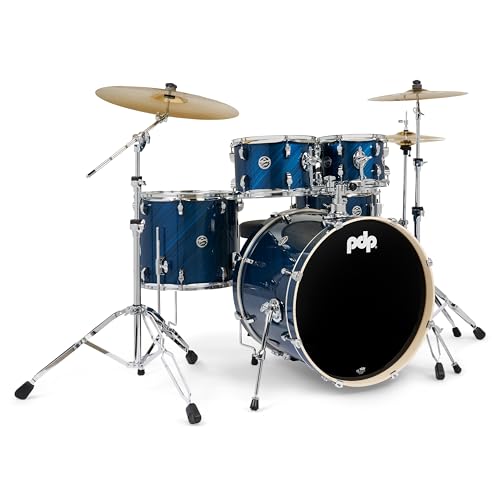
A shell pack is drums only. That sentence sounds obvious, yet a steady stream of buyers order a shell pack expecting a playable kit, because the product photo shows a complete setup with stands and cymbals arranged around the drums. The photo shows a configuration for illustration. The box holds the bass drum, the toms, the floor tom, usually a snare, the tom mounting hardware that attaches to the drums, and little else. To play it, the buyer still needs a bass drum pedal, a hi-hat stand, at least one or two cymbal stands, a snare stand, a throne, sticks, and a set of cymbals with a hi-hat pair, a crash, and a ride. Bought new, that list can approach or exceed the cost of the shell pack itself in the affordable band.
None of this makes shell packs a bad buy. For a player who already owns hardware and cymbals, a shell pack is the smartest way to buy, because every part of the budget goes into the drums and none of it duplicates stands already sitting in a hardware bag. It is also the right route for a player who wants to choose cymbals carefully, since cymbal taste is personal and the difference between a good and a poor ride cymbal shapes the sound of a kit more than almost any other single part. The trap is only a trap when the buyer does not know it exists. Before ordering any PDP kit, read the listing for the words shell pack or hardware included, and then read the included parts list in full. If the listing does not name a pedal and a throne, they are not in the box.
Complete kits invert the trade. Encore, Spectrum, Center Stage, and MainStage put everything in the box, so the total outlay is known on day one and the kit can be played at once. The compromise is that the included hardware and cymbals are built to a price, and they are the parts a growing player will replace first. That is an acceptable bargain for a beginner, whose technique will take a year or two to outgrow entry hardware, and a poor bargain for an experienced player returning to the instrument, who will feel the flex in a light stand and hear the limits of an entry cymbal immediately. The honest way to compare a complete kit against a shell pack plus separate hardware is to price both routes in full, including stands, pedal, throne, and cymbals, and then ask which route leaves the better set of parts after two years of playing.
Auditing the hardware in the box: stands, pedal, and throne
Hardware quality is where entry kits differ most from one another and where product photos tell the buyer the least. Start with the legs. Double braced legs use two struts per leg instead of one, which makes a stand stiffer, heavier, and far less likely to wobble or walk across the floor under a hard hitter. For a crash stand holding a heavy ride, and for the snare stand that takes the full force of every backbeat, double bracing is worth having. For a light splash stand it matters little. Entry PDP kits vary by model and year, so check the listing for bracing on the snare and hi-hat stands at minimum, and be aware that a stand that feels adequate for a ten year old beginner may flex badly under an adult playing rock.
The bass drum pedal decides how the kit feels under the right foot, and it is the included part most likely to be replaced early. A serviceable entry pedal has a chain or sturdy strap drive, a beater with two surfaces, and a spring tension adjustment that actually holds its setting. Warning signs in owner reports are a footboard that flexes side to side, a spring that loosens during play, and a clamp that will not grip the bass drum hoop firmly, which lets the pedal creep away mid song. A player does not need a high end pedal to learn on, but a pedal that fights back teaches poor foot technique, so if any single included part deserves an early upgrade on an entry kit, it is this one, ahead of a second crash cymbal and ahead of any finish matching accessory.
The throne is the most overlooked part of a kit and the one the player spends the most time on. A thin, small, wobbly seat makes long practice sessions uncomfortable and quietly shortens them. Look for a throne with a reasonably thick padded top, a threaded or firmly locking height post, and double braced legs. Height adjustment matters for posture: the player should sit with thighs roughly level or sloping slightly down from hip to knee, high enough that the arms reach the snare without hunching. Many entry thrones sit too low at their maximum height for tall adults, which is a detail worth checking in the specification if the player is over six feet tall. A better throne bought later is money well spent, and it is one of the few upgrades that helps every minute of playing rather than one part of the sound.
The cymbals in the box: brass, B8, and the disappointment to plan for
Here is the point where expectations need setting more plainly than anywhere else in this guide. The cymbals included with entry level complete kits are, with rare exceptions, made from brass or from B8 bronze, an alloy of roughly eight percent tin and the rest copper. Brass cymbals are the cheapest option: they are soft, they sound dull and gong like rather than shimmering, they dent and crack more easily, and most players outgrow them within months. B8 cymbals are a real step up, brighter and more durable, and the better entry sets use B8 for the whole set. Even so, a B8 set packed into a complete kit is built to a price and will not match the complexity, sustain, or feel of a cast B20 bronze cymbal of the kind used on professional recordings.
Why does this matter so much? Because cymbals are the one part of a drum kit that cannot be tuned, damped, or upgraded with a new head. A poor drum with a good head, tuned well, can sound genuinely good. A poor cymbal sounds like itself forever. New players often blame their drums for a harsh, cheap overall sound when the actual culprit is a brass crash with a short, clangy decay sitting above an otherwise decent kit. The fix is known and it is not cheap, which is why it belongs in the budget from the start: plan to replace the cymbals in stages, starting with the ride and hi-hats that get played on every song, then the main crash, treating the included set as a starter set that makes the kit playable while that plan runs.
Compact kits and the New Yorker: solving the space problem honestly
The New Yorker configuration is built around small shells, typically an 18 inch bass drum with a shallow depth, a 10 inch rack tom, a 13 inch floor tom, and a matching 13 inch snare in many runs, though exact sizes vary by year. The point of those numbers is not novelty. A shallow 18 inch bass drum takes far less floor space than a 22 by 18, it is light enough to carry through a venue door in one trip, and at low tuning tension it still produces a round, full note that suits acoustic music. The small toms tune high and clear, which flatters jazz, bossa, folk, and singer songwriter settings where the drums support rather than dominate.
Apartment playing is the use case most often raised and the one that needs the most honesty. A compact acoustic kit is still an acoustic kit: it is loud, and its bass drum will travel through a floor. Smaller shells reduce volume somewhat and make low volume playing more controllable, especially with lighter sticks, brushes, or rods, but they do not make an acoustic kit neighbor proof. What a compact kit genuinely solves is footprint, storage, and transport. It fits a corner, it stores in a closet with the toms nested, it rides in a small car, and it sets up on stages where a full kit physically cannot go. Buyers whose real problem is noise should look at mesh heads, low volume cymbals, or an electronic kit. Buyers whose real problem is space and carrying should look hard at the New Yorker and kits like it.
There are trade offs to accept with open eyes. A 13 inch snare has a higher, tighter voice than a 14 and a smaller target area, which some players love for brush work and others find limiting for a heavy backbeat. Small floor toms will not produce the deep rumble of a 16 inch drum no matter how they are tuned, because tuning a small shell very low produces a flabby note rather than a deep one. And compact kits hold their appeal in specific settings; a player whose main goal is a loud rock band will outgrow one. The right frame is that the New Yorker is a specialist tool that does its job very well, priced and built as a real instrument rather than a toy, and for the working player with a weekly small room gig it can earn its keep faster than any other kit in the range.
Snare drums and the Concept Select idea
The snare is the drum a player hears most, and PDP treats it as a product in its own right through the Concept Select line of metal snare drums. These are standalone snares in metals such as steel, aluminum, brass, and bronze style alloys depending on the model, typically in 14 inch diameters with depths around 5.5 to 6.5 inches and shells rolled or cast to a stated thickness. A metal shell gives a brighter, louder, more cutting voice than a wood shell of the same size, with a sharper rimshot and more ring to control. Steel leans bright and aggressive, aluminum leans dry and controlled, and brass leans warm for a metal drum with a strong fundamental note.
Why would a PDP buyer shop for a separate snare at all? Because the snare is the highest value single drum upgrade on any kit. Swapping the snare changes the backbeat on every song, while swapping a rack tom changes one voice among several. A player who bought an entry complete kit and has already fitted better heads will usually get more from a good metal snare than from any other single purchase of similar cost. The Concept Select range matters here because it puts that upgrade inside the same brand family, with the MAG style throw-off thinking and True-Pitch rods carried across, at a level below the flagship metal snares of the parent DW line.
First setup and tuning: a working method for your own kit
The following guidance is for setting up and tuning a kit you own, and it is the part of drum ownership that repays patience more than any purchase. Start with the room and the rug. Set the kit on a rug or carpet large enough for the bass drum and the throne, because the rug stops the bass drum and hi-hat stand from creeping forward and it gives the spurs something to grip. Place the throne first, sit at a height where your thighs are near level, and build the kit around your body rather than placing drums and then contorting to reach them. The snare goes between your knees, tilted slightly toward you, its top head roughly at belt height. Pedals go where your feet naturally rest, not where the bass drum happens to sit.
Seat a new head properly before tuning it. Fit the head and hoop, finger tighten every tension rod, then press firmly with the palm of your hand in the center of the head a few times to seat it on the bearing edge. From there, tune in a star pattern, moving to the rod opposite the one you just turned, in small increments of a quarter to a half turn. The star pattern keeps tension even as it rises, which prevents a warped hoop and a head that is tight on one side and slack on the other. Tap the head near each rod with a stick as you go, and adjust until the pitch at every rod matches. A head that is in tune with itself rings cleanly; a head that is uneven produces the wobbling, sour overtones that players often blame on the drum.
Tune the bottom head first on toms, because it sets the character of the note. A common starting method is to bring the bottom head to a clear, even pitch, then bring the top head to the same pitch for maximum resonance, slightly lower for a deeper and shorter note, or slightly higher for a brighter and more focused one. Tune toms in musical intervals that suit the sizes: a wide gap between a 10 inch and a 16 inch drum is natural, while a 12 and 13 forced far apart will fight each other. Keep the whole kit in a range where every drum still sounds like itself. Tuning any drum far below its natural range gives a papery slap, and tuning far above it gives a choked ping, and both problems are solved by moving back toward the middle rather than by adding more damping.
The bass drum benefits from a different approach. Most players tune the batter head just above the point where wrinkles disappear, for a punchy and controlled feel, and tune the front head a little higher for tone, with a pillow or folded blanket inside touching both heads lightly if the music calls for a short, dry thump. A small hole in the front head, offset from center, lets air escape, reduces bounce, and gives a microphone an easy home at a gig. The snare wants the most care of all: the bottom head is usually tuned fairly high and very even, the wires adjusted so they respond to a light tap without buzzing when the toms are struck, and the top head tuned to taste, lower for a fat backbeat and higher for a tight crack. Change one thing at a time, play for a few minutes between changes, and write down the settings that work, because a kit that can be returned to a known good tuning in ten minutes is worth more than a kit that sounded great once by accident.
The upgrade path that spends money in the right order
Every PDP kit, from a Center Stage to a Concept Maple, has a sensible upgrade order, and following it prevents the classic mistake of buying an expensive part while a cheap part is holding the whole kit back. The first upgrade, on any kit, is heads. The heads fitted at the factory on affordable kits are chosen for cost and durability in shipping as much as for sound, and they are often thin, single ply, and uneven in tone. A fresh set of quality batter heads, with a proper bass drum batter and a coated snare batter, transforms an entry kit more completely than any other change of similar cost. The drums tune more easily, the tone opens up, the snare gains body, and the player learns what the shells actually sound like, which informs every later decision.
The second upgrade for most players is cymbals, in the order described earlier: hi-hats and ride first, then the main crash, because those are the voices heard constantly. The third is the snare, or a second snare kept as an alternate voice, once the included drum has good heads and wires and still leaves the player wanting a different backbeat. The fourth is hardware, one stand at a time, starting with whichever included stand flexes, slips, or frustrates most often, and including the throne and pedal in that judgment rather than treating them as fixed. Notice what is not on this list: new shells. Players who follow the order above often discover that the kit they already own, with good heads and decent cymbals, covers their needs for years, and that the itch to replace the drums was really an itch to replace the parts around them.
PDP against the DW Design Series: knowing what the step up buys
The natural comparison for a Concept buyer is the DW Design Series, the entry line of the parent brand itself. Design Series kits are built to DW specifications with maple shells, DW hardware fittings, and a level of finish and quality control that sits above PDP, and they carry the DW badge and the resale strength that comes with it. The step up buys finer shell work, more consistent bearing edges, better chrome and finish quality, a wider choice of configurations and finishes, and hardware that a touring player can rely on without a second thought. It also buys entry into the DW ownership world of matching add on drums and parts support.
What the step up does not buy is a different category of sound that makes a Concept kit obsolete. A Concept Maple kit with good heads, tuned well, sits close enough in a live mix that most listeners in most rooms would not separate the two, and the player feels the difference mainly in hardware smoothness, tuning precision, and pride of ownership rather than in a transformed voice. That is precisely the value case for PDP, and it is the case the brand was created to make. A player with the budget for a Design Series kit who values the badge, the finish, and the finer details should buy it without guilt. A player whose budget must also cover cymbals, hardware, cases, and lessons will very often end up with the better overall rig by choosing Concept and spending the difference on the parts that surround the shells.
The same logic applies one tier down. A MainStage or Encore complete kit is not a failed Concept kit; it is a different answer for a player who needs everything in one box and whose playing is still developing. The mistake is not buying an entry kit. The mistake is buying an entry kit while expecting Concept shell quality, or buying a Concept shell pack while forgetting that stands, cymbals, pedal, and throne still have to come from somewhere. Every tier in this range is defensible when it is bought with clear eyes about what is in the box and what the next two years of playing will demand from it.
Check prices on Amazon
Live listings for the shortlist in this guide are pulled from Amazon below, so prices and availability are always current at the moment you look.


Choosing by player: a plain summary for each kind of buyer
For the complete beginner who owns nothing, a complete kit is the right shape of purchase. MainStage is the pick for an adult or older teen who wants a full size kit with the most musical included parts in this range, while Encore, Spectrum, and Center Stage serve younger players and tighter budgets where the priority is a playable kit that can be upgraded part by part. Choose the fusion sizes if the player is shorter or the room is small, and expect to budget for heads within the first year and cymbals after that.
For the returning player or the student moving up from lessons on a practice setup, Concept Maple is the center of the range and the default recommendation of this guide. It gives real maple shells, the DW derived mounts and strainer, fine pitch tuning rods, and a kit that will not need replacing as technique grows. Choose Concept Birch instead if the playing is mostly amplified, recorded, or in styles where a brighter and punchier attack is worth more than low end warmth. Buy the shell pack, add a hardware pack, and put the best affordable ride and hi-hats you can manage alongside it.
For the player short on space, or the working musician playing small rooms and acoustic sets, the New Yorker is the specialist answer, bought for its footprint and portability rather than as a budget shortcut. For the player who already owns a kit and wants the single most effective new voice, a Concept Select metal snare in the depth and metal that suits the music will do more than any comparably priced addition. And for every buyer in this range, the same closing advice holds: read the included parts list in full, decide the bass drum size from the room and the music rather than from a photo, keep the retailer listing and specification sheet for the exact configuration you ordered, and remember that retailer links in guides like this one may earn a commission that never adds anything to the amount a reader pays.
This article is based on published manufacturer documentation and specifications for the PDP and DW ranges, including series descriptions, shell materials, ply and size information, and hardware feature notes, together with general published references on drum shell materials and tuning practice. The writer has not directly used the products described, and no first hand playing impressions are claimed anywhere in this guide; where a judgment is offered, it follows from the published specifications and from how those specifications behave in ordinary playing situations. Specifications, configurations, finishes, and included parts change between production runs, so confirm the exact parts list for the kit you are considering before ordering. A drummer who picks sizes for the room, heads for the music, and cymbals with patience will find that the right PDP kit is the one still being played, gladly, long after the boxes it arrived in have been forgotten.


