Our Top Picks
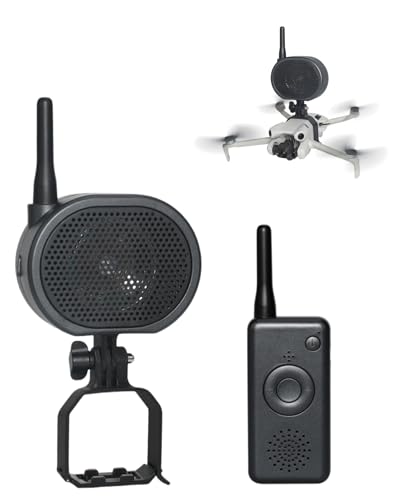
 Universal Drone Speaker Megaphone Loudspeaker Wireless Mini Speaker0.99 x 1 x 1 inches0.1 poundsCheck on Amazon
 Matrice 30/350 RTK Drone Spotlight with Speaker forMatrice 30/350 RTK4.8 x 6.42 x 2.68 inches0.5 poundsCheck on Amazon



What's inside
- What a drone loudspeaker payload actually contains
- Power, sensitivity, and the honest meaning of loudness figures
- Frequency response and why the voice band decides everything
- Mounting, weight, and what the payload costs in flight time
- Playback routes: recorded files, live voice, and text-to-speech
- Battery arrangements and the real cost of an hour of announcements
- Weather, wind, rotor noise, and the geometry of being understood
- Rules, safety, and courtesy when a voice comes from the sky
- Pairing the speaker with cameras, thermal imaging, and lights
- Choosing by scenario: four checklists that start from the job
- Ownership details that decide whether the payload gets used
- Check prices on Amazon
- Pulling the decision together
As an Amazon Associate I earn from qualifying purchases. This post may contain affiliate links at no extra cost to you.
A drone loudspeaker payload is a small powered speaker built to ride underneath or on top of an aircraft and throw a human voice across open ground. It is not a music speaker, and it is not meant for the pilot. The listener is a person on the ground who may be lost, injured, trespassing, working in a far corner of a field, or standing in a crowd that needs to move. The payload turns the drone from a camera that only watches into a tool that can also instruct, warn, and reassure. That single change alters how a flight is planned, because the aircraft now has to be heard clearly at the exact moment its camera finds something worth talking about.
The hardware itself is simple to describe and harder to judge. A typical unit combines a compact driver, a small amplifier, a control board, a battery or a power lead, and a mount shaped for a family of aircraft. Around that core sit the features that separate one model from another: a slot for a memory card, a radio link back to the controller, an app that converts typed text into speech, and a housing shaped to keep weather and dust away from the electronics. None of those parts is exotic on its own. The difficulty is that all of them have to work at altitude, in wind, over rotor noise, and within a strict weight budget that the aircraft was never originally designed around.
Search and rescue work shows the value most plainly. A ground team searching a riverbank, a flooded plain, or a wooded slope can cover only a narrow strip at walking pace. A drone with a camera can scan that same ground in minutes, and a drone with a loudspeaker can speak to the person it finds. A short recorded message played on a loop tells a missing walker to stay in place, wave both arms, and move toward open ground if it is safe to do so. That message matters because a frightened person who keeps moving can walk out of the search area faster than teams can redraw it. The voice from above also confirms to the casualty that the search is real and close, which changes behaviour in ways a flashing light never will.
Event and crowd work uses the same hardware for a different reason. Stewards at a festival, a marathon, or a stadium exit route often need to redirect people who cannot see a sign and cannot hear a ground announcement over general crowd noise. A drone positioned above a pinch point can repeat a calm instruction about which gate is open, which path is closed, and where medical help is standing. The message can be updated in minutes when a route changes, while printed signs and fixed tannoy points stay where they were installed. Used sparingly, the aerial announcement fills gaps rather than replacing the venue system, and it reaches the exact stretch of fence line or footpath where confusion is building.
Agriculture gives the payload a quieter, more routine job. Large fields, orchards, and livestock holdings have corners that a worker on foot reaches slowly. A loudspeaker drone can call seasonal workers in for a break, warn a tractor driver about a gate left open, or play recorded deterrent sounds where birds strip ripening fruit. For livestock, a familiar recorded voice or a short whistle pattern can nudge animals away from a broken fence line without sending a person across wet ground. None of this needs concert volume. It needs a voice that stays intelligible across a few hundred metres of open air, repeated reliably, flight after flight, through a working season.
Site security and perimeter work form the fourth common pattern. Industrial yards, solar farms, construction sites, and storage depots are large, fenced, and mostly empty at night. A patrol drone that only records an intruder produces evidence after the fact. A patrol drone that can speak produces a warning while the event is still happening: the site is monitored, the person has been seen, and they should leave by the main gate. Many operators report that a clear spoken warning ends a trespass without any confrontation at the fence. The recording from the camera still exists, but the loudspeaker is the part that changes what happens next.
Emergency managers add one more pattern, the moving evacuation instruction. After flooding, fire, or a chemical spill, the safe route through a neighbourhood can change street by street. Ground vehicles cannot always enter, and door knocking is slow. A loudspeaker drone can travel above the affected blocks repeating which streets to avoid and where the assembly point stands. The same approach serves lifeguards clearing a stretch of water, harbour staff warning paddleboarders away from a shipping lane, and park rangers moving visitors back from a cliff edge or a swollen river crossing. In every case the task is identical: deliver a short spoken instruction to people who are outdoors, scattered, and unlikely to be looking at a screen.
Clarity matters more than raw loudness in all of these jobs, and that point deserves emphasis before any specification is compared. A shout that arrives loud but smeared is useless. The listener needs words, and words live in consonants: the difference between fifteen and fifty, between stay and stray, between north gate and fourth gate. A payload that preserves consonants at distance will outperform a louder unit that turns speech into a blurred roar. Buyers who judge by the biggest wattage figure on the box routinely end up with the wrong tool, because the figure that predicts success is intelligibility at the listener position, not peak output beside the drone. Readers comparing aircraft for this work may also want our companion coverage of camera models in best affordable drones with cameras, since the camera and the speaker almost always fly together.
What a drone loudspeaker payload actually contains
Inside the housing, the signal chain runs from a stored file or a live feed through a small digital amplifier into a driver usually between two and four inches across. The driver sits behind a grille or a short horn flare that shapes how sound leaves the unit. A horn flare is common because it concentrates output into a cone aimed at the ground, trading wide coverage for greater reach along the axis the pilot can point. Some payloads add a second driver or a passive radiator, though on a flying speaker extra cone area competes directly with flight time, so most designs stay with a single efficient driver and careful enclosure tuning.
The control board handles file playback, volume, and the link to the ground. On simple units the board is little more than a card reader and a trigger input: load files before takeoff, then start and stop them from the controller. On richer units the board runs a small wireless receiver of its own, paired to a phone or a dedicated handset, so the pilot can speak live or send typed text for conversion to speech. The difference matters operationally. A card-only unit can never say anything that was not predicted before takeoff, while a linked unit can respond to what the camera is seeing in the moment.
Mounting hardware is the third element, and it is more varied than the electronics. Some payloads clamp to landing gear or a frame rail with padded jaws. Some slide into a quick-release bracket made for one aircraft family. Others hang from a small gimbal that keeps the speaker pointed at the ground even as the aircraft pitches forward in flight. Each approach carries a trade in weight, setup time, and how repeatably the speaker ends up aimed. A mount that takes five minutes of fiddling at the car will quietly discourage crews from flying the speaker at all, so setup friction is a real specification even though it never appears on a box.
Power, sensitivity, and the honest meaning of loudness figures
Speaker power is quoted in watts, and it is the most misread number in this product class. Wattage describes how much electrical power the amplifier can deliver to the driver, not how much sound reaches a listener. Two payloads rated at the same wattage can differ audibly because their drivers convert electricity into sound with different efficiency. A small driver in a tight enclosure might turn only a small fraction of its input into acoustic energy, with the rest lost as heat. Treat wattage as a rough guide to battery drain and heat, not as a promise about reach.
Sensitivity is the figure that connects power to actual sound. It is usually stated as a sound pressure level in decibels measured one metre from the speaker with a defined input. A higher sensitivity figure means the driver produces more sound from each watt, which is exactly what a weight-limited aircraft needs. When two payloads are compared, the sensitivity line tells more of the truth than the wattage line, because doubling amplifier power only adds a modest step in loudness, while a more efficient driver gains that step for free on every flight and without extra heat.
Peak and continuous ratings add another layer of fog. Some makers quote a peak figure the amplifier can reach for a fraction of a second, which flatters the headline while saying little about a thirty-second announcement. Speech has peaks of its own, in plosive consonants and stressed syllables, so a small amount of headroom is genuinely useful. Still, a buyer comparing payloads should look for the continuous or rated figure and treat any lone peak number as marketing decoration. If a listing gives only one wattage with no method attached, the safest reading is that the method chosen was the one that produced the largest number.
Sound pressure figures need the same scepticism about distance. A rating taken at one metre is a laboratory convenience, not a listening position. Outdoors, sound level falls steadily as distance grows, roughly halving in perceived terms over each doubling of distance in open air, before wind and ground effects have their say. A payload that measures impressively at one metre may be merely adequate at eighty metres, which is a realistic working distance for a drone holding a safe altitude over people or property. Honest makers publish a level at a stated distance or describe an effective range for speech. Vague claims about being heard across a kilometre should be read as best-case numbers for a quiet rural night, not a planning figure for a windy afternoon.
Effective range deserves its own definition. For this product class, range should mean the distance at which a listener with normal hearing can repeat back the words of a message, not the distance at which a faint noise is detectable. A tone or a siren carries far further than speech because the ear only has to notice it. Speech demands far more of the channel. When a specification sheet mixes the two, quoting tone reach beside voice features, the speech range is always the shorter and more relevant number, and it is often the one left unstated.
Directionality shapes range as much as power does. Most drone loudspeakers aim their output downward in a cone, so a listener directly below hears far more than a listener standing off to the side at the same distance. That is usually desirable: the pilot points the aircraft, and the message lands in a rough circle beneath it. But it also means a quoted range quietly assumes the listener is inside the cone. People at the edge of a crowd, offset from the hover point, may hear a noticeably weaker and duller version. Good operating practice therefore moves the drone to the audience rather than expecting the sound to bend toward them.
Frequency response and why the voice band decides everything
Human speech concentrates its meaning in a band that runs roughly from 500 hertz to 4 kilohertz. Vowels carry the power at the lower end, while consonants, the sounds that separate one word from another, live higher up and are far quieter. A loudspeaker payload designed for announcements can therefore be deliberately narrow. It does not need deep bass, and it does not need sparkling treble. It needs a strong, even response through the middle, with enough presence in the upper part of the voice band to keep consonants alive at distance.
That narrow focus explains why drone loudspeakers sound thin and harsh when heard up close on a workbench. The tuning that feels aggressive at arm’s length is the tuning that survives open air. Low frequencies demand cone movement and enclosure volume that a flying payload cannot spare, and they contribute almost nothing to whether a listener understands a sentence. Makers who chase a fuller, more musical sound usually sacrifice either weight or midrange output, and both trades hurt the actual mission. Judged as a voice tool rather than a music box, a bright forward midrange is a feature, not a flaw.
Air itself edits the frequency balance as sound travels. Higher frequencies are absorbed more readily over long paths, and the effect grows with distance and dry conditions. The practical result is that a message can arrive with its vowels intact and its consonants dulled, which is why distant speech often sounds like mumbling even when it is loud enough. Payloads that lift the upper voice band slightly compensate for that loss. Recordings help too: a speaker who articulates consonants crisply and avoids mumbling gives the payload far more to work with than a louder but lazier delivery.
Equalisation features, where offered, should be judged on whether they serve speech. A simple voice preset that trims low rumble and lifts presence is worth more than a row of music modes. Low-frequency content from wind handling noise or a poorly recorded file can consume amplifier power while adding nothing a listener can use, so a high-pass filter is quietly one of the most valuable circuits in the unit. Where the app allows custom settings, a gentle cut below roughly 300 hertz and a modest lift through the presence region is a sensible starting point for announcement work.
Siren and alarm tones sit apart from speech in this discussion. Many payloads include a set of attention tones, and those tones exploit the full output of the driver in a narrow band, which is why they carry so far. A tone is useful as a prelude: two seconds of tone tells people to listen, then the spoken message follows while attention is still raised. Relying on a tone alone communicates only urgency, with no instruction attached, and overuse trains regular audiences, such as site staff or event crowds, to ignore it. Tone first, words second, and silence after is the pattern that respects listeners.
Mounting, weight, and what the payload costs in flight time
Every gram on the aircraft is paid for in flight time, climb margin, and wind tolerance. Compact loudspeaker payloads for consumer and prosumer drones commonly sit in a band from about 80 to 200 grams, while units built for industrial platforms can run considerably heavier with larger drivers and their own substantial batteries. The correct comparison is not against zero but against the aircraft limit for payload and against the other equipment competing for that budget. A spotlight, a thermal camera, and a speaker rarely all fly together on a small airframe, so the loudspeaker decision is partly a decision about what stays on the ground.
Manufacturers of aircraft state a maximum takeoff weight, and responsible operators keep a margin below it. A drone flown at its absolute limit accelerates sluggishly, descends with less authority in turbulence, and drains its battery faster in every manoeuvre. Adding a loudspeaker near the limit can turn a dependable aircraft into a marginal one on a hot day at altitude, where thin air already taxes the motors. The specification to check is therefore threefold: payload weight, the aircraft rated limit, and the weight of everything else on the flight, including guards, lights, and any larger battery option fitted.
Mount style decides how repeatable that weight placement is. A dedicated quick-release bracket made for a specific airframe locks the speaker in one known position, aligned with the body, flight after flight. A universal clamp can fit many aircraft but invites small variations in angle and position each time it is fitted. Gimbal-mounted speakers add a stabilised platform that holds the aiming angle steady, at the cost of extra motors and mass. For a team flying one aircraft type daily, the dedicated bracket usually wins on speed and consistency. For a mixed fleet, a clamp with clear alignment marks is the pragmatic compromise.
Balance matters as much as total weight. A payload hung far forward or off to one side shifts the centre of gravity, and the flight controller compensates by working some motors harder than others. That compensation is invisible in calm air and costly in wind, where the harder-worked motors reach their limit first. Centred, close-coupled mounting keeps the speaker near the natural balance point and minimises the lever arm that gusts can grab. Operators should also route any power or data cable so it cannot foul a propeller or pull sideways on the mount when the aircraft yaws.
Flight time loss is rarely linear, so catalogue endurance figures need discounting. A drone quoted at forty minutes in still air with no payload might deliver thirty in a light breeze and noticeably less with a speaker fitted and the volume high, since a hard-working amplifier draws real current on units powered from the aircraft. Mission planning should use the shortest honest figure: the time the specific aircraft, carrying the specific payload, has repeatedly achieved in similar weather. Rescue and security work in particular should protect a generous landing reserve, because the flight that runs long is usually the flight that found something.
Compatibility claims need careful reading. A listing that names a popular drone family may mean a tested fit, a bracket that physically attaches, or merely that the weight is plausible. Mounting points, gimbal clearance, and downward sensor behaviour differ between generations of the same family. A speaker that blocks a downward vision sensor can upset landing precision and obstacle sensing, and a unit that sits in the gimbal arc can collide with the camera at extreme tilt. Checking the exact airframe variant, not just the family name, prevents the common disappointment of a payload that fits the marketing photo but fouls the real aircraft.
Playback routes: recorded files, live voice, and text-to-speech
Pre-recorded files on a memory card are the oldest and most dependable route. The operator prepares messages before the flight, names them clearly, and triggers them from the controller or a simple remote. Playback is instant, the wording is exactly as approved, and the delivery never stumbles. For regulated or sensitive work, that approval trail matters: a legal team, a venue safety officer, or a rescue coordinator can sign off the precise sentences that will be broadcast. The weakness is rigidity. A card holds yesterday’s plan, and the situation on the ground rarely matches it perfectly.
File discipline makes or breaks the card route. Messages should be short, one instruction per file, recorded in a consistent voice at a consistent level. File names should describe the content in plain words so a pilot under pressure is not guessing which track is the evacuation warning and which is the lost-child announcement. Storage is cheap, so carrying a small library organised by scenario is sensible, and the card itself should be treated as part of the kit, checked and refreshed like a battery. Guidance on choosing durable cards for drone work appears in best dji drone sd cards, and the same logic about write reliability applies when the card holds audio instead of video.
Live voice from the controller is the most flexible route and the most demanding. A microphone at the handset, a radio or network link to the aircraft, and the pilot or a second operator speaks as events unfold. Flexibility is total: names, descriptions, and changing directions can all be given in the moment. The costs are latency, link quality, and human performance. A delay of a second or more between speaking and hearing makes conversation impossible, though one-way announcements tolerate it well. A link that drops syllables at range can garble the very words that matter. And a speaker who is also flying must divide attention, which is why many crews assign the voice role to a second person standing beside the pilot.
Text-to-speech through an app sits between the two. The operator types a message, the system converts it to a synthetic voice, and the payload broadcasts it. Typing is slower than speaking but produces a calm, even delivery in any situation, and it works when the operator must stay quiet or when background noise at the control point would pollute a live recording. Quality varies widely between systems. The points to judge are pronunciation of place names and numbers, the ability to spell out a word phonetically when needed, and whether the voice remains clear when the sentence is long. A synthetic voice that mangles the name of the very street people must avoid is worse than no message.
Recording fresh audio on a phone at the scene is the fourth route, often overlooked. When an unexpected situation develops, a coordinator can record a thirty-second message in a quiet vehicle and transfer it to the payload or play it through a live link. This combines approved wording with same-day relevance. It also allows a familiar voice to be used: a teacher for schoolchildren, a site manager for their own workforce, a family member for a missing person. Familiarity carries trust that an anonymous synthetic voice cannot match, and in rescue work that trust can be the difference between a casualty who responds and one who hides.
Latency and reliability differ enough between routes that they should drive the purchase for some teams. Card playback has effectively no latency and no link to fail, so it suits long repetitive loops over a fixed area. Live links depend on the same radio environment as the video feed, and in cluttered urban spectrum both can suffer together, meaning the voice may break up at the exact moment the picture does. Text-to-speech adds processing delay before broadcast but then plays cleanly. A sensible professional setup layers the routes: card files for the core warnings, live or typed input for the specifics, so a link failure degrades the service instead of silencing it.
Message craft deserves as much attention as the hardware route. An aerial announcement should open with who is speaking and why, give one instruction, and close by saying the message will repeat. Sentences should be short, numbers should be spoken slowly and repeated, and directions should use landmarks people can see rather than compass points they may not know. The message should avoid jargon from the operating agency, because the listener does not share it. Writing the script on paper, reading it aloud at a natural pace, and timing it keeps most loops between fifteen and forty seconds, which is long enough to inform and short enough to be caught in full by someone who starts listening halfway through.
Battery arrangements and the real cost of an hour of announcements
Payloads draw power in one of two ways, and the choice shapes daily operations. A self-powered unit carries its own rechargeable cell, charged on the ground, usually through USB-C. It adds no electrical load to the aircraft and can even be used as a handheld loudspeaker during setup. Its weakness is a second battery to manage: a second state of charge to check, a second ageing curve to track, and a second thing that can be flat when the call comes. Aircraft-powered units draw from the flight battery through a connector or a powered mount. They simplify charging to one system and remove duplicate weight, but every minute of loud playback shortens the flight, and compatibility narrows to aircraft that expose a suitable power output.
Continuous playback time is the figure to compare, not standby time. A speaker that sits silently draws very little, so standby claims can stretch to many hours while meaning almost nothing. Announcement work is bursty in practice: a loop played for two minutes, silence while the drone repositions, another loop. Estimating a duty cycle honestly, perhaps a quarter to a third of flight time spent actually broadcasting, gives a far better planning number than either extreme. Teams should still confirm that the payload cell comfortably outlasts the number of flights planned between charges, with margin for the day that runs long.
Volume is the hidden variable in every battery calculation. An amplifier asked for maximum output on every message can draw several times the current it needs at a moderate level, and distortion rises along with drain. Working one step below maximum usually costs little in listener terms, because intelligibility depends more on clarity than on the final increment of level, while the saving in power and heat is substantial. Operators who treat maximum volume as the default setting are spending battery and driver life to buy distortion.
Weather, wind, rotor noise, and the geometry of being understood
Outdoor sound fights three opponents: distance, wind, and competing noise. Wind does not merely add background sound at the listener ear. A crosswind bends the path of sound and can carry a message away from the intended circle, while gusts create a fluctuating mask that swallows syllables unpredictably. Sound also travels differently with temperature layers, which is why a message can seem startlingly clear on a still evening and disappointingly thin on a breezy afternoon at the same measured distance. Planning ranges should come from the worst conditions the team intends to fly in, not the best morning of the year.
Rotor noise is the opponent the payload brings with it. The aircraft that carries the voice also produces a broadband whine and a rhythmic wash from its propellers, and that noise radiates in the same downward direction as the message. Listeners hear the two together, and the brain must separate a voice from a machine sound it may never have encountered at close range. Hovering slightly offset from the audience, rather than directly overhead, can improve the balance, because the speaker cone still points at the listeners while the worst of the rotor wash is directed elsewhere. A steady hover also beats constant repositioning, since movement smears the sound and distracts from the words.
Altitude is a negotiation between safety, law, and audibility. Higher flight widens the circle the message covers and keeps the aircraft clear of obstacles and people, but every extra metre of height taxes the sound level at the ground and gives wind more opportunity to interfere. Lower flight improves clarity and lets the camera read faces and clothing, yet it narrows coverage and can feel intimidating to the people below. Experienced crews treat altitude as a message variable: descend for the detailed instruction once people are located, climb for the wide-area loop that tells a whole field or beach to pay attention.
The tilt of the speaker decides where the cone actually lands. A fixed downward mount assumes a level hover, but a drone in forward flight pitches nose-down, and a drone holding position in wind tilts into the breeze. In both cases a rigidly mounted speaker ends up aiming ahead of or behind the intended spot. Gimbal-stabilised mounts correct for this automatically, which is their strongest argument. With a fixed mount, the pilot compensates by choosing hover points upwind and slightly beyond the audience, so the tilted cone and the drifting sound settle onto the listeners rather than short of them.
Weather sealing is described with ingress protection codes, where the first digit speaks of dust and the second of water. A payload intended for coastal rescue, farm work, or festival fields should shrug off drizzle and blowing dust without complaint, and the rating on the housing is only part of the story. Card slots, charging ports, and seams between housing halves are the weak points, and covers that fit poorly in gloved hands get left open. After wet flights, drying the unit with its ports open and checking the grille for mud or grass keeps the next flight as clear as the last. Sound that has to pass a grille clogged with field debris loses exactly the high-frequency detail the mission depends on.
For readers used to ground-based public address, the comparison is instructive. A fixed installation such as those covered in best 10 inch pa speakers can rely on mains power, a heavy cabinet, and a position chosen once and optimised. The drone payload gives up all three advantages in exchange for mobility. It goes to the audience instead of asking the audience to come within range, it repositions in seconds when the crowd moves, and it works in places with no infrastructure at all. Understanding that trade explains why drone speaker figures look modest beside ground equipment while the operational results can be better.
Larger ground systems, of the kind surveyed in best 12 active pa speakers, also show what the flying payload deliberately leaves behind: deep bass for music, wide stereo coverage, and the output to fill a hall. None of that serves an evacuation instruction over a flooded street. The drone unit is a specialist, closer to a flying megaphone than to a sound system, and it should be bought and judged as one. Teams that need both can pair them sensibly, with ground speakers holding fixed points such as gates and assembly areas while the drone covers the gaps between.
Rules, safety, and courtesy when a voice comes from the sky
A loudspeaker does not change the flight rules, but it changes how tempting certain flights become. The desire to deliver a message directly over a crowd can pull a pilot toward exactly the overhead position that aviation rules in many places restrict or forbid for aircraft of a given weight. The lawful pattern is usually to stand off to the side, use altitude and the speaker cone to reach the audience, and accept a small loss of clarity as the price of a legal flight. Operators must check the current rules for their own region and aircraft category, because permissions for flight over people, at night, and beyond visual line of sight vary widely and change over time.
Broadcast content can be regulated separately from the flight itself. Noise rules, advertising restrictions, and local bylaws may all bear on amplified sound in public space, and an announcement that is welcome during an emergency may be a nuisance complaint when used for routine promotion in a quiet neighbourhood. Commercial operators in particular should confirm what their area permits for aerial advertising and repeated announcements, and should keep messages factual and necessary. The payload is a public address tool with an unusually long reach, and using it considerately is part of keeping it available for the work that matters.
Privacy deserves deliberate thought. A drone that can speak can often also hear nothing at all, since most payloads carry no microphone, and operators should be ready to explain that distinction to a concerned public. Where a system does record audio at the control point, or where the camera records while the speaker plays, the team holds material gathered in public and sometimes in private-adjacent spaces such as gardens and yards during a search. Clear internal rules about retention, access, and deletion protect both the public and the operator. Announcing the purpose of the flight at the start of a broadcast, in plain language, also defuses suspicion better than any policy document.
Safety around the aircraft itself remains the first duty. A loud startling sound from directly overhead can make people look up, move suddenly, or step into a road, so the first broadcast over a new group should be gentle in volume and clear in intent. Livestock and horses react to both the aircraft and the voice, and agricultural operators should introduce the combination gradually where animals are involved. The speaker should never be used to harass wildlife or to move animals toward a hazard. Finally, the payload must never distract the pilot at a critical moment: message triggers belong in the pre-flight plan, with playback points briefed before takeoff, so no one is scrolling a file list while the aircraft is low and busy.
Pairing the speaker with cameras, thermal imaging, and lights
The loudspeaker earns its keep as part of a workflow, not as a solo instrument. The common rescue sequence runs in four beats: the camera finds a heat signature or a figure, the aircraft marks the position, the speaker delivers instructions to that spot, and the camera watches for the response. A wave, a move into open ground, or a light flashed back confirms the message landed. Without the voice, the sequence stalls at observation. Without the camera, the voice is broadcasting blind. Buying decisions should therefore weigh how the payload integrates with the camera system already in use: shared controller screens, a single app, and triggers that do not force the pilot to swap devices mid-flight.
Thermal imaging sharpens the partnership at night and in cover. A thermal camera can locate a person in scrub, woodland edge, or rubble where a visual camera sees nothing, but a thermal picture cannot tell that person anything. The speaker closes the loop, guiding the casualty to stay put, to move toward a visible light, or to make noise so ground teams can home in. In wildfire and flood work the same pairing lets crews check an area for remaining occupants and then speak to anyone found, street by street, without sending people into the hazard to knock on doors.
Some payloads combine the speaker with a spotlight in one housing, and the combination is more than a convenience. A light marks the spot the voice is addressing, giving listeners a visual anchor for instructions such as move toward the light or stay inside the lit area. At night the light also signals the aircraft position to other air users and to ground teams. The trade is weight and power: two payloads in one shell share a battery and a mount, and the combined unit is heavier than either alone. For small aircraft the separate, lighter speaker often remains the better choice, with lighting left to the aircraft own lamps or a second dedicated flight.
Coordination with ground teams completes the workflow. The drone announcement should tell people what the ground team needs them to do, in the same words the ground team is using, so a casualty hears one consistent instruction from the sky and later from a rescuer. Radio discipline between the pilot, the voice operator, and the ground coordinator prevents overlapping or contradictory messages. A simple shared script, agreed before the flight and amended by one named person, keeps the aerial voice aligned with the operation as it develops. After the flight, the log of what was broadcast, when, and over which location becomes part of the operational record, as valuable as the video file.
Choosing by scenario: four checklists that start from the job
Search and rescue
- Prioritise speech clarity at distance over headline wattage, with a strong presence band for consonants.
- Choose card playback plus a live or typed route, so approved loops and specific instructions are both available.
- Confirm the mount keeps downward sensors clear and the speaker aimed in a windy hover.
- Check total payload weight against the reserve flight time the team policy demands.
- Prepare scripts for found-person, stay-in-place, and move-to-open-ground messages before they are needed.
- Favour weather sealing suited to rain, river spray, and night dew.
Rescue work also rewards simplicity under stress. Controls that can be operated by a cold, gloved, tired crew member at three in the morning are worth more than a deep menu of sound effects. A single button that plays the primary loop, a second that stops it, and a clear indication of what is playing cover most of the real need. Everything else is secondary to a message that starts on time and says the right words.
Events and crowd guidance
- Look for fast message updating, since routes, gates, and timings change through the day.
- Value even coverage of a wide circle for short instructions over extreme reach in one direction.
- Plan standoff positions that keep the flight lawful over and near crowds.
- Prepare multilingual versions of core messages where the audience calls for them.
- Agree volume discipline with the venue so aerial messages support rather than fight the fixed system.
- Keep a tone signal for attention, followed immediately by the spoken instruction.
Event work is repetitive by design, and repetition is where card libraries shine. A set of calm, pre-approved announcements in a consistent voice builds audience trust through the day. The live route then handles the exceptions: a found child described by clothing, a gate closing early, a medical point moving. Crews should rehearse the handover between recorded and live messages so the change of voice does not startle or confuse the crowd.
Agriculture and land management
- Weight durability and sealing highly, since dust, chaff, and early-morning damp are daily conditions.
- Choose simple, robust mounting that tolerates frequent fitting and removal in the field.
- Value battery arrangements that match the farm charging setup already in the vehicle or barn.
- Keep messages short and familiar for workers and, where relevant, for animals used to a known voice.
- Confirm range across open ground rather than headline figures, since fields are the working environment.
- Store the payload in the vehicle kit so it is present for unplanned jobs, not only scheduled flights.
Farm use also benefits from modest expectations properly met. Most agricultural messages travel a few hundred metres over open ground to people who are expecting to hear them. A mid-range payload that survives seasons of dust and knocks will serve better than a delicate flagship. The buying question is less about maximum performance and more about whether the unit will still be working, charged, and in the truck in its third year.
Security and perimeter patrol
- Prioritise a live voice route, because a specific warning to a specific person carries the deterrent effect.
- Pair the speaker decision with the night camera and lighting plan for the same aircraft.
- Confirm the link range matches the patrol route, including the far corners of the site.
- Keep warning scripts factual and measured, naming the site, the observation, and the requested action.
- Log each broadcast with time and location as part of the patrol record.
- Check standby draw and wake behaviour, since patrol payloads sit idle for long stretches between events.
Security operators should also think about escalation. The aerial warning sits between silent observation and sending staff to a confrontation, and its wording should reflect that middle position: firm, polite, and clear about what happens next. A warning that promises a response the site cannot deliver teaches intruders to ignore the voice. Consistency between the message and the real follow-up is what gives the payload its long-term deterrent value.
Ownership details that decide whether the payload gets used
Firmware and app support quietly determine the working life of a connected payload. Text-to-speech voices, file handling, and link behaviour all live in software, and a maker who maintains the app keeps the hardware useful as phones and controllers change. Before choosing a unit, check how recently its app was updated, whether the payload firmware can be updated by the owner, and whether core card playback keeps working with no app at all. A speaker that still plays its card library when the app fails is a resilient tool. A speaker that becomes a paperweight when a login server closes is a liability in a response kit.
Storage and transport round out ownership. The payload should travel in the same case as the aircraft, in a fitted slot, with its card fitted and its cell at a sensible storage charge. A unit carried loose in a vehicle footwell arrives with a damaged grille and a flat battery. Labelling the case position, keeping the charging cable in the same case, and adding the payload to the existing pre-flight checklist all take minutes to arrange and save the flight that would otherwise be abandoned at the launch point. Equipment that is easy to bring is equipment that gets brought, and a loudspeaker only helps on the flights it attends.
Training closes the loop between owning the payload and benefiting from it. Pilots need practice judging how loud a message is at the listener position, which cannot be judged from beside the controller, so early exercises should place a colleague at distance with a radio to report what actually arrived. Voice operators need practice writing and delivering short scripts under time pressure. Crews need a shared vocabulary for requesting messages, so a ground coordinator can call for the evacuation loop by name and hear exactly the file expected. None of this requires the aircraft to leave the ground for long, and an afternoon of it improves real operations more than a modest step up in hardware would.
Check prices on Amazon
Live listings for the shortlist in this guide are pulled from Amazon below, so prices and availability are always current at the moment you look.


Pulling the decision together
The strongest buying approach for this product class starts from the listener and works backwards. Picture the person who must understand the message: where they are standing, what noise surrounds them, how far the drone must hold off, and what the weather is doing. That picture sets the clarity and reach genuinely needed. From there, check the aircraft: the weight budget, the mount that fits the exact airframe, the sensors that must stay clear, and the flight time that remains after the payload is fitted. Only then compare the announcement features, playback routes, battery arrangements, and sealing, in the order the intended scenario will actually use them.
Headline figures should be read last and trusted least. Wattage without sensitivity, range without a definition, and flight time without a payload condition are decorations rather than data. The specifications that predict success are sensitivity, a response shaped for the voice band, an honest speech range, a mount that holds aim in wind, and a playback route that matches the crew structure. A payload that scores well on those five points will serve across rescue, event, farm, and security work with only its script library changing between jobs.
One disclosure belongs on this page: some links on this page may earn the site a commission from the retailer at no added cost to the reader, and that arrangement never changes which payload characteristics this guide treats as important.
When the wind drops over a dark field and a small lit aircraft holds its position while a calm, familiar voice tells a lost walker exactly where to stand and that help is walking toward the light, the whole chain of mount, battery, file, and frequency choices either delivers that sentence intact or it does not, and nothing else about the equipment matters half as much.

