What's inside
- Where to buy
- Key Takeaways
- Quick Picks
- How did we choose these ceiling speakers?
- What does 70V actually mean, and why do commercial ceilings use it?
- Which 70V ceiling speakers should you compare side by side?
- How do you size an amplifier and plan taps for a real building?
- What mistakes do first-time 70V buyers make?
- How do real buildings zone a system like this?
- What happens during a careful installation, step by step?
- Why does paging change what a good ceiling speaker is?
- What keeps a distributed system sounding right for a decade?
- Final Recommendation
- Frequently Asked Questions
- Related Guides
As an Amazon Associate I earn from qualifying purchases. This post may contain affiliate links at no extra cost to you.
gizmoverdict.com is reader-supported. When you buy through links on our site, we may earn an affiliate commission.
Where to buy
Every speaker ranked here is sold through Amazon’s US store, and the buying units differ more than the model names suggest: some listings are a single ceiling speaker, others are contractor packs of eight or ten, and one is a simple pair. Read the unit count before you read anything else, because a distributed-audio job is planned in ceilings, not in boxes. The six picks below cover the realistic spread of commercial background-music and paging work, from a single replacement speaker in a dental office to a ten-speaker pack that can wire a whole restaurant floor in one purchase.
The best 70v ceiling speakers are not hi-fi speakers, and judging them like hi-fi speakers is the fastest way to buy the wrong thing. A 70-volt system is a wiring architecture before it is a product category: one amplifier feeds a long chain of speakers, each speaker carries a small transformer, and each transformer is set — tapped — to draw a chosen number of watts from the line. The music stays at a calm, even level across a big space, announcements cut through everywhere at once, and nobody has to run a separate amplifier channel for every room. Cafes, clinics, warehouses, school corridors, hotel lobbies and retail floors all run on this idea because it scales gracefully and fails gracefully.
That framing decides what this guide rewards. Output at conversation-plus level matters more than bass extension. Tap flexibility matters because a speaker near the till may need to play louder than one over a quiet treatment room. Pack sizes matter because labour, not hardware, dominates the cost of a ceiling job, and opening ten matched boxes beats chasing ten separate deliveries. What does not matter much: the kind of audiophile detail retrieval that a quiet listening room reveals, because a tiled commercial ceiling over espresso-machine noise will never reveal it. Buy for even coverage, intelligible paging and a total load your amplifier can carry with headroom, and a 70V system will sound quietly professional for years.
Key Takeaways
- Do the load maths before choosing models: add every speaker’s tap setting together, then keep that total comfortably below the amplifier’s rated output so the system has headroom.
- The JBL CSS8008 is the reference single speaker here — an 8-inch driver with a multi-tap transformer covering 70V, 100V and 25V lines, bought one at a time for replacements and small rooms.
- Rockville’s two packs attack the same job from opposite ends: the CCL6T eight-pack for gentle background level, the CC65T ten-pack when some zones need real presence.
- An 8-inch cone moves more air than a 6-inch one and fills taller ceilings more easily, but in low ceilings a smaller speaker tapped sensibly disappears better, visually and sonically.
- The OSD Audio pick is the fine-adjustment specialist: its low tap settings, starting under a watt, suit quiet rooms where a normal speaker’s lowest step is already too loud.
- Singles, pairs and contractor packs are different purchases wearing similar names — count the ceilings in the building, not the speakers in the product photo.
Quick Picks
| Pick | Badge | Why it earns its place |
|---|---|---|
| JBL CSS8008 | Best single speaker | A proper commercial 8-inch unit from a pro-audio maker, with a multi-tap transformer that also speaks 100V and 25V for mixed legacy systems. |
| Rockville CCL6T 8-Pack | Best for wide, gentle coverage | Eight matched 6-inch speakers with simple 2.5, 5 and 10-watt taps — a whole small venue’s worth of background music in one carton. |
| Rockville CC65T 10-Pack | Best for larger floors | Ten 6.5-inch speakers whose taps climb to 20 watts, plus an 8-ohm bypass, so busy zones can be driven harder from the same line. |
| Parts Express 8-Inch | Best straightforward replacement | An unpretentious 8-inch speaker with a 70V transformer that drops into existing grids when one old unit dies and the system must match. |
| OSD Audio 8-Inch | Best for quiet rooms | Tap steps that start at a fraction of a watt let treatment rooms, offices and corridors sit at a genuine whisper under the rest of the system. |
| Pyle 8-Inch Pair | Best small-space pair | A two-way pair with a 70V transformer for the single-room job — a small cafe or studio that needs two speakers and no contractor arithmetic. |
How did we choose these ceiling speakers?
We started from the installer’s clipboard rather than the audiophile’s armchair. A commercial ceiling speaker succeeds when the coverage is even, the paging is intelligible at the far table, the total tap load leaves the amplifier unstressed, and the grille disappears into the ceiling tile grid. Every pick here was judged against those four tests first, and only then on sound character. That is why this list contains contractor packs alongside single speakers: the right buying unit is part of the product.
Transformer quality quietly separates the serious entries from the decorative ones. A well-made tap transformer delivers its stated watts without thinning the sound at low settings, and it offers enough steps to balance one room against another. We favoured speakers whose tap ranges solve real zoning problems — a loud kitchen pass versus a hushed waiting area — over speakers that merely offer a transformer as a checkbox. Driver size was weighed against ceiling height: taller spaces and noisier floors justify the 8-inch entries, while low, quiet ceilings are better served by the smaller cones.
We also refused to pretend these are music-critical speakers. None of the six will replace a good pair of bookshelf speakers in a listening room, and none is trying to. Their design centre is speech clarity and pleasant, fatigue-free background music at modest levels, hour after hour, in rooms full of hard surfaces and competing noise. Judged on that honest brief, the differences below are real: tap granularity, pack economics, driver size and the plain competence of the company standing behind the product.
What does 70V actually mean, and why do commercial ceilings use it?
In an ordinary home system, the amplifier connects directly to each speaker, and long cable runs waste power and complicate everything. A 70V system inserts a transformer at both ends of the problem. The amplifier drives a constant-voltage line — the 70-volt figure describes the line’s full-output level — and each speaker’s own transformer steps that voltage down, drawing only the watts its tap is set to. Speakers are wired in parallel along the run, one after another, like lights on a circuit. Add a speaker and you add its tap watts to the total; the wiring plan is arithmetic, not electronics.
The practical gifts are threefold. First, distance: a 70V line can run the length of a warehouse without the losses that would cripple a direct low-impedance run. Second, zoning by wattage: the dining room speakers can be tapped at 10 watts while the corridor speakers idle at 2.5, all from the same amplifier and the same volume control. Third, simplicity: one amplifier, one or two long runs, and no impedance puzzles when the tenth speaker joins the chain. The cost of the design is a ceiling on fidelity — the transformers that make the system flexible also soften deep bass and fine detail — which is why this technology owns commercial ceilings and almost never appears in dedicated listening rooms.
Total-load maths is the one skill the buyer must bring. Suppose an amplifier is rated at 120 watts on its 70V output. Ten speakers tapped at 10 watts each draw 100 watts in total, which leaves too little margin for comfort; the same ten speakers at 7.5 or 5 watts would sit happily. Experienced installers keep the summed taps at roughly eighty percent of the amplifier’s rating or lower, because a system run at its absolute limit sounds strained exactly when the room fills up and the volume creeps upward. Every tap figure quoted in the pick sections below exists to feed that one calculation.
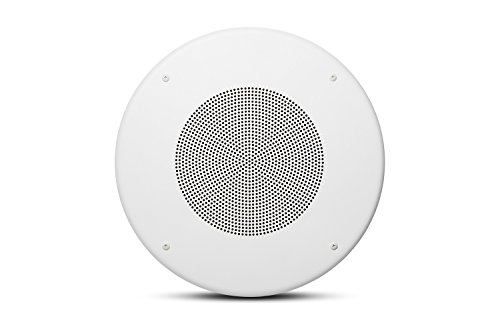
JBL CSS8008 — Best single speaker
The CSS8008 comes from JBL’s Commercial Series, and that lineage shows in the priorities: this is an 8-inch ceiling speaker built for speech intelligibility and dependable background music in spaces that earn money. The larger cone gives it an easy authority at low levels — announcements land with a chest to them rather than a tinny rattle — and in a lobby or retail floor with a high ceiling, that extra cone area is the difference between turning the system up and leaving it where conversation stays comfortable. Bought singly, it is the natural choice for replacing one failed speaker in an existing JBL-voiced system, or for a small room that needs a single, competent voice.
Its transformer is the other half of the appeal. The multi-tap unit handles 70V and 100V distribution and can also run on 25V lines, which matters in older buildings — schools especially — where legacy 25V infrastructure still lives in the ceiling. A speaker that speaks all three dialects saves the installer from stocking variants and saves the building owner from a forced rewiring when one zone is modernised. At its 5-watt class tap settings it is not the loudest option in this guide, and it is not meant to be: it is voiced for the level at which background systems actually live, where clarity per watt beats raw output.
There is also a steadiness to how this speaker behaves across a long day that cheaper units do not always match. Background systems run ten or twelve hours at a stretch, and a transformer that is merely adequate can warm up, drift and subtly thin out by mid-afternoon. The Commercial Series brief assumes exactly that duty cycle — airports, malls and campuses do not power-cycle their ceilings — so the CSS8008 is engineered to sound at hour ten the way it sounded at hour one. Owners rarely articulate that quality, but they feel its absence in systems that seem to get tired, and it is a large part of why the JBL name recurs in professional specifications for unglamorous rooms.
- Driver: 8-inch ceiling speaker, sold singly
- Transformer: multi-tap, for 100V, 70V and 25V lines
- Tap class: 5-watt multi-tap transformer
- Series: JBL Professional Commercial Series (CSS)
- Buying unit: single speaker — order the count your ceiling plan needs
Strengths
- Pro-audio voicing that keeps paging announcements crisp at modest tap settings, even across a noisy lobby.
- Triple-voltage transformer compatibility makes it the safest replacement speaker in mixed or legacy buildings.
- The 8-inch driver fills taller ceilings without strain, so the system volume can stay civilised.
Trade-offs
- Sold one at a time, so a whole-floor job means a long order line and no pack discount.
- Its tap ceiling is modest; a genuinely loud zone, like a bar area, will want the higher-tap Rockville pack instead.
- Commercial plainness is the aesthetic — the grille is neat and white, but nobody will call it a design feature.
Best for: facilities managers replacing speakers in an existing system, and small commercial rooms that need one trustworthy voice. Not suited for: buyers wiring a dozen ceilings at once, who should price the contractor packs first.

Rockville CCL6T 8-Pack — Best for wide, gentle coverage
Eight matched speakers change the planning conversation. Instead of asking which single speaker to buy, you ask how a room should be zoned — and the CCL6T pack is built for the most common answer: lots of gentle sources spread evenly, none of them working hard. Six-inch drivers at 2.5, 5 or 10 watts apiece, distributed across a cafe or clinic ceiling, produce that upholstered, everywhere-and-nowhere background level that customers notice only when it stops. Eight speakers tapped at 5 watts draw 40 watts in total, a load a modest commercial amplifier carries without thinking about it.
The three-step tap range is deliberately simple, and for background duty simplicity is a feature. There is no fiddly dial to mis-set by one notch; the installer picks the room’s level, repeats it eight times, and the system balances itself by symmetry. Where this pack reaches its limit is presence: a speaker capped at a 10-watt tap will not cut announcements over a Friday-night dining room at full chatter, and the 6-inch cone will not fake it. Treat the CCL6T as the quiet majority of a system — the coverage layer — and, in a loud venue, pair the plan with a higher-tapped zone near the bar or counter rather than asking these to shout.
Coverage pattern is where an eight-pack quietly outperforms a pair of larger speakers asked to cover the same floor. Six-inch cones spaced a few metres apart overlap gently, so the level at any table is the sum of several distant sources rather than one near one — the sound feels like weather, not like a radio in the corner. That evenness is precisely what background music is for: no customer asks to move tables because the music is in their ear, and staff working an eight-hour shift are not fatigued by a hot spot near the pass. The pack’s real specification is not any single speaker’s output; it is the uniformity the set produces together.
- Driver: 6-inch, two-way ceiling speaker design
- Transformer taps: 2.5W, 5W, 10W
- Buying unit: pack of eight matched speakers
- Finish: white, for standard ceiling grids
- Intended duty: background music and paging in commercial rooms
Strengths
- Eight identical speakers make even coverage easy — symmetry does the acoustic balancing for you.
- Simple three-step taps are hard to misconfigure, which matters when an installer is on a ladder all day.
- One carton, one delivery, one spare-speaker conversation: the pack logistics suit small venues perfectly.
Trade-offs
- The 10-watt top tap runs out of authority in genuinely noisy rooms at peak hours.
- No 8-ohm bypass, so these live on the 70V line permanently — no repurposing them for a home amp later.
- If your ceiling count is five, you are buying three spares whether you wanted them or not.
Best for: cafes, salons, clinics and small shops that want a whole ceiling of calm background sound from one purchase. Not suited for: loud bars or gyms where announcements must punch through crowd noise.

Rockville CC65T 10-Pack — Best for larger floors
The CC65T pack is the CCL6T idea grown up and given a wider dynamic range. Ten 6.5-inch speakers arrive in the carton, and each carries a tap selector that climbs through 2.5, 5, 10, 15 and 20 watts — so a single purchase can serve a hushed corridor at the bottom step and a clattering food hall at the top, all on one amplifier line. Ten speakers mixed across those settings might draw, say, 90 watts in a big venue; the installer does that sum zone by zone, which is exactly the workflow this pack is designed around. The slightly larger cone helps too, filling the gap between the nimble 6-inch packs and the full 8-inch singles.
The 8-ohm bypass deserves its sentence: each speaker can run directly at 8 ohms, rated at 40 watts in that mode, which gives the pack a second life outside the 70V world. A zone that later gets its own small amplifier, or a test bench check before the ceiling closes, becomes simple. Flexibility like that is why this is the pack we would hand to a growing business — a restaurant group fitting out a second location, a warehouse adding a mezzanine — where the system that goes in this year will not be the system boundary next year. It is still background-and-paging equipment, voiced for clarity rather than thrills, but within that brief it is the most adaptable hardware in this guide.
Think of the tap ladder as this pack’s zoning department. In practice, an installer fitting out a leisure centre might tap the changing-room corridor at 2.5 watts, the cafe at 10, and the poolside-adjacent seating — loud, tiled, echoing — at 20, and all three decisions live in the same carton of speakers bought on the same invoice. Systems built from single-tap-class speakers force those compromises into extra hardware: attenuators, extra amplifier channels, extra line items. The CC65T absorbs them into a selector switch on each unit, which is why, speaker for speaker, it tends to end up the cheapest route to a genuinely multi-level building even before its pack pricing is counted.
- Driver: 6.5-inch ceiling speaker
- Transformer taps: 2.5W, 5W, 10W, 15W, 20W
- Direct mode: 8-ohm bypass, 40W rating
- Buying unit: pack of ten matched speakers
- Finish: white
Strengths
- The widest tap ladder here — quiet zones and loud zones served from one carton and one amplifier line.
- Ten units cover a serious floor plate, and matched spares come built into the arithmetic.
- 8-ohm bypass future-proofs the purchase against layout changes and amplifier swaps.
Trade-offs
- Twenty watts per speaker makes load maths less forgiving — tap a whole floor at the top step and you will outrun a small amp.
- Ten is a commitment; a four-ceiling shop is paying for coverage it cannot use.
- At high taps in a reflective room, background music can turn insistent — the flexibility cuts both ways.
Best for: larger restaurants, warehouses, gyms’ quieter zones and multi-room offices planning one system with varied zone levels. Not suited for: single-room installs, where the pair or a couple of singles cost less and do the same job.
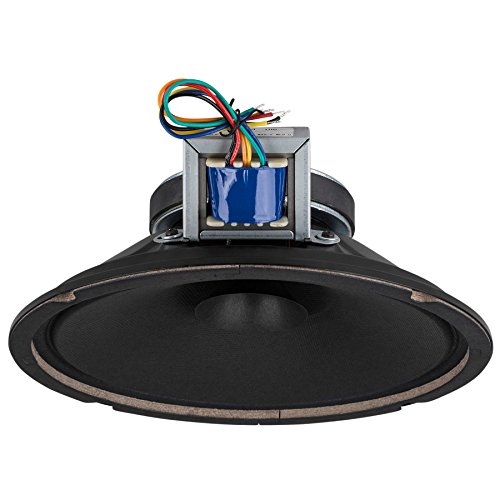
Parts Express 8-Inch Ceiling Speaker — Best straightforward replacement
Parts Express built its name supplying drivers and components to people who fix and build audio gear, and this speaker carries that DNA: an 8-inch ceiling unit with a 70V transformer, sold singly, described plainly, priced for the job rather than the brand story. Its natural habitat is the replacement run — the school corridor where one speaker in a row of nine has gone silent, the office where a water stain took a grille and a cone with it. An 8-inch driver at a sensible tap blends with the surviving neighbours in most legacy systems, because the installed base of commercial ceiling audio is dominated by exactly this format.
What you give up versus the JBL is pedigree and the triple-voltage trick; what you gain is a no-drama purchase that a maintenance budget approves without a meeting. Sound character is honest background fare: speech sits forward, music stays pleasant and unobtrusive, and deep bass is simply not on the menu, as with every pick here. For a facilities team, the deeper virtue is availability of a standard thing — when a ceiling speaker dies the week of an inspection, the correct product is the one that arrives quickly, fits the hole and matches the line. This is that product, and guides should say so without embarrassment.
Replacement duty also rewards a speaker that asks few questions. When the call is “the back corridor has been silent for a month,” the technician wants a unit that fits the existing hole, accepts the existing line, and matches the neighbours closely enough that nobody standing under the join can tell where old system ends and new speaker begins. Standard-format 8-inch commercial speakers are unusually interchangeable in exactly those respects, and this Parts Express unit leans into that interchangeability rather than chasing a distinctive voice. In a category where distinctiveness is usually a liability above a ceiling, that restraint is a professional virtue, and it keeps this unglamorous speaker permanently employable.
- Driver: 8-inch ceiling speaker
- Transformer: built-in 70V transformer for distributed lines
- Buying unit: single speaker
- Intended duty: background music and paging
- Supplier character: parts-and-components specialist
Strengths
- The standard 8-inch format drops into the widest range of existing cutouts and systems.
- Plain specification and plain pricing suit maintenance budgets and one-off replacements.
- Speech-forward balance keeps paging clear without pushing the system level up.
Trade-offs
- No multi-voltage versatility — check that your line is 70V before ordering, because that is the whole offer.
- Single-unit buying means big new installs should price the packs before defaulting to a pile of these.
- Finish and grille detailing are functional rather than polished; designer-led interiors may prefer the JBL’s tidier face.
Best for: maintenance teams replacing failed speakers and small top-up jobs on existing 70V systems. Not suited for: new-build projects where pack pricing and matched sets matter more.

OSD Audio 8-Inch 70V Ceiling Speaker — Best for quiet rooms
Every other speaker in this guide treats low taps as an afterthought; the OSD treats them as the point. Its built-in 5-watt transformer offers settings that descend to a third of a watt — 0.32W at the bottom of the ladder — which sounds like a spec-sheet curiosity until you have sat in a treatment room, a counselling office or a hospital side room where the neighbouring zone’s idea of background level feels like an intrusion. Speakers tapped this low can share an amplifier and a volume setting with a lively reception area while contributing little more than a murmur where quiet is a clinical requirement, not a preference.
The speaker around that transformer is a conventional 8-inch commercial unit, also happy on 25V lines, which broadens its replacement market in older institutional buildings. Its ceiling is equally clear: a five-watt transformer is a five-watt transformer, and no tap setting will make this speaker announce over a cafeteria. That is not a flaw in context — it is the trade that buys the fine low-end control. System designers often solve the quiet-room problem with separate volume controls and extra wiring; the OSD solves it with tap granularity, inside the speaker, for the price of one unit. In buildings with mixed loud and hushed rooms — clinics above all — that is the neatest trick in this entire guide.
The fractional taps repay a moment’s arithmetic. A speaker set to a third of a watt is drawing so little that dozens of quiet rooms can hang on a system whose headline zones consume nearly all the amplifier’s capacity — the quiet rooms are, in load terms, almost free. That flips the usual design anxiety: instead of rationing speakers in hushed spaces, the designer can afford one per room, properly placed, rather than a single louder speaker in a corridor leaking sound through doorways unevenly. Privacy benefits too, since a whisper of music inside a consultation room masks the murmur of the next room’s conversation better than silence punctuated by audible fragments.
- Driver: 8-inch commercial ceiling speaker
- Transformer: built-in 5W transformer, 70V/25V
- Tap range: steps from 0.32W up to 5W
- Buying unit: single speaker
- Finish: white
Strengths
- Fraction-of-a-watt taps deliver genuinely quiet zones on a shared line — unmatched elsewhere in this list.
- Dual 70V/25V compatibility fits both modern and legacy institutional systems.
- Lets designers balance loud and hushed rooms by tap alone, skipping extra zone hardware.
Trade-offs
- Five watts maximum means it cannot serve a noisy zone, full stop — plan its rooms accordingly.
- The fine low taps are wasted in uniformly loud venues, where the Rockville packs are better value.
- Sold singly, so a clinic with many quiet rooms still faces a per-unit order.
Best for: clinics, spas, professional offices and any building where some rooms must stay near-silent while others play music. Not suited for: primary coverage of loud, open commercial floors.

Pyle 8-Inch Ceiling Speakers Pair — Best small-space pair
Not every 70V job is a building. A single-room cafe, a yoga studio, a small workshop or a home-adjacent commercial space often needs exactly two ceiling speakers and the simplest possible path to music and the occasional announcement. Pyle’s pair answers that scale directly: two 8-inch two-way speakers, each with a 70V transformer, flush-mounting into the ceiling as a matched stereo-ish spread for one room. The two-way design — a woofer with a dedicated tweeter — gives background music a little more sparkle at the top than the single-cone commercial units, which suits a room where people sit still and actually listen at close range.
Proportion is the honest caveat. Pyle markets this pair with the kind of exuberant peak-power language that commercial buyers should simply ignore; on a tapped 70V line, what governs the sound is the tap you choose and the amplifier behind it, not a headline wattage. Judge the pair instead on format and fit: two speakers, modest taps, easy mounting, one room covered. Expansion is the other limit — a pair is a pair, and a business that grows into the unit next door will be starting the speaker conversation again, most sensibly with one of the packs above. For the fixed, small, single-room brief, though, this is the least complicated route in the guide.
Small rooms expose speakers in ways big floors never do. Listeners sit closer, stay longer, and hear the system at the level where a dedicated tweeter’s extra air around cymbals and voices is a real, perceptible difference rather than a brochure line. A yoga studio’s playlist, a cafe’s Sunday-morning jazz, a salon’s carefully chosen calm — these are programming choices the owners made deliberately, and a two-way pair presents them with a little more of the texture that made them choose the music in the first place. It remains background equipment, firmly, but it is background equipment with manners suited to rooms where people linger.
- Driver: 8-inch two-way design, woofer plus tweeter
- Transformer: 70V transformer for distributed lines
- Buying unit: pair of two speakers
- Mounting: flush ceiling mount
- Intended duty: single-room commercial audio
Strengths
- A matched pair is the right-sized purchase for one room — no leftover units, no pack premium.
- Two-way design adds top-end clarity that seated listeners in a small room genuinely hear.
- Flush mounting and a simple two-speaker plan make this the easiest install in the guide.
Trade-offs
- Ignore the headline wattage marketing; real output is set by tap and amplifier, as with all 70V gear.
- No growth path — a second room means a second, separate purchase decision.
- Less at home in paging-heavy duty than the speech-voiced JBL and Parts Express singles.
Best for: single-room cafes, studios and small retail spaces wanting tidy ceiling music with minimal planning. Not suited for: multi-zone buildings or anyone likely to expand the system within a year or two.
Which 70V ceiling speakers should you compare side by side?
| Speaker | Driver | Tap range | Sold as | Signature strength |
|---|---|---|---|---|
| JBL CSS8008 | 8-inch | 5W-class multi-tap; 70/100/25V | Single | Pro voicing, legacy-line compatibility |
| Rockville CCL6T | 6-inch | 2.5 / 5 / 10W | Pack of 8 | Even, gentle whole-venue coverage |
| Rockville CC65T | 6.5-inch | 2.5–20W, plus 8-ohm bypass | Pack of 10 | Widest level range per zone |
| Parts Express 8-Inch | 8-inch | 70V transformer taps | Single | Standard-format replacement ease |
| OSD Audio 8-Inch | 8-inch | 0.32W up to 5W | Single | Fraction-of-a-watt quiet zones |
| Pyle 8-Inch Pair | 8-inch two-way | 70V transformer taps | Pair | Right-sized single-room purchase |
Read the table by buying unit first and driver second. The packs win whenever the ceiling count is high and uniform; the singles win when one room, one replacement or one unusual requirement — a whisper zone, a legacy 25V line — drives the decision. Tap range is the third column to study: it is the volume control you set once with a screwdriver and live with for years.
How do you size an amplifier and plan taps for a real building?
Walk the building with a notebook before opening a product page. For each room, note the ceiling height, the floor finish, the noise the room generates itself — kitchen, street frontage, machinery — and the job the speaker must do there: unobtrusive music, clear paging, or both. High, hard, noisy rooms want 8-inch speakers at healthy taps; low, carpeted, quiet rooms want smaller taps and often smaller drivers. Count ceilings per room, then sketch the runs: speakers daisy-chain along the line, so a sensible cable path that visits every ceiling in a loop-friendly order saves both wire and troubleshooting time later.
Now the arithmetic, which is genuinely all of it. Assign each speaker a provisional tap based on its room. Add them. That sum is the load; choose an amplifier whose 70V output rating exceeds it by a clear margin — a fifth of headroom is a sensible floor, more if the venue regularly pushes volume. If the sum outruns the amplifiers you are considering, the fix is rarely a bigger amp: lower the taps in the quiet rooms first, because they were probably flattered anyway. Only genuinely loud zones earn double-digit taps. This is also the moment to decide on volume controls: wall attenuators per room add cost and wiring, but in buildings where one room’s needs swing through the day — a function space, a gym studio — they earn it. Tap-only systems suit steady-state buildings; controlled systems suit changeable ones.
Wire gauge follows run length and total load; long warehouse runs deserve thicker cable, and every install deserves a labelled diagram left with the building. Test before the ceiling closes: walk each room at the system’s normal level, stand in the corners, and listen for the two classic faults — a dead speaker hiding in a row of live ones, and a hot speaker tapped one step too high, glaring out of the wash. Both are five-minute fixes with the tiles open and miserable ones after the decorators leave.
What mistakes do first-time 70V buyers make?
The classic error is summing nothing. A buyer taps twelve speakers at 10 watts, connects them to an amplifier rated below that total, and concludes the speakers sound thin — when in fact the amplifier is simply out of breath. The second error is the mirror image: tapping everything at maximum “to be safe,” which guarantees a harsh, shouty system and the same overload risk. Taps are a budget; spend them where the noise is. A third mistake is judging these speakers by home hi-fi standards on first listen, in a quiet room, at close range — the one context they were never designed for — and returning equipment that would have sounded exactly right doing its actual job over a cafe floor.
Buying-unit confusion causes more returns than sound quality ever will. A “pair” that turns out to be the whole plan for a four-room office, or an eight-pack opened by a buyer who needed two speakers, are both failures of counting rather than engineering. Finally, respect the building’s rules: commercial ceilings involve codes, plenum spaces and sometimes permits, and in many premises the install belongs to a licensed contractor regardless of how simple the wiring looks on paper. This guide chooses speakers; it does not certify installations, and any venue open to the public should treat local code as the senior partner in the project.
How do real buildings zone a system like this?
Consider a neighbourhood restaurant with forty covers, an open kitchen and a small bar. The dining room is the easy zone: six ceilings, moderate noise at full service, music that should sit under conversation. Six CCL6T speakers tapped at 5 watts draw 30 watts and disappear into the evening. The bar corner, competing with glassware, an espresso machine and louder voices, earns two CC65T speakers at 15 watts — the same line, the same amplifier, a different energy entirely. The corridor to the restrooms needs nothing more than presence: a single speaker at 2.5 watts keeps the music continuous so the room change never feels like leaving the venue. Total load: a little over 60 watts, carried by a mid-sized commercial amplifier with room to spare. No single product in this guide covers that building alone; the architecture is the product, and the speakers are its vocabulary.
A medical clinic inverts every one of those decisions. Reception can carry music at a normal background level, but the treatment rooms branching off it are places where people undress, worry and try to rest. This is the building the OSD Audio speaker was born for: tapped at a fraction of a watt, it keeps a thread of the same music barely present, so a patient who can hear reception’s playlist through the door does not feel the room has gone dead. The JBL, meanwhile, belongs over reception itself, where its speech clarity matters twice a day — calling names clearly the first time is a genuine operational benefit in a waiting room, not an audiophile nicety. The clinic’s total load might be under 30 watts for the whole floor. Small numbers, carefully placed, beat big numbers every time in distributed audio.
The warehouse writes a third version of the story. Ceilings are high, the floor is concrete, and forklift noise sets a floor under any useful playback level. Here the 8-inch singles earn their keep, tapped in double digits, spaced for overlap rather than elegance — and here the discipline that matters most is restraint with the total: a long row of speakers at high taps adds up brutally fast, and the honest answers are a larger amplifier or more, lower-tapped speakers, never a system run at its ragged edge. Paging intelligibility, tested from the far racking aisle with machinery running, is the acceptance test. If a spoken number survives that walk, the system works; if it only works at a desk in a quiet office, it does not.
What happens during a careful installation, step by step?
The work begins above the ceiling, not in it. The installer confirms the structure — tile grid, concrete slab, open joists — because each demands different mounting hardware and because a speaker’s weight hangs from whatever is up there for decades. Cutouts are marked from the room plan, checked against lights, sprinklers and ductwork on the actual ceiling rather than the drawing, and only then cut. In tile ceilings the speaker or its support bridge spreads load across the tile and grid together; a bare tile carrying a speaker alone will sag into a visible smile within a few seasons.
Wiring follows the daisy chain on the plan, with each speaker’s transformer tapped before it goes up — setting taps on a bench, or at least at the open ceiling, is faster and more accurate than balancing on a ladder with a screwdriver in your teeth. Polarity is kept consistent along the run so all cones move together; a single reversed speaker in a row thins the sound around it in a way that is maddening to locate later. Slack is left at each position, connections are made to survive being disturbed by the next trade who opens the ceiling, and every run is labelled at the amplifier end. Future maintenance is an installation feature, and the buildings that skip it pay for the omission at the first fault.
Commissioning is a listening walk, not a meter reading. With the room empty, the installer sets the amplifier level, then walks every zone at ear height, listening for evenness: no seat should sit in a hole, no table should sit under a speaker doing all the work. Then the room’s real noise is introduced or imagined honestly — a full dining room is a different acoustic animal from an empty one — and the level is set for the occupied case, which usually means the empty room sounds a touch loud at sign-off. Paging is tested last and from the worst seat in the building. A system signed off this way tends to vanish into the building’s life, which is the highest compliment distributed audio can earn: nobody ever mentions the speakers again.
Why does paging change what a good ceiling speaker is?
Music forgives; speech does not. A background playlist can lose its deep bass and its finest detail to a transformer and still do its job, because the listener’s brain fills in a song it half-knows. A spoken announcement — a name, a gate change, a safety instruction — carries information the listener does not already have, in a narrow band of frequencies where consonants do the heavy lifting. That is why professional distributed systems are judged, first, on whether a sentence survives the room. The picks in this guide that come from commercial lines, the JBL above all, are voiced with that survival in mind: presence in the speech band, controlled behaviour at modest levels, and no boom or fizz to blur the words.
Paging also changes level planning. Music is set for the room’s average mood; announcements must clear the room’s worst moment — the lunch rush, the delivery at the dock, the class change in a school corridor. Designers handle this two ways: either the whole system is tapped hot enough for paging and the music simply runs lower on the same setting, or the amplifier and paging microphone arrangement gives announcements a level advantage of their own. Either way, a speaker that stays composed when driven a step harder than its music duty — no rattling grille, no transformer protest — is worth more than its tap sheet suggests. When you commission a system, test the page from the worst seat at the worst hour you can simulate, and let that result, not the playlist, sign off the taps.
There is a human factor that spec sheets never capture: people trust a building whose voice is clear. A clinic where names are called once, correctly, feels competent before a single clinician appears. A restaurant where the announcement for a ready table reaches the bar without shouting feels calm. Distributed audio is infrastructure, and like good lighting it mostly works by not being noticed — until the one moment it carries something that matters, when it has to work completely. Choosing speakers with that moment in mind is the thread that runs through every pick above, from the fractional-tap OSD guarding a quiet room’s calm to the JBL standing ready to speak for a whole lobby.
What keeps a distributed system sounding right for a decade?
Ceiling speakers live in a hostile attic of dust, temperature swings and other people’s ladders, yet a well-chosen system is expected to run for ten years without a thought. Longevity is mostly decided at purchase and installation: transformers rated honestly for continuous duty, grilles that can be wiped without bending, mounting hardware that does not rely on a ceiling tile’s goodwill, and — the unglamorous winner — spare speakers. Every pack in this guide quietly includes that insurance: a ten-pack fitted across eight ceilings leaves two matched units on the shelf, so a failure in year six is a twenty-minute swap with an identical voice, not a discontinued-model archaeology project. Single-speaker buyers for multi-room systems should deliberately order one extra for the same reason.
The failures that do occur are rarely dramatic. A speaker goes silent because a connection was disturbed during ceiling work above it. A zone gets quieter over years as dust loads a grille. A tap setting chosen for a carpeted room becomes wrong when the room is re-floored in tile and turns twice as reflective. An annual walk with a familiar playlist, listening zone by zone from the worst seat, catches all of it in fifteen minutes — and it is worth writing that walk into the building’s maintenance rhythm, because distributed audio fails by drift, not by collapse. The system that is listened to once a year is the system that never embarrasses anyone during an announcement that matters.
Documentation is the final quiet virtue. A one-page record left with the amplifier — which speaker sits in which ceiling, at what tap, on which run, and where the spares live — converts every future fault from detective work into a errand. The speakers in this guide are all, in their different units and tap ranges, attempts to make that page easy to write: standard formats, repeatable settings, matched sets. Buy the ones whose page your building can keep simple, and the system will repay the tidiness every single time anything changes above the ceiling.
One last piece of honest context for anyone cross-shopping this guide against home-audio advice: the numbers that dominate hi-fi reviews barely appear here, deliberately. Frequency-response curves measured in anechoic chambers describe a speaker alone in a void; a ceiling speaker works in a reflective box full of people, above a grille, behind a transformer, as one voice among eight. What predicts satisfaction in that real setting is coverage, tap fit, speech clarity and the amplifier’s headroom — the four things this guide kept returning to, pick after pick. A buyer who internalises that shift will read every commercial speaker listing more shrewdly afterwards, including the ones we did not rank: look for the tap ladder, the buying unit and the intended duty, and let the adjectives fall where they may. The six speakers above earned their places by answering those plain questions well, each for a recognisably different building, budget and idea of quiet.
Final Recommendation
Most buyers should start from the ceiling count. A floor of eight or more ceilings with steady background duty belongs to the Rockville CCL6T pack; a bigger, more varied floor belongs to the CC65T pack and its wide tap ladder. Single-room and replacement jobs resolve just as cleanly: the Pyle pair for one small room, the Parts Express for a like-for-like swap, the JBL CSS8008 when the building’s lines are mixed or its paging must carry real authority, and the OSD wherever a room’s quiet is part of its function. For a clinic with hushed treatment rooms under a shared amplifier, that last pick is not a niche indulgence — it is the one that makes the whole system feel designed rather than merely installed.
Frequently Asked Questions
Can I run 70V ceiling speakers from a normal home amplifier?
Not directly, unless the amplifier offers a 70V output — most home receivers do not. The speakers expect a constant-voltage line; driving them from a standard 8-ohm output underpowers the transformer and gives thin, quiet results. A small commercial or mixer-amplifier with a 70V output is the correct partner, and several picks here, like the CC65T, also offer an 8-ohm bypass for ordinary use.
How many speakers can one amplifier run?
As many as the tap maths allows. Add every speaker’s tap setting; keep the total comfortably under the amplifier’s 70V rating. Eight speakers at 5 watts is a 40-watt load; twenty speakers at 10 watts is a 200-watt load. The count itself is not the limit — the summed watts are.
What tap setting should I choose for each room?
Start low in quiet rooms — 2.5 watts covers most offices and corridors — and reserve 10 watts and above for noisy, high-ceilinged spaces. The OSD’s fractional taps exist for rooms quieter still. Set, listen from the room’s farthest seat, and adjust: taps are meant to be tuned once, in the real room, not guessed from a desk.
Are 70V speakers good for home theatre or critical listening?
No, and they do not claim to be. The transformers that make distributed wiring possible limit deep bass and fine detail. For a listening room, buy conventional speakers and a conventional amplifier. For covering a building evenly with music and announcements from one amplifier, 70V is the professional answer.
Do I need special cable for a 70V system?
You need suitable speaker cable of a gauge matched to the run length and total load — longer runs and bigger loads want thicker cable — installed in line with local commercial building codes, which may specify plenum-rated cable above ceilings. When the venue is open to the public, a licensed installer is the safest route to a compliant system.
Should I match the speakers already in my ceiling when I extend a system?
Where you can, yes — a room reads as one acoustic space, and two different speaker voices alternating down a corridor is more noticeable than either voice alone. Between rooms, mixing is harmless. If the original model is discontinued, choose a replacement with the same driver size and a similar tap ladder, fit one, and listen from the doorway before committing to a full row of them.
Can different speaker models share one 70V line?
Yes — that is a strength of the architecture. Models mix freely as long as each is tapped appropriately and the summed load stays within the amplifier’s rating. Voicing will vary slightly between brands, so keep one model per room where possible and mix between rooms rather than within them.
Related Guides
Height channels and distributed ceilings solve opposite problems; for the home-theatre side of the speaker world, see our guide to the best add on atmos speakers, and for two-channel listening done properly, the best floor standing stereo speakers roundup covers the towers a 70V system politely declines to imitate. Sound that has to survive weather and throw a long way outdoors continues on the water in the best boat tower speakers.


