Our Top Picks


What's inside
- Why the radiation pattern of a surround matters
- The ELAC front stage these surrounds must complete
- Matching criteria that actually matter
- How switchable bipole and dipole designs work
- Placement: walls, height, distance, and the null
- Power demands and the receiver’s workload
- Room correction, levels, delays, and crossovers
- When dipoles are the wrong choice
- Buying checklist for a dipole surround shortlist
- Check prices on Amazon
- Putting the whole system together
As an Amazon Associate I earn from qualifying purchases. This post may contain affiliate links at no extra cost to you.
A home theater built around ELAC front speakers usually gets the hard part right first. The left, center, and right channels carry dialogue, music cues, and the main effects, and ELAC has spent decades refining exactly those jobs. What often lags behind is the surround field. Many owners finish the front stage, then bolt a pair of small direct-radiating boxes to the side walls and wonder why the room feels busy at the edges and thin in the middle. The image collapses toward whichever surround sits closest. A door slam in a film arrives as a point, not as part of a space. That problem is less about loudness than about how sound leaves the cabinet, and it is the reason dipole and bipole surrounds exist.
This guide looks at dipole speakers, and at switchable bipole and dipole designs, chosen to complete a system whose front stage is ELAC. The scope is deliberate. The speakers discussed here are surround channels, meant for the side and rear positions in a 5.1 or 7.1 layout, not replacements for front speakers and not ceiling channels. They are physical products with real retail availability, described through published specifications, manufacturer documentation, and established acoustics references. Where a number appears in this guide, it is a published technical figure such as sensitivity, nominal impedance, driver size, or a recommended crossover point, not a bench result invented for the occasion.
The short version is simple. A dipole surround sends sound forward and backward along the wall while producing very little output straight at the listener, which creates a broad, diffuse field that is hard to locate. A bipole sends sound in two directions in phase, which spreads the field while keeping more energy and a little more direction. Switchable designs let one cabinet do either job, and that flexibility matters because side positions and rear positions behave differently. Matching either type to an ELAC front stage is mostly about sensitivity, impedance, and general tonal family, not about finding a surround with an ELAC badge. The sections that follow work through each of those points in detail.
Why the radiation pattern of a surround matters
Every loudspeaker radiates sound in a pattern, not in a perfect sphere. A conventional box speaker, often called a direct radiator or monopole, has drivers on one face. Most of its output travels forward from that face, with less energy wrapping around the sides and still less reaching behind the cabinet. At front positions that forward focus is exactly what you want, because it anchors dialogue and effects to the screen. At a side position, the same focus can work against the mix. The surround sits perhaps a metre or two from the nearest seat, aimed across the room, and its forward lobe points close to one listener’s ear. That listener hears the surround as a distinct, localizable source, louder and brighter than the mixer intended.
Film sound was not mixed with that kind of pinpoint surround in mind for most of its history. In a commercial cinema, each surround channel feeds an array of many speakers along the wall, so no single box dominates and the field feels enveloping rather than directional. A home room has one speaker per channel, sometimes two, so the designer of a home surround speaker has to fake the array effect with radiation pattern alone. Spreading output along the wall, bouncing part of it off nearby surfaces, and reducing the direct sound that reaches the nearest ear all push a single cabinet closer to the feel of an array.
A bipole cabinet places drivers on two opposed faces, usually angled or on opposite sides of a shallow enclosure, and drives them in phase with each other. When the front face pushes air outward, the rear face pushes outward too. The result is a figure of output with two strong lobes and comparatively even coverage between them. Sound reaches the listener from the direct path, from the wall behind the speaker, and from reflections further down the room. The surround becomes harder to point at with a finger, yet it still delivers healthy output toward the seats, so effects retain some body and direction when a mix asks for them.
A dipole cabinet uses the same two-face layout but wires the two sides out of phase. When one face pushes, the other pulls. Along the plane that runs perpendicular to the wall, through the middle of the cabinet, the two outputs meet and cancel. That cancellation zone is called the null plane. Output along the wall, forward toward the screen and backward toward the rear of the room, remains strong, while output straight out from the wall, toward a listener seated in the null, drops sharply. Place the seats inside that null and the direct sound nearly vanishes. What the listener hears is almost entirely reflected sound, arriving from many directions and at slightly different times, which the ear reads as spaciousness rather than as a source.
The difference between the two patterns shows up in the language of acoustics as the balance between direct and diffuse sound. A diffuse field is one in which sound arrives with roughly equal strength from all directions, so no single direction stands out. Dipole surrounds push a small room closer to that condition at the surround channels. Bipoles sit between a monopole and a dipole: more diffuse than a direct radiator, less diffuse than a true dipole, and with more total output into the room for a given amplifier watt because the two faces reinforce rather than cancel in most directions.
Neither pattern is automatically better. A mix with discrete, aggressive surround effects, common in action films and games, can benefit from the extra direction and output of a bipole or even a monopole. A mix built on ambience, rain, crowd noise, room tone, and music reverb usually sounds larger and less fatiguing through dipoles. Switchable cabinets exist precisely because owners rarely know in advance which kind of material will dominate their viewing, and because the ideal pattern changes with seat position. Flexibility, in this corner of a system, is a genuine engineering feature rather than a marketing extra.
The ELAC front stage these surrounds must complete
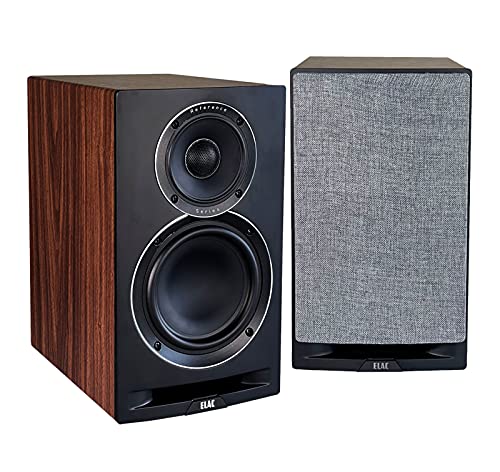
ELAC began in Kiel, Germany, in 1926, and its modern loudspeaker lines are shaped heavily by designs associated with Andrew Jones during his tenure with the company, alongside the engineering team that continued the ranges after his departure. For home theater buyers, the relevant families are the Debut line in its original, 2.0, and 3.0 generations, and the Uni-Fi and Uni-Fi 2.0 ranges above them. These are the front stages this guide assumes: Debut or Uni-Fi towers or bookshelf speakers at left and right, with the matching center channel from the same family under or above the screen.
The Debut family is the value end of the range, and its design language is consistent across generations. Tweeters are soft dome units, commonly described by the manufacturer as silk dome designs, protected by a wide-dispersion waveguide or grille geometry depending on generation. Woofers use aramid fibre cones, a woven material chosen for stiffness at low weight, in woven aramid or aramid-fibre form across the various models. Cabinets are MDF with internal bracing, finished in black ash or walnut vinyl depending on model and market. The Debut center channels follow the same recipe with dual woofers flanking the tweeter, which is why they blend so readily with their matching left and right partners.
Published figures for Debut speakers put sensitivity in the mid-80s decibel range, typically quoted at 2.83 volts measured at one metre, with exact numbers varying by model: bookshelf models tend to sit a little lower, towers a little higher. Nominal impedance is most often listed at 6 ohms for Debut models, with minimum impedance figures dipping lower at some frequencies, as minimum figures do for nearly every real loudspeaker. Maximum power handling figures are published per model and are best read as thermal limits rather than targets. The practical reading of those numbers is that a Debut front stage is a moderately sensitive, moderately demanding load that any competent AV receiver can drive, and that its surrounds should live in the same neighbourhood of sensitivity and impedance so the receiver’s channel trims stay in a sane range.
The Uni-Fi family takes a different technical route. Its defining feature is a concentric driver, in which the tweeter sits at the centre of the midrange cone, mounted on a common axis. In the original Uni-Fi this is a soft dome tweeter nested in an aluminium midrange cone; the Uni-Fi 2.0 revision reworked the concentric unit, the woofer, and the crossover together. A concentric layout makes the midrange and tweeter act as a single point source, which keeps their combined radiation pattern consistent as a listener moves off axis. Vocals and screen effects stay coherent across a wide sofa rather than shifting character from seat to seat.
Uni-Fi speakers are true three-way designs in most models, with the concentric unit handling midrange and treble and a separate woofer, aluminium in the original line, handling bass. Their published sensitivity also sits in the mid-80s decibel range, and the original Uni-Fi models are notably rated at 4 ohms nominal, which asks more current from an amplifier than a 6-ohm or 8-ohm rating does. Uni-Fi 2.0 revised the load to a friendlier figure as part of its redesign, but owners of the earlier models should still treat impedance as a real planning factor when the same receiver must also run surrounds. A surround speaker that presents an easy 8-ohm load can quietly relieve a receiver that is already working hard at the front.
Two traits of these ELAC families matter most for surround selection. The first is voicing. ELAC’s recent ranges aim for a balanced, slightly warm presentation with smooth treble from the soft dome tweeters and clean, controlled bass that rolls off rather than booms. A surround with a sharply boosted treble or a thin, recessed midrange will stand out every time an effect pans from the front of the room to the side. The second trait is dynamic modesty. These are not horn-loaded, high-sensitivity designs. They play cleanly at domestic levels and reward adequate amplifier power, but they do not produce cinema-reference peaks from a watt or two. Surrounds of wildly higher sensitivity would need large negative trims and could still sound jumpy beside them; surrounds of much lower sensitivity would strain to keep up during the loudest passages.
Matching criteria that actually matter
Sensitivity is the first number to compare, because it decides how hard each channel must work to reach the same level at the seats. Sensitivity is published as the sound pressure level a speaker produces at one metre with a standard input, usually 2.83 volts. A surround rated within about two decibels of the front speakers is the comfortable target. With that gap, the receiver’s per-channel trim controls, which typically offer a wide adjustment range in half-decibel steps, can level everything with modest corrections. Modest trims keep every channel near the middle of its range, leave headroom for later fine adjustment, and avoid the odd situation where one channel is pushed hard while another is throttled far back.
Comparing sensitivity figures demands a little care. Some brands quote figures measured in a room, others in anechoic conditions, and the two methods can differ by a few decibels for the same speaker. Some quote at one watt, others at 2.83 volts, and those two inputs are only equal into an 8-ohm load; into 6 ohms or 4 ohms, 2.83 volts delivers more power, which flatters the figure. None of this makes published numbers useless. It means they should be read as approximate, and that a two-decibel window is a sensible tolerance rather than false precision. Room correction systems, discussed later in this guide, will measure the real levels in the real room and trim accordingly, which absorbs small paper differences.
Impedance is the second criterion. A surround channel is one more load on a receiver that may already drive five or seven other speakers, and ELAC front stages often present 6-ohm or, for early Uni-Fi models, 4-ohm loads. Adding surrounds of 8 ohms nominal is the gentle option for the receiver’s power supplies and output stages. Adding 4-ohm surrounds to a system whose fronts are already 4 ohms invites heat and, in receivers with protection circuitry, the possibility of shutdown at high levels. Most dipole and bipole surrounds on the market are rated at 8 ohms or 6 ohms, which suits an ELAC-based system well. Check the published minimum impedance as well as the nominal figure when a manufacturer provides it, and confirm that the receiver is rated for the combined load the full speaker set presents.
Tonal resemblance is the third criterion, and it is the hardest to capture in a number. The goal is not identical drivers in every position. The goal is a surround whose midrange and treble character sits comfortably beside the ELAC fronts, so that a voice, a violin, or a helicopter moving through the room does not change its basic timbre as it crosses from front to side. Soft dome tweeters in the surrounds tend to sit naturally beside ELAC’s soft dome front tweeters. Horn-loaded surrounds, by contrast, often sound more forward and projected, which can pull attention sideways. Metal dome tweeters vary widely: a well-damped aluminium dome can blend fine, while a resonant or boosted one will hiss and spit beside a smooth front stage. Published frequency response graphs, when a manufacturer provides them, help here; look for smoothness through the midrange and treble rather than for extension at the extremes.
It also helps to know where matching matters less. Surround channels carry a smaller share of the programme than the fronts. They rarely carry lead dialogue, they seldom carry the main musical line, and their bass content is usually redirected to a subwoofer by the receiver’s bass management. A surround that is slightly less extended in the bass, or slightly less refined in the top octave, will pass unnoticed in almost all real material. What will not pass unnoticed is a level error, a harsh treble edge, or a midrange so recessed that effects sound hollow as they pass the seats. Spend attention on sensitivity, impedance, and midrange-to-treble balance, and let small differences elsewhere go.
One more form of matching deserves mention: output capability. A surround must reach the levels the front stage reaches, at least briefly, or loud effects will compress and distort at the sides while the front stays clean. Published maximum output or power handling figures give a rough guide. Small dipole cabinets with a pair of modest drivers per side are not built for extreme levels in huge rooms, and no specification can change that. In a typical living room at typical distances, though, a competently designed switchable surround has ample output for film peaks, because the distance to the seats is short and the subwoofer carries the heaviest energy.
How switchable bipole and dipole designs work
A switchable surround cabinet is a small exercise in packaging. Inside a shallow enclosure, often shaped as a trapezoid or a flattened hexagon when viewed from above, sit two sets of drivers on angled or opposed baffles. Each set typically pairs a woofer or mid-woofer with a tweeter, though some designs share a single woofer and duplicate only the tweeters, and a few use full-range drivers on each face. The two faces point along the wall in opposite directions: one toward the screen, one toward the back of the room. Neither face points straight at the listeners, which is the whole geometric point of the design.
The mode switch changes the electrical relationship between the two faces. In bipole mode, both faces receive the same signal with the same polarity, so their cones move outward and inward together. In dipole mode, the polarity of one face is reversed, so its cones move opposite to the other face. The switch on most models is a simple toggle or rotary control on the cabinet, sometimes hidden behind the grille or placed on the rear panel near the terminals. A few designs offer a third option that runs only one face, turning the cabinet into a conventional direct radiator for rooms where that pattern suits a particular position better.
The phase relationship is not a subtle detail; it defines the speaker. In dipole mode, the reversed face creates the null plane described earlier, and the depth of that null depends on how closely the two faces match in output and how symmetric the cabinet geometry is. It also affects bass. At low frequencies, the out-of-phase faces cancel each other’s output around the cabinet, much as the rear wave of an open-baffle speaker cancels its front wave. Dipole surrounds therefore produce less bass than the same cabinet in bipole mode, where the faces reinforce. This is one reason dipole surrounds pair naturally with an 80 hertz crossover to the subwoofer: the region where they are weakest is handed to a speaker built for it.
Choosing a mode is a matter of position and room. For side surrounds placed beside the seating, dipole mode is the classic recommendation, because the null can be aimed at the listeners and the field becomes enveloping. For rear surrounds on the back wall, bipole mode often works better: the seats are not in a single neat null plane relative to the rear wall, and the extra output and mild direction of bipole help effects behind the room register clearly. In narrow rooms where side surrounds sit very close to the seats, dipole mode tames the nearest speaker. In long rooms where the rear speakers are far away, bipole mode preserves energy over the distance. Owners of switchable models can try both with the same familiar scene and keep the mode that makes the surround field feel continuous rather than busy.
Wiring deserves a word, because a dipole cabinet still connects like any other speaker: one pair of terminals, one channel of amplification, unless a specific model states otherwise. The mode switch does the internal work. What owners must not do is improvise dipole behaviour by wiring two ordinary speakers out of phase on one channel. That loads the amplifier with both speakers, produces unpredictable cancellation, and can present a dangerously low combined impedance. The engineered cabinet, with matched drivers, a crossover designed for the job, and a proper switch, is the safe and predictable route to the same idea.
Driver layout also shapes the result. Designs with the tweeter above the woofer on each face behave differently from designs that offset them, and angled baffles spread the two lobes wider than flat opposed baffles do. Manufacturer documentation usually shows the intended orientation, including which face should point toward the screen, and some models mark the cabinet accordingly. Dipole designs can be sensitive to left and right placement: a pair may be built as mirror images, or a single design may need to be flipped depending on side. Follow the maker’s diagram for the specific model rather than assuming symmetry, because a cabinet mounted with its faces swapped can put the wrong dispersion pattern into the room.
best affordable surround sound speakers
Placement: walls, height, distance, and the null
Side surrounds in a 5.1 layout belong beside the seating, or a little behind it, on or near the side walls. The classic guidance from film-sound practice places them roughly at the listener’s shoulder line to slightly behind, elevated above ear height. Elevation matters for two reasons. First, it increases the distance to the nearest ear, which softens the level difference between the closest and farthest seats. Second, it lets the radiation travel over seat backs and listeners’ heads, feeding the reflections that build the diffuse field instead of being absorbed by the first row of upholstery it meets.
A common recommendation is to mount surround speakers so their tweeters sit roughly sixty centimetres to a metre above seated ear level, with the exact figure adjusted for ceiling height and mount design. In dipole mode, the cabinet should be positioned so its null plane passes through the seating: the speaker sits directly to the side of the listeners, and the line running straight out from the wall, through the cabinet’s centre, should cross the main seats. When that alignment is right, listeners sit in the quiet zone for direct sound while the room fills with the reflected field. Moving the same speaker well forward or well back of the seats rotates listeners out of the null and restores direct sound, which some owners prefer for games and multichannel music; the switch to bipole mode accomplishes a similar shift without moving hardware.
Rear surrounds, in a 7.1 layout, go on the back wall or on the rear portions of the side walls, spread apart enough to give the two channels distinct territories but not so far into the corners that reflections from two walls pile up. Corner loading boosts bass unevenly and smears the pattern these cabinets work to create. A reasonable gap from each corner, matched height with the side surrounds, and a clear line along the wall in both directions serve rear dipoles and bipoles well. If the back wall holds a door, a window, or shelving, favour symmetry between the two rear speakers over a theoretically perfect position that only one of them can occupy.
Distance to the seats governs level more than any other placement factor, because sound level falls as distance grows. A surround half a metre from one listener’s ear and three metres from another’s will never balance across the sofa through trim alone without leaving the near listener overwhelmed. Elevation, as noted, is the main tool for softening that geometry in tight rooms. Where a side wall is truly close, dipole mode earns its keep, since the near listener sits in the null and hears mostly reflections that have travelled further and levelled out. Where no wall exists on one side, a stand-mounted bipole at matched height is usually a better answer than forcing a wall design onto a bracket in open air, because these cabinets assume a wall behind them as part of their radiation environment.
Small rooms deserve their own exceptions. In a compact room, the rear wall may be directly behind the sofa, leaving no space for rear surrounds to breathe; a 5.1 layout with well-placed side surrounds will outperform a cramped 7.1 layout in that case. Ceiling height can also squeeze placement: a tall cabinet mounted high in a low-ceilinged room can end up closer to the ceiling than to the listeners, and the strong ceiling reflection changes its character. Mount at the height the room allows, keep both sides symmetric, and rely on calibration to handle the rest. Perfect textbook geometry matters less than symmetry, clearance from corners, and a null or lobe arrangement that treats every seat fairly.
Wall construction plays a quiet role. A dipole or bipole sends substantial energy along the wall surface, so a wall covered in heavy shelving, thick curtains, or absorptive panels will soak up part of the field on one side. Bare plaster or drywall reflects more. If one side of the room is glass and the other is bookshelves, the surround field will lean, and no trim setting fully repairs a reflection imbalance. Owners can help matters with small adjustments: a curtain drawn or opened, a panel added on the lively side, or a slight change in the angle of a stand-mounted speaker. These are refinements, though. Get the basics of position, height, and symmetry right first.
Power demands and the receiver’s workload
Surround channels work less hard than front channels in most programme material. Ambience, reverberation, and occasional effects simply carry less average energy than dialogue, score, and on-screen action. Peaks do arrive: a flyover, an explosion blooming behind the room, a sudden musical swell. Those peaks are brief. A receiver’s surround channels, which on most models share the same power supply as every other channel, must deliver those peaks cleanly, but their average demand stays modest. This is reassuring for owners of ELAC front stages, because the fronts, particularly 4-ohm Uni-Fi models, will claim the larger share of the receiver’s current.
The arithmetic of a full system is worth doing once. A receiver’s published power figure is usually quoted with two channels driven; with five or seven channels driven at once, the available power per channel falls, sometimes considerably. Manufacturers of better receivers publish all-channels figures or at least disclose the power supply capacity indirectly through weight and consumption ratings. For an ELAC-based system, the sensible approach is to choose surrounds that do not add electrical stress: nominal impedance of 6 or 8 ohms, sensitivity in the same mid-80s to low-90s decibel band as the fronts, and no published minimum impedance that plunges toward amplifier-hostile territory. That combination keeps the receiver in its comfort zone at domestic listening levels, which for most rooms means peaks well below the threshold where protection circuits wake up.
Owners who listen loudly in large rooms, or whose Uni-Fi front stage already pushes a modest receiver, have a further option worth knowing about: pre-outs. Many mid-range receivers offer pre-amplifier outputs for at least the front channels, letting an external power amplifier carry the fronts while the receiver’s internal amplifiers handle the surrounds and any height channels. That division suits surround speakers perfectly, since their demands are the lightest in the system. It also future-proofs the ELAC front stage, which will reward better amplification with cleaner peaks long before the surrounds ask for anything similar.
Heat is the slow variable in this equation. A receiver driving seven channels of 6-ohm and 4-ohm speakers in a closed cabinet will run hot, and heat shortens component life and can trigger thermal protection during a long, loud film. Give the receiver ventilation clearance as its manual specifies, keep surrounds on the easy side of the impedance range, and resist the urge to run every channel at maximum trim. Level calibration should end with trims scattered around the middle of their range; if every trim sits near its maximum, the master volume habit that follows will work the amplifiers harder than the programme requires.
Room correction, levels, delays, and crossovers
Modern AV receivers ship with automated setup systems that play test signals through each speaker, listen with a supplied microphone, and set levels, distances, and equalization. Systems such as Audyssey, YPAO, MCACC, and Dirac Live differ in sophistication, but their basic measurements share a logic that matters for dipole and bipole surrounds. Understanding what the microphone hears explains both what auto-setup does well with these speakers and where a human should review its choices.
Level setting is straightforward and reliable. The system plays a band-limited noise signal through each channel in turn and trims each channel so the measured level at the main seat matches a reference. With dipole surrounds, the microphone sits in or near the null, so it hears mostly reflected energy, exactly as a listener does. The resulting trim is therefore honest for that seat. Owners with several seats can repeat measurements at multiple positions where the system supports it, which averages the field across the sofa rather than optimising for one cushion.
Distance setting is really delay setting. The receiver measures how long each speaker’s signal takes to reach the microphone and delays the nearer channels so all arrivals line up in time. With dipoles, the first strong arrival at the microphone may be a reflection rather than a direct wave, because the direct wave is suppressed by the null. Auto-setup can therefore report a surround distance that looks oddly long compared with a tape measure. That is not necessarily an error; the system is aligning what actually arrives. Still, it is worth checking that the reported distances for the two surrounds are plausible relative to each other. A wild asymmetry between left and right surrounds usually means a measurement problem, such as the microphone being shadowed by a seat back, and re-running the measurement with a clear line to both speakers is the fix.
Equalization is where caution earns its place. A dipole’s response at the listening position is dominated by reflections, so its measured curve shows peaks and dips that belong to the room’s reflection pattern as much as to the speaker. Aggressive correction that tries to flatten every wiggle can make the surround sound strained or oddly focused, undoing the diffusion the design exists to create. Many experienced installers limit correction for surrounds to the lower frequencies, where room modes dominate and correction genuinely helps, and leave the midrange and treble closer to the speaker’s natural delivery. Where the receiver allows a correction curtain or a target curve, applying it thoughtfully to surrounds is worthwhile. Where it does not, comparing the corrected and uncorrected results with familiar material is a fair way to choose.
Crossover selection is the owner’s most important manual decision. Small surround cabinets, and dipole cabinets in particular, should not be asked to reproduce deep bass. The long-standing convention for home theater bass management sets the crossover at 80 hertz for speakers of modest size, sending everything below that point to the subwoofer. That figure suits most dipole and bipole surrounds: their drivers, commonly in the 100 to 165 millimetre range for the woofer sections, and their out-of-phase low-frequency behaviour in dipole mode, both argue for handing the bottom two octaves or so to the subwoofer. If auto-setup reports the surrounds as full-range or suggests a very low crossover, override it to 80 hertz, or to 90 or 100 hertz for the smallest cabinets. The subwoofer, placed and calibrated as a single source, reproduces that range more evenly than two small wall cabinets ever will.
After calibration, verify with material rather than with menus. A film scene with steady rain, a crowd sequence, or a musical passage with hall reverberation should sound continuous around the room, with no seat where one surround shouts and no moment where an effect changes character as it crosses the room. Small trim changes of a decibel or so, made by ear from the main seat, are normal finishing work. Keep notes of the final settings; if a firmware update or a curious guest resets them, the notes restore in minutes what calibration took an afternoon to settle.
best 5 1 home theater speakers without receiver
When dipoles are the wrong choice
Honest guidance about dipoles has to include the layouts where they do not belong. The clearest case is object-based audio. Dolby Atmos and DTS:X place sounds at coordinates in a three-dimensional space, and their home layouts assume surround and height speakers that radiate toward the listening area in a predictable, direct way, so that a sound object can be positioned by level differences between identifiable sources. Dolby’s published home layout guidance specifies direct-radiating speakers for the ear-level surround positions in Atmos systems. A dipole, whose whole purpose is to make its location hard to identify, works against that positioning. Owners building a dedicated Atmos room should follow the format’s guidance: direct radiators at ear level, placed at the specified angles, with the ELAC front stage matched by direct-radiating surrounds of similar voicing.
There is a middle path for owners who already own switchable surrounds and later add height channels. Run the switchable cabinets in bipole mode, which restores much of their direct output and localizability while keeping some spread, and place them at the angles the Atmos layout specifies rather than in the classic dipole positions. Many owners find that compromise entirely satisfying for film material. Purists building from scratch for object audio, though, should buy direct radiators for the ear-level ring and spend the dipole budget elsewhere in the system.
Very close seating is a second caution, though it cuts both ways. A dipole needs some distance for its reflected field to develop; if the listener’s head is almost against the wall and the speaker is mounted just above, the geometry becomes cramped and the null hard to sit inside reliably. In that situation a small direct radiator aimed across the listening area, or a bipole, can behave more predictably. Conversely, a side surround very close to one seat in an otherwise workable room is exactly where a dipole shines. The distinction is between close-and-beside, where the null helps, and close-and-above or close-and-behind in a shallow room, where the pattern has no room to form.
Multipurpose rooms raise a third set of questions. A living room that hosts film nights, stereo music, video calls, and children playing on the floor asks contradictory things of its speakers. Multichannel music, in particular, is usually mixed for direct-radiating surrounds: recordings in surround formats place instruments discretely in the rear channels and expect the listener to hear them from those directions. Dipoles smear that placement. Owners whose listening leans heavily toward multichannel music, or toward games with precise positional audio cues that competitive players rely on, will usually prefer bipole mode as a default or direct radiators outright. The switchable cabinet again proves its worth, because the same hardware can serve film night in dipole mode and a music session in bipole mode.
Finally, there is the simple matter of room shape. Long, narrow rooms with the sofa against the rear wall, rooms with one side open to a kitchen or hallway, and rooms where surround positions must go in corners all fight the dipole concept. None of these rooms rules dipoles out absolutely, but each one reduces the advantage over a good bipole or monopole, and owners in such spaces should weight flexibility, the switchable design, more heavily than dipole purity. A speaker that can change its pattern is insurance against a room that refuses to match the textbook.
Buying checklist for a dipole surround shortlist
Drivers, cabinet, and published figures
Start with the driver complement. A typical switchable surround carries a woofer or mid-woofer and a tweeter on each face, with woofer diameters commonly between about 100 and 165 millimetres. Larger drivers move more air and usually bring higher sensitivity and output, at the cost of a bigger cabinet. Tweeter material deserves the same glance given to the fronts: soft dome units tend to sit comfortably beside ELAC’s Debut and Uni-Fi tweeters. Check the published frequency response range to confirm the cabinet reaches comfortably down toward the intended crossover point; a speaker whose response fades well above 80 hertz will leave a gap that no subwoofer placement fully hides. Confirm sensitivity and nominal impedance against the matching criteria set out earlier in this guide, and note the manufacturer’s recommended amplifier power range as a sanity check rather than a target.
Sealed, ported, and wall behaviour
Dipole and bipole cabinets are most often sealed designs, and that suits them. A sealed box placed against a wall behaves predictably, with a gentle low-frequency roll-off that blends well with an 80 hertz crossover. Ported surrounds exist, and a port needs clearance to work as designed; a rear-facing port squeezed against a wall can produce chuffing noises and uneven bass. If a ported model appeals, check where its port fires and how much clearance the manufacturer specifies. Front or bottom ports, or a sealed cabinet, remove the worry entirely for wall mounting. Cabinet depth matters too: these speakers are meant to sit shallow against a wall, and a deep cabinet on a bracket can look awkward and place the drivers further into the room than the design assumes.
Mounting hardware and wiring access
Wall mounting is the default for this speaker category, so examine how each model attaches. Many include keyhole slots for a simple screw mount; others provide threaded inserts for proper brackets, which allow angle adjustment and a more secure hold. A bracket with a slight downward tilt helps in rooms where the speakers must mount higher than ideal. Check the weight in the published specifications and choose fixings rated for it in the actual wall material, plasterboard, masonry, or stud, rather than trusting the generic screws in the box. Terminals should accept the speaker cable already run in the room, and the mode switch should remain reachable after mounting; a switch buried against the wall turns a flexible speaker into a fixed one. Some owners run the first weeks in bipole mode and settle on dipole later, and a reachable switch makes that experiment painless.
Finish, grille, and living with the choice
Finish matching is cosmetic, but a home theater lives in a real room and cosmetics decide whether a system stays welcome there. ELAC Debut models wear black ash or walnut finishes depending on generation and market, and Uni-Fi models have offered black, white, and walnut variants. Surrounds in matte black or white disappear against most walls, which is often the true goal; a surround that visually shouts from the side wall draws the eye during films. Removable grilles let owners choose between a softer look with grilles on and a more technical look with them off, and grille presence slightly affects treble delivery on some designs, so pick one state and calibrate in it. Check whether the manufacturer sells the model in pairs, as most surround models are sold, and whether a single replacement can be ordered later if one cabinet is damaged; a surround pair is a long-term fixture, and serviceability matters more than a small saving at purchase.
If a reader buys through links in this guide, the site may earn a commission from the retailer at no extra cost to the reader. That arrangement supports the work of maintaining guides like this one, and it does not change the criteria set out above, which rest on published specifications and manufacturer documentation.
best 7 1 home theater speakers
Check prices on Amazon
Live listings for the shortlist in this guide are pulled from Amazon below, so prices and availability are always current at the moment you look.




Putting the whole system together
A complete ELAC-based theater with dipole or bipole surrounds comes together in a particular order, and following that order prevents most of the frustrations owners report. Begin with the front stage: Debut or Uni-Fi left and right speakers placed symmetrically around the screen, the matching center channel aligned with them, and a subwoofer positioned where the room gives it the smoothest response. Add the surrounds next, mounted symmetrically at the heights and positions described earlier, in dipole mode for side positions and bipole mode for rear positions as the starting configuration. Wire everything with cable of adequate gauge for the run lengths involved, keeping polarity consistent at every terminal, because a single reversed connection anywhere in a surround array muddies the field in ways calibration cannot repair.
Then set the receiver up deliberately rather than accepting every default. Confirm each speaker is set to small, with the crossover at 80 hertz as the starting point for the surrounds and for any ELAC bookshelf fronts, while tower fronts may suit a lower figure or full-range operation depending on the room and the subwoofer. Run the room correction routine with the microphone at the main seat, at ear height, clear of seat backs, and repeat at further positions if the system supports multi-point measurement. Review the results with a critical eye: levels should be plausible, the two surrounds should report similar distances, and any equalization applied to the surrounds should look restrained rather than violent. Adjust the crossover if the routine set the surrounds to full range, and store a backup of the final settings.
Listening checks after setup should use scenes with different demands. A quiet dialogue scene with room tone confirms that the surround field supports the front stage without drawing attention to itself. A rain or crowd sequence confirms envelopment and seat-to-seat evenness. A strong action sequence confirms that peaks stay clean and that the receiver shows no sign of strain. A piece of familiar music played through the full system, even in an upmixed mode, confirms that the tonal blend between the ELAC fronts and the surrounds holds together on material whose character is well known. Where a scene exposes a weakness, change one variable at a time: mode switch first, then trim, then position, then crossover. Methodical single changes reveal causes; sweeping changes conceal them.
Owners upgrading an existing ELAC system in stages can also use this guide in reverse. If the surrounds already in place are direct radiators and the complaint is harshness or a spotlight effect at the side seats, the radiation pattern is the likely cause and a switchable dipole or bipole is the targeted remedy. If the complaint is weak envelopment despite correct levels, check placement height and symmetry before blaming the speakers. If the complaint is a tonal mismatch, compare tweeter types and midrange balance rather than pursuing bass extension. Each symptom points at a different layer of the system, and the layers are cheaper to fix in the order of pattern, placement, calibration, and only then replacement.
Long-term, the combination this guide describes is a stable one. ELAC front speakers from the Debut and Uni-Fi families are mature designs with published behaviour that surround makers have effectively been designing around for years: moderate sensitivity, moderate impedance, smooth soft-dome treble. A switchable dipole and bipole surround matched on those terms, mounted with care for the null and the lobes, crossed over at a sensible point, and calibrated without letting automation flatten its character, will serve a system through receiver upgrades, room rearrangements, and format changes at the front. The surround field is the part of home theater that listeners feel more than they notice, and that is precisely why getting its pattern right rewards the effort long after the mounting screws are in.
A final practical note concerns records and patience. Keep the manufacturer documentation for both the ELAC fronts and the surrounds together, with the published sensitivity, impedance, and recommended crossover figures marked, because those few numbers answer most questions that arise when a receiver is replaced or a room is rearranged. Note the mode chosen for each surround position and the trim and distance values that calibration settled on, and photograph the rear panels before the cabinets go up on the wall, when switches and terminals are still easy to read. Then give the system time. Ears adjust to a new surround field over several films, and judgments made in the first ten minutes often reverse by the third evening, once the novelty of a wider, quieter field stops drawing attention to itself. Change a setting only when the same flaw appears across different kinds of material, not when one unusually dry or unusually lush mix sounds different from its neighbours. A system built on published figures, careful placement, and restrained calibration should need no further attention than an occasional dusting and the rare re-run of setup after furniture moves.
For the listener who values the hush before a scene opens and the slow decay after it ends, the right dipole surrounds will make an ELAC system feel less like speakers in a room and more like weather moving through a place that exists only while the film is running.

