Our Top Picks


What's inside
- Materials compared: wood, plastic and fabric
- Safety first: sizing, standards and finishes
- Play patterns: cutting, sorting and kitchen play
- Piece counts and food groups
- Cleaning and care over time
- Buying checks before you decide
- How pretend food supports language and learning
- Choosing for home, childcare and travel
- Rotation, repair and passing a set on
- Check prices on Amazon
- Reading a listing like an inspector
As an Amazon Associate I earn from qualifying purchases. This post may contain affiliate links at no extra cost to you.
This guide relies solely on published specifications, manufacturer documents and reference sources; nothing in it rests on hands-on use. It compares pretend food sets by the materials, age grades, safety standards and care instructions that makers publish for each product. If a purchase follows from a retail link on this page, the retailer may pay this site a commission, and that payment never comes out of the buyer’s pocket. Because toddlers mouth, drop and throw play food, this guide treats safety documentation and size information as the first specification, ahead of color, realism or piece count.
Materials compared: wood, plastic and fabric
Pretend food for toddlers comes in three main material families, and each family behaves differently in small hands and small mouths. Solid wood pieces feel weighty and calm. Molded plastic pieces are light, bright and often hollow. Felt and fabric pieces are soft, quiet and squeezable. No family is best in the abstract. The right choice depends on the child age in months, the floors of the home, whether the set will live in a play kitchen or travel to a grandparent house, and how the family feels about noise, weight and cleaning. Maker documents state the material for each set, and that single line predicts much of the ownership experience.
Solid wood sets are usually cut from beech, rubberwood or similar hardwoods, then sanded smooth and painted. A wooden apple has a satisfying heft that helps a toddler learn cause and effect: the piece stays where it is put, stacks with intent and makes a clear sound on a play kitchen counter. Wood resists crushing and survives being stood on better than hollow plastic. Its limits are weight and hardness. A thrown wooden carrot hurts more than a thrown felt one, and a dropped wooden egg can dent a soft floor or chip its own paint at the point of impact. Makers publish piece weight or set weight for some ranges, and those numbers help judge whether a set suits a young toddler still learning to control a swing.
Molded plastic sets dominate the lower age grades for practical reasons. Plastic can be formed into shapes that wood cannot match at a sensible cost: a hollow bread loaf with a scored top, a cheese slice with holes, a fried egg with a raised yolk. Modern sets for this age are typically made from ABS or polyethylene, and maker documents for reputable ranges state that the material is free of BPA and phthalates or that it meets the toy standard for the market where it is sold. Plastic pieces are light enough for a child of eighteen months to carry in both hands, they float in a water table, and they wipe clean in seconds. Their weakness is feel: hollow pieces can seem insubstantial to adults, seams can split after hard use, and thin parts such as a plastic stem can snap where solid wood would only dent.
Felt and fabric sets take the soft route. Pieces are sewn, stuffed lightly and often detailed with stitched or printed features rather than paint. A fabric sandwich set can separate into bread, filling and salad layers held by hook and loop pads, giving toddlers the layering play of a cutting set without any rigid parts. Fabric food is the quietest option for flats and early mornings, the safest option for throwing games, and the easiest option to pack into a soft bag. Its limits are realism and hygiene over time. Fabric absorbs spills, holds odors if stored damp and needs proper washing rather than a quick wipe, and stitched details can loosen when a determined toddler pulls at a thread end with teeth.
Weight deserves its own reading because toddlers carry food constantly. Play at this age is transport: fill a basket, carry it across the room, empty it, repeat. A set whose pieces are individually light but collectively heavy in a full basket will be carried in smaller loads, which is fine play but changes how the set gets used. Wooden breakfast sets with a tray can become too heavy when fully loaded for the youngest children in the age band. Fabric and plastic sets invite longer carrying games and stair free travel between rooms. Maker photographs that show a child carrying the full set give a rough scale, while published set weights give the honest number.
Durability claims in maker documents should be read for what they actually promise. A statement that a finish resists drool and sweat describes a coating tested for contact with saliva, common for wooden toys made for mouthing ages. A statement that a plastic set is dishwasher safe describes heat and detergent tolerance for that product only, and it does not transfer to other sets from the same brand. Sewn sets that publish double stitched seams and embroidered rather than glued details are describing resistance to pulling and mouthing. Each claim is narrow, and treating it as narrow keeps expectations accurate. Broad words such as tough or premium, with no test or material behind them, carry no usable information.
Safety first: sizing, standards and finishes
Safety for pretend food starts with a paradox: the toy represents food, invites mouthing and looks bite sized, yet it must never be small enough to obstruct an airway. Real grapes and cherry tomatoes are themselves choking hazards for young children, so a realistic toddler set must make its grapes and tomatoes notably larger than life. Reputable makers design play food for under threes at a generous scale, and they state the age grade that reflects that design work. A set graded three years and up may contain pieces sized for older children, and that grade is a boundary to respect even when a younger toddler seems advanced in play.
The small parts cylinder is the reference tool behind much of this grading. It is a cylinder of a defined width and depth used in toy safety testing: if a toy or a detachable part fits entirely inside it without force, that item is a small part and is barred from toys intended for children under three in the United States. Buyers do not need to own the cylinder to use the idea. They need to check the age grade, look for detachable elements such as removable stems, caps, wheels or slice joins, and treat any piece that looks bite sized with suspicion until its dimensions are known. Better listings publish the size of the smallest piece in the set, which is the single most useful safety number a maker can offer.
ASTM F963 is the main United States toy safety standard, and maker documents for toddler sets sold in that market commonly state conformance with it. The standard covers mechanical and physical properties, flammability, and limits for certain soluble heavy metals and other substances in toy materials. European sets reference EN 71, a related family of standards with parts covering mechanical properties, flammability and migration of certain elements from toy materials. A buyer does not need to master either document. The practical check is that the set names a current standard, names the market it was made for, and carries the age grade and warnings on the packaging itself rather than only in marketing copy.
Paint and finish safety matter more for mouthed toys than for almost any other plaything. Toddlers explore with the mouth well into the second year, and pretend food goes to the mouth by design, because that is the joke and the learning in the play. Wooden sets should state that paints are water based and that the finish is suitable for toys for this age, ideally with reference to the migration limits in the toy standard for coatings. Plastic sets should state the base material and the absence claims that apply to it, such as BPA free where the maker publishes that claim. Fabric sets should state fiber content and whether dyes and prints are part of a certified textile scheme where the maker uses one. Vague reassurance is not a substitute for these specifics.
BPA and PVC questions come up often with plastic play food, so it helps to know what the published notes can and cannot say. BPA relates to polycarbonate and some coatings; most soft and hard play food today uses other plastics, and makers who test for it say so in their material notes. PVC appears in some soft vinyl toys, and parents who wish to avoid it should look for an explicit statement of material rather than assuming that soft means vinyl or that hard means safe. Where a maker publishes neither the base material nor any absence claim, that silence is information. For a toy that will be mouthed daily, documented material beats undocumented material every time, even when the undocumented set looks charming in photographs.
Age grades such as eighteen months plus, two plus and three plus encode several judgments at once: piece size, detachable parts, strength under torque and pull testing, and the play skills the set assumes. A grade of eighteen months plus on a chunky sorting set signals large, one piece foods with no small joins. A grade of three plus on a detailed cutting set signals smaller parts and a play knife that younger toddlers should not yet use. Households with mixed ages face the hardest version of this decision, because a set bought for a three year old will be reached by a younger sibling. In such homes the youngest child in regular reach sets the safety rule, whatever the older child could handle alone.
Play patterns: cutting, sorting and kitchen play
Cutting sets are the most active form of pretend food. A tomato, loaf or melon comes in two or more sections joined by hook and loop pads, and the child presses a rounded play knife into the join to separate the sections with a satisfying resistance and sound. The play teaches bilateral coordination, because one hand holds the food steady while the other works the knife, and it teaches early ideas of halves, parts and wholes. For toddlers, the specification that matters is the join strength. Pads that hold too firmly frustrate small hands and invite the child to pull pieces apart sideways, while pads that barely hold make the food fall apart during transport, which ends the game before it starts.
Play knives deserve a close reading of their own. For the youngest grades they should be blunt, broad and short, with no point and no serrated edge that could scrape skin. Wooden knives in toddler sets are usually shaped from the same stock as the food and finished to the same standard. Plastic knives should have a thick spine and a handle sized for a fist grip rather than a finger grip. Some sets include a small cutting board, which protects tables and gives the cutting action a defined place. A board also keeps sections from sliding, an underrated aid for a child whose holding hand is still learning its job. Where a set lists its knife and board in the contents, that completeness supports the main play pattern instead of leaving it half equipped.
Whole foods for sorting and naming form the quieter core of toddler food play. A set of single piece fruits and vegetables in clear colors supports color naming, category sorting and first counting long before any cutting begins. Toddlers line pieces up, group all the red items, fill and empty containers by color, and hold up a banana for an adult to name. Sets designed for this play keep shapes distinct and colors true to the real food, because a purple carrot may amuse adults but confuses the naming game. Maker documents that describe a set as a learning resource usually list the foods included, and that list lets a buyer check for a spread across colors and food groups rather than six near identical apples.
Play kitchens and shopping baskets extend every food set. A kitchen gives the food a destination: hob, oven, sink and shelf, each inviting a different action. A basket or cart gives it a journey: shop, carry, unpack, cook, serve. Food sets that publish their piece dimensions help buyers match food scale to the kitchen and basket the family already owns. Oversized wooden pieces may not fit a small play oven door, and tiny plastic pieces vanish inside a large shopping cart. Scale harmony sounds like a design nicety, but for a toddler it is the difference between a game that flows and a game that jams at every step. Related guidance on choosing child sized technology for the same age group appears in best 4g kids smartwatches, where fit and age grading carry similar weight.
Serving and sharing play emerges toward the older end of this age band. Two and three year olds begin to offer food to dolls, teddies and adults, to set plates on a mat and to announce meals. Sets that include simple plates, cups or cutlery support that social turn, though each added item must still pass the same size and material checks as the food itself. Tea and breakfast themes suit this pattern well, because the real routines are familiar from the family table. A toddler who has watched toast and eggs appear every morning can replay the whole sequence with confidence, and familiar sequences are the ones children repeat until they master them.
Sound and texture add smaller layers of engagement. Some plastic foods contain a rattle or squeak, some fabric foods crinkle, and cutting sets produce their signature tearing note from the hook and loop join. Maker documents mention such features when present, and buyers should weigh them honestly. A squeak delights many toddlers and wears on many adults; crinkle fabric holds the attention of the youngest children in the band especially well. None of these features changes the safety reading. A sound unit sealed inside a piece must stay sealed under the pull and bite forces of toddler use, which is one more reason to favor makers who state their conformance with the toy standard for the whole product.
Piece counts and food groups
Piece count shapes pretend food play as surely as it shapes an art set, and it misleads in the same way. A headline count may include every slice section, plate, knife, board and basket as separate pieces, so a set advertised with forty pieces may hold only fourteen actual foods. For toddlers, the number of whole foods matters more than the total, because whole foods are the units of sorting, naming and carrying games. Fourteen varied foods give a rich game. Thirty sections of five foods give a narrow game with many parts to lose. The contents list, read with that distinction in mind, tells the buyer which kind of set is on offer.
Balance across food groups is the next check. A well composed toddler set spreads across fruits, vegetables, proteins, grains and dairy shapes, mirroring the plates the child sees at meals. Dessert heavy sets, crowded with cakes, doughnuts and ice creams, photograph beautifully and support a thinner range of play and language. Sweets have their place in birthday and cafe games for older toddlers, but a first set for a child under two should lean toward everyday foods the child can name from the high chair. Makers who publish a full food list make this judgment easy. Makers who show only a styled pile in photographs require the buyer to count and identify each item from images, which is possible but slower and less certain.
Realistic sizing for toddler hands sits in a narrow band. Pieces should be large enough to fail the small parts test with margin, long enough for a fist grip and light enough for repeated lifting. A whole carrot that a toddler can hold in one hand while working a play knife with the other is sized right. Tiny garnish pieces, such as separate peas, berries or sprinkles, rarely belong in sets for under threes at all, because they combine the worst traits in this category: they are small, they roll, they vanish under furniture and they add almost no play value that a larger piece could not provide. When a set includes such pieces, its age grade usually rises to three plus, and that rise should be honored.
Rolling and loss are practical forces that reshape a set within weeks. Round foods roll under sofas and into other rooms, eggs and oranges most of all. Flat foods such as cheese slices and bread stay where they fall but hide under rugs and mats. Families can plan for this by favoring sets with a storage box that makes the full count visible, and by choosing sets whose makers sell or list replacement pieces where available. A set that drops from sixteen foods to nine in a month still plays, but its sorting and shopping games shrink. Storage and count discipline, discussed further below, are therefore part of the buying decision and not an afterthought.
Duplicate pieces, often seen as padding, can be a genuine asset at this age. Two apples let two children hold the same food during shared play, and duplicates support matching games that single pieces cannot. Twins and sibling pairs make duplicates more valuable still. The distinction is between thoughtful duplicates of core foods and filler duplicates of minor items. A contents list shows which kind a set contains. Two eggs, two apples and two bread slices form a working pantry for parallel play. Four identical sauce bottles form a warehouse shelf that no toddler game needs.
Color realism and finish variation also deserve a note. Foods painted in flat, accurate colors support naming and sorting, while foods with heavy gloss or glitter finishes trade learning value for sparkle. Some wooden ranges use a matte, slightly textured finish that reads as natural and hides small scuffs well. Plastic ranges vary from matte to high gloss within one set, which can make a cheese slice look wet beside a dry bread slice. None of this is a safety matter, yet it shapes how a child maps the toy to the real meal. Buyers comparing sets for a child who is learning food words should weight accurate color and shape above novelty finishes, as the naming game is the educational heart of the category. Guidance on cameras that record these everyday play moments appears in best kids waterproof cameras, for families who document first words and first games alike.
Cleaning and care over time
Play food lives a dirty life. It is mouthed, dropped on floors, carried into gardens, dunked in water tables and occasionally shared with a family dog. Cleaning instructions are therefore a core specification, and makers publish them in varying detail. Plastic sets usually allow washing in warm soapy water and air drying, and some state dishwasher tolerance for the top rack. Wooden sets usually ask for a wipe with a damp cloth and mild soap, with no soaking, because water raises the grain, swells joints in joined pieces and can lift paint at edges. Fabric sets vary from surface wipe only to full machine washing, and that difference decides how a set survives a yogurt incident.
Wipe clean care suits daily maintenance for all three families. A quick wipe after a play session removes drool and food residue before it dries, and it keeps the set ready for the next mouthing round. The limit of wiping is that it does not reach seams, hook and loop pads or the inside of hollow plastic pieces with vent holes. Hook and loop pads collect crumbs and fluff and lose grip over time; a soft brush or a piece of tape lifts much of that debris and restores the cutting game. Hollow plastic pieces that take in bath or water table water should be squeezed and shaken dry and stored where air can reach them, because trapped water grows stale inside a sealed shape.
Machine washable fabric sets offer the deepest clean in the category, provided the maker states the wash method and the pieces have no rigid inserts that washing would warp. A gentle cycle in a mesh bag protects stitching and printed details, and air drying protects stuffing shape better than tumble heat. Sets that are wipe only should not be promoted to machine washing by hopeful owners, because glued details and some prints fail in the first wash. The care label on the product, where present, outranks general advice, including the advice in this guide. That hierarchy, label first and general practice second, applies to every material family in this article.
Paint chipping on wood deserves an honest long view. Even good water based paint on a hard wooden piece will wear at edges and impact points over months of drops on hard floors. Small wear is cosmetic. Larger flakes raise two questions: whether the exposed wood stays smooth, and whether loose flakes could be picked at by a toddler. Makers who serve the nursery market often use finishes that wear by fading rather than flaking, and some publish that their paints meet the migration limits for coatings in the toy standard, which addresses the substance question. Owners should retire or repair a piece whose finish breaks into loose fragments, and a set bought for a mouthing toddler should be inspected weekly as a routine, with that inspection written into family habit rather than left to chance.
Plastic care has its own long term notes. Strong detergents and high heat can cloud some plastics and fade printed details such as sesame seeds on a bun or grill marks on a steak. Sunlight through a window can fade bright colors over a season. None of this affects safety, but it affects the naming game when a red tomato turns pink orange on the sunny side. Storing plastic food in its box away from direct sun, and washing it warm rather than hot unless the maker states heat tolerance, keeps a set looking like the foods it names. Cracked or split plastic pieces should leave play at once, because a split seam creates sharp edges and can release inner parts that were never meant to be separate pieces.
Fabric sets age by softening, which many families count as charm, but seams and hook and loop pads age too. A weekly glance over seams during laundry catches a loosening thread before stuffing escapes. Stuffing that escapes is a hazard for mouthing toddlers and ends that piece service until repaired with tight, secure stitching. Embroidered details survive this life better than glued or printed ones, a point makers state in their construction notes. Families who value the soft, quiet character of fabric food should accept the laundry duty that comes with it, just as wooden set owners accept wipe care and plastic set owners accept seam checks. Every material asks for its own form of attention. For families who film and photograph play for relatives, best instant print cameras for kids covers simple cameras that older siblings can operate during these games.
Buying checks before you decide
The first buying check is the age grade printed on the box, confirmed against the listing rather than assumed from the product title. Titles are written for search and often include broad age words, while the grade on the packaging reflects the maker safety assessment for that exact set. If the listing photographs do not show the grade, look for it in the maker documents or choose a set whose grade is visible. For a child under three, a grade of three plus is a stop sign, not a challenge. Development varies, but airway size does not vary on the same schedule, and the grade exists precisely because adults cannot judge small parts risk reliably by eye.
The second check hunts for small detachable parts. Read the contents list for words such as removable, detachable, caps, tops, stems and wheels, and look at photographs for pieces that clearly separate beyond the intended cutting joins. Cutting sections joined by hook and loop pads are designed separation and are sized as large sections. A tiny removable cherry on a cake is undesigned risk in a toddler set. Batteries have no place in basic pretend food for this age; a set with sound that needs a battery compartment adds a screw secured door and a hazard class that simple food play does not need. Where sound is present, the maker should state how the compartment is secured, and buyers should weigh whether the feature earns its complexity.
Storage decides whether the set stays a set. Boxes with lids, fabric bags and crates that match the piece count let a family put the set away complete and notice a missing piece the same day. A printed or photographed inventory on the box helps older toddlers join the tidying game by matching pieces to pictures. Loose sets sold in a plain carton with no storage plan tend to dissolve into the general toy population within weeks. That outcome is not a safety failure, but it shortens the useful life of the sorting and shopping games that need a known cast of foods. Where a maker sells the storage crate as part of the set, that inclusion has real value and should count in the comparison.
Gift buying for toddlers carries one extra duty: respect the household rules of the child who will receive the set. Some families avoid plastic, some avoid food play that mimics items their child cannot eat for medical or cultural reasons, and some already own two kitchens worth of play food. A brief question to the parents prevents a well meant duplicate or a material mismatch. Where asking is not possible, a modest, well documented wooden or fabric set of everyday foods, graded clearly for the child age, is the most widely welcome choice in this category. Include the receipt path or gift note the retailer offers, since age fit becomes clear only when the box meets the child.
Value in this category is best judged by cost per year of safe use, though this guide publishes no prices and families must do that arithmetic at the retailer. A durable set graded from eighteen months can serve one child through the whole toddler band and then a sibling, which spreads its cost across years. A fragile set that loses seams and flakes paint in months serves briefly at any price. Documented material, named standards, visible age grading and available care instructions are the markers of the durable kind. A set that offers all four markers, in whichever material the family prefers, is a sound buy even before its colors and food list are considered, and those lists can then decide between sound candidates.
Second hand sets need a stricter version of every check in this section. Age grades and care labels may be missing with the box, paints and plastics may predate current standards, and hook and loop pads and seams may be near failure. A used set from a known maker, with its box and labels intact and every piece inspected for cracks, loose parts and finish damage, can be a sensible choice. An anonymous used set with no labels should not go to a mouthing toddler, however sturdy it looks. The documents are part of the product at this age, and a set that has lost its documents has lost part of its safety case. Families setting up a play corner with a screen for older children can read best smart tvs for kids for sizing and placement guidance that keeps toddler play space separate.
How pretend food supports language and learning
Food words are among the earliest nouns many children learn, because meals repeat daily and adults name foods constantly at the table and in the kitchen. Pretend food gives a toddler a way to practice those words away from the pressure of eating. A child can hold a toy egg, hear its name, attempt the word and hand the egg over, all in a calm game with no hunger and no mess. Sets whose foods match the family actual meals support this transfer best, because the word learned in play is the word heard at breakfast. A family that eats rice, beans, plantain and mango daily gains more from a set that includes such foods, or from adding single pieces that reflect home cooking, than from a set built around foods the child rarely sees.
Verbs grow around the food as play matures. Cut, stir, pour, wash, cook, taste, share and tidy all attach to pretend food naturally, and adults who narrate the game feed those verbs in at the moment they make sense. Cutting sets carry the verb cut with unusual clarity, because the action and result are visible and repeatable. Serving play carries share and offer. Washing play in a toy sink carries wash and dry, and it mirrors real kitchen routines the child watches each evening. A set does not need printed learning claims to support this growth. It needs varied foods, a few tools and adults willing to talk during play, and the maker food list lets a buyer judge the varied foods part before purchase.
Early number and quantity ideas also ride along. Toddlers meet one, two and many at the play table long before formal counting: one banana for the doll, two eggs in the pan, many grapes in the bowl, then none left after the shopping game moves them all. Sets with duplicates and with pieces that divide into sections give quantity a physical form. A loaf that separates into four slices shows parts of a whole without any lesson plan. Adults should resist turning this into drilling. The learning lives inside the game, and a toddler who is quizzed stops playing and starts performing, which ends the very activity that teaches.
Category thinking begins with sorting, and food is a kind first category because the groups are visible and tasty in real life. Fruits apart from vegetables, breakfast foods apart from dinner foods, red foods apart from green foods: each sorting rule a toddler tries is a small act of classification. Sets with a balanced food list support several rules, while narrow sets support only one. Storage boxes with divided sections can either help or hinder, depending on whether the divisions match a rule the child can see. Open storage that lets the child invent the grouping each day is often the richer choice, with adult tidying restoring order after the game ends.
Pretend food also carries social learning that has little to do with food itself. Offering a toy meal is an early form of generosity and hosting. Waiting while a meal cooks in a toy oven practices patience inside a story the child controls. Feeding a doll rehearses care routines that the child receives daily, and many toddlers work through new experiences, such as a first haircut or a clinic visit, by first feeding and comforting a toy at a pretend table. These uses argue for keeping a core set available over years rather than rotating it away quickly, because the same apple serves naming at eighteen months, sorting at two and a doll dinner party at three.
Choosing for home, childcare and travel
Setting changes the right answer in this category more than brand does. At home, a family knows its floors, its cleaning habits and the ages of every child in the room, so it can choose weight and material with confidence. Hard floors argue for fabric or plastic food during the throwing months, or for wooden food paired with a rug under the play kitchen. Carpeted rooms forgive wood. Homes with a baby younger than the toddler add a second mouthing child to every calculation, which pushes the whole collection toward the youngest grade present and toward pieces with no detachable elements at all.
Childcare settings multiply every demand. Many children mouth the same pieces in one morning, so cleaning speed and method move to the top of the specification list. Plastic sets that tolerate frequent washing, or wooden sets whose finish stands up to daily wiping with approved cleaners, suit group care better than delicate fabric sets that need laundry cycles between uses. Providers also need documented standards for licensing records, which is another reason maker documents matter beyond the home. Piece counts shrink fast in group settings through loss and damage, so sets with available replacements or with generous duplicates survive the year with their games intact.
Travel and grandparent houses call for a subset rather than a second full set. A small bag of the child favorite whole foods, chosen from the main set, travels well and keeps continuity between homes. Fabric and light plastic pieces suit travel best: they are quiet in a car, safe in a waiting room and forgiving when dropped in public places. Wooden favorites can travel too, packed so they do not rattle against each other and chip. What matters is that the travel subset comes home and rejoins the full count, so the inventory habit survives. A set that lives permanently split across two houses becomes two partial sets, and both lose the sorting and shopping games that need a full cast.
Outdoor play sorts sets by water and dirt tolerance. Plastic food thrives at a water table and in a mud kitchen, where real water and real earth are part of the fun, and it rinses back to readiness in minutes. Wooden food should stay out of standing water and wet earth, because soaking lifts finishes and swells the material. Fabric food outdoors picks up grit and moisture and needs washing before it returns to indoor play. Families with a garden play kitchen often keep a dedicated outdoor plastic set, bought or retired for that purpose, and protect the main indoor set from the hardest duty. That division extends the life of both and keeps hygiene rules simple enough for a toddler to learn: outdoor food stays outdoors until it has been washed.
Noise is a setting factor adults feel and listings rarely mention. Wooden food on a wooden floor in a flat with neighbors below can end evening play. Fabric food is silent. Plastic sits between, with a lighter clatter that rugs mostly absorb. A play mat under the kitchen area solves much of this for any material, and it defines the play territory in a way toddlers understand. When a maker publishes piece material and the family knows its floors, the noise outcome is predictable in advance, one more case where a simple published fact does more work than any amount of styled photography.
Rotation, repair and passing a set on
Rotation keeps a good set feeling new without buying more. Putting a third of the foods away for two weeks and then swapping them back restores interest, because toddlers greet returned pieces like new arrivals. Rotation also creates a natural inspection rhythm: pieces are handled, counted and checked for damage at each swap. Families who rotate should keep the stored portion in a closed box away from damp, and should keep cutting sections together as units, since a tomato half without its partner is a puzzle piece rather than a food. The inventory list on the storage box, mentioned earlier, makes rotation bookkeeping a two minute task.
Repair has clear limits at this age. A fabric seam can be restitched securely, a hook and loop pad can be cleaned or replaced by an adult with strong stitching, and a wooden piece with light wear can be retired to a display shelf. Cracked plastic, split seams that release inner parts, loose magnets in any toy and flaking finish that comes away in fragments are not repair cases for a mouthing child; those pieces leave play for good. Makers rarely publish repair guidance for toddler food, so the safe rule is conservative: if a repair cannot restore the piece to a smooth, single, firmly joined object, the piece is done. No single apple or egg matters enough to argue with that rule.
Passing a set to a younger sibling or another family is a strength of well made pretend food, and it works best when the documents travel with the toys. Keep the box or copy the age grade, material and care notes into the storage container when the set is new, and that information will still exist when the set changes hands two years later. Wash or wipe every piece before handover, inspect each one under the same rules used in weekly checks, and remove any piece that fails. A handed down set with its paperwork and a full, sound count is a genuinely useful gift. A bag of anonymous pieces with no grades and no history returns the receiving family to guesswork, which this guide has argued against from its first section.
End of life for a set is gradual rather than sudden. Foods that no longer suit a growing child food play become props for older games: shop stock for a five year old market stall, still life objects for a first drawing attempt, or counters in early number games under adult supervision once the mouthing years have passed. The safety grade still governs who may use them and how, and pieces that have degraded should be discarded rather than promoted to new roles. A set bought with documented materials and sound construction earns this long second life. A set bought on looks alone usually ends when toddlerhood does, worn out in substance as well as in interest.
Check prices on Amazon
Live listings for the shortlist in this guide are pulled from Amazon below, so prices and availability are always current at the moment you look.
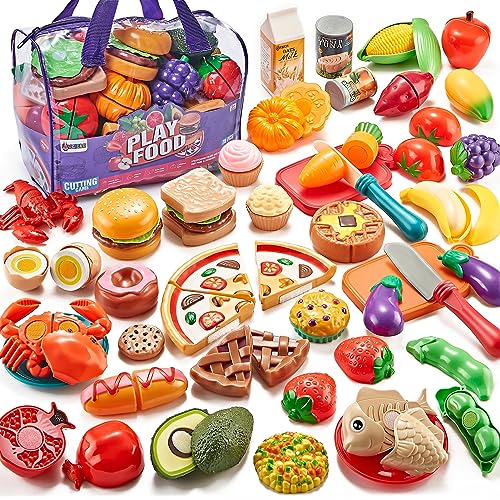
LAUGIGLE Pretend Play Food for Kids Kitchen, 78Pc Cutting Toy Food with Storage Bag


Reading a listing like an inspector
A disciplined final read of a listing, done in a set order, catches most problems before money changes hands. Start with the age grade, then the material line, then the standards statement, then the contents list, then the care instructions, and only then look at the styled photographs for pleasure. That order matters because the attractive parts of a listing are designed to be seen first, and a buyer who begins with photographs has already formed an attachment before meeting the facts. The facts take five minutes to gather for a well documented set. If they cannot be gathered in fifteen minutes because the listing omits them, that difficulty is itself the answer about that set.
Dimensions deserve a ruler rather than an impression. When a maker publishes the size of key pieces, compare those numbers with objects already in the home: a real piece of fruit, the child own spoon, the door of the play oven. A banana listed at a length the family can picture will either fit the child hand and the toy basket or it will not, and the number settles it before delivery. Photographs with a child hand in frame help, but hands vary and camera angles flatter scale in both directions. Numbers do not flatter. Prefer the set that publishes them, and keep a note of the smallest piece dimension for the weekly inspection habit, because that is the piece to watch as wear accumulates.
Contents lists should be counted twice, once for foods and once for everything else. Write down the number of whole foods, the number of cutting foods and their section counts, and the number of tools and containers. That small table exposes the true shape of the set at once. It shows whether desserts crowd out everyday foods, whether one knife serves four cutting items in a queue, and whether the basket in the photographs is actually included or merely a prop. Props in photographs are a recurring trap in this category: styled scenes show kitchens, carts, mats and extra foods that the box does not contain. The contents list is the contract. The photograph is an illustration, and treating them in that order prevents the most common disappointment in toddler food buying.
Warnings and care text, often shown in small print at the end of a listing, repay slow reading. A warning about small parts on a set whose title promises toddler use is a contradiction that should end consideration of that set for a child under three. Care text that forbids washing on a set intended for mouthing raises a practical problem that no discount can solve. A statement that colors may vary is harmless. A statement that the product is a decorative item and not a toy, which appears on some imported food replicas, removes the product from this category entirely, whatever its photographs suggest. Decorative replicas are made to different rules and do not belong in a toddler hands or mouth.
Finally, weigh the maker record that documents can show. A maker who publishes standards conformance, material notes, care instructions and a contact route across its whole toddler range is demonstrating a system, not a single careful listing. That system is what a family relies on when a seam fails or a question arises a year later. A single polished listing from a maker whose other products carry no documentation is a weaker bet, even if the set itself looks identical in photographs. At toddler age, where the user of the product cannot report problems in words, the strength of the maker paper trail is part of the product, and choosing the documented maker is a safety decision as much as a shopping preference.
One last habit protects the value of all these checks. When the set arrives, before the first game begins, photograph the box panels that carry the grade, material and care notes, count every piece against the contents list, wash or wipe each piece as its label directs, and set aside any piece that arrives cracked, split or with a loose part, however small the flaw looks. That ten minute routine confirms that the delivered product matches its documents, starts the set life clean, and gives the family a dated record of the full count, which makes later loss, wear and handover decisions simple and factual rather than matters of memory and debate at the bottom of a crowded toy box on a busy morning.
Keep that record with the storage box, and review it at each rotation swap, noting which foods the child reaches for daily, which ones wait untouched, and which pieces show wear at seams, joins or painted edges. Over a few months those plain notes build a true picture of how the set is actually used in this home, and they guide every later decision, from a replacement piece to a second set, far better than memory, guesswork or the styled promises on the front of any box ever could for a busy family.
Share those notes with grandparents and other regular caregivers, so every adult who supervises the game knows which pieces to watch, which foods are away in rotation, and where the full set belongs when play ends for the day at home.
When a toddler first lifts a wooden apple to their mouth, offers it to a teddy, then carries it proudly across the room to restock an empty shelf, a well chosen set has already done its quiet work of matching small hands, safe materials and a very serious game of dinner.


