Our Top Picks


What's inside
- Scope: factory-set crystal watches, and what that means
- Stone types at this level and how they differ
- Setting styles and the risk of losing a stone
- Case sizes, lug-to-lug and fit on smaller wrists
- Base materials, plating and how finishes wear
- Movements: why Japanese quartz dominates this class
- Water resistance: the splash-rating reality
- Care, cleaning and checking the settings
- Sizing a bracelet when the links carry stones
- The mainstream bling lines, described by class
- Styling contexts, and dressing the watch down
- Making the final choice
- Judging setting quality from photographs and descriptions
- Colour, tone and stone combinations
- Buying as a gift, and buying pre-owned
- Check prices on Amazon
- A short routine for the first month of ownership
As an Amazon Associate I earn from qualifying purchases. This post may contain affiliate links at no extra cost to you.
This guide is built from published specifications, manufacturer documents, catalogue descriptions and reference material, rather than from purchasing or wearing the watches it discusses. Details about stones, settings, case materials and movements are taken from what makers state about their own models and from general reference sources on watch construction. Links on this page may earn a commission from the retailer if a reader buys through them, which supports the site without changing the standards applied here: factory workmanship, honest material descriptions and realistic expectations about wear, water and care.
Scope: factory-set crystal watches, and what that means
This guide covers factory-set crystal watches for men: watches whose stones were set by the maker, or under the makers control, before the watch was sold, and which are sold as complete, warranted products. The stones may cover a bezel, a dial, hour markers, a case or parts of a bracelet, but the defining point is origin. The person or company whose name is on the dial designed the watch around those settings, chose the stones, cut the seats they sit in and accepted responsibility for the finished object through a warranty whose terms are published.
That definition matters because the alternative, the aftermarket custom job often called icing out, starts from a finished watch and modifies it. A jeweller removes a plain bezel and replaces or covers it with a stone-set version, drills or builds up a dial to accept stones, and sometimes sets stones into a bracelet that was never engineered for them. Skilled custom work exists, and some owners prize its individuality, but it is a different product category with different risks, and mixing the two categories in one comparison misleads buyers about price logic, durability and support.
Warranties draw the clearest line. A factory-set watch carries a maker warranty that covers the watch as sold, stones and settings included, subject to the usual exclusions for accidental damage and unauthorised repair. An aftermarket modification usually voids the original makers warranty for the modified watch, because the maker cannot stand behind work it did not perform, parts it did not supply or openings of the case it did not seal. Custom jewellers may offer their own guarantee, and its value depends entirely on that jewellers terms, longevity and willingness to honour it. Before admiring any modified watch, a buyer should ask, in writing, who is responsible when a stone falls out or moisture appears inside the crystal.
Factory setting also brings engineering advantages that are easy to overlook. Seats for stones are cut during production, tolerances are controlled, and the added height and weight of a set bezel are accounted for in the case design and the gasket arrangement. Water resistance ratings, modest as they are on most fashion pieces, at least describe the watch as it left the factory. Bracelets designed for set links have the link structure to hold stones without flexing them loose in ordinary wear. None of this guarantees perfection, but it replaces improvisation with a repeatable process, and repeatability is what a warranty can realistically cover.
Resale and repair follow the same divide. A factory model can be identified from a catalogue, its reference can be looked up, and a replacement bezel, link or crystal can often be ordered through the makers service channels. A one-off custom piece is worth what a particular buyer will pay for that particular work, its stones may be undocumented, and a repairer must assess it as an unknown object before agreeing to touch it. Readers who want sparkle with predictable ownership should start, and usually finish, with factory-set models.
Stone types at this level and how they differ
Most factory-set fashion watches use cubic zirconia, precision-cut crystals from established crystal makers, or, in a growing minority of models, lab-grown stones. Natural mined diamonds appear at the luxury end of watchmaking, but they are not the subject of this guide, and any mainstream fashion model whose marketing implies diamond content without stating it plainly in specifications should be read with care. The honest question for this category is not whether a stone is a diamond. It is whether the maker names the stone accurately and whether its properties suit a watch that will be knocked against desks, doors and gym equipment.
Cubic zirconia is a synthetic material with considerable brilliance and a notably high dispersion, the property that splits white light into coloured flashes called fire. That is why cubic zirconia can look rainbow-like under strong point lighting, sometimes more colourful than diamond, whose fire is more restrained. Its weakness is hardness. On the Mohs scale it sits below diamond, quartz and sapphire, which means dust containing quartz particles can scratch it over time, and its facet edges can soften with abrasion, dulling the crisp sparkle it had when new. In a protected bezel channel it fares well. As exposed dial decoration handled roughly, it ages faster.
Cut crystals, including the precision-cut lead-free crystals sold by well-known crystal houses to many fashion brands, behave differently. Their sparkle tends toward clean brilliance, the white-light return that makes a stone look bright rather than fiery, and consistency is their strength: stones in a production run are matched for size and colour with industrial precision. Their hardness is lower than cubic zirconia in many formulations, so they are best understood as decorative glass engineered beautifully, suited to dials and bezels on watches worn for appearance rather than punishment. Makers who state the crystal maker and stone count in their specifications are giving buyers useful, checkable information.
Lab-grown stones in this context usually means lab-grown cubic zirconia variants, lab-grown sapphire or, occasionally, lab-grown diamond on higher-positioned fashion lines. Lab-grown sapphire is chemically corundum, hard and durable, colourless when produced for decorative setting, and an excellent technical choice where it is offered, though it is less common because of cost relative to crystal. Whatever the stone, cut quality decides how it performs. A well-cut small stone with aligned facets returns light evenly and looks alive in ordinary room light. A poorly cut stone with a deep pavilion or uneven facets looks glassy and dark at its centre, and no setting can rescue it. When product photographs show stones at an angle and in diffuse light, not only under jewellery spotlights, you learn more about cut quality than any adjective in the copy.
Size and count shape the effect as much as material. Many small stones in a pave field create a continuous glittering surface where individual stones blur into texture. Fewer, larger stones read as distinct jewels and show fire more clearly, but each loss or chip is more visible. Makers publish stone counts for many models, and a high count is not automatically better: it means more seats, more prongs or more adhesive points, depending on setting style, and therefore more individual points to inspect during ownership. Judge the overall effect in photographs and the honesty of the specification together.
For readers whose daily watch is a connected model rather than a fashion piece, best mens smartwatches covers that separate category in depth.
Setting styles and the risk of losing a stone
Pave setting packs many small stones close together, held by tiny beads or prongs raised from the metal surface, so the metal nearly disappears beneath a field of sparkle. It is the signature look of the category, used on bezels, case sides and dials. Its beauty depends on uniformity: stones at even heights, beads consistently formed, no gaps where a missing stone would announce itself. Its risk is distributed rather than concentrated. Losing one small pave stone is common enough across a long ownership that buyers should treat it as a maintenance possibility, not a catastrophe, and should favour makers whose service channels can replace a single stone without replacing an entire bezel.
Channel setting lines stones up in a row between two metal walls, with no prongs between individual stones. Bezel channels are popular because the walls protect the stones edges, the profile stays smoother against cuffs and the look reads slightly more architectural than pave. The trade-off is repair complexity. Replacing a stone in a channel can require a setter to work along the row, and stones must match the channel width precisely. Channel-set baguette or square stones also show colour and clarity differences between neighbours more clearly, so matching quality becomes visible in a way pave tends to forgive.
Prong setting, familiar from jewellery, lifts each stone in a small basket of claws, usually four or six, allowing light to enter from the sides and maximising the presence of larger stones. On watches it appears most often for prominent bezel stones, dial accents and crown decorations. Prongs are the most vulnerable element in the whole category. They snag on knitwear, bend in knocks that the stone survives, and loosen gradually with vibration and flexing. A prong-set watch rewards an owner who inspects it, because a bent prong found early is a small repair, while a bent prong ignored becomes a lost stone and a larger bill.
Adhesive and bezel-insert settings form a quieter fourth group. Some fashion models set stones, or stone-effect elements, into an insert or secure them partly with adhesive as part of a designed assembly. This can be perfectly serviceable for dial decoration that faces no mechanical stress, and it keeps production consistent. It is less reassuring on bezels and bracelets that flex and strike objects. Specifications rarely advertise the method, so the practical approach is to judge by placement: decoration behind the crystal is protected by that crystal, while exposed settings on moving parts deserve the more mechanical methods above and a warranty that names stone loss clearly.
Stone-loss risk, stated plainly, rises with exposure, stone size held by prongs, bracelet flex and the owners occupation. A pave bezel worn at a desk job faces a different life from the same bezel worn in warehouse work. Makers design for ordinary wear, not for impact, and warranty terms usually distinguish manufacturing defects, such as a badly formed bead, from damage after a knock. Photograph your watch when it is new, including close views of bezel and dial, and you will have a baseline that makes any later loss or shift easy to document for a service claim.
Case sizes, lug-to-lug and fit on smaller wrists
Bling watches for men occupy the large end of the watch market. Cases between forty and fifty millimetres in diameter dominate catalogues, with many fashion lines clustering in the mid forties and statement models pushing toward fifty. The size is functional within the styles own logic: a pave bezel needs width to carry its stones, a set dial needs area to arrange its pattern, and the aesthetic itself is about presence. A small, discreet bling watch is almost a contradiction, though slimmer models with crystal markers rather than full pave work offer a quieter route into the category.
Diameter alone misleads, as it does everywhere in watch buying. Lug-to-lug length, the distance from the tip of one lug to the tip of the opposite lug, decides whether a case overhangs a wrist. A forty-six millimetre case with a lug-to-lug approaching fifty-four millimetres will overhang many wrists, look unstable and catch on more objects, which matters doubly when its bezel carries stones. The same diameter with downturned lugs and a shorter span can sit surprisingly well. Where makers publish lug-to-lug, use it. Where they do not, case height and photographs on a wrist give partial clues, and a retailer with a clear returns policy reduces the gamble.
Thickness compounds the fit question. Quartz movements are thin, but set bezels, layered dials and domed crystals add height, and many models in this class stand noticeably tall. A tall, wide watch with a metal bracelet is a heavy object, and weight concentrates on the wrist bone if the bracelet does not drape correctly. Buyers with smaller wrists should favour the lower end of the size range, look for bracelets whose first links articulate downward rather than jutting straight out, and consider strap versions, which forgive fit problems that a rigid bracelet exposes.
Wrist measurement is worth doing properly before ordering. Measure circumference at the wrist bone with a flexible tape, note whether you prefer a watch to sit above or below the bone, and compare that against lug-to-lug rather than diameter. As a working guide, the case span should not exceed the flat width of your wrist if you want the watch to look planted rather than perched. There is no shame in the oversized look when it is chosen deliberately; the category celebrates it. The disappointment comes when oversize arrives as a surprise.
Crowns, pushers and case sides set with stones add width that headline diameter excludes. Chronograph-style fashion models, many of them with decorative rather than functional pushers or with functioning entry-level chronograph movements depending on the line, can measure several millimetres wider across the pushers than across the bezel. On a smaller wrist those projections dig in when the hand bends back. Specification sheets that list case width including crown are more honest, and side-profile photographs deserve as much attention as the glamorous front view.
The contrast with mainstream connected watches is instructive, and best all around smartwatches shows how that category handles large cases and wrist fit with different materials and straps.
Base materials, plating and how finishes wear
Stainless steel is the better base material in this class and the one to prefer when a specification offers a choice. It resists corrosion, holds a setting seat reliably, can be refinished lightly and does not expose a contrasting base metal when its surface is scratched. Alloy cases, typically zinc-based alloys cast and finished to resemble heavier metals, allow larger, more elaborate designs at accessible positions in a range, but they are softer, more vulnerable at lug holes and strap bar seats, and less welcoming to repair. A maker who states stainless steel plainly in specifications is signalling the stronger construction. Silence about case material often means alloy, and buyers should ask rather than assume.
Gold-tone and rose-gold-tone finishes on fashion watches are coatings, not solid gold, and the vocabulary matters. PVD, physical vapour deposition, bonds a thin, hard layer of coloured material to the case in a vacuum chamber and is the more durable mainstream method. IPG and related ion plating terms describe a family of processes with similar aims. Both outperform simple paint or thin electroplate, and both will still wear. The honest expectation is gradual softening at high points: bezel edges, crown ridges, bracelet clasp and the links that rub a desk. Rose tones can fade unevenly toward a paler colour, while gold tones may reveal the steel beneath as a bright line at a worn edge. On a steel case that line is subtle. On a plated alloy case the contrast is stronger and refinishing options are fewer.
Black and gunmetal coatings follow the same logic with their own character. They look modern against clear stones, they hide minor scuffs in their darker field, and when they do wear through, the bright metal beneath announces the damage more loudly than on a gold tone. Two-tone designs, part polished steel and part coated, distribute wear more gracefully because their polished sections can be maintained and their coated sections are often recessed. Whatever the finish, specifications that name the coating method give buyers more to go on than those that offer only a colour name and a photograph.
Bracelets deserve the same scrutiny as cases. A solid-link stainless bracelet with a coated finish will outlast a folded-link or alloy bracelet in both structure and appearance, and its clasp, the highest-wear component on any metal watch, determines daily satisfaction. Butterfly and deployment clasps look clean in photographs and can be less adjustable than a simple folding clasp with micro-adjustment holes. Set links near the case cannot be removed for sizing in the usual way on some designs, which connects material choices directly to the sizing discussion below.
Crystals on fashion bling models are usually mineral glass rather than sapphire, and that is a rational allocation at this level, provided buyers understand it. Mineral glass resists shattering well and scratches more easily than sapphire, and a scratched crystal over a set dial undermines the whole effect. Some higher-positioned lines offer sapphire or sapphire-coated mineral, and the specification is worth seeking out if the watch will be worn daily. A crystal replacement on a factory model is a routine service item, which is another quiet advantage of staying within a makers catalogue.
Movements: why Japanese quartz dominates this class
Japanese quartz movements, principally from the large movement makers whose calibres power much of the fashion watch industry, are the typical engine here, and that is a strength rather than an apology. A quartz movement regulates time by counting vibrations of a quartz crystal, which delivers accuracy measured in seconds per month rather than the seconds per day expected of mechanical movements. For a buyer whose priority is appearance, a movement that keeps excellent time, asks for no winding and tolerates long gaps between wears suits the watchs purpose precisely.
Battery life and battery changes are the practical considerations. Published specifications or manuals usually state an expected battery life, commonly a few years depending on the calibre and whether features such as chronograph functions are used. A battery change on a factory-set watch should be done by a watchmaker or service centre that will open the case correctly, avoid disturbing set components near the case back, replace the gasket where the design requires it and check the seals afterwards. A rushed battery swap that nicks a gasket or leaves the back improperly seated is the most common route by which a fashion watch later suffers moisture damage, so the cheapest instant service is often a false economy.
Some models add chronograph, dual-time or day-date complications through their quartz calibres, while others present subdials that are decorative or that show day and date rather than stopwatch functions. Catalogue descriptions should state what each subdial does, and buyers who care should verify function rather than inferring it from appearance. A working chronograph quartz movement is a mature, reliable technology. A decorative subdial is not a defect, but it should be sold as decoration, and makers who label functions clearly deserve preference over those who let photographs imply more than the movement delivers.
Mechanical movements appear occasionally in crystal-set watches at higher positions, usually as a marketing bridge toward luxury, but they bring thicker cases, service intervals and costs that sit awkwardly with fashion cycles. Unless a buyer specifically wants that combination and understands its upkeep, quartz remains the rational default for this category. The money in a bling watch is visibly spent on case, stones and finish, and a dependable quartz calibre keeps the ownership story simple while that visible work does the talking.
End-of-life behaviour is a small, useful detail: many Japanese quartz calibres warn of a dying battery by advancing the seconds hand in larger steps, a feature often listed as a battery end-of-life indicator in movement documentation. Recognising that pattern prevents the confusion of thinking a watch has developed a fault, and it gives the owner time to arrange a proper battery change before the cell expires and, in the worst case, leaks inside a case that also contains a decorated dial worth protecting.
Water resistance: the splash-rating reality
Water resistance is where fashion watch marketing and physical reality part company most dangerously, so this section states the position without decoration. Most factory-set bling watches carry a splash-level rating, the kind described in specifications as resistant to rain and hand washing. That rating assumes seals in factory condition, a crown fully closed and no impact damage. It does not describe a watch for swimming, showering or diving, regardless of how robust a large case looks in photographs.
A pave or channel-set bezel adds specific reasons for caution. Settings create crevices where water, soap and lotion collect, and repeated soaking works moisture and detergent into places a plain bezel does not have. Stones themselves are not harmed by water, but the seats, adhesives on some decorative elements and the gasket system behind the bezel are not designed for immersion on a fashion piece. Hot showers are worse than cold splashes because heat, steam and soap combine to challenge seals and to cloud crystals from the inside if any moisture path exists.
Ratings also decay. Gaskets age, crowns take knocks, case backs are opened for batteries, and a rating printed on a dial describes the watch when it was new and correctly maintained, not a permanent property. Owners who want any water confidence beyond splashes should have seals checked at battery changes and should treat even that as protection against accidents rather than an invitation to swim. The sensible rule for this entire category is simple enough to print on a card in the box: keep it dry, wipe splashes promptly, and choose a different, purpose-built watch for the pool.
Moisture that does enter announces itself as fogging under the crystal, and that is an emergency, not an inconvenience. A fogged fashion watch should go promptly to a watchmaker for opening, drying and seal replacement, because moisture attacks dial decoration, stone seats and movement contacts quickly. Leaving a fogged watch in rice or on a radiator is folklore that wastes the hours when professional drying could save the dial. Factory warranty terms may or may not cover the event depending on cause, which is another reason the earlier distinction between factory support and aftermarket improvisation matters in practice.
Care, cleaning and checking the settings
Care for a set-stone watch begins with a prohibition: do not put it in an ultrasonic cleaner. Ultrasonic baths, excellent for plain metal bracelets, vibrate stones in their seats and can loosen prongs, dislodge pave stones and exploit any weakness that ordinary inspection had not yet revealed. The same caution applies to steam cleaners. Jewellers who work on set watches use those tools selectively and with judgement about which components are detached first. At home, the safe method is slower and simpler, and it works.
Clean the watch with a soft, slightly damp cloth for the case and crystal, a dry soft brush of the kind sold for jewellery to lift dust from around settings, and, for a metal bracelet without set links, lukewarm water with a trace of mild soap, followed by careful drying in the links and clasp. Set bracelets should be wiped rather than soaked, for the water reasons already covered. Dry the watch fully before storing it, because a bracelet put away damp in a closed box keeps moisture against plating and gaskets for days. Polishing cloths intended for precious metals should be used sparingly on coated cases, since every polish removes a little of a coating that cannot be replaced at home.
Inspection is a habit, not a project. Once a month, in good light, run a clean fingertip lightly over bezel and dial settings: a stone that catches or a prong that snags announces itself to touch before it is obvious to the eye. Look across the pave field at a low angle for a dark gap where a stone has gone or a bright point where one has lifted. Check that the crown screws or pushes home as it should, that the bracelet clasp closes with its original firmness and that spring bars sit flush. Five unhurried minutes on that routine prevents most of the losses and failures that owners later describe as sudden.
Storage shapes longevity too. A set watch stored loose in a drawer with keys and other watches will collect scratches on its crystal and knocks on its prongs. A soft pouch or a compartmented box, kept dry and away from prolonged direct sunlight that heats plating and fades dial decoration, costs little and preserves both appearance and resale prospects. If you own several watches and rotate them, a quick inspection when a bling model returns to the wrist catches problems that developed unnoticed in storage, including the slow loosening that vibration and temperature cycles can produce.
Professional servicing for this category is mostly about the movement and seals rather than the stones, but choose a watchmaker who is comfortable assessing settings while the watch is open. A battery change is the natural moment to ask for prongs and bezel security to be checked, for the case to be cleaned around the settings by hand and for any loose stone to be secured before it becomes a missing stone. That combined visit costs little more than the battery work alone and aligns the maintenance of the decorative and mechanical halves of the watch, which age together whether owners plan for it or not.
Readers comparing ownership effort across categories will find the platform view at best apple smartwatches a useful contrast in maintenance expectations.
Sizing a bracelet when the links carry stones
Bracelet sizing is routine on a plain watch and genuinely tricky on a set one, so plan for it before the watch arrives. On many designs the removable links are concentrated near the clasp and are plain, while the links nearest the case carry stones and are fixed as part of the case-to-bracelet architecture. That arrangement limits how small the bracelet can be made. A buyer with a slim wrist should check the minimum bracelet length in specifications or ask the retailer directly, because a bracelet that cannot be shortened enough cannot be solved by enthusiasm or by wearing the watch halfway up the forearm.
Removal itself should be done with proper tools and, ideally, by a jeweller or watchmaker on first sizing. Set links and coated links scratch easily when pins are driven carelessly, and a slipped tool across a pave surface can damage several stones at once. Keep every removed link, its pin and any screws in a labelled packet. Those links are part of the watchs completeness, they may be needed if ownership changes or wrists change, and replacement set or coated links years later may be unavailable or visibly different in finish from the aged originals.
Balance after sizing matters as much as length. Removing links from only one side leaves the clasp off-centre and the heavy case sliding toward the outer wrist. A competent sizer distributes removals between both sides, favouring the six oclock side slightly shorter for many wrists so the case sits centred on top. Try the watch with your normal hand movements after sizing, bend the wrist fully and check for pusher or crown pressure, and confirm the clasp safety mechanism, where fitted, engages rather than merely appearing to close.
Strap versions sidestep most of this. A leather, silicone or fabric strap on a bling case adjusts across a wide range, weighs less and lets a large case sit closer to the wrist. Some buyers prefer the full metal statement, and that preference is legitimate within the styles aims, but a buyer caught between sizes, or one whose wrist changes with heat and season, will usually be happier day to day on a strap or on a bracelet with micro-adjustment in the clasp. Check whether the lug design accepts standard straps, because some integrated bracelets cannot be exchanged at all, and that limitation should be a conscious purchase decision rather than a discovery.
The mainstream bling lines, described by class
Fashion watch brands organise their crystal-set mens models into recognisable classes, and describing those classes is more useful than pretending any single model defines the category. The first class is the crystal-marker dress watch: a clean dial, stones only at the hour positions or as a slim bezel ring, a case in the low forties and a leather strap or slim bracelet. This is the entry point for buyers who want a signal of sparkle that still works with a suit, and it is the class most likely to use stones conservatively enough that a single loss barely shows.
The second class is the pave bezel sports-fashion watch, the centre of gravity of the market. A wide rotating-look or fixed bezel carries one or more rows of stones, the case sits in the mid to high forties, subdials or chronograph styling add visual machinery, and a metal bracelet completes a look designed to be noticed across a room. Quality differences within the class concentrate in bezel construction, bracelet solidity and the evenness of the pave work, all of which can be assessed in photographs and specifications more reliably than brand adjectives can.
The third class is the full-set statement watch, with stones across bezel, case, dial and sometimes bracelet, often in gold tone or rose tone, at the largest sizes the category offers. These pieces are occasion wear in watch form, closer to jewellery than to instruments, and they should be bought with that role understood: they will dominate an outfit, they demand the most careful handling in this guide and they suit owners who enjoy that effect rather than buyers hoping a full-set watch will somehow pass as understated. Their factory warranties and documented stone counts matter most here, because the amount of setting work on display is the largest.
A fourth, quieter class has grown around minimalist and designer-led lines, where a few stones appear in unexpected places: a single stone at twelve, a stone-set crown, a narrow channel along an otherwise plain case. These models suit buyers who like the idea of the category but dress in a restrained register, and they age gracefully because their small amount of setting work is easy to maintain. Across all four classes, the makers documentation, named materials, stated stone types, published dimensions and clear warranty language separate the dependable examples from the merely shiny ones.
Regional and seasonal collections complicate catalogues, since fashion brands refresh lines frequently and a reference may be produced for a limited period. That churn argues for buying the watch in front of you on its documented merits rather than chasing a named collection, and for keeping the box, papers and spare links that support future servicing and resale. A discontinued factory model with complete papers remains a known quantity. A current model with vague specifications is, in ownership terms, the riskier object.
For a budget-conscious comparison in a different watch family, best affordable android smartwatches sets out how that category balances features and cost.
Styling contexts, and dressing the watch down
A bling watch is a deliberate styling decision, and it works best when the rest of an outfit gives it room. Evening events, celebrations, stage and camera work, nightlife and industries where personal presentation is part of the craft all provide contexts where a stone-set watch reads as intentional rather than excessive. In those settings the watch functions like other jewellery, and coordinating its metal tone with belt fittings, cufflinks or other accessories, without matching them slavishly, produces a coherent effect. Gold tone with warm colours and clear stones with cooler palettes are starting points, not laws, and personal confidence does more for the look than any coordination rule.
Dressing the watch down is a skill worth learning because most owners wear their watches in ordinary life far more than at events. A pave bezel model becomes daytime plausible with matte, plain clothing: a dark crew neck, unbranded knitwear, simple trousers and clean trainers let the watch be the single reflective element instead of one sparkle among many. Avoid pairing a full-set watch with other high-shine pieces competing at the same volume, such as glossy logos, heavy chains and mirrored sunglasses all at once, unless maximal effect is precisely the aim. One statement at a time is the principle that keeps the category stylish rather than costume-like.
Workplace judgement varies by field and should be exercised honestly. Client-facing conservative professions may read a large crystal-set watch as a distraction, while creative, entertainment, hospitality and sales environments often read the same watch as flair or even as a conversation piece that helps rapport. Knowing your own context beats following generic permission. A two-watch rotation, the bling model for social life and a plainer watch for formal work, solves the tension for many owners and also spreads wear, extending the life of the set watchs plating and settings.
Fit and grooming details decide whether the look lands. A stone-set watch worn loose enough to slide over the wrist bone looks careless however fine its setting, while the same watch sized correctly sits like jewellery. Sleeves that end cleanly at the wrist display a large case better than sleeves bunched behind it. None of this requires a stylist. It requires the same attention to proportion that the fit section of this guide applied to lug-to-lug measurements, extended to the whole presentation.
Making the final choice
Reduce a shortlist to documented facts. Confirm the stone type in writing, the setting style on bezel and dial, case material and coating method, diameter, lug-to-lug and thickness, movement type and battery expectations, water resistance in the makers own words, warranty coverage for stone loss and the minimum bracelet length if you choose metal. A model whose maker answers all of that in published material has earned more trust than one surrounded by lifestyle photography and silence. Where two models look equal, prefer stainless over alloy, channel or pave security over exposed prongs for daily wear, and the size that fits your wrist over the size that photographs most dramatically.
Expect ownership to include small acts of maintenance and, over years, possibly a replacement stone, a battery change by a careful hand and gradual softening of a coated finish at its edges. A buyer who accepts that picture in advance usually enjoys this category enormously, because the watch delivers exactly what it promises every time it catches the light. A buyer expecting jewellery permanence from fashion materials will be disappointed by physics rather than by any particular brand. Choose the class that matches your life, keep the watch dry, inspect its settings with a fingertip now and then, and let it do the one job it was designed for without asking it to be a dive instrument or an heirloom. Bought with open eyes and worn in the right rooms, a factory-set bling watch is unapologetic, joyful and entirely legitimate on its own terms.
Judging setting quality from photographs and descriptions
Most buyers in this category choose from photographs, so learning to read those photographs critically is a practical skill rather than a connoisseurs indulgence. Start with symmetry. Stones around a bezel should sit at even intervals and even heights, following the bezels curve without bunching at the corners where a round row turns. On a dial, stone markers should align with the printed minute track they accompany, and a pave field should show a regular texture rather than patches where stones sit higher or lower than their neighbours. Enlarged product images, which makers publish for exactly this scrutiny, reward a slow look at full size rather than a glance at a thumbnail.
Light behaviour in photographs tells a second story. A row of well-matched, well-cut stones brightens and dims together as the viewing angle changes across a makers image set. Stones that stay dull while their neighbours sparkle may be poorly cut, dirty in their seats or rendered from a different material in a composite image. Lifestyle photographs under nightclub lighting prove almost nothing, because point lights make even mediocre stones flare. Images in flat daylight, on a wrist outdoors and in a plain side profile are the honest set, and a listing that includes all three is giving a buyer the material for a real decision.
Descriptions deserve the same scepticism as images. Phrases that name a stone type, a count and a setting method can be checked against the photographs and against the makers wider catalogue. Phrases that rely on diamond-like, jewel-encrusted or luxury sparkle without naming anything are decoration in text form. Neither style of copy guarantees the object, but specific language creates accountability: a maker who states a material can be asked about it later, while a maker who stated nothing can dispute nothing. Keep screenshots or copies of the specification at purchase, because fashion catalogues change quickly and your record of what was claimed is part of your warranty evidence.
Colour, tone and stone combinations
Clear stones on polished steel produce the coldest, most versatile version of the look, pairing with almost any wardrobe colour and reading as silver jewellery does. Clear stones on gold tone warm the effect considerably and lean toward celebration and evening wear. Rose tone sits between the two in mood, softer than yellow gold tone and often chosen by buyers who find classic gold tone too assertive for daytime. None of these tones is objectively superior, but they age differently, as the plating discussion explained, and a buyer should choose with the worn-edge future of the finish in mind rather than only its showroom brightness.
Coloured stones introduce another layer. Black stones or blackened settings create a monochrome sparkle that photographs dramatically and dresses down more easily than clear stones, because the contrast is tonal rather than brilliant. Blue and multicolour arrangements appear in seasonal fashion lines and can look striking with coordinated clothing, though they date faster and match fewer outfits. Champagne and smoky stones soften a gold-tone case into a vintage-inflected mood that some makers execute beautifully. The practical rule is wardrobe arithmetic: count how many of your regular outfits a given colourway actually completes, and let that number, rather than the launch photograph, rank your preferences.
Mixed settings, where a pave bezel surrounds a comparatively plain dial or where stone markers sit inside an otherwise unadorned case, often deliver the best longevity of appearance. They concentrate maintenance where it is visible, keep the dial legible and avoid the visual fatigue that a fully covered dial can produce after months of daily wear. Buyers torn between the statement class and the dress class frequently find their answer in these hybrids, which is why so many mainstream lines offer the same case in plain, part-set and full-set versions. Comparing those versions side by side in a makers catalogue is one of the clearest ways to see what each additional field of stones adds and what it costs in upkeep.
Buying as a gift, and buying pre-owned
A factory-set watch is a popular gift precisely because it is jewellery and instrument in one box, but gift buying raises the sizing and taste questions in sharper form. Wrist size is rarely known exactly, which argues for strap models or for bracelets with generous adjustment and a retailer whose exchange terms are clear. Taste is the larger risk: the difference between the crystal-marker dress class and the full-set statement class is a difference in personality, not quality, and guessing wrong leaves a watch unworn. Presentation materials, warranty registration in the recipients name where the maker allows it and retention of all links and papers turn a risky gift into a manageable one.
Pre-owned factory models can be sensible purchases when they are complete and documented. The checks mirror the care section in reverse: inspect every setting for gaps, look for plating wear at bezel edges and clasp, confirm the bracelet includes its removed links, ask when the battery was last changed and by whom, and verify the reference against the makers catalogue so you know the stones are the makers work rather than a previous owners modification. A pre-owned watch with a recent, documented service and a complete set of accessories is a known quantity. One with missing stones already should be valued as a repair project, however attractive its asking position appears beside new examples.
Authentication in this category is less about counterfeit drama than about accurate description. Fashion references are copied, materials are overstated in marketplace listings and aftermarket stones are added to factory cases and then described loosely. Buying through channels that verify reference, material and completeness protects a purchaser more reliably than any home test. Keep expectations proportionate: the aim is to receive the documented factory watch you chose, in the condition described, with its warranty or service route intact.
Check prices on Amazon
Live listings for the shortlist in this guide are pulled from Amazon below, so prices and availability are always current at the moment you look.


SENRUD Men's Diamond Watch Fashion Crystal Rhinestone Quartz Analog Watch Iced-Out Bracelet Wrist Watch (Silver Blue)


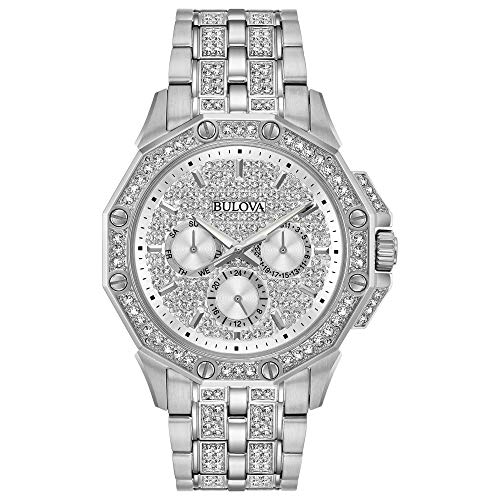
A short routine for the first month of ownership
The first month with a set watch sets the pattern for its life. Wear it in the contexts you bought it for, and notice where it catches, which sleeve fights its bezel and whether its weight distribution still pleases you after a full day rather than a first impression. Photograph it in flat light during the first week, including the bezel, dial, clasp and case back, and store those images with the purchase documents. That baseline protects you if a stone shifts early, when a warranty conversation is simplest, and it gives a future watchmaker a reference for how the settings began.
Register the warranty promptly if the maker offers registration, keep the retailer receipt with the specification record and place spare links somewhere safer than the watch box lid, where they are commonly lost during a house move. Learn the crowns correct operation from the manual rather than by experimentation, particularly on models with screw-down crowns or recessed correctors for day and date functions, because forcing a control is a common and entirely avoidable cause of early repairs in fashion watches generally.
By the end of that month you will know whether the watch has become a natural part of your rotation or an object you admire in its box. Both outcomes are informative. A watch that lives in its box because its size, weight or brilliance feels wrong in your actual life is telling you something about your taste that no catalogue could, and the factory completeness you preserved, papers, links, photographs and all, is exactly what makes exchanging, reselling or regifting it straightforward rather than awkward.
One last consideration belongs to travel, because these watches are often bought with holidays, performances and celebrations in mind. A set watch travelling in luggage should ride in a padded pouch inside hand baggage, never loose in a checked case where impacts and temperature swings work against its settings and plating. Hotel safes protect against loss but not against knocks, so keep the pouch habit even there. If the trip involves beaches, pools or boat days, plan a different watch for the water hours and let the set piece appear for the evening, which is both the safer schedule for the watch and, not coincidentally, the schedule where its sparkle earns its keep most naturally among dressed-up company.
Pack a spare soft cloth as well, since a quick polish before an evening out restores the stones far better than any hurried rinse under a hotel tap ever will.
Ultimately, the appeal of these watches is refreshingly honest: they exist to catch light, mark an occasion and please their wearer, and a factory-set example chosen for sound materials, secure settings and a size that truly fits will go on doing that job with a minimum of fuss for years.


