Our Top Picks
 Budget Shield Drum Shield 5 panels 2ft wide5 foot tall 5 panel drum shield120 x 3 x 60 inches70 poundsCheck on Amazon

What's inside
- What an acrylic shell actually is
- Shell thickness, resonance, and volume
- The standard configuration, drum by drum
- Bearing edges and the tuning range they allow
- Hardware: lugs, hoops, mounts, and the cracking problem
- How acrylic sounds beside maple and birch
- Climate, cold, weight, and the realities of moving the kit
- The four public lines most buyers compare
- Heads: clear against coated, and why the choice is half the sound
- Tuning and upkeep, week after week
- Who should buy acrylic, and who should not
- Check prices on Amazon
- Questions buyers ask most often
As an Amazon Associate I earn from qualifying purchases. This post may contain affiliate links at no extra cost to you.
As an Amazon Associate we earn from qualifying purchases. That single sentence sits at the top because it should. Everything after it rests on published shell specifications, manufacturer literature, head makers’ tuning guidance, and long-running owner reports from drummers who gig, record, and haul these kits through real winters and real loading docks. No claim in this guide depends on a private trial session, and none should be read that way. Where makers disagree about a shell, or where owners report different results from the same model, the disagreement itself is part of the evidence and it is flagged rather than smoothed over.
An acrylic kit stops a room before a note is played. Clear shells catch stage light, coloured shells glow under it, and the hardware seems to float inside a drum you can see straight through. That visual pull is honest and it matters, especially for a working band. Yet a drum set is bought for years of tuning, transport, head changes, and close microphones, not for the first photograph. The useful question is narrower and harder: what does a plastic shell actually do to sound, to durability, and to the small daily jobs of owning a kit?
This guide works through that question in the order a buyer meets it. First comes the material itself, polymethyl methacrylate, and the two very different ways shells are formed from it. Then come thickness, the familiar five-piece layout and what each diameter contributes, bearing edges, lugs and hoops, and the one structural weakness that deserves plain language: holes drilled through a brittle shell. Sound follows, compared carefully with maple and birch rather than praised in isolation. Environment, weight, the four public model lines most buyers cross-shop, head choice, tuning, and upkeep close the practical side, before a direct answer about who should spend money here and who should walk past a beautiful kit and buy wood.
What an acrylic shell actually is
Acrylic shell material is polymethyl methacrylate, usually shortened to PMMA. It is the same family of transparent thermoplastic sold in sheet form for glazing, signage, and protective screens, although a drum shell is not simply a flat sheet bent into a tube and called finished. Density sits close to 1.18 grams per cubic centimetre, roughly twice the density of many tonewoods used for shells, and the material is far stiffer than a ply of maple of equal thickness. Stiffness explains a great deal of the sound described later. A stiff shell reflects energy back toward the heads instead of soaking much of it into the wall, so the heads do most of the talking and they speak quickly.
PMMA also behaves differently from wood at the level of structure. Wood is fibrous, directional, and porous. It swells across the grain when humidity climbs and it shrinks when heated rooms dry out. Acrylic has no grain, no pores open to the air in the same way, and no plies that can separate. A shell is one continuous substance from inner surface to outer surface. That uniformity gives makers a predictable blank, and it gives owners a shell that ignores the damp rehearsal room that would trouble a thin wooden shell left there for a month.
Uniformity is not the same as toughness. PMMA is hard, and hard materials tend to be brittle when a sharp impact concentrates force on a small point. A wooden shell often dents. An acrylic shell, struck at the wrong angle or dropped onto a corner of hardware, may chip or crack instead. That trade sits at the centre of ownership. Buyers who understand it early tend to be happy. Buyers who expect plastic to mean indestructible tend to be disappointed, sometimes loudly and sometimes in the middle of a tour.
Seamless shells and what the word really covers
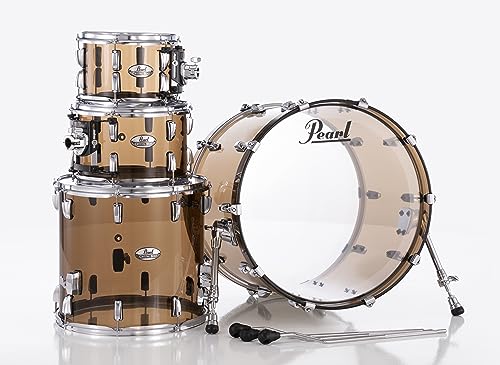
A seamless acrylic shell is formed without a glued vertical joint running from top edge to bottom edge. Pearl describes the Crystal Beat shell in exactly those terms, as a molded seamless construction, and the point is more than marketing vocabulary. Molding or extruding a tube and then finishing it to diameter removes the one line where two ends of a sheet once met. Without that line there is no glue seam to open, no slight step in thickness for a head collar to cross, and no weak meridian where a crack can start and then travel.
Consistency follows from the process. Wall thickness stays even around the circumference because the shell never depended on a worker overlapping or butting sheet ends by eye. Even thickness matters for tuning more than for looks. A lug pulls a head toward an edge, and if the shell wall changes character at one point, the drum can develop a stubborn spot that resists the same pitch as its neighbours. Owners of seamless kits often describe tuning as unusually straightforward, and the construction gives a mechanical reason to believe them.
Seamless does not mean unbreakable, and it does not describe every modern kit. It describes how the tube began. Holes still get drilled for lugs, mounts, badges, and air vents. Edges still get cut and shaped by people and machines. A seamless shell removes one specific failure site, nothing more, and treating it as a guarantee would repeat the oldest mistake in drum buying, which is letting one good feature stand in for the whole instrument.
Seamed shells, the Vistalite inheritance, and honest durability
The classic alternative bends a flat sheet into a cylinder and joins the ends with adhesive, sometimes with a reinforcing strip on the inside. Ludwig Vistalite kits of the nineteen seventies made that construction famous, wrapped in blue, amber, red, clear, and other colours that looked unlike anything wooden on a stage at the time. Plenty of those drums still exist, still get played, and still command respect, which proves a seamed shell can last for decades when it is handled well.
Age nevertheless finds the joint first. Adhesives harden, shrink slightly, and lose some grip after thousands of heating and cooling cycles in vans, clubs, and storage units. A seam can whiten, lift at an edge, or split when a shell flexes under a heavy mounted tom. Repair is possible but it is specialist work, because the solvent welding used for acrylic is unforgiving and a clumsy repair stays visible forever inside a transparent drum. On a vintage kit, seam condition is therefore a buying inspection, not a footnote. Look along the joint in strong light, feel for a ridge with a fingertip, and check whether cracks radiate from nearby holes.
Modern reissues benefit from better adhesives, tighter process control, and decades of hindsight about where the old shells failed. It would be lazy to condemn every seamed shell sold today using photographs of abused drums from 1976. It would be equally lazy to pretend the joint has vanished as a concern. The fair position is simple. A seamless shell eliminates a known weakness. A well-made seamed shell manages that weakness, often very successfully, but the joint remains the first place to inspect after years of use and the first place to protect from impact.
Shell thickness, resonance, and volume
Thickness is the specification buyers quote most and understand least, partly because makers publish it inconsistently and partly because a single number cannot describe a whole kit. Floor toms, kicks, and snares in one range may use different walls. Still, broad patterns hold across brands. Shells around the thinner end of the common range flex a little more under head tension, resonate longer, and give a drum a rounder, more open character at moderate volume. Shells toward the thicker end resist flex, project harder, and dry the note out, because less energy lingers in the wall and more leaves the drum at once.
Think of the difference at the extremes of playing rather than at a polite middle. A thin-walled rack tom struck softly in a small room can bloom, with pitch bending gently as the shell joins in. A thick-walled tom struck with a full stroke at an outdoor festival stays articulate, because the note begins fast, reaches a clear peak, and gets out of the way of the next stroke. Neither behaviour is a defect. They answer different musical problems, and a buyer who plays mostly unplugged rehearsals and small clubs should not automatically chase the thickest shell a catalogue offers.
Kick drums complicate the picture because diameter and depth dominate so much of the result. A thick acrylic kick can feel almost confrontational, with a beater click that survives a dense mix and a low thump that arrives a fraction later. A thinner kick gives up a little of that instant definition and gains warmth that some engineers prefer when the drum is recorded alone. Snares sit at the other extreme of sensitivity. Small changes in wall thickness alter how readily the shell answers a brush drag or a cross-stick, which is why acrylic snares deserve a section of their own later rather than a line in a table.
Volume deserves a correction here. Acrylic kits have a reputation for being loud, and on large stages that reputation is earned. Loudness, though, comes from attack and projection as much as from raw decibels. A shell that returns energy quickly makes each stroke seem forward and present, even when a meter would put a comparable wooden kit closer than the audience perceives. In a tiny room that same forward quality can feel like too much, because there is nowhere for the attack to dissipate before it reaches the back wall and returns.
The standard configuration, drum by drum
Most acrylic kits reach the market in a familiar shell pack built around a 22 by 18 inch kick, rack toms of 10 by 7 and 12 by 8 inches, a 16 by 16 inch floor tom, and, when a snare is included or bought to match, an acrylic snare of 14 by 5.5 or 14 by 6.5 inches. Those numbers are not arbitrary, and they are not merely tradition. Each one balances head response, shell depth, stage footprint, and the physical space left for a player whose knees, stands, and cymbals all compete for the same square metre.
Kick drum: 22 by 18
A 22 inch head moves enough air to anchor rock, pop, and most amplified music without needing heroic tuning. Eighteen inches of depth adds body and a slightly slower, weightier feel compared with a shallower 14 or 16 inch shell. In acrylic the combination reads as punch first and warmth second. The beater impact stays distinct, the fundamental arrives with authority, and the note clears quickly enough that fast double strokes do not smear into one another. Players who favour a very open, jazz-leaning kick sound often find an 18 inch deep acrylic drum harder to soften, because pillows and felt strips can tame sustain but they cannot change how hard the shell throws the initial transient back at the head.
Porting, muffling, and beater choice matter more on this material than many owners expect. A hard plastic or wood beater on a clear single-ply head can sound almost electronic in its click. A felt beater and a coated head pull the same shell back toward a recognisable acoustic thump. Neither setup alters the shell, yet a listener blindfolded might swear two different drums were involved. That sensitivity is useful. It means one kit can cover more ground through head and beater swaps than its reputation for a single fixed sound suggests.
Rack toms: 10 by 7 and 12 by 8
The 10 inch tom supplies the high voice. Seven inches of depth keeps it responsive, so quiet strokes still produce a complete note rather than a papery tick. Tuned high it cuts through guitars without force. Tuned low it can growl, although the pitch range where it stays comfortable is narrower than on a 12 inch drum, and forcing it downward usually produces a flabby head feel long before the pitch satisfies anyone.
The 12 by 8 is the workhorse and, for many players, the tom that decides whether a kit feels right. It bridges melody and weight. It can carry a fill downward from the 10 without a gap, and it can sit in a groove as a single rack voice if the smaller drum is left at home. Acrylic gives the 12 a particularly clear pitch centre, which helps when toms are tuned to intervals, and it also exposes uneven lug tension mercilessly. A quarter turn forgotten on one lug will be audible, not hidden inside a warm blur.
Floor tom: 16 by 16
Square dimensions, sixteen across and sixteen deep, give the floor tom its familiar authority. Legs isolate it from the stage, the head has room to develop a low fundamental, and the acrylic wall keeps accents from collapsing into rumble. In practice this drum often becomes the favourite of the kit. It answers a rimshot with real violence, settles into a half-time groove with weight, and still speaks at low volume when tuned carefully and fitted with a head that is not too thick.
It is also the drum most likely to reveal room problems. A lively acrylic floor tom on a hollow stage can excite the boards and set nearby hardware buzzing. A small piece of gel, a cotton ball inside the shell, or a lighter touch solves most of it. Reaching immediately for heavy muffling usually kills the quality that made the drum worth buying.
Snare: 14 by 5.5 or 14 by 6.5
Depth changes an acrylic snare more than diameter does, because diameter is fixed at fourteen in both common versions. The 5.5 inch shell is quicker, brighter, and a touch drier. Backbeats snap, ghost notes stay separated, and the drum suits funk, pop, and any setting where articulation matters more than sheer body. The 6.5 inch shell adds low midrange weight and a broader backbeat, the sound many rock players picture when someone says acrylic snare. It also responds a little more slowly to the lightest brush work, a trade most rock players accept without hesitation.
Snare beds, wire count, and strainer quality deserve attention equal to the shell. Twenty-strand wires are the usual middle ground. Fewer strands dry the response and sharpen articulation. More strands fatten the buzz and can blur quiet playing on a bright shell. Because acrylic contributes so little warmth of its own, wire and head choices are not decoration on a snare. They are the main tools for steering the drum toward dry, fat, cutting, or open.
Bearing edges and the tuning range they allow
The bearing edge is the narrow rim where shell meets head, and on any drum it governs how cleanly the head vibrates and how wide a tuning range feels usable. Acrylic makes edge quality unusually visible, literally. Hold a clear shell to the light and a wavy or chipped edge announces itself. That transparency is a gift during inspection and a rebuke to sloppy finishing, because nothing hides under lacquer or wrap.
A 45 degree edge, often with a slight outer counter cut, gives a relatively sharp contact point. Heads seat decisively, pitch bends less as tension rises, and the drum tends toward clarity and attack. Low tuning stays articulate longer on a good 45 degree edge, which suits players who like toms pitched down but still want each note to have a front. High tuning also behaves, although the brightness of shell and edge together can become glassy if heads are thin and the room is hard.
A rounder edge spreads contact over a wider band. The head feels a little more cushioned, the note gains body, and the very top of the tuning range softens. Some players describe round edges as forgiving, and that word is accurate in one specific sense: small tension differences between lugs matter slightly less when contact is broader. The cost is a fraction of definition, most noticeable on the kick and on a snare played at low volume.
Double 45 degree profiles and hybrid edges sit between those poles and appear on various models at various times, so the published specification for the exact kit under consideration should be read rather than assumed. What never changes is the maintenance rule. Never set an acrylic shell down on its bare edge on concrete, gravel, or a gritty stage. Wood may forgive a scuff. A nick in an acrylic edge can telegraph into tuning trouble and, in the worst case, start a crack. Edge protectors, a carpet, or simply resting the drum on its side on a soft surface cost nothing and prevent the most avoidable damage in this entire guide.
Tuning behaviour at the extremes ties edge, shell, and head together. Down low, acrylic holds pitch definition better than many expect, because shell stiffness keeps the note focused even when head tension drops. Up high, the same stiffness can push a drum toward a brittle ring if the head is thin and undamped. A slightly thicker head, or a two-ply option, often unlocks the upper range without any other change. Players who judge an acrylic kit only at the tuning the shop happened to leave on it are judging the setup, not the shell.
Hardware: lugs, hoops, mounts, and the cracking problem
Hardware decides whether a good shell stays good. On acrylic it also decides, more bluntly, whether the shell survives. Every lug, mount, bracket, and badge is attached through or against a material that does not compress like wood and does not forgive a screw driven past snug into forceful.
Lug count and what it buys
More lugs distribute head tension across more points, which allows finer control and helps a drum hold tuning under hard playing. Eight lugs on a snare and ten on a kick are common reference points, while toms vary. The benefit is real but incremental. A well-made eight-lug snare with an accurate edge will out-tune a sloppy ten-lug drum every time. Lug count should therefore be read as one sign of intent, not as a score.
Each lug is also another set of holes. Makers reinforce and finish those holes carefully, and under normal tension they are not a worry. The worry begins with overtightening during assembly, impacts that land on a lug, or a shell carried by its hardware and swung against a door frame. Inspect used kits lug by lug. Fine white lines radiating from a hole, sometimes called stress whitening, are an early warning that the material around that point has been strained.
Hoops: triple-flanged steel against die-cast
A 2.3 millimetre triple-flanged steel hoop is the familiar middle path. It is lighter, it flexes a little, and it leaves the drum sounding comparatively open. Rimshots crack without turning the whole note into metal. Cross-stick sounds stay woody in character even though no wood is involved, because the hoop yields enough to keep the click rounded.
Die-cast hoops are heavier, stiffer, and more expensive. They focus the drum, add a pronounced metallic ping to rimshots, raise the perceived tuning stability, and make the whole instrument feel denser in the hands. On an acrylic snare the effect can be thrilling for loud rock and exhausting for everything else, because shell and hoop then push in the same direction, toward attack and projection, with nothing softening the result. On toms, die-cast hoops divide opinion more sharply than almost any other hardware choice. Some players love the focus. Others feel the kit loses the little openness that separated it from a wall of noise.
Weight is not trivial either. A full set of die-cast hoops adds meaningful mass to a kit that is already no lightweight, and that mass rides in the hardware bag and on the player’s back during load-in. Count it before choosing it.
Tom mounts drilled through the shell
Here is the structural point this guide will not soften. A mount bolted through an acrylic shell concentrates the weight and leverage of a tom onto a few holes in a brittle wall. Every time the drum is struck, the tom tries to move. Every time the kit travels, vibration works at those same points. Tighten the mount screws too hard and the stress begins before the first note. Hang a heavy tom at a long angle and the leverage multiplies it.
Cracks around mount holes are the classic acrylic failure, documented in owner reports across decades and brands. They rarely begin as a dramatic shatter. A short line appears near a hole. It lengthens slowly, often unnoticed under a bracket. By the time it reaches an edge or a lug hole, repair options narrow and shell value falls off a cliff.
Prevention is ordinary, unglamorous, and effective. Keep rubber gaskets in place between metal and shell, and replace them when they harden or go missing, because the gasket spreads load and stops metal biting directly into the surface. Tighten mount fasteners to firm, never to the last grunt of a long wrench. Prefer suspension or isolation mounts that grip the hoop or lugs instead of the shell where the design allows. Keep mounted toms as light and as close to vertical as the setup permits, rather than cantilevering a deep 12 inch drum far forward. Remove toms for transport instead of leaving them mounted in a case where a drop becomes a lever. None of this requires talent. All of it requires consistency, which is why disciplined owners keep forty-year-old acrylic kits alive while careless owners crack new ones in a season.
Shell-mounted kick spurs and floor tom leg brackets deserve the same respect. They are smaller loads than a tom mount, but they share the same physics. Check their fasteners during head changes, look for whitening, and treat any new crack line as a stop sign rather than a cosmetic flaw to monitor through a summer of gigs.
How acrylic sounds beside maple and birch
Comparisons help only when they name specific qualities, so here are the four that matter most: attack, warmth, sustain, and low-end character. Maple is the usual reference because it dominates mid-priced and premium kits. Birch is the other useful benchmark, long associated with recording studios.
Attack is where acrylic wins plainly. The initial transient is fast and clean, almost startling on a snare or kick. Notes begin with a defined edge that helps drums stay intelligible when guitars are loud and a room is washing everything together. Maple begins a fraction softer. Birch begins quickly too, but with a different balance, emphasising higher frequencies in a way engineers have long liked under microphones.
Warmth is where acrylic gives ground. Maple produces a broad midrange and a sense of roundness that flatters quiet playing and small ensembles. Acrylic produces less of that cushion. A single tom played alone in a quiet room can sound stark, even a little cold, and no tuning trick fully supplies the low midrange bloom that a maple shell generates naturally. Players who love that bloom usually know it within five minutes of sitting at an acrylic kit.
Sustain runs shorter on acrylic for most comparable setups. The note speaks, peaks, and decays with less lingering resonance. In dense live music that is an advantage, because short notes stack cleanly and leave space. In sparse music it can feel abrupt, as if the drum ends the conversation early. Birch also trends controlled and focused, though with a different tonal colour, while maple generally lets a note hang longest of the three.
Low end surprises people. An acrylic kick and floor tom can produce formidable depth, but the depth arrives with a hard front, more slam than pillow. Engineers sometimes describe the result as modern, and that word captures both the appeal and the risk. Modern fits a lot of current rock and pop production. It fits a nineteen sixties soul repertoire rather less well.
Readers choosing amplification for a rehearsal room around a loud kit may also want to compare guitar cabinets, and anyone weighing options will find our guide to the best 10 guitar speakers useful for matching speaker character to a bright, fast-attacking drum sound. The pairing matters because an overly bright guitar tone and an acrylic kit together can leave a small room with plenty of edge and very little body.
On a large stage
Big stages forgive acrylic nothing and reward it everything. There is space for the attack to travel, a competent monitor engineer can shape what returns to the player, and the kit’s visual presence earns its keep across a wide auditorium. Rock, metal, worship bands in large rooms, tribute acts, and pop productions all use that combination well. Short sustain keeps fast passages clean at volume, and the shells look extraordinary under moving light, especially clear and coloured kits where internal hardware becomes part of the show.
Feedback and bleed still need managing. Bright toms excite cymbal microphones and vocal microphones more than softer shells might. Sensible mic placement and high-pass filtering handle most of it. The mistake is blaming the shell for problems that belong to gain structure.
In the recording studio
Recording exposes acrylic honestly. Close microphones capture that fast attack in detail, which can be thrilling on a snare and tiring across a whole album of tom-heavy songs. Engineers often reach for warmer microphone choices, move overheads a little higher, or choose coated heads to take the edge off. Equalisation tends to involve softening a harsh band in the upper mids and supporting low mids that the shell does not supply generously, rather than the low-end surgery a boomy wooden kick might need.
None of that makes acrylic a poor recording material. Birch built its studio reputation on focus, and acrylic offers focus of another flavour. It makes an excellent second kit, a deliberate choice for songs that need drums to feel urgent and contemporary. It is less often the only kit a versatile studio would keep, because session work rewards the shell that can pretend to be many things, and maple still pretends best.
Climate, cold, weight, and the realities of moving the kit
Humidity is the fear acrylic removes. A shell that does not absorb moisture will not swell, will not push its own seams apart from the inside as a wooden ply shell can, and will not change tuning character dramatically between a dry hall and a damp marquee. Drummers who play outdoor summer dates, coastal venues, or rehearsal spaces with unreliable heating often cite this stability as the quiet reason they stayed with acrylic after the visual novelty wore off.
Cold is the fear acrylic adds. PMMA grows more brittle as temperature falls. A kit left overnight in a freezing vehicle and then knocked during an early load-in is at greater risk than the same kit handled at room temperature. The sensible routine is to let cold shells warm gradually before striking them hard or tightening anything, and to avoid leaving a kit in an unheated vehicle in hard winter at all when any alternative exists. Sudden temperature swings deserve the same caution as impact. Pouring warmth onto a freezing shell, or the reverse, sets up internal stress that the eye may not catch until a crack appears weeks later near a hole.
Ultraviolet light and chemicals form the slower environmental story. Years of direct sun can yellow some clear acrylic and dull coloured shells. Harsh solvents can craze the surface, producing a network of fine lines that no polish removes. Cleaning therefore means a soft cloth, mild soap and water, and products made for plastics. It never means the aggressive cleaner borrowed from the kitchen cupboard because it happened to be nearby.
Weight needs a straight answer. Acrylic shells are dense, and a full kit commonly weighs more than a comparable maple kit of the same sizes, before hardware enters the calculation. Add die-cast hoops, heavy stands, and a hardware bag, and the total load becomes a genuine consideration for a player who carries everything alone up venue stairs. Exact totals vary by range and configuration, so published weights for the specific shell pack should be checked rather than guessed from another brand. What can be said generally is that nobody buys acrylic to save their back. They buy it despite the weight, for sound and appearance, and they manage the weight with cases on wheels, split hardware bags, and an extra trip rather than an injury.
Cases are not optional extras here. A padded hard case protects against the point impacts that acrylic fears most. Soft bags that suffice for a wrapped wooden kit leave an acrylic shell exposed to exactly the corner knocks that chip edges and start cracks. Budget for proper cases when the kit is bought, not after the first damage, and store shells with edges protected and nothing heavy stacked on top of them.
The four public lines most buyers compare
Four names dominate current acrylic shopping. Each represents a different answer to the same questions about seams, hardware, and intended player, and the differences are more instructive than any ranking.
Pearl Crystal Beat
Crystal Beat is the modern benchmark for seamless construction, and Pearl states that construction plainly. The line revived serious interest in acrylic when it returned, offering clear and coloured shells in configurations aimed at working rock and pop players rather than collectors. Hardware is contemporary, parts are widely available, and the kits appear regularly in backline and hire contexts, which says something useful about durability under indifferent handling. For a buyer who wants the seamless argument in its purest current form, this is usually the first kit to examine closely.
Tama Starclassic Mirage
Tama positions the Starclassic Mirage as a premium acrylic offering under a flagship family name, and the detailing reflects that ambition. Shell finish, hardware refinement, and the overall feel in the hands aim at players who want acrylic without any sense of compromise elsewhere on the kit. Tama’s long experience with mounting systems is relevant here, given everything said above about shell-drilled hardware. Buyers should still read the exact mount arrangement for the configuration they want, because premium branding does not repeal physics, but the Mirage rewards close inspection.
Anyone setting up a small stage where drums share space with a compact public address system might pair this research with our look at the best 12 inch speakers, since a focused acrylic kit and a well-chosen twelve inch cabinet can cover a surprising amount of musical ground without overwhelming a room.
Ludwig Vistalite
Vistalite carries the history. The reissued kits trade on one of the most recognisable looks in drumming, and for players raised on photographs of nineteen seventies stages, nothing else quite scratches the same itch. Colours are the point as much as sound for many buyers, and there is nothing shallow about that. A kit that makes a player eager to sit down and practise has done real musical work before a stick is lifted.
The practical advice is to inspect seam construction and hardware on the specific reissue configuration under consideration, to understand exactly what is being bought, and to treat vintage examples with the seam and crack checks described earlier. Heritage is a reason to look. It is not a substitute for looking.
DW Design Series acrylic
DW brings acrylic into its Design Series, the company’s more accessible line, and the appeal is the DW ecosystem: familiar hardware language, wide dealer support, and a kit that sits naturally beside the brand’s wooden offerings. Players already invested in DW stands and pedals often start here for that reason alone. As with the other lines, the deciding details are shell construction, mount design, hoop choice, and the exact sizes offered, all of which should be confirmed against the current published specification for the configuration in question rather than assumed from the badge.
Across all four lines, the same shortlist of questions separates a good purchase from an expensive lesson. Is the shell seamless or seamed, and does the maker say so clearly? How are the toms mounted, and how much weight hangs from the shell? Which hoops are fitted, and can they be changed later? Are replacement parts, matching add-on drums, and spare lugs realistically obtainable in five years? A brand that answers those questions openly has earned more trust than one that talks only about colour.
Heads: clear against coated, and why the choice is half the sound
No buying decision changes an acrylic kit faster than heads. The shell contributes attack and clarity. The head decides how much of that character reaches the listener and how much gets softened on the way.
Clear single-ply heads are the traditional pairing. They keep the look, since a clear head on a clear shell leaves the drum fully transparent, and they keep the sound open, bright, and immediate. For live rock they are often exactly right. Their weakness appears at low volume and under close microphones, where the same openness can turn thin and plasticky, a word owners use often and manufacturers never do.
Coated heads add a thin textured layer that warms the attack, shortens the brightest part of the note, and gives brushes a surface to grip on a snare. A coated batter on the snare is close to a default recommendation for acrylic. On toms, coated heads move the whole kit a step toward versatility, trading a little spectacle, because the shells are partly obscured, for a noticeably broader musical range. Many owners settle on coated batters with clear resonant heads, keeping some transparency and some openness where each does most good.
Two-ply heads, clear or coated, add durability and control. They suit hard hitters and players tired of pursuing a ring-free sound with gels and tape. Hydraulic and heavily damped specialty heads go further still and should be chosen deliberately. On a shell whose sustain is already short, heavy damping can produce a dead thud that no amount of tuning revives. Start lighter than instinct suggests, play the kit in a real room, and add control in small steps.
Kick heads deserve separate thought. A clear batter with a patch, a felt or plastic beater chosen for the click required, and a resonant head with or without a port cover most needs. Ported resonant heads ease microphone placement and feel a little drier. Unported heads look cleaner on a transparent kit and sound fuller at low volume. There is no universal winner, only a match or mismatch with the music.
Musicians who practise and write away from the kit often keep notation, lyrics, and lesson material on a tablet at the music stand, and our roundup of the best affordable tablets for musicians covers screens that stay readable under the same stage lighting that makes acrylic shells glow. It is a small point with practical weight: glare that hides a chart will also be bouncing off a clear floor tom.
Tuning and upkeep, week after week
Start every tuning session with the shell, not the key. Run a fingertip around both edges feeling for nicks. Glance along any seam. Look at each lug hole and mount point in good light. Thirty seconds of inspection catches the problems that thirty minutes of tuning cannot fix, and on a transparent drum there is no excuse for missing them, because the material itself lets light do half the work.
Seat each new head evenly, bring tension up in small increments in a star pattern, and expect acrylic to respond quickly. Small turns produce clear pitch changes, which is satisfying and also means overshooting is easy. Work in quarter turns near the target. Tap beside each lug, match those pitches first, then judge the whole note. Because the shell adds little colour, uneven lug pitches stand out starkly, and because it adds little colour, a well-matched head sounds exceptionally pure.
Low tunings reward patience. Drop tension gradually, keep lug pitches matched as they fall, and stop when the head still returns a defined note rather than pursuing the lowest possible rumble. High tunings reward restraint with head choice. If the top range sounds brittle, change the head before blaming the edge or the shell. Most acrylic tuning frustration traces back to a head fighting the pitch the player wants.
Cleaning is simple and strict. Dust with a dry microfibre cloth. Wash marks away with mild soap, water, and a soft cloth, then dry fully. Keep solvents, abrasive pads, and glass cleaners containing harsh chemicals away unless the maker explicitly approves them for this material. Static attracts dust to acrylic more noticeably than to a wrapped shell, so a kit stored uncovered in a dusty room will look tired quickly. A cover is cheap. Polishing out neglect is not.
Scratches deserve honest expectations. Fine surface marks can often be reduced with plastic polishes made for acrylic, worked patiently by hand. Deep scratches, chips, and cracks are different matters. A crack is structural. Drilling a stop hole at the end of a crack and bonding it is a known repair approach in skilled hands, but it is not a casual home job on a valuable shell, and any seller describing a cracked drum as an easy fix should be treated with suspicion.
Hardware upkeep mirrors wooden kit practice with one addition. Keep tension rods clean and lightly maintained so tuning stays smooth. Check that every gasket between metal and shell remains present and supple. Replace a missing gasket promptly. On wood, metal against shell is a cosmetic issue. On acrylic, it is a stress issue, and stress is the whole story of how these drums fail.
Storage follows from the climate discussion. Indoors, at stable room temperature, in cases, away from radiators and long direct sun, with nothing stacked on the shells. A kit stored that way asks very little. A kit stored in a freezing garage under a pile of amplifiers asks for trouble and usually receives it.
Who should buy acrylic, and who should not
Buy acrylic if the music is loud, the stages are reasonably large, and clarity matters more than warmth. Buy it if the visual side of performance is part of the job, in a tribute act, a pop production, a worship setting with cameras, or any band whose photographs travel further than its recordings. Buy it if damp venues and shifting humidity have made wooden shells feel like hard work. Buy it if a second kit is wanted that contrasts sharply with a warm wooden main kit, because contrast is where acrylic shines brightest and where disappointment is least likely.
Buy it, finally, if the discipline described in this guide sounds manageable rather than burdensome. Cases, gaskets, sensible tightening, warm storage, and a careful load-in are not heroic demands. For the right owner they become habit within a month.
Do not buy acrylic if the dream sound is a small, warm jazz kit that whispers. A skilled player can coax quiet music from these shells, with brushes, coated heads, and gentle tuning, but the material will be working against the intention at every step, and a thin maple or mahogany shell will reach that place with far less effort. Do not buy it if the kit will be thrown into vehicles without cases, lent to strangers weekly, or handled by a rotating cast of students and volunteers. Shared backline abuse is the fastest route to a cracked shell. Do not buy it if weight is already a medical concern, or if the main room is tiny and reflective and cannot be treated, because the kit’s greatest strength will arrive as a problem every single night.
Do not buy it, either, purely because a photograph looked extraordinary. Photographs do not tune, carry, or repair drums. Spend an hour with one in person if at all possible, play it quietly as well as loudly, pick it up, look at the mounts, and ask who services it locally. Desire that survives those ordinary questions is desire worth trusting.
A short buying checklist
Confirm whether the shell is seamless or seamed, in the maker’s own published words. Measure or confirm sizes rather than trusting a headline configuration, because shell packs vary. Identify the hoop type on snare and toms. Trace exactly how each tom mounts and how much of its weight the shell carries. Check that gaskets are fitted at shell contact points. Price proper cases into the same budget as the kit. Confirm spare parts availability for lugs and mounts. Read the warranty language about cracks carefully, noting what counts as impact damage. Then, and only then, choose a colour.
For rehearsal spaces where a drummer is also running playback or a small rig, our guide to the best 10 inch pa speakers may help balance kit volume against compact reinforcement, because an acrylic kit rarely needs much help being heard and the speakers should be chosen for clarity rather than sheer output.
Check prices on Amazon
Live listings for the shortlist in this guide are pulled from Amazon below, so prices and availability are always current at the moment you look.

Donner Drum Set Adult with Practice Mute Pad,5-Piece 22 inch Full Size Acoustic Drum Kit, Black- DDS-520


Questions buyers ask most often
Does acrylic crack easily?
Not under normal playing. Sticks, heads, and ordinary tension will not crack a healthy shell. Impact, overtightened hardware, heavy toms hanging from shell mounts, and cold combined with knocks cause the damage that fills owner forums. The distinction matters because it puts the outcome largely in the owner’s hands.
Can a cracked shell be repaired?
Sometimes, by someone who understands solvent bonding and stress relief in acrylic, and the repair on a clear shell will usually remain visible. Short cracks caught early fare best. Cracks reaching an edge or connecting holes are far graver. Get a specialist opinion before buying any cracked drum at a discount that assumes repair is simple.
Is acrylic louder than wood?
It projects more and its attack registers more strongly, which most listeners experience as louder. Measured output depends on sizes, heads, tuning, and the player. In small rooms the perceived difference is larger than in large ones, because the attack has nowhere to go.
Which heads should a first-time owner start with?
A coated batter on the snare, clear or coated single or two-ply batters on toms according to how hard the kit will be hit, clear resonant heads underneath, and a kick setup matched to beater choice. Change one variable at a time afterward. Changing everything at once teaches nothing about which choice produced which result.
Does colour change the sound?
No meaningful difference follows from pigment in the shell. Colour changes light, mood, and how visible dust and scratches are. Clear shells show every mark and every piece of internal hardware. Darker colours hide dust better and show fingerprints in their own way. Choose with cleaning habits in mind.
An acrylic kit is not a novelty and it is not a universal upgrade. It is a specific material with specific gifts: speed, clarity, projection, stability in damp air, and a look no wooden shell can imitate. Its costs are equally specific: less warmth, real weight, and a shell that punishes rough handling in ways wood forgives. Match those gifts to music that needs them and those costs to a life that can carry them, and the transparent kit behind the lights stops being a gamble and becomes the most honest instrument on the stage.


