Our Top Picks


What's inside
- What a cable attachment set typically bundles
- The lat pulldown bar: width, bend and back angles
- The tricep rope: two ends and a hundred opinions
- The V-handle and close-grip pulling
- Single D-handles: one hand, honest feedback
- Straight bars and revolving curl bars
- The ankle strap and the lower-body half of cable training
- Multi-grip bars and the geometry of choice
- Carabiners, clips and the compatibility question
- Handle construction: steel, knurl, rubber and webbing
- Rotating versus fixed sleeves on bars
- Grip diameters and hand size
- Load ratings and what they actually certify
- Exercise mapping: which handle does what
- Set-count honesty: when carabiners become pieces
- Storage bags, wall hooks and living with the set
- Care for chrome, rubber and webbing
- Safety checks: frayed straps, worn clips and tired welds
- Matching a set to your station and programme
- Mistakes this category reliably produces
- How attachments change resistance through a repetition
- What breaks first: a field guide to wear patterns
- Building a programme around the core six pieces
- Delivery day checks for a bundle of small steel
- Check prices on Amazon
- A note on sharing, lending and second-hand sets
As an Amazon Associate I earn from qualifying purchases. This post may contain affiliate links at no extra cost to you.
Everything in this guide comes from published specifications, manufacturer documents, owner manuals and engineering references about cable hardware, handle construction and rated hardware, not from buying a wall of attachments and working through them in a gym. Stated load figures are therefore treated as claims printed by makers, with the limits of those claims examined openly. Purchases made through the retailer after reading may earn the publisher a commission without changing what you pay, and that arrangement is stated here so the judgements that follow stand or fall on their reasoning alone.
What a cable attachment set typically bundles
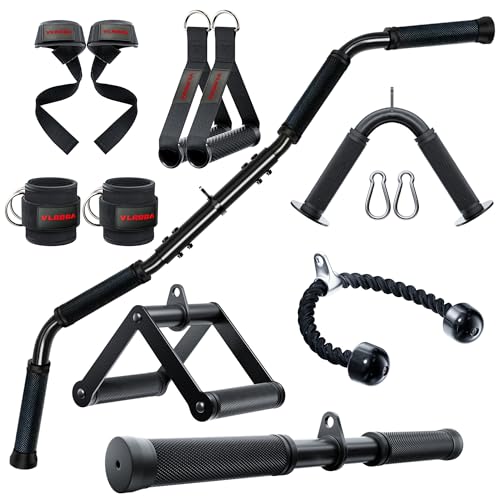
A cable attachment set promises to turn one weight stack into a small gym’s worth of movements. The classic bundle gathers a lat pulldown bar, a tricep rope, a V-handle, a pair of single D-handles, a short straight bar, a revolving curl bar, an ankle strap and, in larger collections, a multi-grip bar with several hand positions. Each piece answers a different mechanical question: how force from a cable should meet the hands, the forearms, the shoulders or an ankle so that a target muscle does the work instead of a joint complaining.
The bundle logic is sound because cable training is modular by nature. The stack, the pulley and the cable stay fixed while the interface changes, and the interface determines grip width, wrist angle, range of motion and whether one limb can drift stronger than the other unnoticed. A thoughtful set therefore covers wide pulling, close pulling, pressing down, curling, rotating the shoulder into a face pull and isolating a hip with a strap. A lazy set duplicates near-identical bars in different lengths and calls the repetition variety.
Before admiring any individual piece, lay the whole bundle out mentally against your own training week. Which movements do you actually perform, on which days, with which grip? Attachments that serve a movement you never programme become hooks of clutter, while a missing piece for a movement you love becomes a recurring improvisation with the wrong handle. Sets earn their keep by covering your programme completely, not by covering a catalogue photograph completely.
The lat pulldown bar: width, bend and back angles
The lat pulldown bar is the longest piece in most bundles and the one whose shape most visibly varies. Classic bars bend downward at the ends, bringing the outer grips slightly toward the lifter and softening wrist angle at wide widths. Others stay straight, or add swivel eyes at the ends, or incorporate several grip positions along a multi-grip frame. Length matters because grip width is the bar’s main variable: hands placed wide shorten the range of motion and emphasise the upper back and lats in a particular way, while a narrower grip lengthens the pull and invites more arm involvement.
For lat width development, coaching convention favours a pronated grip somewhat wider than the shoulders, pulling to the upper chest with the torso nearly upright. For thickness through the middle back, the same bar used narrower, or swapped for a close-grip piece, pairs with a slight lean and a longer squeeze at the bottom. The bar itself does not choose between those outcomes; hand placement and torso angle do. That is why a single well-made pulldown bar plus a V-handle covers more honest ground than three bars of marginally different lengths.
Bar construction deserves scrutiny at this size because a long bar is a lever. Solid steel examples carry reassuring mass and shrug off years of stack work. Hollow tube versions feel light and can flex or dent where the cable eye meets the centre, the highest-stress point of the whole piece. The centre eye should rotate or at least align cleanly with the cable’s pull; a fixed eye welded off-centre twists the bar in your hands at the start of every repetition, a small insult that becomes a large one across a training year.
The tricep rope: two ends and a hundred opinions
The tricep rope is a length of braided nylon or similar cord passed through a central connector, ending in two stops — usually moulded knobs or flared rubber ends — that the hands grip for pushdowns, face pulls, hammer curls and overhead extensions. Its genius is freedom: the hands can separate at the bottom of a pushdown, rotate during a curl, and find their own path during a face pull in a way no rigid bar permits. That freedom suits joints that dislike fixed angles, particularly elbows and shoulders with long training histories.
Rope length quietly governs usefulness. A short rope limits how far the hands can travel apart and crowds taller lifters on overhead work, where the ends run out before the arms reach full extension. A longer rope serves face pulls and extensions more gracefully. The end stops matter equally: smooth, generously sized stops give the fingers something to brace against under load, while small hard knobs dig into palms and encourage the grip to fail before the triceps do, inverting the purpose of the exercise.
Wear concentrates where the rope bends around its connector and where hands twist the braid. Quality ropes use tightly braided synthetic fibre that resists fraying and tolerates chalk and sweat; cheap examples fuzz quickly and shed fibres into the pulley. Because the rope flexes on every repetition, it is also the piece whose condition should be checked most often, a theme this guide returns to when discussing safety inspections.
The V-handle and close-grip pulling
The V-handle — two short grips angled toward each other with a connecting frame and a central eye — exists for close-grip rows and pulldowns with a neutral hand position. Neutral grips, palms facing one another, tend to sit kindly with shoulders and elbows while allowing heavy loading, which is why this unglamorous wedge appears in so many programmes for back thickness. Seated rows with a V-handle, pulled to the lower ribs with a braced torso, form the backbone of many cable back sessions.
Design differences hide in grip spacing and handle diameter. A narrow V brings the hands close and shortens the stretch; a wider frame suits larger torsos and longer arms. Some versions rotate the grips on bearings, most are fixed, and for rowing the fixed pattern is generally preferable because stability under load beats novelty. The weld or casting where the two sides meet the eye carries the full stack force, so a handle with visibly thin, porous-looking joins should be passed over in favour of one with clean, continuous metalwork.
Rubberised coatings appear frequently on V-handles. They cushion the palm and protect other equipment when pieces clash in a storage bin, yet they can tear at the ends and then peel in strips. Knurled bare steel versions feel harsher on day one and outlast coatings by years. The choice mirrors a recurring theme across the whole category: comfort layers age, structural metal endures, and the buyer’s time horizon should decide which one wins.
Single D-handles: one hand, honest feedback
Single D-handles, sold and bundled in pairs, are the diagnostic instruments of a cable station. Each hand pulls independently, so a stronger side cannot quietly subsidise a weaker one, and the cable can travel through arcs that a bar would forbid: crossovers and flyes, one-arm rows, lateral raises, kickbacks and unilateral presses. The D shape — a closed loop of steel or moulded plastic with a grip across its base — keeps the hand aligned with the cable’s line and gives the clip a dedicated eye.
Handle construction splits into three families. Moulded plastic handles are light, cheap and adequate for moderate loads, though their grip sections can flex and their eyes wear oval under metal clips. Steel-framed handles with a knurled or rubber grip section carry heavier stacks with composure. Webbing handles, built from nylon strap with a grip tube, pack flat, never rust and feel gentle on the wrist, at the cost of a slightly less precise connection when loads climb. A set that includes two handle families is quietly offering a load range, light and precise at one end, heavy and rigid at the other.
Grip diameter on D-handles interacts with exercise choice. Slimmer grips suit flyes and lateral raises where the hand should stay relaxed and the shoulder should lead. Thicker grips turn rows and presses into forearm-involving work. Because a bundle usually standardises one diameter across its handles, lifters with notably small or large hands should check that figure in the specification rather than discovering it mid-set, chalked and committed.
Straight bars and revolving curl bars
The short straight bar is the set’s utility player: pushdowns with a fixed pronated grip, straight-arm pulldowns, cable upright rows, seated pressdowns and the occasional curl variation all run through it. Its defining feature should be a revolving centre sleeve — the eye section rotating around the bar’s core — so the cable does not wind the bar in the hands as the stack rises and falls. A straight bar without a rotating centre fights its user gently on every repetition, and the fight is entirely avoidable.
The revolving curl bar adds angled bends that let the wrists sit between pronation and supination during curls and reverse curls, relieving elbow and forearm strain for many lifters. The same bends serve pushdowns for those who prefer an angled grip. Revolving action matters even more here, because curls rotate the bar through a wide arc; a seized sleeve converts that arc into cable twist and unpredictable resistance. When reading a specification, look for an explicit statement that the centre revolves, and treat silence as a fixed sleeve until proven otherwise.
Chrome finish dominates this corner of the category. Bright chrome over steel looks clean, resists rust in humid rooms and wipes down easily, though it can chip at the knurl peaks if the plating is thin. Black oxide and powder-coated bars trade shine for a slightly grippier surface. Either way, knurling depth on these bars should be moderate: enough to hold chalk, not so aggressive that pushdowns performed several times weekly sand the palms raw.
The ankle strap and the lower-body half of cable training
The ankle strap converts a low pulley into a leg machine. Wrapped and secured around the ankle — usually with hook-and-loop fastening over a padded cuff, plus a D-ring or two for the clip — it serves cable kickbacks for the glutes, hip abduction and adduction work, standing hamstring curls and controlled hip flexion for rehabilitation-style training. Without it, a cable station trains the lower body barely at all, which is why its presence or absence changes what a set fundamentally is.
Strap quality lives in the stitching and the ring attachment. The D-ring takes the entire load through a short webbing tab, and that tab’s stitching pattern — boxed, cross-stitched, or a single hopeful line — predicts service life better than any padding description. Padding matters for comfort during kickbacks, where the strap presses into the Achilles area, yet padding over weak stitching is upholstery on a failing structure. Double rings offer clip positions that change the line of pull slightly and provide redundancy in attachment geometry, not in strength.
Sizing deserves a thought for households sharing equipment. A strap sized generously wraps smaller ankles with overlapping layers that can feel bulky, while a small strap on a large ankle fastened over a training shoe may not close fully. Some lifters wear the strap over the shoe’s heel counter for kickbacks, which changes fit again. A set including one strap assumes solo training; pairs exist for supersets and bilateral work, and their absence is a fair reason to budget for a second strap separately.
Multi-grip bars and the geometry of choice
Multi-grip bars, the ladder-like frames appearing in larger sets, offer several parallel and angled hand positions on a single rigid piece. Their promise is ergonomic variety for pulldowns and rows: neutral grips at multiple widths, pronated grips without changing hardware, and angles that let a lifter route around a cranky shoulder. In practice they are the bulkiest item in any bundle, the hardest to store, and the first piece whose absence from a smaller set should be forgiven if the core handles are excellent.
Frame construction is everything here. A multi-grip bar multiplies welds, and each weld is a stress concentration under a stack that can exceed bodyweight. Continuous bends where possible, gussets at the centre eye, and a powder coat thick enough to hide nothing are the signs of a serious frame. Grip sections on these bars are often smooth or lightly textured tubes; sleeves or foam wraps sometimes cover them and should be regarded as replaceable wear items, not structure.
Width interacts with the cable station itself. A wide multi-grip bar on a narrow functional trainer can foul the uprights at the top of a pulldown, and its mass makes one-handed manoeuvring to the clip awkward. Measure the station, not just the bar. The best attachment in a catalogue is a liability if clipping it on requires a wrestling match at head height before every set.
Carabiners, clips and the compatibility question
Every attachment meets the cable through a clip, and that humble junction decides whether a set works with your machine at all. Most home cable stations terminate in a carabiner or a spring snap hook sized for standard attachment eyes. Functional trainers commonly use carabiners through nylon strap loops on their handles, while plate-loaded pulley systems and DIY setups vary widely — some end in a bare cable thimble expecting the user’s own connector.
Compatibility checks are refreshingly concrete. Measure the eye diameter on each attachment and the gate opening of your machine’s clip; a carabiner that cannot pass through a small welded eye renders that attachment decorative. Check whether the clip can close fully with the eye seated, because a gate held ajar by a thick frame loses most of its strength and can unclip under a twisting load. Spring snap hooks tolerate thicker eyes but can side-load more easily. When a set includes its own carabiners, compare their size against your station before assuming the bundle is self-sufficient.
DIY pulley systems — a cable run over a mounted pulley, loaded with plates on a pin — place extra responsibility on the user. The attachments behave identically, but the connector chain is homemade, so every link, from the pulley’s own mounting to the final clip, deserves the scepticism usually reserved for the attachment itself. A rated carabiner between a rated handle and an unrated eyebolt screwed into unknown timber is a system rated by its eyebolt. Sets cannot fix that; only honest assessment of the whole chain can.
Lifters organising a broader home setup sometimes browse best fitness and music smartwatches alongside equipment research, though clip geometry remains stubbornly analogue: measure the eye, test the gate, and never trust a connector that cannot close. That small ritual, repeated at purchase and at every inspection, prevents the one failure mode in cable training that arrives without warning.
Spring clips, carabiners and snap hooks compared
Carabiners with a locking sleeve suit overhead work where a detached handle would fall toward the lifter’s head. Plain spring-gate carabiners change faster between exercises and dominate home gyms for that reason. Snap hooks, the trigger-style clips borrowed from rigging, open wide and close positively, suiting users who swap attachments constantly during circuits. Each style has a rated orientation: load along the spine, never across the gate, never with the nose hooked on an edge. A set that mixes connector styles is not being inconsistent; it is matching connector temperament to exercise tempo, provided every gate closes cleanly on every eye in the bundle.
Handle construction: steel, knurl, rubber and webbing
Solid steel handles announce themselves through weight in the hand and indifference to abuse. Dropped, clashed and chalked for years, a steel D-handle or V-bar emerges with cosmetic scars and unchanged function. The cost is literal weight — a full steel set is heavy to carry, heavy to ship and heavy hanging from a cable at rest, which matters for small stacks whose lightest plate may be dragged upward by a massive bar before the lifter even pulls. On light functional trainer stacks, a heavy lat bar can preload the movement oddly, and webbing or aluminium pieces behave better.
Knurling depth follows the same logic as barbell texture at a smaller scale. Deep, sharp knurl on a pushdown bar secures the grip during heavy work and punishes high-repetition sessions. Shallow, rounded knurl suits the varied, moderate loads most cable work involves. Rubberised coatings soften contact and protect floors when handles swing, yet they absorb sweat, can turn tacky with age, and eventually split at edges where the hand drags across during gripping. Once split, a coating traps moisture against the steel beneath and corrosion starts invisibly — peel back any loose section during inspections rather than admiring its intact remainder.
Nylon webbing handles deserve respect rather than pity. Properly stitched webbing carries serious loads, never corrodes, packs into a drawer and spares the cable station’s paint. Its grip tubes rotate slightly in the hand, which some lifters love during flyes and others dislike during heavy rows. Webbing’s failure mode is visible — fraying, cut fibres, stretched stitching — which is a safety virtue compared with a plastic handle that looks whole until the day its eye snaps.
Rotating versus fixed sleeves on bars
Rotation in cable bars happens at the centre eye, where the clip attaches. A revolving sleeve lets the bar hang and turn freely, so cable twist unwinds instead of winding into the grip, and the bar settles into the hands at the start of a movement without a preliminary shake. Fixed-eye bars are simpler and stronger in principle, with one less mechanism to wear, and they behave acceptably on short, straight movements like pushdowns where rotation barely accumulates.
The difference grows with exercise arc. Curl bars and lat bars travel through angles that twist a fixed connection noticeably, and multi-exercise sessions compound the twist set after set until the cable itself carries a corkscrew memory. A revolving centre that spins smoothly under light finger pressure when unloaded will generally behave under load; one that feels gritty or catches at a point has worn bearings or a bent sleeve, and no lubricant fully restores a bent part. Include sleeve spin in your inspection routine for exactly this reason.
Sealed versus open mechanisms divide the market quietly. Sealed sleeves shrug off chalk dust, the abrasive confetti of every home gym, while open designs invite it in. Chalk inside a sleeve acts as grinding paste. If a maker specifies the sleeve mechanism at all — bushing, bearing, plain bore — that specificity suggests the part was engineered rather than merely assembled, a useful proxy when comparing otherwise similar bars.
Grip diameters and hand size
Cable handles cluster around grip diameters that feel unremarkable to average hands, which is precisely the problem for everyone else. Small hands on a thick pushdown bar fatigue the forearms before the triceps, because the fingers work at a mechanical disadvantage just holding on. Large hands on a slim rope or handle bunch the fingers and concentrate pressure. Specification sheets sometimes list grip diameter; when they do not, handle circumference can be estimated from product photography only crudely, so treat an unstated diameter as a question to ask the seller, not a detail to hope about.
Fat grips are a deliberate training tool in some programmes, recruited to build grip strength through rows and curls. A set whose every handle is thick imposes that tool on every movement, including ones where grip should not be the limiting factor. Conversely, uniformly slim handles cap heavy rowing for many lifters. The balanced bundle mixes: standard diameters on the main bars and handles, with thickness arriving as an option — a fat rope end, a chunky V-handle — rather than as a regime.
Gloves and straps complicate the arithmetic. Lifting straps wrapped around a bar add effective diameter and change which handle suits a heavy row; chalk adds almost nothing dimensionally but transforms friction. Buyers who always row with straps can tolerate slimmer, smoother handles than bare-handed lifters. There is no universal correct diameter, only a correct match among hand, handle, load and habit, and sets that publish their measurements respect that fact.
Load ratings and what they actually certify
Load ratings on attachments arrive in several dialects. Some makers state a maximum working load derived from a safety factor applied to a tested breaking point. Others state the breaking point itself, which sounds heroic and means far less, because working anywhere near a breaking figure leaves no margin for the dynamic spikes that occur when a stack jerks, a lifter slips, or a handle is dropped and caught by the cable. A third group prints a capacity with no stated method at all, a number whose only certain property is that it is round.
Dynamic loading is the concept casual listings omit. A stack labelled with a given mass exerts more than that mass in force during abrupt starts, stops and direction changes; the attachment, clip and cable all experience peaks above the static figure. Sound ratings absorb those peaks inside their safety factor. When comparing two handles, prefer the one whose maker explains the basis of the number — test standard, safety factor, or at least whether the figure is a working limit — over the one brandishing the largest unexplained total.
Ratings also apply to a new, undamaged, correctly loaded piece. A carabiner loaded across its gate, a strap with frayed stitching, a rope whose braid has been cut by a sharp pulley edge: none of these carries its printed rating anymore, whatever the stamp says. Treat ratings as the start of a safety conversation that inspections continue, not as a lifetime guarantee conferred at purchase. Welds deserve the same realism — a rating assumes the weld pictured in the catalogue, and visible porosity or undercutting on the delivered piece means your unit never matched the tested one.
For most home stacks, honestly built steel attachments are comfortably stronger than the loads available, and the practical weak points migrate elsewhere: the clip, the strap stitching, the cable’s own termination, the pulley mounting. A set buying decision weighted toward connector quality and stitching quality therefore protects the user more than one weighted toward the largest bar rating, because systems fail at their weakest element rather than their most advertised one.
Exercise mapping: which handle does what
Lat width work pairs naturally with the pulldown bar at a wide pronated grip, or with single D-handles on a dual cable setup where each side can travel slightly wider than a bar allows and finish with a longer stretch. The D-handle version also lets the wrists rotate subtly through the pull, which some shoulders prefer across high weekly volumes. Back thickness work shifts to the V-handle and to one-arm D-handle rows, movements that load the mid-back through a longer range with the elbow travelling past the torso.
Tricep pushdown variants divide by grip and implement. The rope permits the hands to separate and externally rotate slightly at the bottom, extending the range and suiting lifters whose elbows dislike fixed paths. The straight bar fixes the hands and often allows the heaviest loading, with a revolving centre keeping the cable honest. The curl bar’s angles offer a middle path for sore wrists. Overhead extensions favour the rope again for its length, while reverse-grip pushdowns with a single D-handle isolate one arm at a time and expose left-right differences with embarrassing clarity.
Face pulls belong to the rope, clipped high, pulled toward the forehead with the ends finishing beside the ears and the upper arms parallel to the floor. The rope’s length is the enabling feature; short ropes force a cramped finish that turns the movement into something else. Cable flyes belong to paired D-handles, whose independent arcs let the hands meet in front of the chest through a hugging path no bar can imitate, and whose handles should be light enough not to drag the shoulder into the movement’s start position. Lateral raises with D-handles or straps at the wrist shift work to the side deltoid while sparing grip fatigue.
Ankle strap work completes the map below the waist. Kickbacks extend the hip against a low cable with the knee soft, abduction work moves the leg outward against resistance for the outer hip, and standing curls flex the knee through a range a lying machine would otherwise provide. Each of these depends on strap security more than load; a strap that slips mid-repetition ends the set and occasionally the lifter’s dignity on the floor. Readers cross-checking the wider training picture may also consult best android smartwatches fitness trackers under 100 for the tracking side of a programme, while the movement map above remains the part that decides whether a bundle fits your week.
Unilateral work and imbalance detection
Paired D-handles and a single ankle strap share a virtue no bar offers: they let each limb report separately. Cable stations hide imbalance by design when a bar connects both hands, because the bar averages the two sides into one moving object. Independent handles remove the average. A lifter who discovers the left side failing two repetitions earlier on flyes, rows and pushdowns has learned something actionable about programming — add a set for the lagging side, start sets with it, match repetitions downward — and that discovery required nothing more exotic than the pair of handles already in the box.
Set-count honesty: when carabiners become pieces
Bundle counts inflate through a familiar accounting trick. A set described by a large piece number may count every carabiner, every strap, every handle of a pair separately and every storage accessory as equal citizens, so the headline number can double the count of actual training implements. Rebuild the count the way you would rebuild a barbell total: list the implements that change how force meets the body — bars, handles, rope, strap — then list connectors and storage separately. The first list is the set. The second list is hardware, welcome but not variety.
Duplicates hide inside counts too. Two straight bars differing only in length are one idea expressed twice; a curl bar and a straight bar are genuinely different tools. A rope plus a second, shorter rope is a spare, not a new movement. None of this makes a large bundle bad — spares of high-wear items like ropes and straps are genuinely useful — but the value sits in the spare’s honesty, not in its contribution to a headline number. Price the bundle per distinct function and the comparison between rival sets suddenly clarifies.
Missing pieces deserve the same audit. A set without an ankle strap excludes lower-body cable work. A set without a rope excludes the most joint-friendly pushdown and the standard face pull. A set with handles but no included clip assumes your station provides one that fits every eye. The cheapest bundle plus the three separate purchases it forces often costs more than the complete bundle that looked expensive, freight included.
Storage bags, wall hooks and living with the set
Attachments accumulate into a tangled drawer unless storage is planned with the same seriousness as the training itself. Many bundles include a carry bag, usually a soft duffel or mesh sack. Bags suit renters, garage gyms that pack away, and anyone carrying attachments to a shared space, but they invite the tangle they contain: hooks and eyes snag webbing, knurled bars abrade ropes, and finding the V-handle at the bottom costs a minute of rummaging before every session. A bag works best as transport, not as the daily system.
Wall hooks and peg rails turn the set into a visible inventory. Each piece hangs in its place, damage is obvious at a glance, and the empty hook announces the missing item before it becomes a mystery. Hooks must be rated for the cumulative load — a full steel set is not light — and spaced so heavy bars do not swing against straps. Mount the rail within reach of the cable station but outside the path of a loaded, moving handle; a wall of attachments behind the lifter’s head during pulldowns is a gallery waiting for an accident.
Households with children or curious pets should treat hanging steel at head height as the hazard it plainly is. Low hooks, a closed cabinet, or a lidded bin with internal dividers all beat an artistic wall display in a family garage. The storage question, like so much in this category, resolves by honestly picturing the room and its occupants rather than by copying a showroom photograph. Those rounding out a multi-purpose training space sometimes look at best mens smartwatches for the everyday-carry side of their kit; the attachments still need a hook, a bin or a bag with their name on it.
Care for chrome, rubber and webbing
Chrome bars ask for little: a wipe after chalky sessions, a dry storage spot, and prompt attention to chips before moisture undercuts the surrounding plating. A light machine oil on a cloth, used sparingly and wiped nearly dry, protects chrome and bare steel in damp garages without turning grips treacherous. Rubber coatings and rope ends clean with mild soap and water; solvents and degreasers shorten their lives and can leave residues that transfer to hands and then to eyes, a misery anyone who has rubbed a forehead mid-session will not repeat.
Webbing straps and handles should air dry fully after washing, because nylon stored damp in a closed bag develops odours and, over long periods, degraded fibres. Keep webbing away from sharp storage neighbours — a knurled bar thrown into the same bin saws at straps slowly and silently. Ropes hang best in loose coils rather than tight knots, which set permanent kinks into braid and concentrate wear at the kink’s apex.
Revolving sleeves benefit from occasional cleaning around the centre section where chalk accumulates. A soft brush, a blast of air, and patience outperform flooding the mechanism with lubricant, which attracts the very dust that causes grit. If a sleeve’s spin degrades despite cleaning, regard the bar as a fixed-eye bar for programming purposes and schedule its replacement by wear rather than by catastrophe.
Safety checks: frayed straps, worn clips and tired welds
Cable attachments fail gradually and then suddenly, which makes scheduled inspection the cheapest safety equipment in the gym. Straps announce their retirement through frayed edges, cut fibres across the webbing’s width, stitching that has pulled into loops, and hook-and-loop fastening that no longer holds under a firm tug. Any strap showing damage across a load-bearing section should leave service immediately; webbing does not heal, and a kickback strap that releases under load returns its energy toward the lifter.
Clips wear in ways that hide behind familiarity. Carabiner gates should snap shut crisply from any angle; a gate that closes slowly, incompletely, or with a gritty hinge is finished, regardless of how the body looks. Check the nose where gate meets body for cracks and deformation, and retire any connector that has been loaded across its gate or dropped onto concrete from height onto its gate side. Snap hooks deserve the same gate scrutiny plus a look at the trigger spring. Connectors are inexpensive relative to the injuries they prevent, and suspicion is a sufficient reason for replacement.
Welds and eyes on bars and handles repay a slow visual pass under good light. Hairline cracks radiate from weld toes on centre eyes that have lived hard lives, and paint or chrome can bridge a crack cosmetically while it grows beneath. Flex the piece gently against a fixed point and watch for movement that should not exist. Ropes should be uncoiled and run through the hands, feeling for flat spots, cuts in the braid, and a connector that has begun to chew its mounting hole oval.
Frequency scales with use. A home lifter training cables three times weekly might inspect monthly and find nothing for a year; the inspection that finally finds a frayed strap justifies every empty-handed one before it. Commercial-grade habits cost nothing at home scale: glance at the clip each time you connect, glance at the strap each time you fasten it, and give the whole set a deliberate review whenever the seasons change and the gym gets its other maintenance.
Matching a set to your station and programme
Begin with the station, because compatibility is binary. A selectorised home gym with a single high and low pulley needs the classic core: pulldown bar, rope, V-handle, D-handles, one revolving bar, ankle strap. A functional trainer with dual adjustable pulleys elevates the D-handles to starring roles, makes paired work possible, and rewards a second ankle strap and lighter handles that do not preload small stacks. A DIY single pulley rewards robust connectors and forgiving webbing handles, and it punishes any attachment whose eye geometry assumes a standard carabiner the setup does not have.
Then map the programme honestly across a month, not a motivated week. Count how many sessions actually use cable work for back, arms, shoulders, chest and legs, and let those counts rank the pieces. A lifter whose cable work is ninety percent back and triceps should weight bar and rope quality heavily and treat the ankle strap as a bonus. A lifter rebuilding a shoulder or training glutes seriously inverts that ranking. Sets are bundles, but attention is not required to be evenly spread across their contents; buy the bundle whose best pieces coincide with your most frequent movements.
Consider also who else trains. Shared households multiply hand sizes, strength levels and movement preferences, and a set with two handle styles covers that spread better than a set with one excellent style. Rehabilitation and older lifters in the household elevate webbing handles and ropes — the forgiving interfaces — from accessories to essentials. The catalogue photograph never shows your household; your decision should.
For a final cross-check of how the rest of a training setup comes together, some readers consult best activity smartwatches while planning the room as a whole. The attachment decision itself, however, closes with the station’s clip in one hand and your programme in the other, matching eyes to gates and handles to movements until nothing essential is missing and nothing expensive is redundant.
Mistakes this category reliably produces
The first is buying by piece count and receiving connectors, duplicates and a bag where training implements were expected. The second is ignoring eye and clip compatibility until delivery day converts a bargain into a return shipment. The third is choosing coated handles for comfort and discovering, a year later, that split rubber over damp steel has become the set’s maintenance hobby. The fourth is trusting a headline load figure without asking what it certifies, then loading a strap or a clip as though it shared the bar’s rating.
A fifth mistake is subtler: collecting attachments as motivation. A new handle can refresh a stale movement, but a wall of unused specialty pieces usually signals a programme problem that hardware cannot solve. The core set described throughout this guide covers an entire cable programme for most lifters. Add specialty pieces later, one at a time, each justified by a movement already in the programme that the core set serves imperfectly. That order — programme first, hardware second — keeps the drawer of attachments from becoming a museum of intentions.
How attachments change resistance through a repetition
A cable stack delivers nearly constant tension, yet the attachment in your hands reshapes how that tension is experienced across a movement. A rigid bar locks both arms into one path, so resistance peaks and fades according to the joint angles of the weaker side’s leverage. Independent handles let each arm drift toward its strongest line, smoothing the sticking points and sometimes permitting more total repetitions at the same stack setting. Neither behaviour is inherently superior; they are different training stimuli produced by hardware choices that look trivial in a product photograph.
Handle length creates leverage differences of its own. A long pulldown bar gripped at its ends shortens the effective range at the shoulder while demanding more stabilisation through the trunk, whereas the same bar gripped narrow becomes almost a different exercise wearing the same name. The rope extends the range of a pushdown beyond what a bar allows because the hands can travel past the body’s line at the finish, and that extra segment of travel is where many lifters feel the triceps complete their work. Choosing attachments is therefore partly choosing where in each movement the hard part will live.
Rotation at the wrist adds another layer. Fixed bars hold the forearm in one orientation from stretch to contraction, which can concentrate stress at the elbow during curls and extensions. Revolving sleeves and free handles permit micro-adjustments that distribute that stress, one reason high-volume cable programmes lean so heavily on ropes and D-handles. Lifters returning from elbow irritation often rebuild volume on the forgiving pieces first, then reintroduce rigid bars at lower volumes, a progression the composition of a good set makes possible without further purchases.
What breaks first: a field guide to wear patterns
Experience across home gyms follows a predictable hierarchy of wear. Hook-and-loop fastening on ankle straps tires first, losing grip strength after hundreds of closures contaminated with chalk dust and fabric fibres; rinsing the fastening surfaces and picking them clean extends service, but the material is ultimately a consumable. Rope braid frays next in heavy-use households, starting at the connector where flexing concentrates. Rubber coatings split on their own timetable governed by sunlight, solvents and how often handles clash in storage.
Metal pieces wear more slowly and more honestly. Knurl smooths gradually at the exact spots fingers favour, chrome thins at edges, and revolving sleeves develop play that can be felt as a faint clunk at each direction change. None of these developments is dangerous by itself, yet each marks a point on a timeline the owner should notice rather than discover. A handle that has served five years of weekly rows has earned its retirement fund; planning replacement of the highest-wear pieces — strap, rope, one pair of handles — into the original purchase decision turns a future failure into a scheduled errand.
Clips deserve their own timeline because their wear is the least visible and the most consequential. Gate springs fatigue through cycles, not drama, and a carabiner that has opened and closed ten thousand times may close a fraction slower than it once did. That fraction is the entire warning you will receive. Households that swap attachments between every exercise accumulate cycles quickly, which argues for keeping a spare connector in the storage bin as routinely as a spare strap.
Building a programme around the core six pieces
Six implements cover a remarkably complete cable programme: pulldown bar, V-handle, rope, paired D-handles, one revolving bar and ankle strap. Back training draws on the first two plus the handles for unilateral rows. Chest work runs through the D-handles almost exclusively. Shoulders split between rope face pulls, handle lateral raises and bar upright rows for those whose joints tolerate them. Arms divide among rope, bar and handles across pushdowns, extensions and curls in several wrist orientations. Legs and glutes belong to the strap. A bundle containing those six in sound construction is complete in the only sense that matters, whatever its carton count claims.
Programming exposes gaps that shopping lists hide. Supersets between a bar movement and a handle movement demand quick clip changes or a second connector waiting on the spare handle, a workflow detail that decides whether supersets survive contact with real sessions. Circuits expose storage geography: pieces staged in order along a rail flow, pieces buried in a bag stall. Even the humble question of where the ankle strap lives between leg sessions matters, because a strap that must be hunted for will be skipped, and skipped often enough it leaves the programme entirely.
Progression on cables is measured in stack steps, and attachment choice changes the size of those steps in effect. Moving from a bar pushdown to a rope pushdown at the same stack setting usually makes the exercise harder through range and stabilisation, functioning as an invisible progression between plate jumps. Alternating implements across weeks is therefore a legitimate programming lever, one available only when the set contains genuine variety rather than duplicates. This is the deepest argument for buying functions instead of counts: variety you own is progression you do not have to purchase later.
Delivery day checks for a bundle of small steel
Unpack a new set onto a table and work through it piece by piece before the first session. Clip every attachment to your station’s connector and confirm each gate closes fully with room to spare. Spin every revolving centre and note any that catch. Run fingers along welds, across knurling and around the rims of moulded handles, feeling for burrs that a maker should have removed. Tug each strap’s ring firmly by hand, flex the rope through its full coil, and hang each bar from the cable briefly at a light stack setting to watch how it settles.
Record the set’s real inventory — implements, connectors, spares — in the same training log that will record its work, along with any grip diameters and bar lengths you can measure. That record becomes the reference for inspections, for warranty conversations and for the day a piece goes missing into a friend’s gym bag. Ten unhurried minutes at the start converts a pile of hardware into known equipment, and known equipment is what safe, progressive cable training is built from.
Check prices on Amazon
Live listings for the shortlist in this guide are pulled from Amazon below, so prices and availability are always current at the moment you look.


QPARVERS Cable Machine Attachment LAT Pulldown Attachments Cable Machine Accessories for Home Gym

A note on sharing, lending and second-hand sets
Attachments circulate through the second-hand market constantly, because they are durable, compact and easy to post. A used set can be excellent value, provided the inspection habits described earlier are applied before money changes hands rather than after. Ask for clear photographs of strap stitching, rope ends, clip gates and centre eyes, the four places where wear concentrates, and treat evasive answers about any of them as a finding in itself. Steel bars and handles forgive their previous owners readily; webbing and rope carry their histories in their fibres, and their prices should reflect that asymmetry.
Lending within a training circle follows the same logic. Handles and bars travel between households with little risk beyond loss, while straps and ropes lent out return with unknown loads in their past. None of this forbids generosity; it merely suggests lending the metal first and keeping the soft goods at home. When a borrowed piece reveals a movement your programme has been missing, that discovery is the cheapest market research in the category, and it points directly at the single separate purchase that will complete a core set you already own.
Buy the bundle whose rope, bars and handles serve the sessions you truly repeat, and let every other shiny hook earn its place later.


