Our Top Picks



What's inside
- Why army men battle sets still earn their floor space
- Scale first: 1:32, 1:35, 1:72 and the classic 54 mm soldier
- What a battle set actually bundles
- Poses, moulding quality and the details that betray a cheap set
- Plastic: soft and bendy versus hard and brittle
- Paint: classic unpainted green and tan versus pre-painted finishes
- Themes: the Second World War, modern forces and multi-army buckets
- Safety: age grades, small parts and what the labels actually say
- Established makers and their lines, described by class
- Matching the set to the child, and a note on related buying
- Durability outdoors: sandboxes, gardens and sunlight
- Adult hobby use: wargaming and dioramas versus child play sets
- Cleaning, sorting and storage that actually gets used
- Growing a collection without scale chaos
- Setting up the first game so the set gets a fair hearing
- Check prices on Amazon
- A short buying checklist drawn from the specifications
As an Amazon Associate I earn from qualifying purchases. This post may contain affiliate links at no extra cost to you.
This guide rests on published specifications, manufacturer documents and toy-safety standards references, not on having bought or played with the products described. Dimensions, piece counts, age grades and material descriptions are drawn from what makers and standards bodies publish, and where those sources disagree or stay vague, that uncertainty is flagged rather than papered over. If you buy through a link on this page, the retailer may pay a commission that supports the site, at no extra cost to you; that arrangement does not change which sets are discussed or how their trade-offs are described.
Why army men battle sets still earn their floor space
Few toys ask so little and give so much room to improvise. A bucket of small soldiers needs no batteries, no screen, no network connection and no rulebook thicker than a child’s imagination. Spread across a carpet, the figures become a frontier, a beachhead, a mountain pass or the garden path outside, depending entirely on who is arranging them. That openness explains why a product category older than most of its buyers’ grandparents continues to sell in supermarkets, toy shops and catalogue pages alike.
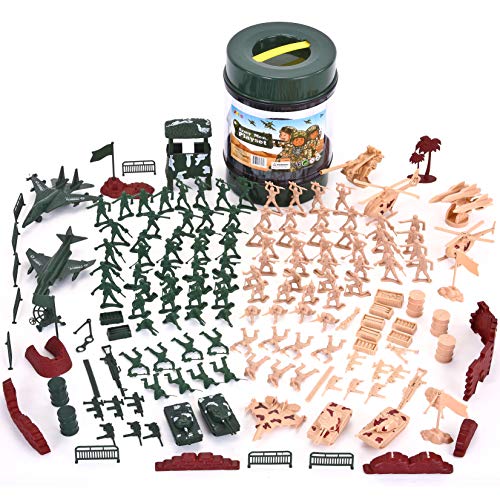
A battle set, as the term is used here, means more than a loose handful of figures. It is a packaged assortment built around opposed play: soldiers in at least two colours or uniforms, usually supported by vehicles, weapons pieces, structures or terrain, sold together so a complete scene can be staged straight from the container. Single packs of figures exist, of course, and they matter for expanding a collection, but the battle set is the starting unit most families buy first and the unit against which value is easiest to judge.
Choosing well is less simple than the low-key packaging suggests. Two boxes can both promise a large piece count while delivering very different things once tipped onto the floor. One may hold a balanced force with vehicles and cover; the other may pad its total with tiny accessories, duplicate flags and a play mat too small for the figures it accompanies. Scale mismatches, brittle plastic, wobbly bases and moulding flaws all hide behind cheerful box art. The sections that follow break the category down into the details that actually decide whether a set gets played with for years or quietly migrates to the bottom of a cupboard.
None of this requires spending heavily or collecting obsessively. It requires reading the specifications with a sceptical eye, deciding which scale and theme suit the child or hobbyist in question, and understanding what piece counts really count. Parents buying a first set, grandparents replacing a beloved childhood bucket, and adult hobbyists hunting affordable figures for a tabletop project all face the same basic questions, even if their answers differ.
Scale first: 1:32, 1:35, 1:72 and the classic 54 mm soldier
Scale is the single most consequential decision in this category, because it governs everything that follows: which vehicles look right, which buildings fit, which later purchases will blend in and which will stand out like giants or dwarfs in the ranks. Manufacturers express scale in two dialects. Ratio scales such as 1:32, 1:35 and 1:72 describe how many times smaller the figure is than a real person. Millimetre scales describe the figure’s height directly, and the classic toy soldier stands about 54 mm tall, roughly two inches, which is why older packaging often simply calls them 2-inch soldiers.
The 54 mm figure sits close to 1:32 scale, and the two terms are frequently used for the same broad class of large toy soldiers. At this size a standing infantryman is tall enough for small hands to grip easily, facial and uniform detail survives casual moulding, and the figures read clearly from across a room. Vehicles made for this class are chunky and satisfying, with wheels that roll over carpet pile and turrets that a child can turn without tweezers. Most traditional bucket and bagged sets live here, which makes 54 mm the easiest scale in which to grow a collection without hunting for compatible oddments.
Figures described as 1:35 come from the modelling world, where that ratio dominates military kits. A 1:35 soldier is slightly smaller than a 1:32 one, and side by side the difference is noticeable but not grotesque; heads and weapons betray it first. Modellers accept 1:35 because the supporting ecosystem of tanks, trucks, artillery and diorama buildings is enormous. For pure floor play the distinction rarely matters, yet mixing the two ratios in a single squad produces a faint visual unevenness that some children notice immediately and some adults cannot unsee once pointed out.
At the other end sits 1:72, a scale borrowed from aircraft and wargaming kits, where a standing figure measures roughly 25 mm. Sets in this class pack remarkable numbers into a small box, and the supporting vehicles are correspondingly compact. The appeal is scope: an entire company can deploy across a dining table, with room left for roads, rivers and villages. The costs are fiddliness and fragility. Rifles become slivers, bases shrink to coins, and younger children find the figures hard to stand up and easy to lose between floorboards. For older children and hobbyists, though, 1:72 offers the cheapest route to genuinely large battles.
Between and around these anchors float looser descriptions. Some makers label figures 1:48, others quote heights of 48 mm, 60 mm or 100 mm for oversized play figures aimed at toddlers and preschoolers. None of these labels is policed with legal rigour, and nominal scale can drift within a single manufacturer’s range. Treat the printed ratio as a starting claim, check the stated figure height in millimetres whenever it is given, and remember that a kneeling or prone figure will always measure shorter than a standing one from the same set.
Why consistency matters when sets are mixed
Scale consistency matters because the eye reads relative size before it reads anything else. A 54 mm sergeant placed beside a 1:72 private does not look like an officer towering over a recruit; he looks like a different species of object, and the shared fiction of the scene collapses. Vehicles suffer worst. A tank scaled for small figures becomes a toy car beside large ones, while a jeep made for 54 mm soldiers dwarfs a 1:72 platoon into passengers in a clown car. Children tolerate more inconsistency than adult collectors do, but even children tend to segregate mismatched figures into separate games once the oddity registers.
Inconsistency also compounds quietly. A collection built from whatever was on offer accumulates three or four near-miss scales, none of which has quite enough figures for a full game, and every new purchase forces the same awkward sorting. Committing to one main scale early, even loosely, turns later buying into simple addition. The odd gift set in a different size need not be banished; it can serve as a separate force for a different kind of game, giants in a fantasy scenario, or the nucleus of a second, smaller collection kept in its own container.
Practical checking helps more than label reading. Stand a new figure beside an existing one and compare head height and base diameter. Check whether a figure’s head reaches a vehicle’s hull at a believable point, roughly waist height against a tank side for most infantry poses. Photographs on packaging are often composites that flatter compatibility, so the stated dimensions and any scale named in the specifications deserve more trust than the artwork.
What a battle set actually bundles
Soldiers are the core, but the supporting cast defines the genre. A typical mid-sized set surrounds its infantry with some combination of armoured and soft-skinned vehicles, heavy weapons, defensive structures and scenery, all intended to turn a line of figures into a position worth attacking or defending. Understanding each component helps a buyer judge whether a particular bundle matches the kind of play it will actually see.
Tanks are the headline vehicle in most sets, usually a generic tracked design with a rotating or fixed turret rather than a faithful copy of a specific historical vehicle. Jeeps and trucks appear next most often, sometimes with trailers, and they earn their place by moving figures and supplies around the imagined battlefield. Artillery pieces, from simple cannons on wheeled carriages to chunky howitzers, give defenders something to crew and attackers something to capture. Aircraft feature in larger assortments: a helicopter with free-spinning or fixed rotors, occasionally a simple fixed-wing plane, almost always moulded in the same plastic and scale-tolerant rather than scale-exact.
Static pieces shape the ground itself. Bunkers and pillboxes provide hard cover with firing slits. Sandbag walls, hedgehog obstacles, barbed-wire sections and ruined walls break up open floor into defensible pockets. Flags serve as objectives, and many sets include one for each side so a capture-the-flag game needs no improvisation. Rock formations, trees, bridges and sections of fence appear in better-equipped bundles, while the humblest scenery item, the printed play mat, unifies everything by giving the scene a printed road network, river or airfield to organise around.
Small accessories fill the remaining count: rifles separate from figures, backpacks, crates, barrels, fuel drums, tents, watchtowers, landing craft in naval-flavoured sets, and occasionally animals or civilian figures in historical ranges. Individually trivial, collectively they decide whether a position looks lived-in or bare. A set with crates and barrels invites supply-depot games; one with tents invites camp raids; one with neither leaves the imagination to supply everything, which some children relish and others find uninspiring after the first afternoon.
Comparing piece counts honestly
Piece count is the most advertised and least standardised number in the category. No rule obliges a maker to count the same way as a rival, so headline totals must be unpacked before they mean anything. A useful habit is to divide any claimed total into three piles in your head: figures, vehicles and structures, and loose accessories. Only the first pile tells you how many soldiers will actually stand on the floor.
Consider how easily totals inflate. A set advertised with a count in the hundreds may contain a few dozen figures, a handful of vehicles, and then a long tail of flags, rifles, crates and mat sections counted one by one. Some makers count a two-part bunker as two pieces, a tank with a separate turret as two, or a sheet of stickers as a piece. None of this is fraud exactly, since the objects are physically present, but it makes cross-brand comparison by headline number almost meaningless. The figures-per-box figure, when stated, is the honest comparator, followed by the number of distinct vehicle types.
Colour split matters as much as the total. Opposed play needs two viable forces, so a set whose figures divide evenly between two colours offers more game than a larger set dominated by one side with a token handful of opponents. Check the stated split if it is published, and be wary of assortments where the second colour turns out to be mostly accessories or vehicle crews rather than infantry. A lopsided bucket can still be worth buying as reinforcements for an existing force, but it disappoints as a first purchase.
Pose count is the third hidden number. One hundred figures drawn from four poses play very differently from sixty figures drawn from twelve poses. Repetition is inherent to the format, since moulds are expensive and each pose must be produced in quantity, yet the best sets distribute their duplicates across enough distinct stances that a deployed line looks varied rather than cloned. Packaging that names or pictures its poses deserves credit for transparency; packaging that shows only a heroic jumble deserves a closer look at the specifications.
Poses, moulding quality and the details that betray a cheap set
Pose variety is where a set’s imagination lives. The classic repertoire includes standing firing, kneeling firing, advancing with rifle at the trail, prone firing, a bazooka or rocket team, a radio operator, an officer with binoculars or a pistol, a flag bearer, a medic, a flamethrower or machine-gun team, marching figures, and specialists such as paratroopers, frogmen or mortar crews in themed ranges. A good battle set samples widely from that repertoire for each side, ideally mirroring poses so neither army feels like an afterthought, though exact mirroring is rare outside premium lines.
Variety serves play directly. Prone and kneeling figures hold a defensive line convincingly; advancing poses suit an assault; officers and radio operators anchor command scenes and storytelling. When every figure stands firing in the same stance, games flatten into two walls of identical silhouettes and children start inventing distinctions the plastic does not support. Mixed poses also future-proof a set, because the same figures can staff a beach landing one day, a street scene the next and a parade-ground display on a shelf in between.
Moulding quality separates respected lines from disposable ones more reliably than any specification. The tell-tale defects are well known to anyone who has handled inexpensive figures. Flash, the thin web of excess plastic left where mould halves meet, fringes bases and fills the gap between arm and torso until trimmed. Bent rifles and bayonets emerge from bags already curved, a souvenir of figures packed warm or stored under weight. Soft detail turns faces into suggestions and uniform webbing into smooth straps. Short shots, where plastic failed to fill the mould, leave a figure missing a hand, a helmet brim or the tip of a weapon.
Base stability deserves its own scrutiny because it decides whether play flows or frustrates. Most figures stand on a flat oval or rectangular base moulded as part of the piece. A base that is warped, too small for the pose, or joined to the feet at a weak angle produces the familiar domino problem: one figure topples into the next, and setting up takes longer than the battle. Leaning poses, figures lunging or throwing, are the worst offenders and the first to check in reviews of a line’s general reputation. Wider, flatter bases and poses kept within their own footprint are the marks of a maker who expected the figures to be stood up thousands of times.
None of these flaws is fatal in a play set destined for the sandbox, and perfectionism would miss the point of an inexpensive toy. The realistic standard is proportion: a few bent rifles in a large bucket are acceptable, a bag where half the figures cannot stand is not. Since individual inspection before buying is rarely possible, the maker’s track record and the line’s longevity become proxies, a theme returned to below when established producers are considered.
Plastic: soft and bendy versus hard and brittle
Most inexpensive army men are moulded from low-density polyethylene, LDPE, a soft and flexible plastic with a slightly waxy feel. It bends rather than breaks, tolerates being stepped on with a flex and a spring back, and survives drops onto hard floors without complaint. Rifles and raised arms in LDPE can be straightened by hand after minor bends, and the material takes the rough handling of young children in its stride. Its weaknesses are cosmetic and structural at the margins: fine detail moulds less crisply, paint adheres poorly, and thin parts can creep into permanent curves if stored bent under pressure in a warm place.
Harder plastics occupy the other end of the trade-off. Polystyrene and ABS, familiar from model kits and construction toys, hold sharp detail beautifully and accept glue and paint as LDPE never will. A hard-plastic figure can carry a recognisable face, readable insignia and a rifle with a distinct barrel and stock. The cost is brittleness. Dropped onto tile, a hard figure chips; trodden on, it snaps rather than flexes, often at the ankle or the weapon, and the resulting edges can be sharp. For display and hobby use that fragility is an acceptable price. For a five-year-old’s garden battles it usually is not.
Between the poles sit medium formulations and vinyl-like materials used by some makers to balance detail against toughness, and the packaging rarely names the polymer at all. Buyers must infer from description and reputation: words such as flexible, soft or unbreakable in a maker’s materials point toward polyethylene, while model-kit language, glue references and painting guides point toward hard plastic. The intended user settles the question. Floor play, outdoor play and mixed-age households argue for soft plastic; shelf display, dioramas and painting projects argue for hard.
Vehicles follow the same logic with an extra variable, since wheels, axles and turret pivots are moving parts. Soft-plastic vehicles shrug off collisions but their axles can sag; hard-plastic vehicles roll straighter and look sharper but shed mirrors, barrels and antennae in rough games. Hollow moulding keeps large vehicles light and cheap, at the price of a drum-like rattle and walls that flex when squeezed. None of these traits disqualifies a set, yet together they predict how it will age, and ageing is where battle sets either become heirlooms or landfill.
Paint: classic unpainted green and tan versus pre-painted finishes
The archetypal army man arrives unpainted, a single colour throughout: olive green for one side, tan, grey or a second green for the other. That monochrome finish is not merely economy. Uniform colour makes opposing forces instantly legible across a room, survives any amount of abrasion because there is no coating to lose, and leaves the figure’s identity open; green men can be any army the game requires. Collectors of the classic form often prefer it for exactly those reasons, and children rarely object to what has always looked correct to them.
Pre-painted sets promise a different pleasure. Uniforms in contrasting cloth colours, skin tones, black weapons and unit markings transform the same moulds into something closer to a finished model, and for display or for children who struggle to project detail onto plain plastic, the difference is dramatic. Quality varies enormously. Good factory painting stays inside the lines it claims, uses several colours with intent, and applies a coating tough enough for gentle play. Poor painting smears faces, pools in recesses, and flakes from flexing soft plastic within weeks, leaving figures that look worse than honest monochrome ever did.
Paint and plastic interact, which is why most pre-painted play figures use harder compounds or specially primed surfaces, and why painted soft-plastic figures deserve extra scepticism. Flex a painted LDPE rifle a few dozen times and the coating at the bend will craze and lift. For a set bought mainly for display, gentle handling makes that a minor concern. For a set bought for the sandpit, unpainted figures are not the budget compromise they appear to be; they are the technically correct choice, and any premium for paint is money spent on a finish the play style will destroy.
A middle path exists for families who enjoy projects: buy unpainted figures in a paint-friendly plastic and decorate a few leaders or specialists at the kitchen table with acrylics. The bulk of the army stays robust and monochrome while command figures gain identity. Makers’ documents for hobby lines usually state whether their plastic accepts paint directly or needs a primer, and that small specification is worth more than any photograph of a professionally finished example.
Themes: the Second World War, modern forces and multi-army buckets
Theme organises a set’s uniforms, vehicles and scenery into a story, and the category revolves around a few durable settings. The Second World War remains the default, for reasons of mould inheritance as much as taste: the classic poses, helmets and vehicles were designed in that conflict’s shadow, and generations of sets have reused its visual language of steel helmets, backpacks and bolt-action rifles. A Second World War set typically fields green against grey or tan, with tanks and artillery that read as period machinery even when no specific vehicle is modelled.
Modern-force sets update the silhouette. Helmets gain covers and mounts, rifles shorten and sprout attachments, body armour squares off the torso, and vehicles shift toward wheeled armoured cars, helicopters and desert-toned trucks. These sets suit children whose reference points come from news footage and contemporary games, and they mix poorly with period figures for the same reason a modern soldier would look anachronistic in a historical film. Neither theme is objectively better; coherence within the collection is what matters, and a household should expect a child who starts with one era to resist reinforcements from the other.
Multi-army buckets take the opposite approach to coherence, bundling three, four or more colours and uniform styles into one container so several factions can fight at once. The format shines for siblings and groups, where each player claims a colour, and for sprawling free-for-all games where alliances shift by the minute. Its weakness is depth: each faction may muster only a small squad with few poses and little vehicle support, so no single army feels complete. As a first purchase for a group of children it can be the smartest format available; as the foundation of a focused collection it spreads the budget thin.
Beyond the big three, smaller themes persist at the edges of the market: earlier twentieth-century conflicts, futuristic troopers, knights and historical ranges that borrow the same production model, and licensed tie-ins that come and go with films. Themed scenery follows the figures, so a bucket may include palm trees for a Pacific setting, ruined European walls, desert rocks or snow-toned bases. Checking that the scenery matches the figures sounds obvious, yet mixed remainder assortments sometimes pair whatever the factory had, and a buyer scanning specifications should confirm the bundle tells one story rather than three.
Theme also carries a household judgement that specifications cannot make. Some families are comfortable with toy soldiers as abstract game pieces; others prefer to steer younger children toward rescue, exploration or historical storytelling framings, or to wait until a child is older. Battle sets vary in how graphically they present weapons and combat poses, and the box art plus pose list usually signals that tone honestly. Choosing a theme is therefore partly a values decision, and the right answer differs by family in a way no buying guide should pretend to settle.
Safety: age grades, small parts and what the labels actually say
Safety in this category turns on one dominant hazard: size. Small figures, separate weapons, wheels, turret parts and accessories can pose a choking risk to children under three, and the entire regulatory apparatus around these toys flows from that fact. The buyer’s job is not to improvise a personal safety standard but to read and respect the labelled grade on the specific set, because that grade reflects how the product was assessed and for whom the maker intends it.
Age grading appears as a minimum recommendation such as 3+ or 5+, printed on packaging and in product specifications. A 3+ grade does not certify that every three-year-old will play safely or happily; it indicates the set was designed and assessed for children of that age and up, without the small-parts prohibition that governs toys for younger children. A 5+ grade on a similar-looking set usually signals smaller or more numerous detachable pieces, finer accessories, or simply a maker’s more cautious assessment, and it deserves to be taken at face value rather than treated as a challenge. When the labelled grade exceeds a child’s age, the correct response is to choose a different, larger-format set, of which the market offers plenty aimed at preschoolers with chunky figures and no loose accessories.
Small-parts warnings carry specific legal weight. In the United States, toys for children under three must not contain small parts at all, and products intended for older children that do contain them must carry the prescribed cautionary labelling. The familiar warning symbol and wording on a battle set are therefore information, not decoration: they announce that the box contains components a toddler could mouth and obstruct an airway. Households with mixed ages face the practical version of this problem, since an older child’s new set enters a home where a younger sibling crawls the same floor. Storage discipline, covered later, becomes a safety measure in such homes, and play on tables rather than floors can reduce the scatter of tiny pieces into toddler territory.
Standards references supply the background framework. ASTM F963, the Standard Consumer Safety Specification for Toy Safety published by ASTM International, is the reference most often cited for toys sold in the United States, covering mechanical hazards, flammability, and limits on certain chemicals in toy materials, among many other provisions. Makers and importers state conformance in their documents, and a specification that names the standard plainly is a better sign than vague assurances about being safe or non-toxic with no framework attached. Other markets apply their own regimes, so a set bought from an overseas seller may cite a different standard or none that a buyer recognises; that gap is a reason for caution, particularly for unbranded assortments with no identifiable manufacturer to stand behind the claim.
Two boundaries keep this discussion honest. First, labelled grades assume the product is used as sold, not modified, chewed into new shapes or handed down after years of damage have loosened parts that began secure; a battered old set should be rejudged on its condition, not its original box. Second, this guide stays with the labelled grades and published standards rather than inventing supplementary rituals, because the grade on the box, matched to the child in front of you, is the decision tool the system provides. Respect it, store accordingly, and retire broken pieces with sharp edges rather than returning them to the bucket.
Established makers and their lines, described by class
Longevity is the closest thing this category has to a quality guarantee, and a handful of producer classes account for most of the sets a buyer will encounter. Their names matter less than recognising which class a given product belongs to, because each class has characteristic strengths and characteristic corners cut.
The first class is the US-made classic line: domestic producers who have moulded soft-plastic soldiers in the 54 mm tradition for decades, selling bagged and bucketed sets in green, tan and grey, often with the same beloved poses their tooling has carried for years. These lines trade on consistency. A bag bought today stands comfortably beside one bought a decade ago, vehicles recur across sets so fleets accumulate naturally, and the plastic formulation is the familiar flexible kind that survives childhood. Detail is honest rather than exquisite, prices stay in impulse territory, and the whole proposition rests on durability and interchangeability rather than novelty.
Bucket assortments form the second class, produced by a range of toy companies for supermarkets, seasonal aisles and catalogue sales. The bucket is both package and promise: a lidded container, a large headline count, two or more colours, and a sprinkling of vehicles, flags and scenery. Quality inside this class spreads wider than in any other. The best buckets rival classic lines figure for figure while adding play value through accessories; the weakest pad counts with flimsy extras and figures whose bases wobble. Because the container encourages keeping the set together, a good bucket is often the most practical first purchase in the entire category, provided the figure count and colour split survive the honest-counting exercise described earlier.
Bagged sets make up the third class, the traditional low-cost format in which figures, and sometimes a vehicle or two, arrive in a printed poly bag with a header card. Bags serve collectors and parents who already own scenery and simply need infantry, and they are the cheapest way to add a specific pose range or colour to an existing force. Without a container, though, they demand a storage plan from day one, and the bag itself gives figures little protection against the bending and crushing that produce warped rifles.
A fourth class serves the hobby market: hard-plastic and premium soft-plastic lines, often in 1:72 or 1:35, sold in boxed sets organised by unit, nation and period, with pose counts and figure counts stated precisely and historical notes on the packaging. These cost more per figure and forgive less in play, but they reward painting and display, and their specifications are usually the most complete in the category. A fifth, opportunistic class of unbranded assortments sits below all of these, copying popular poses in whatever plastic is cheapest; some are perfectly serviceable cannon fodder for sandbox wars, while others fail on flash, smell, stability and paint in ways that only become clear after opening. The class framework lets a buyer price risk correctly: pay classic-line money only for classic-line accountability.
Matching the set to the child, and a note on related buying
Specifications become decisions when they meet a particular child. For a four-year-old, the hierarchy runs safety grade first, then large scale, soft plastic, chunky vehicles and a container that small hands can open and close without help. For a seven-year-old staging elaborate campaigns, pose variety, two balanced forces and scenery move to the front, and 54 mm remains the sweet spot because every later purchase will fit. For a ten-year-old edging toward hobby interests, a 1:72 boxed range or a paintable line can bridge play and modelling, especially if an adult shares the interest and the painting table.
Gifts complicate the picture because the giver rarely knows the existing collection’s scale. A standalone bucket that plays complete by itself is the safest gift format, since it succeeds whether or not it matches anything at home. Loose bags of figures make excellent additions only when the giver has confirmed the recipient’s scale and theme, and a well-meant bag in the wrong size quietly becomes the mismatched orphan described earlier. When in doubt, vehicles and scenery in the common large scale integrate more forgivingly than infantry, because a slightly generous truck offends the eye less than a giant among soldiers.
Households researching several categories of children’s gear at once often compare notes across guides, and readers planning presents may also be weighing connected devices such as best 4g kids smartwatches for an older child, communication-focused options covered under best kids smartwatches for texting and calling for a child starting to message family, audio choices gathered at best headsets for kids for school and travel, and creative gifts like those in best instant print cameras for kids for a child who documents everything. The contrast is instructive: those categories turn on connectivity, fit and software support, whereas army men reward the opposite virtues of simplicity, compatibility and physical toughness. A present budget split between one connected device and one enduring bucket of soldiers covers very different kinds of play, and many families find the combination wiser than doubling down on either.
Durability outdoors: sandboxes, gardens and sunlight
Army men are among the few toys genuinely improved by being taken outside, and also among the few routinely destroyed by it. The sandbox is their natural theatre: trenches dig in seconds, hills hold a charge, and a buried figure becomes next week’s archaeological thrill. Sand, however, is abrasive and invasive. It works into vehicle axles, fills hollow figures through any seam, and grinds painted finishes with every burial. Unpainted soft-plastic figures tolerate this regime best, emerging scuffed but intact, while painted and hard-plastic pieces should be kept to grass and patio duty if their appearance matters.
Garden play adds water, soil and vegetation. Figures survive all three, but mud dries into bases and makes standing treacherous until cleaned, and small green figures in long grass achieve a camouflage so effective that a percentage of every outdoor force must be written off as lost in action. Bright second colours help here; a tan or grey force is easier to muster at tidy-up time than a green one against lawn. Metal-free plastic has one quiet advantage outdoors, since nothing rusts, and a figure forgotten over winter usually needs washing rather than mourning.
Sunlight is the slow enemy. Ultraviolet exposure fades pigments and, over long periods, degrades many plastics toward brittleness. The classic greens bleach toward a pale, chalky tone, reds and bright bucket colours fade fastest, and a set that lives permanently on a sunny windowsill or in a garden trug will age years in a single summer. Occasional outdoor sessions do no measurable harm; permanent outdoor storage does. Bringing the bucket indoors, or at least into shade with a lid on, is the entire defence, and it costs nothing beyond the habit.
Temperature extremes deserve a brief mention. Soft plastic stiffens in hard frost and turns more pliable in strong heat, so a figure that flexes forgivingly in July may snap a thin rifle in January if it is trodden on while frozen. Hard plastics grow more brittle in the cold as well. Sets stored in unheated sheds or car boots through winter should be allowed to return to room temperature before rough play resumes, a small patience that prevents the most pointless breakages of the year.
Adult hobby use: wargaming and dioramas versus child play sets
A significant share of these figures never sees a child’s bedroom. Adult hobbyists buy the same moulds for wargaming, dioramas and modelling projects, and their criteria invert several of the judgements made for play. Understanding the split prevents a buyer from applying the wrong standard in either direction, praising a play set for detail it never promised or condemning a hobby set for fragility that its intended handling never risks.
Wargamers value cheap, consistent infantry in known scales. Soft-plastic 54 mm figures serve large, informal games where units are counted in dozens and a knocked-over figure must survive the fall; 1:72 ranges serve denser historical battles where a table holds hundreds of models and base conventions matter more than individual detail. For gaming, pose repetition is a feature, since a unit reads clearly when its figures share a stance, and unpainted plastic in distinct colours can field two armies straight from the box with no painting queue at all. Players who do paint often choose hard-plastic or primed lines and accept the handling discipline those materials demand.
Diorama builders care about the single figure’s truthfulness: correct webbing, plausible posture, a face that rewards magnification. They buy boxed hobby ranges, convert poses with heat and blades, and mix figures with kit-built vehicles in strict 1:35 or 1:72. A diorama figure may be glued permanently mid-stride on a sculpted base, so base stability, the play set’s cardinal virtue, becomes irrelevant, while flash and soft detail, minor sins in a bucket, become hours of cleanup with a scalpel. Judged by diorama standards almost every play set fails, and judged by play standards almost every diorama figure fails; the products are cousins, not competitors.
The two worlds meet in the family where a parent paints a few figures from a child’s set or a child inherits a parent’s surplus gaming infantry. Such hand-me-downs work best when expectations are set plainly: hobby figures entering rough play will shed paint and parts, and play figures entering a display will look blunt beside kit models. Neither outcome reflects badly on the figures. It reflects a mismatch between object and use, which is precisely what reading specifications is meant to prevent.
Cleaning, sorting and storage that actually gets used
Care routines for plastic soldiers succeed when they are simple enough to happen. Cleaning rarely needs more than warm water, a drop of mild washing-up liquid and an old soft toothbrush for bases and recesses. Sandbox veterans benefit from a soak and a shake in a colander or mesh bag, which clears grit from hollows and axles without losing small pieces down the plughole. Figures should dry fully before returning to a lidded container, since a sealed bucket of damp plastic develops the musty smell familiar to anyone who has opened a forgotten beach toy in October. Painted figures get gentler treatment: lukewarm water, no soaking marathons, no abrasive pads, and no solvents, which can attack both paint and some plastics.
Sorting is where collections either stay playable or dissolve into porridge. The most sustainable system for children separates by colour first, because colour is how forces are chosen, and keeps vehicles and scenery in a second compartment or companion box. Hobbyists sort further, by pose or unit, in compartment trays, but imposing that granularity on a six-year-old guarantees the system collapses by Thursday. A middle path grows with the child: one bucket per army colour, a shared tub for terrain, and a small odds box for broken, odd-scale and mystery pieces awaiting decision.
Storage containers deserve the same honest scrutiny as the sets themselves. The original bucket, if sturdy with a lid that stays on, remains hard to beat, which is one reason the format endures. Thin containers crack at the hinge and spill armies into cupboards; oversized tubs invite every unrelated toy to join the ranks. Bags suit overflow and travel, with zip or drawstring closures keeping rifles from escaping into sofa cushions, though figures stored long-term in bags under other toys return with the bent weapons discussed earlier. A shallow tray or box for the current campaign, with the reserve in buckets, mirrors how the toys are actually used and keeps tidy-up under a minute, which is the threshold below which tidy-up reliably happens.
Breakages should exit the system promptly. A figure with a snapped base that cannot stand, a vehicle missing a wheel, or any piece cracked into a sharp edge goes to recycling where facilities accept the plastic type, or to the bin where they do not, rather than lingering as a hazard and an eyesore. Sentimental exceptions exist, every collection has its decorated veteran, but a bucket that accumulates casualties teaches children that nothing in it is expected to work. Pruning is maintenance, not loss.
Growing a collection without scale chaos
Collections grow by gifts, impulse buys and deliberate reinforcements, and only the third of those respects a plan. Avoiding chaos does not require bureaucracy; it requires three habits held lightly. Keep one main scale as the collection’s home size. Keep one main theme or era, with a tolerated margin for beloved exceptions. Keep each force in its own container so the current state of the army can be seen at a glance. With those habits in place, growth becomes accumulation in a good sense, each purchase adding playable strength rather than miscellaneous plastic.
Before buying reinforcements, count what already serves. A force short of infantry needs figures, not a third tank; a collection rich in soldiers but bare of scenery needs walls, trees and a mat more than another bag of the same poses. Photographing the deployed collection on a phone gives a portable record to consult in a shop, preventing the classic duplicate purchase of a vehicle already owned twice. Where a maker publishes its full range, checking which poses a line already supplied stops a buyer ordering a bag that repeats the home force almost exactly.
New purchases should pass a short interrogation drawn from the earlier sections. Is the scale the home scale, stated in millimetres as well as ratio if possible? Is the plastic the household’s chosen kind, soft for play or hard for hobby? Does the colour extend an existing force or start a viable new one rather than orphaning a handful of figures in a shade nothing matches? Does the honest figure count, not the headline piece count, justify the shelf space? A set that answers those four questions well rarely disappoints, whatever its brand or format.
Gifts from relatives are the usual breach in the wall, and the graceful response is quarantine rather than rejection. A new arrival in the wrong scale gets its own small box and its own kind of game, perhaps as raiders from a distant land whose soldiers happen to be giants in the local fiction, a solution children invent happily when adults do not insist the mismatch is a problem. If the odd set grows on the household, it can graduate into a second collection with its own reinforcements; if not, it remains a self-contained visitor rather than a contaminant of the main force.
Finally, growth should slow as completeness approaches, a concept this category resists because there is always another pose, colour or vehicle. A useful finishing line for a child’s collection is two balanced forces with vehicles, artillery and scenery enough for varied games, plus spares for losses; beyond that, additional sets add storage burden faster than play value. For hobbyists the finishing line is project-based: enough figures for the planned battle or scene, bought in the batches the project needs. In both cases the discipline is the same, buying toward a picture of the finished whole instead of toward the next attractive bag.
Setting up the first game so the set gets a fair hearing
A new set earns its reputation in the first hour, and a little staging helps it succeed. Clear a space larger than feels necessary, because armies deployed shoulder to shoulder leave no room for manoeuvre. Place scenery before soldiers, so hills, walls and the bunker anchor the ground and both players arrange their forces around real cover rather than an empty plain. If a play mat is included, weigh its corners down with the heavier vehicles until it lies flat.
Divide the forces openly, splitting by colour where the bundle provides two armies, and resist balancing the game too precisely. Slight inequality gives the weaker side a reason to use the artillery and the high ground, where the accessories finally justify their presence. Younger players benefit from a simple objective, holding the flag or the bridge at tidy-up time, because a defined ending prevents the slow drift that makes a first game feel endless.
Check prices on Amazon
Live listings for the shortlist in this guide are pulled from Amazon below, so prices and availability are always current at the moment you look.

BMC CTS WW2 Battle of the Bulge – Plastic Army Men 130pc Soldier Figure Playset

BMC WW2 D-Day Plastic Army Men – Invasion of Normandy 114pc Boxed Playset

BMC Revolutionary War Battle of Yorktown – 208pc Plastic Army Soldier Playset
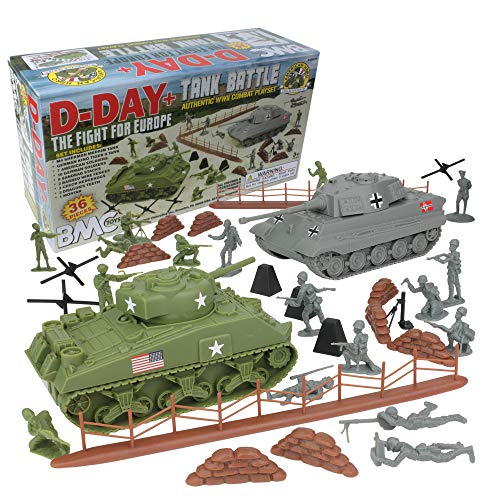
BMC WW2 D-Day Tank Battle – 36pc Plastic Army Men Playset

A short buying checklist drawn from the specifications
Distilled to its essentials, the decision runs as follows. Choose the scale first and write it down if the collection will grow: 54 mm or 1:32 for general play, 1:72 for table-filling scope and older children, 1:35 where modelling compatibility is the point. Confirm the age grade matches the youngest child who will realistically reach the pieces, and treat small-parts warnings as binding. Unpack the piece count into figures, vehicles and accessories, check the colour split between opposing forces, and count the distinct poses the specifications reveal.
Then judge the physical product on its maker’s record: soft LDPE for bending survival in young hands, harder plastics where detail and paint matter and handling will be careful; unpainted monochrome for outdoor and sandbox service, painted finishes for gentler indoor play and display. Look for the defect pattern associated with the line, excessive flash, warped bases, chronically bent weapons, and weigh it against the set’s purpose rather than against an ideal no inexpensive toy meets. Favour established lines whose tooling and dimensions have stayed stable, because stability is what makes today’s purchase compatible with next year’s.
None of these steps requires specialist knowledge, and together they take minutes against documents any reputable maker publishes. That is the quiet strength of this category: the products are simple, the specifications are short, and the gap between a set that delights for years and one that disappoints by half-term is almost entirely visible before purchase to a buyer who knows which numbers are honest and which are theatre.
Choose the bucket whose soldiers stand straight, whose colours divide fairly and whose scale leaves room to grow, and the floor of almost any room becomes a country worth fighting over.


