Our Top Picks

As an Amazon Associate I earn from qualifying purchases. This post may contain affiliate links at no extra cost to you.
## Why a minimalist desk still deserves proper stereo
A tidy desk is not an empty desk. It is a desk where everything that remains earns its place, does its job without fuss, and does not demand attention when it is not in use. Speakers often fail that test. Large bookshelf boxes dominate the surface, separate amplifiers add another slab and another cable, and a tangle of power bricks, interconnects, and volume pods turns the space behind a monitor into a small electrical thicket. Yet the alternative many people settle for, the speakers built into a laptop or a slim monitor, rarely does justice to music, film dialogue, or the long video calls that now fill a working day. Minimalist stereo speakers exist to close that gap. They keep the footprint small, the cable count low, and the appearance calm, while still giving you a genuine left and right channel and a sound that carries across a room rather than leaking thinly from a screen bezel.
That is the spirit of this guide. Every product covered here was chosen because it trims something away. Most of the Creative Pebble models in the line-up draw their power from USB, so there is no separate mains adapter to hide. Several connect with a single cable to a computer and nothing else. The two portable options remove the desk tether altogether for part of the day, working as Bluetooth speakers that can move to a kitchen counter, a workshop shelf, or a garden table and then return. None of them asks for a receiver, a subwoofer the size of a footstool, or a remote control that will inevitably slide under a pile of paper. What they offer instead is a short, honest list of features, stated plainly in their names, and a shape that sits quietly beside a keyboard.
It also helps to be clear about what minimalist does not mean. It does not mean fragile, and it does not mean a novelty item shaped like a pebble or a flying saucer that happens to make noise. A minimalist speaker still needs to reproduce voices clearly enough that a podcast does not require concentration, still needs enough body that acoustic music does not sound like it is being played in another room, and still needs controls that fall to hand without a software menu. The balance is delicate. Remove too much and you have a gadget. Remove the right things, the bulk, the clutter, the unnecessary inputs, and you have a tool that improves a desk precisely because you stop noticing it.
Our research for this guide compared published specifications, connection types, power arrangements, and form factors across the range, and weighed those facts against general, well-understood truths about desktop audio. Small speakers placed close to a listener behave differently from large speakers across a room. A driver angled up toward the ears suits a seated position. A stereo pair separated by the width of a desk creates a more convincing sense of space than a single mono box. Those principles, rather than any invented figures, shape the recommendations that follow. Where a product title states a fact, such as a Bluetooth version, a battery capacity, or a driver size, we say so. Where it does not, we do not guess.
## What minimalist really means at a desk
Start with footprint. A desktop speaker competes for space with a monitor stand, a keyboard, a notebook, perhaps a mug that has achieved permanent resident status. A compact spherical or low-profile design can tuck into the corners that would otherwise go unused, one on each side of a screen, without pushing anything else off the edge. The Pebble family makes this its central idea. The name describes the shape, a smooth rounded form that looks more like a pair of stones than a pair of loudspeakers, and that visual softness matters in a room you live in as well as work in. Hard-edged black boxes announce themselves. Rounded, low speakers recede.
Next, count the cables. Every cable is a decision about routing, a thing to dust around, and a potential snag when you reach for something behind the monitor. USB power is the single biggest simplification available in this category. A speaker that draws power from the same computer it takes audio from, or from a single USB connection that handles both, reduces a traditional setup of mains lead, audio lead, and linking cable to something far tidier. You plug in, the computer recognises the speakers, and the desk stays clear. For a laptop user who docks and undocks through the day, that simplicity is not a luxury. It is the difference between speakers that get used and speakers that stay in a drawer because reconnecting them felt like a chore.
Then consider controls and connections you will actually use. A minimalist product is honest about its audience. A desktop pair aimed at a PC or laptop does not need a rack of inputs for equipment you do not own. At the same time, one well-chosen addition can transform usefulness. Bluetooth is the obvious example in this line-up. The first Pebble generation is a wired desktop speaker and nothing more. The V3 generation adds Bluetooth 5.0, which means the same speakers that serve your computer can also play music from a phone while the computer is asleep. The Pro generation adds RGB lighting, which is admittedly a departure from strict minimalism, yet for many gaming and streaming desks it replaces a separate light accessory rather than adding clutter. Minimalism, in other words, is not a fixed checklist. It is a ratio between what a product does and how much space, cabling, and attention it asks in return.
Finally, think about colour and finish as part of the design rather than an afterthought. Several models here come in both black and white versions, and that choice has practical weight. White speakers disappear against a pale wall and suit the bright, Scandinavian style of desk that fills home-working photographs. Black speakers sit more naturally beside most monitors, whose bezels and stands are usually dark, and they show dust and scuffs less readily in a busy workspace. Neither is better in sound terms, and this guide treats the colour variants as what they are, the same core product in a different finish, while still discussing each listed version clearly so you can match the exact model to your room.
## How to read this guide and choose quickly
If you want the shortest possible path to a decision, begin with your computer connection. Look at the ports you have free and the cables you are willing to run. An older desktop or laptop with standard USB ports and a preference for the simplest possible setup points toward the original Pebble models. A newer machine with USB-C, or a household where a phone needs to play through the same speakers, points toward the Pebble V3. A desk that doubles as a gaming station in the evening points toward the Pebble Pro. A listener who does not want speakers married to one desk at all should skip ahead to the round Bluetooth speaker and the Anker Soundcore 2, the two genuinely portable designs in the group.
Readers who enjoy comparing neighbouring categories will find useful context in our coverage of best 2 1 computer stereo speakers, where systems add a separate bass unit to the desktop formula and trade some tidiness for low-end weight. That contrast is instructive. A 2.1 system can sound bigger, but the extra box has to live somewhere, usually on the floor, with cables running to both satellites. The speakers in this guide accept a different bargain. They keep everything on the desk, in two small enclosures, and rely on proximity to the listener rather than sheer size.
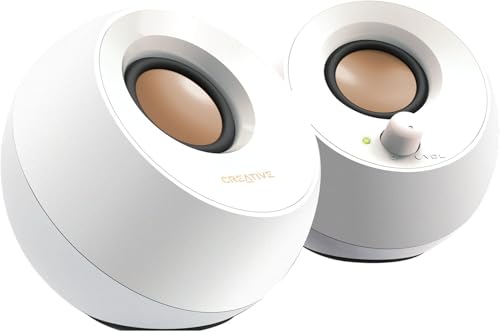
## Creative Pebble in white (B0791J2658): the original simple desktop pair
The Creative Pebble, listed as a 2.0 USB desktop stereo speaker set for PC and laptop in white, is the starting point of the whole family and still the clearest expression of the idea. The 2.0 designation matters and is worth explaining for readers who do not live among speaker specifications. It means two channels and no separate subwoofer. Left and right speakers handle the full range between them, which keeps the system to exactly two objects on the desk and no third object on the floor. For near-field listening, sitting an arm’s length away, that arrangement is entirely sensible. You are close enough that a modest speaker does not have to fill a large room, and stereo separation across a desk is wide enough to place voices in the centre and instruments to the sides.
USB power defines the daily experience. There is no wall adapter to find a socket for, no power strip Tetris behind the desk, and no standby draw from an extra brick. The speakers live and wake with the computer. Shut the laptop and the desk goes quiet and dark. Open it in the morning and your audio is simply there. For shared workspaces, student rooms, and spare-bedroom offices where sockets are already committed to lamps, chargers, and monitors, that single detail can decide whether external speakers are practical at all.
The white finish gives this version its particular character. Against a light desk it reads as part of the furniture rather than equipment, which suits readers building a calm, uncluttered workspace or a bedroom setup where black electronics would jar. White also pairs naturally with the pale laptops and all-in-one computers common in home offices. The trade-off is housekeeping. Pale surfaces show coffee splashes, pen marks, and dust sooner than dark ones, so this version rewards a tidy owner. If your desk hosts workshop projects or children’s homework as well as your work, the black version discussed below may forgive more.
In use, expect this pair to suit the everyday centre of desktop audio: video calls where a colleague’s voice needs to sound like a person rather than a telephone, streamed radio through the morning, YouTube explainers, language lessons, and background music at modest volume while you concentrate. Desktop speakers of this size are not party equipment, and no honest guide should pretend otherwise. What they offer is clarity and presence at the distance you actually sit, which for most desk hours is exactly the improvement that matters. Listeners whose main diet is film scores at high volume or bass-heavy electronic music should treat this as a clarity-first choice and read the Pro and portable sections with that appetite in mind.
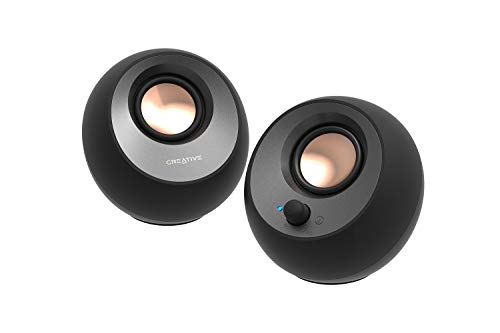
## Creative Pebble 2.0 in black (B0791H74NT): the same idea in the classic finish
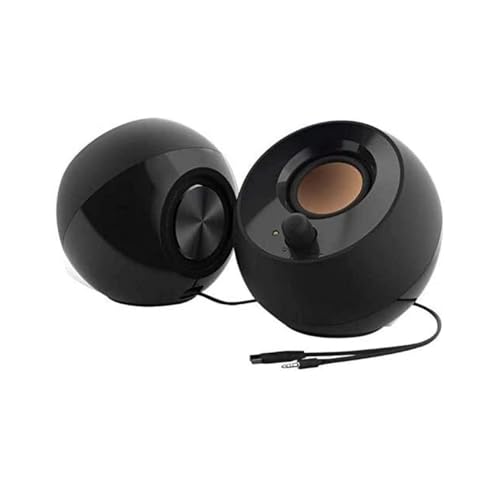
The black version, listed under the ASIN for the Creative Pebble 2.0 USB desktop stereo speakers in black, is the same foundational proposition in the finish most desks will wear best. It is worth discussing separately because finish is not a trivial detail in a product you will look at every day, and because many buyers search specifically for the black model to match a monitor, a dark desk mat, or a gaming setup that only comes out after work. Everything said about the white model applies in structure: a 2.0 stereo pair, USB-powered, designed for PC and laptop use, with a compact rounded form that keeps the desk surface open.
Where the black version earns its own paragraph is in how it handles real life. Dark enclosures hide the scuffs that come from a speaker being nudged by a keyboard, catch less visual attention during video calls when it sits within camera range, and blend into the shadow line under a monitor where cables and stands already gather. In a room that serves several purposes, a living room corner desk, for example, black speakers tend to disappear when the workday ends and the space returns to being a home. That disappearing act is the heart of minimalist design. The best desk equipment is the equipment you forget is there until you need it.
For buyers choosing between the two original Pebble colours, the decision really can rest on the room. Choose white for a bright, deliberate, furniture-led workspace. Choose black for a mixed-use desk, a darker room, or any setup where the speakers share space with tools, textbooks, and the general evidence of a busy household. Sound, connections, and the USB-powered simplicity are the shared story. The finish is how that story fits your home.
## Creative Pebble V3 in black (B08F57GSJ7): USB-C and Bluetooth change the brief
The Creative Pebble V3 in black marks the point where the Pebble idea grows up without growing larger. Its title tells the story in a few words: a 2.0 speaker system, USB-C connection, desktop positioning, and Bluetooth 5.0. Each of those facts answers a limitation of the original design. USB-C is the port that modern laptops actually provide, often in place of the older rectangular USB-A sockets that are steadily disappearing from slim machines. A speaker that speaks the same connection language as a current laptop avoids adapters, dongles, and the small daily friction of reaching for the right cable.
Bluetooth 5.0 is the bigger change. With Bluetooth, the speakers stop being an accessory of one computer and become the sound system for a desk area. Your laptop can remain the wired, always-ready source for work, while a phone or tablet connects wirelessly for music, podcasts, or a video you would rather watch away from the keyboard. A partner working at the same table can share a song without unplugging anything. A teenager doing homework at the family desk can play study music from their own device. None of this requires a second speaker elsewhere in the room, which is precisely the minimalist dividend: one pair of speakers, several sources, no duplication.
The black finish suits the V3’s slightly more technical character. It sits comfortably beside business laptops and dark monitors, and in a home office that doubles as a gaming or streaming corner it will not look out of place when the screen fills with colour in the evening. Readers who prefer the bright look should read on, because the V3 also comes in white, but the black model is the natural default for most mixed desks and the version we would point a first-time buyer toward if they had no strong colour preference.
Stepping back, the V3 also illustrates a healthy pattern in product design. Rather than reinventing the speaker, Creative kept the compact stereo format and the desk-first shape, then updated the connections to match how computers and phones have changed. That restraint is worth valuing. Products that chase novelty often age badly. Products that quietly adopt the ports and wireless standards people now carry tend to stay useful for a long time. If your laptop is recent, if you expect to replace it with an even slimmer machine in a few years, or if Bluetooth playback matters to you at all, the V3 generation is the sensible centre of the Pebble range.
## Creative Pebble V3 in white, with USB-A adapter (B09F9GTKL8): flexibility in a pale finish
The white Pebble V3, listed with a USB-A adapter included, deserves its own discussion because that adapter quietly solves the most common hesitation about USB-C speakers. Many households run a mixture of equipment: a new laptop with only USB-C ports beside an older desktop that has never heard of them, or a work machine that changes every couple of years while the family computer stays the same. A speaker that arrives ready for both worlds, native USB-C for the new machine and an adapter for the older one, removes the risk that a tidy purchase becomes an untidy workaround. You are not left ordering a separate adapter and waiting, or dedicating the speakers to a single computer by default.
The white finish, as with the original Pebble, suits bright rooms and furniture-led desks. Paired with a pale laptop, a light wooden desk, and a plant or two, the white V3 can look almost decorative, which is not a criticism. Equipment that pleases the eye gets kept, cared for, and used. Equipment that offends the eye gets replaced, and replacement is the opposite of minimalism. There is a sustainability argument hidden in aesthetics: choosing the colour you will still like in three years is a genuinely practical decision.
Functionally, this version carries the same Bluetooth 5.0 advantage as the black V3, and that wireless option pairs especially well with the white model’s likely home. In a kitchen-diner or a bedroom workspace, the speakers can serve a computer during the day and then take a phone connection for evening listening without any cable being moved. The desk stays set. Nothing is unplugged, coiled, or draped. For households where the desk is also the household’s media corner, that versatility stretches one purchase across several routines.
## Creative Pebble Pro in black (B0DXW25R3D): RGB joins the minimalist desk
The Creative Pebble Pro in black adds the one feature that sounds least minimalist of all: RGB lighting. Its title lists a 2.0 USB-C desktop speaker system with RGB and Bluetooth, in black. Read generously, though, the Pro is not abandoning the minimalist idea. It is applying it to a different kind of desk. A gaming or streaming desk often accumulates separate light strips, glowing peripherals, and decorative accessories, each with its own cable and controller. A speaker that integrates lighting into an object the desk already needs can, for that audience, reduce the total object count even as it adds colour. The lights live in the speakers. No extra device is bought, powered, or found a home.
USB-C and Bluetooth carry over from the V3 generation, so the Pro keeps the modern wired connection and the wireless freedom to play from a phone. That continuity matters for upgraders. A reader who likes the Pebble format, whose household already knows how the V3 behaves, can step up to the Pro for the lighting and the flagship position in the range without relearning a new system or rewiring the desk. Product families that respect their own earlier designs make upgrading calmer, and calmer is a minimalist quality too.
The black enclosure is the right canvas for RGB. Light shows against a dark finish, reflections stay controlled, and when the lighting is off or set low the speakers return to being discreet black desktop objects rather than glowing novelties. That duality suits desks that work double shifts: professional by day, when a video call demands a sober background, and expressive by night, when the same space becomes a place to play, stream, or watch. One setup serving both moods without a rebuild is a real, if unglamorous, benefit.
Who should skip the Pro? Readers building the quietest possible workspace, a writer’s desk, a study corner, a nursery-adjacent home office, will gain nothing from lighting and should save their attention for the V3 or the original models. Who should choose it? Anyone whose desk already glows a little and who would rather that glow came from fewer, better-integrated objects. Minimalism is personal. For some people it is a bare wooden surface. For others it is a battlestation with nothing redundant on it. The Pro serves the second definition honestly.
## Creative Pebble Pro in white (B0DG2CQ728): the flagship in a light finish
The white Pebble Pro completes the family picture. Its listing describes a 2.0 USB-C desktop speaker system with RGB in white, and that combination, flagship features in a pale enclosure, serves a growing style of desk that pairs white furniture and pale peripherals with colourful lighting. White gaming and streaming setups are no longer a niche. For readers building one, a white Pro avoids the visual interruption of a black speaker pair sitting in an otherwise light arrangement, and the RGB lighting reads differently against white, softer and more diffused in feel than the sharper contrast of the black model.
## Wocdwocd round Bluetooth speaker (B0H7BSBFP2): the minimalist UFO
Not every minimalist speaker is a stereo pair, and the Wocdwocd round Bluetooth speaker is the playful outlier in this guide. Its title gives us a distinctive set of facts: dual 66mm stereo drivers, a 3000mAh capacity battery, and a minimalist UFO design. Take those in turn. Dual stereo drivers mean that, although this is a single round object, it aims to produce a stereo effect from within one enclosure rather than the plain mono output of many small portable speakers. A single object that still respects stereo is a neat trick for spaces where two separate speakers simply will not fit: a narrow shelf, a bedside table, a bathroom cabinet, a campervan counter.
The battery capacity, stated as 3000mAh, tells you this is a genuinely untethered device designed to run away from a socket for meaningful stretches, charged and then carried. Exact endurance depends on volume and use, and the title does not state a playtime figure, so we will not invent one. The honest reading is simpler: this is the speaker in the guide for a listener who wants to pick the sound up and take it to another room, a balcony, or a picnic blanket without thinking about cables at all. The UFO design completes the picture. A low, round, disc-like form sits flat and stable, resists being knocked over in a way tall cylinders do not, and looks like an object of industrial design rather than a piece of audio equipment. On a minimalist shelf, that matters.
Set expectations with care. A single compact enclosure, however cleverly arranged, cannot create the wide physical separation of two speakers placed a desk apart, and stereo from one box is a matter of effect rather than geometry. What the Wocdwocd offers instead is freedom and form: stereo intent, battery power, and a shape that earns compliments. Readers who move around the house while listening, who work at a kitchen table rather than a fixed desk, or who want a speaker for a small flat where every object must justify itself visually, will understand this product immediately. Readers building a fixed workstation should stay with the Pebble pairs above. Readers curious about how larger single-purpose systems compare can explore best 10 inch powered speakers for a sense of the opposite end of the size spectrum, where output matters more than footprint.
## Anker Soundcore 2 (B01MTB55WH): the portable that still does stereo
The Anker Soundcore 2 closes the guide as the most travel-ready option, and its title is the most specification-rich of the group: a portable Bluetooth speaker with 24-hour playtime, IPX7 protection, and 12W stereo sound. Each of those stated facts maps to a real-world freedom. A full day of stated playtime means a speaker you charge occasionally rather than habitually, one that can cover a long garden day, a weekend of kitchen listening, or a working week of desk sessions without a cable in sight. IPX7, a recognised water-resistance rating stated in the title, means the speaker is built to shrug off the wet environments that would end a desktop speaker’s life: poolside splashes, bathroom steam and spray, a rain shower at a campsite, a spilled drink on a picnic table. The 12W stereo sound figure tells you this single portable unit is engineered for stereo output with enough drive to fill a room or an outdoor space at social volume.
Why include a portable like this in a minimalist stereo guide at all? Because for many readers the most minimalist desk is one with no permanent speakers on it. A Soundcore 2 can sit on a shelf or in a drawer, come out when music or a film calls for it, serve the bathroom in the morning and the garden in the afternoon, and then disappear again. It is one object doing the work of several fixed installations. Anker’s long presence in portable audio also counts for something in a category full of anonymous names. A speaker is a battery product, and batteries reward brands with a track record and a support structure.
The honest trade-offs mirror those of the round speaker above. A single enclosure cannot match the physical left-right separation of a true desk pair, and a portable’s sound is tuned for rooms and open air rather than for the intimate near-field of a desk. If your listening is ninety percent computer-based, a Pebble pair will serve you better and cost you no charging routine at all. If your listening follows you around the home, or your desk is a dining table that must clear for dinner, the Soundcore 2 is the most capable expression of the grab-and-go philosophy in this line-up, with the stated endurance and water resistance to back it up.
## The Pebble generations compared, side by side in words
Because four of the eight products here share a surname, a clear comparison is worth its own section. Generation one, the original Pebble in white and the Pebble 2.0 in black, is the wired purist: USB-powered desktop stereo for PC and laptop, no Bluetooth, no lighting, nothing beyond the job of making a computer sound properly human. It suits a fixed desk, an older machine, and a buyer who values the shortest feature list that still covers their needs.
Generation two, the Pebble V3 in black and in white with a USB-A adapter, keeps the stereo desktop format and modernises the connections. USB-C replaces the older arrangement as the headline connection, and Bluetooth 5.0 joins the specification, which transforms the speakers from a computer accessory into a small room system. This is the generation for most modern buyers, and the adapter in the white version’s box acknowledges that real households run old and new machines side by side.
Generation three, the Pebble Pro in black and in white, builds on the V3 formula with RGB lighting and a flagship brief. USB-C and Bluetooth remain, so nothing is lost in the step up; what is gained is the integrated lighting that gaming and streaming desks prize. Think of the three generations as good, more connected, and more expressive, rather than as good, better, and best in sound alone. The right choice is the one whose feature list matches your desk’s actual life. Buying the Pro for a silent study is waste. Buying the original for a Bluetooth household is frustration. The range rewards honesty about your own habits.
Beyond the Pebbles, the two portables answer a different question entirely. The Wocdwocd round speaker bets on design and stereo drivers in a single disc, with a stated 3000mAh battery. The Soundcore 2 bets on endurance and toughness, with stated 24-hour playtime and IPX7 protection. Neither competes directly with a desk pair. They compete with silence in all the rooms where a desk pair cannot go. Readers weighing a whole-home audio strategy might also glance at best 12 active pa speakers to see how public-address scale systems think about coverage, if only to appreciate how completely the minimalist category rejects that philosophy in favour of closeness and restraint.
## Desk setup, cable tidiness, and stereo placement
Setup begins before the speakers come out of the box. Decide where they will live, and clear those two patches of desk properly rather than wedging the speakers into whatever gaps remain. A speaker squeezed behind a stack of books or aimed at a monitor stand will sound like it, because sound needs a clear path to your ears and a stable surface beneath it. Hard, flat desks reflect sound in a lively way that suits small speakers. If your desk is a soft or cluttered surface, even a pair of coasters or a desk mat under the speakers can steady them and tidy the look.
Cable tidiness is where USB-powered designs repay you daily. Route the linking and power cables behind the monitor rather than across the desk, following the path your monitor cables already take, and use the slack rather than fighting it. A cable that droops in a gentle curve looks intentional. A cable stretched taut across a workspace looks like an accident and catches sleeves, notebooks, and mugs. If your desk has a cable tray or grommet, the speakers’ leads should join that system. If it does not, a couple of adhesive clips along the desk’s rear edge will transform the view from your chair, which is the view that matters. Remember that you see the front of your desk setup and the speakers see your ears. Tidy for both.
Placement follows a few general truths that cost nothing to apply. Put the left speaker on the left and the right on the right, at roughly equal distances from your seat, forming a loose triangle with your head. Aim them toward your listening position rather than straight ahead in parallel lines, especially if they are not angled designs. Keep them near the front edge of the desk or at least clear of walls and monitor backs where possible, since a speaker firing into an obstruction loses clarity. Raise them if you can. A small stand, a book, or a shelf that lifts a speaker closer to ear height when seated almost always improves the sense of detail, because desktop speakers otherwise spend their lives aimed at your chest. Angled desktop designs, a long-standing category approach in which the driver tilts up toward a seated listener, exist precisely to solve that geometry, and Pebble-style speakers are commonly arranged with that seated, close-up listening position in mind.
## Who each speaker suits, and a few honest cautions
The original Pebble pair suits the fixed desk and the simple brief: students, home workers on older laptops, and anyone outfitting a second workspace in a spare room where sockets are scarce. The V3 suits the modern laptop owner and the shared household, where Bluetooth turns one speaker pair into a family resource. The Pro suits the expressive desk, the gamer and streamer who want cohesion between sound and light. The round Wocdwocd suits the design-led small space and the listener who moves room to room. The Soundcore 2 suits the indoor-outdoor life, the bathroom singer, the gardener, the traveller, and the minimalist whose desk must sometimes be no desk at all.
Cautions apply across the board. Small speakers have physical limits, and no wording in this guide should be read as promising cinema scale or club volume from a desktop pair. Rooms matter: a large, hard, echoing space will humble any compact system, while a small carpeted study will flatter it. Sources matter too. A speaker can only reproduce what it is fed, and a crackly video call or a low-quality stream will sound like itself through any equipment. And colour, generation, and features should be chosen for the life you have, not the desk in a photograph. The most minimalist purchase is the one you do not have to repeat.
Readers building toward a larger entertainment space, rather than a desk, may eventually outgrow this entire category, and our look at best 1000 tower speakers shows where that road leads: floor-standing scale, room-filling ambition, and a footprint that makes a Pebble look like a paperweight. There is no shame in either direction. Homes change, and audio should follow the home. For now, for the desk in front of you, small and simple is not a compromise. Chosen well, it is the point.
## Our closing recommendation
If one recommendation must stand for the whole guide, it is the Pebble V3 for most readers, in whichever colour suits the room, because it pairs the tidy USB-powered stereo format with the two connections modern life actually uses, USB-C for the computer and Bluetooth 5.0 for everything else. Choose the original Pebble if your desk and machine are older and your needs are purely wired. Choose the Pro if your desk lights up at night and you want the speakers to join in. Choose the Wocdwocd for a design-led, movable stereo object, and the Soundcore 2 when endurance, water resistance, and true portability outrank a fixed stereo image. Every product here trims the desk down to what matters. The best one is the one whose trimmings match your days.
As an Amazon Associate we earn from qualifying purchases, and that simple fact shapes how this page is paid for: if you follow a product link on this site and buy something, the retailer may share a small part of what you pay with us, at no extra cost to you, which in turn funds the time spent comparing specifications and keeping guides like this one current. It never buys a product its place here, and it is why we can afford to be plain about trade-offs, steering you toward the simpler speaker when the simpler speaker is the right answer, rather than dressing every option up as essential. Prices and availability change without notice, so check the listing itself for the final word before you order.
Check prices on Amazon
Live listings for the shortlist in this guide are pulled from Amazon below, so prices and availability are always current at the moment you look.



