Our Top Picks
 Eminence Patriot Cannabis Rex 12" Guitar Speaker with12-Inch13.8 x 13.8 x 6.2 inches9.25 poundsCheck on Amazon
 Monoprice 1x12 Guitar Speaker Cabinet With Celestion Vintage22.7 x 14.2 x 21.5 inches36.54 poundsCheck on Amazon
 Fender Champion II 50-Watt Electric Guitar AmplifierChampion II 5019.8 x 19.8 x 11.5 inches22.95 poundsCheck on Amazon

What's inside
- What the Twin Twelve actually is, and why its speakers matter so much
- The original Jensen pair and the question of what “original” means
- Impedance: the requirement that outranks every tonal preference
- Power headroom: sixty period watts against modern ratings
- Sensitivity, efficiency, and the early breakup the model is loved for
- Alnico against ceramic: two magnet materials, two manners of speech
- The modern replacement families, considered one maker at a time
- Mounting depth and baffle clearance in a shallow cabinet
- Mixing one vintage-voiced and one modern speaker
- Break-in: what changes as a new speaker settles
- Safe practice with a vintage amplifier and a fresh speaker load
- Matching the pair to the way the amplifier is actually played
- A verification checklist to complete before ordering anything
- Mistakes that recur in Twin Twelve speaker swaps
- Check prices on Amazon
- Questions owners ask, answered without folklore
As an Amazon Associate I earn from qualifying purchases. This post may contain affiliate links at no extra cost to you.
The Silvertone 1484 occupies a peculiar place in guitar history. Sold through the Sears catalog in the middle 1960s and built for Sears by Danelectro in Neptune, New Jersey, the model was marketed as the Twin Twelve, a name that described its cabinet plainly: two twelve-inch speakers driven by a tube chassis rated by its maker at roughly sixty watts. It was an ambitious amplifier for a department-store line, with two channels, reverb, tremolo, and a piggyback arrangement in which the head stored inside the speaker cabinet for transport. Surviving examples are now prized for a loose, warm, slightly unruly voice that modern amplifiers rarely imitate on purpose. That voice, however, depended heavily on the two Jensen speakers fitted at the factory, and those speakers are now sixty years old. Paper cones fatigue, voice coils rub, and surrounds crack, so many cabinets today hold one original driver beside a tired substitute, or two replacements chosen with little thought beyond diameter. This guide works through the replacement question methodically: what the amplifier electrically requires, what the shallow cabinet physically accepts, and which modern twelve-inch guitar speakers, from Jensen reissues to Eminence, Celestion, and Warehouse Guitar Speakers, can plausibly carry the Twin Twelve character forward without endangering a vintage output transformer.
A note on method and money belongs near the front. This comparison rests on published documents, schematics, and manufacturer specifications rather than direct use of the products, drawing on period Silvertone and Danelectro literature, vintage-amp service writing, and the spec sheets speaker makers publish for their current catalogs. Where period documentation is ambiguous, this guide says so and explains how to verify the point on your own amplifier. The site may earn a commission when readers buy through links, at no added cost to the reader, and that arrangement does not change the electrical requirements described here, because ohms and watts are indifferent to commerce.
What the Twin Twelve actually is, and why its speakers matter so much
The 1484 was the larger sibling in a family of Silvertone piggyback amplifiers that also included the smaller 1483 bass model and the single-speaker 1482 combo, among others. Period catalog copy presented the Twin Twelve as a serious working amplifier rather than a practice toy, and its specification, by the standards of a mail-order instrument line, justified the claim. The chassis used a tube complement typical of mid-1960s American design, with 6L6-family output tubes in push-pull, a tube-driven reverb circuit players still praise, and tremolo on the second channel. Output figures quoted for the model vary between catalog years and secondary sources, and honest writing should admit that spread rather than pretend one factory number settles everything. The commonly repeated figure is around sixty watts, and even that should be read as a period rating made under period conventions, not as a laboratory measurement of your particular surviving example, which will deliver whatever its aged components allow.
The cabinet is the other half of the instrument: a closed, shallow enclosure holding two twelve-inch speakers side by side, built lightly, with thin panels that contribute their own resonance. Players who describe the 1484 as alive at modest volume and slightly wild when pushed are describing a system, not a chassis: a moderately powered tube amplifier, an efficient pair of American-voiced speakers, and a cabinet that joins in rather than standing aside. Replace the speakers carelessly and the system changes character completely. Fit stiff, high-powered, British-voiced drivers and the amplifier still functions, yet the loose low end tightens, the top end hardens, and the early, friendly breakup that defines the model arrives later or not at all. Fit speakers of the wrong impedance and the change is not merely tonal; it becomes a question of stress on parts that cannot be replaced from any current catalog.
Speaker choice for the 1484 is therefore three problems sharing one shopping list: electrical compatibility, meaning total load impedance and power handling; physical compatibility, meaning depth, magnet diameter, and mounting pattern inside a cabinet that was never generous; and voicing, meaning magnet material, cone behavior, and sensitivity. A candidate has to pass all three tests, and working through them in order, electrical first, keeps the decision grounded.
The original Jensen pair and the question of what “original” means
Period Twin Twelve cabinets were loaded with Jensen speakers, the dominant American guitar-speaker maker of the era, most often Jensen drivers from the Concert or Special Design families in twelve-inch form. Owners and service writers most frequently report ceramic-magnet C12 variants in 1484 cabinets, though alnico P12 examples and mixed factory fitments surface often enough that no single code should be treated as gospel for every production run. Sears bought amplifiers in volume, Danelectro built them in batches, and period component sourcing tolerated substitution when a supplier line ran short. The honest summary is that the archetypal 1484 speaker is a twelve-inch Jensen of modest power capacity, American voicing, relatively light cone, and efficiency high enough to make a sixty-watt amplifier feel generous in a club room of 1965 dimensions.
Jensen date codes help owners identify what they actually have. Vintage Jensen speakers carry a source-date code stamped on the frame or magnet edge, beginning with the manufacturer code 220, followed by digits indicating year and week of production. Reading that code tells you when the speaker was made, which often clarifies whether it is plausibly factory-fitted or a later replacement. This matters because a great deal of received wisdom about the model rests on cabinets whose speakers were changed decades ago and forgotten. Before shopping for replacements, photograph the codes on both of your drivers, note any labels, and record the measured resistance of each unit as described later in this guide. You may discover that the tired sound you blame on age belongs to one wrong replacement fitted in 1983, while the other original Jensen remains healthy and worth keeping as half of a mixed pair.
It also helps to understand what Jensen model codes communicate, because the same code system, revived by the modern Jensen reissue line, organizes much of the replacement market. In the classic scheme, the letter after the size number denotes the magnet and frame series: P indicates alnico, C indicates ceramic, and other letters mark different magnet weights and efficiency classes. The number twelve gives nominal diameter in inches. Suffix letters distinguish cone and voice-coil details. A C12N, for example, is a ceramic twelve with a particular magnet weight and a voice widely associated with American amplifiers of the black-panel era and after, while a P12Q is an alnico twelve of lighter capacity and earlier, softer character. No code, period or modern, promises identical sound across sixty years of production changes; the codes are a map of intent covering magnet type, rough efficiency class, and application.
Impedance: the requirement that outranks every tonal preference
A tube amplifier does not connect to its speakers directly. Between the output tubes and the speaker terminals sits the output transformer, a component that translates the high-voltage, low-current world of the tubes into the low-voltage, high-current signal a speaker can use. That translation works as designed only when the load on the secondary winding presents the impedance the winding expects. Connect a load far from the intended value and the tubes see a reflected impedance they were not biased or built around. A load that is too low draws excessive current and stresses tubes and transformer windings. A load that is too high, or worst of all no load at all, allows voltage spikes that can puncture transformer insulation. Vintage transformers, their materials aged for six decades, deserve more caution than fresh ones, not less. For a broader orientation on how replacement drivers are categorized before impedance even enters the discussion, the survey at best 10 guitar speakers sketches the landscape of sizes and families that guitarists usually compare.
Here the 1484 presents a genuine documentary puzzle, and this guide will not paper over it. Period schematics for the model circulate in several redrawn forms, secondary sources quote the expected speaker load differently, and Danelectro practice across the Silvertone line was not perfectly uniform. Many surviving cabinets hold two eight-ohm speakers, and many service accounts describe the pair presenting a combined load in the four-to-eight-ohm neighborhood depending on whether the factory harness joined them in parallel or series. Those two wirings produce very different totals from identical speakers: two eight-ohm drivers in parallel give four ohms, while the same two drivers in series give sixteen. Because published sources conflict and cabinets have often been rewired, the only defensible instruction is to verify your own amplifier rather than copy a number from a forum post. The sections below explain exactly how, first with arithmetic and then with a meter.
Series and parallel wiring, worked through slowly
Parallel wiring joins both positive terminals together and both negative terminals together. Each speaker receives the full output voltage, and the combined impedance is lower than either driver alone. For two equal speakers, parallel impedance is simply half of one speaker: two eights make four, two sixteens make eight. Series wiring instead runs the signal through one speaker and then the other, positive of the amplifier to the first speaker, a jumper from that speaker to the second, and back to the amplifier. Impedances add: two eights make sixteen, two fours make eight. Mixing unequal speakers complicates both arrangements, because power no longer divides evenly. For a vintage pair, equal nominal impedance in both positions is the sane default, and what the factory intended in the overwhelming majority of cases.
Nominal impedance is itself a polite fiction. A speaker marked eight ohms does not measure eight ohms on a DC meter, and its impedance across the audio band wanders, climbing at bass resonance and rising again toward the top of its range. The nominal figure is standardized shorthand. What matters is that both speakers share the same nominal rating, that your cabinet’s wiring is known rather than assumed, and that the resulting total matches what your chassis provides. Some chassis and harnesses have been modified with added jacks or substituted transformers, one more reason the amplifier in front of you, not a generalized description of the model, is the authority.
Verifying the load with a multimeter and the schematic
A basic digital multimeter, set to its lowest resistance range, answers most of the practical questions in a few minutes, provided you work safely. The amplifier must be off and unplugged; if you are not confident about stored charge inside a tube chassis, stop and hand the job to a technician, because power-supply capacitors can hold a dangerous voltage long after the cord leaves the wall. With the cabinet disconnected from the head, measure across the cabinet input jack or across the speaker harness plug. A parallel pair of nominal eight-ohm speakers typically shows DC resistance a little under four ohms, often around three to three and a half, because a voice coil’s DC resistance normally reads roughly twenty to thirty percent below nominal impedance. The same pair wired in series reads near thirteen to fourteen ohms. Measuring each speaker individually, with at least one lead lifted so the other driver cannot confuse the reading, gives each coil on its own: an eight-ohm Jensen or modern equivalent usually shows between five and a half and seven and a half ohms DC. A reading near zero suggests a shorted coil; a reading of open circuit means the coil or a lead wire has failed; a value wildly different from its partner suggests one speaker is not what its label claims.
Then compare the measured total with the schematic for the model, reproduced in vintage-amp service literature and in the documentation collections that Danelectro and Silvertone restorers maintain. The schematic states what load the output stage was drawn around; the meter states what your cabinet presents. If the two disagree, the wiring or one speaker has been changed, and the correct response is to restore agreement, not to shrug. Photograph the harness before disturbing it, label each lead with tape, and change one thing at a time. Owners who treat verification as a five-minute ritual rarely damage transformers; owners who trust a stranger’s memory of a production run occasionally do.
Power headroom: sixty period watts against modern ratings
Power handling sounds simpler than impedance and hides its own traps. A speaker rating states how much power the driver can absorb continuously under the test conditions its maker chose, and makers have not all chosen the same conditions across the decades. The original Jensens in a Twin Twelve were modest devices by modern standards, rated in an era when a twelve-inch guitar speaker handling twenty to thirty-five watts was entirely respectable, and the pair together shared the amplifier output between them. That sharing is the key arithmetic: in a two-speaker cabinet with equal drivers wired either way, each speaker receives approximately half the total power. A healthy 1484 delivering its full rated output therefore asks each driver to absorb something in the region of thirty watts at the very top of its range, and considerably less through most of a normal performance, because few players run a non-master-volume tube amplifier at full output continuously.
Prudence still argues for headroom above that bare figure. A tube amplifier pushed into heavy overdrive can deliver peaks above its clean rated output, and the 1484 is famous precisely because players push it. Speaker ratings also assume a driver in good condition with free air movement around its coil, while a survivor or a fresh speaker in a tight closed cabinet works harder than the test bench implies. And a replacement pair should outlast the amplifier’s next service interval without becoming the weakest link. A sensible modern target is a pair in which each driver is rated at least around the amplifier’s per-speaker share with a comfortable margin, which in practice points toward drivers rated roughly forty watts and upward per speaker for hard use, while acknowledging that gentler players have run lower-rated alnico pairs in these cabinets for years by respecting the volume control. The dividing line is honesty about actual use: a living-room player who never passes the middle of the dial lives in a different thermal world from a gigging player who dimes the amp through a long set.
Underrating carries a quieter risk beyond simple failure. A voice coil heated past its comfort zone changes resistance as it warms, drags against its gap if adhesives soften, and produces scratchy, buzzing artifacts owners often misdiagnose as tube trouble. If a speaker fails by shorting its coil, the load seen by the transformer collapses toward the dangerous low end at the moment the amplifier works hardest, so adequate headroom is also transformer protection. The opposite error, enormously overbuilt drivers, carries no electrical danger but a tonal cost: heavier cones, stiffer surrounds, and larger coils respond less readily to a modest amplifier, muting the liveliness worth preserving. Headroom is a window, not a ladder; stand comfortably inside it.
Sensitivity, efficiency, and the early breakup the model is loved for
Speaker sensitivity, quoted in decibels for a standard input measured at a standard distance, decides how loud a given amplifier sounds before any question of tone arises. The figure matters doubly for the 1484 because the model’s charm is bound up with where its breakup begins. A Twin Twelve has no master volume; its distortion arrives when the output stage and speakers are worked hard together, and players prize the way that transition happens at volumes a small club or a tolerant household can survive. Fit a pair of very efficient modern drivers, rated near the top of the sensitivity range, and every watt becomes more sound: the amplifier feels bigger, cleaner headroom stretches further, and the sweet transition moves up the dial and up the decibel scale. Fit less efficient drivers and the same amplifier gives up its grit earlier and quieter, which for many owners is precisely the point of owning one.
The arithmetic of decibels rewards attention. A three-decibel difference between two speaker models represents roughly a doubling or halving of the amplifier power needed for the same loudness, so a pair rated three points lower can make a sixty-watt amplifier behave, in loudness terms, like a thirty-watt amplifier through the more efficient pair, while still enjoying the bigger amp’s low-end authority at the point of breakup. Period Jensens were efficient by the standards of their day but are generally outgunned on paper by modern high-sensitivity designs. That is one reason a Twin Twelve with modern drivers can surprise its owner by sounding cleaner and louder than expected: the amplifier did not change, but its voice now projects through a more effective transducer. Readers comparing twelve-inch options across amplifier types will find the dedicated roundup at best 12 inch speakers useful for tracking how sensitivity figures cluster within this size class.
Sensitivity figures demand a grain of salt, because makers measure under conditions that differ in detail: test signal, baffle, and the frequency at which the figure is quoted. Treat published sensitivity as a comparison within one maker’s catalog first and a rough guide across makers second; a two-decibel claimed advantage may shrink in a real cabinet. The broad pattern holds regardless: lightweight vintage-style drivers tend to sit lower, modern ceramics with large magnets sit higher, and alnico designs occupy a middle ground shaped by their compression behavior. Match the pattern to your playing life. A home player seeking early breakup at civilized volume should lean toward the lower-sensitivity, vintage-voiced end of the market. A player who needs the 1484 to hold together beside a drummer should lean the other way and accept later breakup as the price of projection.
Alnico against ceramic: two magnet materials, two manners of speech
Nearly every conversation about vintage guitar speakers eventually becomes a conversation about magnet material, and for once the folklore rests on real physics. Alnico, an alloy of aluminum, nickel, and cobalt, was the standard magnet material of the 1950s and early 1960s. It produces a strong field in a compact structure, and its magnetic behavior under heavy signal gives alnico speakers a quality players describe as compression at the speaker itself: as the coil demands more, the alnico structure yields slightly, softening peaks and rounding the onset of distortion into something often called sweet, chewy, or vocal. Ceramic magnets, built from ferrite compounds, became dominant later in the 1960s because they cost less and resist demagnetization from heat and shock. A ceramic structure can be made larger and more powerful without exotic materials, and ceramic drivers tend to hold their composure further up the power range, with firmer low frequencies and a more immediate, assertive attack.
Translated into Twin Twelve terms, the choice shapes the amplifier’s personality at the volume where it spends its life. An alnico pair leans into the period fantasy: warm mids, a top end that rolls off gracefully rather than biting, bass that blooms instead of punching, and a forgiving response to the bright, slightly raw output of the second channel. A ceramic pair trades some softness for definition: chords separate more clearly, bass notes stay distinct when the amplifier is pushed, and the reverb tail sits in a cleaner frame. Neither is the correct answer. The factory fitted both families across the model’s life, and period players made fine music through each. The useful question is which set of compromises matches your guitar, your room, and your right hand.
Cost and weight follow the physics. Alnico remains expensive, and modern alnico speakers sit at the premium end of every catalog offering them, while ceramic equivalents deliver most of the performance for notably less money. In a piggyback cabinet still carried by its handle, a heavy pair is no trivial consideration. Deep alnico structures with bell covers, and deep ceramic structures with oversized slugs, also compete for the same scarce inches behind the baffle, a constraint treated in detail further on.
The period Jensen voice that replacements are asked to echo
Describing a speaker family in words is an exercise in shared reference, but the period Jensen character is consistent enough across surviving examples to sketch. The classic American twelve of the mid-1960s speaks with a midrange present without being crowded, a top end that extends further than its British contemporaries before rolling away, and a low end generous at low volume and quick to loosen as power rises. Its light, often ribbed cone contributes a faint papery edge at breakup that players recognize on records of the period. Distortion through such a speaker sounds integrated, as though amplifier and driver agreed on the idea together, rather than layered on top by a pedal. Modern makers pursuing this voice manipulate the same variables Jensen did: cone weight and pulp composition, surround compliance, spider stiffness, coil diameter, and magnet strength. When a spec sheet advertises a vintage American voicing, those are the levers being pulled, whether or not the copy mentions them.
The modern replacement families, considered one maker at a time
Jensen reissues: the direct line of descent
The modern Jensen line, produced in Italy by SICA under the Jensen name, is the natural starting point because its catalog is organized around the very codes the original speakers carried. The reissue range divides into the Vintage series, which revisits alnico and ceramic classics, and the Jet series, which pursues more modern voicings. For a Twin Twelve, the Vintage ceramic models draw the most attention. The C12N is the workhorse candidate: a ceramic twelve with a firm, clear American voice, enough power capacity to sit comfortably under a pushed 1484 when used as a pair, and a sensitivity that keeps the amplifier lively without making it shout. Its character is cleaner and tidier than a tired original, with bass that holds its shape further up the dial, and many owners regard it as the closest thing to asking what the cabinet sounded like when the original speakers were new rather than after six decades of fatigue.
The C12K sits at the heavier end of the same family, with substantially greater power capacity and a thicker, more controlled delivery that suits players who push the amplifier hard and want the speakers to remain composed while the tubes do the distorting. That composure is a virtue on stage and a possible loss at home, where a speaker that refuses to join the distortion leaves the amplifier sounding one-dimensional at low volume. The C12Q, lighter in magnet and capacity, leans the other way: earlier speaker involvement, a softer edge, and a ceiling that demands respect from the volume control. On the alnico side, the P12N and P12Q reissues offer the two classic grades of the period recipe, the N with greater capacity and authority, the Q with the lighter touch and lower ceiling that purists often prefer for recording-level volumes. A P12Q pair under a 1484 played hard every night mismatches thermal expectations; the same pair under a home and studio amplifier can sound uncannily right. Jensen also fields modern variants in the Jet range, yet for this amplifier the Vintage line carries the argument, because the project is the recovery of a period voice with modern reliability.
Eminence: the American alternative with a wide bench
Eminence, building speakers in Kentucky since the 1960s, approaches the same American heritage from the other direction: instead of reissuing named ancestors, it offers a broad catalog of voicings that overlap the Jensen territory at several points. Within its Legend series, the maker groups guitar drivers by national character, and the American-voiced twelves are the relevant shelf for a Twin Twelve. The Legend 1258 is the name most often raised in this context, a twelve-inch ceramic driver with a vintage American accent, moderate capacity suited to a pair under this amplifier, and a top end that stays civil at the volumes where the 1484 lives. Eminence publishes thorough specification sheets, including Thiele-Small parameters and frequency-response curves, which rewards the buyer who likes to compare documents rather than adjectives.
Elsewhere in the Eminence catalog, the Cannabis Rex takes a different route to smoothness with a hemp-fiber cone that tames top-end harshness, suiting players who find the brighter channel fatiguing through conventional cones; its capacity and efficiency make it an easy electrical fit, though its darker voice moves the cabinet away from period sparkle. The Swamp Thang and Texas Heat models offer high capacity and bold American delivery for players who want the Twin Twelve to sound larger than history intended, a legitimate goal for a gigging amp that happens to be vintage. The recurring caution with Eminence is breadth: the catalog is large, names change across years, and a model celebrated in an old forum thread may have been revised or retired, so the current spec sheet, not the thread, should confirm impedance, capacity, and depth before money moves.
Celestion: the British accent, used deliberately
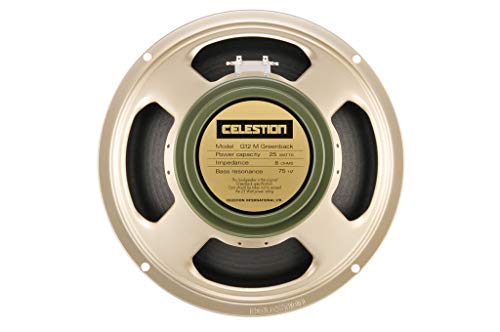
Celestion enters this guide as the conscious departure. The English maker’s twelve-inch guitar speakers defined the British invasion sound that the Twin Twelve’s designers were not pursuing, and fitting them rewrites the amplifier’s accent rather than restoring it. That can be exactly what an owner wants. The Vintage 30, despite a name that misleads many buyers, is a sixty-watt-class ceramic driver with a pronounced upper-midrange emphasis and high sensitivity; a pair under a 1484 produces a loud, forward, unmistakably British-leaning cabinet that cuts through a band with ease and gives up the period American looseness in exchange. The G12M Greenback family, including its higher-capacity Creamback descendants, offers the earlier British recipe: a medium magnet, a cone that breaks up with a woody, vocal character, and in classic G12M form a modest rating that, doubled in a pair, sits close enough to this amplifier’s output to demand the respect discussed in the headroom section. Celestion’s alnico Blue and Gold are revered drivers with a chime all their own; the Blue’s low capacity makes it a poor match for a pushed sixty-watt amplifier even in a pair, while the Gold raises capacity into plausible territory at a price that buys several Jensen pairs. Depth needs checking too, since several Celestion frames run deeper than the American vintage pattern this cabinet was built around.
Warehouse Guitar Speakers: the boutique value route
Warehouse Guitar Speakers, working from Kentucky, built its reputation by voicing drivers after celebrated American and British originals and selling them directly at prices below the famous names. Its American-voiced twelves are the pertinent ones here. The G12C is widely understood as an homage to the classic ceramic Jensen pattern, offering capacity comfortably above the per-speaker share a 1484 delivers and a voice aimed at the clean-to-edge American territory this amplifier inhabits. The G12C/S variant softens the top with a different cone treatment. The G12A carries the homage into alnico, at the premium the material always commands. On the British side of the Warehouse catalog, the Reaper and the ET65 echo Celestion archetypes. Because Warehouse is a smaller operation, published specifications are the buyer’s friend twice over: confirm the impedance version being ordered, since several models come in both eight and sixteen ohms, and confirm mounting depth against the cabinet measurements set out below.
Mounting depth and baffle clearance in a shallow cabinet
Every candidate discussed so far must still fit through the cabinet door, and the Twin Twelve cabinet is shallower than modern enclosures built for modern drivers. The piggyback design prized compactness: the head nestles into the cabinet for transport, panels are thin, and the distance from the baffle to the back panel leaves little spare room behind a speaker magnet. A driver whose published depth looks ordinary in a catalog can still foul the back panel, press against internal bracing, or leave the back unable to seat on its fasteners once fitted. The remedy is measurement before purchase. Remove the back panel and one existing speaker, then measure from the baffle’s front face to the nearest obstruction behind the speaker position, accounting for any brace, cleat, or wiring crossing the space. Compare that figure with the full mechanical drawing most makers publish, which shows magnet diameter as well as depth, because a wide magnet can strike a side cleat that a narrow one clears even at greater depth.
Mounting pattern deserves the same care. Guitar speakers share a broadly standardized bolt circle for each diameter, yet hole counts vary: many frames offer eight holes, some four, and vintage baffles were drilled for the frames of their day. A modern frame usually aligns with at least four existing holes or studs, but that should be verified with the maker’s drawing against your baffle before ordering, since enlarging holes in a sixty-year-old baffle is a one-way modification. Gasket material matters too: a compressed, even seal prevents the buzzing leaks owners later hunt through tubes and hardware. Tighten hardware in a cross pattern, snug rather than forced, because overtightening can warp a stamped frame enough to misalign the voice coil, turning a careful purchase into a rubbing speaker within a week.
Weight completes the physical audit. The cabinet’s handle, baffle, and joinery were sized for period drivers of modest mass, and a pair of heavy modern ceramics adds pounds where the design expected few, stressing a baffle that has spent decades holding speakers against gravity. Check that baffle screws bite into sound wood and that handle hardware is firm. Owners imagining other duties for the cabinet, such as doubling as an extension for a small public-address rig, should note how different that world is: the powered enclosures surveyed at best 10 inch powered speakers solve their own amplification and mounting problems in ways a passive vintage cabinet never attempts.
Mixing one vintage-voiced and one modern speaker
Because the Twin Twelve carries two speakers, it invites a strategy unavailable to single-speaker combos: deliberate mixing. One vintage-voiced driver and one modern driver, side by side, can cover each other’s weaknesses in a way that flatters this particular amplifier. The classic pairing logic for a 1484 runs as follows. A lighter, lower-capacity alnico or vintage-style ceramic in one position supplies the early movement, the soft top, and the period flavor at low volume. A firmer modern ceramic in the other position supplies bass discipline, clarity when the amplifier is pushed, and thermal insurance for long sessions. The ear blends the two from a few feet away into a single complex voice that neither driver produces alone, and a microphone placed before either cone gives a recording engineer two genuinely different tones from one amplifier pass.
Mixing has rules, and they are electrical before they are musical. Both drivers should share the same nominal impedance, so power divides evenly and the combined load stays predictable under either wiring scheme. Their sensitivities should sit within roughly two decibels of each other; a much louder partner does not blend but dominates, reducing the quieter speaker to a faint seasoning. Their power capacities need not match exactly, yet the pair is only as robust as its weaker member at the share of power that member receives, so pairing a delicate driver with a robust modern one does not license full-volume punishment; the delicate half still takes its half. Physical depth must be checked per position, since the two sides of a real cabinet are rarely mirror images once bracing and the head-storage arrangement are counted.
There is also a heritage argument for mixing. Many surviving Twin Twelves already live as mixed cabinets by accident, one original Jensen beside whatever a repair shop had in stock in 1979, and some of those accidental pairings sound genuinely good, which is how the deliberate version earned its following. If one original speaker measures healthy, moves without rub when gently pressed through its travel, and plays free of buzz at moderate volume, keeping it and replacing only its failed partner is a respectable, economical plan. Choose the new partner to complement the survivor: matched impedance above all, sensitivity close to the period driver’s real behavior rather than its faded catalog figure, and a voicing that fills the survivor’s gaps, usually firmer bass and clearer top from the modern side.
Break-in: what changes as a new speaker settles
A new guitar speaker is a mechanical device built from paper, glue, and fabric, and like a new pair of boots it is stiffest on the day it arrives. The surround and the spider, the two flexible suspensions that center the cone and coil, loosen with use, and as they loosen the driver gains low-frequency ease, openness in the mids, and a small measure of sensitivity. Makers acknowledge the process in their literature, and players consistently report that a fresh driver sounds tighter and brighter, sometimes even harsh, during its first hours before settling into the voice it will keep. The practical consequence is patience in judgment: a replacement pair evaluated only during its first evening may be condemned for a stiffness that two weeks of regular playing would have removed.
Break-in requires nothing exotic. Ordinary playing across a range of volumes does the work, and moderate volume with varied material, full chords and single lines and palm-muted figures alike, flexes the suspension more usefully than a punishing sine-wave marathon. Some owners speed the process with a looped signal or a variac-driven filament transformer humming the cones at low frequency overnight, methods described in service literature for decades; they work, but they run an unattended electrical device for hours, and the safer advice is to let the speakers break in through music, in attended sessions, over a fortnight. Expect the largest change early, with diminishing movement after roughly the first ten to twenty hours of real use. Revisit any channel choices made on day one after the speakers settle, because decisions tuned to a stiff cone rarely survive contact with a loosened one.
Break-in also cuts the other way as a diagnostic. A new driver that buzzes or produces a scratchy undertone from its first note is not stiff; it is faulty, misaligned, or mounted badly, and no amount of playing cures a rubbing coil. Distinguish the two conditions early, while return windows remain open: honest stiffness sounds tight and bright but clean, whereas a defect adds a noise that follows certain notes, often the low ones that move the cone furthest. Check mounting torque and confirm no lead wire touches the cone before blaming the driver, since a wire resting against moving paper imitates a defect perfectly and costs nothing to fix.
Safe practice with a vintage amplifier and a fresh speaker load
One rule stands above every other in this guide and admits no exceptions: never run a tube amplifier without a correct speaker load connected. A tube output stage deprived of its load can generate destructive voltages inside the output transformer within moments, and the damage may not announce itself until the transformer fails under ordinary use weeks later. The rule sounds obvious and is broken constantly in practice, by owners who power a chassis on the bench to check a pilot light, who let a speaker cable slip from a jack mid-song, or who test a head before its cabinet arrives from another room. With a 1484, whose transformer is irreplaceable in any faithful sense, the discipline is simple: the speaker cable is connected and verified before the power switch moves, every time, and the standby habits of other amplifier designs do not excuse improvisation here. If the amplifier must be examined live on a bench, a proper resistive load box rated for the amplifier’s output and impedance is the substitute, and fitting one belongs to the same technician conversation as any internal work.
The wider safety picture deserves one honest paragraph. Original filter capacitors dry out and can fail, sometimes taking other components with them. Two-prong cords leave the chassis without a modern earth path, and the so-called death capacitor in many amplifiers of the era can put voltage on that chassis if it fails. None of this is speaker business strictly, yet a speaker swap is often when an owner first thinks seriously about the amplifier’s health, so: have a qualified technician inspect a newly acquired 1484 before the project begins, fit a three-conductor cord and fresh electrolytic capacitors as advised, and then choose speakers for an amplifier whose output figures are real rather than nostalgic. A pair chosen for a sick amplifier’s weak output will be chosen wrong.
Cables form the humble end of the same discipline. Use a proper speaker cable, not an instrument cable, between head and cabinet; a guitar lead’s conductors are too light for sustained output current. Inspect the cabinet jack and harness solder joints while the back is off, because an intermittent connection is a momentary no-load condition wearing a disguise. After fitting new speakers, run the amplifier at low volume first, listening to each driver in turn with an ear near the baffle, before any full-power session. Most fitting errors announce themselves politely at low volume to an owner who bothers to listen.
Matching the pair to the way the amplifier is actually played
Abstract comparisons resolve into a few recognizable owners. The home and recording player, who keeps the Twin Twelve in a small room and values the moment the clean tone begins to fur at speaking-plus volume, is best served by the vintage end of the market: a Jensen P12Q or C12Q class pair, or one survivor original beside a sensitivity-matched modern driver, accepting the lower thermal ceiling as a fair trade for character at low level. The working player who gigs the amplifier beside drums and needs chords to stay legible through a long set should stand at the other end: C12N or C12K class ceramics, an Eminence Legend or Cannabis Rex pair, or the Warehouse G12C pattern, trading a little period softness for composure and insurance. The player deliberately seeking a British reinvention of the amp already knows the destination and should choose Celestion or Warehouse British-voiced pairs with eyes open about sensitivity, since those drivers will make the amplifier louder and push its breakup later in the room even as the speaker’s own breakup character arrives in a different flavor.
Genre follows the same lines without dictating them. The 1484’s natural congregation is the music its era made: blues, early rock and roll, country with an edge, garage rock, and roots styles that prize a vocal midrange and a forgiving top. Alnico and light ceramic pairs serve that congregation faithfully. Heavier modern pairs widen the amplifier’s territory toward louder stagecraft, while hemp-cone options suit players who love the circuit but fight its brightness with single-coil guitars in reflective rooms. Readers whose curiosity runs from this passive cabinet toward self-powered stage enclosures can compare the philosophy at best 12 active pa speakers, where the amplifier and speaker are designed as one sealed decision rather than negotiated across sixty years.
A verification checklist to complete before ordering anything
First, identify what you own: photograph both existing speakers, record their codes, and measure each coil’s DC resistance individually, then measure the whole cabinet at its input. Second, establish the wiring: trace the harness, determine whether the pair runs in series or parallel, and write the resulting total beside the schematic figure so the two numbers can be compared on paper. Third, set the target: choose each new driver’s nominal impedance so your wiring scheme reproduces the load the output stage expects, and if you intend to change the scheme itself, re-derive the total before ordering, because an eight-ohm pair can be a four-ohm cabinet or a sixteen-ohm cabinet depending entirely on two solder joints. Fourth, check capacity per driver against half the amplifier’s realistic output with margin for overdrive, and check sensitivity against your volume goals. Fifth, measure available depth against each candidate’s mechanical drawing, magnet diameter included, and confirm the mounting-hole pattern against your baffle. Sixth, decide the voicing family on purpose, alnico or ceramic, American or British, matched pair or deliberate mix, so the order expresses a choice instead of a mood.
Mistakes that recur in Twin Twelve speaker swaps
The most damaging mistake is ordering by diameter alone, two twelve-inch speakers of whatever impedance the retailer lists first, and discovering the mismatch only in the transformer’s obituary. The most common disappointment is subtler: fitting very efficient, high-capacity modern drivers and finding the beloved early breakup exiled to a volume the household cannot tolerate, a result that follows directly from the sensitivity arithmetic and surprises only owners who skipped it. A third error is judging a fresh pair within its first hour and returning a good speaker for the crime of being new. A fourth is overtightening mounting hardware and warping a frame, then blaming the maker for the resulting rub. A fifth is discarding original Jensens that a recone specialist could have returned to service, since a properly reconed period driver often satisfies owners more than any reissue; reconing deserves a quote before the old speakers are treated as scrap. Finally, there is the error of running the head, just for a second, with nothing connected, which this guide has already addressed and will not forgive.
Check prices on Amazon
Live listings for the shortlist in this guide are pulled from Amazon below, so prices and availability are always current at the moment you look.


Questions owners ask, answered without folklore
Can one new speaker replace one failed original?
Yes, provided impedance matches exactly, sensitivity sits close to the survivor’s real output, and the survivor measures healthy and plays clean. This is often the most musical outcome available: half the cabinet keeps its authentic voice while the modern half supplies reliability.
Does the pair have to come from the same maker?
No. It has to agree on impedance, approximate sensitivity, and compatible capacity. Makers do not share a secret handshake that mixed pairs lack, and the deliberate-mix strategy described earlier depends on crossing catalog lines without electrical penalty.
Will a higher-capacity speaker sound worse at low volume?
Not automatically, but the tendency is real: heavier cones and coils built for large power figures often respond less eagerly to small signals. The effect is one of degree, and plenty of mid-capacity modern drivers stay lively under this amplifier. Treat capacity as a window to stand inside rather than a score to maximize.
Is reconing an original Jensen better than buying a reissue?
It is different rather than simply better. A skilled recone preserves the original magnet structure and frame and restores a period-correct moving assembly, while a reissue offers factory-fresh consistency. Owners who value originality lean toward the recone; owners who value predictability lean toward the reissue. Either path, done properly, respects the amplifier.
What if the schematic and the cabinet disagree about load?
Trust the measurement of your cabinet for what it is, trust the schematic for what the amplifier wants, and reconcile the two before playing through the result. Disagreement means a previous hand changed something, and the change, not the paperwork, is what needs correcting.
Sixty years after Sears printed the Twin Twelve in a catalog, the kindest thing an owner can hand one is a pair of speakers chosen with a meter, a tape measure, and a clear idea of its voice, so that the next chord through that shallow cabinet lands exactly where its makers aimed it in 1965.

