What's inside
- Key Takeaways
- Quick Picks
- How Did We Rank Cameras That Only Work as Part of a System?
- Why Does the 8-32mm Zoom Range Keep Appearing?
- What Do Infrared Distance and WDR Decide After Dark?
- What Does the Recorder Half of the System Actually Do?
- The Six Plate Cameras, Examined One by One
- How Should a Plate Camera Be Positioned to Actually Read?
- What Happens at the Edges: Dirty Plates, Odd Vehicles and the Unreadable?
- Gate Camera or Road Camera: How Does a Small Site Choose?
- What Does the Installation Itself Demand: Posts, Cable and Power?
- How Do the Six Divide by Lane and Distance?
- Which Mistakes Make Plate Systems Read Nothing?
- Final Recommendation
- Frequently Asked Questions
- Related Guides
As an Amazon Associate I earn from qualifying purchases. This post may contain affiliate links at no extra cost to you.
gizmoverdict.com is reader-supported. When you buy through links on our site, we may earn an affiliate commission.
Where to buy: each camera below links to its Amazon listing, which is where you confirm the recorder or software pairing it expects, because plate recognition is a system purchase wearing a camera’s clothes.
The best license plate recognition cameras are not really cameras in the consumer sense; they are the front end of a reading system. The lens gathers a plate at a gate, a barrier or a site entrance, and the recognition itself — the turning of pixels into a plate string, a timestamp and an entry in a searchable log — happens in partnership with a compatible recorder or software platform. This guide is written around that fact rather than in denial of it. The six cameras below are judged on what their listings actually state: zoom range, sensor, infrared distance and the recognition ecosystem each one names, with no standalone accuracy figure promised for any of them, because no honest figure of that kind exists outside a specific installation.
That framing protects you from the category’s favourite disappointment. A plate camera pointed like a general security camera — too high, too wide, too far — reads nothing, however good its sensor, while a modest camera mounted at plate height on a slow lane reads all night. The reviews therefore spend as much time on geometry and pairing as on hardware: which zoom range covers which lane position, which infrared throw matches which mounting distance, and which listings bind you to one maker’s recorders. Buy the camera whose stated numbers describe your gate, and whose ecosystem you are genuinely willing to run.
Key Takeaways
- Four of the six picks share the same professional lens formula — an 8-32mm motorised zoom — because that range lets one bullet camera be tuned to lanes at different distances during installation.
- Recognition is a partnership: every camera here works with a compatible NVR or software layer, and the ONWOTE states its permitted recorder models by name in its title.
- Infrared distance divides the field sharply — a stated 98ft on the Amcrest and LTS, against a stated 328ft on the Titanium — and the right figure is the one that matches your mounting distance, not the largest.
- Sensor size is stated only once, on the Amcrest’s 1/1.8-inch low-light sensor; elsewhere the titles compete on WDR figures, with 120dB stated on the Anpviz and ONWOTE.
- The GW Security entry is the outlier by design: a 4X zoom, a stated 120 km/h speed capability and vehicle attribute recognition for faster roads rather than slow gates.
Quick Picks
| Pick | Badge | Why it made the cut |
|---|---|---|
| Amcrest LPR Camera (8-32mm) | Low-light gate standard | An 8-32mm zoom on a stated 1/1.8-inch low-light sensor with active deterrents and 98ft of night vision, for entrances that work after dark. |
| Anpviz LPR PoE (8-32mm) | Weather-sealed all-rounder | The same professional zoom range with a printed IP67 rating, 120dB WDR and an SD slot taking cards up to 256GB. |
| ONWOTE LPR PoE (8-32mm) | Closed-system certainty | An 8-32mm motorised lens and 120dB WDR that works only with three named ONWOTE recorders — a limitation that doubles as a compatibility guarantee. |
| GW Security LPR (4X zoom) | Moving-traffic pick | A stated 120 km/h capture capability plus vehicle type, colour and direction recognition, TAA compliant, for roads rather than barriers. |
| LTS PRO-X LPR | Compliance-first bullet | A 4MP PRO-X series LPR bullet with a stated 98ft of IR and NDAA compliance, for buyers whose procurement rules come before their preferences. |
| Titanium LPR Bullet (8-32mm) | Long-throw sentinel | An 8-32mm motorised zoom with a stated 328ft of infrared, True WDR, audio and alarm, and NDAA standing for distant lanes. |
How Did We Rank Cameras That Only Work as Part of a System?
By reading each title as a contract with three clauses. The first clause is optical: the zoom range, stated in millimetres or as a multiplier, because plate capture lives and dies by how many pixels land on a plate of fixed physical size at your lane’s distance. Four cameras here converge on 8-32mm, and that convergence is the market telling you where the working envelope sits — wide enough to frame a slow lane from a near post, long enough to reach across an entrance from a safer mounting point. The GW’s 4X and the LTS’s silence on zoom mark them as different instruments, judged on their own stated terms.
The second clause is photonic: how the camera handles the two lighting problems of plate work, darkness and glare. Darkness is answered by infrared throw — stated at 98ft on two picks, 328ft on one, unstated on others — and by sensor size, stated only by the Amcrest. Glare is answered by wide dynamic range, because a plate lit by headlights against a dark lane is an exposure problem before it is anything else; the 120dB figures on the Anpviz and ONWOTE, and the Titanium’s True WDR claim, are the titles competing on exactly that ground.
The third clause is allegiance: which recorder or software family the camera expects to think with. This is the clause buyers skip and regret. The ONWOTE prints its three permitted recorder models in its title. Others imply ecosystems through their series names and compliance marks. Since the recognition log, the search tools and the alert behaviour all live in that partner system, a camera cannot be ranked apart from it — so the reviews below treat pairing as a specification, and the guide’s first buying question is not which camera, but which system you intend to run.
Why Does the 8-32mm Zoom Range Keep Appearing?
Because it maps almost exactly onto the geometry of real entrances. At its 8mm end, the lens frames a lane from a post a few metres away — the barrier, the gate pillar, the car-park entry column. At 32mm, the same camera reaches a lane from across a forecourt or down a short approach road, mounted somewhere a ladder and a cable run are practical. Motorised adjustment, named on the Anpviz, ONWOTE and Titanium, means that framing is set from the ground, by phone or laptop, while watching the live plate view — the installer zooms until the plate fills the prescribed portion of the frame, locks it, and the installation’s most important decision is made with evidence rather than eyesight.
The zoom’s second job is forgiveness. Entrance layouts change: a barrier moves, a lane is repainted, a new gatehouse steals the original mounting point. A fixed-focal plate camera survives none of that; an 8-32mm camera is re-aimed and re-zoomed in an afternoon. This is also why the multiplier-quoted GW, at 4X, is a different tool rather than a lesser one — its stated brief is moving traffic at speed, where the camera sits close to a predictable lane line and reach matters less than the capture moment. Judge zoom against your lane’s measured distance, from the actual mounting point you can use, and the millimetres in these titles become a tape measure you can shop with.
What Do Infrared Distance and WDR Decide After Dark?
Most plate events that matter happen in the dark, and the dark fights back in two ways. The first is simple absence of light, answered by infrared: the camera illuminates the lane with light the driver cannot see and the plate’s reflective surface returns generously. The stated throws in this guide — 98ft on the Amcrest and the LTS, 328ft on the Titanium — should be read against your mounting distance the way a torch’s range is read against a path: the figure must cover the lane with margin, and surplus beyond that buys evenness rather than miracles. A camera whose IR barely reaches the plate produces captures that degrade exactly when weather, dirt or a fast approach conspire, which is to say exactly when the capture matters.
The second fight is contrast. A vehicle arriving at night presents headlights at full beam, a windscreen in darkness and a plate somewhere between — an exposure range that defeats cameras without serious dynamic range, which either expose for the headlights and lose the plate or expose for the plate and drown in glare. That is the problem the stated 120dB WDR figures on the Anpviz and ONWOTE, and the Titanium’s True WDR, exist to solve, and why WDR belongs in a plate camera’s headline specifications rather than its footnotes. The Amcrest answers the same night with a different weapon — its stated 1/1.8-inch low-light sensor, a physically large light-gatherer by bullet-camera standards — and the two philosophies, sensor versus processing, are the night’s real contest in this shortlist.
Practical corollary: test at night, at speed, in rain if the sky offers it, before the installation is signed off. Plate systems fail in combinations — wet tarmac reflections plus a dirty plate plus an angle a degree too wide — that no daytime commissioning visit reveals. Every camera here will produce a beautiful capture of a clean plate at noon; the purchase should be decided by the worst capture of the worst week, and that capture can only be collected by testing in the conditions that produce it.
What Does the Recorder Half of the System Actually Do?
Everything the word “recognition” promises. The camera delivers a stream; the recorder or software detects the plate region, reads the characters, stamps the result with time and lane, files the still and the clip, and makes the whole archive searchable by plate string. That division of labour explains the ONWOTE’s title, the most honest in this guide: the camera works only with three named recorder models, because the reading intelligence it was built for lives in them. It also explains why this guide promises no accuracy figures — recognition quality is a property of camera, recorder, angle, speed and light combined, and any percentage printed on a camera box describes a laboratory, not your gate.
The buying consequence is that ecosystem questions come first. Which recorder family do you already run, or intend to? How are plate logs searched, exported and retained, and who is allowed to see them? A plate log is personal data in most jurisdictions — a record of movements — and a business running one takes on retention and access duties that should be decided deliberately, with the system’s tools, rather than discovered later. The cameras with compliance marks speak to institutional buyers on exactly this level: NDAA standing on the LTS and Titanium, TAA compliance on the GW, are procurement languages for organisations whose purchasing rules are part of the specification.
Storage planning follows from the same partnership. Plate systems generate an event record per vehicle — small stills and short clips rather than continuous rivers of video — but a busy entrance accumulates them into serious volume, and the Anpviz’s stated SD slot, accepting cards up to 256GB, hints at the edge-storage habits of cameras that must keep working when a network link sulks. Ask of any pairing: how many days of our traffic fit, what happens on day thirty-one, and how a specific Tuesday’s 8:14 arrival is found in under a minute. The system that answers those three cleanly is the system; the camera is its eyes.
The Six Plate Cameras, Examined One by One

Amcrest LPR Camera (8-32mm) — Low-light gate standard
The Amcrest is the elder statesman of this list, and its title spends its words the way experienced installers spend money: on the sensor. A stated 1/1.8-inch low-light sensor is a physically generous light collector for a bullet camera, and it anchors a specification built for entrances that earn their keep after sunset — 4MP at 30fps through an 8-32mm optical zoom, AI designation in its model identity, active deterrents for the human moments a gate produces, and a stated 98ft of night vision. The package reads as a camera specified by people who knew their problem was darkness, not distance.
The 98ft infrared figure is the honest boundary of its design: this is a camera for lanes within comfortable reach of its mount, which describes the great majority of gates, barriers and car-park entrances in the world. Active deterrents — the lights and sounds a camera can raise when a person loiters in its zone — suit staffed and semi-staffed entrances where a deterrent now is worth more than a recording later. Its listing on Amazon carries the current pairing and firmware details, which matter for a model whose ecosystem is its selling point.
- Zoom stated: 8-32mm optical
- Sensor stated: 1/1.8-inch low-light, 4MP at 30fps
- Night vision stated: 98ft
- Deterrents stated: active deterrents included
- Form stated: bullet, IP PoE, model IP4M-1072EW-AI
- WDR figure: not stated in the listing title — verify with the maker’s documentation
Strengths
- The only stated sensor size in the guide, and a large one — night capture is its design centre.
- Active deterrents give an attended gate a voice, not just a witness.
- The 8-32mm professional zoom range tunes to most real entrance geometries.
Trade-offs
- 98ft of stated IR ends its candidacy for long approach roads.
- No WDR figure is printed in the title, leaving the headlight-glare question to documentation.
- No ingress rating is printed in the title for exposed mounting assessments.
Best for: gates and car-park entrances within moderate range whose traffic peaks after dark. Not suited for: a lane mounted hundreds of feet from the camera position, where its stated infrared cannot follow. Check the Amcrest’s current system pairings on Amazon before adding it to an existing recorder.

Anpviz LPR PoE (8-32mm) — Weather-sealed all-rounder
The Anpviz matches the professional formula and then answers the questions the Amcrest leaves open. Same 8-32mm reach, here explicitly motorised; a stated 120dB of WDR for the headlight problem; 4MP at 30FPS; an SD card slot accepting up to 256GB for edge storage; and the specification most of this guide’s titles omit — a printed IP67 waterproof rating, which is a testable promise about dust and water immersion rather than a hope. For an entrance camera that will live outdoors on a post through every season, that printed rating is a purchasing fact of the first order.
The SD slot deserves its sentence, because it changes the camera’s failure behaviour. A plate camera with local storage keeps recording events through a network outage, a recorder reboot or a cut cable’s quiet hours, and the log the business cares about survives the infrastructure’s bad day. Aimed by its title at business use, the Anpviz reads as the risk-manager’s pick of the six — nothing exotic, every base covered, the specification written like a checklist an insurer might draft. Amazon’s listing for it confirms the current recorder compatibilities its recognition expects.
- Zoom stated: 8-32mm motorised
- Dynamic range stated: 120dB WDR
- Sensor stated: 4MP at 30FPS
- Storage stated: SD card slot up to 256GB
- Weather sealing stated: IP67 waterproof
- Infrared distance: not stated in the listing title — verify with the maker’s documentation
Strengths
- IP67 printed in the title gives exposed mounting a tested sealing grade.
- 120dB WDR addresses the headlight-glare exposure problem head-on.
- 256GB edge storage keeps the plate log alive through network failures.
Trade-offs
- Its title states no infrared distance, so night reach must be confirmed from documentation.
- No sensor size is stated, leaving low-light gathering to be proven in testing.
- Its business framing assumes a recorder ecosystem the buyer must still choose.
Best for: exposed entrance posts in real weather, where sealing and edge storage carry the risk. Not suited for: a site whose night range must be settled from the listing alone, since its title declines to print an infrared distance. Read the Anpviz listing on Amazon for its night-vision specification and recorder pairings.

ONWOTE LPR PoE (8-32mm) — Closed-system certainty
The ONWOTE’s title does something rare in this category: it tells you, by model number, exactly which recorders the camera will work with — PNT-808, PNA-8016-T, PNT-1232 — and by implication that it will work with nothing else. Read generously, that is not a limitation but a guarantee wearing a warning’s clothes. A camera and recorder family tested together, sold together and supported together removes the entire genre of fault that lives between vendors, where the camera maker blames the recorder and the recorder maker blames the camera while your gate reads nothing. For a commercial business — the audience its title names — that single-throat-to-choke quality has real monetary value.
The camera itself matches the professional template: 8-32mm motorised lens, 120dB WDR, 4MP at 30FPS, wired PoE. The specification is deliberately unremarkable, because the product being sold is certainty rather than novelty. The buying rule follows directly: this camera is a superb purchase inside an ONWOTE system decision and a pointless one outside it, so the recorder question must be answered first and the camera second. Its Amazon page lists the current bundle and recorder pairing options for businesses building the system whole.
- Zoom stated: 8-32mm motorised
- Dynamic range stated: 120dB WDR
- Sensor stated: 4MP at 30FPS
- Compatibility stated: only PNT-808, PNA-8016-T, PNT-1232 recorders
- Audience stated: commercial business ANPR/LPR
- Infrared distance: not stated in the listing title — verify with the maker’s documentation
Strengths
- Named recorder compatibility eliminates cross-vendor pairing risk entirely.
- The full professional template — motorised 8-32mm, 120dB WDR — without exotic claims.
- A single-vendor system simplifies support for a business without IT depth.
Trade-offs
- It is unusable with any other recorder family — the closed list is absolute.
- No night-vision distance is stated in the title for range planning.
- Switching ecosystems later means replacing the camera with the recorder.
Best for: a business building or already running an ONWOTE recorder system at its entrance. Not suited for: any site with an existing recorder from another maker, where its compatibility list excludes the pairing outright. Confirm the ONWOTE recorder pairing on Amazon matches the system you run or intend to buy.

GW Security LPR (4X zoom) — Moving-traffic pick
Every other camera in this guide assumes traffic that slows — at a barrier, a gate, a ticket machine. The GW assumes traffic that does not. Its title leads with a stated 120 km/h speed capability, which repositions the entire product: this is a camera for access roads, site entrances on fast approaches and thoroughfares where vehicles pass at road pace and the capture must happen in the fraction of a second the plate crosses the frame. Its 4X motorised zoom is shorter than the 8-32mm crowd’s because its mounting geometry is different — close to a predictable lane, framing a known window of road.
Beyond the plate, its title claims vehicle attribute recognition — type, colour and direction — which serves the log’s usefulness in a way pure plate strings cannot: an unknown plate on a known vehicle description is a searchable event, and direction turns a camera pair into a movement record. TAA compliance marks its institutional intent, speaking to public-sector and contractor buyers whose procurement rules are written into law-adjacent language. The GW’s listing carries its current mounting and system details, which road-speed buyers should study with particular care, since capture at pace is the least forgiving installation in this guide.
- Speed stated: 120 km/h capture capability
- Zoom stated: 4X motorised
- Sensor stated: 4MP
- Recognition stated: vehicle type, colour and direction attributes
- Compliance stated: TAA
- Infrared distance: not stated in the listing title — verify with the maker’s documentation
Strengths
- A stated road-speed capture capability no gate camera here attempts to claim.
- Vehicle attribute recognition makes events searchable beyond the plate string.
- TAA compliance suits public and contractor procurement frameworks.
Trade-offs
- 4X zoom reaches less than the 8-32mm picks for distant or offset mounting.
- No infrared distance is printed in the title for night-range planning.
- Its speed brief is wasted at a barrier, where slower cameras do the same job.
Best for: fast approach roads and site entrances where vehicles do not stop. Not suited for: a distant gate viewed from across a forecourt, where its 4X reach runs out before the plate is large enough to read. Review the GW Security listing on Amazon for its current system requirements.

LTS PRO-X LPR — Compliance-first bullet
The LTS title is the tersest in this guide — a model string, a series, 4MP, a stated 98ft of IR, the words License Plate Recognition and NDAA — and that terseness is itself a market signal. This camera is sold into professional channels where the buyer reads datasheets rather than listings, and where the decisive facts are the series it belongs to and the compliance it carries. NDAA standing matters concretely to government-adjacent sites, schools, utilities and contractors whose funding forbids non-compliant hardware; for those buyers the LTS is not one option among six but the shape options are allowed to take.
Within its stated facts, the profile is coherent: a 4MP bullet in a named professional series, with the same 98ft infrared class as the Amcrest, aimed at the standard gate distances of institutional sites. Everything else — zoom range, WDR, sensor — is unstated in the title and must be taken from the maker’s documentation, a research burden this guide flags rather than fills. Buyers in its channel will do that reading as a matter of routine. Its Amazon listing is the starting point for the current PRO-X pairing and datasheet trail.
- Sensor stated: 4MP
- Night vision stated: 98ft IR
- Series stated: PRO-X, model LXIP9943LPR-50R
- Compliance stated: NDAA
- Zoom range: not stated in the listing title — verify with the maker’s documentation
- WDR figure: not stated in the listing title — verify with the maker’s documentation
Strengths
- NDAA compliance qualifies it for institutional procurement the others cannot enter.
- A professional-series pedigree implies channel support and documented pairings.
- 98ft IR matches the standard gate-distance class proven elsewhere in this guide.
Trade-offs
- Its title states no zoom range, so lane geometry cannot be planned from the listing.
- Neither WDR nor sensor size is stated, leaving night quality to the datasheet.
- Its channel orientation makes it a research-heavier purchase for a small business.
Best for: institutional and contractor installations where NDAA compliance is a hard requirement. Not suited for: a purchase that must be fully specified from the listing alone, since this title deliberately leaves the detail to its documentation. Start the LTS PRO-X datasheet trail on Amazon before specifying it into a bid.
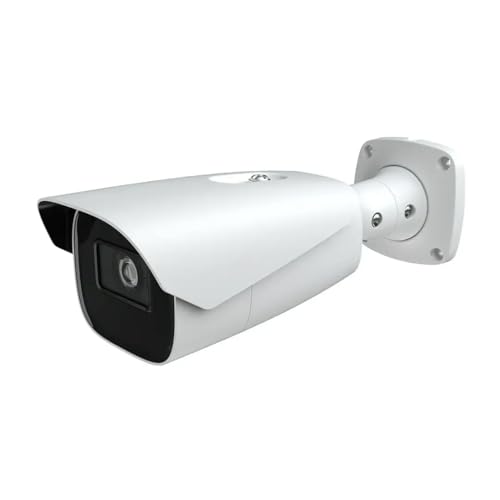
Titanium LPR Bullet (8-32mm) — Long-throw sentinel
The Titanium’s headline is a number three times larger than the class standard: a stated 328ft of infrared, behind the familiar 8-32mm motorised zoom, with True WDR, audio, an alarm interface, an SD slot and NDAA standing completing a specification that reads like the checklist of every other pick combined. Long infrared throw serves a specific geography — the camera mounted high or far for safety, survivability or cabling sense, watching a lane it cannot sit beside: the far side of a depot yard, the entrance at the end of an exposed approach, the gate whose post keeps being clipped by the vehicles it watches.
The audio and alarm provisions mark its second role: this is a camera that can participate in an entrance’s life, hearing and being heard, raising an alarm output to a wider system rather than merely witnessing. True WDR addresses the glare half of the night problem that its IR throw cannot. The discipline this guide applies to all its picks applies here with interest — 328ft is an illumination figure, and the plate at that distance still needs the zoom, the angle and the recorder partnership to become a log entry. The Titanium’s Amazon page sets out its current lens and alarm particulars.
- Zoom stated: 8-32mm motorised
- Night vision stated: IR 328ft — the longest throw in this guide
- Dynamic range stated: True WDR
- Sensor stated: 4MP IP bullet
- Extras stated: audio, alarm, SD slot
- Compliance stated: NDAA
Strengths
- 328ft of stated infrared opens mounting positions no other pick here can serve.
- Audio and alarm outputs let the camera act in an entrance system, not just observe.
- NDAA standing plus SD edge storage covers compliance and resilience together.
Trade-offs
- Long-throw installations punish small aiming errors the short-range picks forgive.
- Its capability is surplus at an ordinary gate, where the 98ft class suffices.
- No ingress rating is printed in the title for an exposed far-mount assessment.
Best for: distant lanes, high mounts and large yards where the camera cannot sit near the plates it reads. Not suited for: a standard barrier a few metres from its post, where its long throw and alarm hardware are money spent on distance never used. Look over the Titanium’s full specification on Amazon before planning a far mount around it.
How Should a Plate Camera Be Positioned to Actually Read?
Lower and narrower than instinct suggests. The instinct that ruins plate installations is the security instinct — mount high, see everything — applied to a job that is closer to portrait photography. A plate camera wants to be near plate height, looking along the lane rather than down at it, because steep vertical angles foreshorten the plate and defeat the reading software, and horizontal angles beyond a modest slant skew characters into illegibility. The lane should be a place where vehicles are slow or briefly stationary — a barrier, a pinch point, a speed hump doing double duty — because every increment of speed steals sharpness the sensor cannot buy back.
Then zoom until the plate owns the frame. Recognition systems read a plate region of a certain size; a wide scenic shot of an entrance gives them a postage stamp. The motorised zooms in this guide exist for this exact moment of commissioning — the installer watches the live view, tightens the frame until a test vehicle’s plate sits at the prescribed scale, and locks the lens there for the season. Revisit the framing after any layout change, and after the first week of logs, because the log itself is the audit: the missed reads cluster at an hour, a direction or a vehicle type, and each cluster is the installation confessing a specific fault — glare at dusk, speed at the morning rush, a queue position outside the frame.
Height interacts with weather in one more way worth planning for: a camera at plate height lives in the spray zone of passing vehicles, and its lens will film over with road water on wet days faster than any elevated camera’s. The commissioning visit should include a look at where spray lands, whether a small hood or a slightly sheltered offset solves it, and how the lens will be reached for the monthly cloth — because a camera that cannot be cleaned safely will not be cleaned at all, and its slow fade will be misdiagnosed as failing electronics by everyone who inherits it.
Light the scene for the camera you bought. Infrared cameras want a lane free of competing IR sources and reflective clutter; WDR cameras want their chance against headlights, which means not adding a badly aimed floodlight that blinds them at the capture moment. If the site also needs a visible deterrent light, place it for humans and let the camera’s own night system work in peace beside it. Commissioning at night, with the site’s real vehicles at real speeds, is not thoroughness — it is the installation, and the daytime visit is merely the scaffolding for it.
What Happens at the Edges: Dirty Plates, Odd Vehicles and the Unreadable?
No honest guide to this category ends at the clean test vehicle. Real lanes deliver plates filmed with road salt, plates tilted on a bent bracket, plates half-hidden by a tow bar, bike rack or the trailer the vehicle is pulling. They deliver motorcycles, whose plates sit in a different place and at a different scale; delivery vans that stop with their rear doors open across the capture zone; and the occasional vehicle with no front plate at all in jurisdictions that do not require one, which is why so many installations read rear plates on exit rather than front plates on entry. A recognition system earns its keep in how gracefully it degrades across that menagerie — logging the partial, flagging the uncertain, and never silently inventing a character to complete a string.
This is where the GW’s stated vehicle attributes earn a second look. A log entry that carries type, colour and direction beside an imperfect plate read is still a findable event: the white van at 8:14 is retrievable even when its plate defeated the reader. Systems without attributes leave the operator scrubbing video by timestamp, which is the pre-recognition workflow wearing modern clothes. When you evaluate any pairing from this guide, ask what an unreadable plate leaves behind in the log — because on a real site, the unreadable are not an edge case but a weekly constituency, and the difference between systems is measured in what they salvage from failure.
Maintenance writes the other half of the edge story. A lens filmed with winter grime, a spider’s web across the infrared array, a mount knocked two degrees by a reversing trailer — each quietly taxes the read rate until the log’s gaps are noticed by somebody investigating an incident, which is the worst possible audit. The professional habit is a scheduled glance: a weekly look at one known vehicle’s captures, a monthly lens cloth, a framing check against a saved reference frame after any work near the mount. Plate systems do not usually die; they fade, and the fade is preventable by exactly the sort of dull routine that the rest of this guide keeps recommending.
Gate Camera or Road Camera: How Does a Small Site Choose?
By watching its own entrance for a day and answering one question: do vehicles present themselves, or do they pass? A site with a barrier, a gate, a rising bollard or even a habitual pause — a driver reaching for a fob, a visitor pressing an intercom — owns a presentation moment, and presentation moments are what the 8-32mm gate class is built to harvest. The vehicle is slow, the plate is steady, the geometry repeats a hundred times a day, and any of the four millimetre-zoom picks here, properly commissioned, will read that lane with the reliability of a turnstile.
A site whose vehicles pass — the yard entered at road speed, the rural access track, the service road behind a retail park — has no presentation moment to harvest, and gate cameras installed there produce the category’s signature failure: a log full of almosts. That is the GW’s stated territory, and its 120 km/h figure should be read as the boundary marker between the two philosophies rather than as a boast. Between the territories sits a third option worth naming: change the site, not the camera. A speed hump, a chicane or a re-sited barrier can convert a passing lane into a presenting one for less than the price difference between camera classes, and civil works, unlike electronics, do not need firmware updates.
Small sites should also count the human system around the camera. A gate log that nobody reviews is a diary nobody reads; the sites that benefit from recognition are the ones with a question they ask it regularly — which vehicles were in the yard overnight, when did the contractor arrive, whose car is blocking the bay again. If no such question exists, a good general camera and a timestamp may serve better than a reader with nothing to read for. Buy the recognition when the question is real, and the system will be maintained like the tool it is rather than abandoned like the gadget it would otherwise become.
What Does the Installation Itself Demand: Posts, Cable and Power?
Every camera in this guide is a PoE device in spirit or in fact, which means the installation is really a small civil-engineering project with a camera at the end of it. The post comes first, and it must be a post that does not move: a plate camera’s framing tolerance is measured in centimetres at the lane, so a mount that sways in wind or shivers when a lorry passes spends the system’s sharpness on weather. Existing gate pillars and barrier cabinets make the best mounts precisely because they were built not to move; a new post should be specified with the same stubbornness, concreted, and placed where vehicles cannot clip it — or, where clipping is inevitable, where the camera can be remounted at the identical position without a fresh survey.
The cable run is the second project. PoE carries power and data together, which simplifies the trench but imposes a distance discipline: long runs to far gates need planning, sometimes a mid-point switch or a fibre hop, and always a route that future digging will not find by accident. Buried cable should be ducted, drawn on the site plan and photographed before the trench closes, because the person who needs that drawing in five years is a stranger to today’s installation. Surge protection at both ends is cheap insurance in exposed runs — a gate camera at the end of a hundred metres of copper is a lightning rod with a lens, and the Titanium’s far-mount use case makes the point for the whole class.
Power budgets close the triangle. Infrared arrays and motorised zooms draw hardest exactly when the system matters most — at night, mid-zoom — so the PoE switch or injector feeding the camera must be rated with headroom rather than arithmetic equality, and a switch shared with other cameras should be summed honestly across a winter night when every illuminator on the site fires at once. Cameras that reboot at 2 a.m. are almost never faulty; they are hungry. Specify the power the way the titles specify the optics — from the stated figures, with margin — and the installation’s least visible decision becomes the one nobody ever has to revisit.
How Do the Six Divide by Lane and Distance?
| Pick | Zoom as titled | Night figure as titled | System character | Best-fit lane |
|---|---|---|---|---|
| Amcrest LPR | 8-32mm optical | 98ft night vision | AI PoE bullet, active deterrents | Dark gates at moderate range |
| Anpviz LPR PoE | 8-32mm motorised | Not stated; 120dB WDR | IP67, SD up to 256GB | Exposed business entrances |
| ONWOTE LPR PoE | 8-32mm motorised | Not stated; 120dB WDR | Three named recorders only | ONWOTE-system commercial sites |
| GW Security LPR | 4X motorised | Not stated | Vehicle attributes, TAA | Fast approach roads |
| LTS PRO-X LPR | Not stated | 98ft IR | PRO-X series, NDAA | Compliance-bound institutions |
| Titanium LPR Bullet | 8-32mm motorised | IR 328ft, True WDR | Audio, alarm, SD, NDAA | Distant lanes and high mounts |
Which Mistakes Make Plate Systems Read Nothing?
Mounting for the view instead of the plate is the founding error — the camera placed to admire the whole entrance, from a height that flatters the site’s geography and defeats the reading. Every other mistake is a variation: zoom left wide because the picture looked nicer, angle accepted because the post was already there, night performance assumed from a daytime test. A plate system has exactly one deliverable, and installations should be judged, ruthlessly, by test captures of real vehicles in real conditions before anyone calls them finished.
Buying the camera before the system is the second error, and this guide’s structure is built to prevent it. A recognition camera orphaned from its intended recorder — or paired by hope with whatever NVR was on offer — produces a video stream and a grievance. Decide the recorder family, the search tools and the retention policy first; then let the compatible cameras compete. The ONWOTE’s blunt compatibility list is the honest extreme of a rule that applies, quietly, to every pick here.
A fourth error hides in the diary: never auditing the log against reality. Once a month, somebody should stand at the gate for twenty minutes with a notebook, then compare the notebook with the system’s record of the same twenty minutes. Every discrepancy is diagnostic gold — a direction that reads badly, a vehicle class that vanishes, an hour when glare wins — and the audit costs less time than one argument about a missed delivery. Systems that are audited stay accurate; systems that are trusted stay assumed.
The third error is ignoring the log’s legal weight. A plate archive is a movement record, and keeping it forever, sharing it casually or letting every staff login browse it are decisions with consequences in most jurisdictions. Set the retention period, the access list and the export rules when the system is commissioned — the same week the framing is tuned — because retrofitting governance onto a year of accumulated logs is nobody’s idea of a good quarter.
Final Recommendation
A word about evidence, since it is the end product all of this serves. A plate log entry will occasionally be asked to stand up somewhere formal — an insurance dispute, a police enquiry, a disagreement with a contractor about who was on site when. Entries survive that scrutiny when the system behind them was run like a records system: clock synchronised, retention enforced, exports logged, framing documented at commissioning. None of that rigour can be retrofitted to a casual installation, and all of it is nearly free at the start. Buyers who suspect their log may one day be evidence should commission it as evidence from the first night, and the cameras in this guide — several of them compliance-marked for institutional work — are built to live inside exactly that discipline.
Start with the lane, not the lens. Measure the distance from the mounting point you can actually use to the plate position you can actually arrange, note whether your traffic stops or flows, and let those three facts shortlist the six for you: the 98ft class for ordinary gates, the Titanium for distance, the GW for speed, the ONWOTE when its recorder family is your system, the Anpviz when weather and edge storage carry the risk, the LTS when compliance writes the rules, and the Amcrest when darkness is the main adversary. Then commission the chosen pairing at night, with real vehicles, and read its first week of logs the way an auditor reads accounts — because a plate system that has survived its own audit is no longer a camera purchase at all, but a witness the whole site can rely on.
Frequently Asked Questions
Does an LPR camera read plates entirely on its own?
Not in the way the phrase suggests, and the distinction is worth understanding before any money moves, because it decides what else must be bought, installed and maintained alongside the camera itself. These cameras are built to work with a compatible recorder or software layer where the recognition, logging and search live — the ONWOTE names its permitted recorders in its title, and the others imply their ecosystems. Plan and budget for the pairing from the outset, because the camera alone delivers a video stream, not a plate log that anyone can search, audit, export or act upon with any real confidence.
How accurate will the recognition be at my gate?
Any figure quoted outside your installation would be invented, and this guide declines to invent one. Accuracy emerges from the whole arrangement — camera, recorder, mounting height and angle, vehicle speed, plate condition and light — which is why commissioning tests with your own vehicles, at your own gate, at night, are the only honest measurement available to any buyer.
What zoom do I need for a gate twenty metres from the camera post?
That distance sits squarely in the 8-32mm class’s working envelope, which is precisely why four of the six picks carry that range: at its long end the lens frames a plate at the scale recognition needs from across a forecourt, and at its short end the same camera could be remounted beside the barrier itself if the layout changes next year. What matters more than the exact metre count is the commissioning discipline — zoom to the plate, lock it, and verify with test vehicles rather than with the installer’s eye.
Why do some titles print an IP rating and others not?
Because listings are written for different channels. The Anpviz prints IP67 for a business buyer comparing on the page; the LTS, sold into professional channels, leaves its sealing to a datasheet. Absence from a title is not evidence of absence — but it does transfer the research duty to you, and for an exposed mount that duty should be discharged before purchase, not after the first storm.
Can one camera cover two lanes?
Rarely well. A plate camera’s frame must be tight on one lane’s plate position, and two lanes means two plate positions at different distances and angles, each demanding its own zoom setting, its own exposure behaviour and its own share of the sensor’s resolution. Wide multi-lane views are the classic cause of systems that read nothing reliably. Budget a camera per lane, or narrow the site to one controlled lane — the barrier layout is part of the recognition system whether it is purchased as such or not.
How long should a plate log be kept?
As long as the purpose requires and no longer — a period most sites should measure in weeks rather than years, set deliberately against the disputes and questions the log genuinely exists to answer, and reviewed whenever the site’s use of the entrance changes. A log kept for gate disputes, delivery queries and incident investigation does its work quickly; beyond that window it becomes a movement archive of staff and visitors that carries obligations without benefits. Decide the retention period when the system is commissioned, set the recorder to enforce it automatically, and treat any request to extend it as the policy decision it is rather than a storage upgrade.
Do plate cameras work with motorcycles and trailers?
With more difficulty, and the log should be expected to show it. Motorcycle plates sit higher, smaller and at different angles than car plates, and a camera framed tightly for cars may crop them out entirely; trailers present the towing vehicle’s plate problem in reverse, sometimes showing a plate that belongs to the trailer rather than the vehicle pulling it. Sites with significant motorcycle or trailer traffic should commission with those vehicles in the test set, frame for them deliberately, and judge the system on the whole fleet that actually uses the lane rather than on the saloon cars that flatter it.
Related Guides
Plate recognition usually joins a wider entrance-watch setup. General coverage of the same ground belongs to the motorised cameras in our best pan tilt motion detecting waterproof outdoor zoom cameras guide, while footage that must prove its own timing is the subject of the best date time stamp cameras roundup. For the fixed-camera layer around a gate, the best 4k security cameras selection covers the static end of the system, and sites recording around the clock can compare the best 24 7 security cameras guide before settling the recorder plan.


