What's inside
- Where to buy
- Key Takeaways
- Quick Picks
- How Did We Sort the Outdoor Field?
- What Do Shade Classes and IP Ratings Actually Mean?
- What Does an Outdoor Television Do All Winter?
- How Do the Six Outdoor Sets Split by Sun and Space?
- What About Sound, Sport and Film After Dark Outdoors?
- How Should You Install a Television That Lives Outside?
- What Goes Wrong When People Buy Outdoor TVs?
- Final Recommendation
- Frequently Asked Questions
- Related Guides
As an Amazon Associate I earn from qualifying purchases. This post may contain affiliate links at no extra cost to you.
gizmoverdict.com is reader-supported. When you buy through links on our site, we may earn an affiliate commission.
Where to buy
Amazon’s United States store carries all six televisions below; head to their product pages to pin down the brightness class, mounting options and warranty terms — outdoor sets live harder lives than indoor ones, so read the coverage for weather exposure carefully before ordering. Measure your mounting wall and check sun direction at your usual viewing hours first; no specification rescues a screen installed in the wrong light.
The best lcd tvs for outdoors solve a problem indoor televisions never face: the sky. An ordinary set carried onto a patio dies by inches — glare first, then heat in a sealed cabinet, then a rainstorm that finds the vents, then a winter that finishes the job. A purpose-built outdoor television is engineered against every one of those deaths: a sealed, weather-rated enclosure, a panel bright enough to argue with daylight, and components chosen to shrug off the temperature swings of a screen that lives outside through the seasons. The six sets in this guide are all genuine outdoor models, and the argument between them is about where your outdoor space sits on the spectrum from shaded porch to open poolside.
That spectrum is the organising idea of everything below. Manufacturers divide the outdoor world into full shade, partial sun and full sun, and the divisions are not marketing garnish — they describe how much light falls on the screen, and they decide how bright the panel must be and how much you should expect to pay. A set built for a covered deck will wash out beside a pool at noon; a full-sun set on a shaded porch is money spent fighting an enemy that never arrives. Read the picks with a photograph of your own space in mind, at the hour you actually sit in it.
Why LCD, specifically, owns this category is worth a sentence, because shoppers sometimes ask after outdoor OLED. Outdoor life rewards the LCD architecture: a backlight that can be built to fight daylight, an enclosure that can be sealed and serviced, and panel economics that survive being priced for weather. Every serious outdoor line from the makers in this guide is LCD-based, in LED and QLED and Neo QLED flavours, and that consensus across competitors is itself information — the industry’s engineers have voted with their product ranges, and this guide follows their verdict rather than pretending the outdoor OLED era has arrived.
Honesty notes, as this category attracts loose language. We use weather and brightness terms exactly as the listings state them: the Sylvox sets carry an IP56 waterproof rating in their titles, with brightness classes described by the maker as 1000-nit for partial sun and full shade and 2000-nit for full sun; Samsung’s Terrace is a partial-sun design; the Furrion Aurora lists a 750-nit screen for partial sun. One respected name is absent from the picks: SunBrite’s Veranda line is a fixture of this category, but our listing checks found no set to link you to, so it appears in the guidance below as a name to research rather than as a pick we can send you to.
Key Takeaways
- The Sylvox Deck Pro sets are the versatile core of this guide: IP56-rated 4K panels whose maker classes them at 1000 nits for partial sun and full shade, in 43- and 55-inch sizes.
- Samsung’s The Terrace is the premium partial-sun option, a Neo QLED with anti-glare treatment and a weather-resistant build for covered, design-conscious outdoor rooms.
- The Sylvox Pool Pro 55-inch is the only full-sun pick here, classed by its maker at 2000 nits for yards, poolsides and business use where shade never reaches the screen.
- Furrion’s Aurora Partial-Sun 2 brings an impact-resistant screen and Wi-Fi-boosting external antennas, a combination aimed at active yards and large properties.
- The Sylvox Deck Pro QLED 43-inch adds QLED colour and Dolby Vision to the deck formula for smaller, covered spaces where picture quality still matters.
- Placement class matters more than brand: match the television to your shade reality first, and every other decision gets easier.
Quick Picks
| Pick | Badge | Why it is here |
|---|---|---|
| Sylvox 43″ Outdoor TV 4K IP56 (Deck Pro 3.0) | Best for Covered Decks | IP56 sealing and a 1000-nit partial-sun class in the size most porches actually fit. |
| Sylvox 55″ Outdoor TV 4K IP56 (Deck Pro 3.0) | Best All-Round Outdoor | The same deck-proven formula at the size group viewing outdoors really wants. |
| Samsung 55″ The Terrace Partial Sun | Best Premium Partial Sun | Neo QLED picture, anti-glare finish and Samsung polish for a designed outdoor room. |
| Furrion Aurora Partial-Sun 2 43″ | Best for Active Yards | An impact-resistant screen and range-extending antennas for lively, spacious properties. |
| Sylvox 43″ Outdoor QLED TV (Deck Pro QLED 3.0) | Best Small-Space Colour | QLED colour and Dolby Vision inside the IP56 deck formula at 43 inches. |
| Sylvox 55″ Full Sun Outdoor TV (Pool Pro 3.0) | Best for Full Sun | A 2000-nit class panel built for poolsides and yards where the screen faces open sky. |
How Did We Sort the Outdoor Field?
We sorted by sunlight first, because sunlight sorts everything else. Each pick’s shade class comes from its own listing: partial sun and full shade for the Sylvox Deck Pro models, partial sun for the Samsung Terrace and the Furrion Aurora, full sun for the Sylvox Pool Pro. A set’s class is a promise about the conditions it was designed for, and our ordering respects those promises rather than pretending every outdoor television is interchangeable. If your space is a covered porch, the full-sun flagship is not better for you; it is merely brighter than your problem.
Weatherproofing came second. The Sylvox sets state an IP56 rating in their listings — a formal ingress-protection grade describing resistance to dust and powerful water jets — while Samsung describes the Terrace as weather resistant and Furrion describes the Aurora as weatherproof. We report each maker’s language as given and resist translating one brand’s words into another’s numbers. What matters practically is that every set here was designed to live outside permanently, unlike the indoor televisions some households gamble on under a porch roof; the differences are of degree and design philosophy, not of category.
We also weighed total cost of honest ownership. An outdoor television’s price is the beginning of its budget, not the whole of it: an outdoor-rated mount, proper exterior power, possibly a weather-rated soundbar and possibly an electrician all belong in the arithmetic. Sets were not penalised for needing those things — they all do — but our recommendations favour the picks whose class and size keep the total proportionate. A household is better served by the right shade class fully installed than by a grander panel dangling from an indoor bracket on an extension lead.
Finally, we weighed the outdoor-specific practicalities: screen size against typical viewing distances on decks and lawns, audio that must compete with open air — several picks list Dolby Atmos support — and connectivity in spaces where the router is a house away. Furrion’s external antennas exist precisely for that last problem. A television can have a magnificent panel and still fail a backyard if its Wi-Fi cannot reach the fence, so reach earned its place in our thinking alongside brightness.
What Do Shade Classes and IP Ratings Actually Mean?
Start with the rating, because it is the only formal language in this category. An IP code grades an enclosure against solids and liquids; the Sylvox listings state IP56, in which the first digit speaks to dust protection and the second to water — at that level, protection against powerful water jets from any direction. In plain terms, rain, splashes, sprinkler overshoot and a hosed-down deck are inside the design brief. It is not a licence to pressure-wash the screen or submerge it, and no outdoor television at any price should be treated as garden equipment rather than electronics.
Shade classes are the industry’s practical shorthand for light. Full shade means the screen never takes direct sun — under a roof, on a covered porch — and modest brightness suffices. Partial sun means the screen takes direct light for part of the day or sits in bright open shade; panels classed around the figures the Deck Pro and Terrace listings describe are built for it. Full sun means the screen faces open sky through the bright hours, the poolside and yard scenario, and it demands the strongest class of panel — here, the Pool Pro’s stated 2000-nit design. Misclassifying your space is the expensive error in this category, and it almost always errs optimistic: people remember their porch as shadier than it is.
Insects and pollen, the unglamorous actors, deserve their line as well. Sealed enclosures keep the small wildlife of a garden out of the electronics, where an indoor set’s open vents read as an invitation; pollen and dust films, meanwhile, are why outdoor screens use surfaces that tolerate regular gentle cleaning. None of this appears in advertisements, and all of it appears in ownership. When a maker states a formal ingress rating, as the Sylvox listings do, this is the daily reality that rating is quietly describing.
Heat is the third environmental actor, less discussed than water. A dark enclosure in direct sun becomes an oven, and outdoor sets manage it with enclosure design, venting strategies and components rated for the range. This is another reason the shade class matters: a partial-sun set installed in full sun fights not only glare but its own temperature. Buy the class above your conditions if your space sits on a boundary; the headroom is cheaper than the replacement.
What Does an Outdoor Television Do All Winter?
The question sounds like a joke and is actually a buying criterion. An outdoor set earns its price across twelve months, not three: it sits through autumn storms, winter freezes and spring pollen, and its enclosure, seals and mount are working the whole time even when nobody watches. This is the deepest difference between a purpose-built outdoor television and an indoor set on a brave porch. The indoor set’s warranty and design assume a climate-controlled room; the outdoor set’s entire engineering brief is the year outdoors, and the picks in this guide were chosen from the small company of models that make that brief explicit in their listings.
Off-season behaviour varies by household. Some owners leave the set mounted year-round, exactly as designed, checking seals and fixings when the clocks change. Others bring the panel indoors for the harshest months, which the smaller 43-inch sets here make genuinely practical — a one-person carry, a stored mount left waiting on the wall. Neither habit is wrong; what matters is choosing the set whose size and mounting match the habit you will actually keep, because a 55-inch panel that nobody wants to move in November will live outside regardless of intentions, and should be bought with that honesty in mind.
There is a pleasant corollary: the outdoor screen extends the house. A deck with a television that lives there — not one carried out for occasions — gets used on weeknights, for the news with morning coffee and the last innings after dinner, in the unplanned way that makes outdoor rooms worth building. The permanence is the point. Every pick below is sold as a permanent resident of its space, and the installation guidance later in this guide treats it with the seriousness a permanent resident deserves.

Sylvox 43″ Outdoor TV 4K IP56 (Deck Pro 3.0) — Best for Covered Decks
The 43-inch Deck Pro is where most outdoor installations should start their thinking. Its listing states the formula plainly: a 4K smart outdoor television, IP56 waterproof, weatherproof by design, with a 1000-nit brightness class the maker assigns to partial sun and full shade, and Dolby Atmos support for the audio side. On a covered deck, a screened porch or a gazebo — the spaces where outdoor viewing actually concentrates — that specification is not a compromise version of anything. It is the correct tool, sized for rooms that are really rooms, with walls implied and a roof doing the heavy weather work.
Forty-three inches suits those spaces honestly. Deck seating sits closer than lawn seating; a 43-inch 4K picture at six or eight feet is generous, and the smaller cabinet is easier to mount securely on a porch post or wall, easier to angle away from the low evening sun, and easier on the structure asked to hold it through storm seasons. The smart platform built in means the set needs only power and Wi-Fi to become the deck’s entertainment centre — morning news with coffee, a match while the grill works, a film after dark when outdoor screens look their absolute best.
Its limits are the limits of its class, stated plainly. Point it at open sky beside a pool and midday will defeat it; that scenario belongs to the Pool Pro below. Within its stated territory, though, this is the balanced purchase — weather-sealed, sensibly bright, honestly sized — and for the majority of households whose outdoor room has a roof, it is the pick we would install first and replace last.
- Screen: 43-inch, 4K smart outdoor television
- Protection: IP56 waterproof rating per listing
- Brightness class: 1000 nit, assigned by its maker to shaded and partly sunny spots
- Audio: Dolby Atmos support
- Line: Deck Pro 3.0 (2026)
- Best space: covered deck, screened porch, gazebo
Strengths
- A formal IP56 rating states its weather protection in testable terms.
- Right-sized for porches and decks, where viewing distances are indoor-like.
- Brightness class honestly matched to shaded and partially shaded spaces.
Trade-offs
- Not a full-sun set; open poolside placement will overwhelm it at midday.
- Outdoor audio still competes with open air; a weather-rated soundbar may follow.
- Like every outdoor set, it wants a proper outdoor-rated mount and power arrangement.
Renters of holiday properties and hosts of short-stay guests will recognise this set’s virtues immediately: a porch television that guests can operate without instructions, that survives the season’s weather unchaperoned, and that nobody needs to carry inside when a storm is forecast. Reliability that does not depend on the owner’s presence is a feature, and at 43 inches the Deck Pro delivers it in its most manageable form.
Best for: covered decks and porches where the family genuinely lives outdoors in season. Not suited for: unshaded poolside walls or yards where the screen faces the afternoon sun.
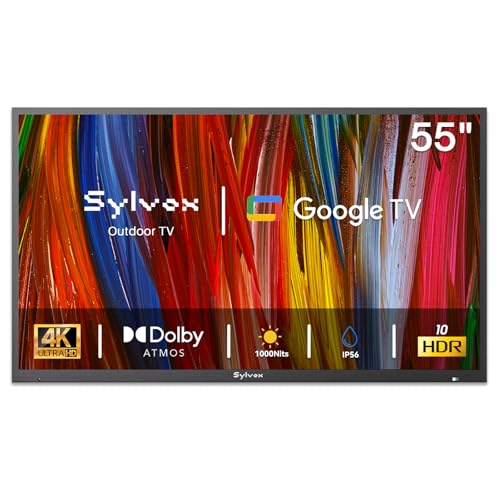
Sylvox 55″ Outdoor TV 4K IP56 (Deck Pro 3.0) — Best All-Round Outdoor
Everything said about its 43-inch sibling applies here at the scale outdoor group viewing actually wants. The 55-inch Deck Pro carries the same listing formula — 4K, IP56 waterproofing, a 1000-nit class for partial sun and full shade, Dolby Atmos support — across a panel large enough to serve a deck full of chairs, a hot-tub’s audience or a lawn’s edge where the fire pit circle gathers. If the outdoor room is the household’s summer living room, this is its television: big enough that nobody squints at a score bug, sealed enough to stay mounted when the season turns.
Size outdoors behaves differently from size indoors. Ambient light shrinks perceived pictures, and viewers sit farther back and more spread out than any sofa arranges them, so a panel that would dominate a lounge merely fills a deck. The 55-inch class is the outdoor sweet spot for exactly that geometry, and pairing it with the Deck Pro’s shade class covers the largest number of real installations in this guide: the covered or partially covered space, the group of six to ten viewers, the screen that hosts sport by day and films by night.
The responsibilities scale with the panel. A 55-inch outdoor set is a substantial object in weather; it wants a mount rated for outdoor use and for its weight, fixings into structure rather than cladding, and a power supply arranged by someone who respects electricity outdoors. None of that is a criticism — it is the ordinary price of a permanent outdoor installation, and this set repays it with the most generally useful combination of size, sealing and shade class in the guide.
- Screen: 55-inch, 4K smart outdoor television
- Protection: IP56 waterproof rating per listing
- Brightness class: 1000 nit, the maker’s deck-class rating
- Audio: Dolby Atmos support
- Line: Deck Pro 3.0 (2026)
- Best space: large covered decks and outdoor living rooms
Strengths
- The outdoor sweet-spot size with formal IP56 weather protection.
- Serves group viewing distances that defeat smaller panels outdoors.
- Same honest shade-class matching as its 43-inch sibling, at scale.
Trade-offs
- Still a partial-sun class set; full-sun placement belongs to the Pool Pro.
- Its size and weight demand structural mounting and a two-person installation.
- Open-air audio at group distances may justify an outdoor soundbar budget.
Sport is this set’s home fixture. A 55-inch 4K picture at deck distances keeps a whole gathering inside the match — score graphics legible from the grill, replays readable from the hammock — and the shade class means the afternoon fixtures, the ones outdoor sport is actually scheduled around, play in the light they were scheduled in. Households whose summers are organised by tournaments will use this television more than any other object on the deck.
Best for: households whose covered outdoor room hosts real gatherings all season. Not suited for: small balconies or fully exposed poolside walls.

Samsung 55″ The Terrace Partial Sun — Best Premium Partial Sun
The Terrace is what happens when a flagship television programme decides to live outside. Samsung builds it as a 55-inch Neo QLED 4K set for partial sun, with Quantum HDR+, Dolby Atmos, a wide viewing angle, an anti-glare screen and a weather-resistant build — the vocabulary of its indoor flagships, translated for a covered terrace. For design-conscious outdoor rooms, the kind with proper furniture and a kitchen that happens to be outside, the Terrace’s appeal is that it looks and behaves like a premium television that chose the patio, not like equipment that tolerates one.
The anti-glare treatment and wide viewing angle are its working virtues. Outdoor seating sprawls — loungers, dining chairs, a hammock at an angle no living room would permit — and a panel that holds its picture across that sprawl serves the whole gathering rather than the two centre seats. Neo QLED colour gives summer content, sport and nature programming a richness that flatters the setting, and Samsung’s platform and Alexa integration slot into households already running the company’s ecosystem indoors, one remote language across the whole property.
Its designation must be respected: the listing says partial sun, and Samsung means it. The Terrace belongs under cover or in a space where direct sun visits briefly, not on a wall that bakes from noon. Within that brief it is the connoisseur’s pick of this guide — the set chosen when the outdoor screen should feel like a continuation of the house’s interior standard. As a 2024 model it also sits a generation behind Samsung’s newest indoor lines, which matters little outside, where the panel’s talents are environmental as much as electronic.
- Screen: 55-inch Neo QLED 4K, The Terrace partial sun
- HDR: Quantum HDR+
- Surface: anti-glare, wide viewing angle
- Build: weather resistant per listing
- Audio: Dolby Atmos
- Model: QN55LST7DAFXZA, 2024
Strengths
- Flagship picture lineage with anti-glare handling for sprawled outdoor seating.
- The most design-integrated option for finished outdoor living spaces.
- Samsung ecosystem continuity for households already invested indoors.
Trade-offs
- Partial sun only; Samsung’s own designation excludes open-sky placement.
- Weather language is the maker’s own rather than a formal IP grade.
- Premium positioning within this guide, as befits its indoor-flagship ancestry.
There is also a hosting argument for the Terrace that transcends specifications. Guests read a space’s intentions instantly, and a terrace whose screen is a considered Samsung rather than a compromise announces that the outdoor room is a real room — dinners will be unhurried, the match will be watched properly, the evening is meant to be spent here. Hosts who entertain seriously outdoors buy that signal knowingly, and the Terrace is the only pick in this guide that sends it at full strength.
Best for: covered terraces and designed outdoor rooms wanting a flagship-grade picture. Not suited for: unshaded walls, or installations that require a formal IP grade stated in writing.

Furrion Aurora Partial-Sun 2 43″ — Best for Active Yards
Furrion builds for the recreational-vehicle and outdoor-leisure world, and the Aurora Partial-Sun 2 carries that accent: a 43-inch 4K LED outdoor smart television, weatherproof, with a 750-nit screen, an XtremeShield impact-resistant front, and RangeXtend external antennas intended to boost Wi-Fi reach. Read those features as a portrait of its intended home — a yard where balls get kicked, where the router is far away inside a house, where the television lives a physical life rather than a decorative one.
The impact-resistant screen is the headline for active households. Outdoor sets face hazards no lounge ever produces: a stray football, a ladder carried past, hail with ambitions. A front designed to take a knock converts those moments from insurance claims into anecdotes, and for families whose garden is a sports facility in all but name, that resilience may outweigh every picture consideration in this guide. The antennas answer the other great outdoor frustration — the set is only as smart as its signal, and a big property’s far corner is exactly where household Wi-Fi goes to die.
Its brightness class sits a step below the Sylvox deck sets on paper, at a stated 750 nits for partial-sun use, so placement discipline matters: give it shade or partial shade, as its name instructs, and it performs its role with character. Households choosing between this and the 43-inch Deck Pro are really choosing a threat model — weather and glare on one side, impact and distance on the other — and the Aurora is the honest answer when the second list sounds like your garden.
- Screen: 43-inch, 4K LED outdoor smart TV
- Brightness: 750-nit LED screen per listing
- Front: XtremeShield impact-resistant screen
- Connectivity: RangeXtend Wi-Fi-boosting external antennas
- Build: weatherproof per listing
- Class: Partial-Sun 2
Strengths
- Impact-resistant front suits sporty, accident-prone yards like nothing else here.
- External antennas directly address the far-corner Wi-Fi problem.
- A leisure-industry maker’s feel for how outdoor screens are actually treated.
Trade-offs
- Its stated brightness class is the most modest here; shade discipline is essential.
- Partial-sun designation, like the Terrace, excludes open-sky mounting.
- The rugged brief matters less in a quiet, covered, adult porch where the Deck Pro shines.
Caravan and cabin owners form the Aurora’s quiet constituency, and their logic transfers to any second property: a set that tolerates knocks, reaches reluctant Wi-Fi and asks little of its owners between visits. Furrion’s leisure-vehicle heritage shows in that tolerance for irregular, enthusiastic use — the television as campsite equipment rather than furniture — and households whose outdoor life has that character will feel understood by this design in a way the sleeker picks cannot match.
Best for: family yards with games, distance from the router and a lively relationship with stray balls. Not suited for: bright, exposed placements or still, formal terraces.

Sylvox 43″ Outdoor QLED TV (Deck Pro QLED 3.0) — Best Small-Space Colour
This Deck Pro variant answers a specific, common brief: the covered outdoor space is small — a gazebo, a compact patio, a garden room — but the household refuses to treat its picture as an afterthought. The listing describes a 43-inch weatherproof smart 4K QLED television, IP56 waterproof, classed at 1000 nits, with Dolby Vision and Dolby Atmos support and a Google operating system. QLED colour in an outdoor set is a statement of intent: animation, sport and summer films get the saturated, confident palette they deserve, in a space that happens to have a roof made of sky-adjacent materials.
Dolby Vision support distinguishes it within the Sylvox family here, giving streamed film content its most capable HDR handling in the smaller size class — relevant because small covered spaces are where outdoor film nights actually succeed, the audience close, the sound contained, the darkness achievable after sunset. A gazebo with this set, a few chairs and a summer evening is a cinema that happens to smell of grass, and the QLED panel’s colour is a real part of that illusion rather than a specification ornament.
Choose it over the standard 43-inch Deck Pro when colour and film are the space’s main events; choose the standard set when the space is a general-purpose deck where news, sport and background viewing dominate and the QLED premium buys less visible difference. Either way the IP56 sealing and shade class are shared, so the decision is about picture appetite, not weather — a pleasant kind of decision, and the sign of a range sensibly built.
- Screen: 43-inch, smart 4K QLED television
- Protection: IP56 waterproof rating per listing
- Brightness class: 1000 nits per listing
- HDR: Dolby Vision support
- Audio: Dolby Atmos support
- Platform: Google OS per listing; Deck Pro QLED 3.0 (2026)
Strengths
- QLED colour and Dolby Vision bring film-grade picture to a small covered space.
- Formal IP56 sealing shared with the wider Deck Pro family.
- The gazebo-and-patio size, specified beyond its class.
Trade-offs
- Same partial-sun class ceiling as its siblings; not a full-sun answer.
- Its colour talents are wasted on purely background, daytime-only viewing.
- Small spaces may still prefer the standard Deck Pro’s simpler brief.
One more household fits this set precisely: the one building its outdoor room gradually, piece by piece, and wanting the screen to be the piece that never needs upgrading as the space matures. QLED colour and Dolby Vision at 43 inches will still look like foresight when the gazebo gains furniture, lighting and a heater; buying the picture once, properly, is cheaper than buying it twice, and this variant is the Deck Pro family’s way of letting a small space do exactly that.
Best for: gazebos, garden rooms and compact patios where film nights are the main event. Not suited for: open poolside mounting or very large gathering spaces.
Sylvox 55″ Full Sun Outdoor TV (Pool Pro 3.0) — Best for Full Sun
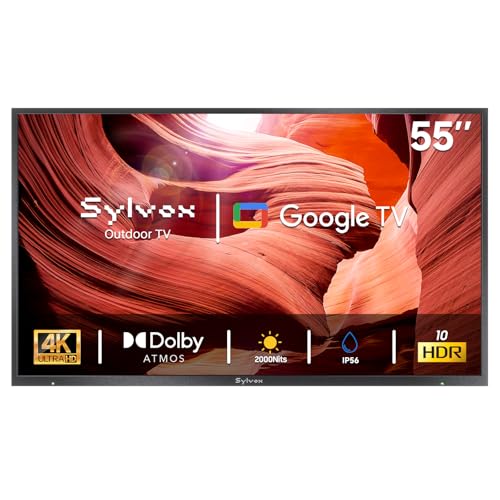
Every guide has one pick that exists for the hardest version of the problem, and the Pool Pro is this one’s. Its listing states the brief without flinching: a 55-inch outdoor television classed at 2000 nits for full sun, 4K UHD, IP56 waterproof, sunlight readable, with Dolby Atmos support, aimed at yards, poolsides and business use. Full sun is the condition that humiliates ordinary outdoor sets — direct light on the screen through the bright hours — and a panel designed and classed for it is a different instrument from a shade set gamely enduring exposure.
Poolside is the canonical installation: no roof, no apology, viewers in loungers at distance, the screen competing with water reflections and a white-hot sky. The Pool Pro’s brightness class is what makes a midday match or a swim-up news check a real picture rather than a rumour, and its 55-inch size matches the viewing distances pools impose. The listing’s mention of business use is telling, too — cafés, beer gardens and rental properties buy this class because a screen that guests can actually read at noon is a commercial asset, and the same logic serves a household whose garden hosts like a venue.
Respect the installation this class demands. Full-sun placement means full thermal load, so follow the maker’s clearances, mount into structure, and arrange power with outdoor discipline. It also means accepting that even a full-sun panel fights physics at the day’s worst angle; a thoughtful installer angles the screen or chooses the wall with the sun’s path in mind, letting the panel’s class handle the rest. Given that respect, the Pool Pro is the only pick here we would sign for beside an unshaded pool — because it is the only one its maker signed for it first.
- Screen: 55-inch, 4K UHD outdoor TV
- Brightness class: 2000 nits, full sun per maker
- Protection: IP56 waterproof rating per listing
- Readability: sunlight readable per listing
- Audio: Dolby Atmos support
- Line: Pool Pro 3.0 (2026); yard, poolside and business positioning
Strengths
- The only full-sun class panel here, built for open-sky placement.
- IP56 sealing pairs the brightness with formal weather protection.
- Sized and classed for poolside distances and commercial-style use.
Trade-offs
- Over-specified and over-priced for a covered porch, where the Deck Pro suffices.
- Full-sun installation carries the heaviest thermal and mounting demands here.
- Even its class benefits from an installer who plans around the sun’s path.
Private buyers sometimes hesitate at the Pool Pro’s commercial accent, and they should not. The qualities a beer garden needs — legibility at noon, sealing that survives seasons, a size that reads across a crowd — are the same qualities a family pool demands on the one afternoon a week when everyone is in the water and the match matters. Buying the class of equipment venues trust is not excess; it is the shortest route to a poolside picture that simply works, every bright day, without negotiation.
Best for: unshaded poolsides, open yards and outdoor business spaces facing direct sun. Not suited for: covered decks, where its firepower buys nothing the shade class doesn’t.
How Do the Six Outdoor Sets Split by Sun and Space?
| Television | Shade class per listing | Weather language | Natural habitat |
|---|---|---|---|
| Sylvox Deck Pro 43″ | Deck class: shaded to partly sunny | IP56 waterproof | Covered decks, screened porches |
| Sylvox Deck Pro 55″ | Deck class: shaded to partly sunny | IP56 waterproof | Large outdoor living rooms |
| Samsung The Terrace 55″ | Partial sun | Weather resistant | Designed terraces under cover |
| Furrion Aurora 43″ | Partial sun | Weatherproof, impact-resistant front | Active family yards |
| Sylvox Deck Pro QLED 43″ | Partial sun class, 1000 nits | IP56 waterproof | Gazebos and garden rooms |
| Sylvox Pool Pro 55″ | Full sun | IP56 waterproof | Poolsides and open yards |
Two rows deserve a second look from undecided readers. The two 43-inch Sylvox sets differ mainly in appetite: the standard Deck Pro is the deck’s all-purpose screen, while the QLED variant is the same skeleton wearing a film lover’s panel, and households often agonise between them longer than the difference warrants — if films after dark are even a third of the space’s life, the QLED earns its place. And the Terrace’s row, with its maker’s own weather language instead of a formal grade, is not a weaker row; it is a different manufacturer’s dialect, to be weighed alongside its flagship picture rather than against a number it never claimed.
Read the table from your photograph of the space, not from the prices. The shade column is the decision; the rest is refinement. Note also the guide-text name that does not appear as a pick: SunBrite’s Veranda series is a long-standing shade-class line in this category, and households researching beyond these six will meet it — our checks simply found no listing to link, so it earns a mention here rather than a review, and any comparison you run should hold it to the same shade-class discipline.
What About Sound, Sport and Film After Dark Outdoors?
An outdoor television leads three distinct lives, and a good installation serves all of them. The daytime life is sport and news against ambient light, where the shade class earns its money and where a set’s job is legibility: scores, tickers, faces in helmets. The golden-hour life is the social one — music videos, a film starting as the light fails, the screen becoming the garden’s fire — where colour and size matter most and where the QLED and Neo QLED picks in this guide show their breeding. The night life is the revelation: outdoors after dark, with no ceiling to bounce light and no walls to reflect it, even a modest outdoor panel looks cinematic, its blacks deepened by the genuine darkness around it. Households routinely report that the set they bought for July afternoons is loved most at October film nights.
Sound shapes each life differently. Daytime wants clarity at distance, against birdsong, traffic and water. Evening wants restraint — the same volume that felt modest at noon carries across three gardens at ten o’clock, and outdoor courtesy is a real design constraint, not a nicety. The sets with Atmos support here give dialogue a forward, focused character that lets you run lower levels for the same intelligibility, which is the neighbourly setting as well as the cinematic one. Plan seating inside the sound’s natural throw, keep the screen’s audio aimed at your chairs rather than the street, and the garden’s acoustics will feel designed rather than endured.
One more seasonal truth: outdoor viewing peaks twice, in high summer and again in the crisp weeks when blankets and heaters extend the season. A set installed in June gets judged in October by different light, and the households happiest with their purchase are the ones who chose a shade class with margin — the class above their June conditions — because autumn’s low sun finds angles summer never showed them. Margin, in outdoor electronics, is the closest thing to wisdom this guide can sell you.
How Should You Install a Television That Lives Outside?
Mounting is a structural decision before it is a viewing one. Use a mount rated for outdoor use and for the set’s weight, fixed into studs, masonry or posts — never into cladding or fence panels alone — and remember that wind loads a large panel like a sail. Angle the screen slightly downward toward the seating, which serves both viewing geometry and the shedding of the worst reflections, and position it, where the architecture allows, so the sun’s daily path crosses it at the hours you are least likely to watch.
Height is the installer’s other judgement call, and outdoor seating argues lower than indoor instinct suggests. Deck chairs, loungers and benches all sit their occupants deeper than a sofa does, and a screen centred for standing eye level will crane every neck in the garden. Sit in the actual chairs with a tape measure and a patient friend holding a cardboard template; ten minutes of that theatre prevents a season of quietly wrong geometry.
Power deserves professional respect. Outdoor electricity wants proper exterior outlets, weatherproof covers that stay closed while plugs are in use, and cable runs that neither trip guests nor invite mower blades. If the installation needs new wiring, that is an electrician’s afternoon, and it is money better spent than any accessory. Connectivity planning belongs in the same visit: test the Wi-Fi signal at the mounting spot with a phone before the set goes up, and if it falters, solve it with an access point or a set like the Furrion whose antennas are built for distance — not with hope.
Shade itself can be part of the installation. A pergola slat, an awning, a well-placed sail — modest architecture that takes the direct sun off the screen for the worst hour can move a space down a full shade class, letting a Deck Pro do a Pool Pro’s job or letting any set live an easier thermal life. If you are planning the outdoor room from scratch, design the shade and the screen together; the cheapest brightness is the sunlight that never arrives.
Finally, plan the set’s year, not just its summer. Decide whether it stays mounted through winter under the maker’s guidance or comes indoors; keep vents and seals clean with nothing harsher than the maker allows; and check fixings each spring, because outdoor hardware loosens in weather the way indoor hardware never learns to. An outdoor television is a small building project with a picture, and households that treat it that way get a decade from it.
What Goes Wrong When People Buy Outdoor TVs?
A subtler mistake is forgetting the neighbours and the household’s own sleepers when planning placement. A screen angled across a fence line performs for the wrong audience, and a set mounted outside a bedroom window exports its light and sound into the one room that wanted neither. Walk the property’s edges and the house’s windows before the mount is drilled; outdoor televisions are neighbourly technology only when somebody plans them that way.
The expensive classic is misreading the shade. A porch that feels shady at breakfast takes two hours of direct sun at four o’clock, across exactly the screen, and the partial-shade set bought for it spends its life losing that daily battle. Walk the space at several hours before ordering, phone camera in hand, and be brutally honest about where the light lands. The second error is its mirror image: buying the full-sun flagship for a roofed deck, spending the difference on brightness the roof makes useless, when the same money would have bought the mount, the soundbar and the electrician.
Third, households gamble on an indoor television outdoors. It works — for a while, under a deep roof, in a kind climate — and the gamble’s terms only become visible when humidity, insects or a cold snap collect the debt, usually just outside warranty. Every set in this guide exists because that gamble is unnecessary at sensible money. Fourth, buyers forget sound: open air swallows television audio, and a set whose speakers were an afterthought will be shouted over by its own garden. The Atmos-supported picks here help, and a weather-rated soundbar helps more. Fifth, they mount at indoor heights for outdoor seating; loungers and deck chairs sit lower than sofas, and the screen should meet those eyes, not the eyes of a person standing at a kitchen counter.
Final Recommendation
One last discipline before ordering: stand in the space at the hour of your favourite programme, hold up a phone at the screen’s planned position, and look at its dark display. What you see in that glass — sky, hedge, your own face — is the enemy every set in this guide is engineered against, in descending order of strength. Match the strength to the reflection, and you have made the decision the way installers make it.
Let the sun in your photograph decide. If the space wears a roof, the Sylvox Deck Pro in the size your seating distance wants — 43 inches for porches, 55 for true outdoor living rooms — is the balanced heart of this guide, with the QLED variant for film-loving gazebos and Samsung’s Terrace for terraces finished to an indoor standard. If the yard is active and the router is far, Furrion’s Aurora was drawn for your map. And if the screen must face open sky beside a pool, buy the Pool Pro’s full-sun class and install it like you mean it. The right outdoor television disappears into the life of the space; choose by shade, mount it like a structure, and summer evenings will take care of themselves.
Frequently Asked Questions
Can I just use a regular television outside under a covered porch?
People do, and porches vary, but understand the gamble: an indoor set carries no weather sealing, its vents invite humidity and insects, its brightness was designed for lamplight rather than daylight, and outdoor use generally sits outside its warranty’s intentions. A purpose-built set like the Deck Pro models costs more than the cheapest indoor screen and less than replacing the gamble twice. For a permanent installation, we recommend the tool built for the job.
What does IP56 actually protect against?
The IP code grades enclosures against dust and water ingress; at the 56 level stated in the Sylvox listings, the water digit describes protection against powerful jets — rain, splashes and hosing at a distance are inside the brief. The dust digit matters more than gardeners expect: a summer of pollen, barbecue smoke and wind-blown grit works at every seam of an outdoor enclosure, and a set graded against fine-particle ingress keeps that slow abrasion outside the electronics, where a merely rain-sheltered design lets it accumulate quietly across seasons. It does not mean submersible, and it does not license pressure-washing. Treat an IP56 outdoor television as weatherproof electronics: built to live in the rain, still deserving ordinary care.
How bright does an outdoor TV need to be?
It depends entirely on the shade class of the space, which is why this guide organises by class rather than by a single number. Covered and partially shaded spaces are served by the classes the Deck Pro, Terrace and Aurora listings describe; open full-sun placement needs the strongest class, represented here by the Pool Pro’s stated 2000-nit design. Judge your space’s worst viewing hour, not its best, and buy the class that covers it.
Will an outdoor television survive winter?
These sets are designed to live outside permanently, and their makers build them for wide temperature ranges — but follow the specific model’s guidance in its listing and documentation, especially in climates with severe freezes. Coastal owners should add one habit to the calendar: salt air is patient, and a gentle wipe-down of the enclosure and a check of exposed fixings each season keeps the marine atmosphere from quietly corroding what the seals cannot cover. Inland owners face the gentler enemies of dust and pollen, answered by the same seasonal attention at longer intervals. Sensible households also re-check mounts and seals seasonally. A cover can add protection in the off-season for sets that stay mounted; what matters most is that the installation was done properly in the first place.
Do outdoor televisions work with streaming sticks and consoles?
Yes — the smart platforms built into these sets cover the major services directly, and their HDMI inputs accept a streaming stick or console the way any television’s do, with the practical caveat that accessories carried outdoors share the weather. Most households find the built-in platform sufficient and keep delicate extras indoors, sending content to the set over the network instead. If a stick must live outside, house it in the set’s own sheltered port area and treat it as a consumable rather than an heirloom.
How do I get good sound outdoors?
Open air disperses sound, so start with the set’s own system — several picks here support Dolby Atmos — and sit closer than you would indoors if dialogue matters. Distance is the silent variable in every outdoor audio complaint: a conversation that feels effortless at three metres becomes a negotiation at eight, whatever the speakers, which is why the seating plan and the screen plan should be drawn on the same afternoon, by the same person, with the same tape measure. For gatherings and larger spaces, add a weather-rated soundbar mounted with the television; it is the single most effective upgrade to an outdoor setup. Keep neighbours in the planning: directional sound aimed at your seating, at sensible hours, keeps the peace that outdoor living depends on.
Why isn’t there a SunBrite pick in this guide?
SunBrite’s Veranda line is a recognised name in shade-class outdoor televisions, and we looked for it as we built this guide. Our listing checks did not return a set we could link you to with confidence, and this guide only reviews televisions we can send you to directly. It is mentioned in the comparison discussion above so your own research can include it, held to the same shade-class discipline as the six picks.
Related Guides
If the viewing moves indoors to a sunlit lounge, our guide to the best tvs for brightness covers the Mini-LED sets built for that room. For the opposite end of the light spectrum, our roundup of the best tvs for dark movies explores OLED panels made for blacked-out film nights. And for a compact screen for a spare room or study, our picks of the best 43 inch 4k tvs with hdr stay indoors at the size two of these outdoor sets share.


