Our Top Picks
 TV Ears Improved Digital Wireless Headset SystemOne Size10 x 3.75 x 6.25 inches0.1 poundsCheck on Amazon


What's inside
As an Amazon Associate I earn from qualifying purchases. This post may contain affiliate links at no extra cost to you.
Turning the television up rarely solves the real problem. When dialogue sounds muffled, when consonants disappear into background music, or when one ear hears noticeably less than the other, a louder room is not the same as a clearer picture of the words. The rest of the household ends up listening at a volume they did not choose, the viewer still misses lines, and everyone gives up a little on the program they sat down to enjoy together. Wireless TV listening headsets built for people who are hard of hearing approach the problem from the opposite direction: they bring the sound directly to the viewer’s ears, at a personal volume, with controls that shape speech so it is easier to follow.
That difference is the organizing idea of this guide. Generic TV headphones mainly promise private listening and freedom from a cable. Hearing-assist TV headsets add a second job: making dialogue easier to understand. Depending on the model, that help can include voice or dialogue clarification, tone controls that emphasize the frequencies where speech lives, left and right balance adjustment for asymmetric hearing, independent volume that does not change what anyone else hears, and in one case in this guide a personalized left and right hearing profile. Those features matter more for this audience than raw bass, gaming modes, or how a headset looks on a shelf.
One point needs to be plain from the start. These products are listening aids for television viewing. They are not hearing aids, and they are not medical devices. They do not diagnose hearing loss, they are not fitted to an audiogram by a clinician, and they are not a substitute for professional care. If hearing has changed, if one ear has suddenly become worse, if there is pain, dizziness, or ringing that worries you, or if you are unsure whether a TV headset is appropriate alongside existing care, talk to an audiologist or another qualified professional. This guide can help you compare TV listening products and ask better questions before buying; it cannot answer medical questions.
The eight products below fall into a few recognizable groups. Two are TV Ears systems, a long-running style of under-chin wireless headset built specifically around voice clarification. Two are SIMOLIO models for seniors, one focused on balance and tone control with a long stated range, the other combining radio frequency and Bluetooth in a single headset. One is the Avantree Crescendo Me, the most explicitly personalized option here, with separate left and right hearing adjustment and an HDMI ARC soundbar passthrough. The remaining three are dock-based over-ear wireless headphones for TV aimed at seniors and gift buyers, with long stated playtime, multiple wired connection options, and plug-and-play positioning. Presenting them side by side is useful precisely because the brands overlap: choosing well means choosing a model and a feature set, not just a name.
What makes a TV headset a hearing-assist headset
A standard wireless headphone answers one question: can I hear the TV without a wire? A hearing-assist headset has to answer several harder questions at once. Can I understand the words, not just detect that someone is speaking? Can I raise my own volume without raising the volume in the room? Can I favor the ear that hears better, or boost the side that needs more help? Can I change the tone so voices sound less boomy and less buried under music and effects? And can I do all of that from the chair, without asking someone else to get up and adjust the television every few minutes?
Dialogue clarity is not the same as volume
Speech intelligibility depends heavily on clarity in the mid and upper parts of the voice range, where consonants such as s, f, t, and th carry much of the meaning. Many television mixes work against the listener: film scores swell under conversation, action effects are mixed loud for impact, and flat-panel TV speakers fire sound away from the viewer or compress it into a thin, small enclosure. Simply amplifying everything brings the music and effects up along with the words. Voice clarifying technology, clear-dialogue modes, and tone controls try to change the balance inside the sound itself, giving speech more presence relative to everything competing with it. The exact implementation differs by brand and is described in different words, which is why this guide sticks closely to what each product states and treats the underlying goal, rather than any proprietary label, as the point of comparison.
Independent volume protects shared viewing
For many households, the most valuable feature is also the simplest: the headset listener controls their own volume while the TV speakers stay where everyone else wants them, or even stay muted. That arrangement turns a nightly negotiation into a non-issue. A partner can listen at a modest level, grandchildren are not blasted during a visit, and the viewer using the headset no longer has to choose between missing dialogue and apologizing for the noise. When you compare models, check how the connection is made, because the ability to use headset and speakers together can depend on which TV output is used and how the television handles that output. We return to that setup question later, because it is one of the most common reasons a first purchase disappoints.
Balance and tone controls address uneven hearing
Hearing is rarely perfectly symmetrical. Many people hear better in one ear, or find that higher sounds fade sooner on one side. A single volume knob cannot fix that imbalance; it just makes the stronger ear louder too. A left and right balance control lets the listener shift more sound toward the ear that needs it. Tone control works on a different axis, shaping the overall character of the sound toward brighter or fuller presentation. Used together, balance and tone give the viewer a small, personal equalization toolkit that the television’s own settings usually do not offer per listener. The Avantree model in this guide goes further with personalized left and right hearing, which is the closest any product here comes to treating each ear as its own listening situation.
If you are still deciding whether you need this specialized category at all, our broader guide to best headsets for listening to tv covers the wider TV listening landscape, while this article stays focused on the hearing-assist features that general roundups often mention only in passing.
How to choose: the features that actually matter
Start with the listening problem, not the product list
Before comparing transmitters and batteries, name the main frustration as precisely as you can. Is dialogue clear in quiet scenes but lost whenever music starts? That points toward voice clarification and tone modes. Is one ear consistently weaker? That points toward balance control or personalized left and right adjustment. Is the conflict mainly about room volume? Almost every system here solves that with independent listening, so connection type and comfort may matter more. Does the viewer move between the TV and a phone or tablet? That points toward the dual-connection SIMOLIO model. Does the household already use a soundbar? Then passthrough or bypass support becomes a deciding feature rather than a footnote. A clear problem statement cuts the list down faster than any specification table.
Connection type: optical, RCA, AUX, HDMI ARC, Bluetooth, and RF
Every headset here has two halves: a way of getting sound out of the television, and a way of getting it to your ears. The wired side matters because televisions differ. Optical digital output is common on modern sets and is named by several dock-based models here. RCA and analog AUX connections suit older televisions and remain useful fallbacks when a digital port is already occupied. HDMI ARC, offered on the Avantree Crescendo Me, is the modern TV-to-soundbar pathway, and its passthrough design is meant to let a soundbar stay in the chain rather than forcing a choice between the bar and the headset. Bluetooth connects directly to TVs and mobile devices that support it, but range, pairing behavior, and delay vary by television. Dedicated radio frequency systems, such as the SIMOLIO designs and the classic TV Ears approach, use their own transmitter, which keeps the wireless link under the system’s own control and typically supports the longer stated ranges in this guide.
Transmitter bases and charging docks
Most of these systems live on a base. On TV Ears systems, the transmitter sends the TV signal to the lightweight headset and the headset returns to the base to charge. On the dock-based over-ear models, the charging dock typically combines the transmitter and the charging cradle in one unit that sits near the television. That arrangement has a quiet practical advantage: the headset has a home. It is charged where it is used, it is easy to find, and picking it up and putting it on becomes a habit rather than a small project involving a loose cable. When you compare docks, think about placement. The base needs power, a cable run to the TV’s audio output, and a position where its signal is not buried behind metal cabinetry. A tidy installation on day one pays off every evening after.
Latency and lip-sync
Latency is the small delay between sound leaving the television and arriving at your ears. When it grows noticeable, lips and words drift apart, which is especially tiring for viewers who already rely partly on watching the speaker’s mouth. Several models here state low latency as a headline feature, and dedicated transmitter systems are generally designed with TV viewing, rather than general-purpose audio, as their primary job. Bluetooth connections to a television can be more variable, because the delay depends on both ends of the link. If lip-sync bothers the viewer in ordinary viewing, favor systems that state low latency plainly, keep the transmitter’s own link as the primary route for TV, and check whether the television itself offers an audio delay or lip-sync adjustment in its settings.
Comfort and form factor: under-chin versus over-ear
The TV Ears style places a lightweight receiver under the chin with small earpieces, a design that has been associated with TV listening for years. Many viewers like that there is little weight on top of the head and nothing enclosing the ears, which can feel cooler over a long film and less isolating in a shared room. Over-ear headphones, used by the SIMOLIO, Avantree, and dock-based models here, surround the ear with cushioned cups. That can feel more secure, can soften room distractions, and suits viewers who simply prefer a conventional headphone feel. Neither shape is automatically better. Head size, hairstyle, glasses, earrings, sensitivity to pressure, and how long a typical viewing session lasts all shape the answer. If the headset will be worn for an entire evening of programs, comfort is not a secondary feature; it is the feature that decides whether the device gets used at all.
Battery life and the reality of charging habits
Stated playtime in this group ranges from the SIMOLIO SM-823D Pro’s stated 14 hours to dock-based models stating 45, 60, or 65 hours. Longer stated playtime means fewer midweek charging worries, but the charging system matters as much as the number. A headset that drops onto a dock by the TV effectively charges itself as part of the routine. A headset that must be remembered and plugged in will eventually be found empty at the start of a program. Think in terms of viewing days rather than hours: how many evenings between charges, and what happens on the evening someone forgets? For a gift purchase especially, the most forgiving combination is long stated playtime plus a dock that makes charging automatic.
Range and moving around the home
Two SIMOLIO models state a range of 164 feet, and one dock-based model states 100 feet. Treat any stated range as a best-case figure measured in favorable conditions; walls, floors, and metal structures shorten real-world reach. Still, generous range has a genuine use in this category. Viewers like to keep listening while making tea, letting the dog out, or moving to the kitchen during a break without losing the thread of a program. If the home is large, if the TV room is separated from the kitchen by several walls, or if the viewer is rarely seated in one place, range deserves real weight in the decision. If viewing happens in one chair in one room, almost any system here will cover the distance, and clarity features should take priority.
The products, model by model
The order below groups the two TV Ears models and the two SIMOLIO models together, because comparing siblings first is the honest way to shop these brands. A newer or differently numbered model is not automatically the right one; the right one is the one whose stated strengths match the viewer’s actual problem.
1. TV Ears Original System, Model 11681
The Original TV Ears System, Model 11681, is the clearest expression of the TV Ears idea: a wireless TV listening headset system built around Voice Clarifying Technology, stated to work with all TVs. That single stated purpose tells you who it is for. This is not a general entertainment headphone that happens to connect to a television; it is a dedicated listening system for viewers whose central complaint is that voices are hard to pick out.
The under-chin form factor is the other half of its identity. For viewers who dislike the weight and enclosure of full headphones, who wear their headset for long stretches, or who simply want something that feels closer to a listening aid in spirit than to a pair of music headphones, this style has enduring appeal. It also tends to suit shared rooms: the viewer is connected to the program without being sealed off from a knock at the door or a question from the next chair, though anyone who wants stronger isolation from room noise should look at the over-ear models below.
Choose this model when voice clarity is the first priority, the television setup is conventional, and the simplicity of a single-purpose system is a virtue. Households buying for a parent who wants one job done without menus or modes often find that focus reassuring. What it does not emphasize, in its stated description, is the balance, tone-mode, and personalization toolkit that the SIMOLIO and Avantree models put at the center of their designs, so viewers with strongly uneven hearing should read those sections carefully before deciding.
2. TV Ears Improved Digital System, Model 11741
The TV Ears Improved Digital Wireless Headset System, Model 11741, keeps the same family promise and adds a different emphasis: powerful transmitters for improved range and signal strength, again stated to work with all TVs. Treat the two TV Ears entries as distinct models of one brand, not as two brands. The 11681 leads with voice clarification; the 11741 leads with the strength and reach of its wireless link.
That distinction matters in real homes. A signal that drops, crackles, or fades when the viewer shifts in a chair or steps into the next room undermines the whole point of the device, and frustration with dropouts is a common reason listening systems end up in a drawer. If the TV sits in a large room, if the seating is far from the set, if the transmitter will have to live in a cabinet or behind other equipment, or if a previous wireless headset struggled to hold its connection, the model that foregrounds transmitter strength is the natural TV Ears candidate.
As with its sibling, the appeal is dedication and familiarity: a headset style designed for TV listening rather than adapted from something else, and voice-focused positioning for viewers who are hard of hearing. Compare the two TV Ears models on the conditions of your room first. A compact apartment with seating close to the screen makes the clarification-led original a tidy fit; a bigger, more obstructed space makes the digital system’s stated range and signal emphasis more relevant.
3. SIMOLIO SM-823D Pro
The SIMOLIO SM-823D Pro is where this guide’s adjustment features come into full view. Its stated description combines loud and clear voice with left and right balance control and tone control, compatibility with a soundbar, a stated 14 hours of rechargeable battery life, an ambient mode, and a stated range of 164 feet. That is a deliberate bundle for seniors, and almost every element answers a hearing-assist need rather than an entertainment extra.
Balance and tone together are the headline. A viewer who hears less on one side can shift sound toward that side instead of simply turning everything up, and tone adjustment lets them shape voices toward a presentation they find easier to follow. Ambient mode deserves attention too: it speaks to the wish to remain aware of the room, a conversation, or a doorbell while still listening, which many viewers prefer to the sealed-off feeling of full isolation. The stated range supports moving around the home while staying with the program, and soundbar compatibility acknowledges that many living rooms no longer rely on TV speakers alone.
4. SIMOLIO 2-in-1 RF and Bluetooth Headset
The second SIMOLIO model is a different design, not a restatement of the first. It combines radio frequency and Bluetooth in a 2-in-1 headset, offers three tone modes with clear dialogue, a bypass to a soundbar, balance and independent volume control, a stated range of 164 feet or 50 meters, and the ability to work with a phone and tablet as well as the television. Where the SM-823D Pro is a TV-first senior headset with ambient awareness, this model is the flexible connector of the pair.
The three tone modes are worth understanding. Rather than a single tone adjustment, preset modes let the viewer switch between shaped sound profiles and settle on the one that makes dialogue easiest to follow in different kinds of programs: a quiet drama, a panel discussion, and a film with a heavy score do not present speech in the same way. Balance and independent volume control keep the hearing-assist core intact, and the soundbar bypass addresses the same living-room reality as its sibling’s soundbar support, letting the household’s existing speaker setup remain part of the chain.
The Bluetooth side extends the headset beyond the TV. A viewer who watches some content on a tablet, takes calls or listens on a phone, or simply wants one headset for the evening’s screens rather than two, gets real value from that dual design, while the RF link keeps a dedicated route for television with the stated long range. If the household’s listening is exclusively at the TV, the SM-823D Pro’s ambient mode and simpler brief may suit better. If listening is spread across devices, this is the SIMOLIO to shortlist.
5. Avantree Crescendo Me
The Avantree Crescendo Me describes itself as personalized wireless TV headphones for seniors, and personalization is exactly what separates it here. Its stated features include personalized left and right hearing with clear TV dialogue, an HDMI ARC soundbar passthrough, a stated 60-hour battery life, and replaceable parts. For a viewer whose two ears need genuinely different treatment, this is the most individualized approach in the guide.
Personalized left and right hearing goes beyond a balance slider. A balance control shifts the overall mix from side to side; a personalized profile is meant to shape what each ear receives according to that ear’s needs. For asymmetric hearing, that distinction can be the whole purchase. It is also the feature that most deserves patience during setup: personalization only helps if the viewer takes the time to work through it carefully, ideally in a quiet room with familiar dialogue, and revisits it after a few evenings rather than treating the first attempt as final.
The HDMI ARC soundbar passthrough solves a modern problem neatly. Many homes route TV sound through a soundbar, and a headset system that forces the bar out of the setup creates friction for everyone else. A passthrough design is intended to let the soundbar stay connected while the headset listener gets their own feed. Add the long stated battery life and replaceable parts, which speak to keeping a product in service rather than replacing it when a wear item ages, and the Crescendo Me emerges as the considered choice for a soundbar household with uneven hearing. Viewers in other listening contexts sometimes need entirely different gear, from the specialized world covered by best aviation headsets with noise canceling to simple single-ear options, but for personalized TV dialogue this model sets the guide’s high-water mark.
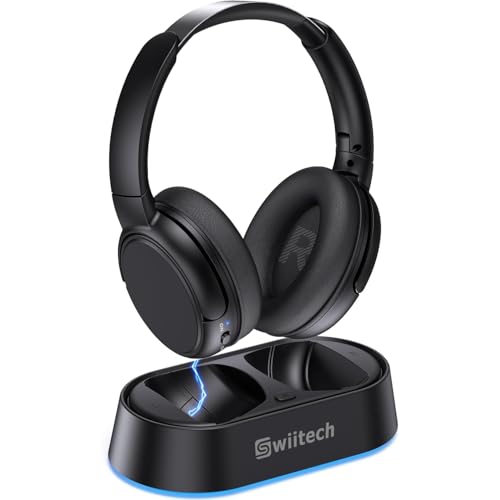
6. Wireless Headphones for TV for Seniors with Charging Dock, 65-Hour Playtime
This dock-based over-ear model leads with endurance and ease: a stated 65-hour playtime, a charging dock, optical, RCA, AUX, and Bluetooth connection options, low latency, plug-and-play positioning, and an explicit pitch as an ideal gift for seniors. Not every product name in this category is a traditional brand name, so judge this one on its stated bundle, which is coherent: many ways to connect, a long time between charges, and a dock that keeps the headset ready by the television.
The connection list is its practical strength. Optical suits many current televisions, RCA and AUX reach older sets and secondary TVs, and Bluetooth adds a direct route where the TV or another device supports it. For a gift buyer who cannot inspect the recipient’s television in advance, that breadth reduces the risk that the headset arrives with no usable output to plug into, though checking the TV’s ports beforehand is still the safer course whenever it is possible.
What this model does not state is the adjustment toolkit: no balance control, tone modes, or personalized hearing appear in its description. Its hearing help comes from the fundamentals: private listening at a personal volume, over-ear delivery close to the ears, and low latency for comfortable lip-sync. For a viewer whose hearing difficulty is mainly about volume and distance from small TV speakers, those fundamentals may be enough, and the simplicity of plug, play, and dock may suit better than a feature-rich model whose controls would go unused.
7. Wireless Headphones for TV with Charging Dock, Bluetooth 6.0
The second dock-based model is close in spirit to the first, and the honest way to present it is as a distinct model with its own stated details rather than as the same product twice. It also states a 65-hour playtime and a charging dock, adds Bluetooth 6.0, low latency, optical, AUX, and RCA connections, plug-and-play setup, and, notably, the words assistive hearing in its own description, along with positioning as a gift for parents and seniors.
That assistive hearing mention matters because it signals the intended audience in the manufacturer’s own framing: this is not positioned purely as an entertainment headphone but as a listening help for older viewers. As with its dock-based sibling, however, its stated description does not name balance, tone, or personalized controls, so its assistance rests on direct, personal, low-latency listening rather than on shaping sound per ear. Readers comparing the two 65-hour dock models should focus on the connection and wireless details each states, on which seller and support route they trust, and on the small practicalities of dock design and fit, rather than expecting a large difference in philosophy.
8. Wireless TV Headphones for Seniors with Charging Dock, 45-Hour Playtime
The third dock-based model states a 45-hour playtime, low latency audio, a stated 100-foot range, clear TV dialogue, Bluetooth 5.3, plug-and-play setup, and an over-ear design in black. It sits in the same family of ideas as the two models above: a charging dock by the television, private over-ear listening, and an emphasis on getting started without fuss.
Its distinguishing stated points are the named range and the explicit clear-dialogue claim. A stated 100 feet is more than enough for the typical path from TV chair to kitchen in most homes, and it gives this model a concrete mobility figure that the other dock-based entries do not state in the same way. Clear TV dialogue, in its description, aligns it with the central need of this guide, though again without the named balance or tone controls of the SIMOLIO models or the personalization of the Avantree.
Single-ear and overnight listening are different needs entirely, addressed separately in best mono bluetooth headsets and best headsets for sleeping, and neither should be confused with the shared-room TV problem this guide is solving.
Matching the model to the viewer
If one ear hears much less than the other
Put balance and personalization at the top of the list. The two SIMOLIO models offer balance control, with tone adjustment alongside it, and the Avantree Crescendo Me offers personalized left and right hearing. A headset without any side-to-side adjustment can still help through closeness and personal volume, but it cannot correct an imbalance, and viewers with strongly uneven hearing are the most likely to find a plain headset only half useful.
If dialogue disappears under music and effects
Prioritize the models that name voice or dialogue work in their own descriptions: the TV Ears systems with Voice Clarifying Technology, the SIMOLIO models with clear voice and tone modes, the Avantree with clear TV dialogue, and the dock-based model that states clear TV dialogue. Then use the television’s own dialogue or night settings, if it has them, as a complement rather than a competitor. Small changes at both ends of the chain add up, and subtitles remain a legitimate companion to any headset; many viewers find that captions plus clearer audio together restore programs that either tool alone could not.
If the household has a soundbar
Look for the words passthrough, bypass, or soundbar compatibility, which appear in the Avantree and both SIMOLIO descriptions. The goal is a chain where the soundbar keeps serving the room and the headset serves its listener, without unplugging anything when the headset is not in use. Before buying, identify how the soundbar currently connects to the TV, because a headset that wants the same single port needs a passthrough design or a different available output to coexist peacefully.
If the viewer also listens on a phone or tablet
The SIMOLIO 2-in-1 model is the natural fit, since it states work with phone and tablet alongside its RF television link, and the Bluetooth-capable dock models can also pair directly where devices support it. One headset across screens reduces the number of devices an older viewer has to charge, pair, and remember, which is a usability benefit that specification lists understate.
If this is a gift
Buy for the recipient’s television and habits, not for the longest feature list. Confirm the TV’s available outputs if you can, favor a dock that makes charging automatic, favor stated plug-and-play simplicity when the recipient dislikes setup, and favor balance or personalization only when you know uneven hearing is part of the picture. A short note in the box explaining, in plain words, what to plug where will do more for the first evening than any accessory. And keep expectations kind: the first session is for adjusting fit, volume, balance, and tone together, ideally with a familiar program, not for judging the gift in the first five minutes.
Before you buy: questions to resolve
- What audio outputs does the TV have, and which are free? Check for optical, RCA, AUX, and HDMI ARC, and note what the soundbar already uses. This single answer eliminates more wrong purchases than any other.
- Can the TV speakers and the headset work at the same time? The answer depends on the output used and the TV’s settings. If shared viewing is the point, confirm the arrangement the household actually wants is possible with the connection you plan to use.
- Does the viewer wear hearing aids? This is general guidance only, not medical advice. Some viewers use a TV headset instead of their aids for television, some prefer over-ear cups that fit comfortably around their usual setup, and some find an under-chin style easier. Fit and comfort with existing aids is a personal question to try carefully at home, and any question about how a listening product fits into prescribed hearing care belongs with the viewer’s audiologist.
- How uneven is the hearing between ears? If the difference is noticeable in everyday conversation, shortlist models with balance control or personalized left and right hearing rather than hoping volume alone will compensate.
- How long are typical viewing sessions, and who will remember charging? Match stated playtime and dock style to the household’s real routine, not its best intentions.
- How far will the viewer wander while listening? If the kitchen, porch, or another floor is part of the routine, weigh the models that state longer range more heavily, and expect walls to reduce any stated figure.
- Is a soundbar, cable box, or streamer already in the chain? Map the current wiring before choosing, and prefer passthrough or bypass designs where ports are contested.
Setting up for the clearest first evening
Install the transmitter or dock in daylight, not five minutes before a program starts. Connect the cable your television supports, select the matching audio output in the TV’s settings, and, where a digital output offers format choices, follow the headset maker’s guidance for the setting their system expects. Charge the headset fully before the first session. Then sit in the usual chair, play a dialogue-heavy scene the viewer knows well, and adjust in a deliberate order: personal volume first, balance second so both ears feel evenly served, and tone or dialogue mode last, switching slowly between options and giving each a full minute of real speech. Small adjustments made patiently on familiar material teach more than an hour of flipping through channels.
Check prices on Amazon
Live listings for the shortlist in this guide are pulled from Amazon below, so prices and availability are always current at the moment you look.


Frequently asked questions
Will a TV headset let me listen without disturbing others?
Yes, that is the core design of every system here. The viewer listens at a personal volume through the headset, while the room volume is set independently or muted, depending on the television, the output used, and the household’s preference.
Can these headsets replace hearing aids?
No. They are television listening aids, not hearing aids or medical devices. They are built to make one source, the TV, easier to hear in the home. They do not assess hearing, they are not prescribed or fitted as medical treatment, and questions about hearing health or prescribed devices should go to an audiologist.
Which connection is best for an older television?
Older sets often offer RCA or analog AUX outputs, which is why several dock-based models here name those connections explicitly. Check the actual ports on the set rather than guessing from its age, and remember that an output already used by another device may need a passthrough arrangement or a different free port.
What if voices still sound unclear at a comfortable volume?
Work through tone or dialogue settings slowly, check balance so the stronger ear is not dominating, confirm the transmitter is receiving the TV’s proper audio output, and try captions alongside the headset. If difficulty understanding speech is present in everyday life beyond television, that broader concern deserves a professional hearing evaluation.
Are over-ear headphones or under-chin headsets better for seniors?
Neither is universally better. Over-ear models, like the SIMOLIO, Avantree, and dock-based entries, give a familiar cushioned fit and more separation from room noise. The under-chin TV Ears style is lightweight and leaves the ears open, which some viewers find cooler and less isolating. Session length, glasses, personal comfort, and how much room awareness the viewer wants should decide.
Our research for this guide compared stated features across all eight models, checked how each describes its own clarity, balance, tone, connection, and charging design, and weighed those claims against the everyday realities of shared living rooms, soundbars, older televisions, and uneven hearing. Prices and availability change often, so we do not print fixed figures here; check the current listing for the model you choose. As an Amazon Associate we earn from qualifying purchases.
Related guides
- Best Mono Bluetooth Headsets: One Ear on the Call, One on the World
- Best Affordable Bluetooth Headsets: Earpieces and Light Work Headsets That Earn Their Keep
- Best Aviation Headsets With Noise Canceling: ANR Flagships and the Honest Passive Pair
- Best Bluetooth Headsets for Noisy Office: 6 Stereo Picks With Dongles, Bases and Big Batteries


