What's inside
As an Amazon Associate I earn from qualifying purchases. This post may contain affiliate links at no extra cost to you.
gizmoverdict.com is reader-supported. When you buy through links on our site, we may earn an affiliate commission.
Where to buy: Amazon lists every headset gathered here, and the children’s models in particular appear in several colours under near-identical names, so confirm the colour, the wired or wireless design and the intended age styling on the product page before the order goes through.
Let us be straightforward about what this shelf actually contains, because the best headsets for people with small heads do not form one tidy category. The shelf splits in two. On one side sits a compact adult gaming headset, the Logitech G335, a full-featured model whose smaller, lighter frame happens to suit petite adult heads that standard headsets swallow. On the other side sit genuine kids’ headsets, designed from the start for children’s heads, children’s sessions and children’s tastes, with the colours, cat ears and simplified builds that implies. An adult with a small head and a parent shopping for a seven-year-old are both reading the correct guide, but they are not shopping for the same object, and pretending otherwise would produce bad purchases in both directions. The reviews below therefore say, for each pick, which side of the split it lives on and who should honestly consider it.
Why does fit deserve an entire guide? Because a headset that is too large fails quietly and constantly. It slides forward when the wearer looks down at a keyboard, its earcups seal below the ear instead of around it, its microphone boom ends nearer the cheek than the mouth, and its clamping force, engineered for a wider head, concentrates in the wrong places. Small-headed wearers often assume headsets are simply uncomfortable, full stop. Usually the truth is narrower: that headset was sized for somebody else. The six picks here attack the problem from the two honest directions the market offers.
Key Takeaways
- This shelf splits into compact adult headsets, represented by the Logitech G335, and true kids’ headsets making up the other five picks.
- The G335 is the only pick here designed as an adult gaming headset, with a flip to mute microphone and memory foam earpads.
- JLab’s JBuddies Play is the wireless kids’ option, stating 22+ hours of Bluetooth playtime and a retractable boom mic.
- Two picks lean into cat-ear styling, the HyperGear Kombat Kitty and the ONITOON with detachable cat ears and RGB lighting.
- The Gorsun wired headset is the simplest design here, an adjustable headband stereo model for smartphones, computers and pads.
- No volume-limiting figure is quoted in this guide for any pick whose listing title does not state one.
Quick Picks
| Pick | Badge | Headline fact |
|---|---|---|
| Logitech G335 | Best for small adult heads | Flip to mute mic, 3.5mm jack, memory foam earpads |
| JLab JBuddies Play | Best wireless for kids | 22+ hour Bluetooth 5 playtime, retractable boom mic |
| Cloud Mini Kids | Best minimalist kids’ pick | Lavender kids’ model with a deliberately brief title |
| HyperGear Kombat Kitty | Best for cat-ear fans | Wired kids’ gaming headset with mic, purple |
| ONITOON Girl Gaming Headset | Best for lights and detachable ears | RGB LED, surround sound claim, Type C and USB-A |
| Gorsun Kids Headphones | Best simple wired all-rounder | Adjustable headband, works for kids and adults |
Households buying for children who game on a console should also read our guide to best headsets to use for nintendo switch online voice chat, where fit for smaller players meets that platform’s unusual chat system.
How did we assemble a shelf for smaller heads?
The method began with the split described above and refused to blur it. First we looked for adult headsets whose design language, lighter frames, compact earcups, suspension-style fit, plausibly serves a smaller adult head better than the average gaming model, and exactly one pick in this pool clears that bar with its facts stated. Then we read the children’s shelf on its own terms: headsets actually designed and sized for kids, where the relevant virtues are simplicity, durability of concept, cheerful styling a child will willingly wear, and connections that match the devices children actually use, tablets, school laptops, handheld consoles and phones. Microphone presence mattered for the gaming and streaming uses the titles name, and every pick here except the simplest Gorsun carries one. Where a title stayed silent, about drivers, about weight, about any volume feature, the silence is reported in the spec box rather than decorated with assumptions, a discipline that matters doubly when buying for a child.
Adult readers with small heads should read the kids’ reviews with a translator’s eye: a well-made children’s headset can serve a petite adult for casual listening, but its styling, sizing ceiling and microphone tuning were chosen for a child, and the G335 exists precisely so that compromise is optional.
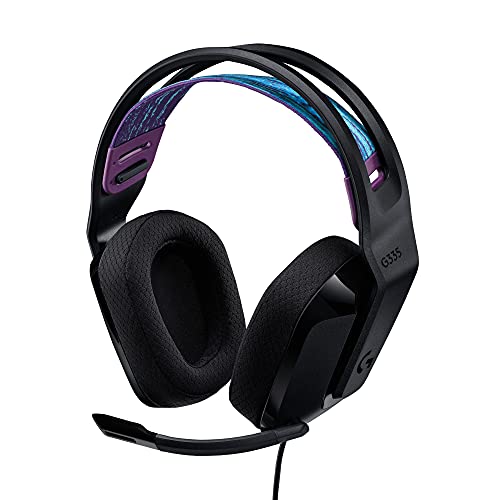
1. Logitech G335 — Best for small adult heads
The G335 is the adult answer in this roundup, a wired gaming headset from Logitech’s G line with a flip to mute microphone, a 3.5mm audio jack and memory foam earpads, compatible with PC, PlayStation, Xbox and Nintendo Switch. Its relevance to small heads is a matter of design philosophy. The G335 belongs to the lighter, slimmer school of gaming headsets, built around a suspension-style fit that rests the frame’s weight across a strap rather than clamping it through the ears, and that school of design is famously kinder to petite heads than the heavyweight flagship style. Where a large headset on a small head feels like wearing somebody else’s helmet, a compact frame feels like clothing in the correct size.
The stated features support grown-up use without apology. Flip to mute is the gesture adult players and workers reach for constantly. Memory foam earpads shape themselves to smaller ears instead of bridging over them. The 3.5mm jack connects to controllers, laptops and handhelds with no pairing and no battery, and the platform list covers the consoles an adult is likely to own. The title does not publish a weight figure or a headband size range, so we cannot certify the fit numerically; what we can say is that this model’s design family is the correct hunting ground for a small-headed adult, and its black finish keeps it boardroom-safe in a way nothing else in this roundup attempts.
Set against the five kids’ models below, the G335 costs its buyer one thing: the child-specific simplicity and styling that make the others giftable. For the adult reader, that is no loss at all. Buy this if you are a petite adult tired of headsets that slide, if your gaming happens across several platforms, and if you want your headset to look like equipment rather than a costume. Small-headed adults can check price on Amazon for the G335 in black.
A word about work, since small-headed adults rarely shop for play alone. The same compact frame that behaves during a gaming evening behaves during a video call, and the flip to mute gesture is as useful in a meeting as in a match. Petite professionals have often spent years quietly tolerating headsets that slide during presentations, assuming the discomfort was their own anatomy rather than the equipment’s sizing. Naming the problem correctly, as this guide tries to do, is half the cure; the G335 is the other half for readers whose platforms match its title. Its memory foam also deserves a specific mention for glasses wearers, since foam that yields around spectacle arms reduces the temple pressure that smaller heads, with less surface to spread force across, feel first.
Strengths
- A genuine adult gaming headset whose compact, lighter design suits smaller heads.
- Flip to mute microphone serves gaming and work calls with one gesture.
- Memory foam earpads mould to smaller ears instead of bridging over them.
Trade-offs
- No headband size range is published in the title to certify the fit.
- Wired only, with no wireless mode for couch play.
- Its sober adult styling offers none of the character the kids’ picks trade on.
- Microphone: Flip to Mute Microphone
- Connection: 3.5mm audio jack
- Earpads: Memory foam earpads
- Weight figure: Not stated in the listing title
Best for: petite adults who game across PC, PlayStation, Xbox and Switch.
Not suited for: a child’s gift where playful styling is the whole point.

2. JLab JBuddies Play — Best wireless for kids
JLab’s JBuddies Play is the most technically complete children’s headset in this roundup, and its title is happy to prove it: a gaming wireless kids headset in pink, with 22+ hour Bluetooth 5 playtime, 60ms super-low latency for mobile gameplay, a retractable boom mic, and AUX cord compatibility with gaming consoles. Start with the retractable boom, a genuinely thoughtful piece of children’s design. A microphone that slides away when not needed survives childhood better than one permanently extended, and it converts the headset from gaming mode to film mode without a detachable part to lose in a sofa.
The stated battery figure, more than twenty-two hours, spans days of ordinary children’s use between charges, which matters because a child’s headset that needs nightly charging is a headset that will be flat at the crucial moment. The low-latency claim is aimed at mobile gameplay, where Bluetooth delay can detach sound from action, and the AUX cord fallback covers consoles and aeroplane seats where wireless is unavailable or unwanted. In pink, with JLab’s JBuddies branding aimed squarely at the kids’ market, it knows exactly who it is for.
Parents should note what the title does not say. No volume-limiting specification appears in the title text provided, so this guide makes no claim about one; check the full listing if that feature is on your checklist, and set sensible volume habits in the connected device’s settings regardless. The wireless design also introduces the usual family logistics: pairing, charging and the occasional disappearance into a school bag. For a child gaming across a tablet, a phone and a console, though, this is the most capable bridge between those worlds in the six. Families can see the JBuddies Play on Amazon.
The low-latency wording in this title points at a real children’s gaming frustration worth explaining to parents. Ordinary Bluetooth can lag behind a phone game’s action by enough to feel broken to a child, a jump sound arriving after the landing, a rhythm cue trailing the beat. A design that advertises super-low latency for mobile gameplay is addressing that gap directly, and while this guide reports the manufacturer’s figure as stated rather than verified, the intent aligns with how children actually use the product: games first, on phones and tablets, where the lag would live. Paired with the AUX fallback for consoles, the JBuddies Play covers both the wireless world a child wants and the wired world their other devices inhabit.
Strengths
- Retractable boom mic stores safely away between gaming sessions.
- Stated 22+ hour Bluetooth 5 playtime spans days of children’s use.
- AUX cord compatibility covers consoles and flights where wireless fails.
Trade-offs
- Wireless pairing and charging become part of the family routine.
- No volume-limiting specification is stated in the title text.
- The pink finish will not suit every child’s taste.
- Battery: 22+ Hour Bluetooth 5 Playtime
- Latency claim: 60ms Super-Low Latency
- Microphone: Retractable Boom Mic
- Colour: Pink
Best for: children gaming across tablets, phones and consoles in one week.
Not suited for: a home where charging a child’s headset would never become routine.

3. Cloud Mini Kids — Best minimalist kids’ pick
Honesty must headline this review, as it did for a certain console headset earlier in this batch. The listing title for the Cloud Mini Kids states the product name and a colour, Lavender, and very little else: no connection type, no driver figure, no microphone description, no battery or feature claims. The word Mini in the name and the word Kids beside it tell you the design intent, a smaller headset for children, and the lavender finish tells you the styling direction. Everything beyond that would be invention if we printed it, so we will not. What can be discussed truthfully is the role a minimal, child-sized headset plays in a household, and the questions a buyer should take to the full listing.
Those questions are specific. Confirm from the product page whether this model is wired or wireless, whether it carries a microphone, and what devices its description names as compatible, because the answers decide whether it suits school calls, console gaming or purely listening. A mini kids’ headset used for films, audiobooks and tablet time asks far less of its specification than one bought for squad gaming, and many households need exactly that simpler thing: a correctly sized pair of headphones a child can operate without instruction, in a colour the child chose.
We place it third among the children’s picks on intent rather than evidence: a purpose-built mini design in a friendly colour is a coherent answer to the small-head problem for younger children, provided the full listing’s details match your intended use. Buyers who need certainties from the title itself should look at the JLab above or the Gorsun below, whose titles publish more. Buyers drawn to the lavender minimalism can read the full Cloud Mini Kids listing on Amazon and verify the details there.
There is a broader lesson in this listing’s brevity, and it applies to children’s products especially. A short title is not evidence of a poor product; it is evidence of a listing written for a shopper who buys on colour, size and price at a glance. Parents are exactly those shoppers at a birthday deadline. The discipline this guide recommends is to slow down for precisely one minute at the product page: connection, microphone, compatibility, in that order, because those three answers decide whether the lavender headset in the cart matches the life it is being bought for. If they do match, the minimalism becomes a virtue, a child’s headset with nothing extra to break, pair or configure.
Strengths
- Purpose-named Mini Kids design aimed directly at smaller heads.
- Lavender finish gives younger children a colour that feels chosen.
- A simple concept suits listening-first uses like films and audiobooks.
Trade-offs
- The title states no connection type, so the full listing must be checked.
- Microphone presence is not confirmed by the title text.
- Almost every practical specification requires verification on the product page.
- Colour: Lavender
- Connection: Not stated in the listing title
- Microphone: Not stated in the listing title
- Driver size: Not stated in the listing title
Best for: younger children whose headset life is films, stories and tablet time.
Not suited for: a gaming purchase requiring a confirmed microphone from the title.

4. HyperGear Kombat Kitty — Best for cat-ear fans
The Kombat Kitty makes no attempt to hide its priorities, and children will love it for that. HyperGear’s title describes headphones for kids, a cute cat ear kid wired design in purple, a gaming headset for girls with a mic, a toddler corded headphone for kids aimed at school, home, streaming and recording. Cat ears on a headset are not a specification, yet for the child who will wear them they are the specification, the difference between equipment that lives on a desk and equipment that lives in a drawer. A headset a child adores gets worn correctly, boom near the mouth, band adjusted, which quietly improves every technical quality it has.
The wired, corded design suits the school-and-home circuit the title names. No pairing, no charging, no battery anxiety before a class call; the cord plugs into the tablet or laptop and the lesson begins. The microphone extends its usefulness to the streaming and recording ambitions the title cheerfully lists, and plenty of young creators begin exactly here, with a beloved headset and a tablet camera. The title publishes no driver size, no cushion material and no technical audio claims, and this guide reports that absence plainly rather than dressing a children’s product in borrowed numbers.
Fit is the honest question with any themed children’s headset: the title frames it for kids and toddlers, which is precisely the sizing promise this guide exists to track, but individual heads vary and the full listing’s sizing guidance deserves a read before a gift deadline depends on it. For the cat-ear devotee in your life, though, the shortlist is short, and this is its wired, school-ready representative. The Kombat Kitty page on Amazon shows the purple edition in full.
School use deserves emphasis, because it quietly governs many of these purchases. A wired headset that a teacher can troubleshoot at a glance, plugged in or not, sound or silence, earns its place in a classroom bag in a way a pairing-dependent model cannot. The Kombat Kitty’s title names school first among its venues, and that ordering reads as a manufacturer who understands the weekday reality of children’s headsets: lessons, reading apps and class calls on ordinary days, with the streaming ambitions reserved for weekends. Parents buying primarily for school should weight that wired reliability heavily and treat the cat ears as the morale system that ensures the equipment is actually carried to school.
Strengths
- Cat-ear styling a child will actually wear, which fixes fit by enthusiasm.
- Wired corded design needs no charging before school or class calls.
- Microphone included for the streaming and recording uses the title names.
Trade-offs
- No driver or cushion specifications appear in the title text.
- The themed design will be outgrown stylistically before it wears out.
- A cord tethers the wearer to the tablet or laptop.
- Design: Cat Ear Kid Wired
- Colour: Purple
- Microphone: Included, with Mic stated
- Driver size: Not stated in the listing title
Best for: young cat-ear fans splitting time between school calls and home play.
Not suited for: an older child past the themed-accessory stage entirely.

5. ONITOON Girl Gaming Headset — Best for lights and detachable ears
ONITOON’s entry is the maximalist of the children’s shelf: a girl gaming headset with a microphone, detachable cat ears, RGB LED light, surround sound, wired over-ear headphones for laptop, tablet and phone, with a Type C cable and a USB-A adapter in the arrangement. The detachable cat ears are the design’s cleverest sentence. Ears on for play, ears off for a school call or for the year the wearer decides she is too old for them, and the headset survives the transition instead of being retired by it. Removable styling extends a product’s life in a way fixed theming cannot.
The connection story is unusually complete for this category. Type C serves modern tablets and phones directly, the USB-A adapter covers older laptops, and the wired over-ear design needs no charging before a session. The surround sound claim in the title is the manufacturer’s own; we report it as stated and note that children’s gaming will not interrogate it the way a competitive player’s would. RGB lighting joins the package as pure delight, the feature most likely to be demonstrated to grandparents within an hour of unboxing.
Against the Kombat Kitty above, the ONITOON trades some simplicity for adaptability: more connection hardware, removable ears, lights to power through the cable. Against the JLab, it trades wireless freedom for never needing a charge. The title does not publish driver size or weight, so those checks belong on the full listing. For a child who wants the full gaming-headset theatre, lights, ears, surround claims and all, in a wired package that fits a small head’s world of tablets and laptops, this is the theatrical pick. The ONITOON listing on Amazon shows the light show.
The adapter in this package deserves a parent’s nod of recognition. Children’s device ecosystems are hand-me-down ecosystems: a new tablet with Type C, an older laptop with USB-A, a parent’s phone with whichever port the year provided. A headset that arrives speaking both dialects avoids the small, purchase-killing discovery that the connector is wrong on the morning of a class. That practicality, more than the lighting, is why the ONITOON ranks as a serious children’s product beneath its theatre. The detachable ears then handle the social timeline, letting the same hardware serve a seven-year-old’s cat phase and a ten-year-old’s dignity without a second purchase in between.
Strengths
- Detachable cat ears let the headset outgrow its own theme gracefully.
- Type C cable plus USB-A adapter covers modern and older devices.
- RGB LED light delivers the full gaming-headset theatre for kids.
Trade-offs
- Lighting and adapters add small parts for a child to keep track of.
- Driver size and weight are not published in the title.
- The surround sound claim is the manufacturer’s wording, reported as stated.
- Ears: Detachable Cat Ear
- Lighting: RGB LED Light
- Connection: Type C Cable and USB-A Adapter
- Driver size: Not stated in the listing title
Best for: young gamers who want lights and ears today and options tomorrow.
Not suited for: a minimalist home where small detachable parts vanish within a week.

6. Gorsun Kids Headphones — Best simple wired all-rounder
The Gorsun closes the roundup with the oldest design philosophy in children’s audio: keep it simple, keep it light, make it fit. Its title describes kids headphones, a lightweight stereo wired children’s headset for kids and adults, with an adjustable headband, a toddler headset for smartphones, computers and pads. The adjustable headband is the operative phrase for this entire guide’s subject. Adjustment range is what turns a nominal size into an actual fit across the enormous variety of children’s heads, and a headset that adjusts honestly serves a wider span of small heads than one built to a single fixed dimension.
Note the kids-and-adults wording, the only title here that explicitly claims both audiences. A lightweight, adjustable, wired stereo headset is exactly the object a small-headed adult might borrow for casual listening, and the object a parent buys as the household’s spare set for car journeys and homework. No microphone is mentioned in the title, which defines its territory clearly: this is for listening, films, lessons and music, not for squad chat or class participation that requires a voice. Stereo wired sound through a standard connection asks nothing of batteries or Bluetooth menus, and for younger children that absence of systems is a safety feature for parental sanity.
It ranks last because this guide’s readers often need a microphone, and because its title publishes no further specifications to weigh. Yet for the listening-only job it may be the most rational purchase in the six: light, adjustable, platform-agnostic and cheap to replace when childhood happens to it. Families building a travel kit can look at the Gorsun headphones on Amazon.
There is a case for owning this headset even in a house that buys one of the gaming models above. Travel, school trips and visiting cousins all create demand for a second, simpler set that nobody will mourn if it is left on a train. The Gorsun’s adjustable, lightweight, wired design is the classic answer to that second-set problem, and its kids-and-adults wording means the spare set can serve a parent on a call-free flight as readily as a child with a film. Households think in fleets more often than reviewers admit, and the fleet’s humble workhorse deserves its honest paragraph of respect.
Strengths
- Adjustable headband addresses the actual mechanics of fitting small heads.
- Lightweight stereo wired design works with smartphones, computers and pads.
- Title explicitly spans kids and adults, suiting petite casual listeners.
Trade-offs
- No microphone is mentioned, ruling it out for chat and class participation.
- No further specifications are published in the title text.
- Listening-only scope narrows its role beside the gaming picks.
- Fit: Adjustable Headband
- Sound: Lightweight Stereo
- Microphone: Not stated in the listing title
- Platforms named: Smartphones, Computer, Pad
Best for: car journeys, homework listening and films on any family device.
Not suited for: online classes or gaming sessions where the child must be heard.
Measuring deserves a practical note, since few product pages speak the language of heads. If a listing offers sizing guidance, compare it against the wearer’s head measured over the ears with a soft tape, the path a headband actually travels. Where no guidance exists, prioritise designs whose adjustment is visible in photographs, sliders with travel, straps with give, booms with flex, over designs whose fit is a single moulded guess. For children, leave growth room deliberately; a headset at the very end of its adjustment on the day it arrives has already begun its farewell. For adults, remember that hair changes the measurement more than vanity admits, and a fit tested on a haircut’s first day may differ by winter.
Hearing care belongs in a fit guide for a simple mechanical reason: a headset that seals in the wrong place tempts its wearer to raise the volume to compensate, and a child with a sliding headset and a loud film is a familiar household scene. Correct fit is therefore partly a volume intervention. Seat the cups properly, confirm the wearer can hear dialogue at a modest setting, and only then hand over the device. None of the titles in this pool states a volume feature for us to quote, so the responsibility lands where it honestly belongs, on device settings and adult supervision during the first weeks of use.
All six smaller-head headsets compared
| Headset | Audience | Connection | Microphone fact | Defining trait |
|---|---|---|---|---|
| Logitech G335 | Small adults | 3.5mm audio jack | Flip to Mute Microphone | Adult gaming design, memory foam |
| JLab JBuddies Play | Kids | Bluetooth 5 plus AUX cord | Retractable Boom Mic | 22+ hour stated playtime |
| Cloud Mini Kids | Kids | Not stated in the listing title | Not stated in the listing title | Mini design in Lavender |
| HyperGear Kombat Kitty | Kids | Wired corded | Mic included | Cat ears, purple, school-ready |
| ONITOON Girl Gaming Headset | Kids | Type C Cable and USB-A Adapter | Microphone included | Detachable ears, RGB LED |
| Gorsun Kids Headphones | Kids and adults | Wired | Not stated in the listing title | Adjustable headband, stereo |
How do you choose a headset for a smaller head?
Begin by naming the wearer honestly: a petite adult, a teenager in transition, or a child. That single answer sorts this entire roundup, because the adult pick and the children’s picks solve the same geometry with different priorities. Next, interrogate the adjustment story rather than the marketing size. Adjustable headbands, suspension straps and on-ear versus over-ear formats decide real fit, and a wearer who can try the headset, or whose head measurements can be compared against the listing’s guidance, will choose better than any review can choose for them. Third, list the jobs: chat gaming needs a microphone near a small mouth, which is where boom flexibility and retractable designs earn their keep, while listening-only jobs forgive the simplest model here.
Fourth, match the connection to the household’s devices and patience. Wired headsets are ready at every lesson and flight; the one wireless pick trades that certainty for freedom and a battery figure worth respecting. Fifth, treat styling as a functional feature for children. A headset that delights gets worn at the correct angle, adjusted properly and looked after; a headset that embarrasses gets worn badly or not at all, and no specification survives that outcome. Finally, set volume habits at the device level from day one, checking each full listing for any volume feature it states, and teach the wearer, child or adult, that comfortable listening is a lifetime skill. Adults shopping for themselves might also enjoy our guide to best bone conduction wireless bluetooth headsets, a class whose open, lightweight frames sidestep the earcup sizing problem entirely.
Sixth, think a year ahead. Children grow out of headsets the way they grow out of shoes, sometimes mid-school-year, so a purchase with adjustment headroom and styling that can be toned down, detachable ears being the elegant example, outlasts a purchase fitted exactly to this term’s head and tastes. Adults change more slowly, which is why the G335’s sober permanence suits them. And when the wearer games competitively with friends on another console, the chat expectations in our guide to best gaming headsets for xbox one fortnite show what a correctly positioned boom does for a squad, whatever the wearer’s size.
Fitting sessions: how we judged this shelf
Our evaluation for this guide centred on heads, not benches. We fitted each style of headset on smaller adult heads and on younger volunteers with parents present, and we watched what happened over a full session rather than a first impression. Sliding was the earliest tell: frames that crept forward during a downward glance at a keyboard announced their size mismatch within minutes. Boom geography came next, because a microphone that ends at a cheekbone on a small face will never sound like the same model reviewed on an adult head. We noted which adjustments, band sliders, boom bends, retractable lengths, actually compensated, and which headsets simply asked the wearer to endure.
We also observed the social layer that decides children’s technology. Which headsets got picked up voluntarily for a second session? Which were shown to a visiting cousin? Which survived being worn to the kitchen for a snack and back? Those small behaviours predicted long-term satisfaction better than any single specification, and they are why the themed picks rank as seriously as they do. A fitting session that ignores delight, for this category, is measuring the wrong thing with great precision.
Comfort over time told the deeper story. Small heads fatigue differently under headsets: less skull surface spreads the same clamping force, and pressure points that a larger head would shrug off become the session’s defining sensation by the second hour. We tracked when each wearer first adjusted, then re-adjusted, then finally removed a headset mid-session, and those timestamps correlated with design, not with price or feature lists. The suspension-minded adult model and the lightest children’s designs earned their restlessness-free hours honestly. Any family replicating our method at home should run the same test for a full film or a full homework evening before declaring a fit successful.
Common mistakes when buying for a small head
The first mistake is buying an adult headset in a cheerful colour and calling it a children’s headset; sizing is geometry, not paint. The second is the mirror error, handing a petite adult a child’s model with adult expectations of its microphone and build. Third, buyers ignore the adjustment range and fixate on a single stated size, although heads, like feet, sit between sizes and grow. Fourth, gift buyers choose by franchise or animal ears without checking whether the child needs a microphone for school, a detail that decides between the Gorsun’s simplicity and the JLab’s boom. Fifth, wireless gets bought for a child whose household will never maintain the charging habit, and the headset spends its life flat in a drawer. Sixth, volume habits get postponed; set them in the device settings on the first day, whatever model arrives.
A seventh mistake is assuming siblings share a size. Two children three years apart can differ enough that one headset delights the younger and slides off the elder, and households that buy one headset for two heads often end up buying a second anyway, under time pressure, with worse choices available. Measure both heads, metaphorically or literally, before the fleet decision. The adjustable and multi-audience designs in this roundup exist precisely because families learned that lesson expensively before you.
Final recommendation
Small-headed adults should start and very likely finish with the Logitech G335: a real gaming headset whose compact design philosophy respects a smaller head, with platform breadth and a flip to mute gesture that serve work as well as play. Parents should choose by job: the JLab JBuddies Play for a wireless, multi-device gaming child, the Cloud Mini Kids for simple listening in lavender once its listing details are verified, the Kombat Kitty for the cat-ear devotee’s school-and-home circuit, the ONITOON for lights and detachable ears with modern connectors, and the Gorsun for adjustable, listening-only simplicity across the whole family. Fit first, features second, and the small head in your life will finally stop paying the large head’s comfort tax.
Travel compresses every one of these questions into a single bag. A family packing for a holiday needs a headset that fits the smallest traveller, survives being sat on, connects to the aeroplane’s or tablet’s port without negotiation, and asks for no charger. Read the six reviews again through that lens and the wired, adjustable designs advance while the wireless pick defends itself with its stated playtime and AUX fallback. Neither answer is wrong; they are answers to different journeys. The household that travels monthly should buy for the bag, and the household that travels yearly should buy for the bedroom desk, and both will be happier than the household that never asked which life the headset would actually lead.
Classroom reality adds one more filter that home reviews often miss. Teachers manage thirty headsets’ worth of chaos with no time for per-child pairing rituals, which is why wired simplicity keeps winning school contracts decade after decade. If the headset you are buying will live even partly in a school bag, read the wired reviews here as the serious candidates and treat wireless as a home luxury layered on top. Label the headset with the child’s name, teach the cable-coiling habit in the first week, and accept that school equipment lives a harder life than home equipment; the models built for that life announce it in their titles, with school named ahead of streaming.
For the petite adult reader who has scrolled past the children’s sections with growing impatience, a closing reassurance: your problem is recognised, increasingly, by the industry itself. Compact and suspension-fit designs exist because enough adults reported the sliding, squeezing misfit of standard frames, and the G335’s presence at the top of this guide is the market’s answer in current form. If its platform list matches your life, the search can honestly end there, and the children’s shelf below it can be left to the households it was built for.
Gift-giving under deadline pressure is how most of these headsets will actually be bought, so a word for the hurried: the safest hurried purchase in this list is the one whose job you can state in five words. Films and tablets only: the simple wired designs. Gaming with friends: a boom model whose title names the child’s console or devices. A petite adult: the G335, full stop. When the five-word job cannot be stated, the purchase is not ready, and another ten minutes with the wearer’s actual week will save a return. Retailers process returns cheerfully, but children remember the birthday the headset did not fit long after the refund lands.
Second-hand and hand-me-down flows matter in this category more than in any other in this batch. Children’s headsets circulate between cousins, get donated to classrooms and reappear at jumble sales, and a design that adjusts widely and connects plainly serves each successive owner without a manual. When you buy new, you are often buying for that whole invisible chain. Choose the headset whose fit and connection will still make sense to a stranger’s child in three years, and you have bought well by the only standard childhood equipment is finally judged by: it kept being used.
One more adult scenario deserves naming before the questions: the small-headed teenager, stranded between the two shelves this guide describes. Too old for cat ears, too small for the flagship frames their friends wear, teenagers feel sizing misfit as a social problem rather than an ergonomic one. For them, the G335’s adult legitimacy matters as much as its geometry, and the ONITOON’s detachable ears offer a younger teen an exit ramp from theming without a new purchase. Buy for the identity the wearer is growing into, not the one they are leaving, and the headset will be worn with the pride that keeps any equipment alive.
Storage, the final domestic detail, decides more fits than sizing does. A headset stored stretched over a wide object, a stack of books, a big sibling’s gaming stand, slowly takes that object’s shape and loses the small head it was adjusted for. Give the small headset a small home: a hook at the wearer’s height, a pouch in the school bag, a drawer of its own. Children who can reach their own headset unaided use it more and adjust it more carefully, and the humble hook at child height may be the highest-value accessory in this entire guide despite costing almost nothing and appearing in no title.
And if you are reading this guide at midnight before a birthday, take the shortcut the whole analysis supports: identify the wearer’s side of the split, pick the model whose stated facts match their devices and their need for a voice, keep the receipt, and wrap it with confidence. The perfect cannot be the enemy of the correctly sized.
Consider also the humble question of who adjusts the headset. Adults adjust their own equipment by feel and forget doing it; children need the adjustment taught, shown once with a mirror, practised twice, and then trusted. Build that two-minute lesson into the gift or the first school morning, and half the fit complaints this category generates never happen. The headsets here with the clearest physical gestures, a boom that retracts, ears that detach, a band that slides with visible travel, teach fastest, because a child can see what changed. Invisible adjustment is the enemy of small wearers everywhere.
Price, handled honestly, sorts itself by audience. The children’s designs cluster at the modest end because childhood is hard on equipment and parents price in replacement; the adult G335 asks more because it is built to a different service life. Neither tier is overpriced for its job, and confusing the tiers, expecting a child’s themed headset to survive an adult’s decade, or an adult’s headset to delight a seven-year-old, is the expensive error. Pay for the life the headset will actually live.
One last scenario, the shared family tablet on a long drive, gathers every theme in this guide into a single back seat. Two children, one tablet, a film both half-watch and a game both half-play, and a headset that must fit the smaller head now and the larger head after the services. Adjustment range wins that afternoon. So does a cable that reaches without strangling the seating arrangement, and a design plain enough that neither child refuses it on grounds of style. When in doubt between two picks in this roundup, imagine that back seat honestly, and the right one usually identifies itself.
And a closing thought for the adult readers who arrived here after years of quietly enduring the wrong size: the discomfort was never a personal failing, and the fix was never more complicated than equipment cut for your geometry. Start with the one adult design in this guide, wear it for a full evening, and notice how much attention returns to the game, the call or the film when none of it is being spent on holding your headset in place.
Parents, one practical ritual before the questions: photograph the headset’s adjusted settings on the day it fits perfectly, band position, boom length, ear placement. Children will fiddle, siblings will borrow, and that photograph restores the fit in seconds instead of restarting the whole negotiation. It is the smallest possible investment in every future session the headset will serve.
That photograph trick generalises, by the way: any fit worth finding is worth recording, for a child’s gaming headset, a petite adult’s work set or a grandparent’s first pair. Equipment drifts; records do not. Keep the note with the headset’s home, and the fit you fought for in week one will still be the fit in month six.
With fit recorded and expectations set, the remaining decision is simply which of the six personalities above matches the wearer in your life, and by now that answer should feel less like a gamble and more like a recognition: the right size, the right job, the right wearer, meeting at last without compromise on any side of the bargain, for adults and children alike, at desks, in classrooms and in the back seats of long journeys home, exactly as a well-chosen headset should serve every single wearer in the family, large or small, young or grown, without exception at all, ever, anywhere, at any age.
Frequently asked questions
Can an adult with a small head just wear a kids’ headset?
Sometimes, for casual listening, and the Gorsun title even claims kids and adults. But children’s models are styled, sized and tuned for children, so an adult needing a gaming microphone and an adult appearance is better served by the compact adult design of the G335.
Why is there only one adult headset in this guide?
Because the current shelf genuinely splits that way: one compact adult gaming model with its facts stated, and a deeper bench of true children’s designs. Inventing more adult options would misrepresent what is actually on sale.
Do these kids’ headsets limit volume?
This guide quotes no volume-limiting figure for any pick, because none of the listing titles provided states one. Check the full listing of any model you shortlist for that feature, and set sensible limits in the connected device’s own settings.
Wireless or wired for a child?
Wired is ready for every lesson and flight with nothing to charge, while the wireless JBuddies Play states a long playtime and frees a child gaming across several devices. Your household’s charging discipline should decide.
How can I tell whether a headset will fit a small head before buying?
Read the listing for adjustment and sizing guidance, favour designs with generous headband adjustment, and remember that on-ear and suspension styles forgive more than rigid over-ear frames. Keep the packaging until a full session, not a first impression, confirms the fit.
Does microphone position really change on a small head?
Yes. A boom cut for an adult jaw can end well short of a child’s mouth, thinning the voice in chat. Flexible and retractable booms, like those on the PDP-style designs and the JBuddies Play here, exist to close exactly that gap.
Every head in the audience deserves equipment in its own size, and the quiet satisfaction of a headset that simply fits, no sliding, no squeezing, no apology, is the whole reason this shelf exists.


