What's inside
- Key Takeaways
- Quick Picks
- How We Chose These Picks
- NRR and SNR: Why Are There Two Numbers in This Guide?
- Why Does the Seal Matter More Than the Sticker?
- Radio or Streaming: What Should Play Inside the Cups?
- Controls, Gloves, and the Mid-Mow Adjustment
- Can You Still Hear the World Around the Mower?
- What About Trimmers, Blowers, and the Rest of the Weekend?
- Riding Mower, Push Mower, or Zero-Turn: Does the Machine Change the Muff?
- How Do You Set Up the Phone Side Before the First Mow?
- What Does a Full Season of Ownership Look Like?
- Buying for Two: A Partner, a Teenager, a Crew
- The Six Bluetooth Mowing Earmuffs, Reviewed
- What Should You Check in the First Ten Minutes of Ownership?
- The Six Muffs at a Glance: Ratings as Titled, Nothing Converted
- Which Mowing Headset Mistakes Should You Avoid?
- Final Recommendation
- Frequently Asked Questions
- Related Guides
As an Amazon Associate I earn from qualifying purchases. This post may contain affiliate links at no extra cost to you.
gizmoverdict.com is reader-supported. When you buy through links on our site, we may earn an affiliate commission.
Where to buy mower hearing protection with audio: all six picks are listed on Amazon under the titles we checked, and the linked names open those listings. Buy by the exact model names here — this shelf is crowded with lookalike earmuffs whose ratings and radios differ in ways the photographs will never tell you.
The best bluetooth headsets for mowing are not really headsets in the office sense at all. They are hearing-protection earmuffs — the same species of gear worn on factory floors and shooting ranges — with a Bluetooth receiver and speakers built into the cups. That order of priorities is the whole story of this category: the protection is the product, and the audio is the feature that makes the protection pleasant enough to wear for a two-acre afternoon. A mower is loud company for hours at a stretch, and the difference between enduring it bare-eared with earbuds cranked underneath and wearing a proper rated muff with music inside it is the difference between a chore survived and a chore almost enjoyed.
This guide holds a strict line on numbers. Every protection figure below is copied from the pick’s own listing title — a Noise Reduction Rating of 26 dB for the two 3M models, an SNR of 30 dB or 31 dB for the two PROHEAR models, 25 dB NRR for the ISOtunes, 23 dB NRR for the Klein — and the guide does not convert, blend, or rank those numbers against each other, because NRR and SNR are different rating systems measured under different standards. What a rating cannot tell you matters just as much: no figure in a title knows how the muff fits your head, and fit is where real-world protection is won or lost. The reviews therefore spend as much time on seals, controls, and batteries as on the numbers.
Expect this guide to read a little differently from a typical headset roundup. Comfort here means a seal that survives sweat. Sound quality means speech and music staying intelligible at modest volume under a cushion, not audiophile sparkle. Battery life means whether the pair is alive in week six of the season, not a laboratory figure. Every pick is graded against the Saturday it will actually live through — tall grass, full sun, fuel on your hands, and a fence line that always takes longer than you remembered.
One more boundary, stated once and applied throughout: this guide reports the ratings manufacturers publish and describes fit and features. It does not promise health outcomes, diagnose anything, or certify that any muff makes any mower safe. Hearing protection is a rated product used in a loud environment; use the ratings as the makers state them, follow the mower maker’s own safety guidance, and treat a good seal as your personal responsibility every single wear.
Key Takeaways
- These are rated hearing-protection earmuffs with Bluetooth audio inside — protection first, playlist second.
- Protection figures are quoted exactly as titled and never converted: NRR and SNR are different systems and their numbers are not interchangeable.
- The seal decides real-world results — glasses arms, hat brims, and worn cushions all leak sound past a rating.
- Two picks add AM/FM radio, which never buffers, never needs a phone signal, and never drains your phone.
- Battery claims range from the PROHEAR 037’s stated 120 hours of playtime to the Klein’s stated 50 hours — judge them as titled, and note the 3M titles state no battery figure.
- Controls you can work with gloves on matter more on a mower than any app feature.
Quick Picks
| Pick | Badge | Why it is here |
|---|---|---|
| 3M WorkTunes Connect | The benchmark mower muff | 3M’s Bluetooth hearing protector with a 26 dB Noise Reduction Rating in its title — the name this category is measured against. |
| 3M WorkTunes Connect + AM/FM | Radio built into the benchmark | The WorkTunes formula plus AM/FM radio alongside Bluetooth, again titled at a 26 dB Noise Reduction Rating. |
| PROHEAR 037 Bluetooth (30dB SNR) | The marathon battery | Bluetooth 6.0 earmuffs titled at 30dB SNR with a rechargeable 1100mAh battery and a stated 120 hours of playtime for mowing, workshops, and snowblowing. |
| PROHEAR 033 Bluetooth + AM/FM | Radio plus the highest SNR here | Bluetooth and AM/FM radio earmuffs titled at 31dB SNR with a rechargeable 1500mAh battery, aimed squarely at lawn work. |
| ISOtunes Link Bluetooth Earmuffs | The jobsite-shaped option | Bluetooth earmuffs titled as OSHA compliant work headphones with a 25 dB NRR, built for mowing and construction alike. |
| KLEIN TOOLS AESEM2 Slim Bluetooth Earmuffs | The slim low-profile pair | Slim Bluetooth 5.4 earmuffs from Klein Tools with foam cushions, a stated 50-hour battery, and a 23dB NRR for construction and workshops. |
How We Chose These Picks
The pool was filtered on three title-level facts: the product had to be a hearing-protection earmuff, it had to carry Bluetooth audio, and it had to state its protection rating in its own listing title. That last rule is this guide’s spine. Earmuffs that hide their rating behind marketing adjectives were excluded, because a buyer comparing protection deserves numbers the maker was willing to print. The survivors divide neatly into the category’s real families: the 3M benchmark in streaming and radio flavors, the PROHEAR pair with their SNR ratings and big batteries, and two trades-shaped entries from ISOtunes and Klein Tools.
We also kept the rating systems segregated on purpose. Rather than manufacturing a league table the underlying standards do not support, each review reports its own pick’s figure in its own system and spends its judgment on the things a buyer can actually compare across brands: fit style, controls, radio, battery claims as titled, and intended environment. That is less tidy than a ranked chart and considerably more honest.
NRR and SNR: Why Are There Two Numbers in This Guide?
Because the industry genuinely has two. NRR — Noise Reduction Rating — is the figure used in the United States, derived from testing under American standards. SNR — Single Number Rating — is its European counterpart, derived under a different test protocol with different assumptions. The two PROHEAR models are titled in SNR; the 3M, ISOtunes, and Klein models are titled in NRR. A 31 dB SNR and a 26 dB NRR are not two scores in one contest, and any guide that subtracts one from the other to declare a winner is doing arithmetic the standards never authorized.
What you can legitimately do with the numbers is compare within a system: the ISOtunes’ 25 dB NRR sits a step below the 3M pair’s 26 dB NRR on paper, and the Klein’s 23 dB NRR sits below both. Within SNR, the PROHEAR 033’s 31 edges its sibling’s 30. Those are paper comparisons of laboratory figures, useful as a starting orientation and nothing more. The moment any of these muffs goes on a real head, the seal — how completely the cushion closes around your ear — becomes the loudest variable in the system, louder than a decibel or two of rating.
So shop the numbers with respect and the fit with obsession. If you wear glasses, know that temple arms break the cushion’s seal and cost real protection; some wearers choose thinner arms or fit the muffs with extra care for exactly this reason. If you wear a hat, the brim and the headband will negotiate, and the muff usually loses. A rated muff worn badly is an unrated muff with a number printed on it, and no title in this guide can fix that from the page.
Why Does the Seal Matter More Than the Sticker?
Sound is patient. It finds the gap at the jaw hinge, the channel a glasses arm cuts through the cushion, the spot where a ponytail lifts the cup’s edge. Laboratory ratings are earned on test fixtures with perfect seals; your Saturday is not a test fixture. This is why the reviews below keep returning to cushions and clamping: foam cushions that conform, like the Klein’s stated foam cushions, or cushions in good condition on any model, are not comfort garnish — they are the mechanism by which the printed rating becomes a real one.
Build the habit of the deliberate fit. Put the muffs on before the engine starts, seat the cups fully over the ears rather than on them, run a finger around each cushion’s edge to feel for gaps, and adjust the headband so the pressure is even rather than heroic. Recheck after the first fuel stop; sweat and vibration migrate everything. A muff that needs a mid-mow reseat is telling you something about its fit on your head, and a different model from this list may simply be shaped for you.
Replacement cushions belong in the same conversation. Cushion foam hardens and cracks with seasons of sweat and sun, and a hardened cushion seals like a wooden ring. Makers of serious muffs sell replacement cushions for a reason. If your current pair predates your mower, fresh cushions may restore more protection than a new purchase would — and whichever pick below you choose, plan on treating its cushions as consumables from day one.
Radio or Streaming: What Should Play Inside the Cups?
Bluetooth streaming gives you your library, your podcasts, your audiobook — the whole phone, piped into the muff. For the long narrative pleasures, a two-hour mow with an audiobook is a genuinely different afternoon from a two-hour mow without one. Streaming’s costs are small but real: the phone’s battery shares the work, the signal can fumble when the phone is in the house and you are at the property’s far fence, and a call or notification will interrupt at its own pleasure unless you discipline the settings before you start.
AM/FM radio, offered by the 3M + AM/FM and the PROHEAR 033, is the older technology and in this setting arguably the sturdier one. A ballgame, a talk station, the local weather band of your afternoon — radio asks nothing of your phone, never buffers, and sips power. For mowing specifically, where the phone is safer left in the garage than in a vibrating pocket, a radio muff keeps the entertainment self-contained. Many owners of radio models report the ballgame-on-Saturday ritual becomes the reason the chore gets volunteered for.
The choice is a personality test more than a specification. Streamers with a podcast queue should buy Bluetooth-only without a backward glance; the radio would be dead weight. Listeners whose mowing companion is a broadcast — sports, talk, local radio — should weight the two radio picks heavily. And the several picks here with Bluetooth alone still leave the phone’s own radio apps as a streaming route, data permitting. There is no wrong answer, only an answer that mismatches its owner’s Saturdays.
Controls, Gloves, and the Mid-Mow Adjustment
A mower is a vibrating, two-handed commitment, and the moments you touch your hearing protection mid-job are moments of partial attention. That makes control design a safety-adjacent feature in the practical sense: big, distinct, glove-friendly controls get used in one blind reach; small flush buttons invite fumbling, looking down, and one-handed steering. When you audition any pick here, perform the test that matters — put on your work gloves, look at the horizon, and change the volume and pause the audio by touch alone. The muff that passes that test in the driveway will behave on the lawn.
Battery design shapes the same practicality across the season. The PROHEAR models and the Klein state rechargeable batteries with their capacities or hours printed in their titles; a rechargeable muff joins the Sunday-evening charging ritual alongside the trimmer battery. The 3M titles state no battery figure, so their power story must be read in the full listing before assuming anything — a deliberate flag in their spec boxes below. What matters is not which chemistry wins but whether the routine fits your life: a muff that is dead in the garage when the grass is tall is a muff you will mow without, once, and then habitually.
Sweat and heat complete the practical picture. Earmuffs are warm by nature — they seal the ears under cushions in summer sun — and mowing is warm work. Slimmer profiles like the Klein’s may run less bulky under a hat, and every model here benefits from the mid-job break you should be taking anyway for fuel and water: lift the cups, let the air in, reseat deliberately. Comfort in this category is not softness; it is the discipline of fit, repeated.
Can You Still Hear the World Around the Mower?
A fair question with a layered answer. A sealed muff lowers everything — the mower most of all, but also the approaching car, the child’s call, the dog at the fence. That is the physics of protection, and this guide will not pretend any pick repeals it. What varies is how wearers manage it: many models in this class let audio volume sit low enough that the muff’s attenuation, not the music, does the work, and the practical habit is to keep entertainment volume modest rather than heroic, so the world’s louder signals still register against it.
Build awareness into the routine itself. Mow with your eyes up in a scanning pattern, the way you were taught to drive. Pause the audio at the street edge, the driveway crossing, the gate where the kids come through — a single button press you rehearsed with gloves on. When someone approaches, the muff comes off or the audio stops; conversation through a sealed cup at mower volume is a misunderstanding machine. None of this is a product feature, and all of it matters more than the difference between one pick and the next.
If your property demands constant awareness — a road-front lawn, toddlers in the yard, livestock at the fence — be honest that a fully sealed muff with music is the wrong tool for those hours, and mow those stretches with protection alone or with the audio off. The best pick in this guide is the one whose use you can adapt to the afternoon you actually have.
There is a middle setting worth practicing: one cup lifted for a conversation is a worse seal and a better neighbor, and the muff should come fully off instead whenever the engine can be idled or stopped for the exchange. Half-worn protection is mostly theater. Build the stop-and-talk habit — engine down, muff off, full attention — and the people in your life will stop dreading the sight of the earmuffs, which is its own kind of safety feature for a household that shares a yard.
What About Trimmers, Blowers, and the Rest of the Weekend?
The mower is the headline act, but the same muff serves the whole loud weekend: the string trimmer’s whine, the leaf blower’s roar, the chainsaw’s serious work, the snowblower the PROHEAR 037 names outright in its title. A muff bought for mowing that also fits your workshop — the ISOtunes and Klein titles both speak the language of construction and workshops — spreads its cost across the calendar. Consider where else the pair will live: the garage hook by the door serves more tools than the mower shed does.
Different tools stress the fit differently. A trimmer’s work is stop-start, with the muff lifted and reseated often, which rewards a lighter, quicker fit. Chainsaw work adds a helmet question — some sawyers wear helmet-mounted muffs, a different product class from everything here — and this guide’s picks are headband muffs for the mower-first buyer, not helmet systems. Blower work is a long steady roar much like mowing itself, and the radio picks’ charms apply unchanged. Buy for your loudest, longest task, and the shorter ones inherit the benefit.
Storage closes the loop. Muffs stored crushed under a toolbox lose their cushion shape and their seal; muffs hung on a hook keep both. Sun through a garage window ages foam as surely as sweat does. The pair you buy from this list will serve seasons if its cushions are treated as the working parts they are — inspected each spring, replaced when they harden, and never asked to seal through a crack.
Riding Mower, Push Mower, or Zero-Turn: Does the Machine Change the Muff?
The machine sets the duration, and duration sets the priorities. A push-mower half-acre is a forty-minute appointment: almost any pick here will feel fine, and the radio-versus-streaming question dominates. A zero-turn on two acres is a feature film: battery claims, cushion comfort, and heat management move to the front of the brief, and the PROHEAR 037’s stated endurance or the 3M pair’s benchmark fit earn their keep. A tractor with a mower deck on a small farm adds dust, sun, and long straight passes where a ballgame on the radio is not a luxury but the difference between a chore and a ritual.
Vibration differs by machine, too, and it works on the fit. A walk-behind’s handles keep your hands busy and your head relatively still. A rider’s seat transmits the machine’s whole personality upward, and a muff that seals beautifully in the driveway can micro-shift across an hour of it — one more reason the mid-job reseat belongs in the routine. Zero-turn operators, hands committed to the lap bars, should weight the glove-test for controls most heavily of all: there is no free hand coming to rescue a fiddly button.
Electric mowers complicate the picture pleasantly. They are quieter than their gasoline ancestors — though “quieter” still leaves a loud machine at arm’s length for an hour — and some owners wonder whether rated muffs are still the right call. The ratings in this guide exist because sustained noise at these levels is the product’s whole premise, and the muff’s second job, carrying your audio at civilized volume without competing against the machine, becomes more enjoyable the quieter the machine is. On an electric mower, the entertainment half of these products simply works better.
How Do You Set Up the Phone Side Before the First Mow?
The muff is half the system; the phone’s settings are the other half, and five minutes there prevents a season of small irritations. Build a mowing playlist or podcast queue in advance so the session never asks you to browse with gloves on. Set the phone to a focus or do-not-disturb mode that silences notifications but keeps whatever you genuinely need, because a notification chime at mower volume inside a sealed cup is a small jump scare repeated hourly. If your phone offers a headphone volume limit or loud-sound reduction setting, set it deliberately rather than discovering it mid-season.
Decide where the phone lives during the mow. A pocket on the mower’s far side is a dropped phone in tall grass; a pocket on your person is a vibrating, warming phone against your leg for two hours. Many owners leave the phone at the garage’s edge or the porch — within Bluetooth reach of the near lawn, accepting that the far fence is radio territory, which is one more practical argument the two radio picks make without saying a word. If your property is large, test the streaming range on foot before the first real session, walking the boundary with the muff on, and learn your dead zones as knowledge rather than as mid-mow surprises.
Pair once, properly, at the kitchen table: muff and phone introduced, volume sanity-checked at conversation level indoors, controls learned by touch. Every subsequent Saturday should start with the muff simply reconnecting. Technology that demands a fresh negotiation every weekend is technology that gets left on the hook, and the hook is where hearing protection does nobody any good at all.
What Does a Full Season of Ownership Look Like?
Spring begins with inspection: cushions squeezed for springiness, headband checked for cracks, last autumn’s grime cleaned off, battery charged and — for the radio models — presets refreshed for the new season’s stations. The first mow is a shakedown: fit rechecked, controls relearned by touch, the far-fence range retested. Owners who give the muff this one deliberate hour in April rarely think about it again until October, which is the highest state a tool can achieve.
Summer is the endurance test the category is named for. Heat makes every cushion warmer and every wearer more tempted to lift the muff “just for this pass” — the pass that becomes the habit that becomes the season. Counter it with the break rhythm: fuel, water, cups lifted for air, cups reseated with intention. Sweat management is fit management, because a sweat-slicked cushion seals differently from a dry one, and the mid-job reseat after a break is worth more than any specification in this guide.
Autumn hands the muff to the blower and the chainsaw’s season, and winter — for the PROHEAR 037’s stated snowblowing brief and for northern owners generally — to the snowblower, where cold stiffens cushions and shortens every battery’s patience. Bring the muff indoors between winter jobs rather than leaving it in the unheated garage, and let it warm before wearing; a cold cushion seals like a board until it softens. Stored warm, charged on schedule, and inspected each spring, a muff from this list is a multi-year tool, and its cost divides itself across seasons until it looks like the cheapest thing in the garage.
Buying for Two: A Partner, a Teenager, a Crew
Households with two mowers’ worth of hands discover that one muff is a scheduling conflict wearing a headband. The second pair need not match the first — indeed it probably should not, since the second wearer’s head, glasses, and listening religion differ. A common household pattern pairs a radio model for the broadcast loyalist with a streaming model for the podcast devotee, and the Klein’s slim profile often wins the smaller head or the hat-wearer of the family. What must match is the routine: both pairs charged, both pairs hung on adjacent hooks, both wearers glove-tested on their own controls.
Teenagers earning lawn money deserve the same rated seriousness as adults — the ratings in the titles do not ask the wearer’s age — plus one extra conversation about volume. The entertainment inside the muff should sit at a level where the world’s signals still register, and the habit is easier taught at the first mow than corrected at the fiftieth. For a small landscaping crew, the ISOtunes’ workplace framing and the fleet logic of identical models — shared chargers, shared cushion replacements, one control layout to train — outweigh the household’s mix-and-match charm.
Whatever the combination, label the pairs. Two black muffs on one hook wall will be grabbed interchangeably, fit adjustments will wander, and the careful per-wearer setup will dissolve. A strip of tape with a name on the headband is the whole system, and it works every time it is used.
The Six Bluetooth Mowing Earmuffs, Reviewed

3M WorkTunes Connect — The benchmark mower muff
WorkTunes is the name that built this category’s mainstream, and the Connect is its Bluetooth form: a wireless hearing protector whose title states Bluetooth technology and a 26 dB Noise Reduction Rating. 3M’s authority in hearing protection is the deepest in this guide — this is a safety-products maker that added audio, not an audio brand that added a rating — and for many buyers that lineage settles the question before features are even compared. The Connect is the streaming-only expression of the line: your phone’s music, podcasts, and calls, delivered inside a rated muff.
Its role in the list is the reference point. When a neighbor asks what to buy for a riding mower and a podcast habit, this is the default answer the category gives, and the burden on rivals is to explain what they add — radio, battery hours, slimness, a different rating system. What the title does not state is the battery story, and this guide flags that rather than guessing: read the full listing for power and charging details before deciding how it fits your routine. For the buyer who values the benchmark maker’s name and a clean Bluetooth brief, the Connect remains the muff to beat.
- Type: wireless hearing protector with Bluetooth, per the listing title
- Protection rating: 26 dB Noise Reduction Rating (NRR), as titled
- Radio: Not stated in the listing title — verify with the maker’s documentation
- Battery: Not stated in the listing title — verify with the maker’s documentation
- Maker: 3M
Strengths
- The category’s benchmark maker, with hearing protection as its home trade.
- Clean Bluetooth streaming brief without features you will not use.
- 26 dB NRR stated plainly in the title for like-for-like NRR comparisons.
Trade-offs
- No radio in this model; broadcast listeners should take the AM/FM sibling.
- Battery and charging details require a full-listing read.
- A full-size muff is warm work in high summer, as the whole class is.
Best for: the phone-streaming mower who wants the benchmark name on the headband.
Not suited for: ballgame listeners who want radio without a phone involved.
Start the category comparison here — open the WorkTunes Connect listing on Amazon and confirm its battery details against your charging habits.

3M WorkTunes Connect + AM/FM — Radio built into the benchmark
Take the benchmark and add the ballgame. The WorkTunes Connect + AM/FM’s title promises Bluetooth and AM/FM radio in one wireless hearing protector, again rated at a 26 dB Noise Reduction Rating. That combination covers both listening religions in a single muff: stream the podcast from the phone when the phone is along, or leave the phone in the garage and let the radio carry the afternoon. For households whose mowing ritual is a Saturday broadcast, this is the 3M to buy, and the streaming-only sibling becomes the one that needs to justify itself.
Radio in a muff has a second, quieter virtue: independence. It works at the far fence where the phone’s Bluetooth gives up, in the dead-signal hollow where streaming buffers, and on the morning the phone is simply forgotten inside. The trade is the usual one — more features mean more controls to learn with gloves on, and the radio’s presets become one more small ritual to set up once and enjoy for seasons. As with its sibling, the title states no battery figure, so the power details wait in the full listing; everything else about this pick’s brief is stated with 3M’s characteristic plainness.
- Type: wireless hearing protector with Bluetooth and AM/FM radio, per the listing title
- Protection rating: 26 dB Noise Reduction Rating (NRR), as titled
- Audio sources: Bluetooth streaming plus AM/FM radio
- Battery: Not stated in the listing title — verify with the maker’s documentation
- Maker: 3M
Strengths
- Radio independence from the phone, its signal, and its battery.
- The benchmark maker’s muff in its most complete listening form.
- Same stated 26 dB NRR as the streaming-only sibling.
Trade-offs
- More controls to learn by touch than the simpler Connect.
- Battery specifics are not in the title and need confirming.
- Radio reception in metal sheds and hollows varies, as radio does.
Best for: the Saturday broadcaster — sports, talk, and local radio over the lawn.
Not suited for: a minimalist who will only ever stream from a phone.
If your mowing has a theme song and it comes from a radio station, view this model’s Amazon listing and check its tuner and battery details in full.

PROHEAR 037 Bluetooth (30dB SNR) — The marathon battery
The PROHEAR 037’s title leads with endurance: Bluetooth 6.0 hearing protection headphones with a rechargeable 1100mAh battery, a 30dB SNR rating, and a stated 120 hours of playtime, aimed at mowing, workshops, and snowblowing. That playtime figure, taken as titled, is the headline — a muff you charge monthly rather than weekly changes the ownership rhythm entirely, and for the owner whose mowing is one chore among many loud ones, a battery that is simply never the problem has real value. Bluetooth 6.0 is the current generation of the standard, a freshness point none of the older designs here can claim.
Hold its 30dB SNR in its own system, as this guide insists: it is the higher of the two PROHEAR figures and cannot be subtracted from the NRR numbers elsewhere on the page. PROHEAR is a hearing-protection specialist brand rather than a general audio name, and the 037’s brief — big battery, current Bluetooth, three named work settings — is coherent for the multi-tool household. The questions a careful buyer takes to the full listing are the fit questions: cushion style, clamping, and how those 120 hours were measured, because playtime claims live and die by volume settings. Even discounted by real-world skepticism, the endurance brief is this pick’s honest distinction.
- Type: Bluetooth hearing protection headphones, per the listing title
- Protection rating: 30dB SNR, as titled
- Bluetooth: 6.0
- Battery: rechargeable 1100mAh, stated 120H playtime
- Stated settings: mowing, workshops, snowblowing
Strengths
- Stated 120-hour playtime removes charging from the weekly routine.
- Current-generation Bluetooth 6.0 connection.
- Named for three loud chores, not just the lawn.
Trade-offs
- SNR figure cannot be compared arithmetically with the NRR picks.
- Playtime claims depend on volume; real seasons will grade the number.
- No radio — streaming is the only entertainment source.
Best for: the multi-chore household that wants charging to be a monthly event.
Not suited for: radio listeners or anyone needing an NRR-stated label for a workplace rule.
Endurance at the top of your list? Open the 037’s Amazon listing and study its fit and cushion details as closely as its battery claims.
PROHEAR 033 Bluetooth + AM/FM — Radio plus the highest SNR here
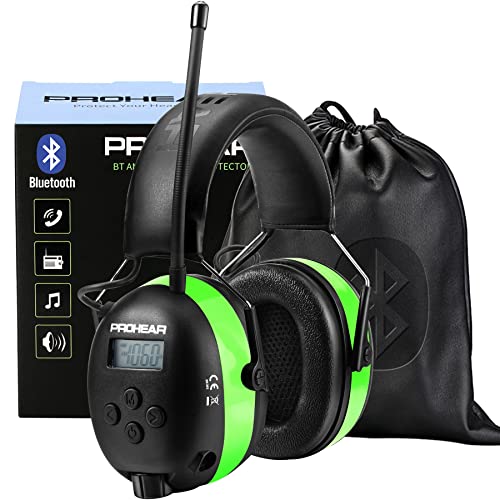
The PROHEAR 033 pairs the two entertainments — Bluetooth and AM/FM radio — with the highest SNR figure in this guide, 31dB as titled, a rechargeable 1500mAH battery, and an explicit lawn-mowing purpose. It is, on paper, the most complete brief in the list: both audio religions, the biggest stated battery capacity here, and a rating at the top of its own system’s local comparison against its sibling’s 30dB. For the buyer who wants one muff that answers every Saturday scenario, the 033 is the easiest shortlist-topper in the guide.
The discipline of this guide applies to it fully: 31dB SNR is an SNR figure, not a trump card over the NRR models, and the honest comparison axes are the ones you can feel — radio included, battery capacity stated, lawn purpose named. PROHEAR’s specialist positioning shows in the completeness of the brief. Take to the full listing the questions of cushion comfort across a long session and control size for gloved hands, because those are the grounds on which this otherwise complete package will actually be judged by your Saturdays.
- Type: Bluetooth hearing protection with AM/FM radio headphones, per the listing title
- Protection rating: 31dB SNR, as titled
- Battery: rechargeable 1500mAH
- Stated setting: mowing lawn
- Bluetooth version: Not stated in the listing title — verify with the maker’s documentation
Strengths
- Bluetooth and radio together — no listening scenario left out.
- The largest stated battery capacity in this guide.
- Top SNR figure within its own rating system here.
Trade-offs
- SNR cannot be cross-compared with NRR numbers on this page.
- Feature richness means more controls to master by touch.
- Bluetooth generation is not stated in the title.
Best for: the one-muff buyer who wants radio, streaming, and battery in a single package.
Not suited for: a workplace that requires an NRR-labeled protector specifically.
For the complete-brief shopper, the 033’s Amazon listing is the deep read — confirm its fit details and control layout there.
ISOtunes Link Bluetooth Earmuffs — The jobsite-shaped option
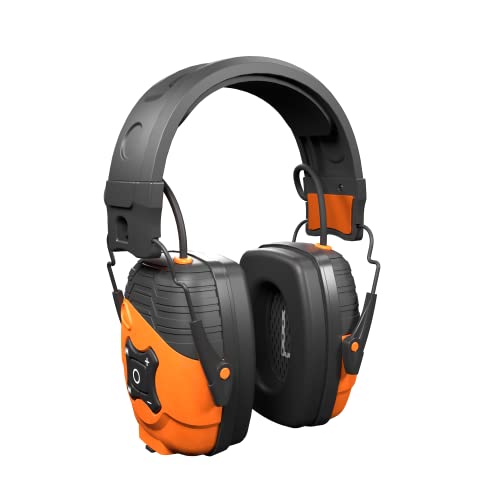
ISOtunes built its brand on hearing protection for people who work in noise professionally, and the Link’s title speaks that language: Bluetooth earmuffs, OSHA compliant headphones for work, ear protection for mowing and construction, an ultra-durable design, and a 25 dB NRR. The compliance framing is the distinction to notice. Where the other picks address a homeowner’s Saturday, the Link addresses a workweek — it is the pick for the landscaper, the groundskeeper, and the homeowner whose mowing is one task inside a generally loud working life.
Its stated 25 dB NRR sits a decibel below the 3M pair’s figure within the same system — a paper difference this guide reports without dramatizing, because fit will outweigh it on any real head. The ultra-durable design claim, as titled, matches the jobsite brief: this is gear meant to be knocked around in a truck cab and a workshop, not cosseted. If your muff will live a working life beyond the lawn — construction days, shop hours, a crew’s shared rotation — the Link is the pick whose title was written for your calendar. Confirm its battery and control details in the full listing, where this guide’s flags point.
- Type: Bluetooth earmuffs / work headphones, per the listing title
- Protection rating: 25 dB NRR, as titled
- Framing: OSHA compliant, for mowing and construction
- Design claim: ultra-durable
- Battery: Not stated in the listing title — verify with the maker’s documentation
Strengths
- Workplace framing and durability brief for professional noise days.
- One muff honestly serving both the lawn and the jobsite.
- NRR stated in-title for regulated-environment comparisons.
Trade-offs
- A decibel below the 3M pair on paper within the NRR system.
- No radio; streaming carries the entertainment alone.
- Battery story must be confirmed in the full listing.
Best for: landscapers, groundskeepers, and loud-workweek owners generally.
Not suited for: a radio-first listener or a purely occasional mower.
Working in noise beyond the lawn? Read the Link’s full Amazon listing and weigh its durability brief against your calendar.

KLEIN TOOLS AESEM2 Slim Bluetooth Earmuffs — The slim low-profile pair
Klein Tools is an electrician’s institution, and the AESEM2 brings a tradesman’s priorities to this category: slim Bluetooth 5.4 hearing protection earmuffs, rechargeable, with foam cushions, a stated 50-hour battery life, and a 23dB NRR, framed for construction and workshops. Slim is the operative word. A lower-profile cup interferes less with hat brims, hoods, and the general headgear of outdoor work, and it packs smaller in a crowded truck or garage. For the mower who found full-size muffs bulky company, this is the pick designed to be forgotten on the head.
Judge its 23dB NRR honestly within its system: it is the lowest figure in this guide, and the trade is explicit — profile and wearability against rating. For the suburban mower on a modern machine, worn with a disciplined seal, many owners will accept that exchange for a muff they actually keep on; the best protection in this entire category is the pair that stays worn for the whole job rather than the pair with the finest number hanging on the garage hook by noon. Foam cushions support the comfort side of that bargain. Confirm the noise-canceling wording in its title refers to the audio experience in the full listing, and let the slimness be judged by your own hat collection.
- Type: slim Bluetooth hearing protection earmuffs, per the listing title
- Protection rating: 23dB NRR, as titled
- Bluetooth: 5.4
- Battery: rechargeable, stated 50-hour battery life
- Cushions: foam cushions
- Stated settings: construction and workshops
Strengths
- Slim profile plays well with hats and hoods and packs small.
- Stated 50-hour rechargeable battery is a solid, checkable claim.
- A trades maker’s build priorities: plain, durable, unadorned.
Trade-offs
- The lowest NRR figure in this guide — the slimness trade is real.
- No radio; Bluetooth streaming is the whole entertainment story.
- Framed for construction and workshops rather than mowing by name.
Best for: hat-wearing, bulk-averse owners who value a muff that disappears on the head.
Not suited for: the loudest commercial machinery where every rated decibel is spoken for.
If bulk has kept muffs off your head in past summers, try the AESEM2’s Amazon listing and judge its slim brief against your own workwear.
What Should You Check in the First Ten Minutes of Ownership?
Unbox at the table, not at the mower. Fit the muff over your usual yard-work configuration — glasses on if you mow in them, hat on if the hat is non-negotiable — and feel for the seal’s gaps with your fingertips before any engine starts. Pair the phone, set a comfortable indoor volume, and learn the controls blind, in gloves, until pause and volume are reflexes. Then walk the property boundary on foot, muff on and streaming, and map where the signal thins; that map decides where the phone lives on mowing day.
Finish with the boring paperwork of tools: note the charging cable’s type and where it will live, register the charging hook or shelf, and — if cushions are replaceable on your model — note the cushion part name somewhere you will find it in year two. Ten minutes of this converts a purchase into a system. Skipping it converts a system into a gadget that happens to be shaped like earmuffs, and gadgets get left behind on the loudest day of the year.
The Six Muffs at a Glance: Ratings as Titled, Nothing Converted
| Pick | Rating as titled | Radio | Battery as titled |
|---|---|---|---|
| 3M WorkTunes Connect | 26 dB NRR | Not stated in title | Not stated in title |
| 3M WorkTunes Connect + AM/FM | 26 dB NRR | AM/FM included | Not stated in title |
| PROHEAR 037 | 30dB SNR | No | 1100mAh, stated 120H playtime |
| PROHEAR 033 | 31dB SNR | AM/FM included | 1500mAH rechargeable |
| ISOtunes Link | 25 dB NRR | No | Not stated in title |
| KLEIN TOOLS AESEM2 | 23dB NRR | No | Stated 50-hour, rechargeable |
Which Mowing Headset Mistakes Should You Avoid?
Comparing NRR and SNR numbers as if they were one scale. They are different rating systems. Compare within a system, and let fit and features decide across systems.
Wearing the muff over a hat brim or thick glasses without checking the seal. The rating assumes a closed cushion. Break the seal and you have broken the product’s core promise to the extent of the leak.
Cranking the music to fight the mower. The muff’s job is to lower the mower so modest audio volume suffices. If you are turning up, reseat the muff first.
Buying controls you cannot work with gloves on. Test by touch, eyes on the horizon, before the first real mow — not during it.
Letting the battery die as a lifestyle. The pattern is always the same: the muff is forgotten once, mowed without once, and discovered to be optional by a brain that prefers the path of least resistance — which is why the charging routine has to be attached to something you never skip, like hanging the keys or closing the garage. A dead muff in tall grass becomes a skipped muff. Fold charging into the same routine as the trimmer and the fuel can.
Storing muffs crushed or in harsh sun. Cushions are the seal, and the seal is the product. Hang them up, keep them shaded, replace cushions when they harden.
Final Recommendation
Decide your listening religion and your rating system, and the list sorts itself. Streamers who want the benchmark should take the 3M WorkTunes Connect; broadcast loyalists should take its AM/FM sibling or the PROHEAR 033, which pairs radio with the biggest stated battery and the top SNR figure here. Endurance shoppers belong with the PROHEAR 037 and its stated 120 hours. Working owners whose noise extends past the lawn should look hardest at the ISOtunes Link, and anyone whose past muffs failed on bulk should give the slim Klein the honest trial its profile promises. Whichever you choose, fit it deliberately, keep the volume modest, and charge it with the other tools. The best bluetooth headset for mowing is the rated muff that is sealed, charged, and still on your head when the last stripe is cut — the one whose fit you checked in spring, whose controls your gloves know by heart, and whose ballgame or audiobook turned the loudest chore of the week into the one you quietly look forward to, season after season, cushion after cushion, stripe after stripe, until the neighbors start asking what changed about your Saturdays.
Frequently Asked Questions
Is a higher decibel number always better?
Only within the same rating system, and only on paper. A 26 dB NRR and a 25 dB NRR are comparable as titled; neither can be arithmetically compared with a 30dB SNR. On a real head, the seal’s quality routinely outweighs a decibel of laboratory rating.
Can I take calls on these while mowing?
Bluetooth models connect to your phone, so calls can arrive — but a sealed muff at mower volume is a poor telephone, and stopping the mower to talk is the sane pattern. Set the phone to not interrupt, and let the mowing finish first.
Why do two picks include AM/FM radio?
Because radio needs no phone, no signal, and no streaming battery, and a great many mowing hours are happily married to a ballgame or a talk station. It is the self-contained option, and for some owners it is the whole point.
How do glasses affect these earmuffs?
Temple arms pass under the cushion and can open a leak in the seal, reducing real protection below the titled rating. Fit carefully, consider slimmer frames for yard work, and reseat the cups after putting glasses on rather than before.
What if my workplace requires a specific rating label?
Then shop inside that system only. A requirement written around NRR is answered by the NRR-titled picks — the 3M pair, the ISOtunes, the Klein — and an SNR figure, however large, is not a substitute label. Read your employer’s or your own standard first, and let it narrow the list before features are compared.
How often should cushions be replaced?
When they harden, crack, or stop springing back — the moment they can no longer close the seal they exist to make. Inspect them each spring and treat replacement as maintenance, not repair.
Can I wear these over a cap or with a ponytail?
You can, and the seal will negotiate. A cap’s brim under the headband lifts the band; a ponytail through the band’s gap lifts a cup’s edge. Wear the cap, then fit the muff over it and check the seal with the fingertip test; route a ponytail low or through the headband’s opening where the design allows. The muff that seals over your real hairstyle and headwear is the right one — which is why the first-ten-minutes check in this guide insists on your actual yard configuration.
Do these work for shooting or hunting?
The titles here frame mowing, workshops, construction, and snowblowing, and this guide judges them on that ground. Shooting sports have their own electronic muff category built around impulse sounds and instant compression, which is a different product brief; do not let a mowing muff’s presence in the garage quietly promote it into a role its title never claimed.
Related Guides
Protective and working headsets appear across the site in other uniforms. For the cockpit’s version of rated passive protection, see best headsets for fixed wing student pilots. For the opposite problem — letting the world in on purpose — read best open back headsets, and for voice-first professional wear, try best headsets for 9 1 1 dispatchers.


